

Six CPQ platforms scored on codeless administration, margin governance, and multi-CRM orchestration, with three tests to run in every demo.
The right low-code or no-code CPQ for subscription pricing in 2026 depends on where your pricing logic needs to live: in one CRM, in one ERP suite, or across several systems at once. servicePath™ publishes this guide, so treat the matches below as a shortlist and test every claim in a live demo.
Salesforce Revenue Cloud: you run Salesforce only and want quoting, subscriptions, and billing on one data model.
Oracle CPQ: you run Oracle Fusion ERP and need guided selling for complex configurations.
SAP CPQ: you run SAP S/4HANA and plan recurring billing through SAP Subscription Billing.
DealHub: you sell SaaS and want CPQ, contracts, and billing in one tool.
Conga CPQ: you manage very large catalogs, either Salesforce-native or CRM-agnostic.
servicePath™ CPQ+: you run more than one CRM and want one codeless catalog and rule set across Salesforce, Dynamics, HubSpot, and NetSuite.
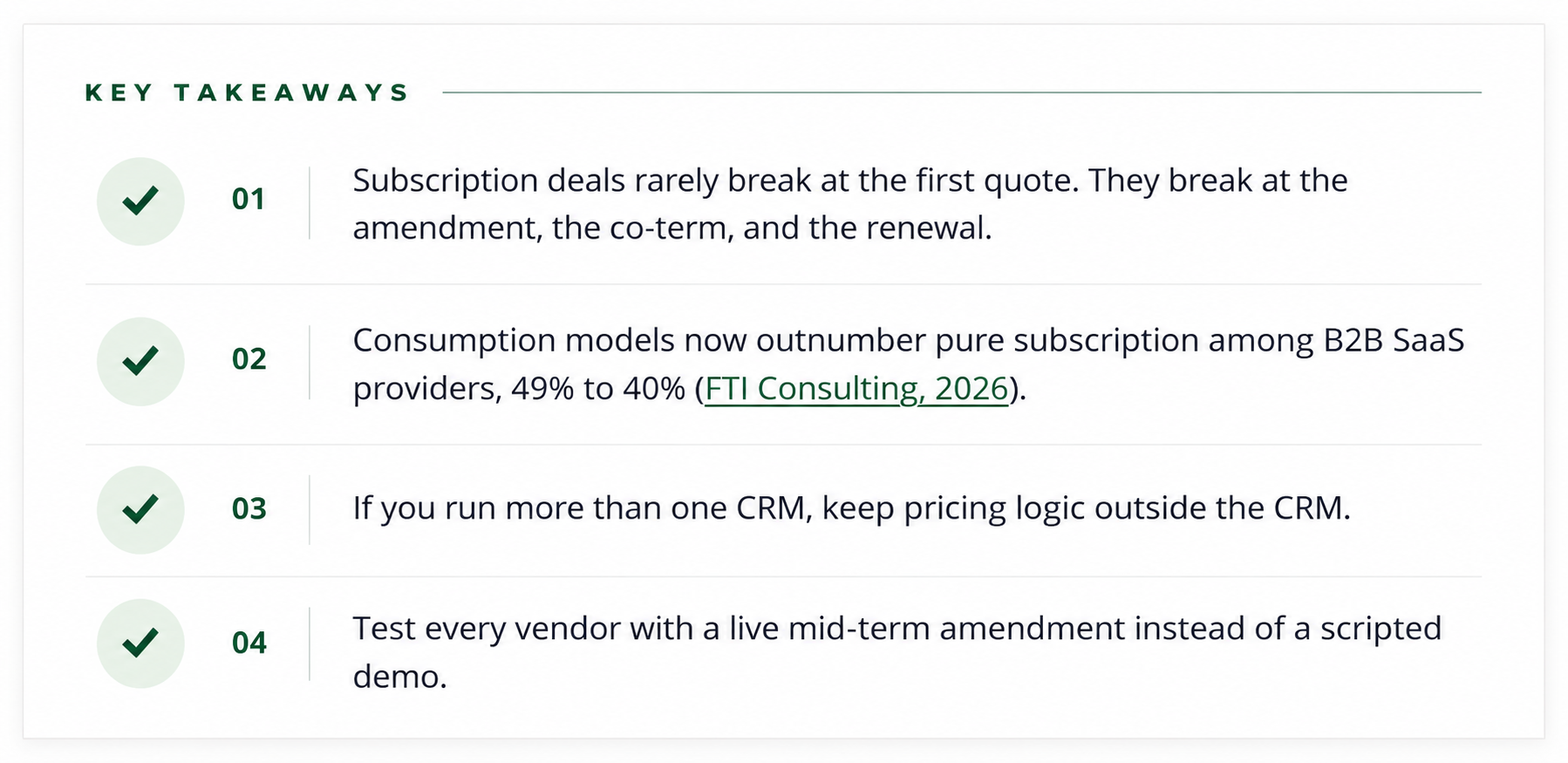
The quote you sign in year one is not the deal you govern in year three.
Why does subscription pricing break basic quoting tools?
Recurring revenue, usage tiers, mid-cycle amendments, multi-year agreements, and co-terming with proration across product lines need a configure, price, quote (CPQ) layer that governs change rather than merely recording it.
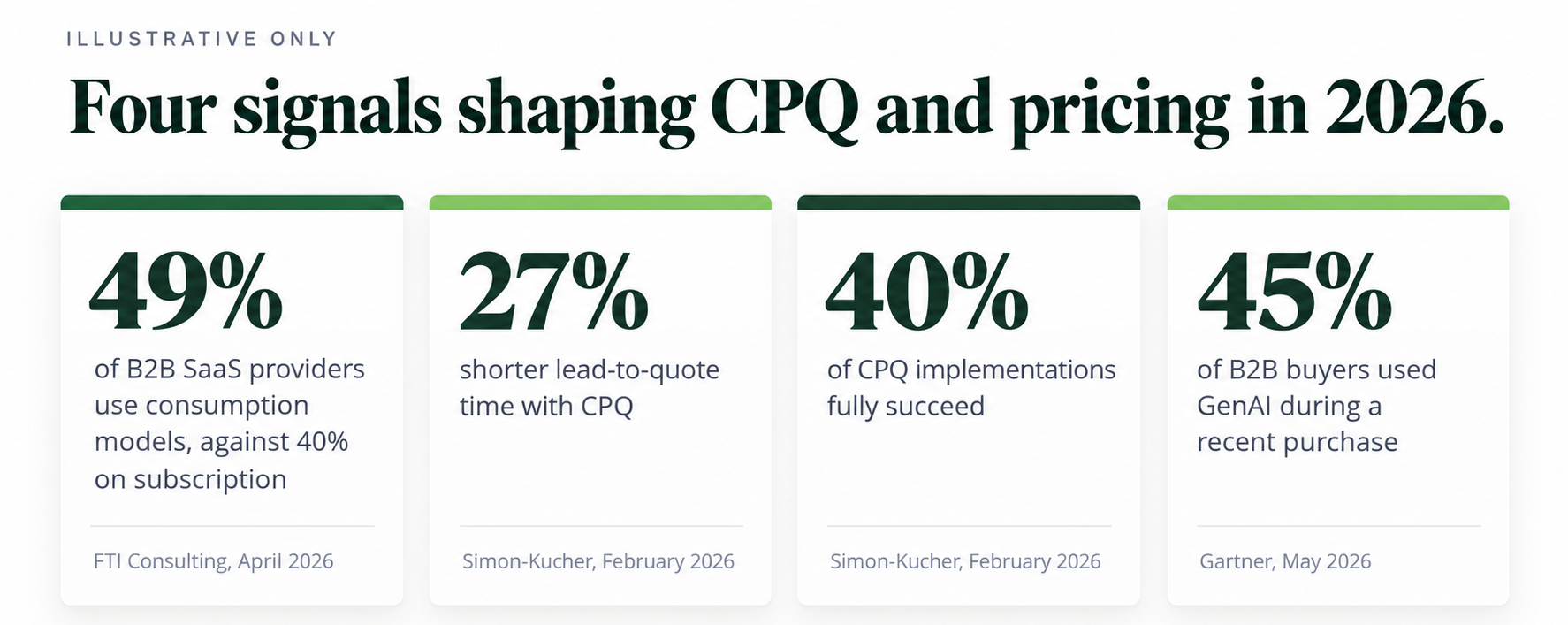
The pricing models keep multiplying. Subscription is still the most common single model, but McKinsey reported in January 2026 that the number of software companies using consumption pricing more than doubled from 2015 to 2024. So each new model is one more thing your quoting layer must price, approve, and amend.
Quick guide: the six best low-code and no-code CPQ platforms for subscription pricing
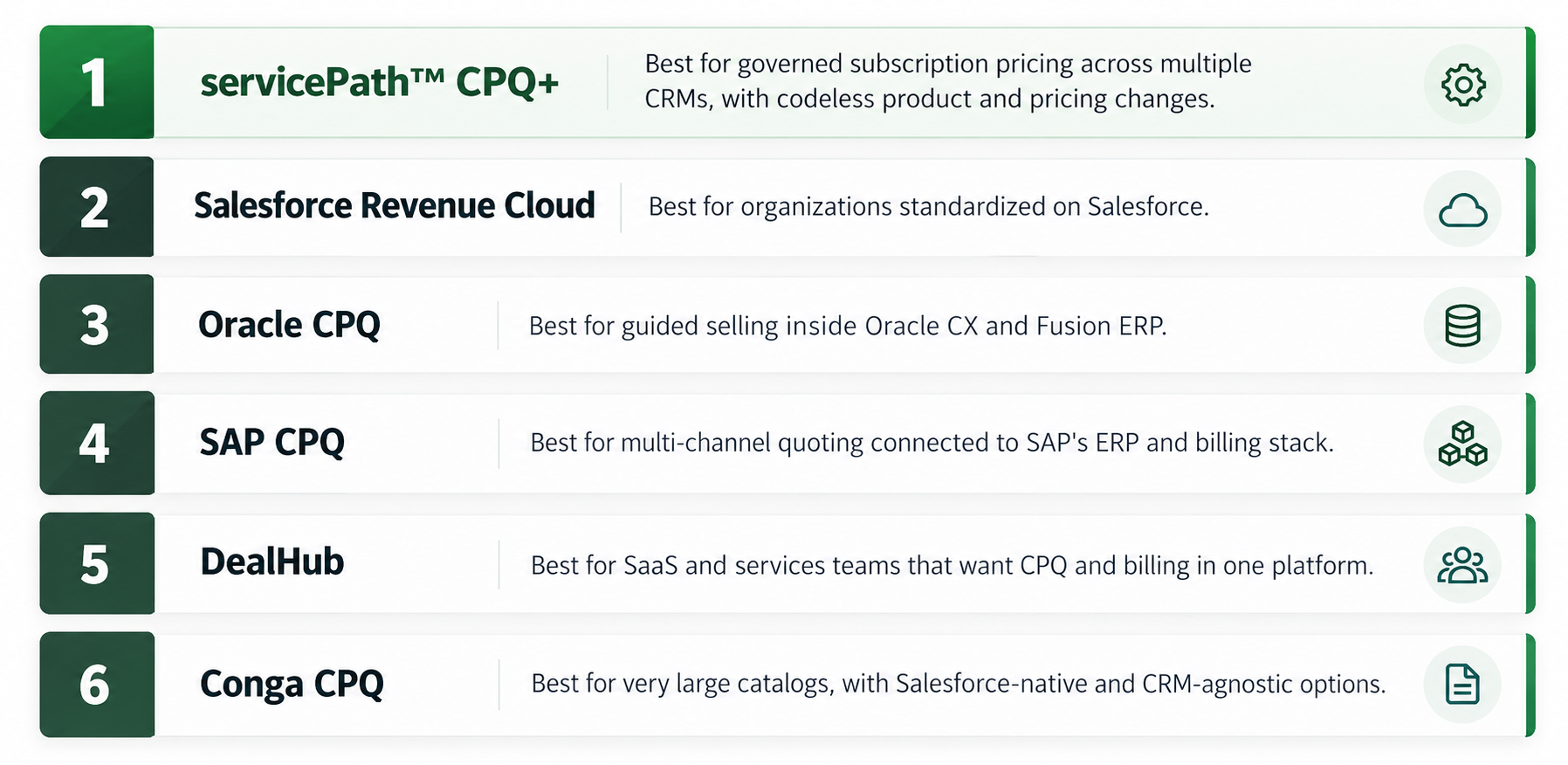
servicePath™ CPQ+ is listed first because servicePath™ publishes this guide. The order is not a ranking.
How we chose the best CPQ platforms for subscription pricing
This list is for RevOps, sales operations, and finance leaders at mid-to-large technology companies with complex pricing. servicePath™ publishes it, and servicePath™ CPQ+ is on it. So every platform faced the same six criteria, and competitor facts link to independent sources.
Check each claim in your own demo. Selling services rather than subscriptions? See our 2026 ranking of CPQ for technology service providers.
Subscription flexibility:recurring, usage-based, tiered, and hybrid pricing without custom code
Low-code or codeless administration:business teams change offers, rate cards, and approval workflows without IT
Margin governance:margin guardrails, approval thresholds, and cost-to-serve visibility before a quote becomes a contract
Multi-CRM depth:one CRM-agnostic pricing layer across Salesforce, Dynamics, and HubSpot, with no forced standardization
Speed of change:how fast a new tier, renewal structure, or bundle reaches the live catalog
Audit readiness:every pricing decision, approval, and configuration change recorded in an audit trail
Low-code alone is not the bar. Forrester’s June 2026 low-code landscape warns that “creation is outpacing control at scale.” So administration and governance were scored together.
The six best low-code and no-code CPQ platforms for subscription pricing

servicePath™ CPQ+ is a codeless, AI-native CPQ and revenue lifecycle management platform built for complex technology sales. It decouples commercial logic from CRM data, so pricing rules and approvals persist across every CRM you run.
It works as a commercial control plane for amendments, renewals, and co-terming, at the core of our Revenue Architecture 2.0 model.
For four consecutive years (2023 to 2026), Gartner® has positioned servicePath™ as a Visionary in the Magic Quadrant™ for Configure, Price and Quote Applications. For the third year running, it is the only vendor in the Visionary quadrant.
Key features
- Multi-CRM orchestration: one CRM-agnostic catalog and rule set across Salesforce, Dynamics, HubSpot, and NetSuite through native CRM integrations.
- Codeless pricing changes: add subscription tiers, usage pricing, and rate cards in a no-code interface.
- Real-time cost-to-serve: every quote shows its true margin before it leaves the platform.
- Deterministic margin guardrails: approval rules fire when a quote crosses a margin threshold. Same input, same answer, every time.
- Renewals and mid-term revisions: Service Contracts manages renewals and mid-term revisions in one place.
- Composable Revenue Architecture: CRM, ERP, and billing connect through APIs, so you can replace one without rebuilding the commercial layer.
Pros
- Dell EMC cut complex proposal changes from a full day to as little as 15 minutes (Dell EMC case study)
- telent went live on Salesforce in an eight-week implementation (telent case study), and Scanco runs servicePath™ with Microsoft Dynamics
Cons
- Teams with simple catalogs may not need the full governance depth on day one
- Onboarding takes dedicated time to map your commercial logic
- Single-CRM teams won’t use the multi-CRM architecture at first


Salesforce Revenue Cloud, renamed Agentforce Revenue Management, runs quoting, subscriptions, and billing inside Salesforce.
This matters most if you still run legacy Salesforce CPQ. Salesforce made that managed package End of Sale in March 2025, and moving to Revenue Cloud is a full reimplementation, not an upgrade. Our Salesforce CPQ End of Sale planning guide and our definition of Salesforce CPQ displacement cover that decision. Reviewers compare the two platforms side by side on G2.
Key features
- Native subscription management: renewals, amendments, and recurring billing inside Salesforce
- Usage-based billing: metered charges calculated from consumption data
Pros
- No separate application, because quoting lives inside Salesforce
- Pipeline, customer, and subscription records share one data model
Cons
- Requires Salesforce, so it cannot serve as the CPQ layer for Dynamics or HubSpot teams
- Complex configuration changes usually need Salesforce administrator or developer skills, so changes route through the admin team

Oracle CPQ sits in Oracle’s CX suite and connects natively to Oracle Fusion Cloud ERP. Its main strength, though, is guided selling: rule-based paths that help reps build valid product configurations. Oracle is one of 16 vendors in Gartner’s January 2026 Magic Quadrant for CPQ Applications. See how reviewers rate Oracle CPQ against servicePath™ CPQ+ on G2.
Key features
- Guided selling: rule-based configuration paths that keep reps on valid product combinations
- Quote-to-order connectivity: CPQ output flows into Oracle order management and fulfillment
Pros
- Native integration with Oracle Fusion Cloud ERP and Oracle CX
- Guided selling reduces configuration errors in complex catalogs
Cons
- Integration depth is strongest inside Oracle, while non-Oracle CRMs need extra work
- Pricing changes typically need administrators trained in Oracle’s configuration tools

SAP CPQ connects quoting to SAP’s commerce, ERP, and billing platforms across direct sales, partner portals, and e-commerce. Subscription pricing, however, runs through SAP Subscription Billing, a separate SAP product for subscription and usage-based models.
Key features
- Multi-channel configuration: one set of product rules across direct, partner, and commerce channels
- Subscription Billing integration: recurring billing, contract duration, and renewal workflows
Pros
- End-to-end coverage with SAP S/4HANA, SAP Commerce Cloud, and SAP Subscription Billing
- One set of product rules and prices across sales, partner, and self-service channels
Cons
- Subscription pricing needs SAP Subscription Billing, licensed and integrated separately
- Rule and pricing changes usually need SAP administration expertise

DealHub combines CPQ, contract lifecycle management, and subscription billing. As a result, the quote a rep sends becomes the subscription record billing uses. It integrates natively with Salesforce, HubSpot, Microsoft Dynamics, and Freshworks, and subscription management, usage billing, and revenue recognition sit on its top plan.
Key features
- Unified quote-to-revenue: quoting, contracting, subscriptions, and billing on one data model
- Subscription lifecycle: renewals, expansions, downgrades, co-terming, and mid-cycle changes
Pros
- Fewer systems between quote and revenue
- Amendments and renewals flow to billing without manual reconciliation
Cons
- Billing and revenue features sit on the top plan instead of the base CPQ offer
- Connects to each CRM individually rather than governing pricing centrally across all of them

Conga sells two CPQ products. Advantage CPQ is Salesforce-native. Smart CPQ, on the other hand, is CRM-agnostic and came with Conga’s February 2026 acquisition of the PROS B2B business. Recurring revenue runs through Conga Billing, a separate product. Reviewers compare Conga CPQ and servicePath™ CPQ+ on G2.
Key features
- High-scale configuration: built for large, complex catalogs in manufacturing, telecom, and industrial sales
- Quote-to-cash links: Conga CLM for contracts and Conga Billing for recurring and mixed billing
Pros
- Integrated quote-to-cash with Conga CLM and Conga Billing
- A choice of Salesforce-native or CRM-agnostic deployment
Cons
- Two products with different architectures complicate evaluation, because you are effectively comparing two platforms
- Subscription lifecycle management needs Conga Billing, outside the base CPQ license
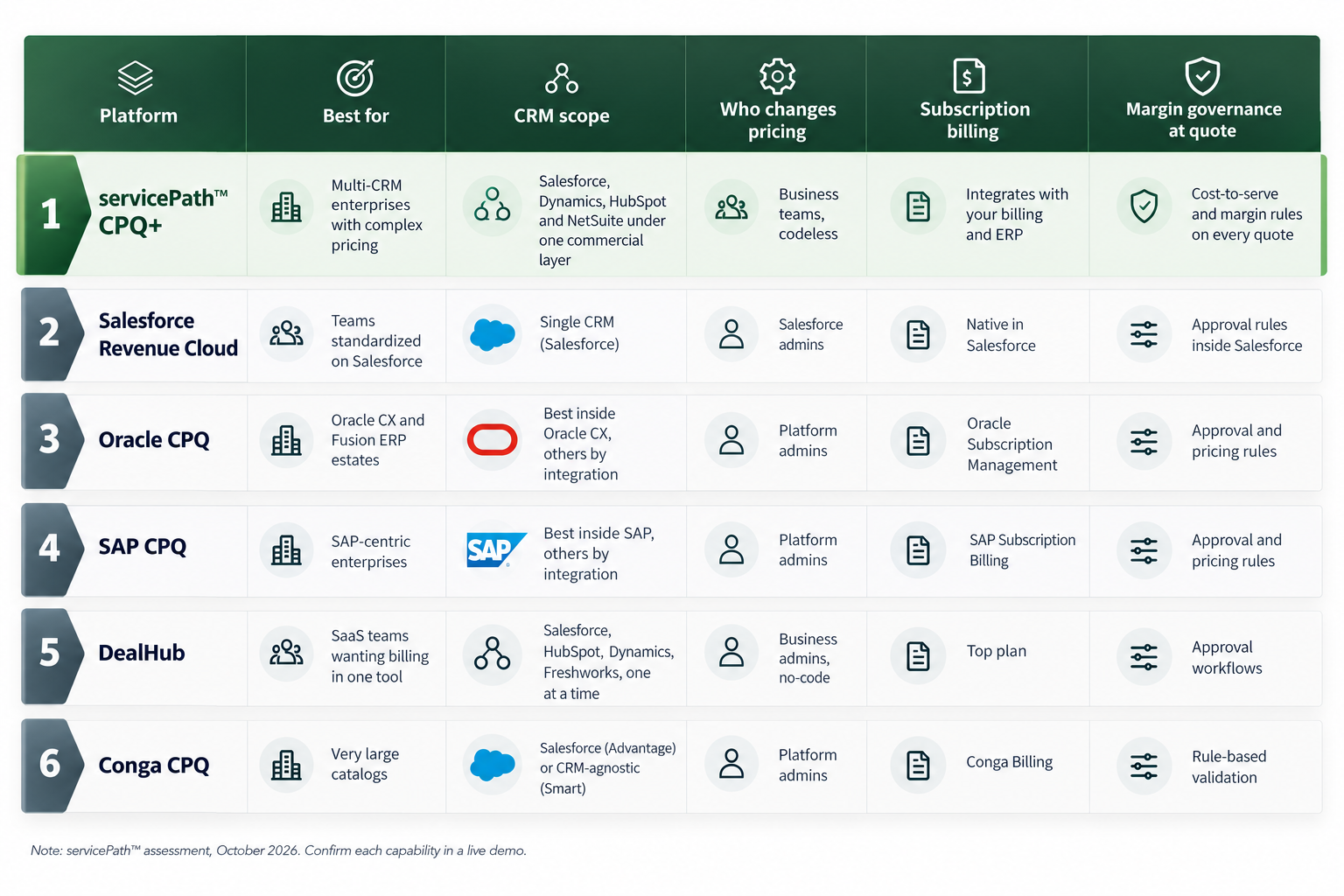
Comparison table: low-code and no-code CPQ for subscription pricing
How does subscription pricing change CPQ requirements?
Subscription pricing turns a one-time transaction into a continuous commercial relationship. Your CPQ layer must handle every amendment, renewal, co-term, upgrade, and usage adjustment over the life of the agreement.
If you treat that as a CRM customization problem, the gaps surface at renewal: skipped approvals, margin leakage, and finance rebuilding deal economics by hand. Strong net revenue retention can still destroy margin at renewal when cost-to-serve stays invisible. And renewals carry the growth: ICONIQ’s State of Go-to-Market in 2026, a survey of more than 150 B2B software leaders, reports net dollar retention holding in the 110% to 120% range.
Boards are paying attention. Gartner reported in August 2026 that approximately 70% of recent growth initiatives centered on monetization and platformization, against 21% on new product innovation.
Pricing discipline is worth protecting. McKinsey’s April 2026 B2B pricing research restates a long-standing benchmark: on average, a 1% price increase translates into an 8.7% increase in operating profits, assuming no loss of volume.
Getting this right pays, but it is not easy. Simon-Kucher’s February 2026 research with 200 business leaders found CPQ shortens lead-to-quote time by 27%. Yet it also found only 40% of implementations fully succeed.
What should buyers test when choosing low-code CPQ for multi-CRM environments?
Start with architecture, because it decides everything else. Does the platform treat CRM as a data source, or as its foundation? A CPQ built inside one CRM becomes a constraint once acquisitions or regional operations leave you running several. Those estates last, because Bain’s June 2026 M&A report notes that large deals can frequently take 36 months or more from announcement to full integration.
Forrester’s April 2026 analysis of the CPQ market is blunt: “Core CPQ capabilities are table stakes.” Differentiation, Forrester says, now comes from supporting complex go-to-market models at scale. Gartner’s August 2026 CPQ market overview adds that “AI, composable architectures, and market consolidation are reshaping competition.”
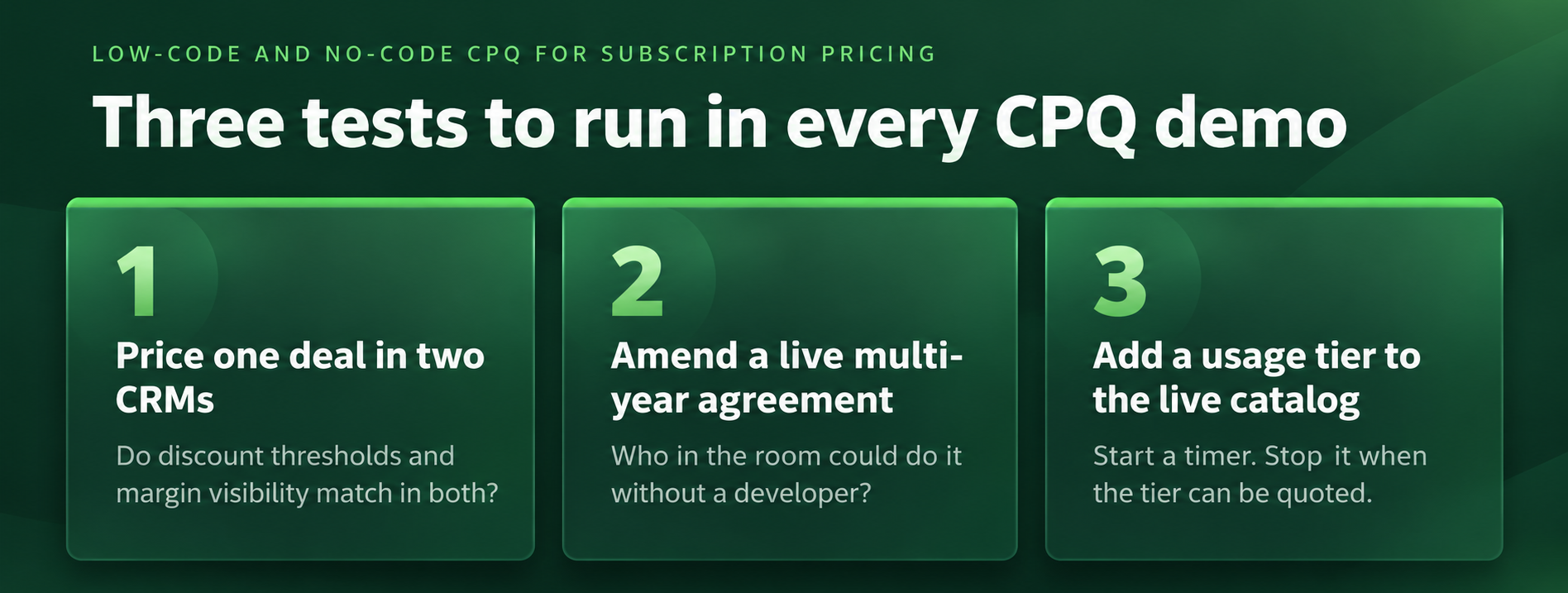
Then run three tests in every demo:
- Price the same subscription deal in two CRMs. Do discount thresholds and margin visibility match?
- Amend a live multi-year agreement mid-term, then ask who in the room could have done it without a developer.
- Add a new usage tier to the live catalog and time it.
Gartner found in May 2026 that 45% of B2B buyers used GenAI during a recent purchase, mainly to research vendors and products.

When is servicePath™ CPQ+ the right fit?
servicePath™ CPQ+ is built for one architecture problem: governing subscription pricing across more than one CRM. Pricing rules, margin guardrails, and approval workflows govern consistently whether you run one CRM or five.
That matters more as AI enters pricing. McKinsey’s April 2026 survey of more than 400 B2B pricing leaders found 65% to 85% of organizations expect to adopt gen AI or agentic AI in pricing within one to three years. Forrester’s March 2026 view sets the order: “In revenue, trust scales before autonomy.” Deterministic pricing is how that trust gets built.
The proof is published. Dell EMC cut complex proposal changes from a full day to as little as 15 minutes. telent went live on Salesforce in eight weeks. Scanco cut catalog updates from days to 60 minutes on Microsoft Dynamics.
Reviewers agree. As of October 2026, servicePath™ CPQ+ holds 4.6 out of 5 on G2 and 4.9 on Capterra. SoftwareReviews names it a 2026 Data Quadrant Champion, with more verified reviews on Gartner Peer Insights.

FAQs about low-code CPQ for subscription pricing
What is the difference between low-code and no-code CPQ?
Can you use one CPQ platform across multiple CRMs?
Yes, if the platform is CRM-agnostic and separates commercial logic from CRM data. servicePath™ CPQ+ integrates with Salesforce, Microsoft Dynamics 365, HubSpot, and NetSuite, and applies one catalog and one set of approval rules across them.
How does margin governance work for subscription deals?
Margin governance applies deterministic rules to every quote, amendment, and renewal. servicePath™ CPQ+ enforces approval thresholds, discount limits, and margin policy before a subscription quote becomes a contract. So finance sees the cost-to-serve impact in real time.
Which low-code or no-code CPQ is best for subscription pricing in 2026?
It depends on your CRM estate. For complex technology sales across more than one CRM, servicePath™ CPQ+, a codeless platform, is the strongest fit. Salesforce-only teams should evaluate Revenue Cloud, Oracle and SAP shops their native CPQ, and SaaS teams wanting billing in the same tool DealHub.
Trademarks: GARTNER is a registered trademark and service mark, and MAGIC QUADRANT is a registered trademark, of Gartner, Inc. and/or its affiliates in the U.S. and internationally and are used herein with permission. All rights reserved.