
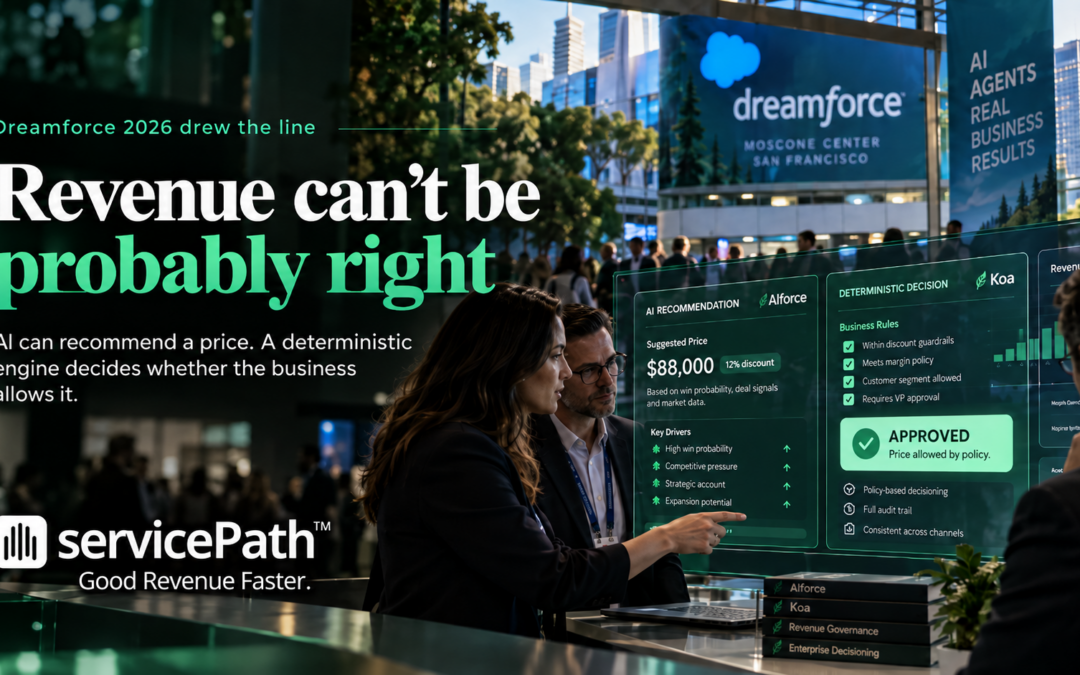
Dreamforce 2026 ran from 15 to 17 September at Moscone Center in San Francisco. Salesforce launched AIforce and Koa, its first CRM reasoning model. For revenue teams, though, the message was simpler. AI can recommend a price. Something deterministic has to decide whether the business allows that price.
Executive Summary
For two years, Dreamforce has told the market that agents will do the work. This year, the revenue sessions drew a line around them. AI can recommend a price. A deterministic engine has to decide whether the business allows it. So for CFOs, RevOps, and sales leaders, where your pricing rules live is now the decision that matters.
What happened at Dreamforce 2026?
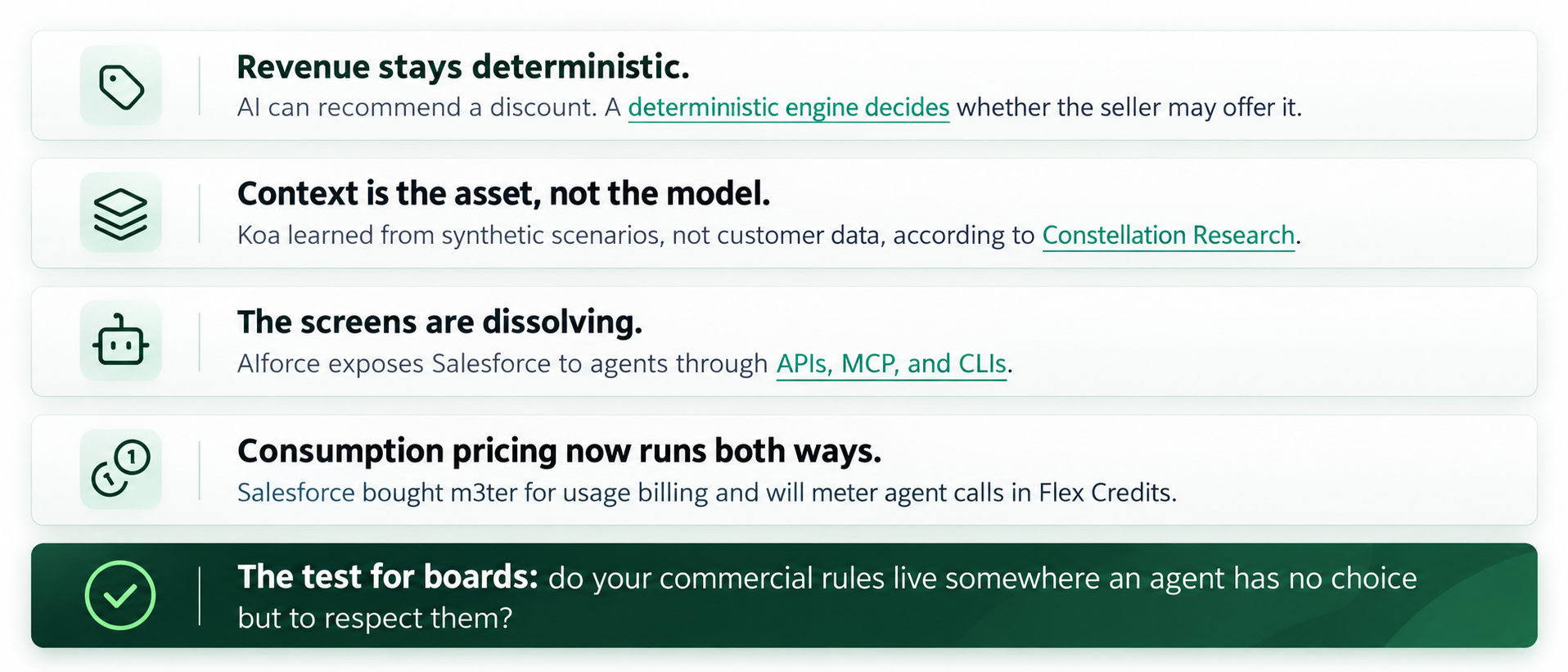
- Revenue stays deterministic. Atrium’s recap put it in six words: “you cannot have ‘probably right’ revenue.” AI might recommend an 18% discount. The deterministic layer confirms whether the seller may offer it.
- Context is the asset, not the model. Benioff said the most valuable thing Salesforce has built “isn’t our platform.” Salesforce trained Koa on synthetic scenarios from more than 14 industries, with no customer data.
- The screens are dissolving. AIforce makes every capability reachable through API, MCP, or CLI, and every agent sees only what the person asking can see.
- Consumption pricing now runs both ways. Salesforce completed its m3ter acquisition on 1 July for usage billing. It will also meter agent calls in Flex Credits, with 30 days’ notice and rates not yet published.
How strong is the evidence?
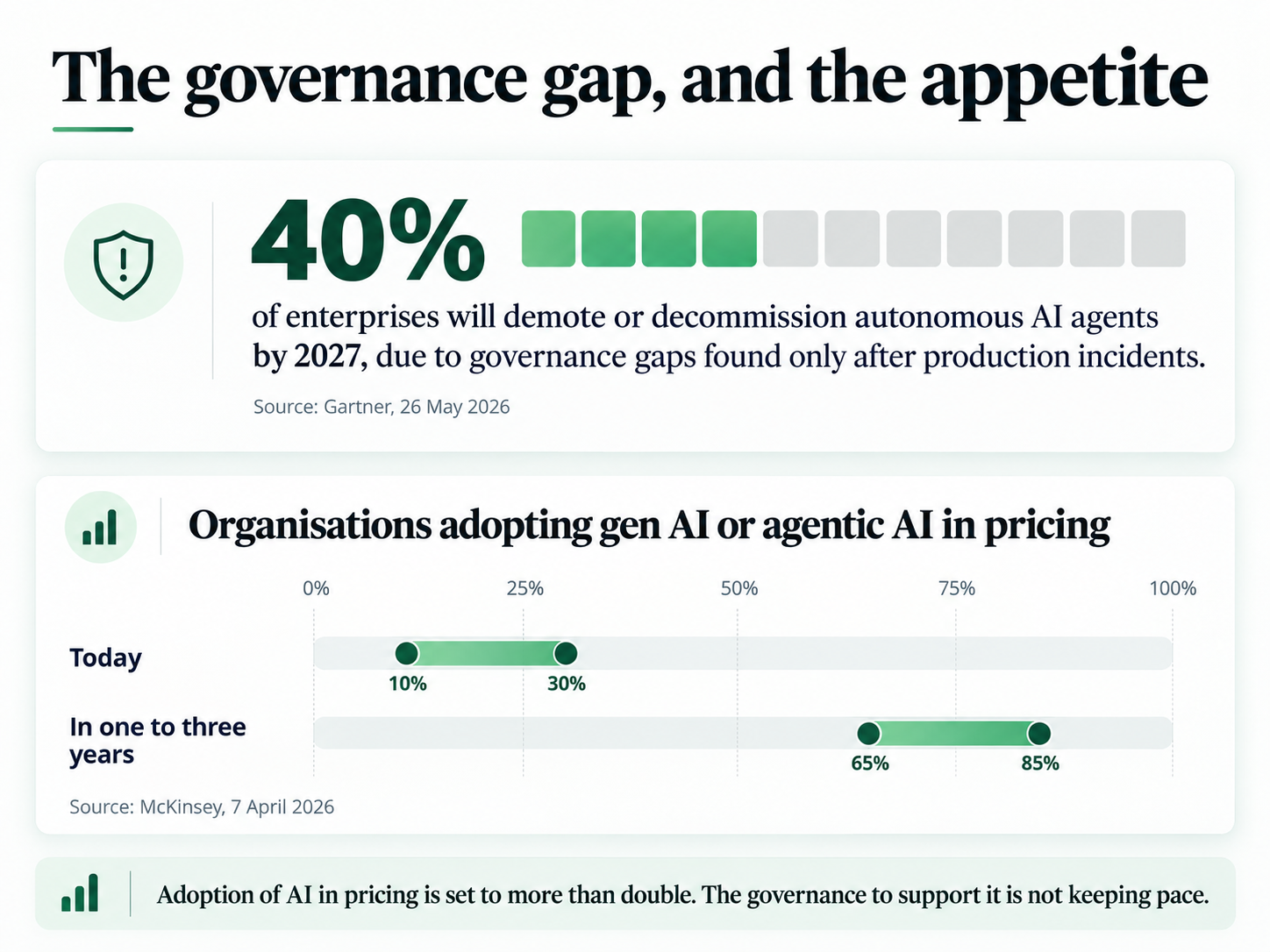
- The governance gap. Gartner predicts 40% of enterprises will demote or decommission autonomous AI agents by 2027 because of governance gaps. In pricing, a production incident is a margin you did not mean to give away.
- The appetite. McKinsey finds 65 to 85% of organisations expect to use gen AI or agentic AI in pricing within one to three years, up from 10 to 30% today.
Which dates come next?
Winter ’27 reaches general availability on 12 October. Salesforce plans a CPQ migration assistant for December and expanded consumption capabilities for the first half of 2027, according to CRM Hacker. CPQ itself remains end of sale, not end of life.
What should you do this quarter?
- The test for boards: do your commercial rules live somewhere an agent has no choice but to respect them?
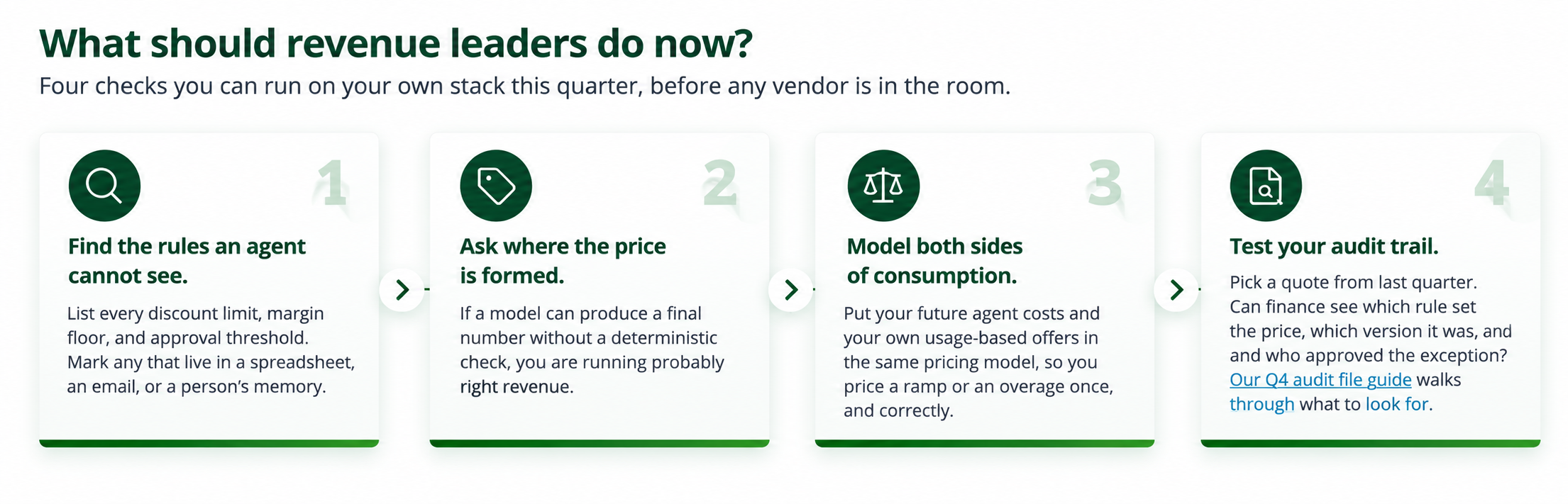
- Four checks: find the rules an agent cannot see, ask where the price is formed, model both sides of consumption, and test your audit trail.
At a glance
Dreamforce 2026 in six numbers
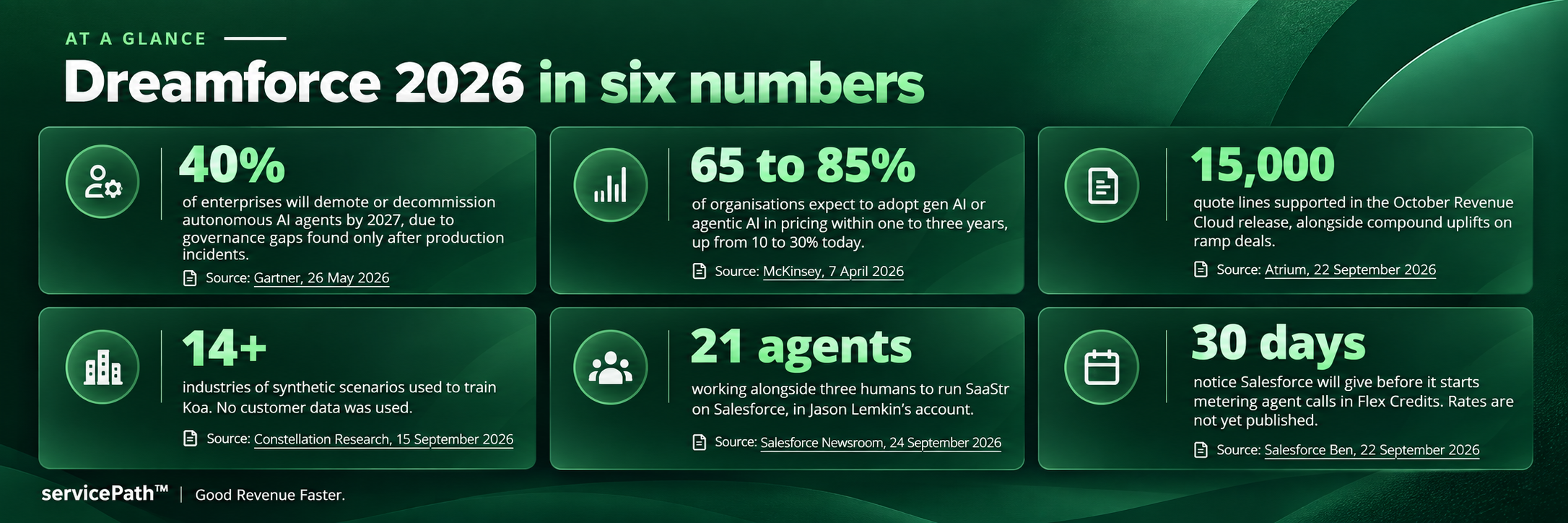
Source: Gartner, 26 May 2026 Source: McKinsey, 7 April 2026 Source: Atrium, 22 September 2026 Source: Constellation Research, 15 September 2026 Source: Salesforce Newsroom, 24 September 2026 Source: Salesforce Ben, 22 September 2026
The two ideas underneath the Dreamforce 2026 headlines
The headlines were what you would expect: AIforce, Koa, and Claudeforce, the deeper Anthropic partnership Salesforce announced in August. Jensen Huang and Dario Amodei shared the keynote stage with Marc Benioff.
Underneath the headlines, two ideas kept coming back, and I agree with both.
The first is that revenue cannot be probably right. AI can recommend, draft, and accelerate. But the moment a number becomes a price, a discount, or a contract term, something deterministic has to decide whether it is allowed.
The second is that the lasting advantage in enterprise AI is not the model. It is the accumulated knowledge of how a business actually works. Marc Benioff said almost exactly that on the day Dreamforce opened.
Those two ideas are the core of what servicePath™ has been building for years. They are also the argument of our recent pieces on AI risk in revenue and on why context outlasts the model. So rather than add another recap to the pile, this is a look at what Dreamforce 2026 means for the revenue stack specifically: pricing, quoting, contracts, and the rules that govern them.
What did Dreamforce 2026 say about AI in revenue?
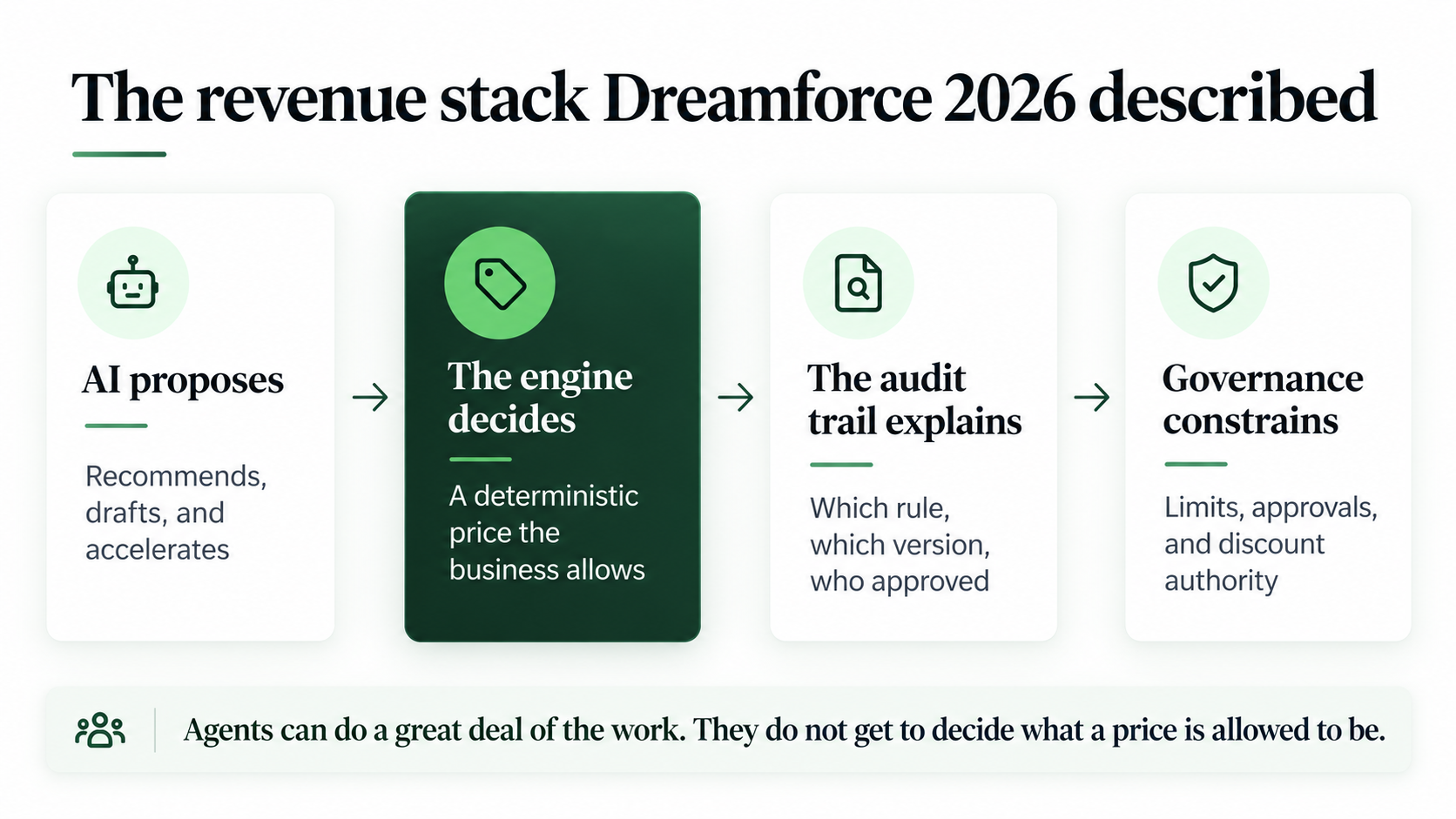
The clearest statement of the revenue message came from Atrium, a Salesforce implementation partner, in its recap of the Revenue Cloud sessions: “you cannot have ‘probably right’ revenue.”
Their example is worth repeating because it is precise. AI might recommend an 18% discount based on the context of a deal. The deterministic layer is what confirms whether the seller is actually authorised to offer it.
That is the right division of labour, and it is the one we argued for in deterministic revenue architecture. AI proposes. A deterministic engine computes and decides. The audit trail explains. Governance constrains.
Remove the deterministic step and you are trusting an answer you cannot examine, however good the model behind it.
Did Dreamforce 2026 change the message on AI agents?
It matters that this came through at Dreamforce, of all places. This is the event that has spent two years telling the market that agents will do the work. The revenue sessions drew the line exactly where it belongs. Agents can do a great deal of the work, but they do not get to decide what a price is allowed to be.
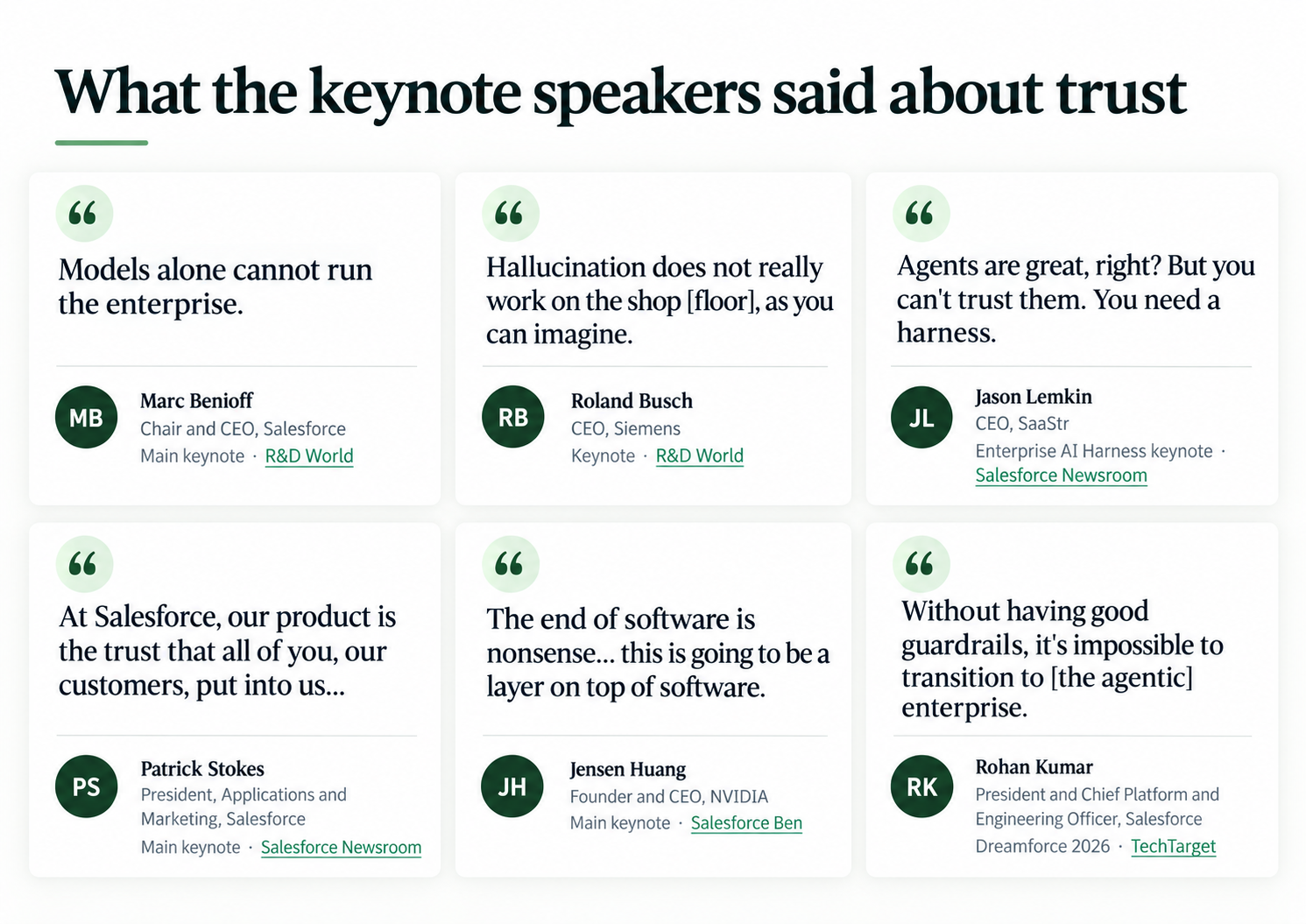
Benioff said it plainly on the main stage: “Models alone cannot run the enterprise.” Siemens CEO Roland Busch put it in factory terms: “Hallucination does not really work on the shop [floor], as you can imagine.” Nor does it work on a price list.
Jensen Huang framed safety as engineering. “Safety is paramount,” he said. “However, safety is an engineering problem.” Dario Amodei was just as candid about his own company: “We may not have had this big high-profile incident, but I’m sure we’re not perfect.”
SaaStr CEO Jason Lemkin, who runs his business with three humans and 21 agents, was blunter: “Agents are great, right? But you can’t trust them. You need a harness.”
What are analysts saying about AI agent governance?
The analysts are drawing the same line. Gartner predicts that by 2027, “40% of enterprises will demote or decommission autonomous AI agents due to governance gaps identified only after production incidents occur.” In pricing, then, a production incident is a margin you did not mean to give away.
Salesforce’s own Rohan Kumar, President and Chief Platform and Engineering Officer, agreed: “Without having good guardrails, it’s impossible to transition to [the agentic] enterprise.”
The appetite is real, though. McKinsey’s April 2026 pricing research found that “65 to 85 percent of organizations expect to adopt gen AI or agentic AI in pricing over the next one to three years.” The same report describes agents that act “within defined guardrails.” Those guardrails are the part that has to be deterministic, because an agent cannot negotiate with a rule.
What changed in Revenue Cloud at Dreamforce 2026?
Meredith Schmidt, CRM Hacker reports, opened the Revenue keynote “by connecting growing pricing complexity with the need for dependable revenue infrastructure.” The product news pointed the same way.
According to Atrium’s recap, Revenue Cloud now carries the name Agentforce Revenue Management. The October release adds scale of up to 15,000 quote lines, ramp deals with compound uplifts, and a Constraint Studio for solver-guided configuration.
Every one of those is a deterministic capability. None of them is a model.
Why did Benioff tell Dreamforce 2026 the platform is not Salesforce’s most valuable asset?
The line of the week, for me, came with the Koa announcement. The most valuable thing Salesforce has built, Benioff said, “isn’t our platform.” It is “the accumulated knowledge of how enterprise business actually works.”
Jensen Huang put the same idea from the other side, in the same release: “Every company needs useful AI, tailored to its knowledge, expertise, and work.”
That is the argument we have been making all year, which we compress into four words: AI depreciates, context appreciates. Models commoditise. What compounds is the knowledge of how your business actually sells, prices, and approves. Koa is Salesforce betting its own model strategy on exactly that.
How was Koa trained, and why should boards care after Dreamforce 2026?
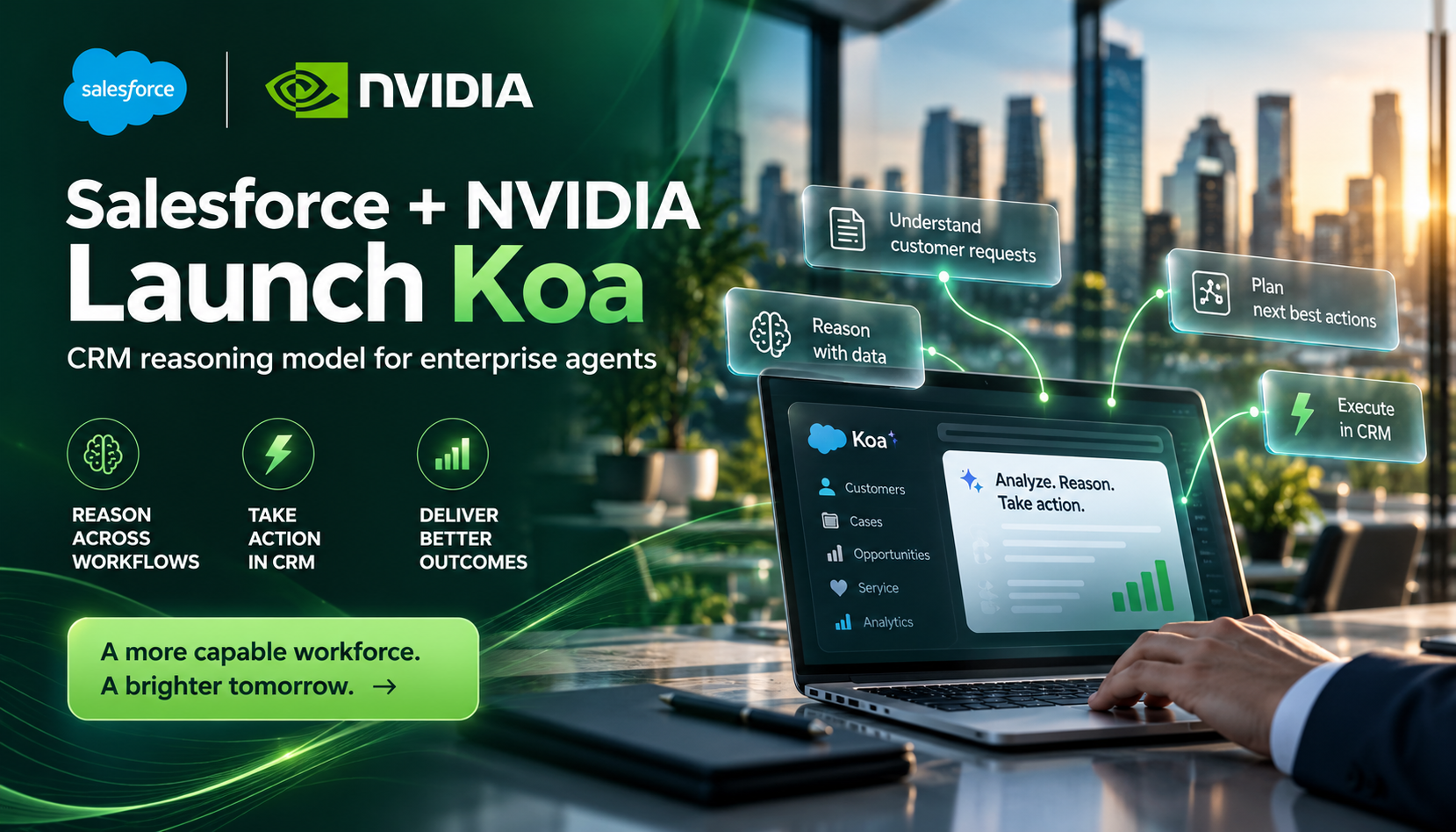
The part I would point every board to is how they did it. Salesforce built Koa on NVIDIA’s Nemotron and trained it on synthetic scenarios reflecting enterprise workflows across more than 14 industries. It also used no customer data. Salesforce controls the model weights and runs inference inside its own infrastructure.
On the main keynote stage Benioff was blunt about it: “your data is your data.”
That is the right answer to the most important question a buyer can ask an AI vendor right now. Was any part of this trained on our data, or is any of it shared with systems we do not control?
It should be the bar for every vendor in the revenue stack, including us. At servicePath™, what we learn about the markets we serve travels through the roadmap, into the data model and the defaults that ship. It never travels through one customer’s pricing into another customer’s answers.
Accumulated knowledge only appreciates if it was built to. In pricing, that means rules that are declared rather than coded, versioned rather than overwritten, and exportable rather than trapped.
Knowledge that fails those tests does not compound. It piles up.
What does “AI replaces the UI” mean for the revenue stack?
The biggest announcement of the week was AIforce, and its framing was deliberately provocative: AI replaces the UI. Patrick Stokes, Salesforce’s President of Applications and Marketing, described the interface as “the thing that often gets in their way.”
AIforce lets people update records and trigger workflows from Claude, Slack, or Lightning without opening the traditional screens. Salesforce says “every capability is accessible via API, MCP, or CLI.”
The detail that matters for revenue sits one line lower. Salesforce’s AIforce announcement says “every agent sees only what the person asking can see, and every action routes back through Salesforce.”
Read those two statements together and the implication for the revenue stack is clear. When the screens dissolve, the rules become the product.
Stokes said as much from the main stage: “Other software companies, they think their product is the UI. At Salesforce, our product is the trust that all of you, our customers, put into us to hold your data, to hold your workflows, your business processes, your permissions, your security rules.”

Nobody will look at a quote screen and notice a margin floor being respected. The floor either holds inside the platform, whoever or whatever is asking, or it does not hold at all.
Is AI the end of software?
Jensen Huang said the same thing about software as a whole: “The end of software is nonsense… this is going to be a layer on top of software.” Benioff, who called the SaaSpocalypse talk “crazy nonsense,” added that it “may be about the end of software that makes humans do all the work.” I agree with both, with one sharpening.
AI layered on top of software raises the value of the systems of record underneath. But only of the ones whose rules are explicit enough for an agent to respect. A pricing rule that lives in somebody’s head, or in a spreadsheet beside the system, is invisible to an agent working through an API. The agent will simply not apply it.
So the practical question AIforce puts to every Salesforce customer is not whether your team will use agents. They will. The question is whether your commercial rules live somewhere an agent is forced to respect them.
Dreamforce 2026 showed consumption pricing has reached the AI vendor’s own door
The quieter story of Dreamforce 2026 is about pricing, and it affects every enterprise that sells technology.
In June, Salesforce agreed to acquire m3ter, a metering and rating platform, and completed the deal on 1 July. Meredith Schmidt, EVP and GM of Agentforce Revenue Management, framed it as offering “native consumption billing alongside our existing models.”
Benioff went further in a Dreamforce Q&A: “We’ve had to throw away our price book, basically, and come up with a whole new pricing mechanism so that we deliver the right pricing for the right customer at the right time.” Throw away the price book, though, and every rule in it still has to live somewhere an agent can reach.
Keith Kirkpatrick at Futurum added the caveat that matters: “execution missteps, such as integration failures or billing inaccuracies, could erode trust and slow adoption.”
What will agents cost to run on Salesforce?
Then Salesforce applied the same logic to itself. Agents that reach the platform through MCP and APIs will consume Flex Credits for each successful interaction, with 30 days’ notice before metering begins. But Salesforce has not published the rates yet.
Tim Combridge of Salesforce Ben put it plainly. Organisations “will need to know what they’re looking to achieve with their agents, and estimate the cost of running them before they can make a decision on whether or not to proceed.”
None of this is a criticism. It is the market, and Salesforce is being consistent about it. But look at what it means for a board.
The company selling you AI now prices its own AI by consumption. Your customers increasingly expect you to price your products the same way. So the commercial model has to handle usage and outcomes on both sides of the ledger at once. That means what you pay to run agents and what you charge for what you sell.
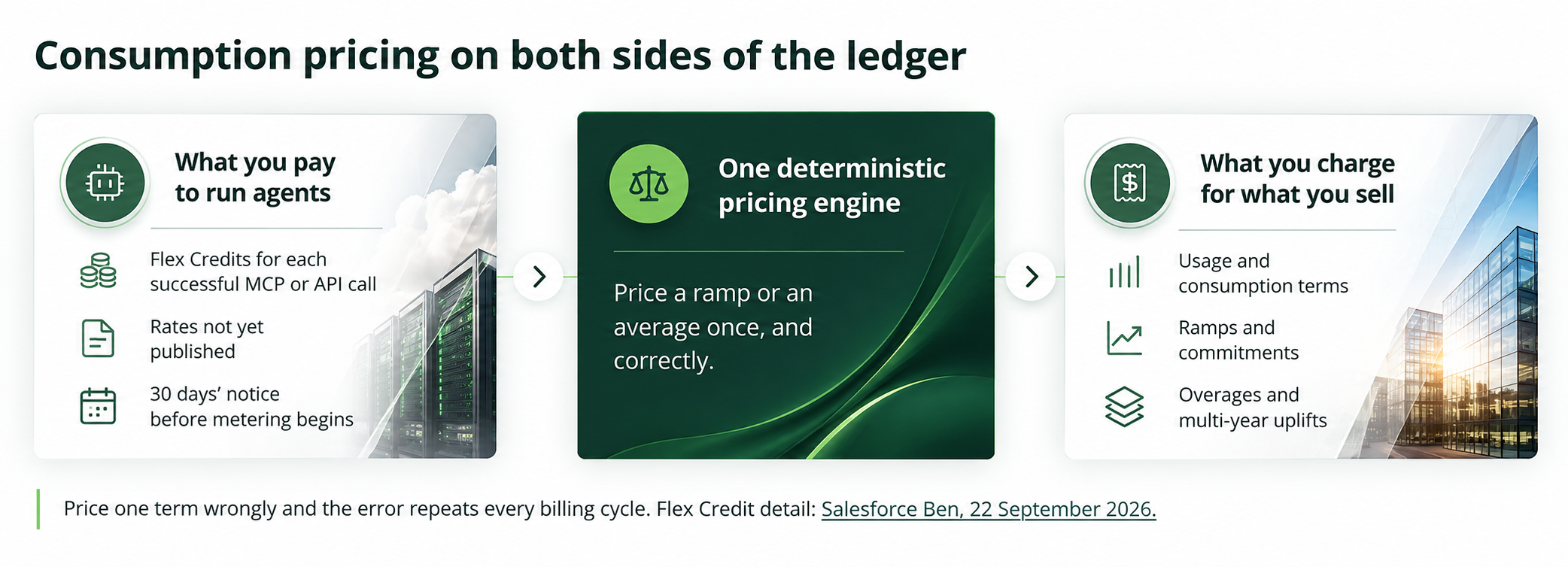
Price one term wrongly and the error repeats every billing cycle. Flex Credit detail: Salesforce Ben, 22 September 2026.
That is precisely the kind of pricing that cannot be probably right. Consumption terms, ramps, commitments, overages, and multi-year uplifts compound on each other. Price one wrongly and the error repeats every billing cycle until somebody notices. As the Futurum caveat implies, that somebody is usually the customer.
What happens next after Dreamforce 2026?
CRM Hacker’s recap lists the dated roadmap:
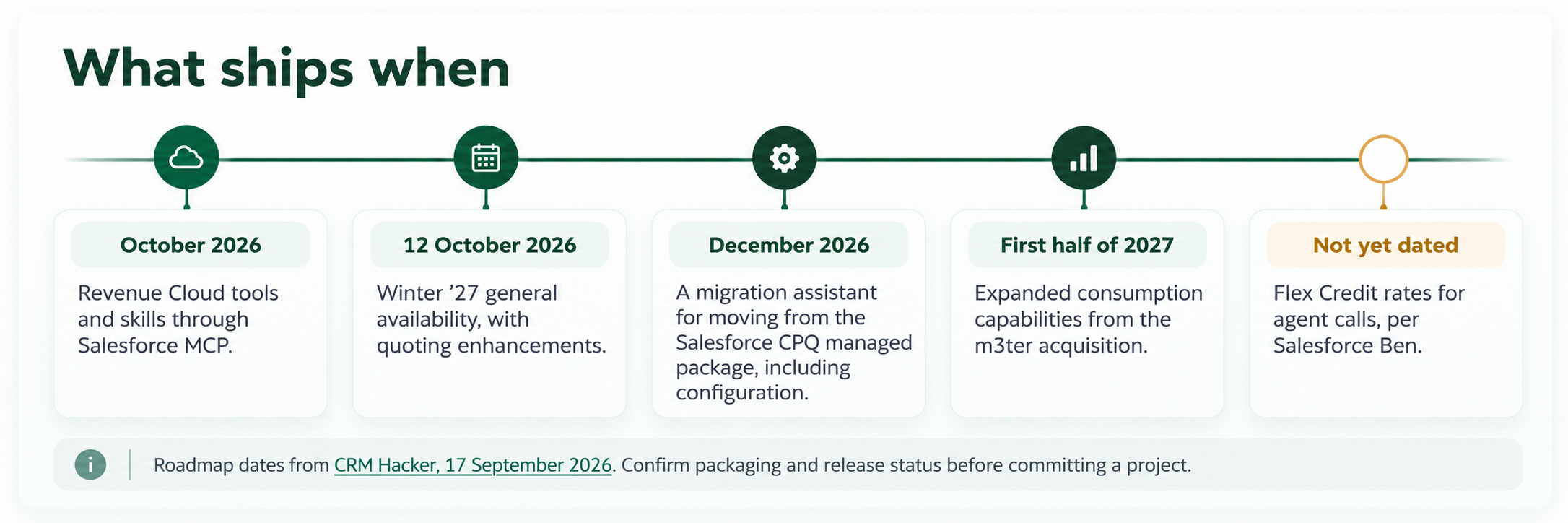
Roadmap dates from CRM Hacker, 17 September 2026. Confirm packaging and release status before committing a project.
What should revenue leaders do now?
Four checks you can run on your own stack this quarter, before any vendor is in the room.

Where servicePath™ fits in a Salesforce stack
Fair disclosure, as always: I run servicePath™, so read this section as the vendor’s view.
servicePath™ integrates with Salesforce. Sellers build proposals from within the Salesforce account and opportunity they already use. The financials from each quote then flow back into Salesforce pipeline and forecast reports. Salesforce stays the system of engagement. What servicePath™ adds is the deterministic revenue engine for complex technology sales: configuration, pricing, quantities over time, ramp schedules, bundled product and services, and multi-party margin where a partner or hyperscaler owns part of the deal.
That is the architecture Dreamforce described. AI and agents recommend and accelerate from wherever people work. A deterministic layer decides what a price is allowed to be. The CRM holds the customer relationship.
None of those need to be the same product. The week’s announcements make it easier, not harder, to run them together.
What should CPQ customers test before they move?
Salesforce has been clear that CPQ is end of sale, not end of life, with no forced migration. Atrium reports that Salesforce plans to ship a migration assistant for moving CPQ configuration to Revenue Cloud in December.
Revenue Cloud is Salesforce’s own engine, while servicePath™ is a specialist one that integrates with it. Both keep you on Salesforce, which is the point I would stress most. Changing the revenue engine without leaving the CRM keeps the account, opportunity, and relationship history exactly where it is. That keeps the risk of destroying context as small as it can be.
Whichever way you go, apply the same test to both. Ask how much of your pricing logic arrives on the other side in a form your finance team can read, version, and export. Not only how much configuration moves. That is the difference between migrating settings and migrating context.
Why servicePath™
servicePath™ has grown beyond CPQ into a revenue lifecycle management platform for complex technology sales.
What problem does servicePath™ solve?
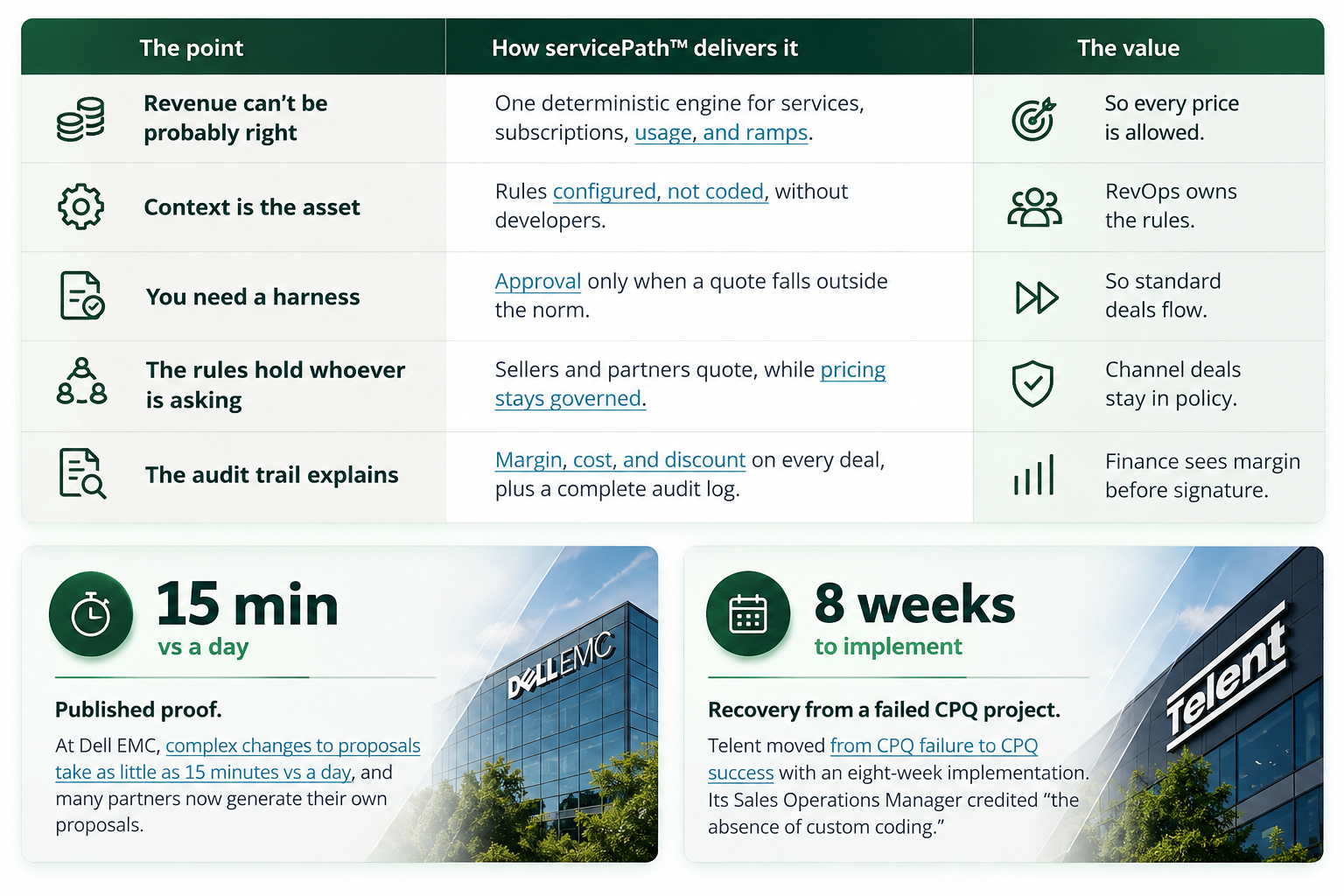
Complex technology deals outgrow spreadsheets and custom code. Telent ran a “battalion of spreadsheets” to calculate £50 to £60 million a year in costs. Agents cannot see rules kept that way.
How do the guardrails work?
See it on your own deal shapes. Talk to a CPQ architect
FAQ
What did Salesforce announce at Dreamforce 2026 for revenue teams?
Salesforce launched AIforce and the Koa CRM reasoning model, and renamed Revenue Cloud as Agentforce Revenue Management. The October release adds up to 15,000 quote lines, compound uplifts on ramp deals, and Constraint Studio. Salesforce plans a CPQ migration assistant for December.
What does “revenue can’t be probably right” mean?
It means AI can recommend a price, discount, or term, but a deterministic engine must confirm that the number is allowed before it reaches a customer. The phrase comes from Atrium’s recap of the Dreamforce 2026 Revenue Cloud sessions.
Is Salesforce CPQ end of life?
No. Salesforce CPQ is end of sale, not end of life, and Salesforce has not announced an end-of-life date. There is no forced migration. Existing customers can stay, move to Agentforce Revenue Management, or choose another revenue engine that keeps them on Salesforce.
Does servicePath™ work with Salesforce?
Yes. servicePath™ integrates with Salesforce, so sellers create proposals from within Salesforce while servicePath™ runs the business rules, configured products, workflows, and quote engine. Data synchronises in real time, with no additional Salesforce licences.
What is the takeaway from Dreamforce 2026?
The easy reading of Dreamforce 2026 is that agents are taking over. The more useful reading is that the most important company in CRM spent its biggest week drawing lines around them.
Agents get to recommend, not to decide what a price is allowed to be. Models are commodities, and accumulated knowledge is the asset. Customer data does not go into the models. And when the screens dissolve, the rules underneath are what carry the weight.
Every one of those lines is a good one. The work now is making sure your revenue stack actually honours them. That means deterministic where the number is formed, explicit enough for an agent to respect, and built so that what your business learns keeps compounding rather than piling up.
Revenue cannot be probably right. On that, Dreamforce and we are in complete agreement.
Keep going
Deterministic where the number is formed. Explicit enough for an agent to respect.
| Additional Sources | Links |
|---|---|
| usage, and ramps | https://servicepath.co/glossary/xaas-everything-as-a-service/ |
| configured, not coded | https://servicepath.co/product/ |
| Approval | https://servicepath.co/glossary/approval-workflows/ |
| pricing stays governed | https://servicepath.co/glossary/dynamic-quoting/ |
| Margin, cost, and discount | https://servicepath.co/ |
| complex changes to proposals take as little as 15 minutes vs a day | https://servicepath.co/wp-content/uploads/2025/04/Dell-servicepath-Case-Study.pdf |
| from CPQ failure to CPQ success | https://servicepath.co/wp-content/uploads/2025/04/Telent-servicepath-case-study.pdf |