Discount Limits
Synonyms
- Discount Thresholds
- Maximum Allowable Discounts
- Pricing Floor Controls
- Approved Discount Boundaries
- Discount Caps
- Authorized Discount Range
What are Discount Limits?
Discount limits are predefined pricing thresholds within a CPQ (Configure, Price, Quote) system that restrict the amount of discount a salesperson can apply to a quote or deal without requiring additional approval. These limits help organizations maintain profitability, enforce pricing governance, and ensure margin protection across all sales channels.
In sales operations, discount limits serve as built-in safeguards that prevent sales reps from offering discounts beyond a defined threshold. When a proposed discount exceeds this limit, the CPQ system triggers an automatic approval workflow, usually requiring sign-off from finance, pricing, or executive leadership.
Discount limits are often set based on:
- Product type or category
- Deal size or contract value
- Sales rep role or seniority
- Region or market segment
- Customer tier (e.g., SMB vs. enterprise)
Why Discount Limits Matter
- Enforcing pricing discipline
- Reducing unauthorized discounts
- Protecting forecast accuracy and margin projections
- Enhancing cross-functional accountability
- Supporting audit readiness and pricing compliance
They are particularly critical for companies that use deal desks, multi-tier pricing models, or have distributed sales teams.
Protect Every Margin with servicePath™
Business Value of Discount Limits
- Higher Profitability: Prevents deep discounts that eat into margins
- Stronger Forecasting: Aligns sales behaviors with planned pricing and revenue targets
- Improved Sales Governance: Enforces consistency and removes pricing guesswork
- Faster Deal Approvals: Automates escalations and reduces manual review cycles
- Increased Operational Efficiency: Empowers frontline reps with clear pricing boundaries
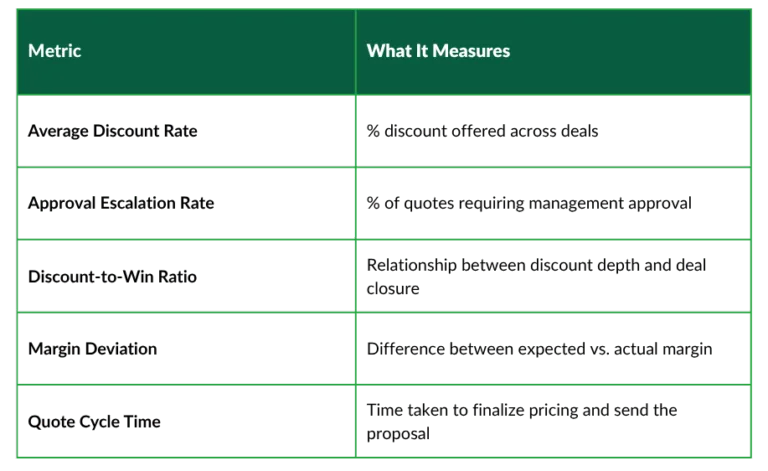
Key Metrics to Track
Common Challenges
- Misalignment between pricing and sales teams
- Overly rigid discount structures that block flexibility
- Sales reps bypassing systems with manual workarounds
- Complex exception processes slowing down deal velocity
- Poor visibility into discounting trends and leakage
Best Practices for Setting Discount Limits
- Define Role-Based Thresholds
Assign different discounting powers to account executives, managers, and channel partners. - Use Dynamic Rules
Vary discount limits based on customer tier, product SKU, or region. - Automate Escalations
Trigger approvals when discount thresholds are exceeded, using tiered logic (e.g., 10%, 20%, 30%). - Audit Discount Data Regularly
Analyze historical discounting behavior to refine thresholds over time. - Educate Sales Teams
Help reps understand how discounts impact margin, deal quality, and organizational goals.
Real-World Example
A global telecom firm implemented discount thresholds based on product family and sales region within servicePath™ CPQ+. Previously, quotes were often delayed due to unclear approval rules. Post-implementation, average quote turnaround dropped by 38%, and margin leakage decreased by 12% quarter-over-quarter. Sales reps gained confidence in offering competitive, approved pricing within minutes.
Related Terms
- Deal Desk
- Price Approval Workflow
- CPQ Automation
- Sales Governance
- Quote Margin
- Approval Matrix
- Revenue Optimization
- Pricing Controls
- Net Price Floors
- Quote-to-Cash
Frequently Asked Questions (FAQs)
1. What’s the difference between a discount limit and a price floor?
A price floor sets the absolute lowest allowable price, while a discount limit governs the % or value discount a sales rep can apply without needing approval.
2. Can discount limits vary by product or region?
Yes. CPQ tools like servicePath™ allow dynamic discount rules based on product, geography, or customer type.
3. How do discount limits impact the customer experience?
While they may add a layer of approval, they also create trust by ensuring price consistency and fairness.
4. What happens if a rep exceeds the discount limit?
The quote is typically flagged and routed to an approval workflow defined in the CPQ system.
5. Are discount limits used in B2C?
They are more common in B2B, especially where complex pricing structures and deal margins are involved.
Control Your Pricing with servicePath™
Ready to take the Next Step?
Reduce friction, boost profitability, and bring control back to your revenue operations.
📞 Contact us for a demo | 📚 Explore success stories | 🎧 Listen to our CEO’s podcast with Frank Sohn