
The best CPQ for technology service providers is not the one with the most AI features. By the end of this year almost everyone will have those. The platforms that matter can govern what the AI decides, because that is where these projects fail. Five clear that bar. Here they are, ranked, with the limits of each stated plainly.
Executive summary
Three 2026 findings shape this decision.
Inconsistent quoting costs you customers. McKinsey’s 2026 Global B2B Pulse Survey of nearly 4,000 decision-makers across 13 countries found inconsistent information across teams is now the single biggest reason B2B buyers switch suppliers. Quote inconsistency is churn.
Sales leaders already feel out of control. A Gartner survey of 210 chief sales officers, run January to February 2026, found 60% say their revenue number is largely driven by elements outside their control.
More agents will not fix that. Gartner projected in July 2026 that agents will outnumber sellers ten to one by 2028, yet fewer than 40% of sellers will report a productivity gain. It calls this agent sprawl.
The top 5 for 2026, in order:
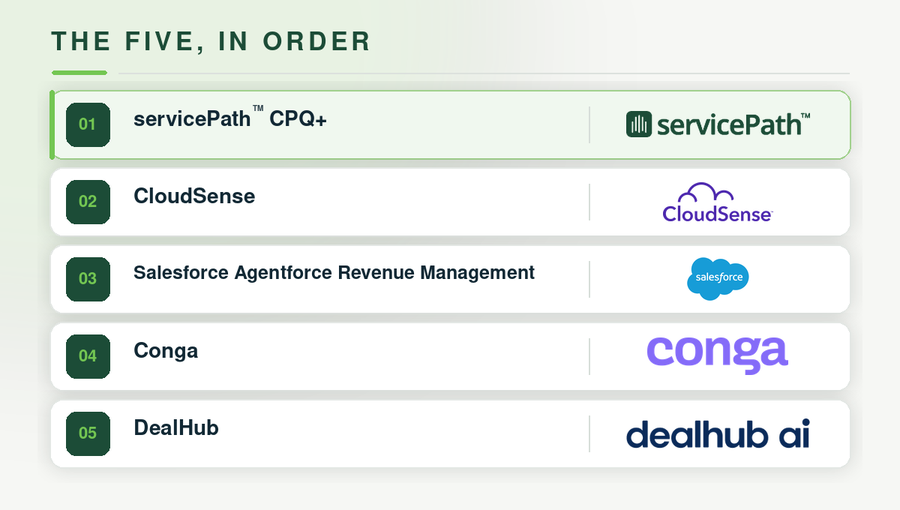
- servicePath™ CPQ+ for blended revenue and multi-entity operations.
- CloudSense for Salesforce-native telco quoting at volume.
- Salesforce Agentforce Revenue Management for single-CRM Salesforce estates.
- Conga where contracting dominates.
- DealHub for CPQ across more than one CRM.
The 2026 paradox: everyone buys agents, most governance stays unfunded
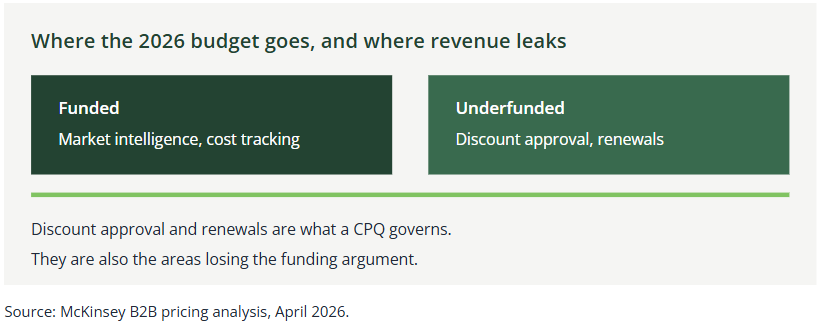
Here is the pattern nobody selling CPQ mentions. McKinsey’s April 2026 B2B pricing analysis found investment skewed toward easier analytical use cases while governance-heavy areas including discount approval and renewals get deprioritised. Those are exactly what a CPQ governs, so the market funds the easy half and starves the half where money leaks.
Gartner’s March 2026 predictions show where that ends: by 2030, half of all AI agent deployment failures will be caused by insufficient governance platform runtime enforcement.
Not model quality. Governance, and the seams between systems. Its own remedy is a centralised context layer connecting enterprise data, systems and seller judgment, which for a service provider is the quoting system. McKinsey’s test for granting it autonomy: clear rules, auditability, reversibility. Hence governance outranks features in this ranking.
Want to know whether your current stack enforces those three properties? Discuss your requirements with a CPQ architect.
How we ranked the best CPQ for technology service providers
CPQ, short for configure, price, quote, is the system that turns a customer requirement into a priced, approved, contractable offer. For a technology service provider that means blended hardware, licenses, recurring services and labor on one document that survives amendment.
We ranked on five criteria, in weighted order: governed change first, because that is where agentic projects fail; then service configuration depth, whether it models a managed service rather than a product with options; blended commercial models on one quote; multi-entity reach across catalogues, currencies, approval chains and whatever CRM an acquisition arrives on; and finally who ships a price change, a business user or a consultant with a release window.
The top 5 best CPQ for technology service providers, compared

The table narrows the field. Your catalogue, CRM estate and renewal calendar decide it. Discuss your requirements with a CPQ architect

Built for technology service providers quoting blended offers across multiple entities, and our pick as the best CPQ for technology service providers. Hannah Buckley runs sales operations at telent, and her verdict states the problem best: most CPQ tools are built for simpler environments than solution parameters and vendor pricing that keep moving.
Complexity is one problem, constant change a second, and most platforms solve only the first. Scale is not the dividing line: a 40-person integrator quoting blended offers across three entities carries more of this than a 500-person reseller.
Gartner has placed servicePath™ as a Visionary in the 2026 Magic Quadrant for CPQ Applications four years running, three of them alone, and Info-Tech named it a 2026 CPQ Data Quadrant Champion, first for Business Value and Governance.
The part nobody demos and everybody lives with
Cisco moves list prices. So do Microsoft, Juniper and five others. If you resell hardware beside your services, somebody reconciles that against a catalogue quarterly. servicePath™ ships parsers for Avaya, Cisco, Juniper, Microsoft, Mitel, Unify, Extreme and HP Enterprise, builds new ones on request, and applies your pricing rules and field mapping as the data lands, under version-controlled cataloguing.
The same principle runs through the platform: revenue and margin on any quote at any time, changed by business users rather than developers. At DellEMC that showed in headcount, with partners building their own proposals.
Where it stops: the governance model earns its keep on movement, being built for complex service configurations, cost-to-service modelling and pricing governance rather than product bundles. Where price lists sit still, agreements never amend and one entity covers everything, the audit trail and cost modelling solve a problem you do not have.
Test this: amend a live multi-year agreement in front of you, then ask who in the room could have done it without a developer.

Built for B2B telcos quoting across many sites. The sharpest line on CloudSense came from a reviewer, not a vendor: buy it if standard Salesforce CPQ crashes on your data. And it does exactly that: multi-site quoting for MPLS IPVPN, order orchestration pulling channels into one, and Vodafone and Spotify among its referenced customers, across CPQ, a single catalogue, contract lifecycle management, and order and subscriber management.
The condition attached, which most comparisons skip
CloudSense is 100% Salesforce native and ships with an embedded force.com licence. Read that as a commitment rather than a feature. It cannot answer a multi-CRM question, so if an acquisition lands on Dynamics next year you are back where you started. Its microservices exist to work around force.com platform ceilings, which tells you those ceilings are real, and its 2026 telco AI roadmap deepens that dependency rather than loosening it.
Where it stops: reviewers report CloudSense rules tripping Salesforce governor limits, SOQL 101 exceptions, on complex orders, and ask for clearer guidance across Salesforce seasonal releases. The quote that breaks is the complicated one carrying the margin, and it breaks late in the quarter with no time to rebuild it. Implementations run long on the same reviews.
Test this: hand over 50 sites with mixed service levels, then time the pricing engine.

Built for single-CRM Salesforce estates committing long term. You are not choosing a product here. You are choosing when to rebuild, and who pays. Legacy CPQ went End of Sale in March 2025 and still had no published End of Life date as of February 2026, so renewals continue.
What stops is the roadmap: legacy sits outside Agentforce. Revenue Lifecycle Management became Revenue Cloud Advanced became Agentforce Revenue Management in short order, and a June 2026 buyer analysis treats that churn as a reason to look elsewhere.
Budget the rebuild, not the migration
The successor runs constraint-based logic where legacy was rule-based, so pricing rules get re-engineered rather than migrated, and a different data model means every workflow and integration is recreated. A May 2026 migration analysis puts three to four weeks on integration work alone, covering CLM connectors written against CPQ objects, cross-cloud workflows, ERP and billing, and names integration failure as a leading cause of go-live slippage.
Conga, which sells against this and should be read with that in mind, reports early projects running past a year at two to four times planned cost. Independent commentary is blunter: the professional services bill tends to rival the original implementation.
Where it stops: the platform assumes one CRM and the logic is written into it. Connectors are built against CPQ objects, so pricing and approval rules sit inside the Salesforce object model rather than above it. A regional subsidiary or an acquired brand on Dynamics joins by integration project, not configuration. Nor is the timing yours: no End of Life date has been published, so you are budgeting a rebuild against a deadline Salesforce has not set.
Test this: ask for a written scope of the logic rebuild rather than the data migration, and establish which approval rules survive it.

Built for contract-led revenue operations where the paper matters more than the configurator. Conga has read entry three and built its pitch on it: no forced migration, a route off Salesforce CPQ without rip-and-replace, and CRM-agnostic optionality. Now Conga Advantage CPQ, it announced Leader placement in the 2026 Gartner Magic Quadrant and first place for Long-term Deal Negotiation in the January 2026 Critical Capabilities report.
The CRM-agnostic claim in enterprise CPQ, checked
Conga markets CRM-agnostic optionality while practitioner reviews describe Conga CPQ as the configure-price-quote module of a Salesforce-native revenue lifecycle suite, and a May 2026 analysis calls its heavy Salesforce dependency a poor fit for teams running HubSpot or Dynamics.
Both can hold depending on deployment, and the difference decides whether Conga solves your multi-CRM problem or inherits it.
Ask for the architecture diagram, not the brochure. Read the company as bigger than it was, too: its own Magic Quadrant page describes a unified organisation carrying two CPQ products after the combination with PROS. Two products under one roof is optionality for them and a question for you: which one are you being sold?
Where it stops: the usability complaint is documented, not gossip. A consultant on G2 describes a steep learning curve, maintenance complexity, and an interface that feels functional but dated. TrustRadius reviewers report performance lags on large carts and time-consuming initial setup of product structures and rules.
A May 2026 alternatives analysis puts average implementation at around four months per G2 reviewers, with some deployments closer to six. G2 scores it 8.1 for ease of setup against 8.4 for meeting requirements.
Test this: configure a managed service with per-device tiers and conditional add-ons, not a product bundle.

Built for high-growth SaaS and B2B companies running several sales motions at once. It is the only platform here that removes a system rather than adding one. Gartner Peer Insights in February 2026 describes quoting, contracting, subscription billing and a digital DealRoom on one engine, native across Salesforce, HubSpot and Dynamics 365. A June 2026 review adds the commercial detail: billing connects two ways to quotes and contracts, so mid-cycle co-terms, prorating and upsells stop being manual reconciliation.
Why this CPQ software gets picked, and where it stalls
Playbook-based guided selling is the mechanism: reps answer a questionnaire, the system generates products, prices from rules and routes approvals inside the CRM. The DealRoom tracks which buying-committee members engage and enforces guardrails so discounts cannot bypass approval. For a RevOps team on HubSpot needing real CPQ, options are thin and this is the strongest.
Where it stops: not user satisfaction, which is high. G2 rates DealHub 9.1 on meeting requirements and 9.0 on ease of use, against Conga’s 8.4 and 8.3. It ranks fifth here on our criteria, not on quality. Its own tiering scopes the core product at moderate product complexity, roughly 40 to 100 SKUs and straightforward pricing models. Reviewers describe a blank slate requiring everything built from scratch.
One running multiple brands under a single holding entity asks for more flexibility to specify by brand. On G2, another reports limited API connectivity needing a separate playbook, doubling implementation and maintenance overhead. That multi-brand gap is the service provider profile, and it is why DealHub ranks fifth despite the broadest scope here.
Test this: have them serve one catalogue into two CRMs, then check whether the pricing rules live in one place.
Also evaluated, and why they missed the top 5
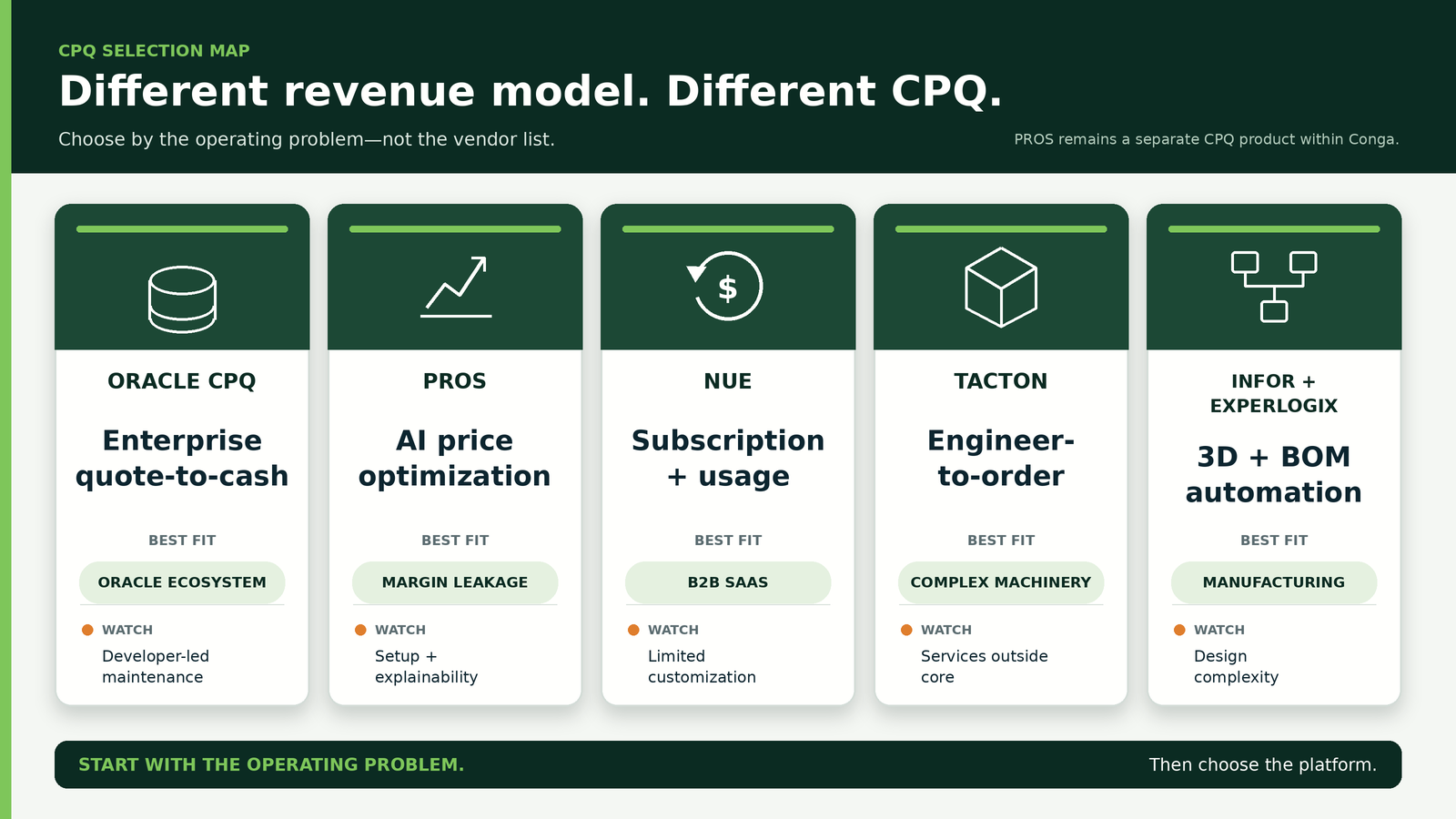
All strong platforms, answering a different question. PROS appears separately from Conga because the two now sit in one organisation with two CPQ products, so you can still be sold either.
Oracle CPQ. A Leader for a ninth consecutive year, with quote-to-cash depth few here match. The catch is maintenance. Reviewers describe coding skills needed for BML scripting, specialists hired on top of premium licensing, and performance degrading on large configurations. One draws the line precisely: fine to medium complexity, a challenge once rules get highly customisable. Pick it when you run Oracle Fusion Cloud with developers to keep it fed.
PROS, now part of Conga. A Leader four times in four years, and the strongest pricing science here: AI-driven optimisation rather than configuration breadth. G2 puts it at 6.6 for ease of setup against Conga’s 8.1. Reviewers also want more visibility into how the optimal price gets calculated. Pick it when margin leakage is the symptom and configuration is straightforward.
Different revenue model, different CPQ software
Nue. Salesforce-native quoting, subscriptions and billing in one scope, so mid-term amendments need no rebuild. OpenAI, Glean and Chili Piper are among its referenced customers. G2 reviewers flag limited customisation, learning difficulty and complex setup, and the design centre is subscription revenue, not blended hardware and labour. Pick it when you are a B2B SaaS business metering consumption.
Tacton. Highest on Completeness of Vision among the 16, and for a second year highest on Ability to Execute, with deep constraint solving for configured machinery. Built around manufacturing and CAD, so services pricing and amendment governance sit outside the design centre. Pick it when you configure engineered products to order.
Infor and Experlogix. Manufacturing CPQ with 3D visualisation and bill of materials automation. Infor took Leader placement a third consecutive time. Experlogix runs against Dynamics 365 and Salesforce, and Capterra reviewers praise its configurability while warning the same flexibility produces convoluted Design Center instances, performance issues and no native version control. Pick these when your catalogue is physical products with engineering rules.
Simple catalogue? Buy CPQ for MSPs instead
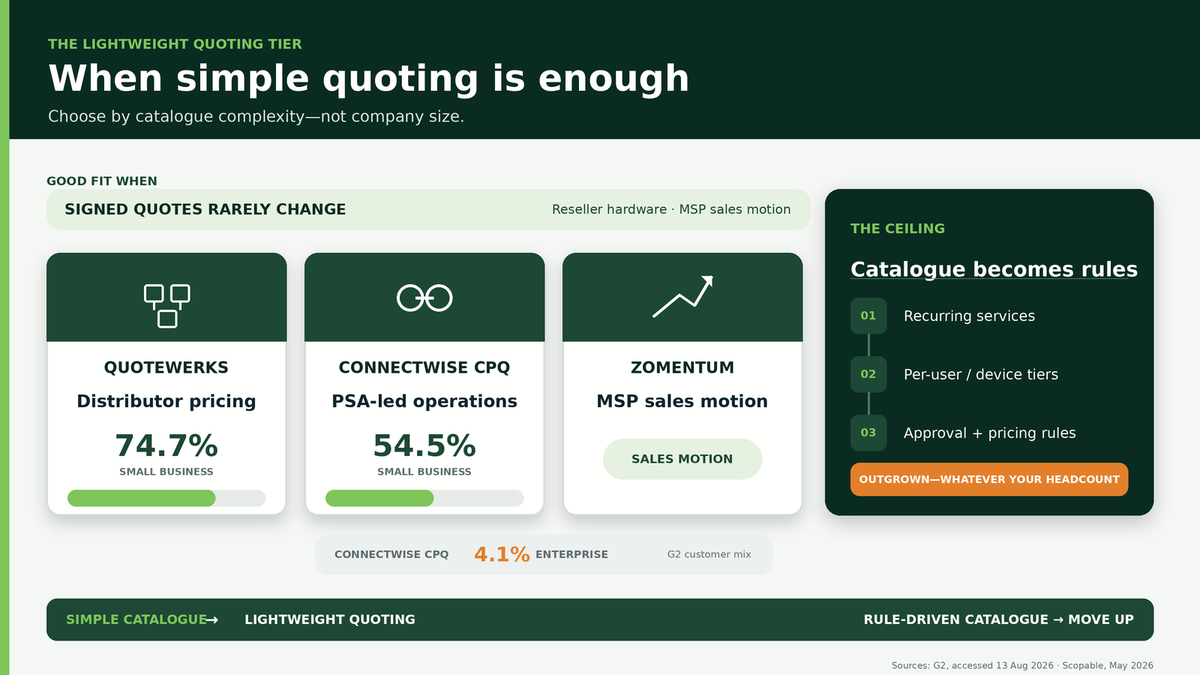
If you resell distributor hardware and quotes rarely change once signed, the tier above is overhead. G2 shows where those tools sit: QuoteWerks reviews run 74.7% small business, ConnectWise CPQ 54.5% small business against 4.1% enterprise (accessed 13 August 2026).
Buy QuoteWerks for distributor pricing depth, ConnectWise CPQ if its PSA runs your operations, or Zomentum for the sales motion.
Know the ceiling, because it is a catalogue problem rather than a size one. A May 2026 comparison notes QuoteWerks bundling feels less natural for recurring services on per-user or per-device tiers, so most teams price them separately. The day those need pricing rules rather than a spreadsheet, you have outgrown the tier whatever your headcount.
Why servicePath™
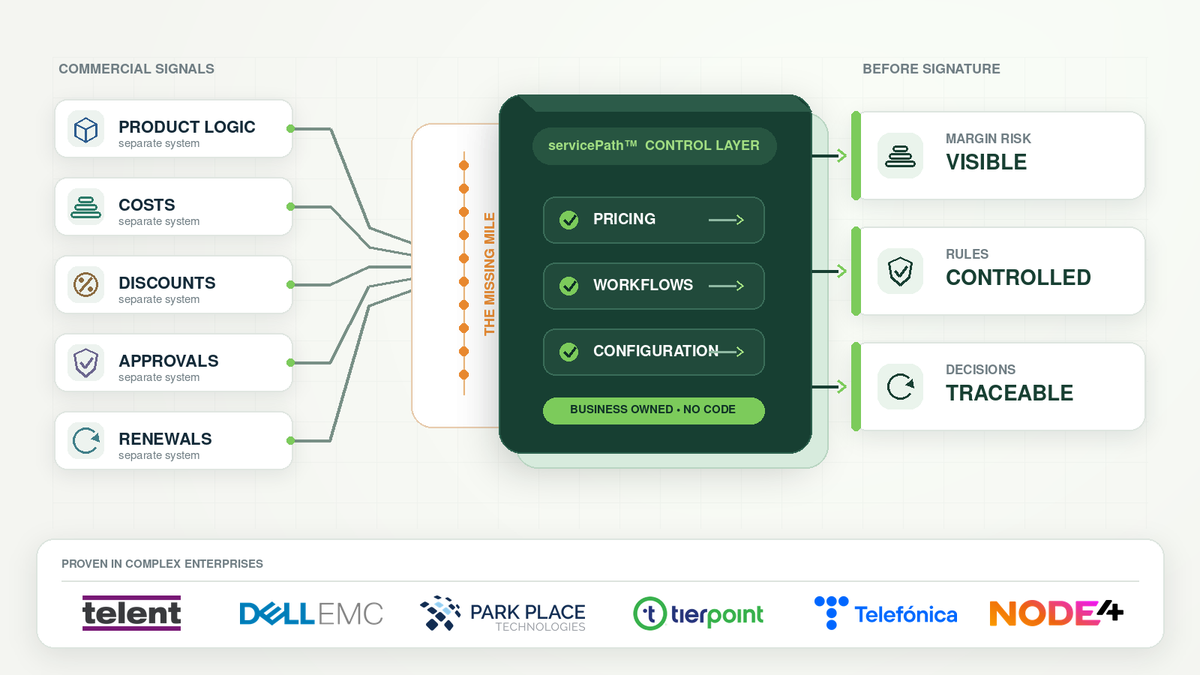
Most quote failures are not arithmetic failures. They are control failures, which is why the best CPQ for technology service providers is judged on control rather than features. Product logic lives in one system, costs in another, discounts in email, approval history in the CRM, renewal assumptions in a spreadsheet.
We call that gap the Missing Mile, and closing it is the whole design premise: margin risk visible before signature, and pricing, workflows and configurations managed by sales, finance and operations rather than developers.
Named customer quotes from telent and DellEMC sit on our case studies page, alongside Park Place Technologies, TierPoint, Telefónica and Node4.
Frequently asked questions about CPQ for technology service providers
What is the best CPQ for technology service providers in 2026?
servicePath™, CloudSense, Salesforce Agentforce Revenue Management, Conga, and DealHub. Fit beats ranking: network-led Salesforce estates favour CloudSense, contract volume favours Conga, and multi-CRM estates favour DealHub or servicePath™.
Is Salesforce CPQ software still supported in 2026?
Yes. It went End of Sale in March 2025, so new customers cannot buy it, but no End of Life date had been published as of February 2026 and existing customers still renew. Account teams cite August 2026 for legacy renewals, which is chatter rather than policy. Moving to Agentforce Revenue Management is a re-implementation, not an upgrade.
Is CPQ for MSPs different from enterprise CPQ?
Yes, and the split runs on size rather than category. MSP tools optimise for distributor feeds and proposal speed. Enterprise CPQ optimises for governance and lifecycle change. The switch point arrives when recurring services need pricing rules rather than a spreadsheet.
Talk to a CPQ architect
Submit your details to connect with a servicePath™ CPQ architect and discuss your CPQ+ requirements. Our approach starts with your challenges, not the platform. Talk to a CPQ architect
Good Revenue Faster.
servicePath™ · servicepath.co