


Executive summary
Legacy CPQ is any pricing system that fails one of five conditions, whatever its age. Can someone new read the rules? Can you replay an old quote? Will the logic leave with you? Does each deal teach it something? Is anyone extending it as your market moves? Miss one and a decade of pricing context becomes sediment instead of an asset.
This is Part 2 of AI depreciates, context appreciates. Each condition comes with a test you can run in an afternoon. The tests matter more now, because AI built on legacy configure, price, quote (CPQ) logic scales whatever it finds. It is written for the CFOs, CROs, and RevOps leaders who own pricing, and the boards above them.
If you run only one, run the exit test in the third condition. It tells you where the other four stand. It also tells you whether replacing is a transfer or a rebuild.
The clause everybody drops
AI depreciates. Context appreciates. I have been saying that for most of this year, and it is only half the sentence.
The model you license today will be a commodity within 18 months. The numbers back that up.
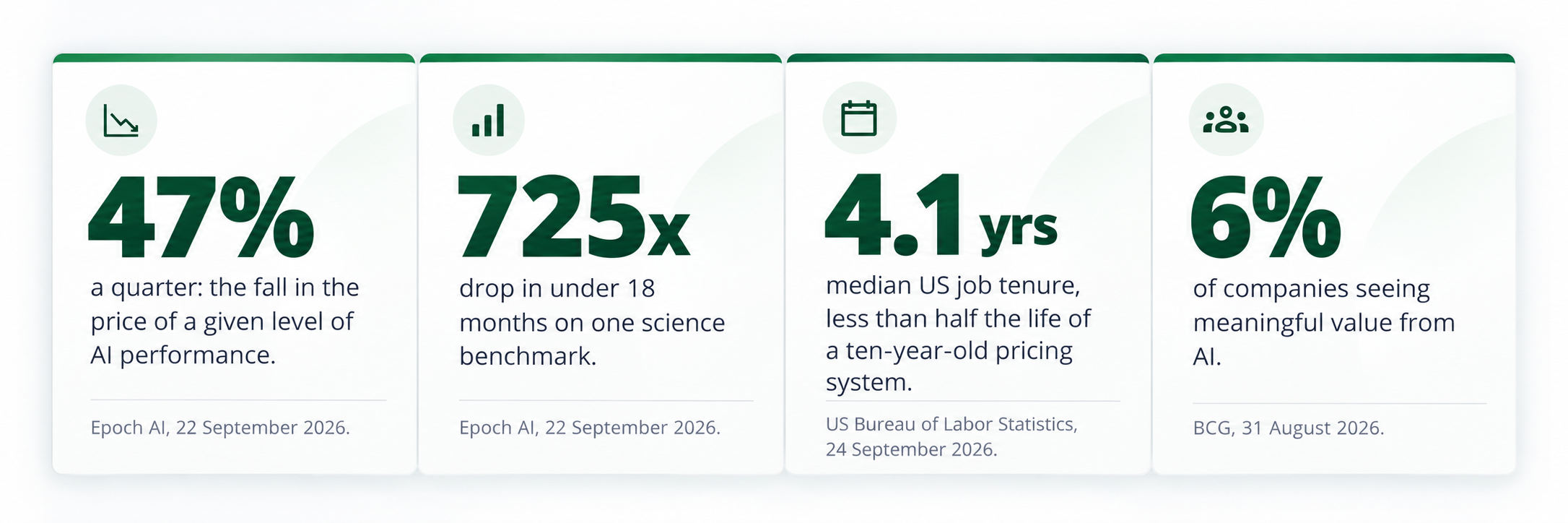
The price of a given level of AI performance keeps falling. Epoch AI tracked the cheapest model able to reach a set score on five tests. That price fell by about 47% a quarter on average between 2023 and 2026. On one hard science test, a 75% score cost about 30 cents a question in January 2025. Under 18 months later, a newer model matched it for four hundredths of a cent.
The leading models are also getting hard to tell apart. On the Arena leaderboard, Stanford’s AI Index 2026 found the top four models fewer than 25 points apart in March 2026. A year earlier, the gap was roughly 97 points.
If AI is getting cheaper, why are AI bills rising?
Gartner expects overall inference costs to rise, because token use is growing faster than token prices fall. Reasoning models and agents use far more tokens per task, and Gartner predicts the cost per agentic workflow will rise more than fivefold through 2028.
So the price of the model is falling and the bill is rising. Neither is where your advantage sits. Everyone can buy much the same model.
If the model is a commodity, what appreciates?
The second half is where the money is, and it is where the sentence usually gets cut. The accumulated knowledge of how your business actually prices compounds for as long as you run the business, but only if it was built to compound.
Most of it was not. Most accumulated context does not appreciate. It piles up. It sits in customisations nobody wants to touch, in approval habits that differ by region for reasons nobody recorded, in the heads of three people who were there for the original implementation, and in a spreadsheet somebody maintains on the side because the system could not hold it.
IDC calls this tacit knowledge: “everything an organization knows but has never written down.” The people holding it move on. Median US job tenure was 4.1 years in January 2026, less than half the life of a ten-year-old pricing system.

Does legacy CPQ get wiser with age?
Appreciation is an architectural property, not a natural consequence of time. A system does not get wiser by being used for 10 years. It gets wiser by being used for 10 years and meeting a specific set of conditions, and if it misses any one of them the same decade of use makes it heavier instead.
Why does AI raise the stakes on legacy CPQ?
There are five conditions that separate legacy CPQ from an asset. They are testable in an afternoon, and they apply equally to what you already own and to anything on a shortlist.
They matter considerably more right now than they did two years ago, because putting AI on top of sediment does not turn it into an asset. It just produces answers from it faster than anyone can check them.
Gartner looked at organisations reporting successful AI initiatives. They invest up to four times more of their revenue in data quality, governance, and similar foundations.
Only 39% of technology leaders in the same survey were confident their current AI investments would improve financial performance. BCG found only 6% of companies seeing meaningful value from AI. Most pilots, it found, do the same work slightly faster while the cost base stays too high.
What are the five conditions that separate legacy CPQ from an asset?
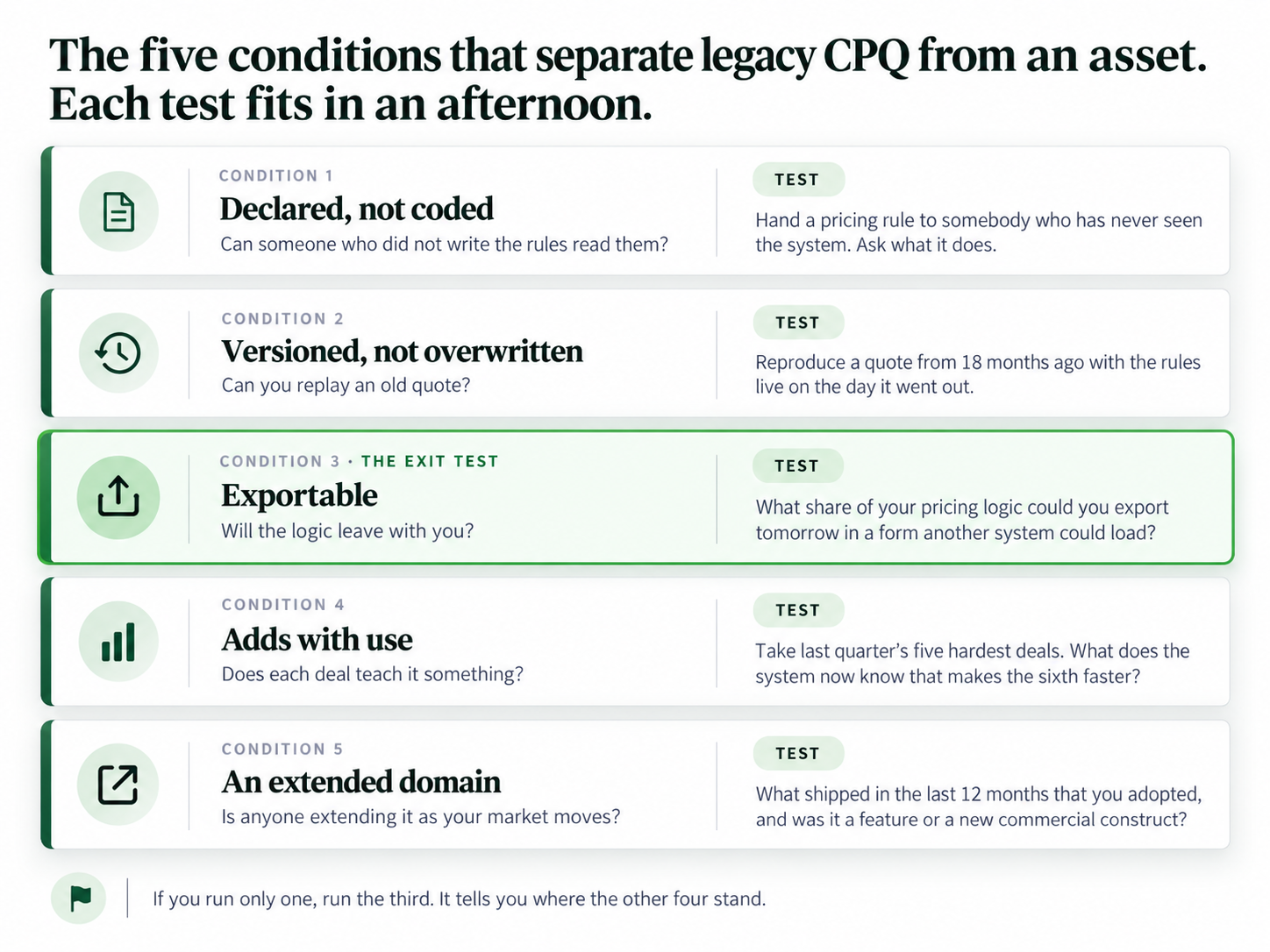
Declared rules, versioned history, exportable logic, learning from use, and an extended domain. Each one has a test.
Only if the rules are declared, not coded
Declared rules can be read, changed, and moved by somebody who did not write them. Coded rules require the person who did. Logic in a custom script, a plugin, or a trigger counts as code, whatever the admin screen says.
The difference surfaces on the day that person leaves, on the day an auditor asks why a price is what it is, and on the day a market shift needs 40 rules revised rather than four.
The test: hand a pricing rule to somebody who has never seen the system and ask them to tell you what it does.
Only if it is versioned, not overwritten
Every price is issued under a state of the world: a catalog version, a rate card, approval thresholds, a margin floor. If a change overwrites that state rather than superseding it, the reasoning behind every historical quote quietly disappears.
Versioned context is reproducible. Overwritten context is simply gone, and nobody finds out until the day somebody asks.
The test: reproduce a quote issued 18 months ago with the rules that were live on the day it went out.
Only if your pricing logic is exportable
Context you cannot hand back to yourself in machine-readable form is not context you own. It is context you rent, and the rent falls due on the way out.
Machine-readable means the rules themselves, with their conditions, effective dates, and approval paths. Not a CSV of the records they produced.
This is the most useful question in the set, because it is answerable in days and it reframes every decision downstream.
In the EU it is also becoming a legal question. The Data Act has applied since 12 September 2025, and cloud providers must drop all switching charges by 12 January 2027. EU lawmakers are still negotiating how far that reaches into SaaS. Treat it as the direction of travel.
The test: what percentage of your pricing logic could you export tomorrow in a form another system could load? Under half means much of your pricing logic lives outside the system, in a folder of tribal knowledge.
Only if using it adds to it
A system that only records is not compounding. The exception approved outside policy has to land as a precedent with a reason attached, not as an email thread somebody half remembers. We showed what an AI agent does with an undocumented precedent in Your deal desk or your AI agents: it treats the exception as the going rate.
The negotiated ramp has to become a reusable construct rather than a bespoke build. The difference between a record and an asset is whether the next person benefits from what the last one learned.
The test: take last quarter’s five hardest deals. What does the system now know that makes the sixth one faster?
Only if somebody is extending the domain, not just your instance
Your own accumulation is half of it. The markets you sell into keep moving: consumption and outcome terms, agent-based pricing, partner and marketplace routes that keep rewriting who owns the margin on a deal.
The movement is additive. Bain found most software companies moving past seat pricing layer new meters on top of seats rather than replacing them.
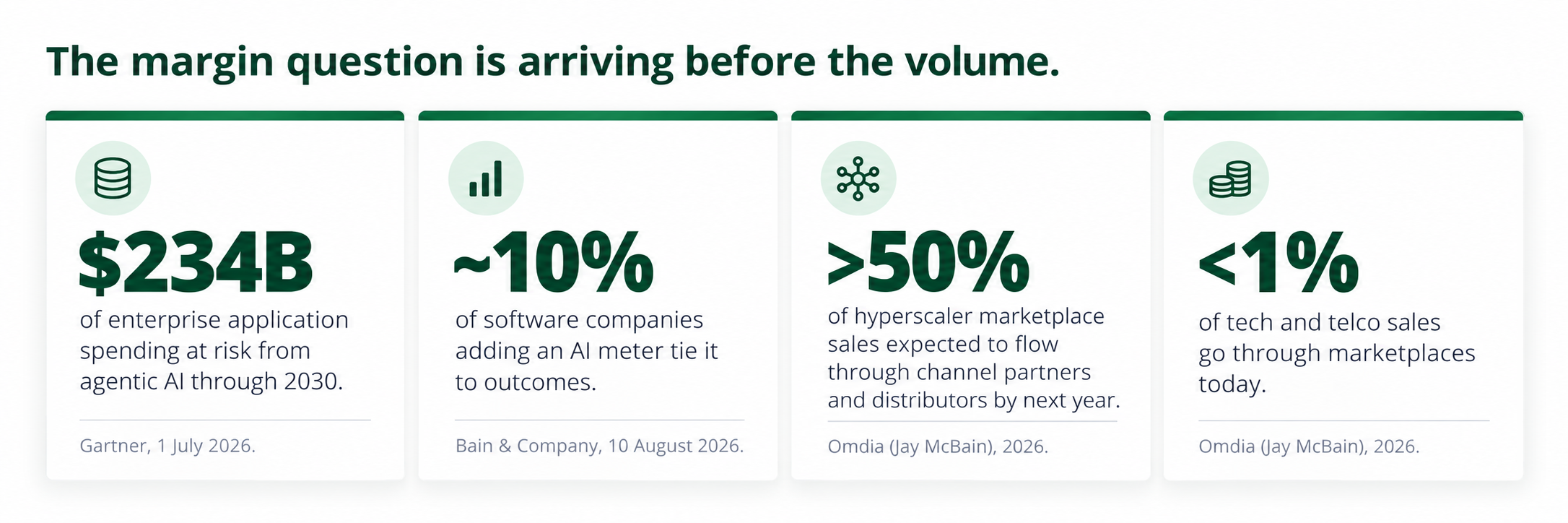
Only about 10% of those adding an AI meter tie it to outcomes. Gartner puts up to $234 billion of enterprise application spending at risk from agentic AI through 2030. Omdia’s Jay McBain expects more than half of hyperscaler marketplace sales to flow through channel partners and distributors by next year. Marketplaces are still small: McBain puts them at less than 1% of tech and telco sales.
Hybrid pricing means more constructs per deal. If nobody is extending the platform to absorb those, your context compounds beautifully inside a shape that is falling behind the market it is supposed to describe.
The test: what shipped in the last 12 months that you actually adopted, and was it a feature or a new commercial construct?

Miss one and you have accumulation, not appreciation
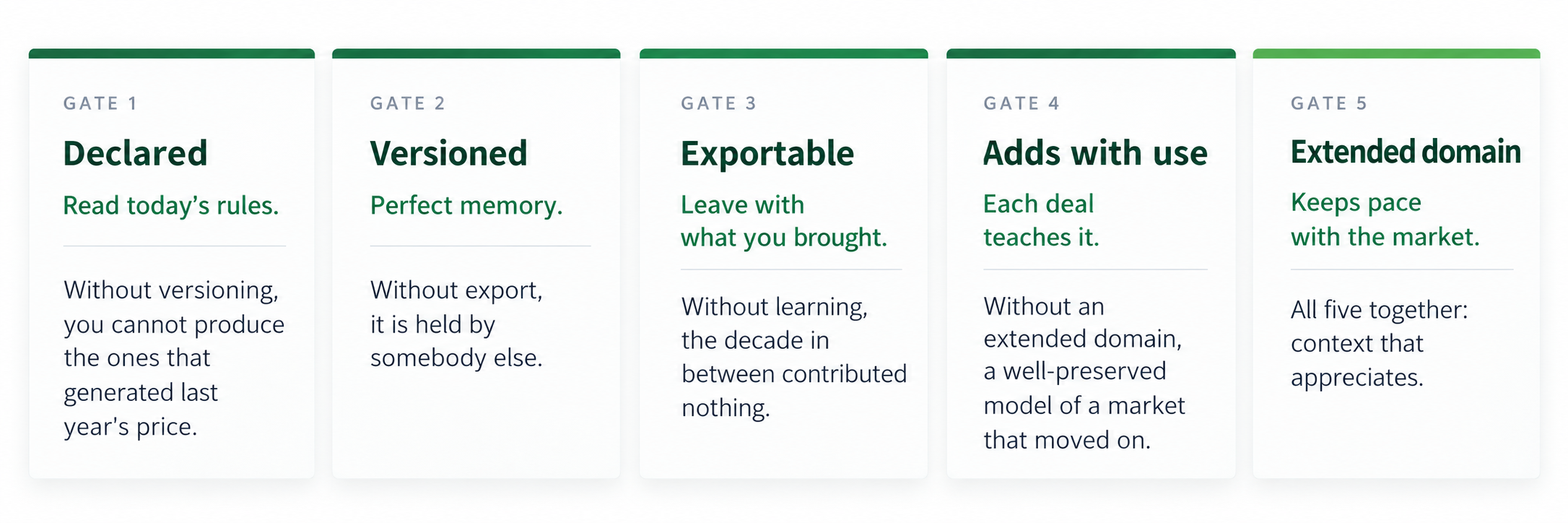
These are not a scorecard where four out of five is a pass. They are gates, and each one makes the next meaningful.
Declared but not versioned means you can read today’s rules and cannot produce the ones that generated last year’s price. Versioned but not exportable means perfect memory, held by somebody else.
Exportable but not additive means you can leave with exactly what you brought, and the decade in between contributed nothing. And all four without anybody extending the domain gives you a beautifully preserved model of a market that has moved on without you.
Four out of five is not a pass. These are gates, and each one makes the next meaningful
Which brings us to the word everybody is using as a weapon this year.
What makes a system legacy CPQ?
Legacy CPQ is not old software. Legacy is what a system becomes when it stops meeting these conditions. That is the whole definition, and it is why the age of a platform tells a board almost nothing. A three-year-old system can fail four of the five on day one. A 15-year-old one can pass all five and be the most adaptable asset in the business.
In the everyday sense of the word, servicePath™ is legacy too. Anything installed is legacy. The day a system goes into production it stops being new and becomes something an organisation depends on, and depended-on is the working definition. There is no version of this argument where the incumbent is old and we are modern.
So when an AI-native entrant tells you your stack is legacy CPQ and theirs is not, they have not made an argument. They have named a date. Ask them for the five conditions instead, and notice that a system with no history cannot pass the fourth one at all, because it was not there.
The replacement trap in CPQ migration
Once a board accepts it is holding legacy CPQ, failing two or three of these, the reflex is to replace it. That reflex is where most of the money goes, and boards almost always cost it wrong.
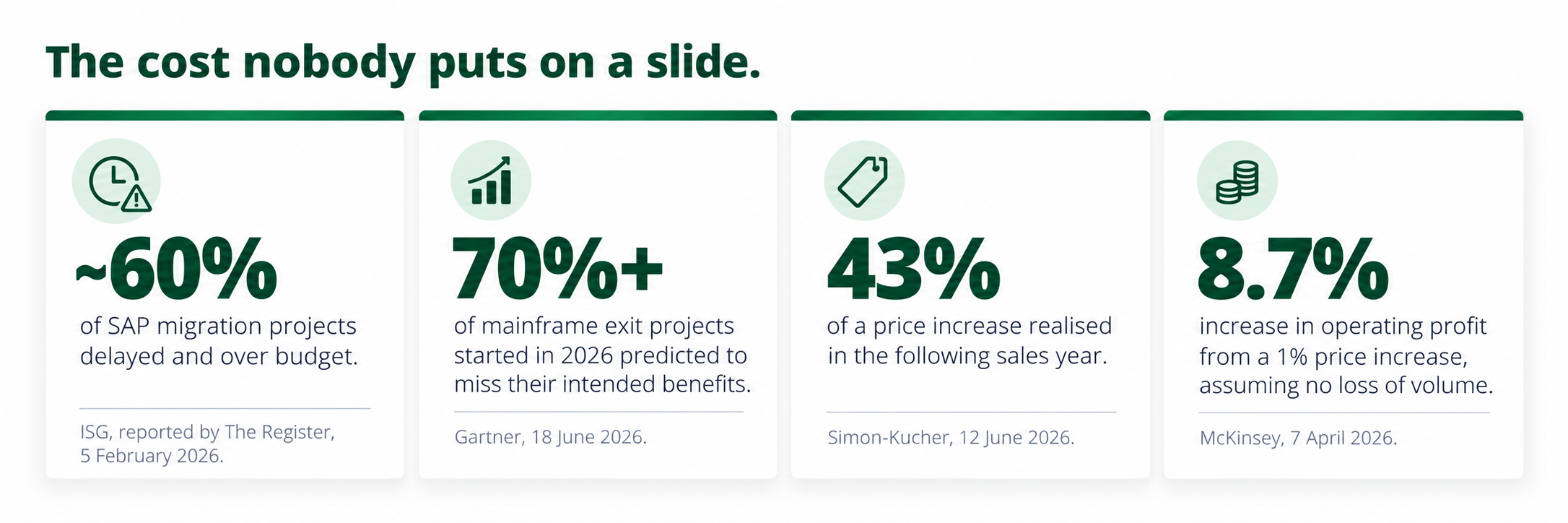
Every migration is a context-destruction event. The visible cost is licences, the integrator, and the internal programme. The cost nobody puts on a slide is the accumulated commercial reasoning that does not survive a data mapping exercise.
ISG research reported by The Register found nearly 60% of SAP migration projects delayed and over budget. More than half of respondents admitted over-customising the old system.
What transfers in a CPQ migration, and what does not?
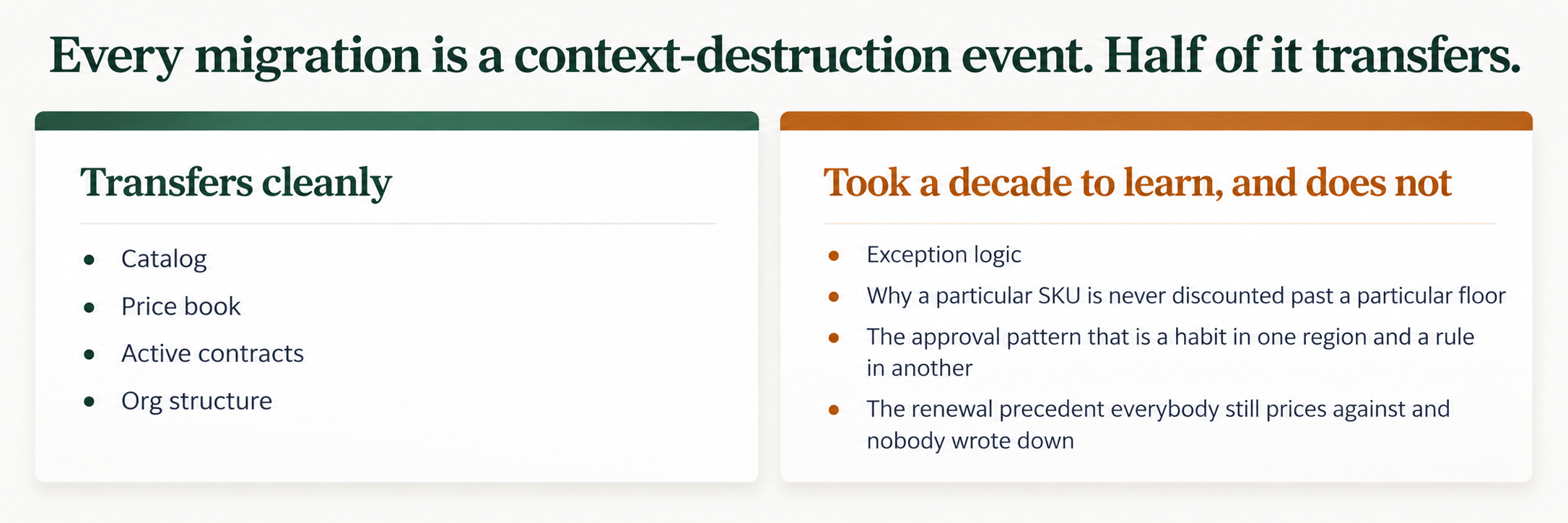
The easy half transfers cleanly: catalog, price book, active contracts, org structure.
The half that took a decade to learn does not. Exception logic. The reason a particular SKU is never discounted past a particular floor. The approval pattern that is a habit in one region and a rule in another. The precedent set on a renewal three years ago that everybody still prices against and nobody wrote down.
The most visible live example is Salesforce CPQ. It went end of sale on 19 March 2025, with no end-of-life date announced.
Forsys, a Salesforce implementation partner, says moving to Agentforce Revenue Management means rebuilding every rule, object, and integration, not migrating them. The new product runs on a different data model. We covered the choices in Salesforce CPQ is not end of life.
Nor will AI carry the logic across for you. Gartner predicts that more than 70% of mainframe exit projects started in 2026 will miss their intended benefits. The cause is an overestimation of GenAI tooling. Different system, same lesson.
What does a rebuild cost the deal desk?
So the arithmetic reads like this.
The morning after go-live, your new system is technically superior to the one you replaced and commercially dumber than it.
Earning that back takes years, and in the meantime the deal desk fills the gap by hand, which is exactly where margin leaks and exactly what nobody is measuring.
Execution is where pricing already leaks. Simon-Kucher research suggests companies realise 43% of any price increase in the following sales year, often because execution breaks down.
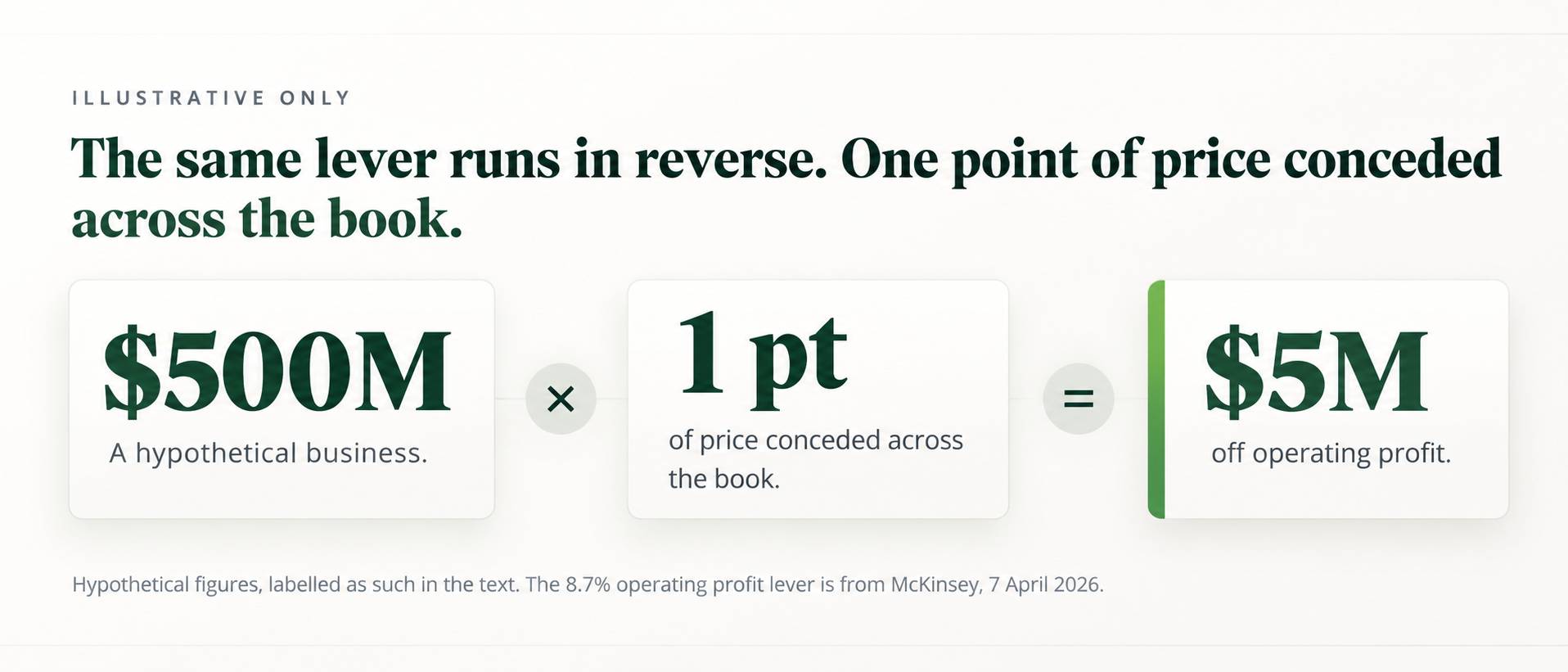
McKinsey calculates that a 1% price increase translates into an 8.7% increase in operating profit, assuming no loss of volume. The same lever runs in reverse. On a hypothetical $500 million business, one point of price conceded across the book is $5 million off operating profit.
None of that is an argument for never moving. It is an argument that the third condition decides whether the move is survivable. If your logic is exportable, a migration is a transfer. If it is not, a migration is a rebuild wearing a transfer’s budget.
Which changes what a shortlist is for. The vendor who can take your rules in machine-readable form, load them, and show them back in a shape your finance team recognises is worth more than the vendor with the better demo. If your vendor was acquired and a renewal is forcing the question, start with the seven questions to ask before you renew

Why servicePath™: designing for context that compounds
I run servicePath™, a revenue lifecycle management platform for complex technology sales. Hold us to the tests rather than to the claims.
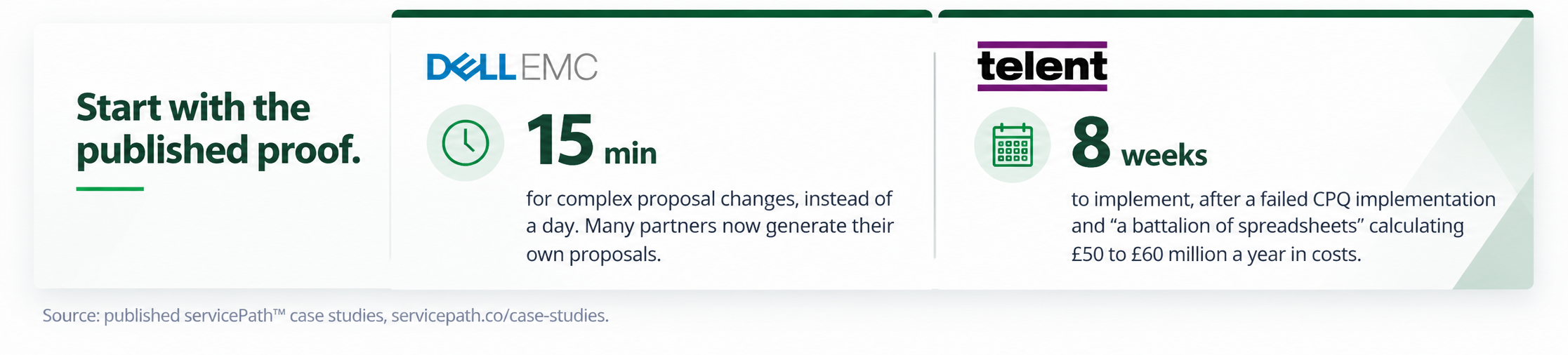
Start with what customers report. Dell EMC reports complex proposal changes taking as little as 15 minutes instead of a day. Many of its partners now generate their own proposals. Telent came to us after a failed CPQ implementation. Its quoting team relied on “a battalion of spreadsheets” to calculate £50 to £60 million a year in costs. The implementation took eight weeks, which the case study calls relatively smooth.
How does servicePath™ approach the legacy CPQ tests?
One and two are architectural, and we design for them deliberately.
We are building the platform around declared rules, so the people who own pricing can read and change the logic without needing the person who wrote it. Our newest pricing work versions rules and prices instead of overwriting them, so the reasoning behind a price is kept rather than replaced.
Run the five tests on us, the same way you would on anyone on your shortlist.
How does industry insight reach your pricing?
Five is where I want to be exact, because it is the condition vendors describe most loosely and it is the one that deserves precision.
The industry insight travels through the roadmap, not through your data. What we learn from operating in complex technology sales shapes what gets built: the constructs in the data model, the capabilities on the roadmap, the defaults that ship.

This is where years in complex technology sales show. The commercial constructs these markets need are already in the product. You do not build those. They are there because the product has spent years in exactly these markets, and they keep being extended as the markets move.
What it does not mean is that one customer’s pricing trains something that serves another. Those are two entirely different claims, and the market blurs them constantly at the moment. Any vendor making the first should state plainly, in writing, that they are not making the second.
Here is ours: servicePath™ trains no models of its own and uses no customer data for training

What can software not do for you?
One honest limit. All five conditions describe software. None of them tells you whether anybody in your business still agrees with the rules the software is faithfully preserving. BCG puts change management at 70% of the effort in making AI pricing stick.
A platform can hold your context. It cannot hold your opinion of it, and that review is yours no matter whose software you buy.
If you run only one legacy CPQ test, run the exit test
Five conditions is more than most boards will action this quarter. So if you take one thing from this, take the third.
Ask what percentage of your pricing logic you could export tomorrow in a form another system could load. Ask it of what you already own, ask it of everyone on your shortlist, and ask them to demonstrate it on your data rather than on a reference deck.
It is answerable in days, it costs nothing, and it tells you the truth about the other four. A system that can hand your context back in machine-readable form has almost certainly declared it, versioned it, and been built by people who expected to be asked. A system that cannot has told you where the other conditions stand without anybody having to test them.
And a vendor who is uncomfortable with the exit question has just told you which direction they intend to move your context.
Find out which one you are holding before you put a model on top of it.
Quick answers
What is legacy CPQ? Legacy CPQ is any configure, price, quote system that fails one of five conditions: declared rules, versioned history, exportable logic, learning from use, or an extended domain. Age is not the test.
How do you run the exit test on legacy CPQ? Ask what share of your legacy CPQ pricing rules you could export tomorrow in a form another system could load. Ask the vendor to show it on your data, not a reference deck. Under half means much of your pricing logic lives outside the system.
Is moving off Salesforce CPQ a migration or a rebuild? Salesforce CPQ went end of sale on 19 March 2025, and existing customers can keep using and renewing it. Independent partners describe the move to Agentforce Revenue Management as a rebuild on a different data model.
Should you replace legacy CPQ before adding AI? Not by reflex. Run the exit test first. If your pricing logic exports in a form another system can load, a replacement is a transfer. If not, you are paying for a rebuild, and any AI you add inherits what survives.
Related reading
On the series: AI depreciates, context appreciates and 88 hours to solve, two years to trust: a board’s guide to AI risk in quote-to-cash.
On the foundation: A strong CPQ foundation matters more than the next hundred tools, Every CPQ vendor has AI now. Three other things decide the future of CPQ, and Deterministic AI governance: 5 reasons AI revenue projects fail in 2026.
On migration: Salesforce CPQ End of Sale: decide before fall planning locks.
Glossary: Quote-to-Cash (Q2C), Automated Bundling, and the full servicePath™ glossary.