


Executive summary
Salesforce CPQ is End of Sale, not End of Life. Nothing shuts off. But Salesforce’s strategic quote-to-cash investment has moved to the Agentforce Revenue Management suite, and Revenue Cloud Advanced is now CPQ’s designated successor. The real deadline is your own Q4 planning calendar, not Salesforce’s.
Existing customers can renew, add users, and receive support, and Salesforce has published no End of Life date. But most MSPs and technology services companies lock Q4 and FY27 roadmaps in September and October. A Configure, Price, Quote (CPQ) decision that misses that window slips a full year while complexity compounds.
Below: the verified facts, a six week plan, and an honest map of your three realistic paths, with a clear view of exactly where servicePath™ fits and where another route serves you better. Straight guidance either way.
It is the last stretch of summer. Deals are slower, half your team is at the lake, and nobody wants to open a project plan before Labor Day. Good. Enjoy it. This is not a “drop everything” post.
I have spent 20 years watching technology services companies make and defer platform decisions. So I can tell you what the summer lull really is: the only quiet runway before fall planning hits. One item deserves a September slot before the Q4 scramble starts. Your Salesforce CPQ roadmap.
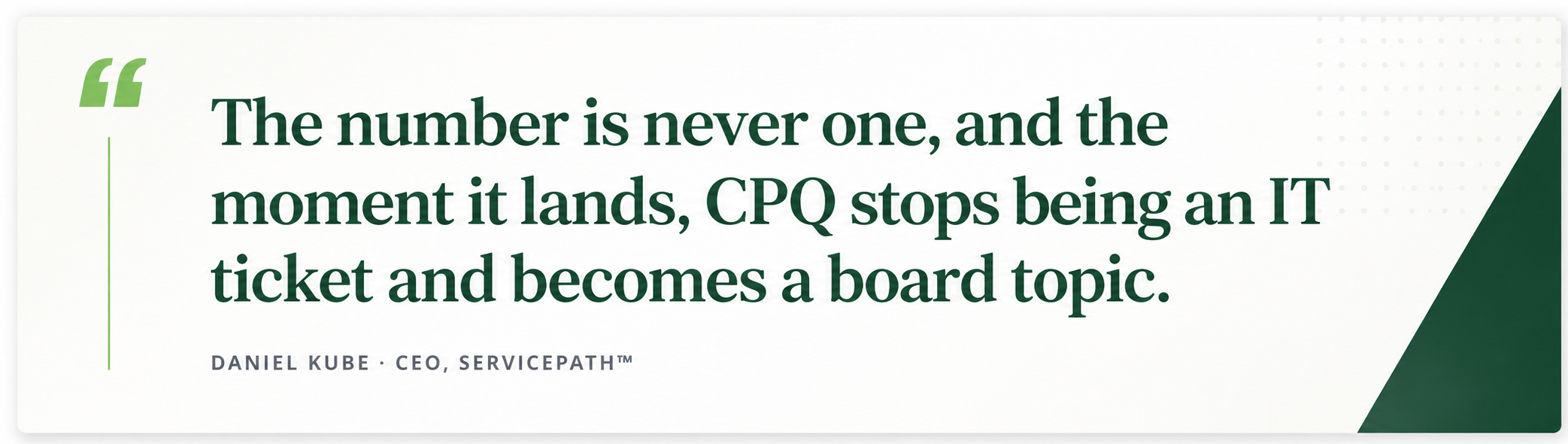
Over the past 18 months I have watched dozens of enterprises work through this decision. One scene keeps repeating. A leadership team that grew through acquisition discovers, mid-audit, that nobody in the room can say how many CRMs the business runs. The number is never one, and the moment it lands, CPQ stops being an IT ticket and becomes a board topic.
“My promise for what follows: no invented deadlines, and clear labels on fact versus estimate versus my own read. I will be open about where servicePath™ has a commercial interest, and give you straight guidance on the best fit for your business, wherever it leads
What happened to Salesforce CPQ?
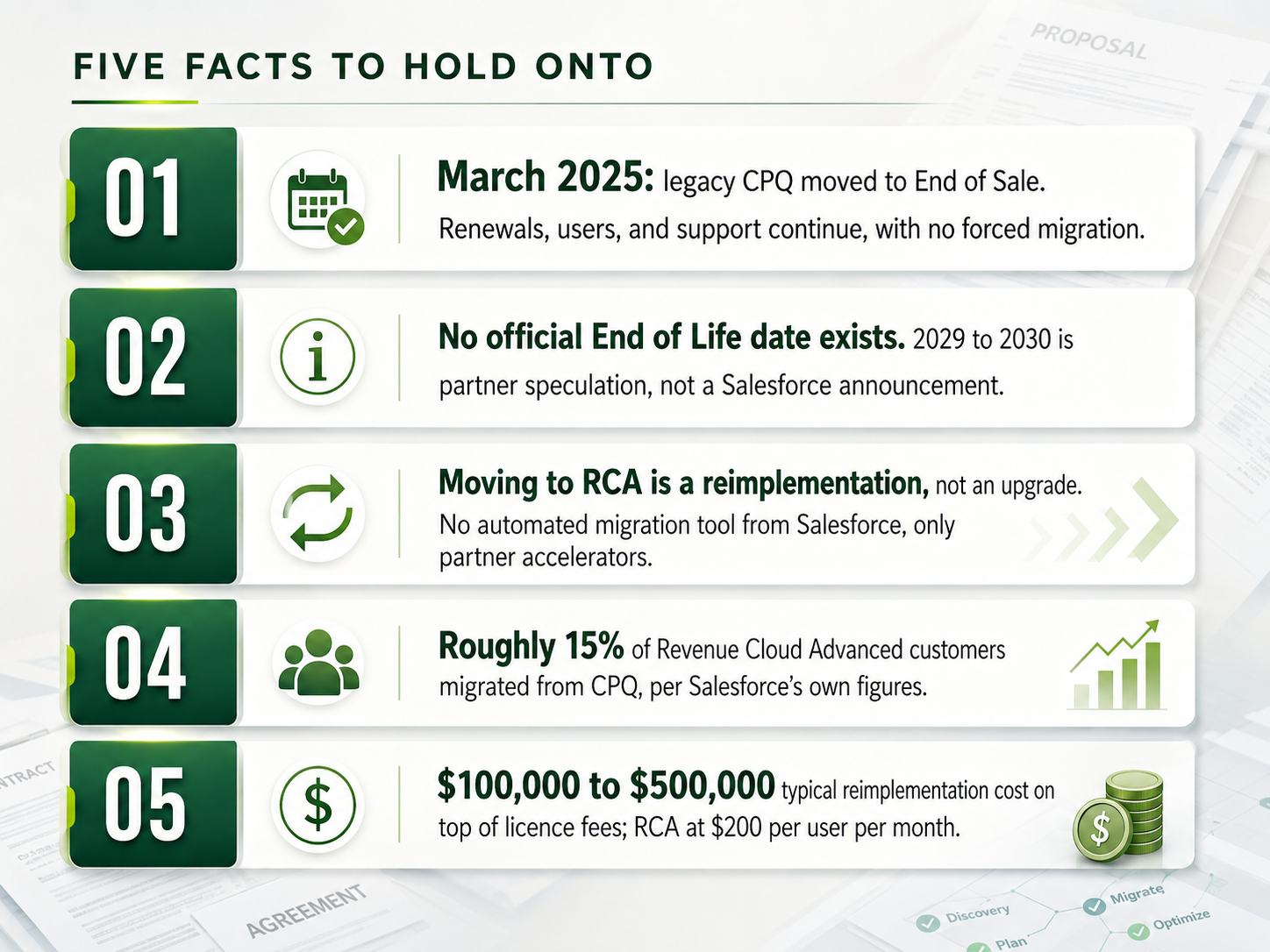
In March 2025, Salesforce moved its legacy CPQ managed package to End of Sale. That is the SteelBrick product behind quote-to-cash at thousands of companies. Here is what that means, drawn from Salesforce’s own documentation, updated as recently as July 2026:
Salesforce stopped selling new CPQ licenses to net-new customers. Existing customers can keep using CPQ, add users, renew, and receive support and critical fixes. Nothing breaks on day one, and Salesforce states plainly that there is “no forced migration.”
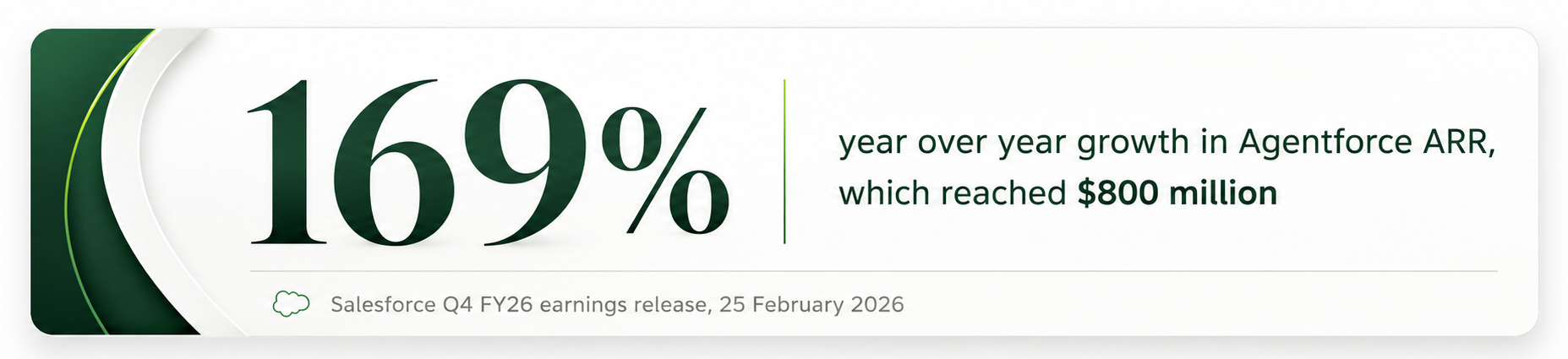
R&D investment has moved. Strategic investment has shifted to the Agentforce Revenue Management suite, with Revenue Cloud Advanced (RCA) as CPQ’s designated successor, a shift SalesforceBen confirmed at the announcement. Want proof beyond marketing pages? Salesforce’s Q4 FY26 earnings reported Agentforce ARR of $800 million, up 169% year over year.
CEO Marc Benioff told investors the company has been rebuilt as “the operating system for the Agentic Enterprise.” Those are company-wide numbers, not an RCA line item. But my read is simple: the platform’s centre of gravity has moved, and the next decade of product lives there.
There is no official End of Life date. Salesforce describes CPQ as in a maintenance phase: supported, but with no new feature development. It points to its retirement philosophy rather than a date. Partner commentary projects an eventual window around 2029 to 2030, so treat that as informed speculation, not an announced deadline.
The move to RCA is a reimplementation, not an upgrade. This is the fact most posts bury. CPQ runs on custom objects inside a managed package. RCA, however, runs on standard platform objects with a different data model and pricing engine.
Redress Compliance’s independent analysis is blunt: Salesforce provides no automated migration tool, so you rebuild rules and pricing rather than copy them. Partner-built tools from Forsys, IdeaHelix, and Prodly accelerate the transformation, but acceleration is not a lift and shift. Redress puts typical reimplementation cost at $100,000 to $500,000 on top of licence fees, with RCA at $200 per user per month.
So no, nothing is being switched off this September. If anyone claims a hard EOL deadline lands this fall, question everything else they tell you. What is real is quieter and more urgent. The vendor has publicly redirected its future, and that gap widens every renewal cycle you spend without a plan.
The real deadline
When do you actually need to decide about Salesforce CPQ?
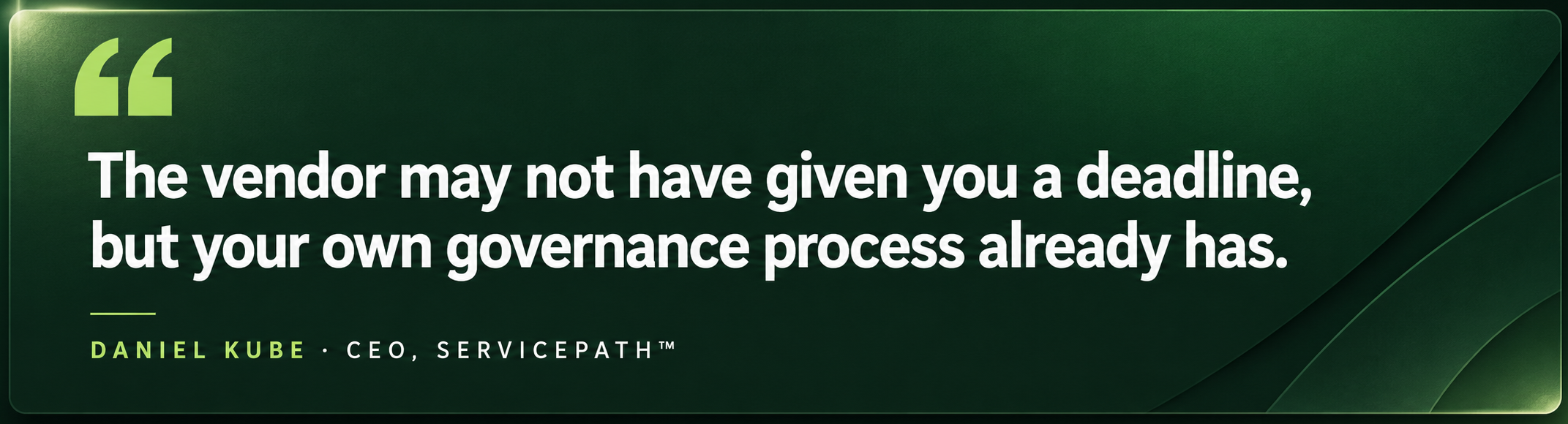
Most of the MSPs and technology services companies I work with lock Q4 and next fiscal year roadmaps in September and October. If your fiscal calendar differs, shift the dates; the logic holds. Leadership allocates budget, sizes headcount, and finalizes the “big platform projects” list. Nobody formally rejects a CPQ decision that arrives late. It simply never gets considered, decided by the calendar instead of by you.
Moreover, a year is expensive here, for three compounding reasons.
Reason one: migrations take longer than budget cycles.
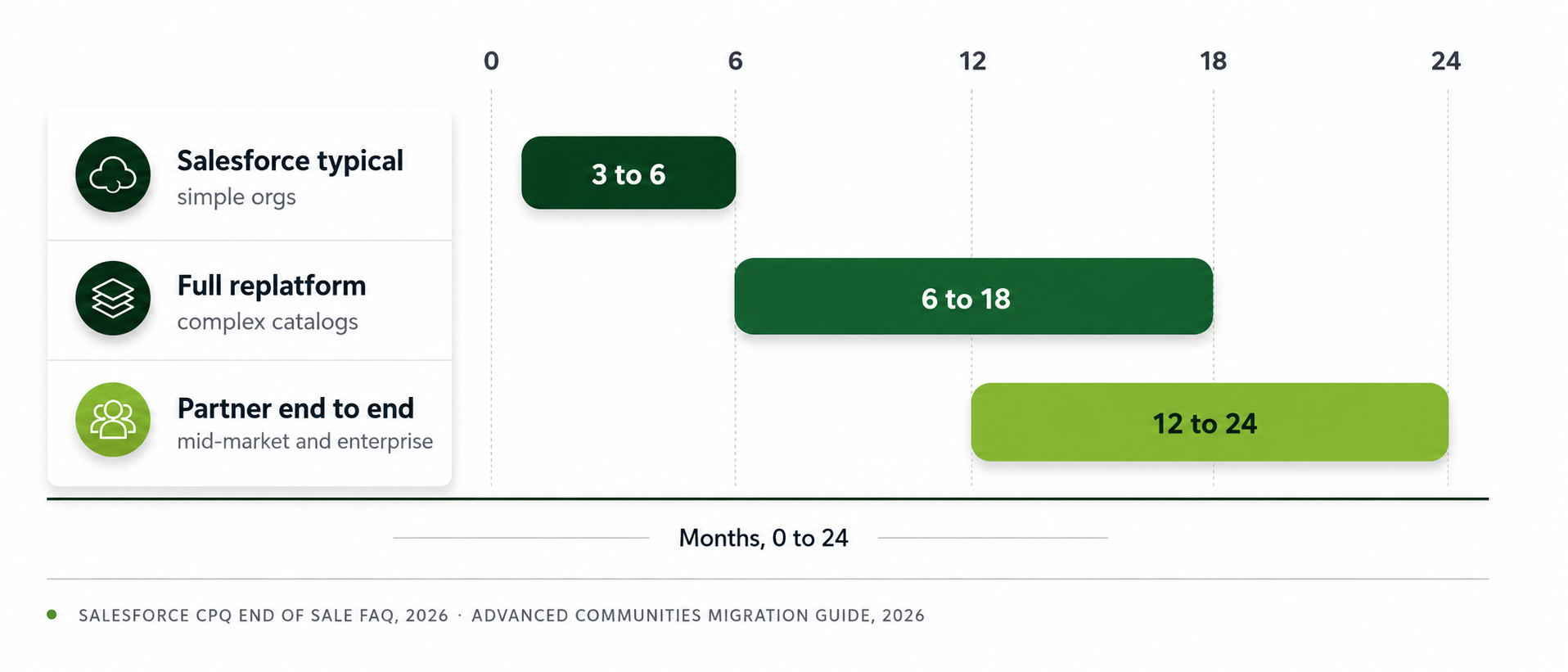
Start with Salesforce’s own numbers. The FAQ describes typical migrations of three to six months, which is honest for clean, simple orgs. For the companies I talk to every week, however, it is optimistic.
You must review, rebuild, or retire every piece of custom Apex, every Quote Calculator Plugin, every Price Rule, and every integration. Complex catalogs, multi-tier approvals, or multi-currency pricing typically mean 6 to 18 months for a full replatform. Implementation partners describe 12 to 24 months end to end for mid-market and enterprise orgs. These ranges are not physics. They vary with the custom logic you carry, which is why the week one audit matters more than any published number.
Work backward: to be live, or even credibly underway, before your next major renewal, the decision belongs in this planning cycle.
Migration timelines
How long does the move really take?
Months from decision to live, by scenario. The published ranges vary with the custom logic you carry.
Reason two: the cost of standing still is not zero.
Nucleus Research’s 2025 CPQ Technology Value Matrix frames the entire market around “the cost of inaction.” Companies that keep deferring modernization pay through slower quoting, more errors, thinner margins, and quiet revenue leakage. Our own field observations are directional estimates from client work, not audited benchmarks.
They put revenue leakage among legacy CPQ users at 3% to 7% of ARR. Sales ops spend 30% to 40% of their time on workarounds. Take the low end and run it against your ARR; that is what “next year” costs. Meanwhile, MGI Research’s CPQ Top 35 Buyer’s Guide 2026 calls CPQ “a foundational system within the revenue architecture.”
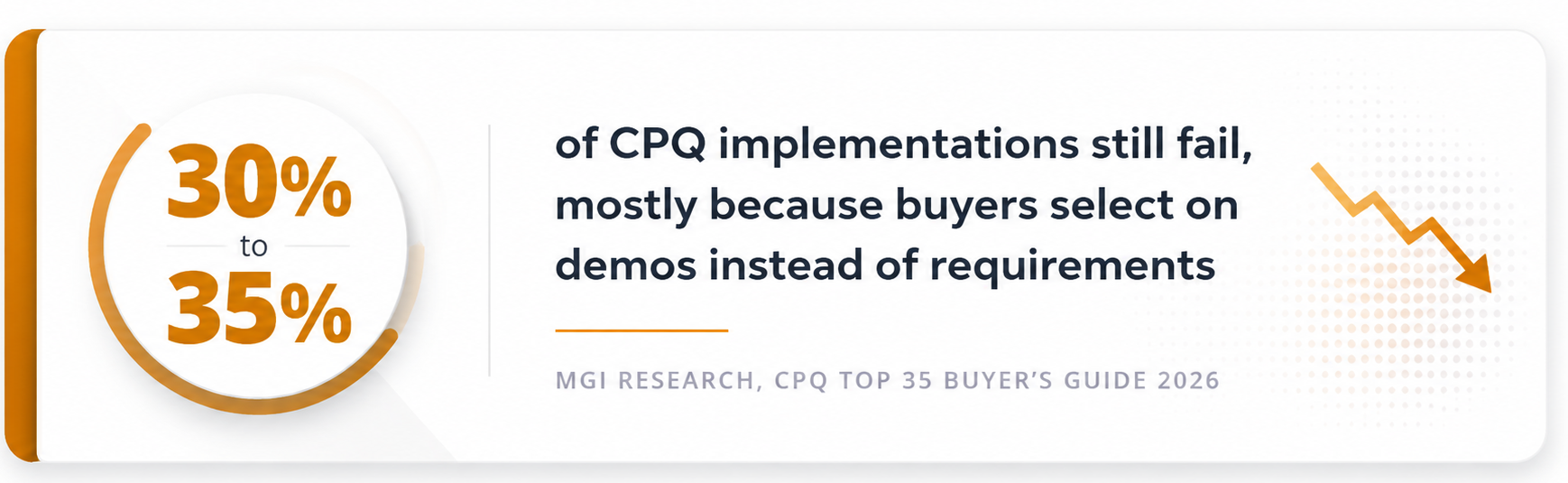
Yet 30% to 35% of implementations still fail, mostly because buyers select on demos instead of requirements. A rushed migration forced by a renewal deadline is how companies join that statistic; a planned one, started now, is how they avoid it.
Reason three: your business is getting more complex faster than your CPQ is standing still.
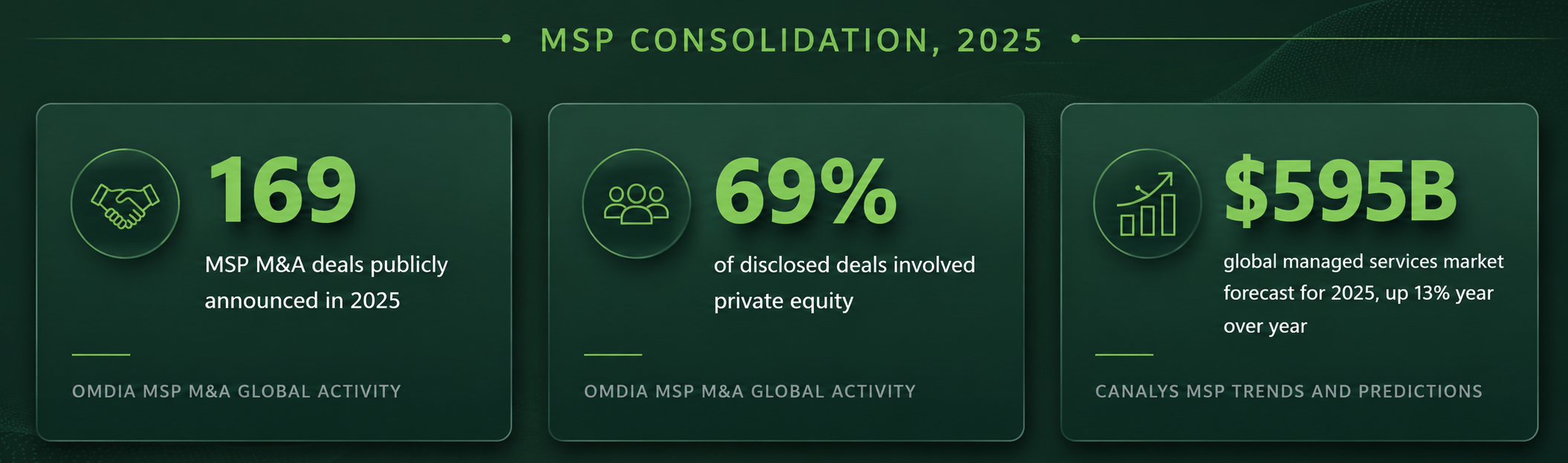
The managed services sector is consolidating hard. Omdia’s MSP M&A analysis recorded 169 publicly announced deals in 2025. Private equity appeared in 69% of disclosed deals, and North America accounted for roughly three quarters of acquirer-side activity. All of this sits inside a global managed services market Canalys forecast at $595 billion for 2025, up 13% year over year.
Every acquisition brings another CRM, another catalog, another pricing philosophy. If your growth plan includes M&A, the question changes. It is not “how do we migrate the CPQ we have.” It is “what revenue architecture survives the next three acquisitions.”
And here is the finding that should worry acquirers most. McKinsey’s 2026 B2B Pulse research found that inconsistent information across teams is now the number one reason buyers switch suppliers. Connecting that to multi-CRM sprawl is my inference.
But I watch it play out in the field. Fragmented systems are not just an internal tax, because your customers feel the seams and leave over them. Waiting a year does not preserve the status quo. It adds entities to the problem.
Put those three together and the honest conclusion is simple. In short, calm decisions made in August beat rushed ones made at renewal.
Six weeks, one owner
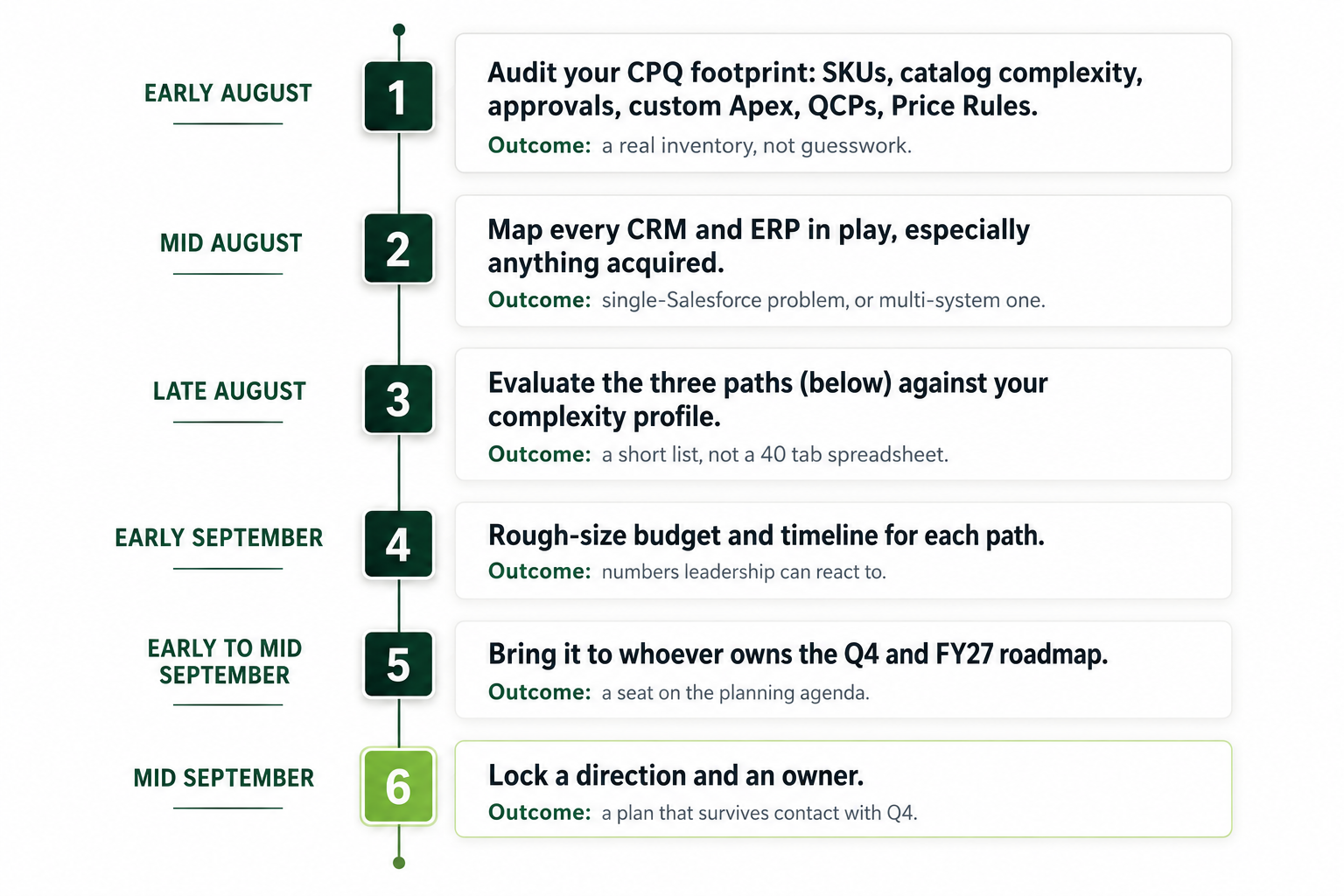
A realistic six week plan, early August through mid September
You do not need a task force, just one accountable owner and six focused weeks. The owner runs the evaluation. Finance, IT, RevOps, and security own pieces of it. Six weeks buys decision readiness, not a completed procurement.
The pre-fall checklist
Before you close the laptop for the summer, get these seven items on paper:
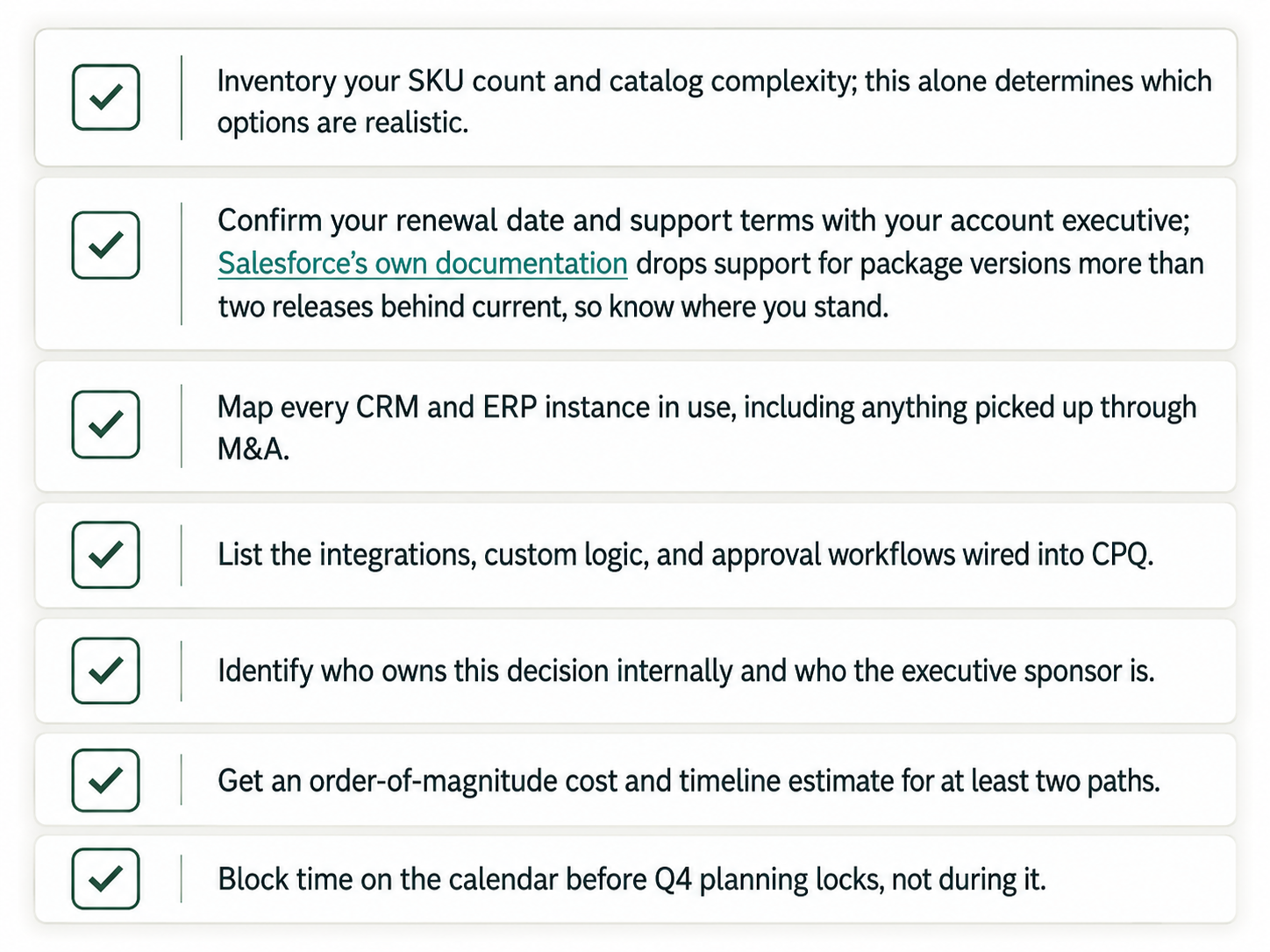
An afternoon on this list is the difference between a September plan and a September surprise.
The decision map
Your three realistic paths, and the honest fit for each
There is no single right answer here, and any post claiming one is selling something. Including, potentially, this one. So, the decision map first, our interest second. These three are strategic directions, not an exhaustive menu; variants like phased coexistence or consolidating CRMs first collapse into one of them. Hold every candidate to the same fields: fit, disqualifiers, cost, disruption, integration ownership, AI readiness, and exit risk.

Keep legacy CPQ running and layer AI agents or microservices around it to buy 12 to 18 months of runway. This genuinely fits simpler operations (our internal shorthand is under 500 SKUs) where the business is not changing shape quickly and leadership needs time to align.
Still, be honest about what this is. For complex catalogs it is life support, not a strategy. Salesforce’s Spring ’26 release repositioned Revenue Cloud as the Agentforce Revenue Management Agent, and those agents run on a core-native object model that legacy CPQ sits outside of.
Before you bolt agents onto a legacy package, one caution. Gartner predicts over 40% of agentic AI projects will be canceled by the end of 2027 over costs, unclear value, and weak risk controls. That is a general finding, but in my view, wrapping without governance is how you join it.
Meanwhile, Forrester expects at least one in five B2B sellers to face AI buyer agents pushing dynamic counteroffers during 2026. Quoting is becoming machine to machine, and a wrapped legacy package was never designed to answer an agent. So treat wrapping as a bridge, and make sure it leads somewhere.


Is the honest answer to “how many CRMs do we run?” just “one, and it is Salesforce”? Then staying inside the ecosystem is often the right call. After all, RCA is a genuinely modern architecture: API-first, composable, built for multi-channel selling.
Already roughly 15% of its customers migrated from CPQ, and the partner tooling ecosystem is maturing. Go in with clear eyes on two things. It is a reimplementation with real cost. And you are recommitting to a single vendor’s roadmap for a decade. So for a clean single-Salesforce shop, that trade is often worth it.


(Related words, not synonyms: composable means modular, vendor-agnostic means free of any one platform.) Is the honest CRM answer “multiple,” or “it depends which entity you ask”? Then you are in different territory.
This is the standard condition for acquisitive MSPs and technology services companies, a population the Omdia numbers show growing every quarter. Consequently, forcing every acquired entity into one CRM’s revenue stack means re-solving the same integration problem after every deal, on someone else’s timeline. The alternative is a composable revenue architecture.
This is a CPQ and revenue lifecycle layer designed to sit above multiple CRMs and ERPs. The quoting engine, catalog, and margin controls stay constant while the systems underneath change.

One rule cuts across all three paths. SKU counts (under 500, over 1,000) are servicePath™ heuristics, not laws. Real complexity lives in rule depth, entities and currencies, contracted pricing, amendments and renewals, integrations, and approval layers. When several of those run deep, an AI wrapper will not hold, whatever your SKU count. You need a real migration plan, whichever direction it takes.
That third scenario is the problem servicePath™ was built for. Which brings me to the part most vendor posts hide in the footer.
Why servicePath™
Full transparency: servicePath™ is a CPQ and Revenue Lifecycle Management platform, and we compete for exactly the evaluations this post recommends. Read everything above knowing that; I would rather say it directly than let you discover it in the links.
Here is where we earn a place on your shortlist: complex technology sales. That means MSPs, telcos, IT services, and hardware-plus-services businesses running large catalogs, multi-entity pricing, cost-based margin visibility, and more than one CRM or ERP.
Because we sit above the CRM layer rather than inside one vendor’s package, an acquisition is far less likely to trigger a full re-platforming project. The work does not vanish. Catalog harmonisation, connectors, and training are real in any architecture.
But the new entity onboards into the same quoting engine. Sales keeps one process while integration works at its own pace underneath. That is why our customers tend to be the acquisitive, multi-system businesses path three describes. It is also why the End of Sale decision window matters more to them than to anyone else.
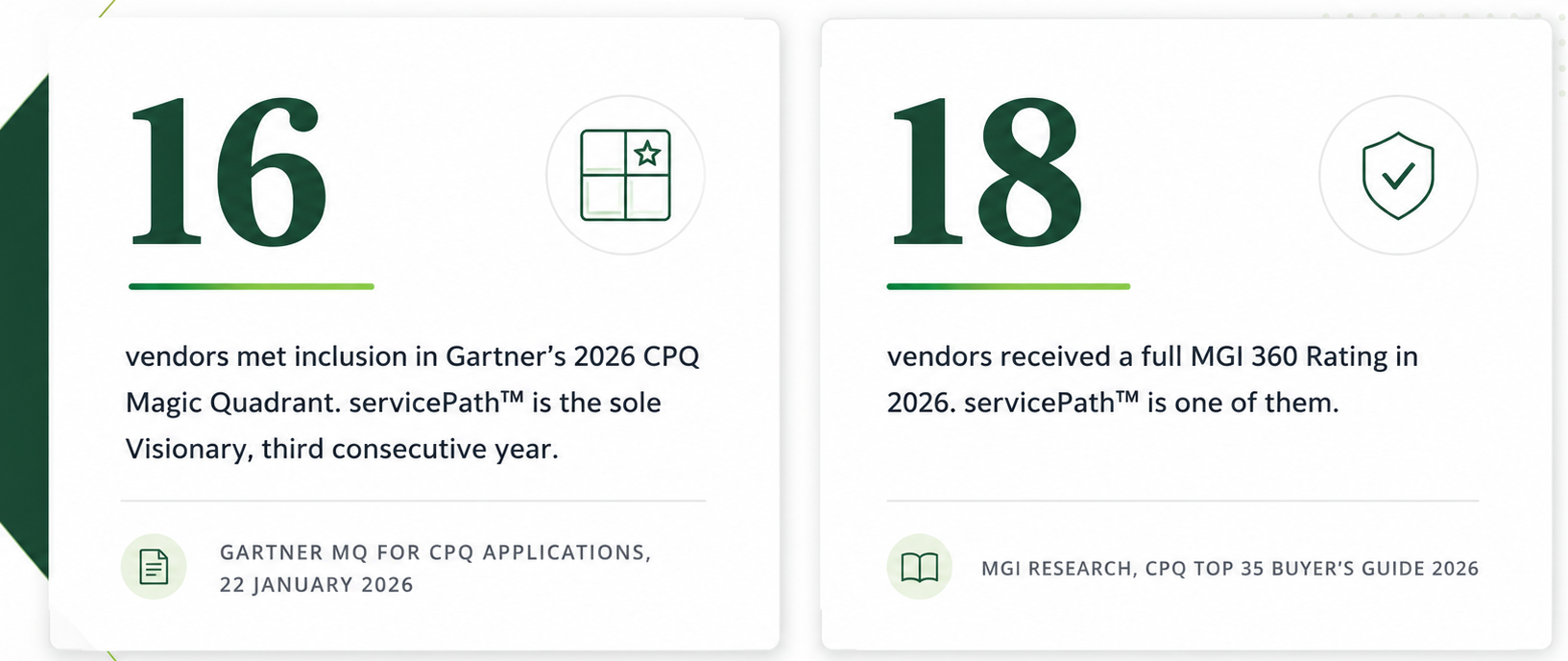
You do not have to take my word on it. Take Gartner’s 2026 Magic Quadrant for Configure, Price and Quote Applications, published 22 January 2026. Of the 16 vendors that met inclusion, servicePath™ stands alone in the Visionary quadrant for the third consecutive year. And in MGI Research’s CPQ Top 35 Buyer’s Guide 2026, we are one of 18 vendors to receive a full MGI 360 Rating. Put us through your evaluation on the same terms.
We are built for complexity: multiple CRMs and ERPs, large catalogs, multi-entity pricing, and revenue that has to stay governed through acquisition after acquisition. That is where servicePath™ earns its place, and where we will back ourselves against anyone. I
Whichever path fits, the evaluation is the same six weeks. Do the inventory, ask the CRM question honestly, and put numbers in front of the roadmap owner before planning locks.
Frequently asked questions
Is Salesforce CPQ end of life in 2026?
No. Salesforce CPQ is End of Sale, not End of Life. Existing customers can keep using CPQ, renew, add users, and receive support, and no End of Life date has been announced. What has changed is investment, which has moved to Revenue Cloud Advanced within the Agentforce Revenue Management suite.
When will Salesforce CPQ actually be retired?
Salesforce has not published a retirement date and points to its product retirement philosophy instead. Partner commentary projects a window around 2029 to 2030, but that is informed speculation. Confirm your actual renewal and support terms with your account executive rather than planning around a rumored date.
Is moving from Salesforce CPQ to Revenue Cloud Advanced an upgrade or a migration?
Neither. It is a reimplementation: rules, bundles, and pricing logic are rebuilt rather than copied, and Salesforce provides no automated migration tool, though partner-built accelerators exist. Meanwhile, Salesforce describes typical migrations at three to six months, while implementation partners cite 12 to 24 months for complex, heavily customised orgs.
What should MSPs running multiple CRMs after acquisitions do about Salesforce CPQ End of Sale?
Start with an honest systems inventory: how many CRMs and ERPs run across all entities. If more than one, evaluate a vendor-agnostic CPQ layer alongside the Salesforce-native path. The next acquisition then extends your platform instead of restarting the debate. With 169 MSP deals announced in 2025 alone, architecture that assumes future acquisitions beats architecture that assumes none.
The actual message
Nothing is on fire, and nobody’s system shuts off next month. Go enjoy the rest of your summer.
Just do not let “nothing is on fire” become “we never looked at it” by the time planning starts. After all, the vendors’ timelines are ambiguous by design; your calendar is not. Run the checklist and ask the CRM question. Confirm your renewal terms with your account executive before any blog, including this one, sets your timeline.

Request a 20-minute executive briefing
In complex sales, the winner is rarely whoever quotes first; it is whoever understood the deal best. The same holds here: the advantage belongs to whoever walks into planning season already holding the analysis.
About the author
Daniel Kube is CEO of servicePath™, the Configure, Price, Quote and Revenue Lifecycle Management platform built for complex technology sales. servicePath™ has spent more than 15 years helping technology service providers and MSPs govern pricing, margin, and revenue across multiple CRMs and ERPs. It is the sole Visionary in the 2026 Gartner Magic Quadrant for CPQ Applications, its fourth consecutive Visionary year. Daniel writes on revenue architecture at servicePath™ Insights.