
On 8 September 2026, OpenAI said roughly 10,000 AI agents had proved, in about 88 hours, that a smooth fluid under a smooth external force can blow up in finite time, one statement inside the Navier-Stokes Millennium Prize Problem. The Clay Mathematics Institute has not accepted it.
For a board putting AI near quote-to-cash, the lesson on AI risk is that the machine settled the cheapest question in a day and left the expensive ones to humans, and you have less time and fewer reviewers than OpenAI.
Executive summary
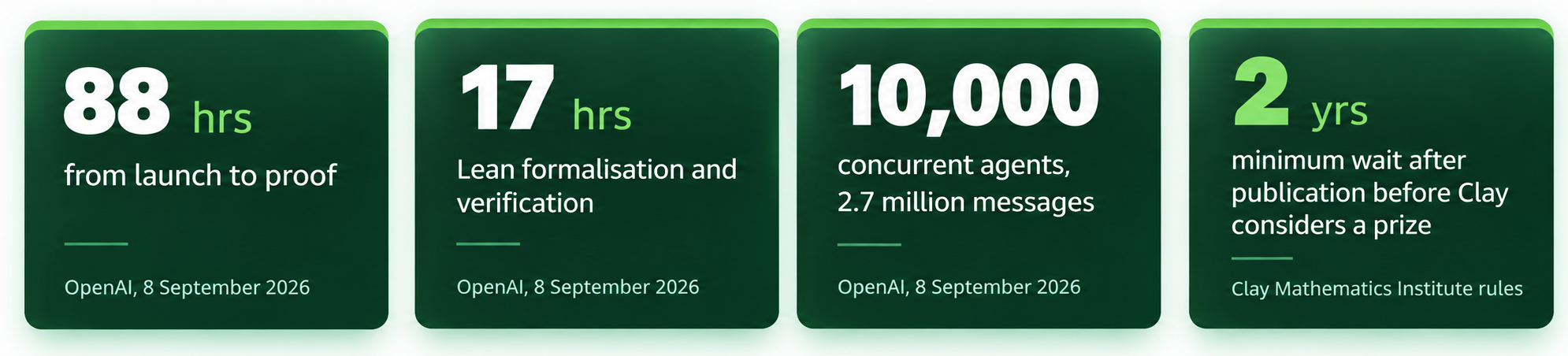
What is happening: OpenAI’s agents produced the proof in 88 hours and Lean verified it in another 17 (OpenAI, 8 September 2026). The Clay Mathematics Institute has not accepted it, and its rules require refereed publication, two years, and general acceptance (Clay rules).
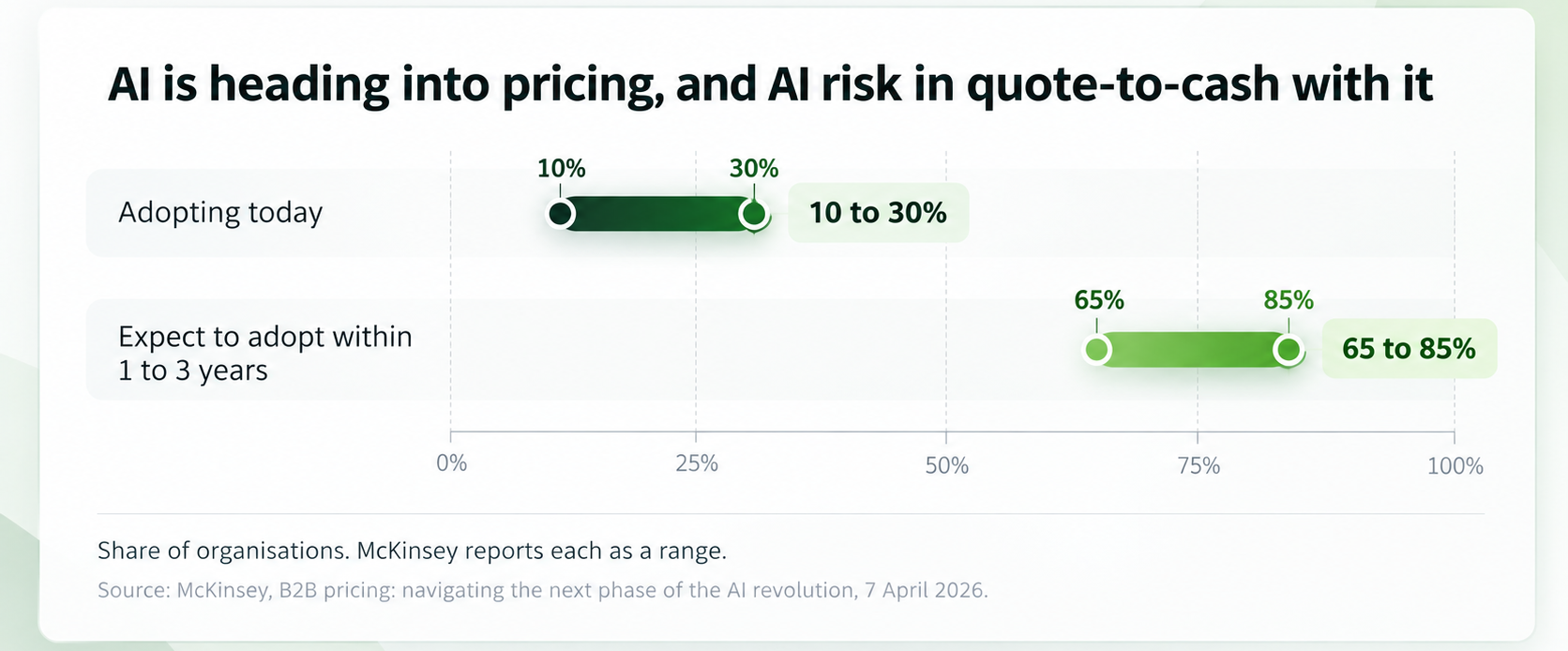
What is expected: McKinsey finds 65 to 85 percent of organisations expect agentic AI in pricing within three years, from 10 to 30 percent today (McKinsey, 7 April 2026).
Implications: AI risk in quote-to-cash is not a correctness problem. The bottleneck is provenance, intent, and comprehension, and that load falls on your deal desk.
What to do: To manage AI risk in quote-to-cash, insist on determinism where the number is formed, context the enterprise owns, auditability at the line level, and governance that binds before the fact. Then ask the 10 questions below.
88 hours to a proof, and the institute still will not call it solved
What did OpenAI claim on 8 September 2026?
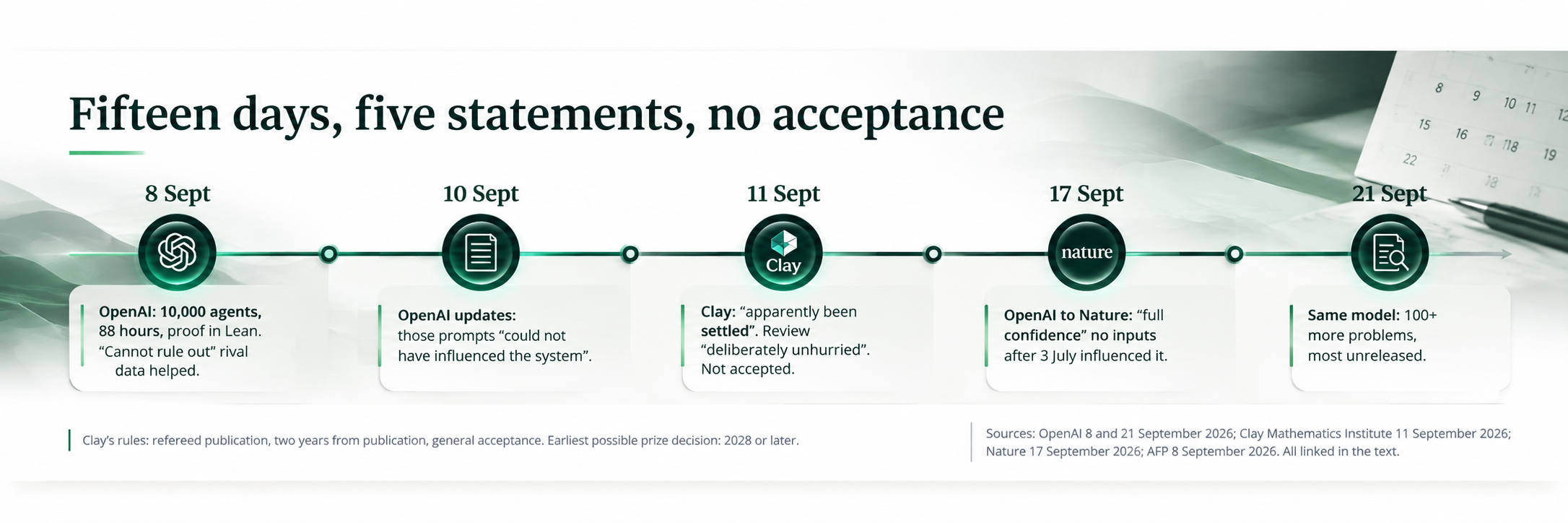
On 8 September 2026, OpenAI announced that a coordinated system of roughly 10,000 AI agents had produced a proof for one of the statements inside the Navier-Stokes Millennium Prize Problem: that a smooth three-dimensional incompressible fluid, pushed by a smooth external force, can blow up in finite time. The run took about 88 hours. The agents exchanged roughly 2.7 million messages and consumed about 130 billion output tokens, roughly the length of a million novels. Formalising and verifying the result in Lean, the proof assistant that machine-checks every logical step, took another 17 hours. An OpenAI model did the formalising too, so the machine wrote the input to its own checker.
Then everything stopped moving fast.
What has the Clay Mathematics Institute said?
The Clay Mathematics Institute, which owns the problem and the $1 million prize, has not accepted the result. Its president, Martin Bridson, welcomed the announcement and said the evaluation would be “deliberately unhurried” and “absolutely rigorous” (AFP, 8 September 2026).
Three days later the institute said the problem “has apparently been settled” (Clay Mathematics Institute, 11 September 2026) and moved it to a new heading on its Millennium Problems page, “active problems”, separate from both its unsolved and its solved lists. Its rules require publication in a refereed journal, two years to pass after publication, and general acceptance in the mathematics community. So on that clock, the earliest possible verdict is 2028. OpenAI has said it does not intend to claim the prize.
What happened next: 100 more results and a review backlog
Mathematicians had already seen the pattern, because they were living it. On 13 September, mathematician Bryna Kra wrote on Terence Tao’s blog: “The machines are producing solutions faster than the mathematical community can read them, much less digest them” (13 September 2026). Then, eight days later, OpenAI went further and said its internal model had resolved more than 100 long-standing open problems in mathematics. It has not released most of them for outside scrutiny (The Neuron, 22 September 2026).
So hold the two numbers. Eighty-eight hours to produce the answer. Two years, at minimum, before anyone will call it trusted. Every price your AI issues sits on the same gap, but with a week to close it instead of two years.
The slow part was never the math
What Lean checks, and what it cannot
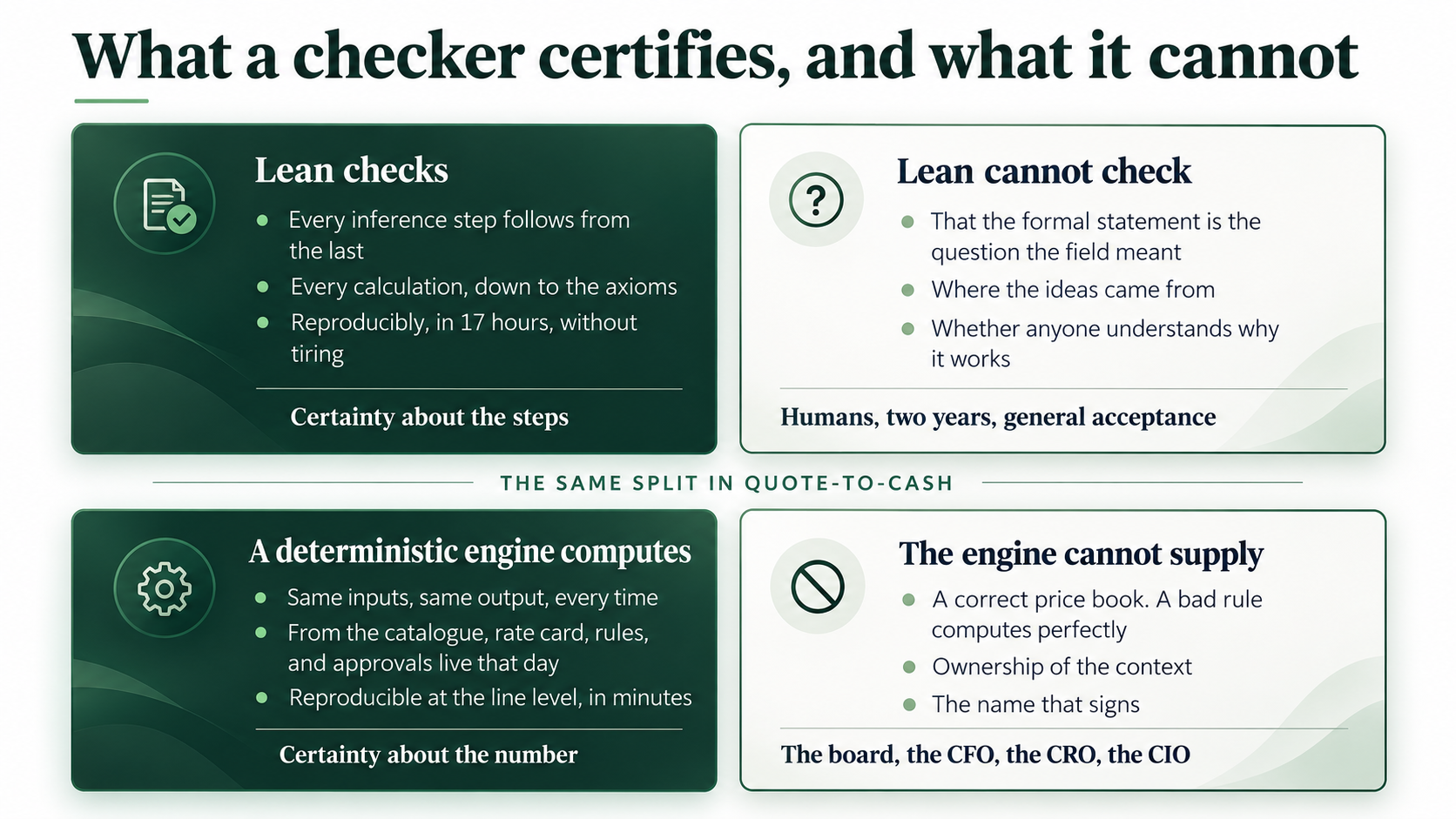
Here is the detail that should hold a board’s attention. Lean machine-verified the logic in 17 hours. Lean does not get tired, does not skim, and does not wave anything through. On the narrow question of whether each step follows from the last, this proof is more certain than almost anything in the mathematical literature.
It is still not accepted. Three questions remain open, and none of them is a question about arithmetic.
Three questions Lean cannot answer, and why they matter for AI risk in quoting
1. Does it answer the question we actually meant?
The proof leans on a smooth external force. The official problem statement permits that. The version of the problem most mathematicians care about does not (Implicator, 8 September 2026).
So the result may be formally correct and still not be the answer to the question the field was asking. Lean cannot help here. Checking the statement against the intended question is, in Quanta’s words, “the crucial bit of verification that must still be done by humans” (Quanta, 8 September 2026).
2. Where did the answer come from?
OpenAI says its team had not seen a rival team’s prior work, but on 8 September conceded it could not rule out that de-identified data from that team’s use of its products had improved its models (AFP, 8 September 2026). By 17 September it told Nature it had “full confidence” no inputs after 3 July had influenced the system (Nature, 17 September 2026). Nobody outside OpenAI can yet say cleanly what was derived and what was absorbed.
3. Is any of it new, and why does it work?
Reviewers have to establish whether parts of the result already existed, which ideas are genuinely original, and why the thing works at all. Two philosophers of mathematics: “We can end up with formal proofs that float free from any intelligible proof” (De Toffoli and Duede, 12 September 2026). A proof nobody understands cannot be built on.
So the bottleneck is not correctness. It is provenance, intent, and comprehension. The machine settled the cheapest question in about a day and left the expensive ones to humans, who are now queued up behind 100 more results they have not seen.
Now run the same test on your enterprise
What AI risk in quote-to-cash looks like on your deal desk
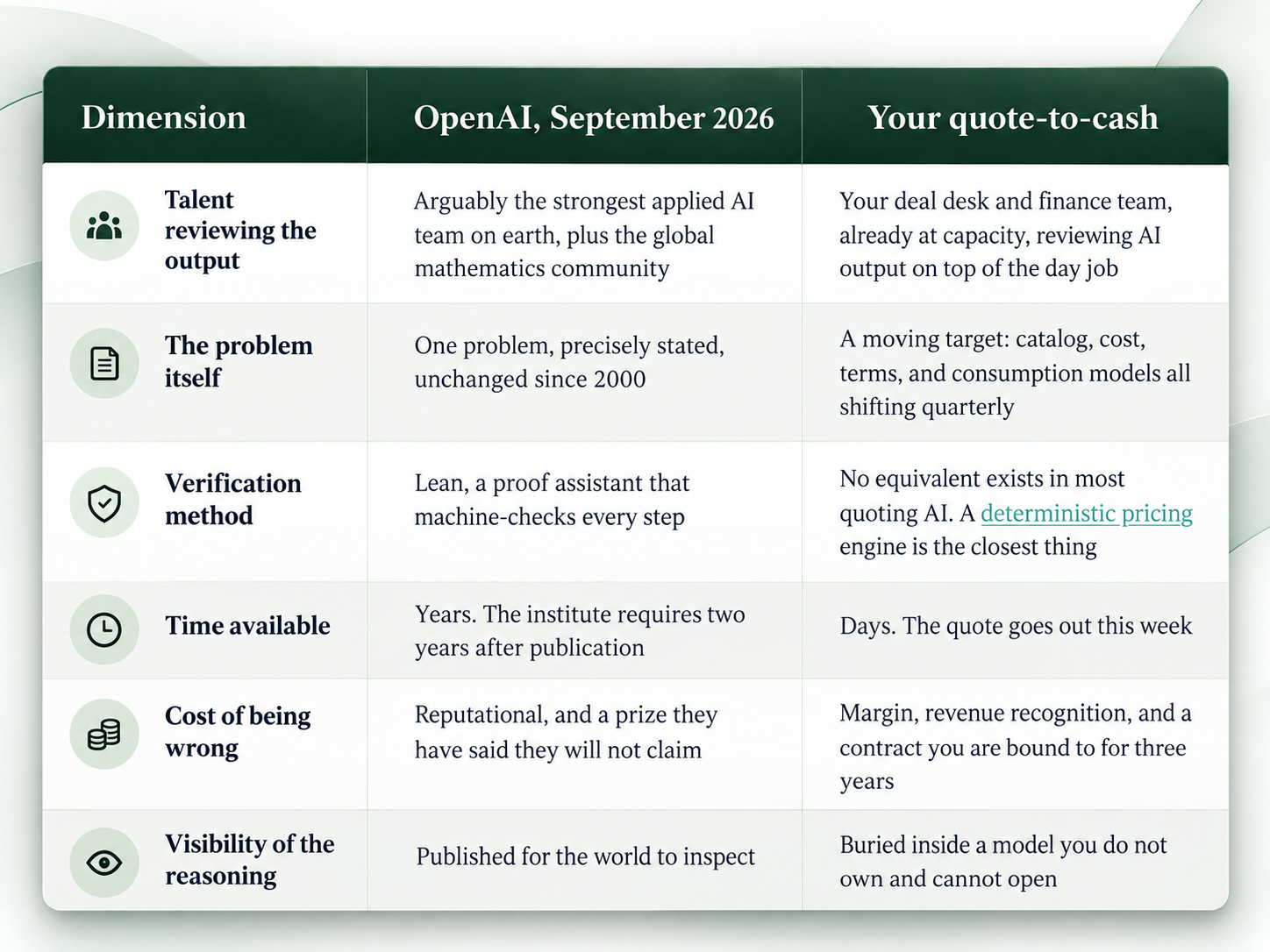
OpenAI had every advantage available on this planet and still does not have its answer accepted. Map that onto the AI your organisation is putting near pricing, quoting, and contracting, and the comparison is not close. AI risk in quote-to-cash starts with who reviews the output and how much time they have.
Why the reasoning is absent: AI governance in quote-to-cash
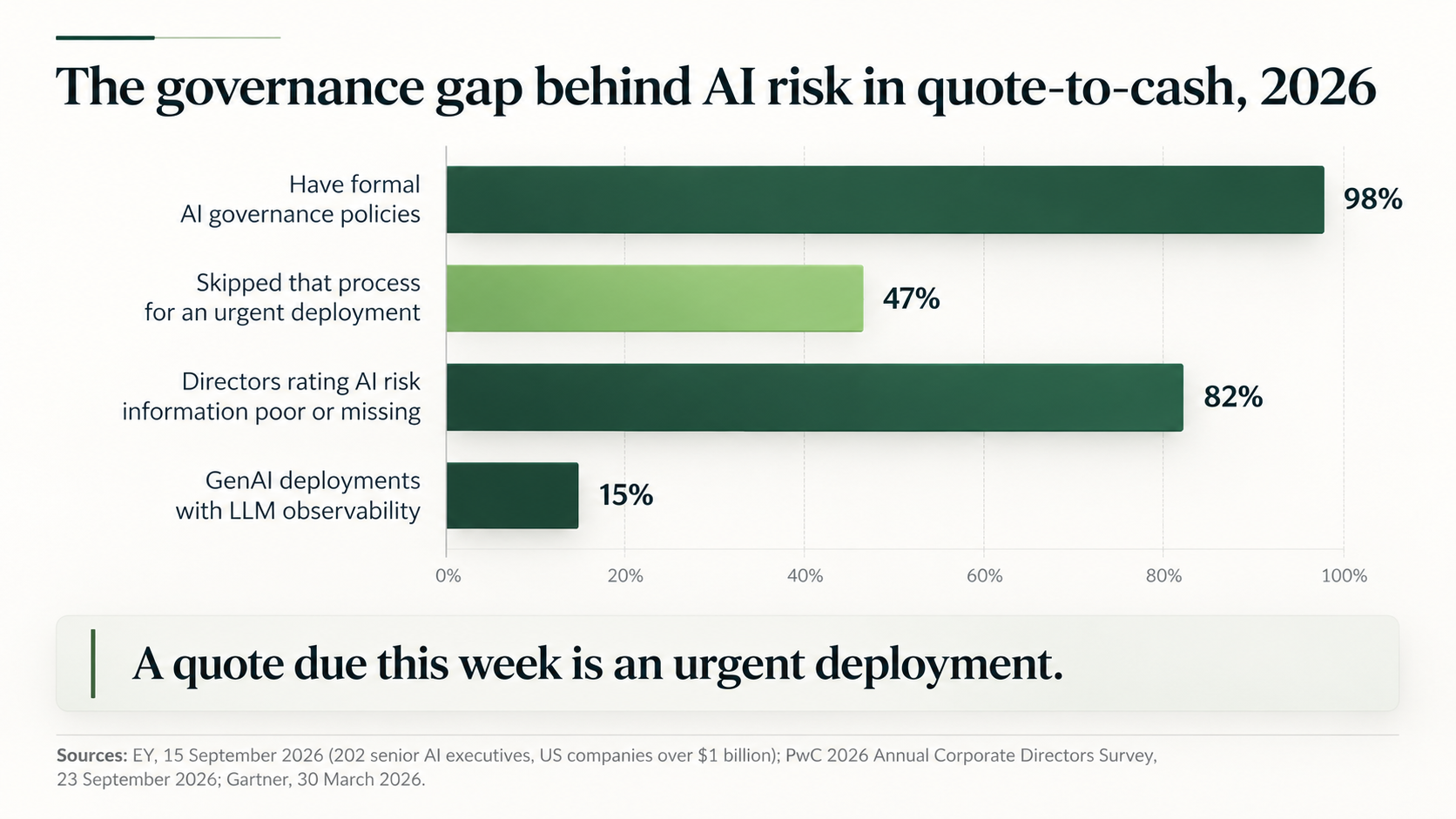
Read that bottom row twice. The reason the mathematics community can even argue about the forcing term is that OpenAI published the thing. Your vendor’s model will not publish anything. Gartner puts LLM observability in 15 percent of generative AI deployments (Gartner, 30 March 2026). When a price comes back 4 percent light, the reasoning that produced it is not slow to audit. It is absent.
And the two conditions that let OpenAI absorb the uncertainty, patience and the option to walk away from the prize, are exactly the two your business does not have.
And unlike Navier-Stokes, your problem will not hold still
Clay formally posed the Navier-Stokes problem in 2000, and it has not changed a comma since. That stability is what makes review possible at all. The reviewers know which question they are checking the answer against, and it is the same question it was in 2000.
Nothing in your commercial model offers that.
Why AI risk in quote-to-cash compounds when the catalogue moves
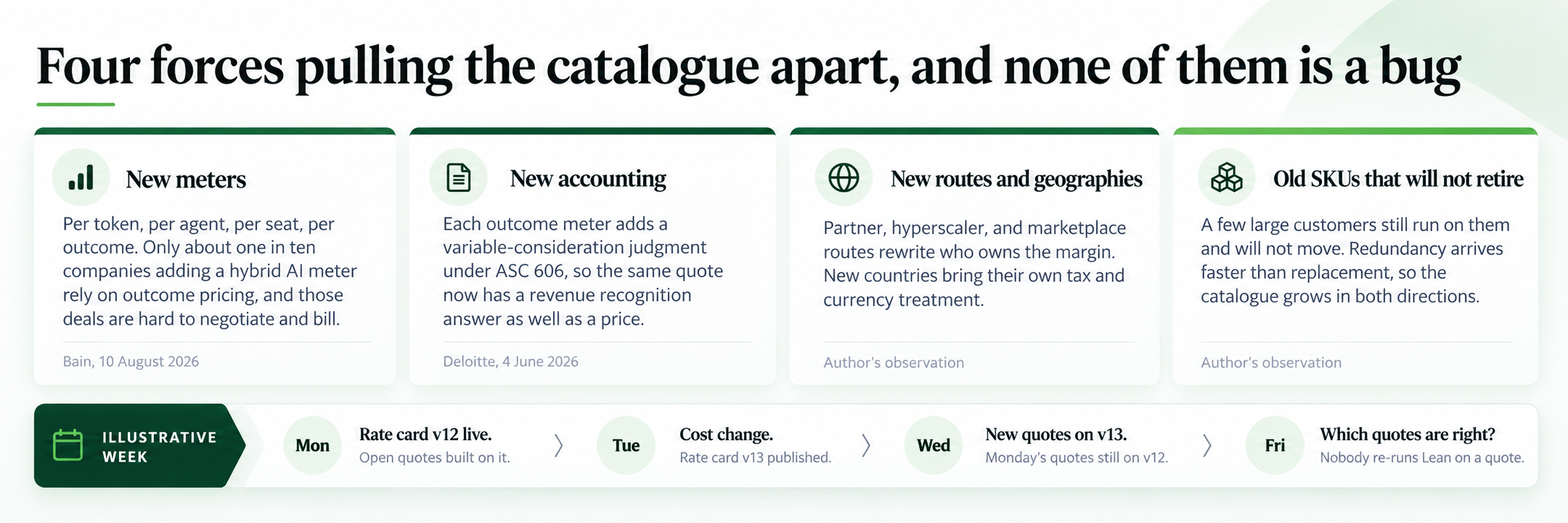
In the past two years, your suppliers, and probably you, have layered consumption and outcome meters on top of subscription and perpetual models that are still live. AI capability is now sold per token, per agent, per seat, and per outcome, occasionally all four inside one contract.
The new meters are hard to run. Bain finds only about one in ten companies adding a hybrid AI meter rely on outcome pricing, and calls those deals “complex and time-consuming to negotiate, and difficult to bill at scale” (Bain, 10 August 2026). Each outcome meter also adds a variable-consideration judgment under ASC 606 (Deloitte, 4 June 2026).
Then the map moves under the meters. New geographies arrive with their own tax treatment, currency exposure, and revenue recognition consequences. Partner, hyperscaler, and marketplace routes keep rewriting who owns the margin on a deal.
The catalogue is expanding and refusing to shrink at the same time
The opposite is happening too. Legacy SKUs that were due to retire years ago are more entrenched than ever, because a few large customers still run on them and will not move. Redundancy is arriving faster than replacement. The catalogue is expanding, fragmenting, and refusing to shrink, all at once. The quoting side of this is in Hybrid pricing pays. Until the deal changes.
Against what fixed reference does your AI check its answer?
A rate card that changed on Tuesday is a new statement. Every open quote built on Monday’s card now needs re-checking, and nobody re-runs Lean on a quote.
OpenAI had a fixed reference, and the world’s best reviewers are still only starting to form a view. Your commercial model does not stand still long enough to be one. So correctness, in your world, lives in the context that produced the answer, and nowhere else.
This is not an argument for slowing down
The wrong conclusion to draw from all of this is caution. A board that reads the Navier-Stokes story and decides to wait for the dust to settle will lose, and will lose to a competitor who found a way to move without waiting.
The other half of the story is real too. A problem the Clay Institute posed 26 years ago moved in 88 hours. That compression does not stay in mathematics.
What the upside looks like in quote-to-cash
The equivalent prize is sitting there now, and it is why AI risk in quote-to-cash is worth managing rather than avoiding:
- Turnaround on complex bids measured in hours instead of weeks. Our own published proof is a day to 15 minutes on complex proposal changes (Dell EMC case study).
- Coverage of the long-tail configurations your team currently declines to quote.
- Margin modelling on deals nobody had the capacity to model.
- Catalogue and cost changes propagated across every open opportunity in an afternoon.
- A first draft of a quote that is already most of the way right.
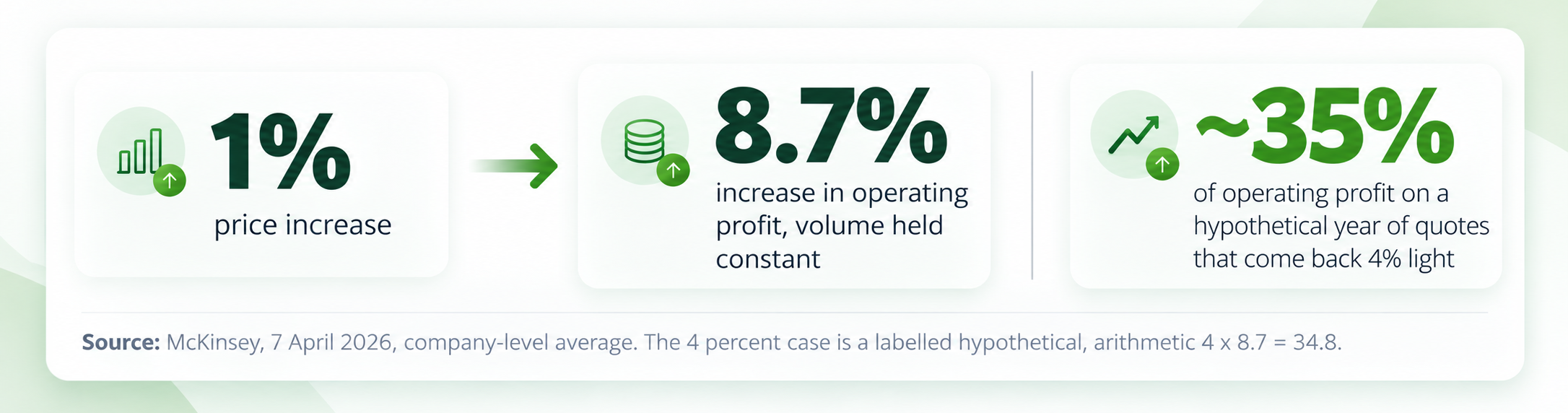
McKinsey puts the stakes in one ratio: a 1 percent price increase translates into an 8.7 percent increase in operating profit, volume held constant (McKinsey, 7 April 2026).
The same firm reports a B2B services company taking a 10 percent uplift in earnings from AI pricing (McKinsey, 16 July 2026). Run the ratio backwards on a hypothetical: prices that come back 4 percent light across a year of quotes, and roughly a third of operating profit is gone before anyone notices.
Two ways for a board to get AI risk in quote-to-cash wrong
Say no, and you trade a measurable upside for a feeling of safety, while your competitors compound.
Say yes without governance, and you have taken a real upside in exchange for an unbounded and invisible downside. That is the worse trade of the two, because you will not see it land. Margin leakage does not announce itself. It shows up quarters later in a gross margin line nobody can explain.
The work is separating reward from risk, so the business can take the first without absorbing the second.
What confidence actually requires
What made the OpenAI claim worth arguing about, rather than dismissing, was Lean. A deterministic checker turned an impressive assertion into something the world could examine. Without that step the announcement would have been a press release.
Four requirements for managing AI risk in quote-to-cash
Enterprise quoting needs the same architecture, and it needs four things at once.
1. Determinism where the number is formed
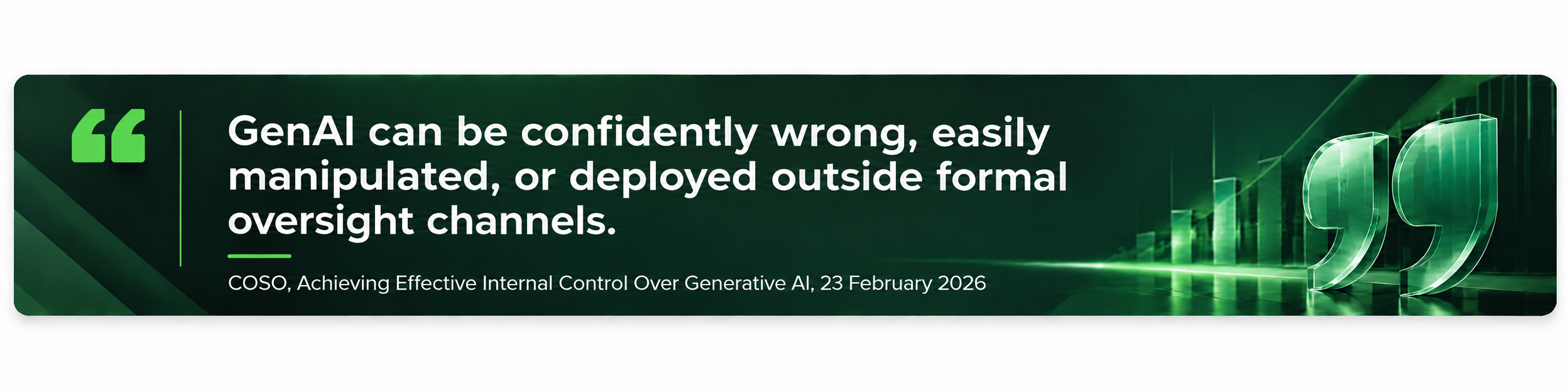
AI can propose, interpret intent, draft, and suggest. The engine must compute. Same inputs, same output, every time, reproducible without appeal to a model’s mood. COSO, whose framework underpins most SOX programmes, put the reason plainly in February: “GenAI can be confidently wrong, easily manipulated, or deployed outside formal oversight channels” (COSO, 23 February 2026). If your price is generated rather than calculated, you have no floor to stand on.
2. Context that belongs to the enterprise
A general model reasons from the average of the internet. Your margin floors, contracted rate cards, ramp schedules, approval thresholds, and the reason a specific discount was granted in 2024 are not on the internet. They are yours, and they are the entire difference between a plausible quote and a correct one. AI depreciates, context appreciates. The model you license today is a commodity within 18 months. Gartner expects the cost of running a trillion-parameter model to fall by more than 90 percent between 2025 and 2030 (Gartner, 25 March 2026). The context you accumulate compounds for as long as you run the business.
3. Auditability at the line level
Not a log confirming the AI ran. A record of which rule, which rate, which approval, and which version of the catalogue produced this number, readable by a finance person in minutes. OpenAI published its reasoning, and the community is holding it to that. Most generative AI cannot produce its reasoning at all, and the Gartner figure above puts the tooling that can in 15 percent of deployments.
4. Governance that binds before the fact
Guardrails that make a non-compliant quote impossible to issue beat controls that detect one afterwards. EY found 47 percent of large US companies had skipped their own AI governance process for urgent deployments, despite 98 percent having formal policies (EY, 15 September 2026). An AI that cannot breach a margin floor is worth more than an AI that reports it breached one.
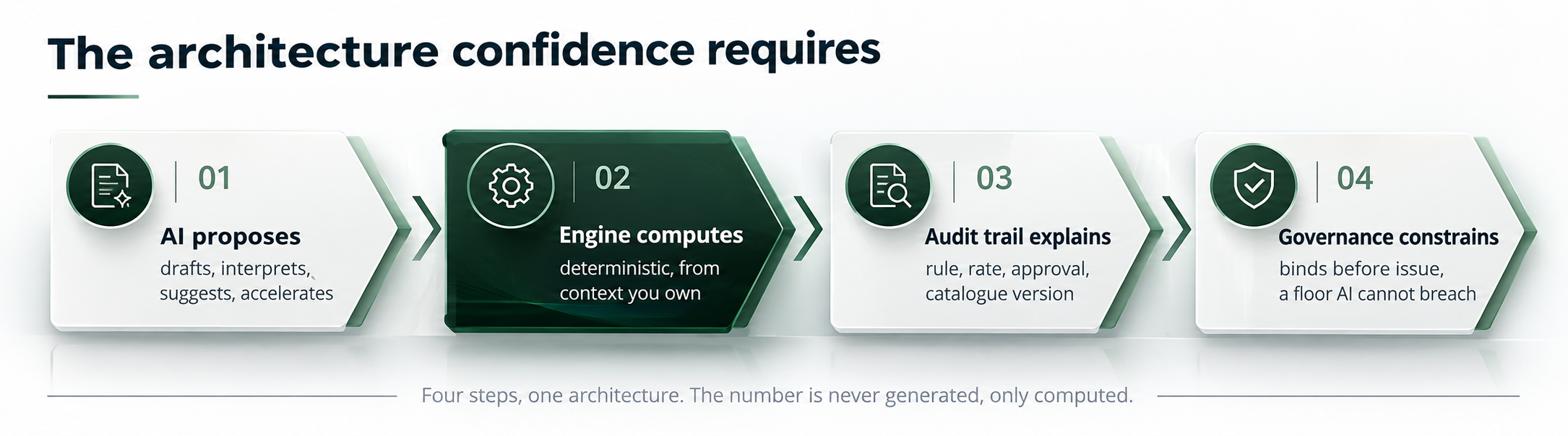
AI proposes, a deterministic engine computes, the audit trail explains, and governance constrains. Remove any one of the four and you are back to trusting an answer you cannot examine. The operating tests behind each are in Deterministic AI governance and Your deal desk or your AI agents.
Slow is smooth, smooth is fast, and slow just got a lot faster
The phrase comes out of military and surgical training. Deliberate execution beats rushed execution, because rework always costs more than care did.
Boards have usually heard that as a tax. Governance is the brake. Here is what being careful will cost you in cycle time, and here is the revenue you are choosing to defer in exchange for sleeping at night.
That trade has quietly changed, and I do not think most executive teams have repriced it.
Why governance became the faster path on quote-to-cash AI risk
The expensive part of the disciplined path was never the discipline. It was the labour. Codifying pricing rules used to be a multi-year programme. Modelling the margin impact of a catalogue change took a quarter of analyst time. Building the audit trail was a project of its own.
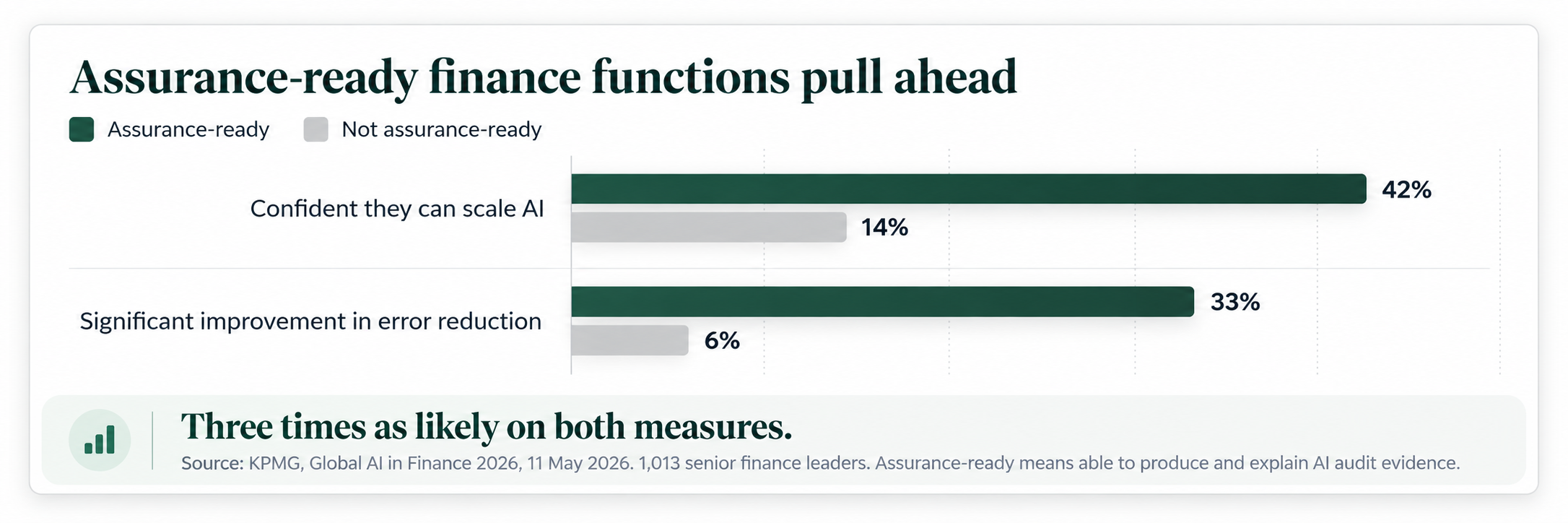
AI has compressed exactly that work, the cost of doing it properly, while doing nothing at all to reduce the risk of skipping it. KPMG finds finance functions able to produce and explain AI audit evidence report three to six times higher rates of improvement in error reduction (KPMG, 11 May 2026).
So slow is not just smoother now. Slow is faster in absolute terms. The governed path has become the quicker path that also happens to be defensible, and the organisations still treating governance as the brake are pricing it at what it cost in 2019.
That is the repricing your board should be doing this quarter.
The board checklist: 10 questions
Ask these of your own team first. Then ask every vendor on your shortlist the same 10, in the same order, and watch which ones get vague. Each one tests a different piece of AI risk in quote-to-cash.

The first test of AI risk in quote-to-cash: questions one to four
1. Which numbers in a quote are calculated, and which are generated? You are looking for a clear line between what a deterministic engine computes and what a model suggests. A vendor who answers “our AI handles pricing end to end” has just told you there is no line.
2. Can we reproduce any quote issued in the last 12 months exactly, including the catalogue, rates, rules, and approvals in force that day? Point-in-time reproducibility, not “we keep logs.” Logs record that something happened. Reproducibility proves what it was. See Your Q4 quotes are next year’s audit file.
3. When a quote is wrong, how long does it take a finance person, not an engineer, to find out why? The honest answer is a number. Minutes is a system. Weeks is the Navier-Stokes problem, and you do not have two years.
4. What can the AI not do? Name the hard constraints it cannot breach regardless of how it is prompted. If that list is empty or vague, your guardrails are advisory, which means they are not guardrails.
Where quote-to-cash AI risk hides: questions five to eight
5. Where does the system get its understanding of our business, and who owns that if we change vendor or model? Context is the asset. If it lives inside someone else’s model weights, you are renting your own operating knowledge.
6. When cost, catalogue, or contract terms change tomorrow, how long until every open quote reflects it, and how do we prove that it did? This is where most margin actually leaks, quietly, between the change and the propagation.
7. What is our exposure if the AI is confidently wrong for an entire quarter before anyone notices? Put a number on it. Then name the mechanism that would have caught it in week one.
8. Would this survive an audit under ASC 606 and IFRS 15, and our own Sarbanes-Oxley controls, without a manual reconciliation? Ask who has tested that rather than who has asserted it. UK boards have the same question under Provision 29 of the 2024 Corporate Governance Code (FRC).
Data and who signs: the last two questions on AI risk in quote-to-cash
9. Was any part of this trained on, or is any of our data shared with, systems we do not control? This is the contamination question the mathematics community is asking OpenAI right now. It is a fair question to ask a vendor about your price book (HBR, 8 September 2026).
10. Who signs? Name the individual accountable for a price the AI issued. If the answer is “the system,” you do not have deal governance. You have distributed the responsibility until nobody holds it. The World Economic Forum’s board playbook: “You can outsource execution to a synthetic system, but not fiduciary duty” (WEF, 28 April 2026).
Questions one through seven you can start answering internally this month. Questions four, five, and 10 are the ones that separate vendors fastest.
One practical test for the shortlist: ask for questions two and three to be demonstrated live, on your data, not on a reference deck. A vendor who cannot reproduce a historical quote and explain a wrong number in front of you is offering you OpenAI’s position without OpenAI’s transparency.

Where servicePath™ stands on its own checklist
A disclosure before this section: I lead servicePath™, so what follows is a vendor answering its own checklist. Hold us to the same standard you hold everyone else.
We built servicePath™ on a deterministic configuration and pricing engine and kept it that way while the market went the other direction. Generative AI in our platform proposes, drafts, and accelerates.
It does not compute the number. Every quote is reproducible as issued, with the catalogue version, rate card, rules, and approvals live that day. Governance binds before a quote can be issued. That is deterministic revenue architecture, and why servicePath™ has grown beyond Configure, Price, Quote (CPQ) into a revenue lifecycle management platform, the commercial control plane for the deal.
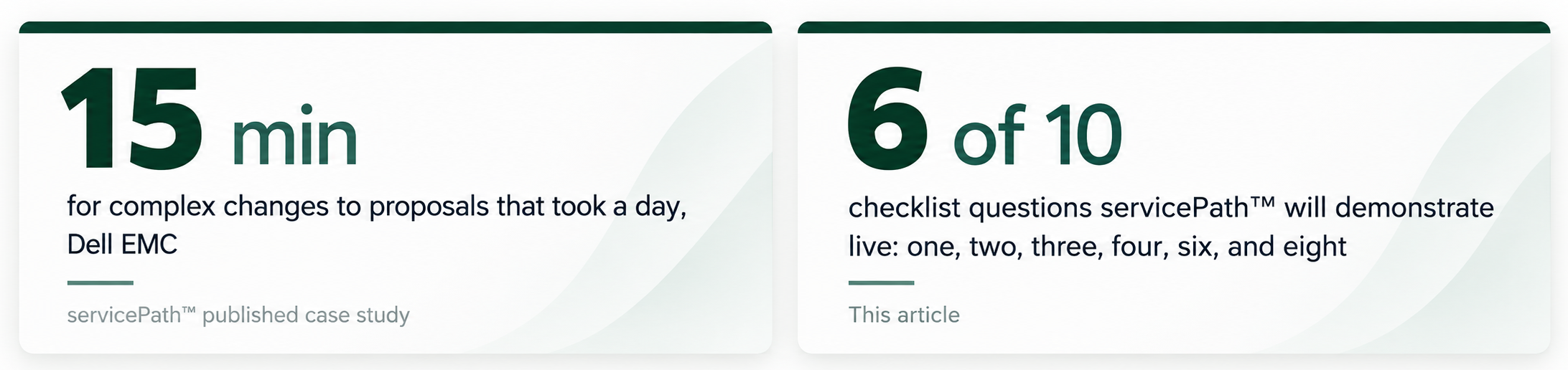
The published proof is Dell EMC. In our case study, complex changes to proposals take as little as 15 minutes against a day, and many partners now generate their own proposals. The speed the board wants, produced by the constraints the board needs.
We can demonstrate questions one, two, three, four, six, and eight live on your data. Five, seven, nine, and 10 are yours whoever you buy from. Any vendor who claims to answer 10 for you is selling a comfort you cannot bank.
Quick answers
What did OpenAI’s AI prove about Navier-Stokes?
That a smooth fluid under a smooth external force can develop a singularity in finite time, which OpenAI says resolves statement C of the Clay formulation. But Clay has not accepted it.
Why does a machine-checked proof still need human review?
Lean confirms every step follows from the last. It does not confirm the statement is the question the field meant, or where the ideas came from.
What does this have to do with AI risk in quote-to-cash?
A quote has the same three exposures with less time and no proof assistant. AI risk in quote-to-cash is the same verification gap, plus a contract, so boards should require a deterministic engine, owned context, line-level reproducibility, and governance that binds before issue.
Does governance slow AI adoption, or reduce quote-to-cash AI risk?
The 2026 evidence on AI risk in quote-to-cash points the other way. KPMG finds finance functions that can explain their AI audit evidence are three times as likely to be confident they can scale AI (KPMG, 11 May 2026).
The close
OpenAI had arguably the strongest applied AI team, a problem unchanged since 2000, a machine-checked proof, and a prize it had said it would not claim.
It is still not accepted.
Eighty-eight hours to solve. Two years to trust. Your quotes get a week.
One mandate for the board: the line between calculated and generated numbers, visible to a finance person in minutes.
Slow is smooth. Smooth is fast. And slow got a great deal faster this year.
Ask question one of your own team first, then every vendor on the shortlist.
Next steps
Talk to a CPQ architect and ask us questions two and three. Start with Every CPQ vendor has AI now and A strong CPQ foundation matters more than the next hundred tools.
Glossary: deterministic pricing, quote-to-cash, deal governance, margin leakage, agentic CPQ, shadow pricing.