
Annual Recurring Revenue (ARR)
Synonyms
- Recurring Annual Revenue
- Subscription Revenue
- Annualized Recurring Revenue
- SaaS Revenue Model
- Predictable Revenue Stream
What is Annual Recurring Revenue (ARR)?
Why ARR Matters in SaaS & Subscription Models
- Revenue Growth & Stability – Helps assess long-term revenue predictability.
- Customer Retention & Expansion – Tracks renewals, upsells, and expansions.
- Business Valuation & Investor Appeal – Essential for securing funding and mergers/acquisitions.
- Revenue Forecasting & Financial Health – Supports long-term strategic decision-making.
Maximize Your ARR with servicePath™ CPQ+
How to Calculate ARR
To calculate ARR accurately, use the following formula:
ARR = (Total Subscription Revenue + Recurring Revenue from Contracts) – (Revenue Lost from Churn & Downgrades)
Breakdown:
- Total Subscription Revenue: Annualized revenue from active customers.
- Recurring Revenue from Contracts: Multi-year contracts divided into yearly values.
- Churn & Downgrades: Revenue lost from cancellations or customer downgrades.
For example, if a SaaS company has $1.5 million in subscription revenue, gains $500,000 from contract renewals, and loses $200,000 due to churn, its ARR would be $1.8 million.
Key Benefits of ARR
- Revenue Predictability – Ensures stable, forecastable income streams.
- Performance Benchmarking – Evaluates growth and retention strategies.
- Investor & Stakeholder Confidence – Critical metric for business valuation.
- Subscription Growth Optimization – Identifies expansion and retention opportunities.
- Scalability & Market Positioning – Measures company health in competitive landscapes.
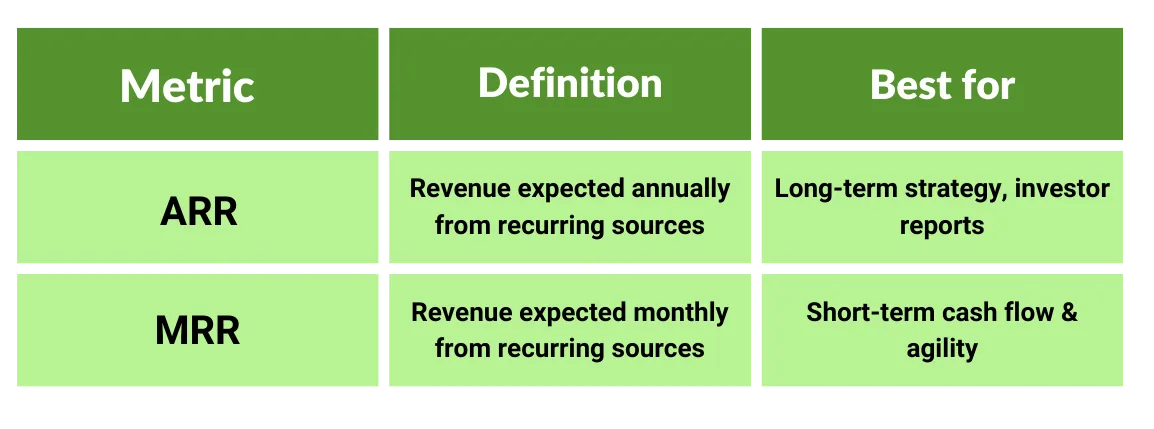
ARR vs. MRR (Monthly Recurring Revenue)
How AI & Machine Learning Enhance ARR Analysis
- Predicting Churn & Retention Trends – Machine learning algorithms analyze customer behavior.
- Optimizing Pricing Strategies – AI identifies the best pricing models for revenue growth.
- Enhancing Customer Segmentation – Understands ARR impact across different customer tiers.
- Automating Subscription Management – Smart billing and renewal tracking minimize churn.
When to Use ARR
- SaaS & Subscription Models – Essential for tracking revenue from B2B SaaS, streaming services, and cloud-based platforms.
- Enterprise Software & IT Services – Forecasts revenue from long-term licensing and managed services.
- Financial Planning & Valuation – Investors and CFOs use ARR to assess company health and scalability.
How to Increase ARR
- Enhance Customer Retention & Reduce Churn – Implement proactive support, loyalty programs, and customer success initiatives to keep subscribers engaged.
- Optimize Subscription Pricing & Packaging – Use AI-driven analytics to refine pricing models and introduce value-based pricing tiers.
- Upsell & Cross-Sell to Existing Customers – Leverage customer data to offer relevant upgrades and complementary services.
- Automate Renewal & Expansion Workflows – Streamline contract renewals and expansion processes to prevent revenue leakage.
- Leverage AI for Predictive Revenue Insights – Use machine learning to identify at-risk customers and optimize revenue growth opportunities.
- Expand into New Markets & Vertical Segments – Tailor offerings to untapped customer segments to drive new recurring revenue streams.
Use Cases for ARR
- Investor & Board Reporting – ARR is a core KPI for securing funding, IPOs, and M&A deals.
- Strategic Pricing Adjustments – Helps adjust pricing tiers based on customer retention and lifetime value.
- Customer Upsell & Cross-Sell Planning – Identifies opportunities for expansion revenue growth.
- Churn Reduction Initiatives – Measures retention strategies’ effectiveness in improving ARR.
How servicePath™ Helps Optimize ARR Management
servicePath™ CPQ+ enhances ARR tracking, forecasting, and growth by:
- Automating Subscription & Contract Pricing – Eliminates manual errors in ARR calculations.
- Optimizing Revenue Forecasting – AI-driven insights for better financial planning.
- Reducing Churn with Predictive Analytics – Proactively manages at-risk accounts.
- Enhancing Renewal & Expansion Management – Streamlines contract renewals and upsells.
- Ensuring ASC 606 & IFRS 15 Compliance – Aligns revenue recognition with global standards.
Related Terms
- Monthly Recurring Revenue (MRR)
- Customer Lifetime Value (CLV)
- Revenue Churn
- Net Revenue Retention (NRR)
- Deferred Revenue
- Subscription Management
Frequently Asked Questions (FAQs)
1. How is ARR different from total revenue?
ARR only includes recurring revenue from subscriptions and contracts, whereas total revenue includes one-time sales and non-recurring income.
2. Can ARR fluctuate month to month?
While ARR is an annual metric, monthly fluctuations in churn, upsells, and new contracts can impact its growth trajectory.
3. Why is ARR important for SaaS companies?
ARR is a crucial valuation metric, helping SaaS businesses secure funding and optimize growth strategies.
4. How does ARR impact business valuation?
Investors use ARR to assess a company’s recurring revenue potential, influencing funding rounds and acquisition deals.
5. What factors affect ARR growth?
Key factors include customer acquisition, expansion revenue, churn reduction, and pricing strategies.
Future-Proof Your Revenue Strategy with ARR
Understanding and optimizing Annual Recurring Revenue (ARR) is critical for business success. servicePath™ CPQ+ provides AI-driven insights, automated revenue tracking, and predictive analytics to maximize ARR and business growth.
Contact us today.