

A 2026 CFO guide to pricing, margin, and AI quotes: where commercial authority should live, and how to prove the rule applied to a deal was the rule Finance intended.
Executive summary
A commercial control plane is the governed layer where an enterprise defines and enforces how it sells. Specifically, it holds configuration, pricing, discount authority, approval policy, margin rules, and the evidence behind each decision, and it can serve multiple CRMs, portals, partner channels, and AI-enabled workflows.
Let me be precise. Control plane is established engineering vocabulary; commercial control plane applies it to revenue decisioning. It is not yet a settled analyst category, and not automatically the right design for every company. In practice, it becomes relevant when commercial logic is fragmented across systems, when acquisitions create more than one CRM, when margin policy must be enforced consistently, or when software begins generating quotes faster than people can review them. Moreover, two developments make the question urgent in 2026: the rise of AI agents in B2B buying, and the architectural decision now facing Salesforce CPQ customers. Both are examined below.
This guide contains three working instruments you can use without talking to any vendor: an eight-measure quarterly baseline, a seven-point governance diagnostic, and a five-question trace to run on one complex deal.
The enterprise already has a commercial control plane
Most enterprises already have one. It is made of people: the sales director who knows which discounts are really allowed, the finance manager who approves exceptions by email, the spreadsheet everyone trusts more than the system, the RevOps analyst who reconciles it all before quarter end.
For years, that informal control plane may have kept the business running. However, the problem is that it runs at human speed, depends on institutional memory, and becomes harder to audit with every added product, entity, channel, acquisition, pricing model, or AI.
By the end of this guide you will have a name for that arrangement, and a five-question test for whether your systems have outgrown it.
What is a commercial control plane?
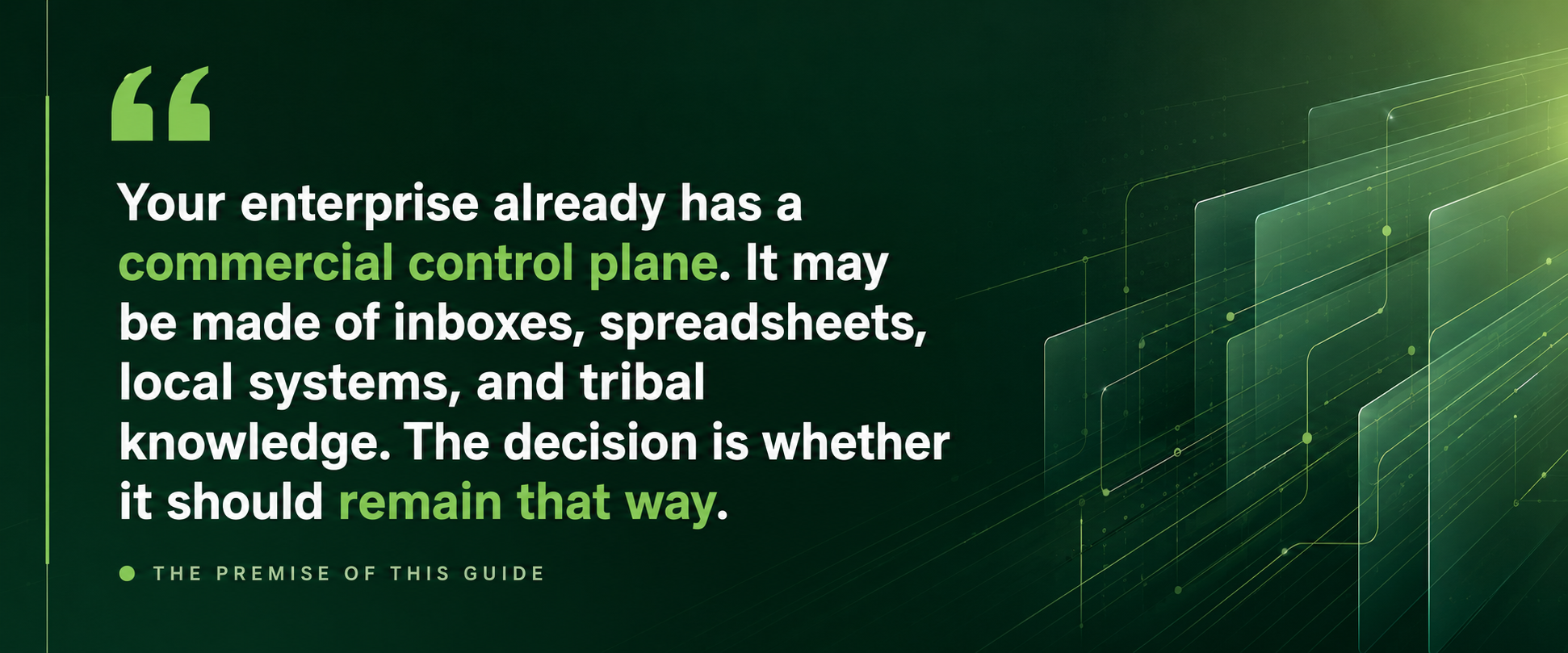
A commercial control plane is the governed layer where an enterprise defines and enforces how it sells. Specifically, it governs:
- What can be sold and in which combinations
- Which price, rate, or commercial model applies
- Who can approve a discount or exception
- Which margin and cost thresholds must be protected
- What evidence must be recorded for each decision
- How those rules are exposed to CRMs, portals, partner channels, finance systems, and AI-enabled workflows
The phrase, notably, borrows from network architecture. In networking, as IBM explains, the control plane decides how traffic should move while the data plane executes that decision; Cloudflare describes it as the signals that set the route versus the traffic that follows it.
Applied to commerce, therefore: the commercial control plane sets policy, and sellers, channels, systems, and agents execute within it.
This is an architectural model, not a claim that every business needs another product. A suite-native CPQ can perform the role; so can an independent platform; in a smaller company, one properly governed CRM may be enough. Instead, the test is whether one authoritative, enforceable version of commercial policy exists wherever a quote can originate.
Why the architecture matters in 2026
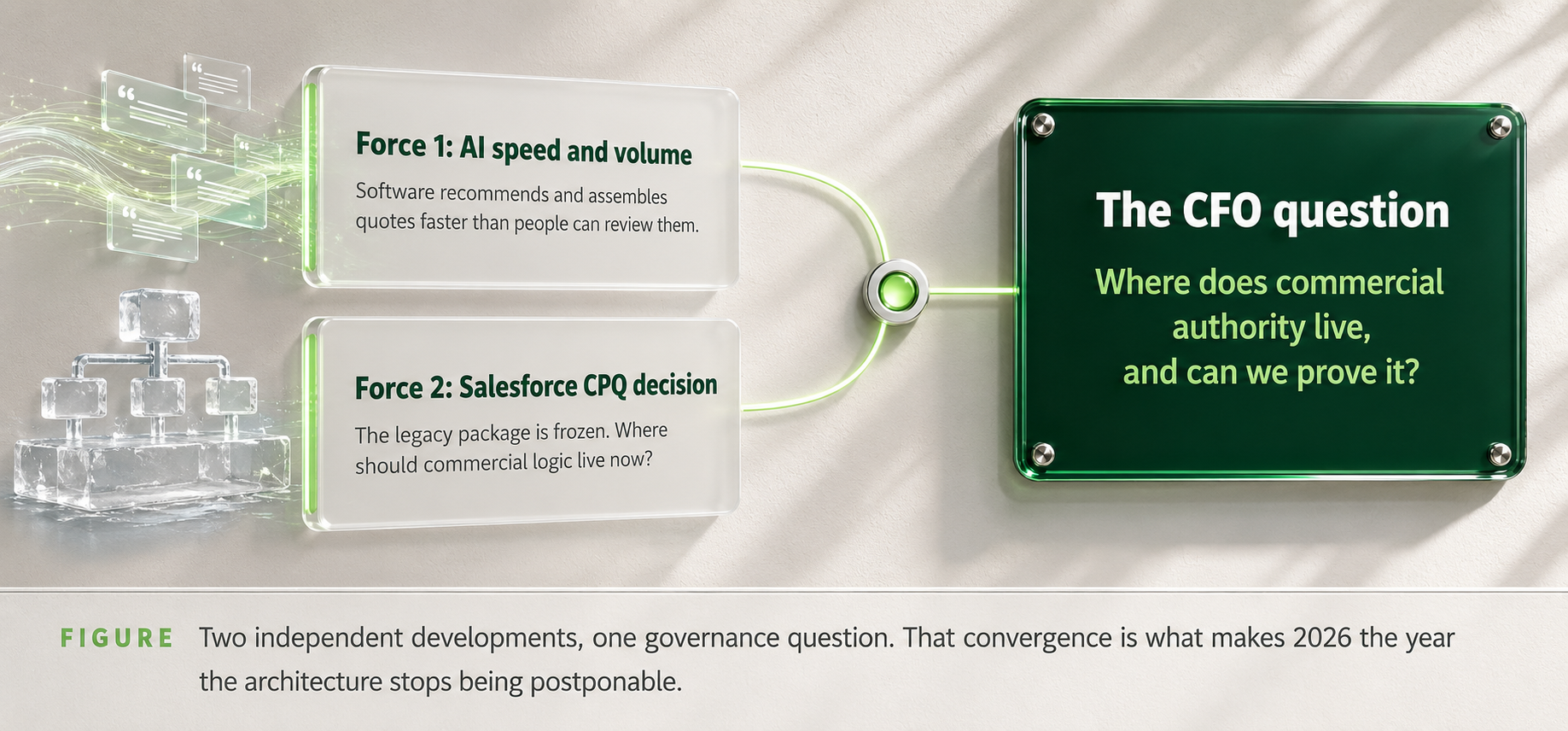
Force one: AI is increasing the speed and number of commercial decisions
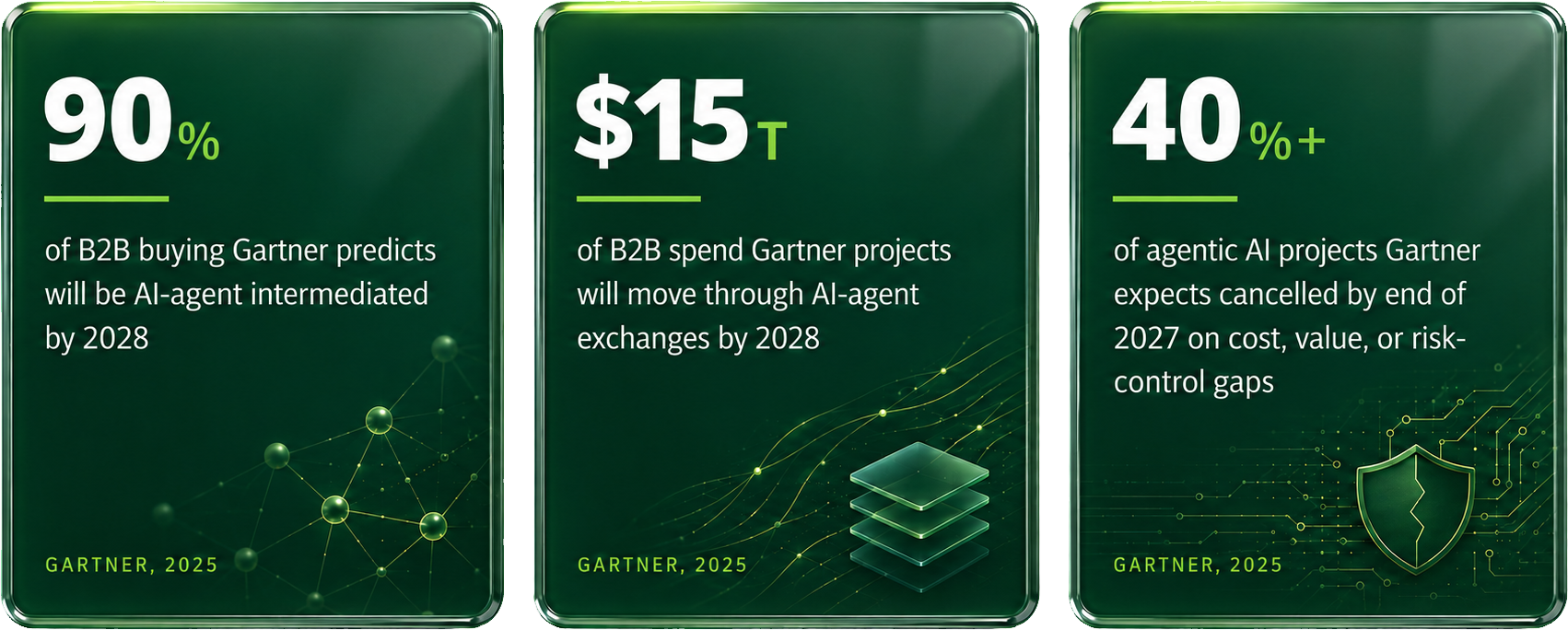
Gartner predicts that by 2028, AI agents will intermediate 90% of B2B buying, representing more than $15 trillion in spend, and that composable, API-first, cloud-native, headless products will establish a significant competitive moat.
That is a forecast, not proof that agent-to-agent commerce is already the norm. For example, current products can already let an agent assemble a quote; Salesforce has demonstrated Agentforce using revenue APIs to generate quotes within pricing and configuration rules. Broad autonomous negotiation remains emerging, not universal.
However, the governance problem arrives before full autonomy: software recommending a discount or assembling an offer needs a trusted source for the rules it may apply.
The warning matters as much as the opportunity: Gartner expects more than 40% of agentic AI projects to be cancelled by the end of 2027 on escalating costs, unclear value, or inadequate risk controls.
Adoption is outrunning cost control
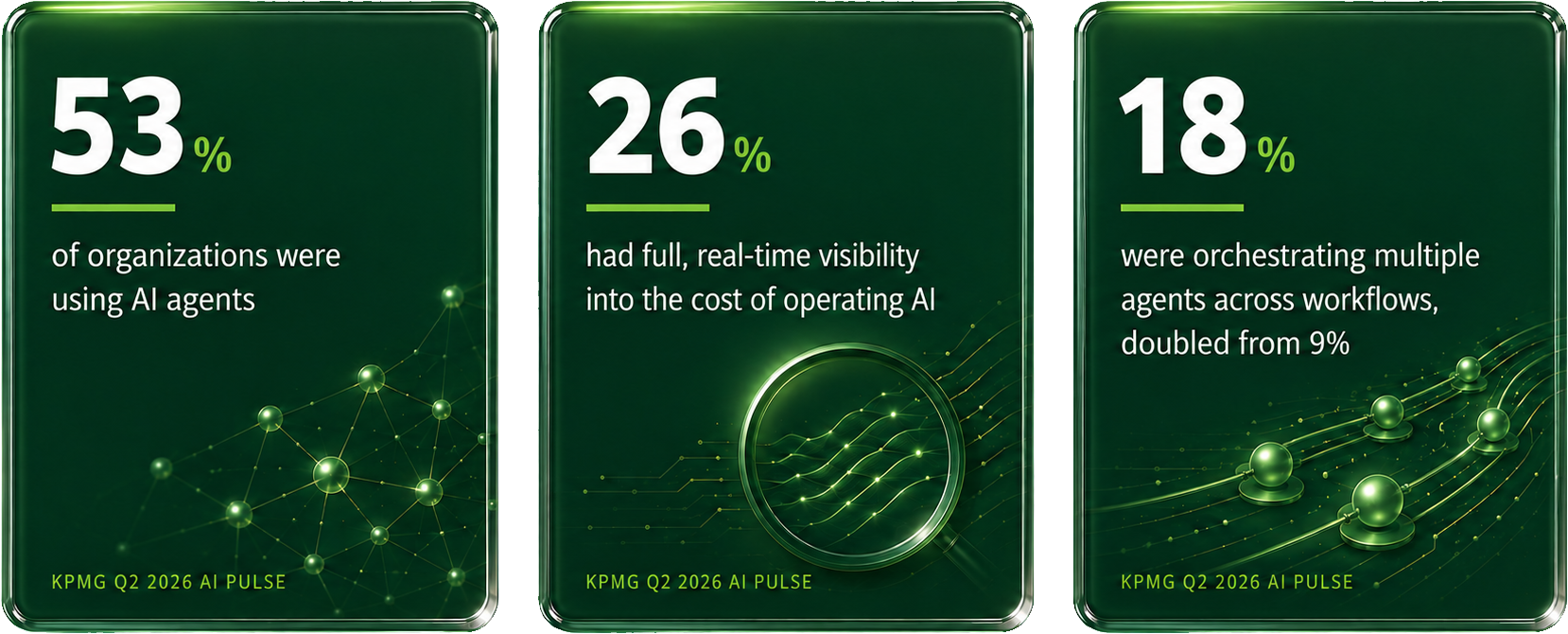
KPMG’s Q2 2026 AI Pulse makes the gap concrete: 53% of surveyed organizations were using AI agents, only 26% had full, real-time visibility into the cost of operating AI, and the share orchestrating multiple agents had doubled from 9% to 18%.

Force two: Salesforce CPQ customers face an architectural decision
Salesforce’s legacy CPQ managed package is no longer receiving new feature development; customers can renew, add licenses within their terms, and receive support, and Salesforce is directing them toward Agentforce Revenue Management, described as a complete, composable revenue platform built natively on Salesforce; its CPQ documentation states the current position.
End of Sale is not End of Life, and there is no justification for inventing a shutdown date. Instead, the strategic question is different: should commercial authority remain native to one suite, or serve several systems from an independent layer?
A Salesforce-centered enterprise may reasonably choose the native path; a multi-CRM group built through acquisition may value independence. The decision should follow operating reality, not vendor ideology. Our Salesforce CPQ End of Sale guide maps the timeline and the options in detail, and this analysis covers what the freeze means for RevOps.
Commercial control plane, CPQ, CRM, and platform CPQ
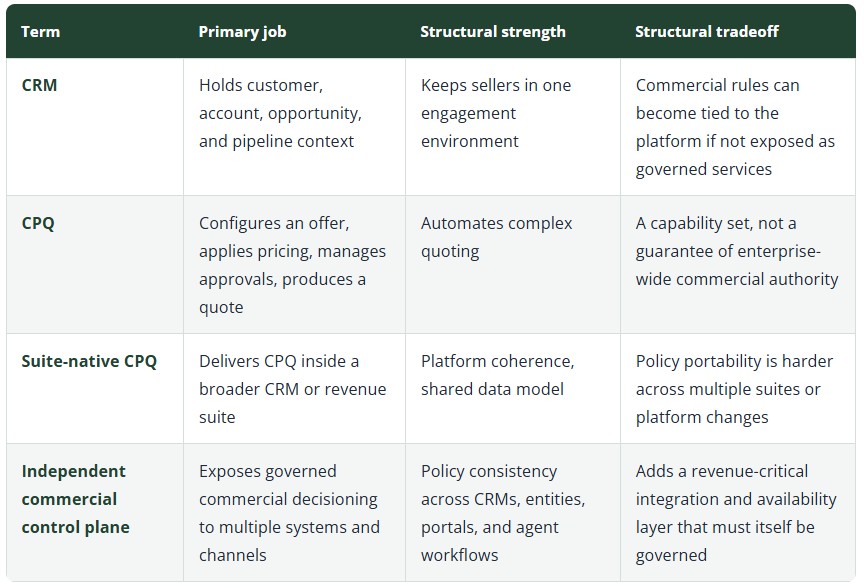
In short, the honest choice is not “open good, platform bad.” Suite coherence has value. Independence has value. Both create risk when ownership, data, integration, availability, and change control are weak.
What must a commercial control plane include?
Five capabilities define the minimum useful layer.
1. Configuration governance
Products, bundles, dependencies, exclusions, and substitutions versioned and enforced at quote time; an invalid solution should not become valid because it originated in a different CRM or channel. For technology-enabled services this extends to vendor dependencies, service levels, consumption assumptions, and cost-to-serve.
2. Pricing and discount authority
Price books, rate cards, discount thresholds, and exception policies with named owners, recording which rule version produced the price, who approved any departure, and whether the contract preserved the approved economics. Above all, the objective is not to eliminate commercial judgment. It is to distinguish judgment from improvisation.
3. Approval orchestration
Approvals triggered by economic and risk conditions: margin, discount depth, terms, size, mix, duration. However, a long approval chain is not proof of control; it can be evidence that nobody trusts the data enough to let the process move. The better question is not “How many people approved this?” but “Which approval materially changed the outcome?”
4. Margin and cost visibility
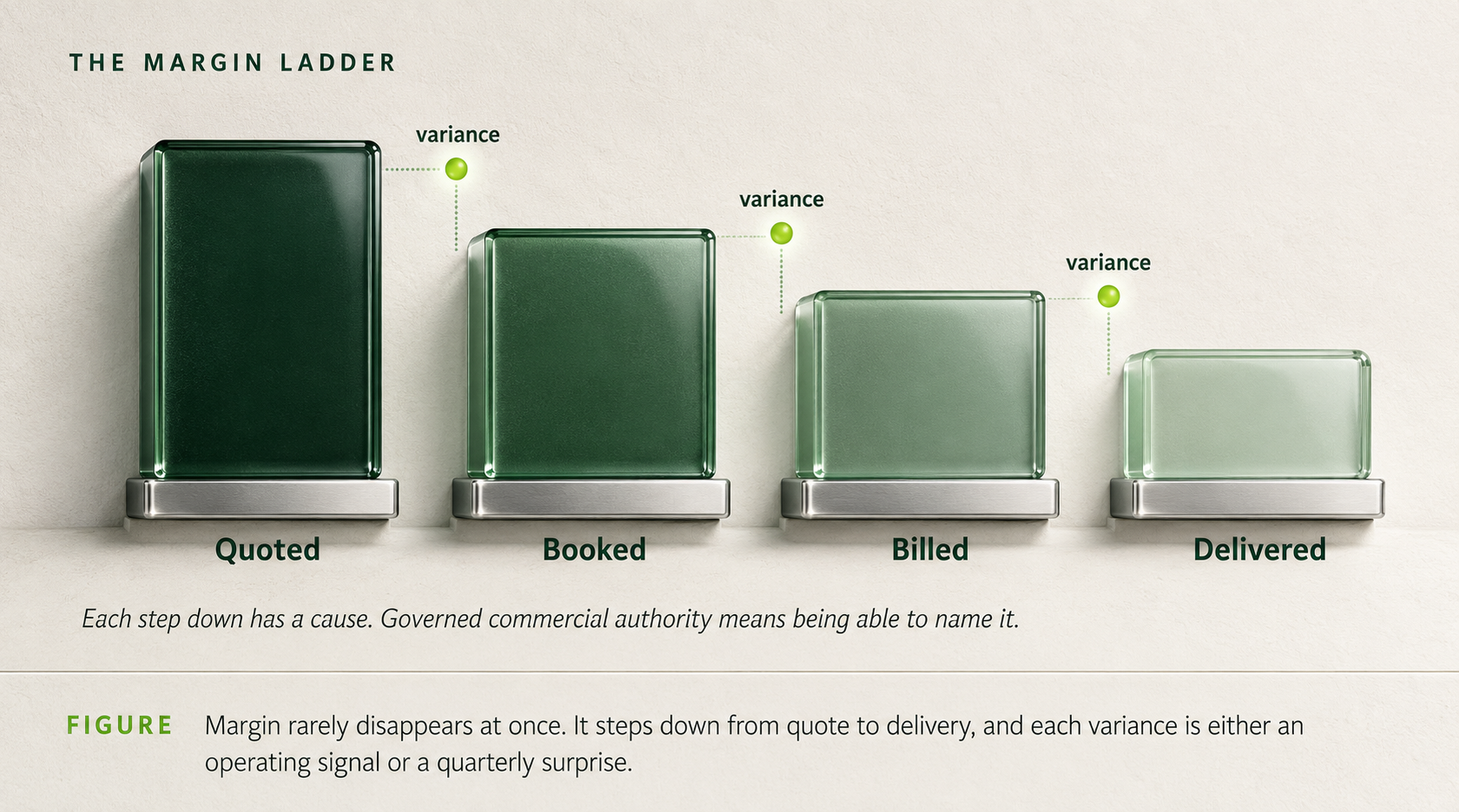
Compare quoted margin with booked, billed, and delivered margin; divergence needs a cause: an unauthorized discount, a vendor-cost change, scope creep, unbilled usage, a renewal at the wrong rate. Consequently, without that traceability, margin erosion becomes a quarterly surprise instead of an operating signal.
5. Connectivity and evidence
Rules available through secure, monitored integration points, with an audit trail for every material decision. Gartner describes CPQ as a key front-to-back-office integration point and advises a robust master-data strategy; centralizing poor data does not create commercial truth. The layer needs version control, release governance, monitoring, rollback, revenue-critical availability, and clear accountability for every rule and data source.
The CFO business case: measure the gap before buying anything
The weakest business cases begin with a generic revenue leakage percentage. Leakage is not one thing: discount leakage before signature, unbilled usage after it, uplifts that never reach renewals, billing disputes, vendor-cost erosion, and delayed cash all have different owners, evidence, and remedies. Combining them into one dramatic percentage may make a slide look better. It makes the investment case worse.
Meanwhile, there is credible evidence that commercial discipline matters. World Commerce & Contracting reports average contract-value erosion of 8.6% from weaknesses in commercial and contract management; that is contract-value erosion, not automatically lost revenue or recoverable cash, and it should be described accurately.
McKinsey analyzed three years of data from nearly 500 companies, mainly larger B2B subscription businesses, and found the higher-performing quote-to-cash cohort grew ARR at roughly four times the rate of the other, while cautioning that the study could not establish simple causation. Indeed, that caveat makes the finding more credible, not less.
Baseline one quarter before you shortlist
Therefore, before discussing vendors, ask Finance and Revenue Operations to baseline one complete quarter on these measures.
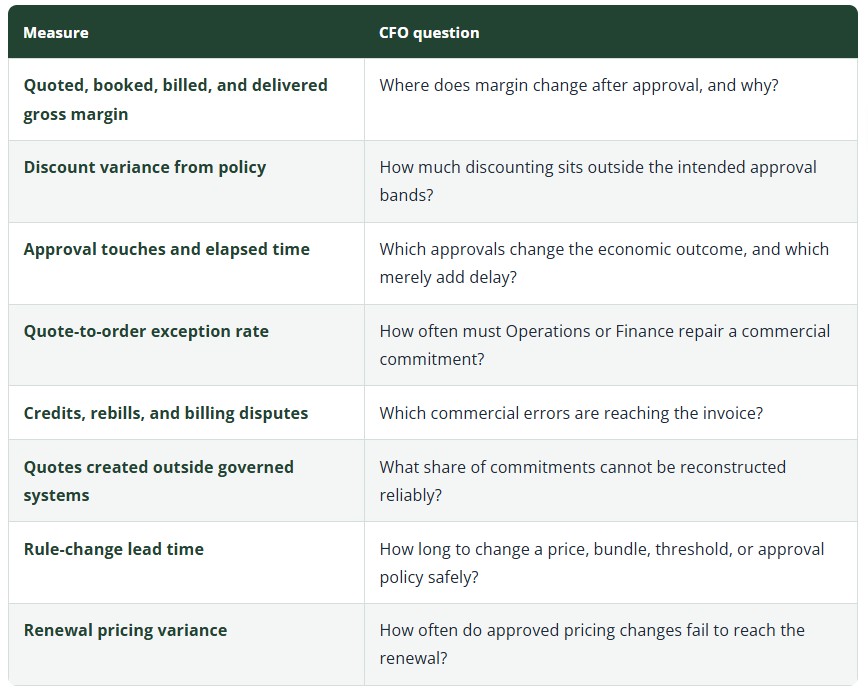
Finally, one trap deserves naming. Some of these measures, delivered margin by deal or renewal-pricing variance in particular, may be impossible to produce with current systems. However, that is not a reason to skip the exercise: if Finance cannot produce the numbers, the inability is itself the finding.
This scorecard does not prove a new platform is needed. It tells you whether the problem is economic, procedural, architectural, or simply bad data. When you do reach a shortlist, apply the same discipline to vendors, including us.
The finance and compliance boundary
Because pricing and approvals sit upstream of financial reporting, they matter to the control environment. But precision matters. ASC 606 and IFRS 15 establish principles for recognizing revenue from customer contracts; they do not require CPQ or a commercial control plane.
SOX Section 404 requires applicable public companies to assess internal control over financial reporting; it does not prescribe a quoting architecture. A governed layer can support the evidence behind those controls: pricing logic, approval history, rule versioning, quoted-to-contracted-to-billed traceability. That is a control benefit, not a claim of automatic compliance.
What CFOs are prioritizing in 2026
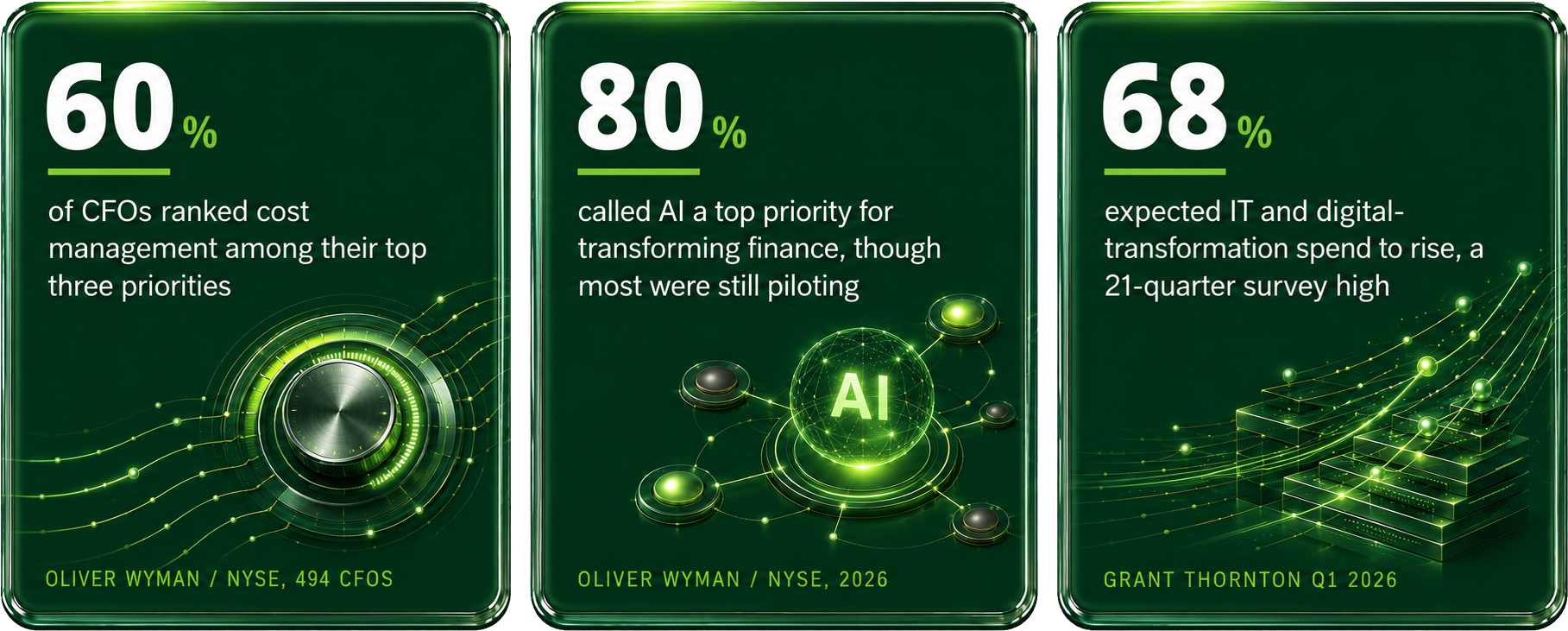
The finance agenda supports discipline, not a technology rush. The Oliver Wyman Forum and NYSE surveyed 494 CFOs behind roughly 12% of global market capitalization; Grant Thornton’s Q1 2026 survey found customer affordability shaping pricing strategy for 73% of finance leaders.
The mandate is not “buy more AI.” It is: fund transformation, protect margin, and demand evidence the investment can be governed.
AI needs commercial controls, not just AI controls
AI governance addresses model risk, data quality, privacy, and accountability. Commercial governance defines what may be sold, at what price, with which approvals, and which commitments require human judgment. They overlap; they are not the same.
NIST’s voluntary AI Risk Management Framework organizes AI risk into Govern, Map, Measure, and Manage and is technology-neutral, which is why it is useful here. For AI-enabled quoting, I translate it into four requirements.
Authority
Define what the agent may recommend, assemble, approve, or send. An agent allowed to suggest a configuration is not necessarily authorized to approve a discount or issue a binding commitment.
Boundaries
Enforce products, prices, discount floors, contract terms, and margin thresholds through deterministic rules. AI operates within the policy. It should not invent the policy while executing the transaction.
Evidence
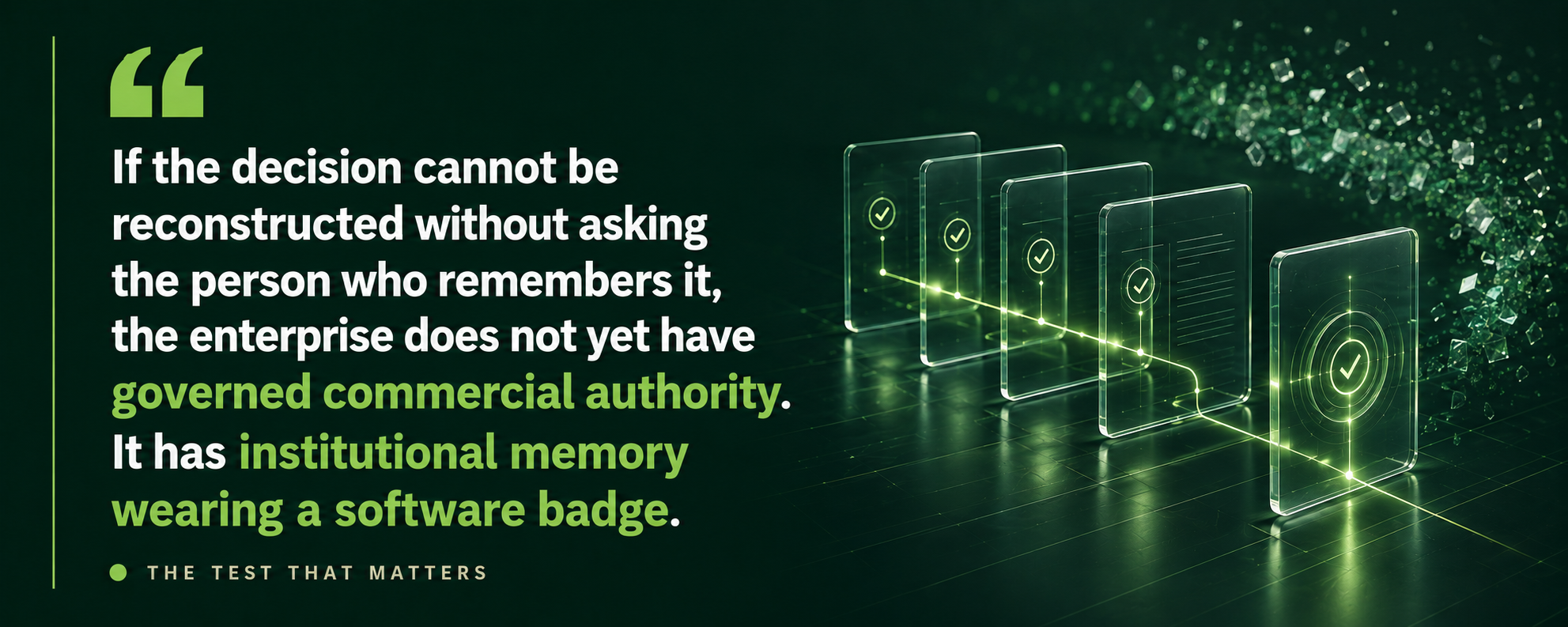
Record the input, rule version, output, approvals, overrides, and exception path. A decision that cannot be reconstructed cannot be governed.
Intervention
Give a named human owner the authority to stop, reverse, and investigate a decision. The point is not to slow the agent down. It is to make speed safe enough to use.
When an independent commercial control plane makes sense
The architecture deserves consideration when several of these are present: multiple CRM instances; acquisitions introducing new systems; complex products, vendors, or cost models; mixed subscription, usage, and one-time pricing; margin policy needed across business units; partners and portals consuming the same rules; AI workflows generating commercial actions; or a CPQ transition already forcing the question.
Specifically, multi-CRM reality is the strongest signal: one unit in Salesforce, another in Dynamics 365, another in HubSpot. The enterprise can force every acquisition through a CRM migration before commercial integration begins, or connect those systems to one governed layer of shared rules. That is where independence creates value.
When it is the wrong choice
An independent layer may be unnecessary with one stable CRM, a simple catalog, limited pricing variation, and no plan to expose commercial logic to other systems or AI workflows.
Equally, it is wrong if the organization will not fund the operating model. The layer fails when data has no accountable owner, business units can bypass rules without evidence, integrations are brittle, changes are not reversible, the layer becomes an availability bottleneck, or every exception becomes a permanent rule.

What the layer costs
A guide this insistent on disaggregating leakage should apply the same discipline to cost. The layer carries at least five cost categories: software subscription; implementation and data migration; integration build and ongoing maintenance; the operating cost of a revenue-critical service, including availability and release governance; and the internal operating model of named owners, testing, and change control.
I will not invent representative figures; they vary too much by complexity and data quality to be honest as one number. But every category belongs in the business case, and a vendor proposal showing only the first is not a business case. The baseline exists so cost is compared against a measured gap rather than a fear.
Who owns it, and the exit question
Ownership is shared, but accountability cannot be. Finance owns margin policy; Product or Commercial Operations owns catalog logic; Sales owns adoption; Technology owns architecture, availability, and integration. One named executive must have authority to resolve conflicts.
In addition, the dependency question deserves stating plainly, because this guide has warned about lock-in and an independent control plane is itself a serious dependency. Before committing to any vendor, including servicePath™, ask: if we leave in five years, do our rules, versions, approval history, and audit evidence export in usable form?
Is there source-code escrow or an equivalent continuity arrangement? What is the documented exit path? In contrast, a vendor that answers those questions in writing is offering an architecture. One that will not is offering a different lock-in with better slides.
The layer does not replace the CRM, nor ERP and billing; it ensures the approved price, scope, and structure reach those systems consistently.
It does not guarantee revenue-recognition compliance: it strengthens upstream evidence, while compliance depends on accounting policies, controls, and audit requirements.
And the biggest implementation risk is assuming centralization fixes ownership and data quality. It does not. Instead, it only puts the problem in one place.
A practical commercial-control-plane diagnostic
A working diagnostic, not an industry benchmark. Score two points for “yes, across all relevant systems,” one for “partly,” zero for “no.”
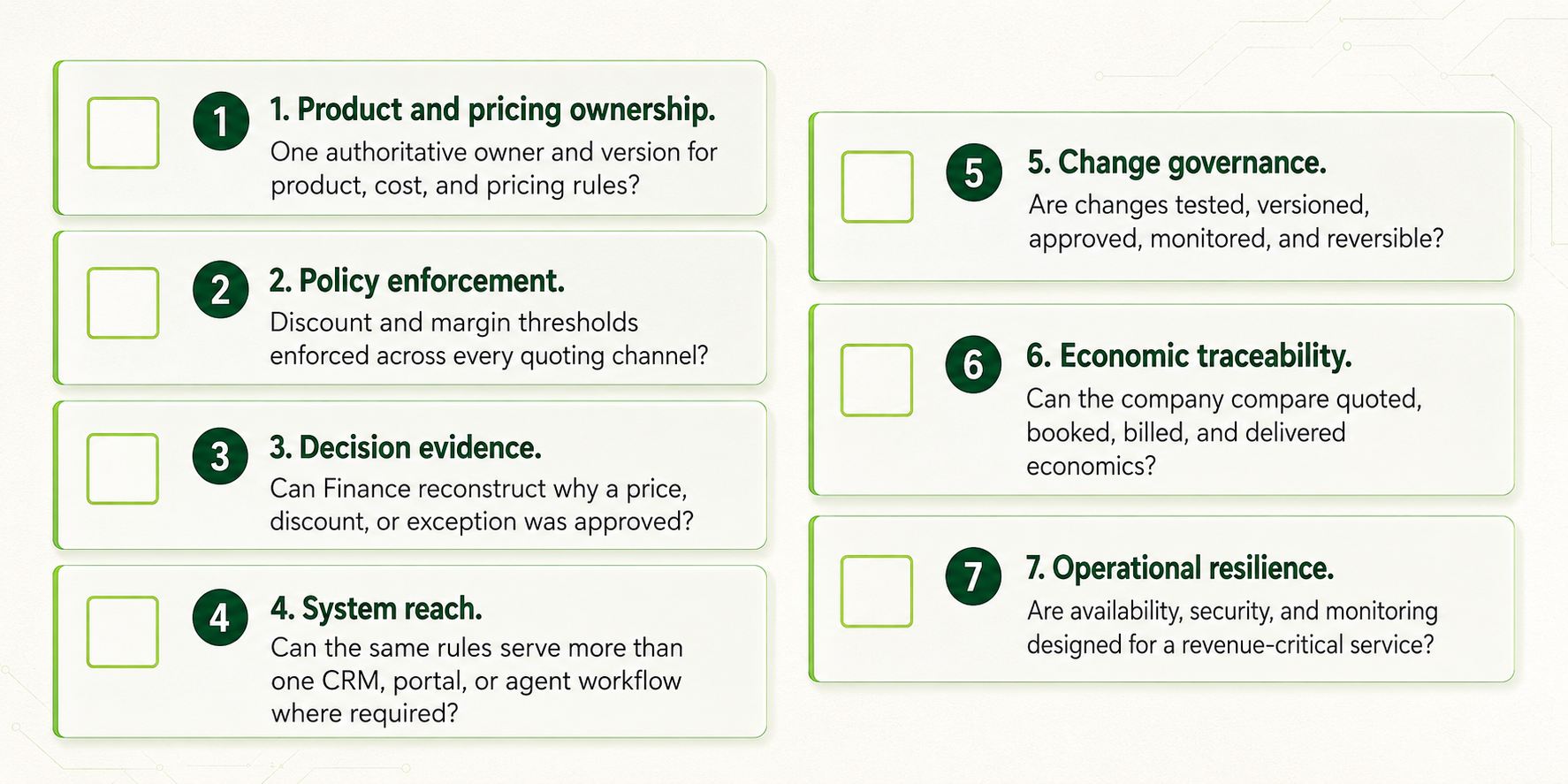
As working guidance, not a benchmark: 11 to 14 suggests commercial authority is genuinely governed.
7 to 10 suggests partial governance, strong in one channel and improvised elsewhere.
Below 7, commercial policy is fragmented, weakly evidenced, or operationally fragile, and that finding matters whether or not any software is ever purchased.
Why servicePath™
I lead servicePath™, and this architecture reflects how we believe complex commercial decisioning should work. servicePath™ is a commercial control plane for complex technology services; its CPQ+ platform provides governed configuration, pricing, approvals, margin visibility, and quoting for complex technology products, managed services, telecommunications, subscriptions, and multi-vendor offerings. Published integrations include Salesforce, Dynamics 365, HubSpot, with APIs and webhooks to billing, finance, and service management.
The principle, which we call Revenue Architecture 2.0: deterministic rules for commercial authority, AI to accelerate the work those rules permit.
For instance, AI may help a seller find an offer, assemble a configuration, or flag an exception. It should not silently override pricing, margin, or approval policy.
That is the difference between AI-assisted execution and uncontrolled automation.
Evidence from servicePath™ customers
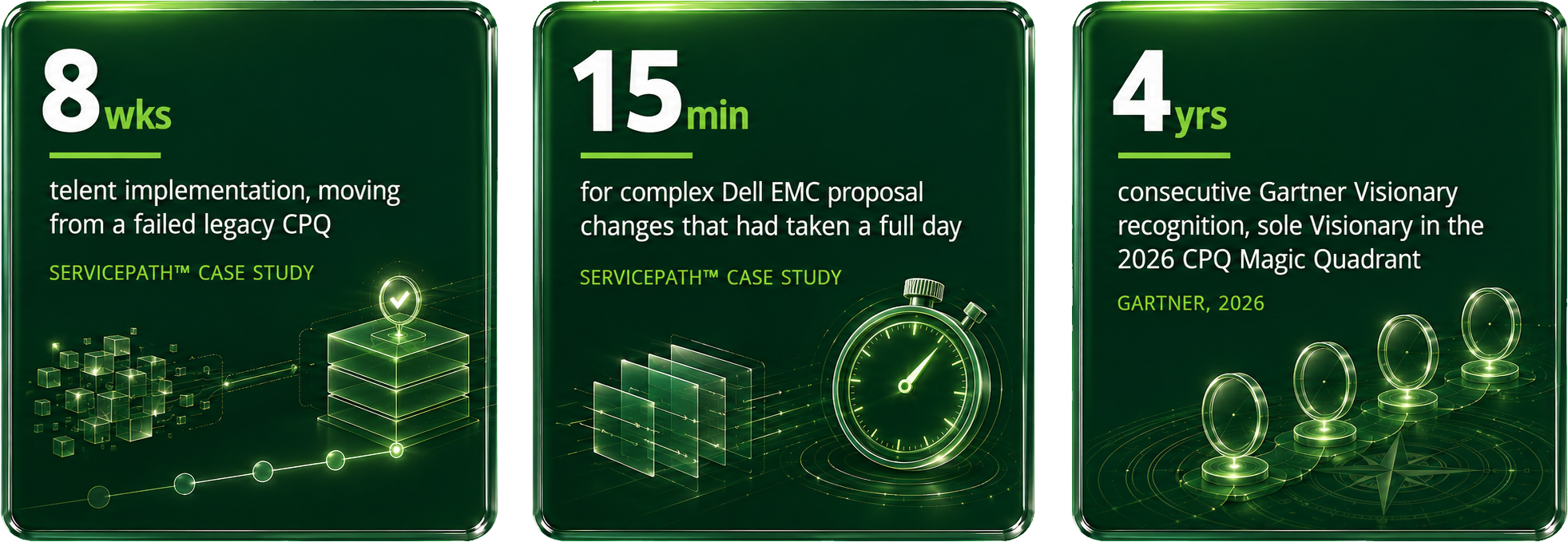
Most importantly, proof should be customer evidence, not adjectives. telent replaced a failed legacy implementation through an eight-week deployment, reporting faster, more accurate quoting and complex services calculations without un-roll backable custom code. Dell EMC reports day-long partner proposal changes completed in as little as 15 minutes.
Gartner positioned servicePath™ as the sole Visionary in the 2026 Magic Quadrant for CPQ, a fourth consecutive Visionary year, the third alone in that position. None of this means servicePath™ is right for every enterprise; it shows where the approach has worked.
Start with the rule, not the demo
In practice, bring one complex deal into the room and trace it from opportunity to quote, approval, contract, order, invoice, renewal, and delivered margin. Ask five questions:
- Which system supplied the product, pricing, and cost data?
- Which rule produced the price?
- Who approved the exception, and why?
- Did the economics change before billing or delivery?
- Can the full decision be reconstructed without asking the person who remembers it?
If the answer to the last question is no, three next steps, in order of commitment:
Run the diagnostic. The seven-point scorecard above takes one meeting and no vendor. Score the shortlist. Put the same seven questions to every vendor, servicePath™ included; an evaluation that cannot fail its own author is marketing, not measurement.
Then talk to us. Book a CPQ architecture review and put servicePath™ through the same five-question trace with your own deal.
That may have been enough when people produced every quote. It will not be enough when people, digital channels, partners, and AI agents all participate in the same commercial system.
Frequently asked questions
Is a commercial control plane the same as CPQ?
No. CPQ names the capabilities used to configure, price, approve, and quote. A commercial control plane describes the architectural role those capabilities play as the authoritative source of commercial policy across systems. CPQ is the capability; the control plane is the responsibility.
How is a commercial control plane different from a CRM?
A CRM holds customer, opportunity, and pipeline context. A control plane holds and enforces the logic governing what the enterprise can sell, at what price, with which approvals and thresholds. The CRM answers “who are we selling to?” The control plane answers “how is this enterprise permitted to sell?”
Why does a commercial control plane matter for AI agents?
Agents need a reliable source for prices, configurations, discounts, and approval authority; without it they act on incomplete or outdated logic. The control plane gives the agent enforceable boundaries and evidence of what it did.
What should a CFO measure first?
Quoted versus booked versus delivered margin, discount variance from policy, approval time and touches, quote-to-order exceptions, billing credits and disputes, renewal-pricing variance, rule-change lead time, and the share of quotes produced outside governed systems.
When is an independent commercial control plane unnecessary?
For a company with one stable CRM, a simple catalog, limited pricing variation, few exceptions, and no need to expose commercial rules to other systems, channels, or AI-enabled workflows.
Gartner does not endorse any vendor, product or service depicted in its research publications, and does not advise technology users to select only those vendors with the highest ratings or other designation. Gartner research publications consist of the opinions of Gartner’s research organization and should not be construed as statements of fact. Gartner disclaims all warranties, expressed or implied, with respect to this research. GARTNER and MAGIC QUADRANT are registered trademarks of Gartner, Inc. and/or its affiliates.