

Quick Read
servicePath™ is the sole Visionary in Gartner’s 2026 Magic Quadrant for CPQ Applications—the fourth consecutive year as a Visionary and the third year standing alone. With the CPQ market reaching $5.8 billion in 2026 and 40% of apps gaining AI agents, platform adaptability now outweighs vendor size. servicePath™ combines Codeless Agility today with AI-Embedded architecture for tomorrow—trusted by Dell, Telefónica, TierPoint, Park Place Technologies, telent, and many more.
📑 Table of Contents
- Quick Read
- Key Entities Referenced
- Executive Summary
- Why This Matters
- The Obsolescence Question
- Adaptability at AI Speed
- Why servicePath Stands Alone
- Deep Expertise Meets AI-Embedded Architecture
- Customer Validation
- By The Numbers
- What This Means for You
- When to Act: CPQ Obsolescence Timeline
- What Happens After You Choose servicePath
- Trusted By Tech-Enabled Enterprises
- FAQs
- Learn More About Our Gartner Recognition
- Research Sources & Citations
Key Entities Referenced in This Article
servicePath™ | CPQ platform vendor | Sole Visionary 2024–2026; Visionary 2023–2026
Gartner® | Global analyst and advisory firm | Publishes Magic Quadrant research reports
Magic Quadrant™ | Gartner’s vendor evaluation framework | Assesses Ability to Execute + Completeness of Vision
CPQ | Configure, Price, Quote software | Revenue operations platform category
Visionary Quadrant | MQ positioning (high vision, forward-looking) | Indicates future-ready, adaptable architecture
AI-Embedded Architecture | Design pattern for AI integration | Platform built to absorb AI capabilities natively
Codeless Agility | Low-code/no-code configuration approach | Enables rapid changes without custom development
Executive Summary
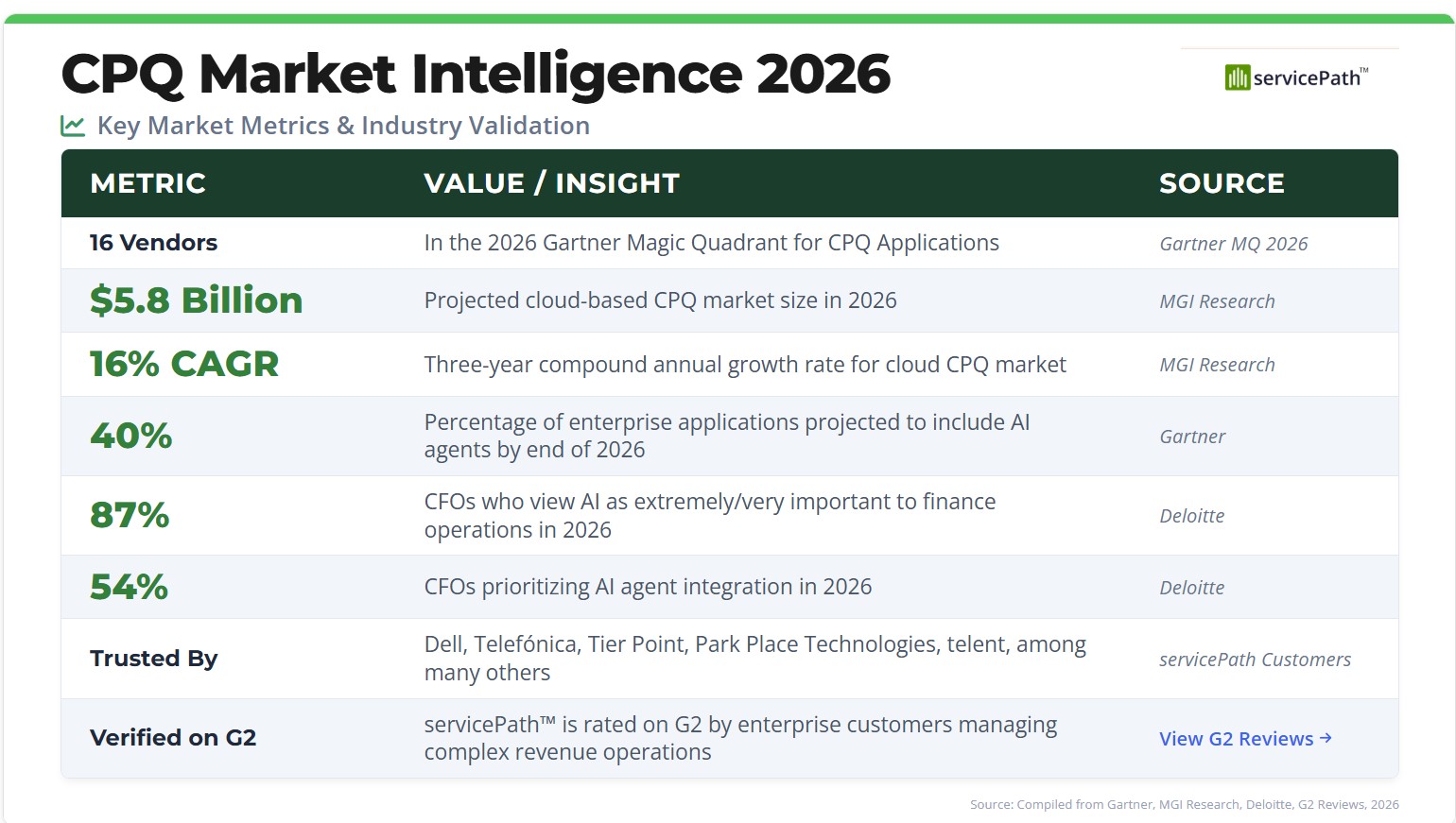
On January 21, 2026, Gartner released its Magic Quadrant for CPQ Application Suites. While over 300 vendors operate in the CPQ space globally, Gartner’s inclusion criteria act as a filter that separates basic quoting tools from true enterprise-grade platforms. Only 16 vendors met these rigorous standards for evaluation.
Among these 16 elite platforms, servicePath™ stands alone in the Visionary quadrant—the only vendor Gartner positioned there in 2026.
For the fourth consecutive year (2023–2026), servicePath™ has been recognized as a Visionary—and for the third year running (2024–2026), servicePath™ is the only vendor in the Visionary quadrant.
This recognition arrives at a pivotal moment:
The cloud-based CPQ market is projected to reach nearly $5.8 billion in 2026, growing at a 16% three-year CAGR (MGI Research).
40% of enterprise applications are expected to include task-specific AI agents by the end of 2026 (Gartner).
87% of CFOs view AI as extremely or very important to their finance operations in 2026, with 54% actively prioritizing AI agent integration (Deloitte CFO Signals, January 2026).
The implication? Obsolescence risk now outweighs vendor size. Adaptability at AI speed is the new benchmark.
servicePath™ addresses this shift by combining Codeless Agility for today’s complexity with AI-Embedded architecture for tomorrow’s capabilities—serving tech-enabled enterprises including Dell, Telefónica, TierPoint, Park Place Technologies, Telent, to name a few.
What is “AI Speed”?
The ability to update pricing models, product bundles, approval workflows, and discount structures in weeks—not quarters—while maintaining governance for financial compliance.
Example: Mid-quarter pricing changes driven by AI-recommended discounts, deployed without replatforming or 6-month professional services engagements.
Why This Matters: The Board-Level Shift
In 2026, enterprise boards are asking a new question:
“How fast can our revenue operations change without replatforming?”

The drivers are clear:
- Pricing models change mid-quarter in response to competitive pressure.
- Product bundles shift as AI recommendations surface new margin opportunities.
- Approval workflows must adapt when new sales motions launch.
- Discount structures require real-time updates as AI-driven guidance evolves.
Legacy CPQ platforms—built for stability, not volatility—accumulate AI debt faster than they can evolve. Furthermore, the cost of waiting compounds: every quarter spent on a non-adaptive platform increases the technical and financial burden of eventual replatforming.
servicePath™ was built for this environment.
The Obsolescence Question
By 2026, the cost of anchoring complex revenue operations to rigid platforms has become measurable:
- Replatforming costs escalate as customizations multiply.
- Shadow IT emerges when CPQ can’t keep pace with business changes.
- Professional services dependencies rise as AI-driven changes require vendor-led releases.
The question enterprises are asking:
“Is our CPQ platform a strategic asset—or a future replatforming liability?”
This shift explains why obsolescence risk now outweighs vendor size in platform selection. As AI accelerates the pace of revenue model changes, platforms that require 6–12 months of professional services for pricing updates are no longer viable.
Adaptability at AI Speed

The New Benchmark: Weeks, Not Quarters
In 2026, adaptability at AI speed means:
- Mid-quarter pricing changes that don’t require a release cycle.
- AI-driven discount guidance that updates in real time, not in the next quarterly patch.
- Dynamic approval workflows that adapt to new product bundles without replatforming.
- Multi-entity, multi-currency complexity handled without custom code.
- Omnichannel support (direct sales, partner portals, self-service) from a unified platform.
The AI Acceleration Factor
According to Gartner, 40% of enterprise applications will include task-specific AI agents by the end of 2026—up from less than 5% in 2025 (source).
This creates a new form of technical debt: AI debt—platforms that can’t absorb AI capabilities without heavy customization or vendor-dependent roadmaps.
servicePath™ addresses this by embedding AI-ready data models and governance frameworks into the platform architecture itself, enabling enterprises to integrate AI agents without replatforming.
Why servicePath™ Stands Alone
Gartner evaluates CPQ vendors on two axes:
Ability to Execute – Current market presence, customer satisfaction, and operational scale.
Completeness of Vision – Strategic direction, innovation roadmap, and market understanding.
Visionaries are positioned in the upper-right quadrant: high vision, forward-looking execution. They are built for volatility, not just for today’s market.
What Being a Visionary Means
Visionaries don’t just solve today’s problems—they architect for tomorrow’s unknowns:
- Rapid pricing and packaging updates without replatforming.
- Real-time workflow adaptability as AI recommendations evolve.
- AI-ready data models that support predictive pricing, generative quoting, and dynamic orchestration.
- Reduced replatforming risk as AI-driven revenue models accelerate.
The Four Quadrants in Practice

Leaders excel in current execution and market presence
Visionaries prioritize future adaptability and architectural innovation, reducing long-term replatforming risk
Challengers demonstrate strong execution within specific segments
Niche Players serve specialized use cases effectively
Why servicePath™ Has Been the Sole Visionary for Three Consecutive Years
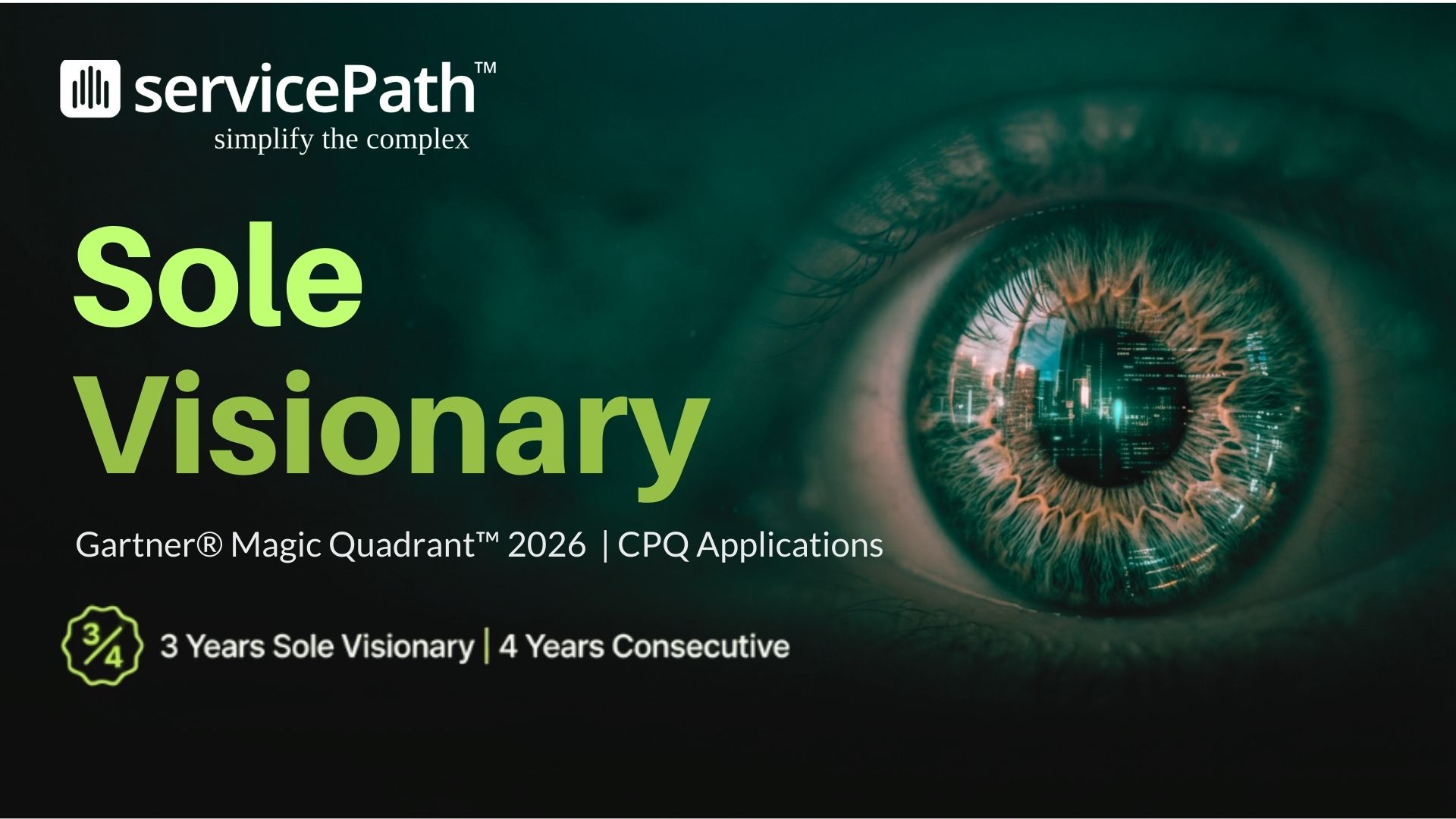
From 2024 to 2026, servicePath™ has been the only vendor in the Visionary quadrant. This isn’t a one-year anomaly—it’s a three-year signal that Gartner recognizes a differentiated approach to CPQ architecture.
What this positioning reflects:
- A contrarian strategy built for volatility, not just scale.
- A commitment to future-ready architecture over feature parity with legacy platforms.
- A focus on speed-to-change as a competitive advantage, not a professional services engagement.
Executive Perspectives: Why This Recognition Matters
“We believe this placement reflects a growing recognition that enterprise revenue models have changed faster than the systems designed to support them. The real risk today is anchoring complex revenue to tools that can’t evolve. Our focus is helping enterprises make better decisions upstream, before a quote becomes a contract.”
— Daniel Kube, CEO of servicePath™
Deep Expertise Meets AI-Embedded Architecture
servicePath™ delivers a dual mandate:

1. Today’s Complexity – Codeless Agility
Enterprises managing complex revenue operations require:
- Multi-entity quoting across subsidiaries, regions, and legal structures.
- Multi-currency pricing with real-time FX handling and localized tax rules.
- Configurable product catalogs that support bundles, subscriptions, usage-based models, and hybrid pricing.
- Dynamic approval workflows that adapt to deal size, discount thresholds, and margin impact.
- Integrations with CRM (Salesforce, Microsoft Dynamics), ERP (SAP, Oracle, NetSuite), billing systems, and revenue recognition platforms.
servicePath™ handles this complexity without 6–12 months of professional services. Codeless Agility means enterprises can deploy and maintain sophisticated quoting logic now, without 6–12 months of professional services or heavy custom code that creates technical debt. This enables business users to configure workflows, pricing rules, and approval logic without IT dependencies—allowing continuous evolution without replatforming.
2. Tomorrow’s Architecture – AI-Embedded Design
As a result, servicePath™ is engineered for a future where:
- AI agents recommend pricing adjustments based on win-rate data and competitive intelligence.
- Predictive margin models flag deals at risk before they enter the approval queue.
- Generative quoting auto-populates product configurations based on customer profiles and historical patterns.
- AI-driven discount guidance updates in real time as market conditions shift.
- Structured data outputs support downstream financial systems for revenue recognition and compliance workflows.
This architecture doesn’t require enterprises to wait for a vendor roadmap—it provides the platform foundation to absorb AI capabilities as they emerge.
“AI is transforming enterprise revenue. That’s why we’re delivering intelligence embedded across the platform, extending our proven financial capabilities into revenue recognition and cash-flow forecasting, and AI-powered collaboration spaces for complex deal negotiation.”
— Ben Buck, Product Director, servicePath™
Customer Validation: What Customers Are Saying
The capabilities Gartner recognized are the same ones our customers depend on daily.
“We have found that servicePath™ not only handles great complexity, but also constant change.”
Hannah Buckley
Sales Operations Manager, telent (UK)
“For our business, a huge challenge is constant change in technology and pricing. Solution parameters change, as does vendor pricing. Most CPQ solutions are built for simpler environments and are not engineered to account for this rate of adjustments. We have found that servicePath™ not only handles great complexity, but also constant change.”
Read the full telent case study →
“This efficiency allows us to spend more time with our partners, helping them solve more strategic business and technology challenges.”
Brandon DaCosta
Consultant Product Manager, Sales Enablement, Dell
“servicePath™ has helped us scale our sales operations. Many partners can now generate their own proposals and configurations using the platform. This efficiency allows us to spend more time with our partners, helping them solve more strategic business and technology challenges.”
Read the full Dell case study →
By The Numbers: A Snapshot of servicePath™ and the CPQ Market {#by-numbers}
What This Means for You: Strategic Implications by Role

For CFOs: Preserving Strategic Option Value
In volatile markets, strategic option value—the ability to pivot without replatforming—becomes a measurable asset.
servicePath™ reduces:
- Vendor lock-in through open APIs and composable architecture.
- Total Cost of Ownership (TCO) by eliminating multi-year professional services engagements.
- Dependency on vendor roadmaps through codeless configurability.
Enabling Financial Compliance & Governance
servicePath™ helps organizations comply with critical accounting standards including ASC 606, SOX, and related financial regulations through platform capabilities that enable:
Audit Trail & Governance:
- Complete quote approval tracking with timestamps and user attribution
- Configuration change history and version control
- Role-based access controls and segregation of duties
- Contract modification audit trails
Revenue Recognition Support:
- Structured data outputs that integrate with downstream financial systems
- Clear documentation of product delivery timelines for revenue scheduling
- Multi-period revenue allocation tracking
- Automated revenue waterfall reports
Why this matters for CFOs: Organizations using servicePath™ can demonstrate audit-ready processes that satisfy external auditors and internal compliance requirements—reducing the risk of revenue restatements, accelerating quarter-close cycles, and providing the governance controls finance teams need.
Important note: servicePath™ provides the tools that enable compliance—we help customers achieve ASC 606 and SOX compliance through platform features, auditability, and structured data workflows. This is not a certification for servicePath™ itself, but rather capabilities that help our customers maintain their own compliance standards.
Questions to ask your current CPQ vendor:
- How quickly can we deploy a new pricing model without professional services?
- What percentage of our CPQ configuration is custom code vs. declarative logic?
- Can we integrate AI-driven discount recommendations in Q2 2026—or do we wait for your next release?
- Can you provide audit-ready documentation for ASC 606 compliance?
For CIOs: Future-Ready Architecture
AI debt compounds faster than technical debt. Platforms that can’t absorb AI capabilities natively will require costly middleware, custom integrations, or full replatforming.
servicePath™ provides:
- AI-ready data models that support predictive pricing, generative quoting, and AI agent orchestration.
- Real-time integrations with CRM, ERP, billing, and revenue systems—no batch jobs, no overnight syncs.
- Cloud-native, API-first architecture that eliminates the technical debt of monolithic CPQ platforms.
Strategic consideration:
In 2026, the question isn’t “Does our CPQ work today?”—it’s “Can our CPQ absorb AI capabilities in 2027 without replatforming?”
For CROs: Speed to Revenue
Revenue operations in 2026 require:
- Partner self-service quoting that reduces sales team bottlenecks.
- Dynamic approval workflows that adapt to new sales motions without IT intervention.
- Configurable product catalogs that support bundles, subscriptions, and usage-based pricing from a single platform.
- Real-time pricing updates that reflect margin targets, competitive positioning, and AI-driven recommendations.
servicePath™ enables:
- Faster quote-to-cash cycles through automated approvals and real-time integrations.
- Reduced sales friction by empowering partners and direct sellers with the same quoting platform.
- Revenue model flexibility without waiting for vendor-led releases.
When to Act: The 2026 CPQ Obsolescence Timeline
Q1 2026: Evaluate (Now)
Assess your current CPQ’s speed-to-change capability.
Map upcoming revenue model changes (new pricing, product bundles, AI integrations).
Calculate the cost of waiting—every quarter on a non-adaptive platform increases replatforming costs.
Q2 2026: Build the Business Case
Quantify AI readiness: Can your platform absorb AI agents in 2027 without custom development?
Model TCO impact: What are the professional services costs for your next 3 pricing updates?
Benchmark time-to-value: How long does it take to deploy a new approval workflow today?
H2 2026: Decision Window
Enterprises that wait until 2027 face compressed timelines and higher implementation costs as AI adoption accelerates.
Furthermore, the window for strategic planning narrows as AI-driven competitors gain speed-to-market advantages.
Cost of Inaction:
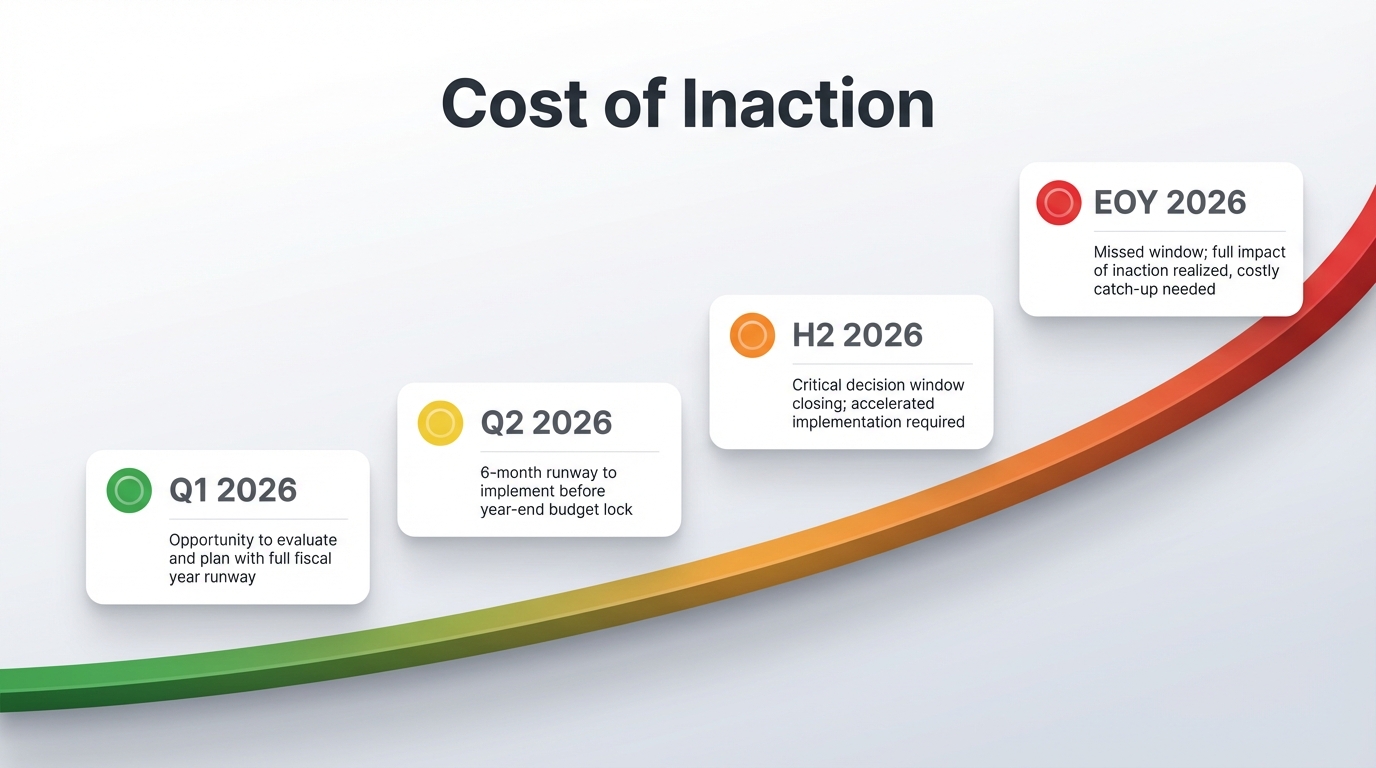
Q1 2026: Opportunity to evaluate and plan with full fiscal year runway
Q2 2026: 6-month runway to implement before year-end budget lock
H2 2026: Compressed timelines; risk of deferring to 2027 amid rising AI debt
2027: Replatforming costs increase 30–50% as AI capabilities become table stakes
servicePath™ as an AI-Era Hedge
In portfolio terms, servicePath™ is a hedge against:
- Rigid vendor roadmaps that lag market changes.
- Heavy customization that compounds technical debt.
- Slow release cycles that prevent mid-quarter pricing updates.
- AI unreadiness that forces costly middleware or replatforming.
The result? Enterprises preserve strategic option value—the ability to adapt revenue operations at the speed of AI-driven market changes, not at the speed of vendor-led release cycles.
What Happens After You Choose servicePath™
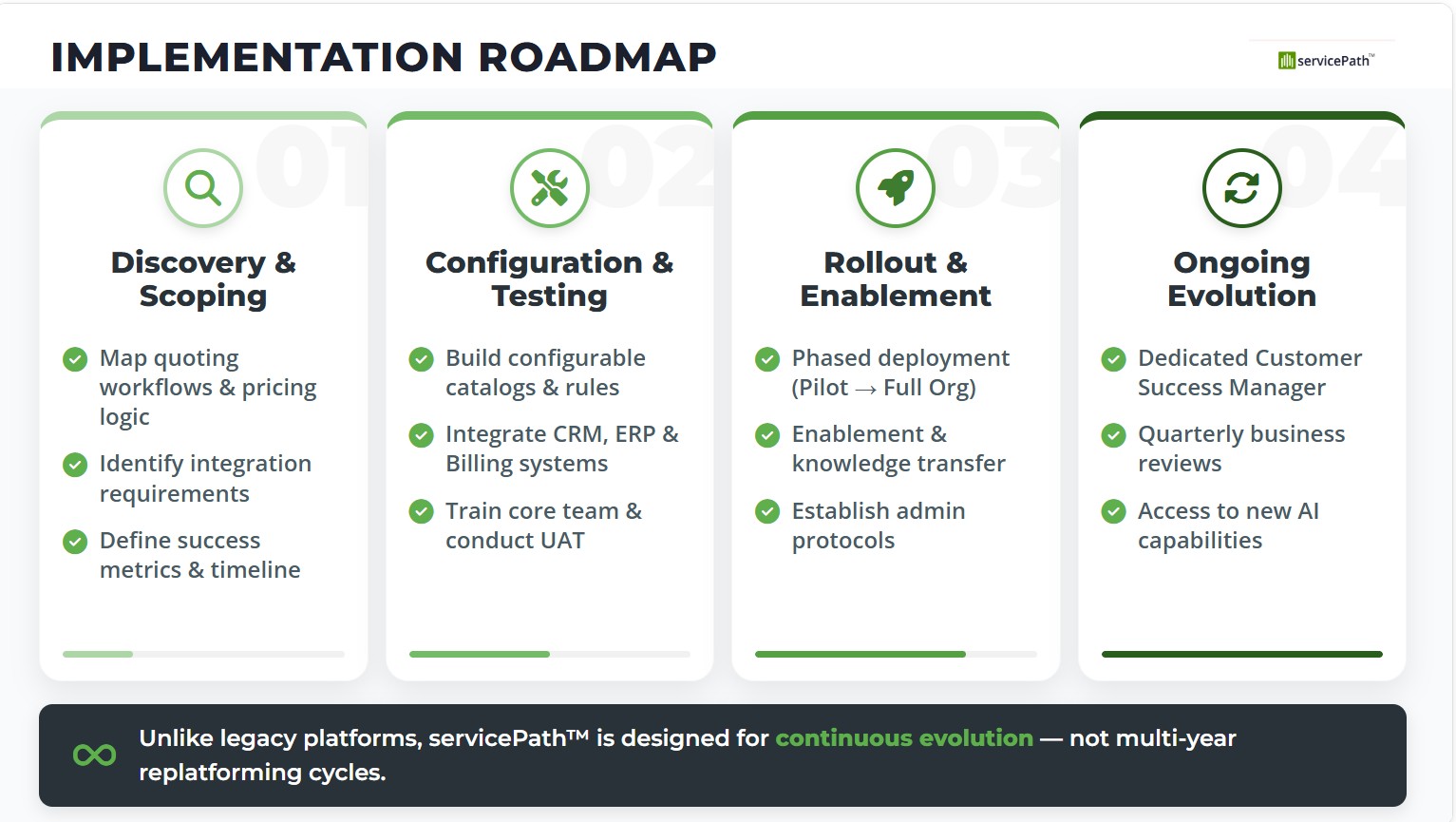
Phase 1: Discovery & Scoping
- Map existing revenue processes, pricing logic, approval workflows, and integration requirements.
- Identify quick wins (e.g., partner self-service quoting, multi-currency pricing) and long-term roadmap (e.g., AI agent integration).
- Define success metrics: time-to-quote, approval cycle time, pricing update frequency.
Phase 2: Configuration & Testing
- Configure product catalogs, pricing rules, approval workflows, and CRM/ERP integrations using servicePath™’s low-code interface.
- Conduct sandbox testing with pilot users (sales, RevOps, finance).
- Iterate based on feedback—no professional services lock-in; changes happen in days, not months.
Phase 3: Rollout & Enablement
- Deploy to production with phased rollout (pilot teams → full sales org → partner portals).
- Train users on quoting, approvals, and reporting.
- Establish governance: who can update pricing rules, approval thresholds, and product configurations.
Phase 4: Ongoing Evolution
Not a “set it and forget it” system—servicePath™ is designed for continuous evolution.
- Quarterly roadmap reviews with your Customer Success Manager (CSM).
- Access to new AI capabilities (predictive pricing, generative quoting) as servicePath™’s product roadmap evolves.
- No replatforming required—new capabilities integrate into your existing configuration.
Trusted By Tech-Enabled Enterprises

servicePath™ serves enterprises with complex revenue operations across financial services, technology, manufacturing, and telecommunications—including Dell, Telefónica, TierPoint, Park Place Technologies, telent, amongst others.
Common use cases:
- Multi-entity quoting for global enterprises with subsidiaries across regions.
- Partner portal enablement for indirect sales channels.
- Subscription and usage-based pricing for SaaS and managed services providers.
- Complex approval orchestration for high-value deals requiring CFO, legal, and compliance sign-off.
- Recovering from failed CPQ implementations (Salesforce CPQ, Oracle CPQ, SAP CPQ).
View customer success stories →
Customer Validation: servicePath™ is rated on G2 by enterprise customers managing complex revenue operations.
View G2 Reviews →
FAQs: What This Means for You
1. What does it mean to be the sole Visionary in the 2026 Gartner Magic Quadrant for CPQ?
servicePath™ is the only vendor positioned in the Visionary quadrant among 16 CPQ vendors evaluated by Gartner. While over 300 vendors operate in the CPQ space globally, Gartner’s inclusion criteria—which separate basic quoting tools from true enterprise-grade platforms—narrowed the evaluation to just 16 vendors. This marks the third consecutive year (2024–2026) as the sole Visionary and the fourth year in the Visionary quadrant (2023–2026).
The Visionary quadrant reflects platforms designed for future adaptability and architectural innovation—built to reduce long-term replatforming risk as AI-driven revenue models accelerate.
2. Why does obsolescence risk matter more than vendor size? And what is “adaptability at AI speed”?
Obsolescence Risk:
With the cloud CPQ market reaching $5.8 billion in 2026 (MGI Research) and 40% of enterprise apps projected to include AI agents (Gartner), platforms requiring heavy customization and vendor-led release cycles accumulate technical debt faster than AI-driven market changes occur.
Adaptability at AI Speed:
This means the ability to update pricing models, product packaging, approval workflows, and integrations in weeks—not quarters—with minimal custom code. For example: deploying mid-quarter pricing changes driven by AI-recommended discounts without replatforming.
According to Deloitte CFO Signals (Q4 2025), 87% of CFOs view AI as extremely or very important to their finance operations in 2026, and 54% are actively prioritizing AI agent integration.
3. How does Gartner evaluate CPQ vendors?
Gartner evaluates CPQ vendors on two axes:
Ability to Execute – Current market presence, customer satisfaction, product capabilities, and operational scale.
Completeness of Vision – Strategic direction, innovation roadmap, market understanding, and future adaptability.
The Visionary quadrant (upper-right) reflects platforms with high vision and forward-looking execution—designed to address future market volatility, including omnichannel support, AI integration, and dynamic sales orchestration.
servicePath™’s positioning as the sole Visionary for three consecutive years (2024–2026) signals a differentiated approach: building for tomorrow’s AI-driven revenue models, not just today’s feature parity.
4. Which enterprises use servicePath™?
servicePath™ serves tech-enabled enterprises with complex revenue operations across financial services, technology, manufacturing, and telecommunications.
Capabilities include:
- Multi-entity quoting across subsidiaries and regions
- Multi-currency pricing with real-time FX and localized tax rules
- Configurable product catalogs (bundles, subscriptions, usage-based models)
- Dynamic approval workflows
- Integrations with CRM, ERP, billing, and revenue recognition systems
Notable customers include: Dell, Telefónica, TierPoint, Park Place Technologies, telent, to name a few
Explore customer success stories →
5. What is the difference between a Visionary and a Leader in the Gartner Magic Quadrant?
Leaders (upper-right quadrant) demonstrate strong current execution and market presence—they dominate today’s market with large customer bases, extensive features, and proven operational scale.
Visionaries (upper-left quadrant) emphasize future adaptability and architectural innovation—they are built for tomorrow’s unknowns, including AI integration, composable architectures, and rapid market pivots.
Key distinction:
Leaders optimize for today’s market dominance.
Visionaries optimize for tomorrow’s market volatility.
servicePath™’s three consecutive years as the sole Visionary reflects a strategic focus on AI-ready architecture and speed-to-change—capabilities that reduce long-term replatforming risk as AI-driven revenue models accelerate.
6. How long does it take to implement servicePath™ CPQ?
Typical timeline:
Phase 1: Discovery & Scoping (map processes, integrations, success metrics)
Phase 2: Configuration & Testing (configure catalogs, pricing, workflows, integrations)
Phase 3: Rollout & Enablement (deploy to production, train users, establish governance)
Phase 4: Ongoing Evolution (continuous improvement, AI capability integration)
Key differentiator:
servicePath™ is designed for continuous evolution, not one-time deployment. As new AI capabilities emerge (predictive pricing, generative quoting), they integrate into your existing configuration—no replatforming required.
Schedule an Executive Briefing to discuss your timeline →
People Also Ask
Q: What is CPQ software?
A: Configure, Price, Quote (CPQ) software automates complex quoting processes, including product configuration, pricing calculations, approval workflows, and contract generation.
Q: How is servicePath different from Salesforce CPQ?
A: servicePath™ is built for AI-speed adaptability with codeless configuration, eliminating the professional services dependencies common in legacy platforms like Salesforce CPQ.
Q: Can servicePath handle multi-currency pricing?
A: Yes. servicePath™ supports multi-entity, multi-currency quoting with real-time FX rates and localized tax rules.
Q: What integrations does servicePath support?
A: servicePath™ integrates with CRM (Salesforce, Microsoft Dynamics), ERP (SAP, Oracle, NetSuite), billing systems, and revenue recognition platforms via pre-built connectors and APIs.
Ready to preserve your strategic option value in 2026?
Schedule Your Executive Briefing →
servicePath™ — Built for Change, Not Stability
A Thank You—and an Invitation
To our customers, partners, and team: thank you. Four consecutive years as a Visionary reflects your trust. Three years standing alone in that quadrant reflects your feedback. It reflects your willingness to bet on a platform built for change, not stability.
In particular, special recognition to Ben Buck and Kyle Lear—and our entire product and dev teams. Your relentless focus on solving real customer problems drives everything we build.
Now, to enterprise leaders evaluating CPQ in 2026: let’s talk.
Specifically, we’re offering private, 20-minute Executive Briefings for CFOs, CIOs, and CROs to discuss:
✅ What the 2026 Gartner Magic Quadrant reveals about market direction
✅ How to assess your current CPQ’s obsolescence risk and AI readiness
✅ Whether servicePath™ aligns with your revenue roadmap and transformation goals

Learn More About Our Gartner Recognition
On January 22, 2026, Gartner published its Magic Quadrant for Configure, Price and Quote Applications, evaluating 16 vendors. For the fourth consecutive year, servicePath™ has been recognized as a Visionary—and for the third year running, the only vendor in the Visionary quadrant.
View Our Gartner Recognition Page →
Note: Access to the full Gartner Magic Quadrant report requires a Gartner subscription. Learn more at Gartner.com
View Our Press Release
Additional Resources
📚 Read Enterprise Case Studies
📖 Explore Our CPQ Glossary
🎯 Request a Platform Demo
Research Sources & Citations
All market data and statistics cited in this article are sourced from authoritative research organizations:
✅ MGI Research CPQ Market Summary – Cloud-based CPQ market projections
https://mgiresearch.com/research/cpq-market-summary/
✅ Gartner Press Release – AI agents in enterprise applications forecast
https://www.gartner.com/en/newsroom/press-releases/2025-08-26-gartner-predicts-40-percent-of-enterprise-apps-will-feature-task-specific-ai-agents-by-2026-up-from-less-than-5-percent-in-2025
✅ Deloitte Q4 2025 CFO Signals Survey – CFO AI adoption and priorities
https://www.deloitte.com/us/en/insights/topics/business-strategy-growth/4q-2025-cfo-signals-survey.html
Private Executive Briefings for CFOs, CIOs, and CROs
If you’re evaluating CPQ platforms in 2026—or assessing whether your current platform can absorb AI capabilities without replatforming—we offer private 20-minute Executive Briefings.
These sessions are designed for:
- CFOs evaluating strategic option value and TCO impact.
- CIOs assessing AI readiness and architectural debt.
- CROs seeking speed-to-revenue and partner enablement.
Schedule a briefing:
📧 Email malika.durrani@servicepath.co with subject line “2026 Strategy”
🌐 Or visit servicepath.co to learn more
Additional Resources:
🎯 Step 1: Request a Demo
See servicePath™ in action with a personalized demo.
Request a Demo →
🎯 Step 2: Schedule a CPQ Architect Briefing
Discuss your architecture, integrations, and AI readiness with our solution architects.
Schedule an Architect Briefing →
🎯 Step 3: Request a Proof-of-Concept (POC)
Validate servicePath™ with your actual data, workflows, and use cases.
Request a POC →
🎯 Step 4: Explore Our CPQ Glossary
Understand key CPQ concepts: Codeless Agility, AI-Embedded Architecture, Composable CPQ, and more.
Visit CPQ Glossary →
Research Sources & Citations
All data points in this article are sourced from authoritative third-party research:
MGI Research – CPQ Market Summary
Cloud-based CPQ market size ($5.8B in 2026) and 3-year CAGR (16%)
MGI MarketView™: CPQ Market Summary
Gartner Press Release – AI Agents Forecast
40% of enterprise applications will include task-specific AI agents by end of 2026
Gartner predicts 40% of enterprise applications will be integrated with AI agents
Deloitte CFO Signals – Q4 2025 Survey
87% of CFOs view AI as critical; 54% prioritizing AI agent integration
The year ahead: North American CFOs reveal their top 6 expectations for 2026
G2 Customer Reviews – servicePath™ CPQ
Independent customer ratings and reviews
servicePath CPQ
Gartner Disclaimer
Gartner, Magic Quadrant for Configure, Price and Quote Applications, Mark Lewis, Luke Tipping, 22 January 2026.
GARTNER and MAGIC QUADRANT are registered trademarks and service marks of Gartner, Inc. and/or its affiliates in the U.S. and internationally and are used herein with permission. All rights reserved.
Gartner does not endorse any vendor, product or service depicted in its research publications, and does not advise technology users to select only those vendors with the highest ratings or other designation. Gartner research publications consist of the opinions of Gartner’s research organization and should not be construed as statements of fact. Gartner disclaims all warranties, expressed or implied, with respect to this research, including any warranties of merchantability or fitness for a particular purpose.
