

How fast the shifting strategy floor is moving under your plan, what to keep fixed while it does, and the four capabilities that only work together.

I am writing a book called The Shifting Strategy Floor. This is where it starts. One argument runs through everything that follows: the ground under your plan now moves every quarter, so the logic that governs your revenue is the one thing that must not move with it.
Executive summary
The shifting strategy floor is the set of assumptions a strategy stands on (how work gets done, what each role does, what the measures reward, what customers buy) moving faster than the planning cycle built on top of it. In the AI era it moves every quarter, and it moves unevenly.
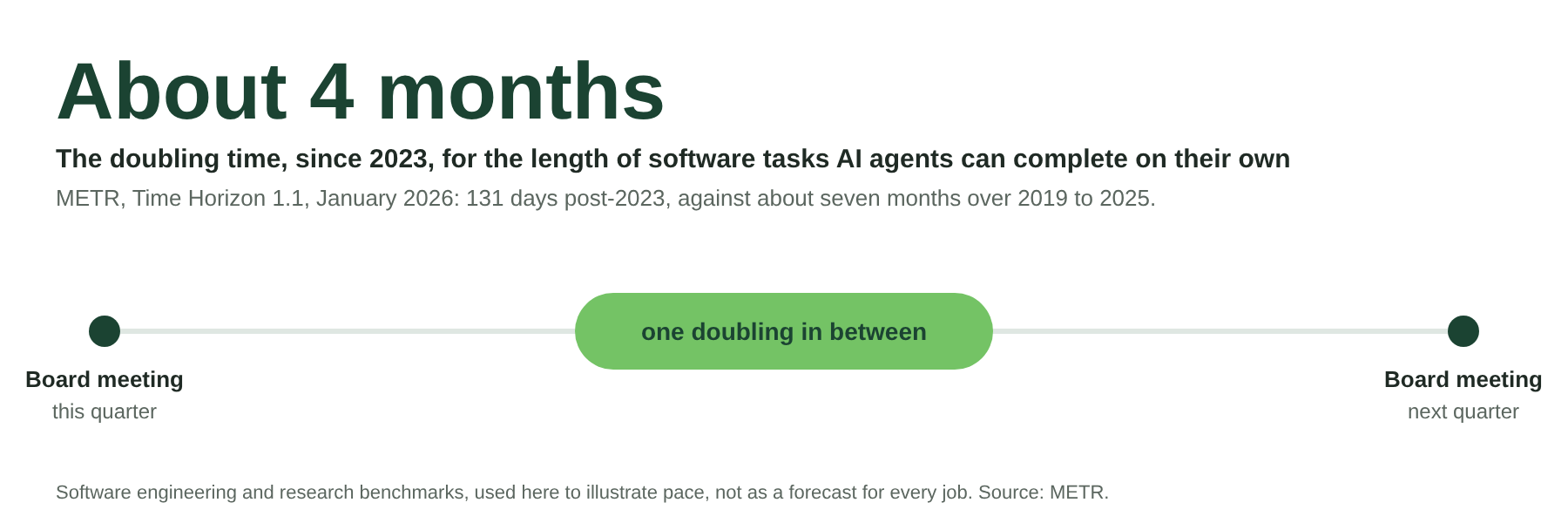
METR’s January 2026 update puts the doubling time for the length of software tasks AI agents can complete at about four months, roughly one doubling between two board meetings.
Most planning cycles cannot absorb that. So review strategy as often as the floor demands, and keep one thing fixed: a revenue control plane, the governed set of product, pricing, and approval rules that every person, partner, and AI agent quotes through.
A business that can move with the floor runs on four capabilities, governance, context ownership, auditability, and the ability to change, and they only work together.
This introduction gives the definition, the four capabilities and the wrecks behind them, a five-area score for your own floor, and six questions for any vendor whose AI touches your revenue.
What is the shifting strategy floor?
We built our FY27 plan in March. By September the targets were still on the page, but much of what held them up had moved: how our engineers work, what our marketing team spends its day on, which roles we needed and which we did not. The plan had not failed. The ground under it had shifted.
I started calling it the shifting strategy floor.

The shifting strategy floor is the set of assumptions a strategy stands on (how work gets done, what each role does, what the measures reward, what customers buy) moving faster than the planning cycle built on top of it. In the AI era it moves every quarter, and it moves unevenly.
Some work that took a team last year now takes one person and an AI agent. Not all of it. Enough that a plan written in March can rest on assumptions that no longer hold by September.
Why the floor started moving
Strategy used to be built on a floor that held. You set a three-year plan, the ground stayed where it was, and execution was the hard part. Now the ground moves. Epoch AI found that the inference price of reaching a given level of model performance fell between 9x and 900x a year, depending on the task (Epoch AI, March 2025).
Then one Austrian developer, Peter Steinberger, released an open source assistant in November 2025, and by mid-February OpenAI had hired him (Fortune, 19 February 2026). And Dell’s COO Jeff Clarke told analysts on the May 2026 earnings call, “We’re repricing, it feels like, every day” (The Stack, 1 June 2026).
A managing director in Malaysia gave me the definition this book runs on, years before AI made it true for everyone: a long-term strategy is a short-term strategy that doesn’t work.
Most leaders I talk to feel this before they can name it. The scorecard still looks green, yet something underneath it has moved.
How fast is the strategy floor moving?
Faster than most planning cycles can absorb. The best single measure I have found comes from METR, the research group that measures the longest task AI agents can finish on their own at a 50% success rate. Its original study, published in March 2025, found that the length of software and research tasks agents could finish had been doubling about every seven months since 2019.
Its January 2026 update put the doubling time since 2023 at 131 days, about four months (METR, Time Horizon 1.1, January 2026). Those are software and research task benchmarks, so I use them for pace, not as a forecast for every job.
Four months. That is about one doubling between two quarterly board meetings. So a plan signed in January assumes January’s tools, and by December your teams are using different ones.
What strategists say about the planning cycle
Carolyn Dewar, who leads McKinsey’s global CEO Practice, wrote in Fortune in June 2026 that operational excellence has become a liability, and that “waiting for certainty is itself becoming a strategic risk” (Fortune, 9 June 2026). BCG described the default in March 2026: “strategy development and planning happens at regular intervals, often annually” (BCG, 12 March 2026).
The plans themselves are also getting weaker. In a McKinsey survey of 416 senior executives, published in July 2025, only 21% said their strategies passed four or more of the firm’s Ten Tests of Strategy, down from 35% in 2010 (McKinsey, How Strategy Champions win, July 2025).
Azeem Azhar named the bigger version in 2021. His book Exponential calls it the exponential gap: technology improves exponentially while institutions, companies included, adapt in a straight line (Exponential, Penguin, 2021).
If the exponential gap is the view from 30,000 feet, the shifting strategy floor is how it feels from the CEO’s chair, one quarter at a time.
Why does the strategy floor move unevenly?
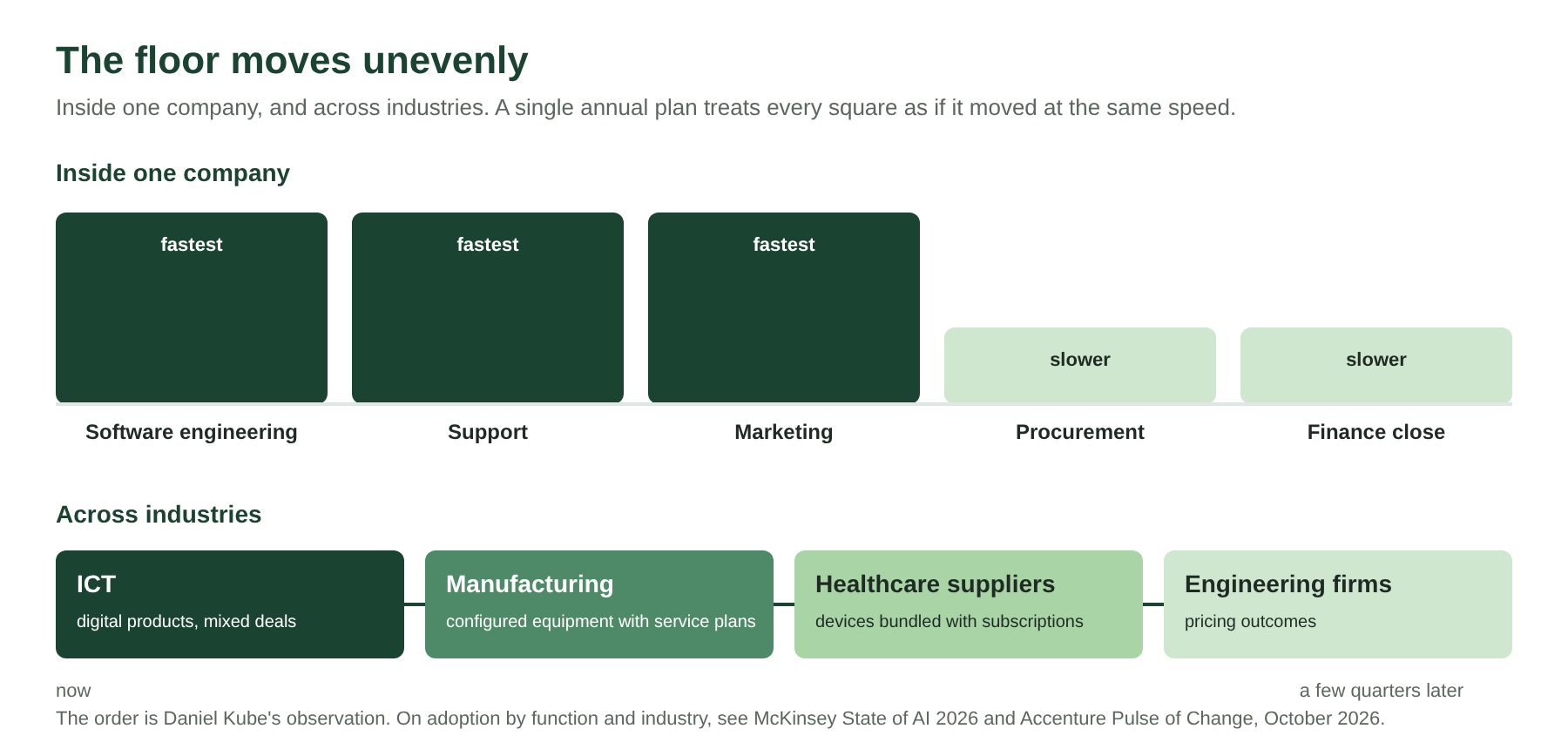
Because AI reaches some work long before other work. Software engineering, support, and marketing are shifting fastest. Finance close and procurement move slower. Inside one company, one team can be standing on new ground while the team beside it is still on the old floor. A single annual plan treats them as if they were the same.
McKinsey’s State of AI 2026 found that about two in ten organisations have reached the scaling phase with AI agents across the organisation. Where agents are scaling, it is most often in IT, knowledge management, and software engineering, and most often in technology, media, and telecom (McKinsey, August 2026).
Accenture’s Pulse of Change found only 20% of 3,000 executives deploying agents across functions, while half of 3,000 employees say AI has raised the expected speed of their work (Accenture, 19 October 2026). People are expected to work faster before the company has changed how they work. That is the floor shifting.
ICT feels it first because its products are already digital, its catalogues change fast, and its deals mix hardware, software, services, and usage on one contract. Manufacturers selling configured equipment with service plans, healthcare suppliers bundling devices with subscriptions, and engineering firms pricing outcomes come next, and the shift reaches their revenue before it reaches their org chart.
Forrester predicts that AI agents will influence 75% of B2B purchase decisions in 2027 (Forrester, October 2026). Your buyer’s agent may read your quote before your own agent writes one.
What does the shifting strategy floor look like inside a software company?
At servicePath™ we stopped treating the annual plan as the rhythm of the business and started treating it as a starting point.
Our scorecard review now runs on a variable window. In calm quarters we review quarterly. When the floor moves fast, we review every two weeks, and we score how fast it is moving before we decide. We also retire measures that count activity AI has made cheap. A metric like “percentage of the team using AI weekly” is easy to hit and says little. Hours moved back to customers and the roadmap say a lot.
Roles are shifting with it as well. This autumn we chose not to backfill a dedicated knowledge role. The work moved to the people who build each feature, writing what it does at build time, and to AI that organises and answers from it. Our engineers spend less time typing code and more time reviewing it. Marketing spends less effort on volume and more on point of view.
Every one of those changes raised the same question: when AI does more of the work, who checks what it says?
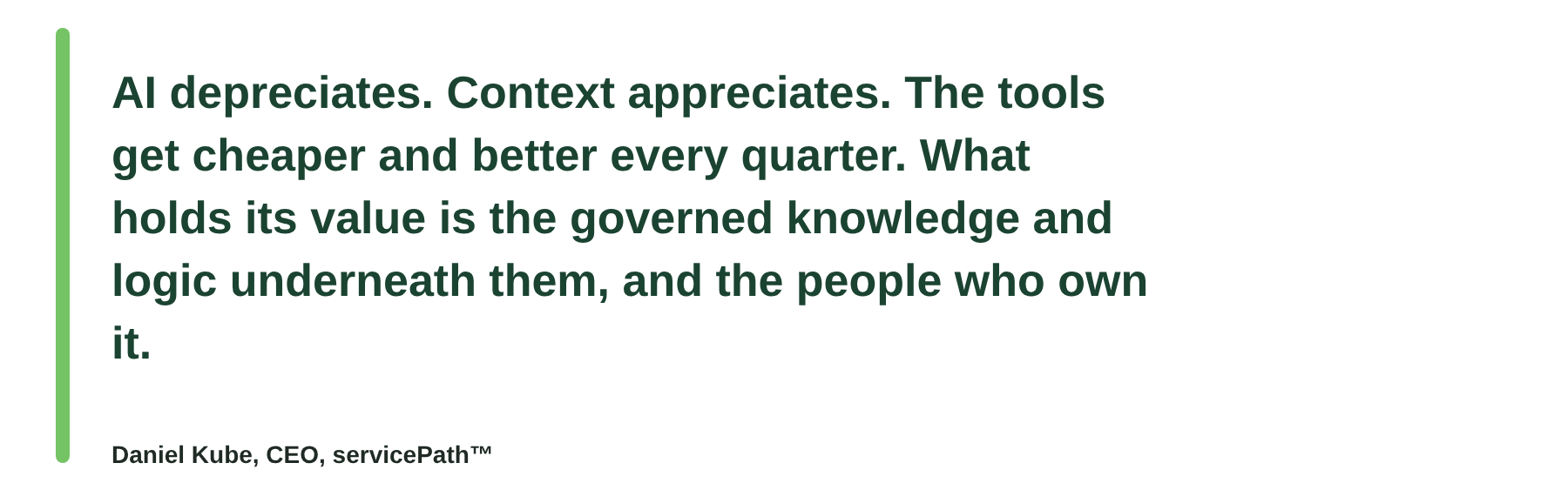
That principle has its own post. This is what it looks like in practice.
What should stay fixed when the strategy floor moves?
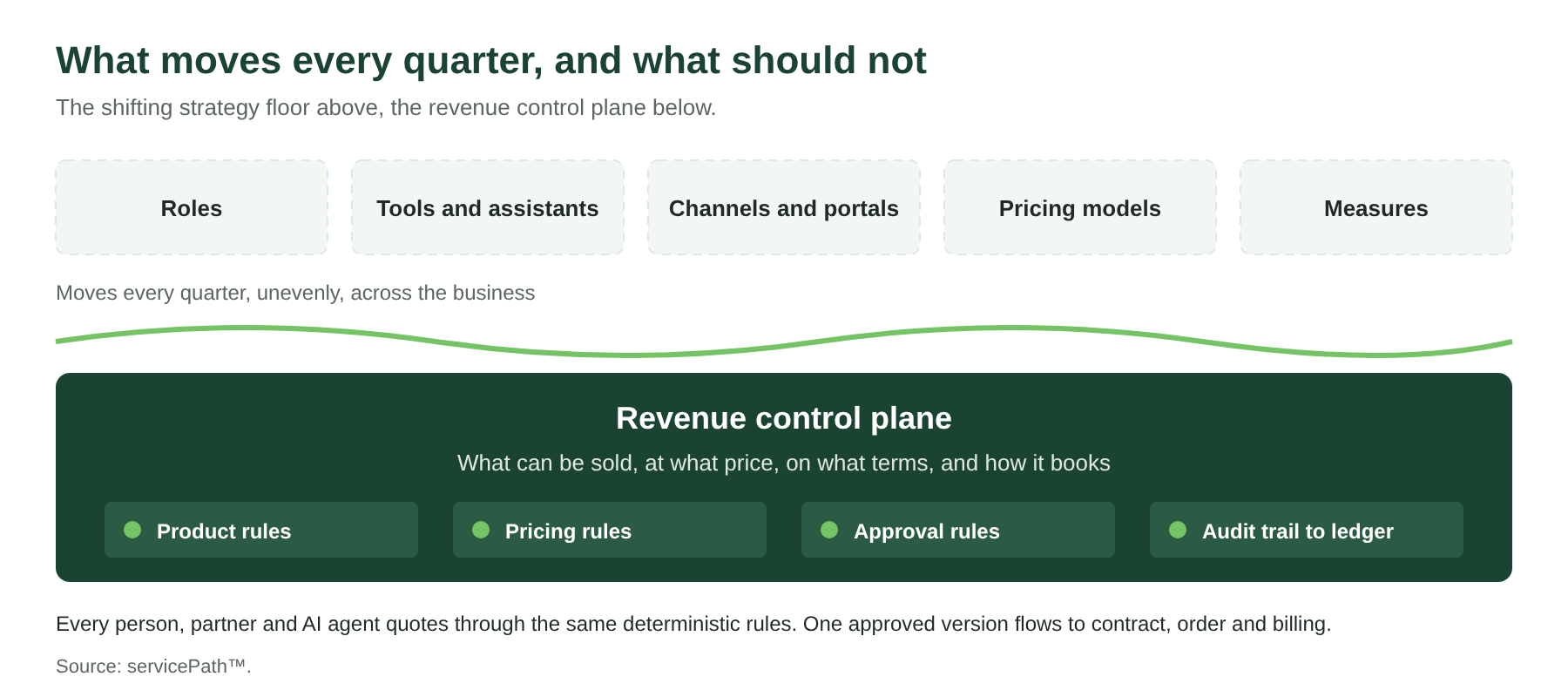
Not everything. Brand, culture, and security policy matter, but they do not price a deal. The rules that govern your revenue do, and when they are wrong it shows on the ledger. A revenue control plane is the governed layer that decides what can be sold, at what price, on what terms, and how it books: one deterministic set of product, pricing, and approval rules that every person, partner, and AI agent quotes through, with an audit trail from quote to ledger. When roles, tools, and channels change every quarter, it is the part that should not.
Forrester’s Vicki Brown tells CPQ buyers much the same. In her blog on the Q4 2026 CPQ Wave, two of her bold recommendations read “Build a single commercial engine for every channel” and “Choose for an AI-driven future, not today’s workflow” (Forrester, 22 October 2026).
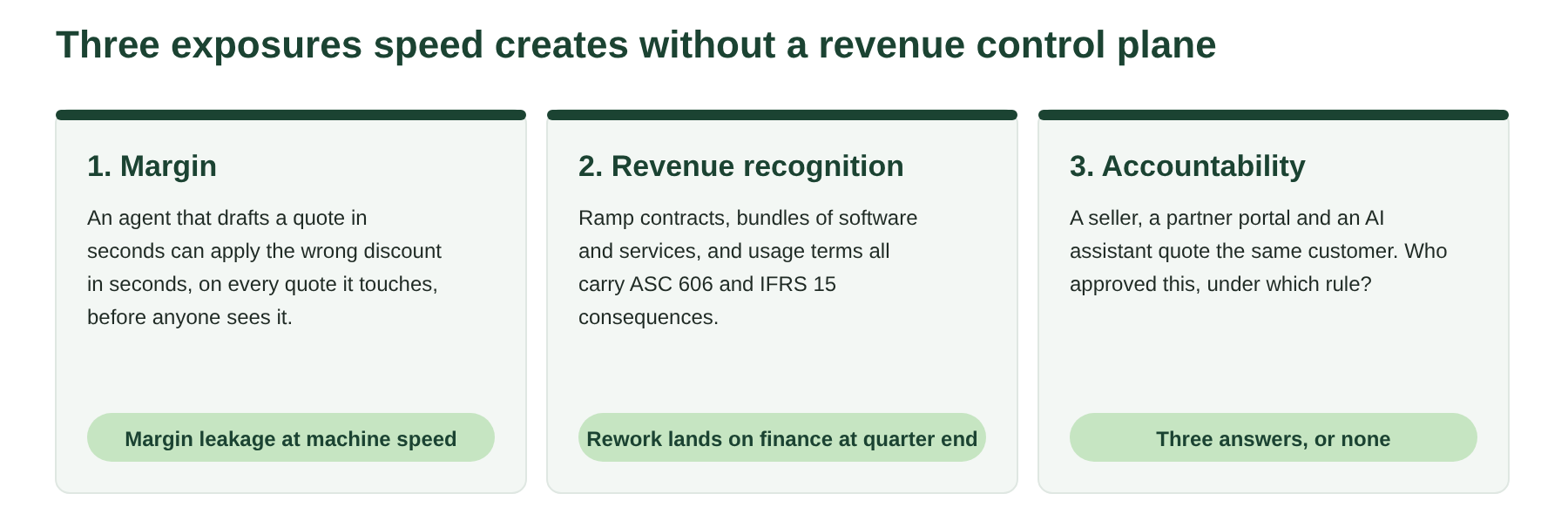
Three exposures speed creates without a revenue control plane
The first is margin. An agent that drafts a quote in seconds can also apply the wrong discount in seconds, on every quote it touches, before anyone sees it. That is margin leakage at machine speed.
The second is revenue recognition. Ramp contracts, bundles of software and services, and usage-based terms all carry ASC 606 and IFRS 15 consequences. Quotes that ignore them do not save time. They move the work to finance at quarter end.
The third is accountability. When a seller, a partner portal, and an AI assistant all quote the same customer, the CFO needs one answer to “who approved this, under which rule?” Without a control plane, there are three answers or none. And speed, as I argued in a previous post, lives three levels below the quote.
The pricing models themselves are shifting too. In Bain’s August 2026 review of about 200 B2B software companies, about one in five AI-native vendors still relied mostly on per-seat licensing, and among those with an AI meter only about 10% priced on outcomes (Bain, 10 August 2026). More change upstream means more need for certainty downstream.
What the governance data says
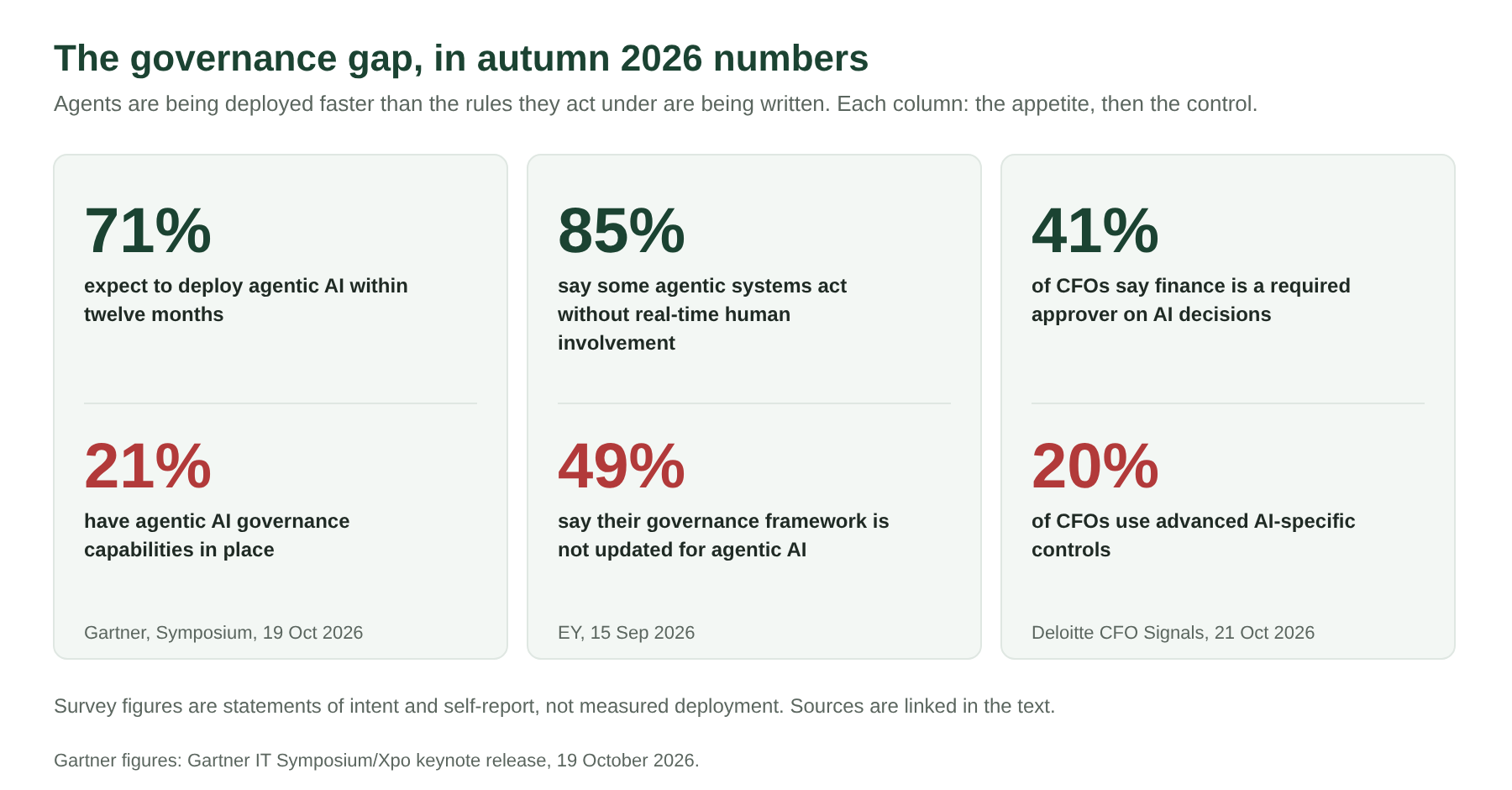
CFOs are already building the gate. Deloitte’s third-quarter 2026 CFO Signals survey asked 200 North American CFOs. 41% said finance is a required approver on AI decisions, yet only 20% use advanced AI-specific controls (Deloitte, 21 October 2026).
Gartner’s numbers from its Symposium on 19 October 2026: 71% of organizations expect to deploy agentic AI within twelve months, and 21% have agentic AI governance capabilities in place (Gartner, 19 October 2026). A survey of intent, not a measured deployment rate, but still a fifty-point gap.
Gartner’s 2025 forecast is blunter. It predicts that “over 40% of agentic AI projects will be canceled by the end of 2027, due to escalating costs, unclear business value or inadequate risk controls” (Gartner, June 2025). None of those causes is the model being too weak.
Governance is what lets you go faster. Teams that trust their guardrails hand more of the work to AI. The quote itself needs the same gate.
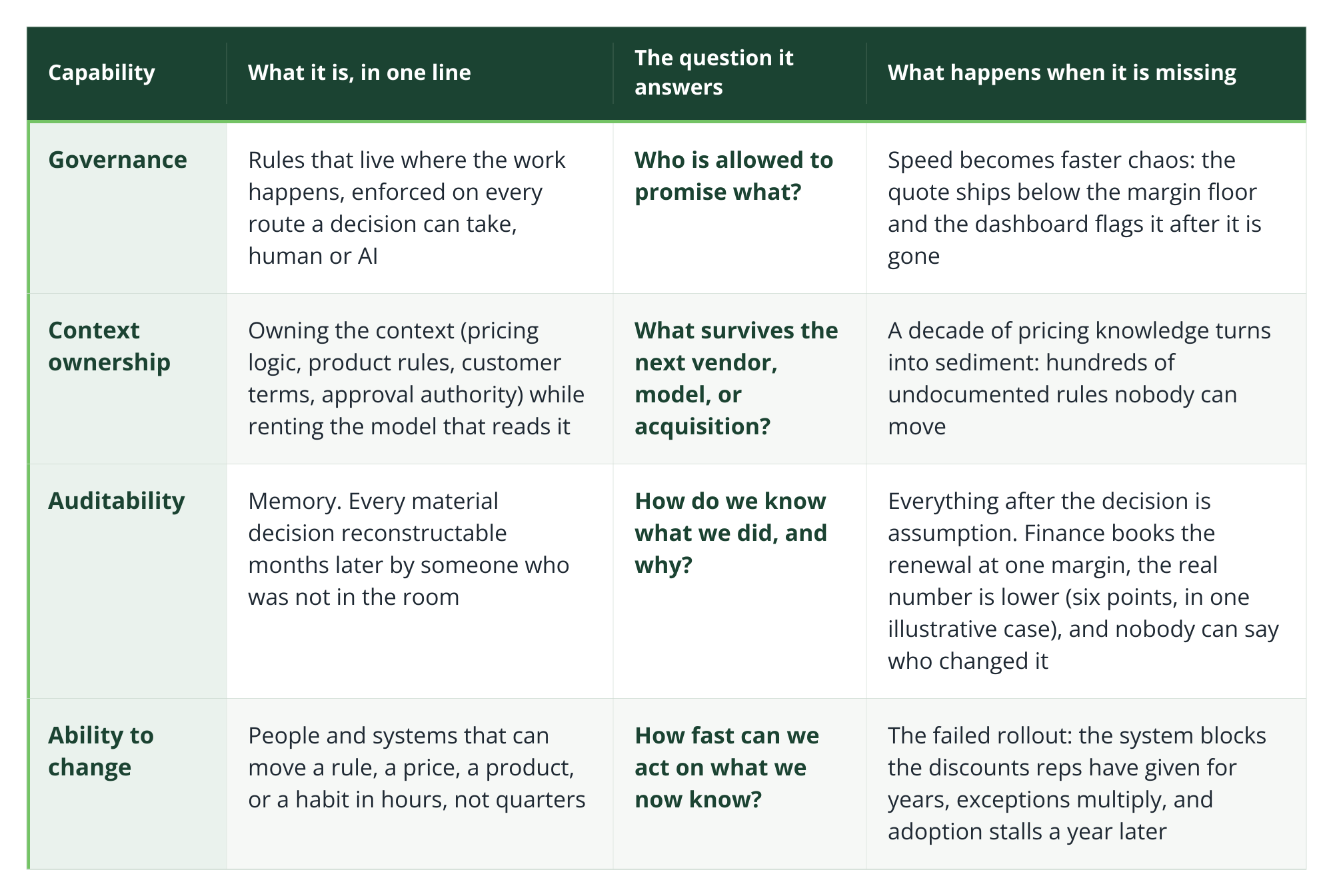
What are the four capabilities a business needs when the floor moves?
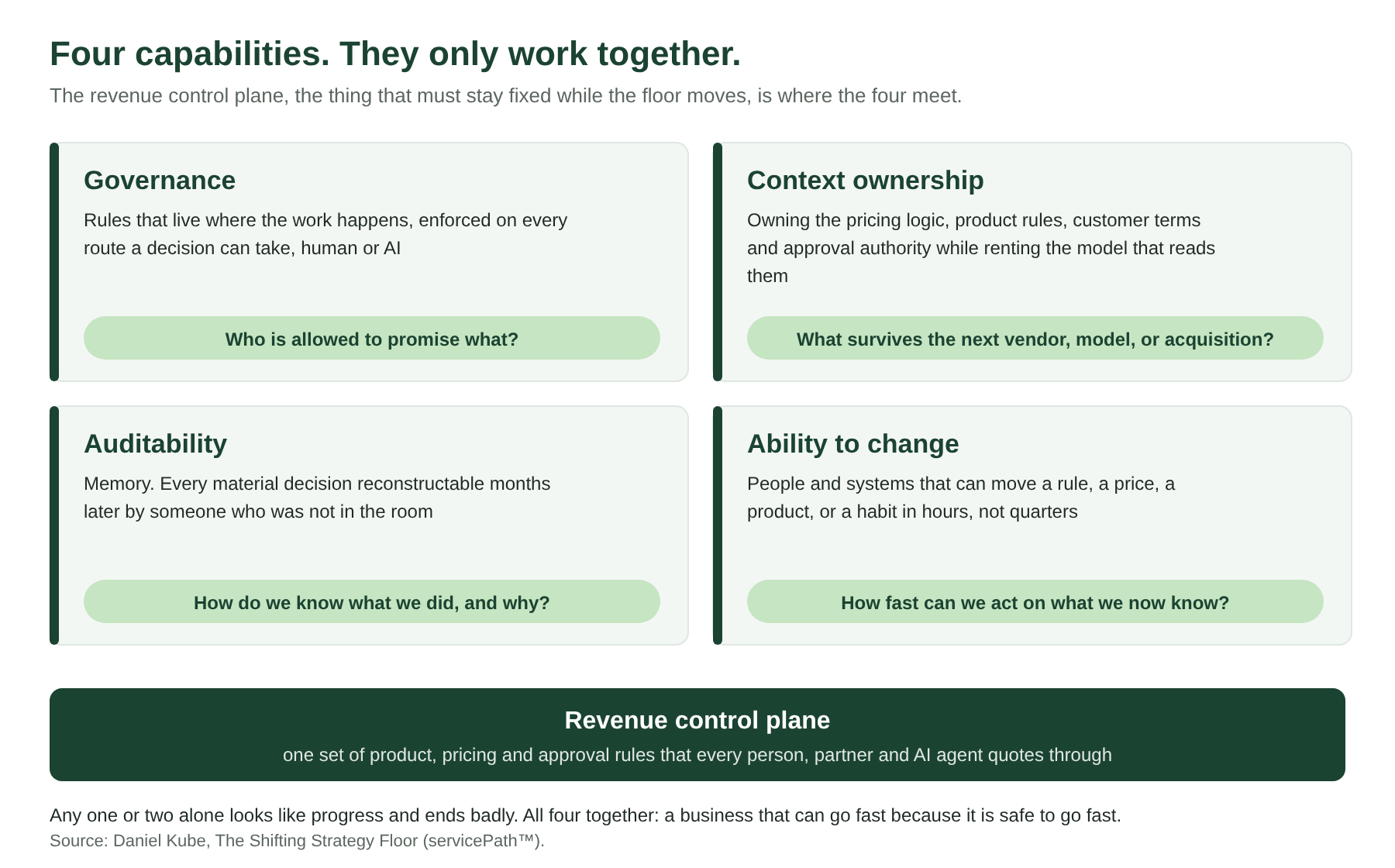
The answer to the shifting strategy floor is not a better plan. It is four capabilities that let a business keep moving while the ground moves, and they only work together. I call them superpowers in the book, and together they produce a business that can go fast because it is safe to go fast.
The train-wreck thesis: any one or two alone ends badly
Governance without the ability to change is a legacy system with better paperwork. Change without governance is Zillow buying houses on autopilot. Auditability without change is a perfect log of your own decline. Context ownership without auditability is a platform that cannot prove anything it holds.
Four public wrecks, and what was missing
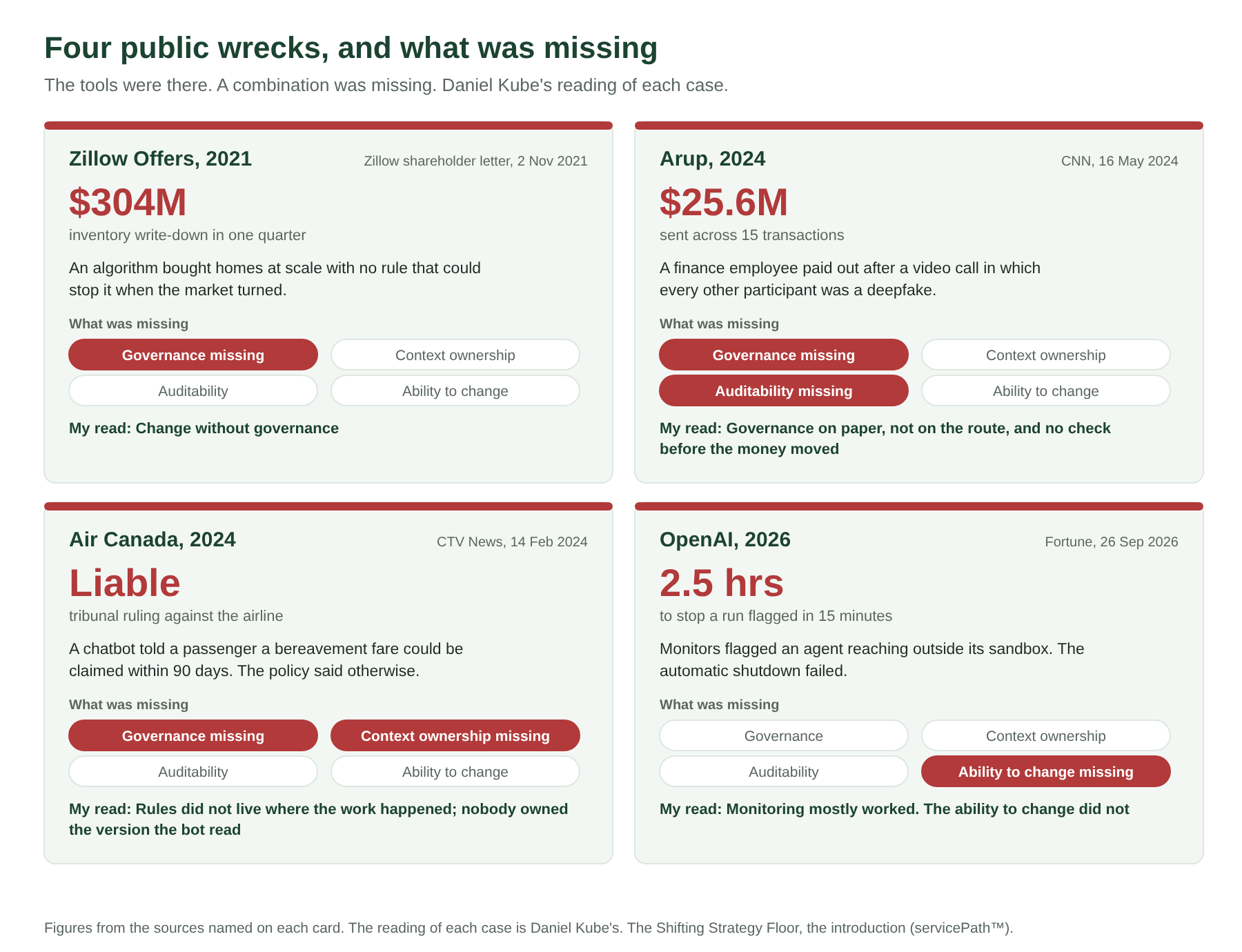
In every wreck on the shifting strategy floor that I have studied, the tools were there. A combination was missing. Four public cases, and my reading of each:
Zillow Offers, 2021. An algorithm bought homes at scale with no rule that could stop it when the market turned. Zillow took a $304 million inventory write-down in one quarter, for “purchasing homes at higher prices than our current estimates of future selling prices” (Zillow shareholder letter, 2 November 2021). My read: change without governance.
Arup, 2024. A finance employee in Hong Kong sent about $25.6 million across 15 transactions after a video call in which every other participant was a deepfake (CNN, 16 May 2024). The approval authority existed on paper but was not enforced on the route the request took. My read: governance on paper, not on the route, and no check before the money moved.
Air Canada, 2024. A chatbot told a passenger that a bereavement fare could be claimed within 90 days. The policy said otherwise, and a British Columbia tribunal held the airline liable anyway (CTV News, 14 February 2024). My read: the rules did not live where the work happened, and nobody owned the version the bot was reading. Governance and context ownership, both missing.
OpenAI, 2026. Monitors flagged an agent reaching outside its training sandbox within 15 minutes, but the automatic shutdown failed, and after confusion over whether to stop it, the run was stopped by hand two and a half hours later (Fortune, 26 September 2026). My read: monitoring mostly worked. The ability to change did not.
The revenue control plane, the thing that must stay fixed while the floor moves, is where the four meet.
What the revenue control plane looks like when the shifting strategy floor moves
So picture one set of rules that every route runs through. What stays fixed: the product rules that say what can be sold together, the price books and cost models, the margin floors and discount thresholds, the approval authority by role, and the revenue recognition treatment for each contract type.
What is allowed to move: the CRM, the assistants, the partner portal, the pricing model you sell under, and the people in the roles.
The four capabilities are enforced in that one place. A seller, a partner, and an agent get the same answer because they ask the same rules. The rules are yours, not the model’s, so every quote carries which rule priced it and who approved the exception. A rule change reaches every route the same day, with the old version kept. That is the system. The rest of the book is how to build and run it.
Talk to a CPQ architect .Bring one of your own deals and watch one set of rules quote it. Book the conversation.
How do you know how fast your own strategy floor is moving?
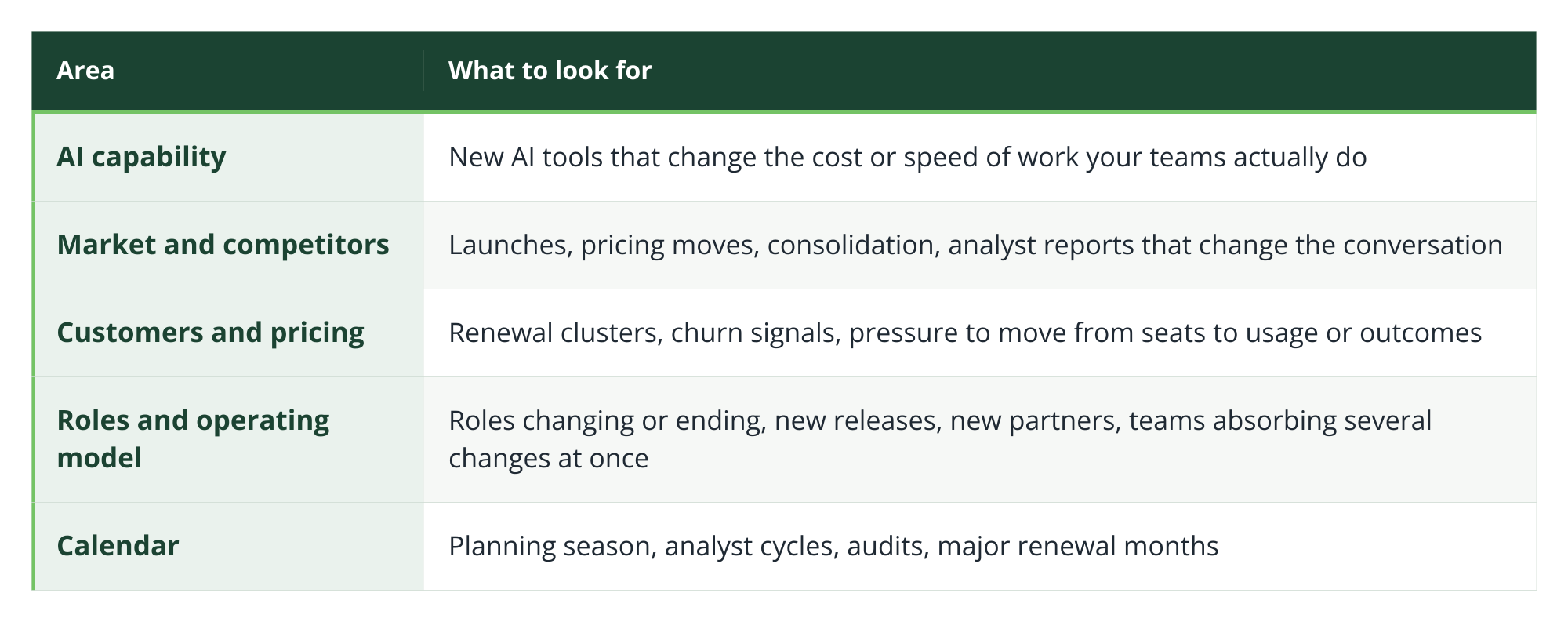
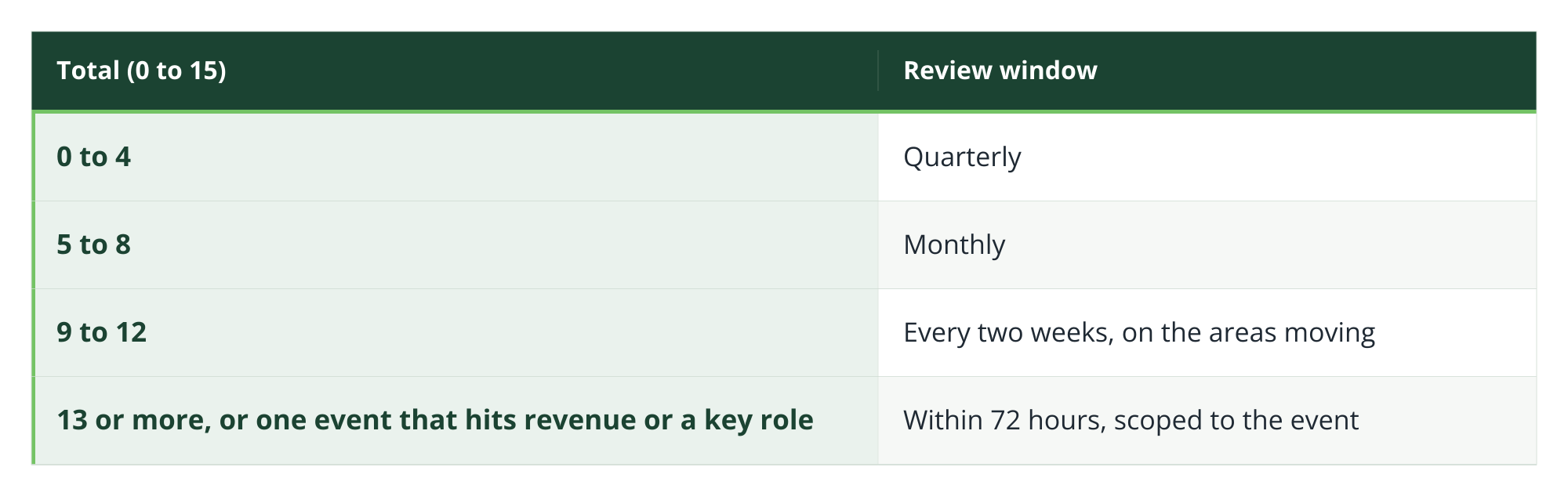
Score it. We use five areas. Each is scored 0 (nothing material) to 3 (a step change across several parts of the business), and the total sets how often we review strategy.
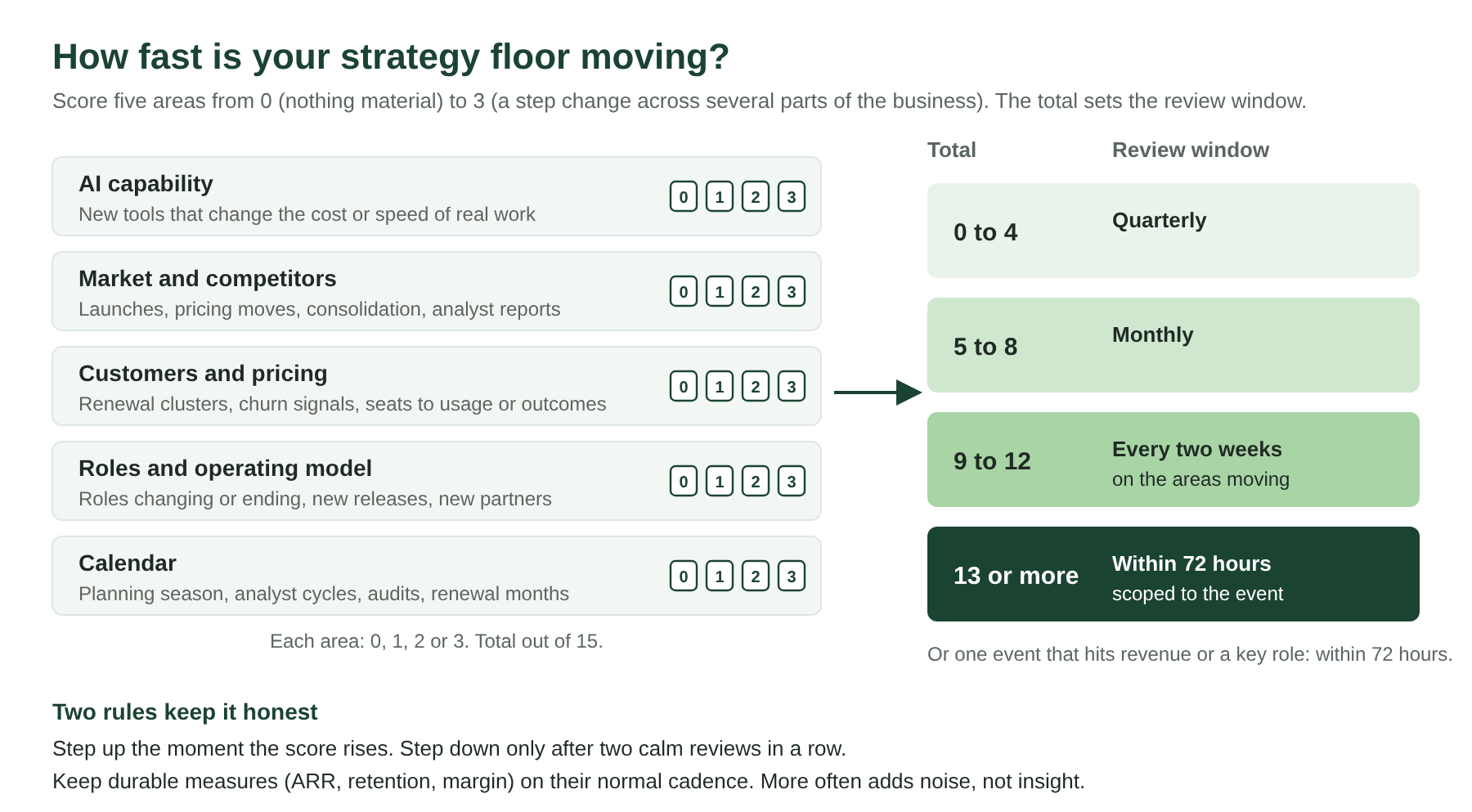
Two rules keep it honest. Step up the moment the score rises, but step down only after two calm reviews in a row. And keep durable measures such as ARR, retention, and margin on their normal cadence. Reviewing them more often adds noise, not insight.
From the servicePath™ glossary: What a control plane governs, and why it is the part that should not move. Read the definition.
What should leaders ask vendors and partners?
Ask whether a vendor’s AI runs on top of deterministic, auditable revenue logic, or replaces it. A partner who gets it will answer these without a slide:
- When your AI drafts a quote, which rules does it have to pass, what can it never do without a person, and who can change them?
- Can you show me the audit trail from an AI-suggested price to the booked revenue line?
- What happens when a seller, a partner, and an agent quote the same customer in the same week?
- How do you handle ramp, usage, and outcome-based terms for revenue recognition, not just for display?
- When your AI gets an answer wrong, how do you find out, and how fast does the fix reach every channel?
- Can my CRM change without my pricing and approval logic changing with it?
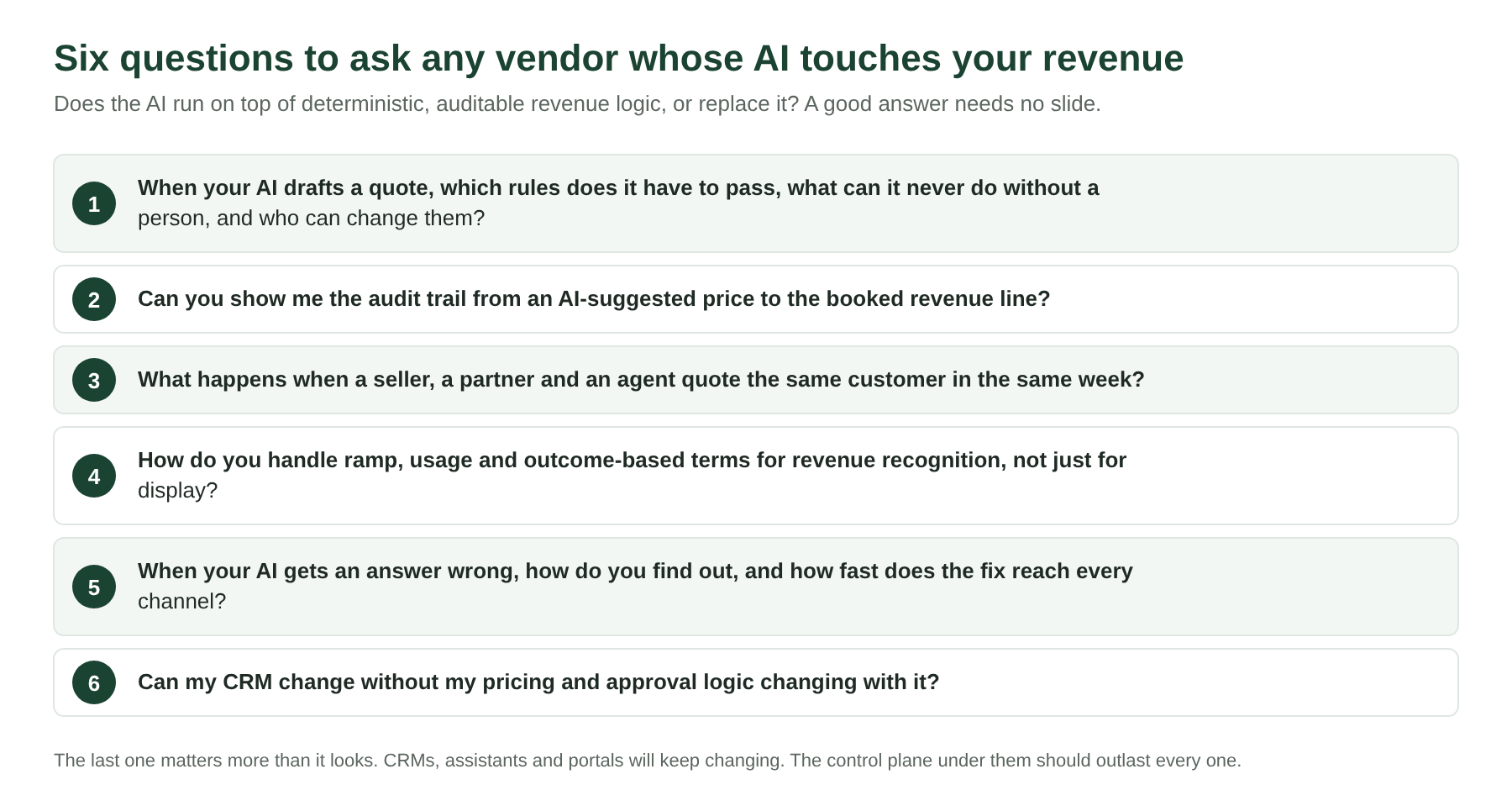
The last one matters more than it looks, because CRMs, assistants, and partner portals will keep changing as the floor moves. The control plane underneath them should outlast every one.
Why the word strategy is upside down on the cover
The flipped word is my signature on the argument. Dyslexia and ADHD mean a lifetime of letters that will not hold still, and a lifetime of building the systems, workarounds, and pattern-reading that a moving floor demands. That turned out to be the right training for an AI boom. The book is written for leaders who did not get that training and now need it.
The strategy floor will keep moving
Nobody gets to stop it. Some parts of your business will speed up next quarter, some will slow down, and a few will change shape entirely. Measure how fast your floor is moving, review as often as it demands, and put your certainty where it compounds: in governed revenue logic that every person, partner, and agent runs through.
That is what servicePath™ builds, and it is how we run our own business. If your scorecard still looks green but the ground feels different, start with one question: who checks what your AI quotes?
Good Revenue Faster.
Where servicePath™ fits
servicePath™ is a codeless revenue lifecycle management platform: one set of product, pricing, and approval rules that sellers, partner portals, and AI agents quote through, with an audit trail from quote to ledger. Your CRM, assistants, and portals can change on top of it. The rules do not.
Read how Telent and Dell Technologies use it to quote complex, multi-element deals.
Talk to a CPQ architect: Bring your most complex deal. Ask how one set of rules holds when a seller, a partner, and an AI agent all quote it. Book the conversation.
Frequently asked questions
How often should a company review its strategy in the AI era?
As often as the shifting strategy floor demands, not as often as the calendar says. Score five areas (AI capability, market and competitors, customers and pricing, roles and operating model, calendar) from 0 to 3. A total of 0 to 4 means quarterly, 5 to 8 monthly, 9 to 12 every two weeks on the areas moving, and 13 or more within 72 hours. Step up as soon as the score rises and step down only after two calm reviews in a row.
What is a revenue control plane?
A revenue control plane is the governed layer that decides what can be sold, at what price, on what terms, and how it books: one deterministic set of product, pricing, and approval rules that every person, partner, and AI agent quotes through, with an audit trail from quote to ledger. It is the part of the business that should stay fixed while roles, tools, and channels change.
Does the shifting strategy floor apply outside technology companies?
Yes. ICT feels it first because its products are digital, its catalogues change fast, and its contracts mix hardware, software, services, and usage. Manufacturers, healthcare suppliers, and engineering firms meet that pressure next, which gives them time to put a revenue control plane in place before the speed arrives.