

Why enterprises need governed pricing, costing, and configuration as AI changes how they sell.
Executive summary
AI has made the quote cheap and the promise expensive. An agent produces a polished three-year proposal in seconds, applies every rule it has, and still commits you to a deal you should not sign.
The business controls that promise, or nobody does, through the pricing rules, cost models, and approval authority its quoting platform enforces on every route a request takes, human or agent.
On an illustrative $100,000 a month service, a 10% discount removes a third of the gross profit; add a supplier cost rise and it removes 60%, which is $648,000 over three years.
That is AI quoting governance, and it is a board question before it is a software one. My test for any proposal: profitable, deliverable, approved by someone with authority. My test for any vendor, including mine: one difficult deal.
Next year every vendor in my category, servicePath™ included, will quote as fast as your customer can ask. Speed is table stakes now. What it does not settle is who owns the promise inside that proposal, and most boards have not priced that yet.
An AI agent prepares a three-year managed service proposal in seconds. It assembles the solution, applies a discount, and produces a polished document.
But the supplier cost has changed. Premium support is missing from the cost model. The discount requires finance approval. The proposal is ready to send before anyone has checked whether the business should make the promise.
The scenario is illustrative. AI does not have to hallucinate to create commercial risk. It applies the supplied rules correctly and still produces a deal the business should not accept.
Why governed pricing is now a board question
An AI agent prepares a three-year managed service proposal in seconds. It assembles the solution, applies a discount, and produces a polished document.
But the supplier cost has changed. Premium support is missing from the cost model. The discount requires finance approval. The proposal is ready to send before anyone has checked whether the business should make the promise.
The scenario is illustrative. AI does not have to hallucinate to create commercial risk. It applies the supplied rules correctly and still produces a deal the business should not accept.
As AI accelerates quoting, control over commercial commitments becomes more valuable. At servicePath™ we say AI depreciates, context appreciates: the model gets cheaper every quarter, while the cost models, dependency rules, and negotiated exceptions that make a complex quote correct only get harder to assemble and more valuable to own.
For technology service providers, telecoms, and other companies selling complex services and solutions, that should change how they evaluate CPQ software and how they use the platform they already have. It puts AI quoting governance on the evaluation checklist, next to price.
Are we making better commitments, or just producing proposals faster? I put that question to every leadership team I meet. Most answer the second part and think they have answered the first.
The quote got cheap. The promise did not.
Consider a simplified managed service sold for $100,000 per month, with $70,000 in modeled monthly delivery costs.
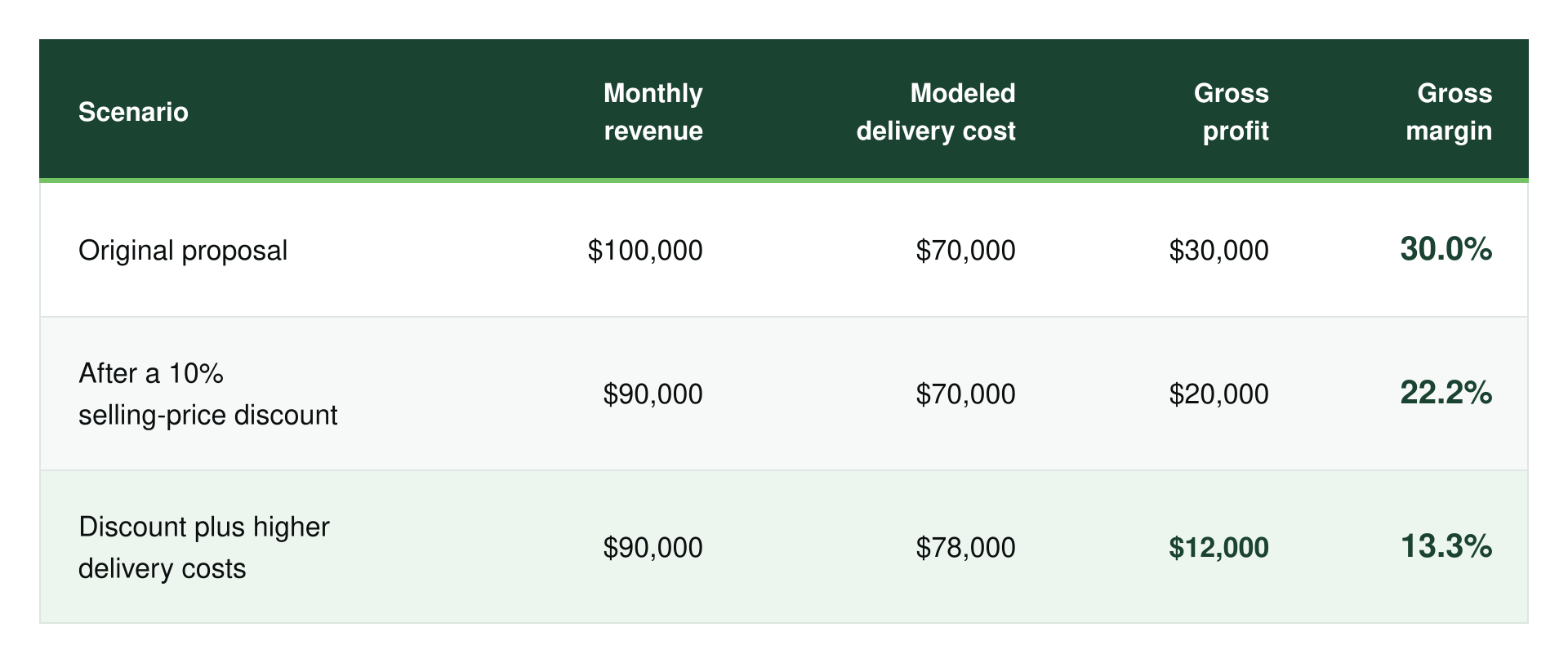
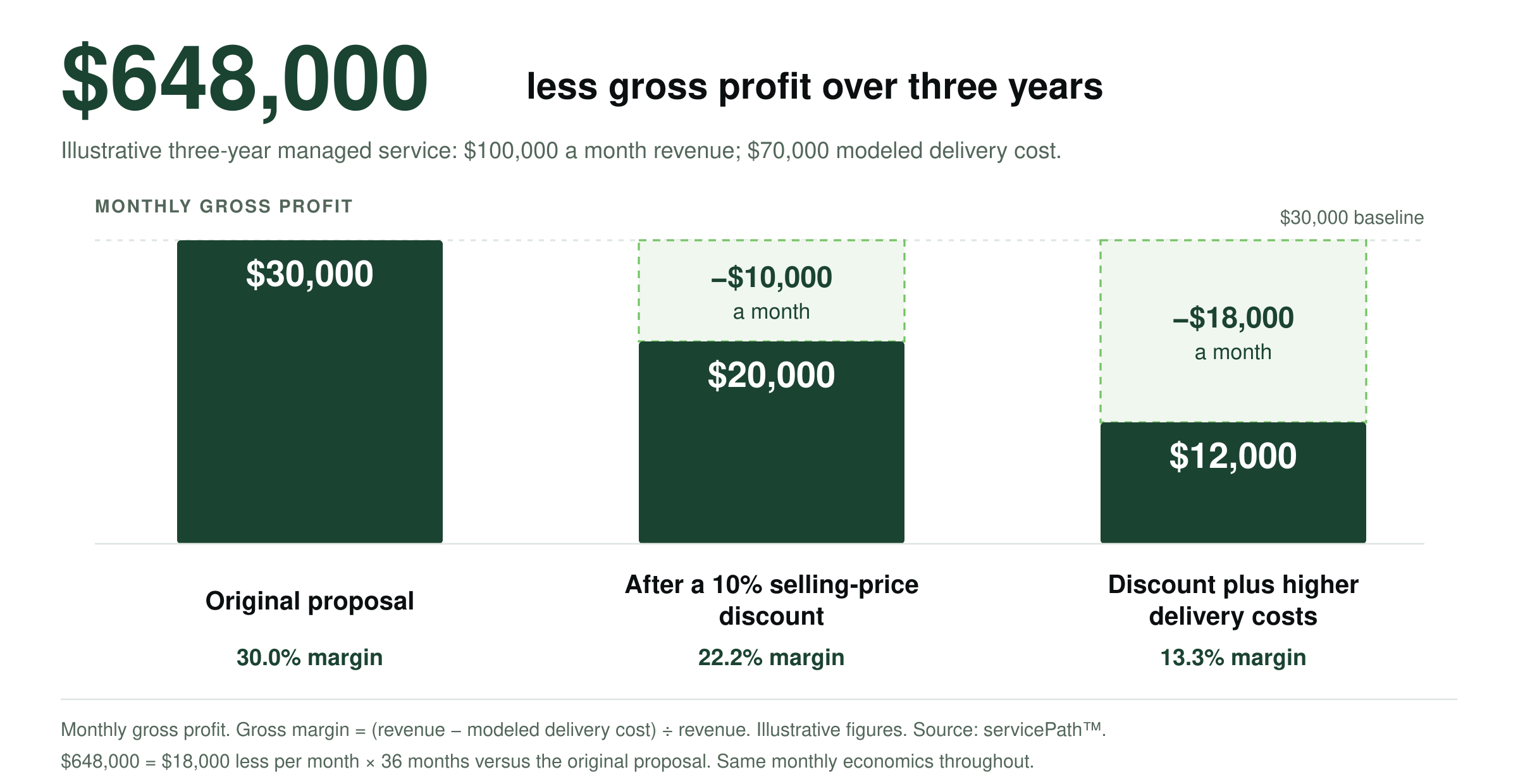
Illustrative figures: how a discount and a cost change erode gross margin on a three-year managed service quote. Gross margin = (revenue minus modeled delivery cost) divided by revenue. Actual results depend on the completeness and accuracy of the cost model.
What a 10% discount does to margin without CPQ governance
The 10% discount takes a third of the gross profit at unchanged costs. With the higher costs shown above, gross profit falls 60% from the original proposal. Over three years, that $18,000 monthly difference is $648,000 less gross profit, assuming the same monthly economics throughout.
AI compresses the time needed to prepare a proposal. It does not shorten the exposure being accepted.
That is why pricing, costing, and configuration belong in the same commercial decision. A configuration change alters support obligations. A longer contract increases exposure to supplier costs. A discount makes a previously acceptable service uneconomic.
AI can help sellers explore these choices faster. The platform must make their consequences visible before approval, not in the year-two review.
A three-year promise deserves more than a margin check on day one. What happens when the supplier costs or support obligations change? Somebody already knows. The question is whether the quote engine did.
Who gets paid when the quote is wrong?
Follow the money and the problem explains itself.
A suite vendor is paid when you consume more of the suite. A systems integrator is paid for the hours or the milestone. A sales rep is paid on the booking. An agent vendor bills on usage, and usage means more quotes. Every one of them does better when quotes are faster. Not one of them is paid when the margin on year three holds.
So the speed will arrive whether you govern it or not, because everyone in the chain benefits from the speed. The governance arrives only if someone whose bonus depends on delivered margin puts it there. In most companies that is the CFO, and the CFO usually sees the quoting tool last.
What the CEOs building the agents say
The CEOs building the agents say the same thing, in their own language. Satya Nadella spent an hour on 20VC this month on why companies should own their intelligence, and in his essay on models as insider risk he writes that the controls governing what a model can access and what actions it can take “must sit outside the model.” Atlassian’s Mike Cannon-Brookes put it more bluntly: “You have to be able to see who did what when.”
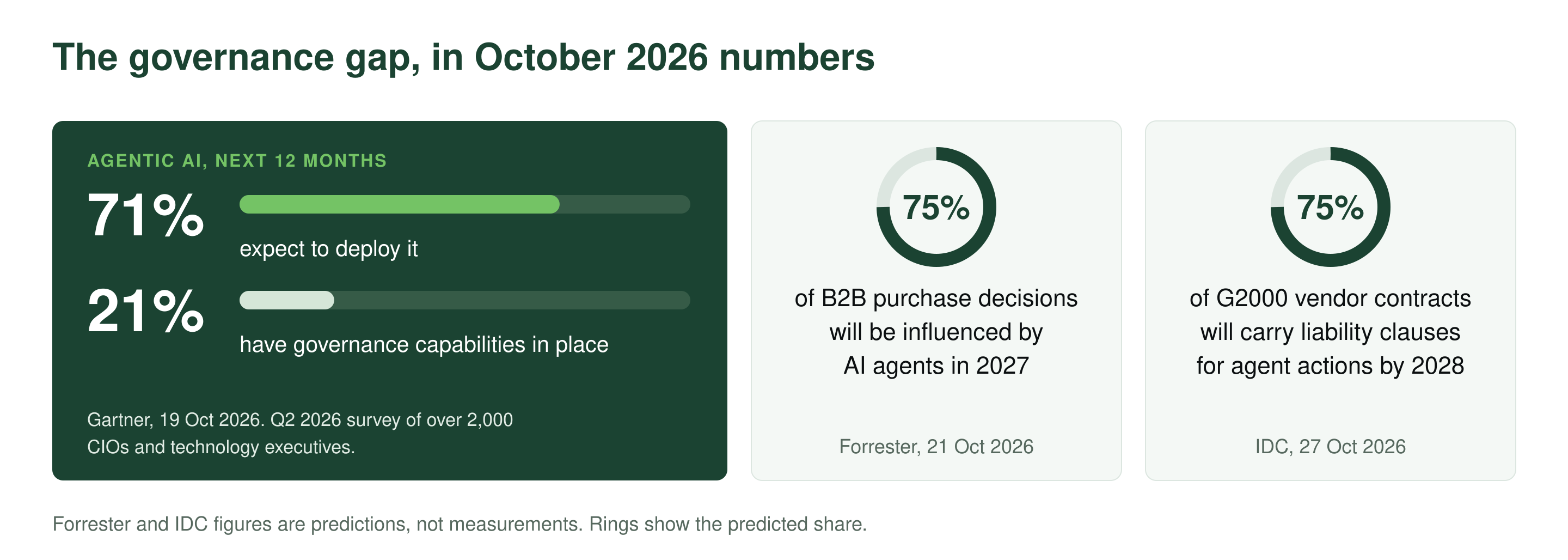
Gartner has the number. At its Symposium on 19 October, it reported that 71% of organizations expect to deploy agentic AI within twelve months and 21% have agentic AI governance capabilities in place. That is a survey of intent, not a measured deployment rate. It is still a fifty-point gap, and a quote is where that gap turns into a signed contract.
Faster is useful. But is the deal profitable, deliverable, and approved by someone with the authority to make the commitment? That is my test.
The controls must survive an enthusiastic agent
A CRM records the opportunity. An ERP records the order. Billing records the charge. Each has an essential role. Recording a transaction does not establish that the business authorized its underlying economics.
Before a proposal becomes a promise, the business needs to establish:
- Whether the configuration is valid and deliverable.
- Whether the applicable prices, customer agreements, and costs are current.
- Whether the margin meets policy and who can approve an exception.
- Which approved version should flow into the contract, order, and billing handoff.
That is the job of a commercial control plane: one governed place for product rules, pricing logic, cost models, and approval authority. It is what AI quoting governance looks like in practice. We use the term for how servicePath™ works. Use whatever term you like. Just make sure the thing exists.
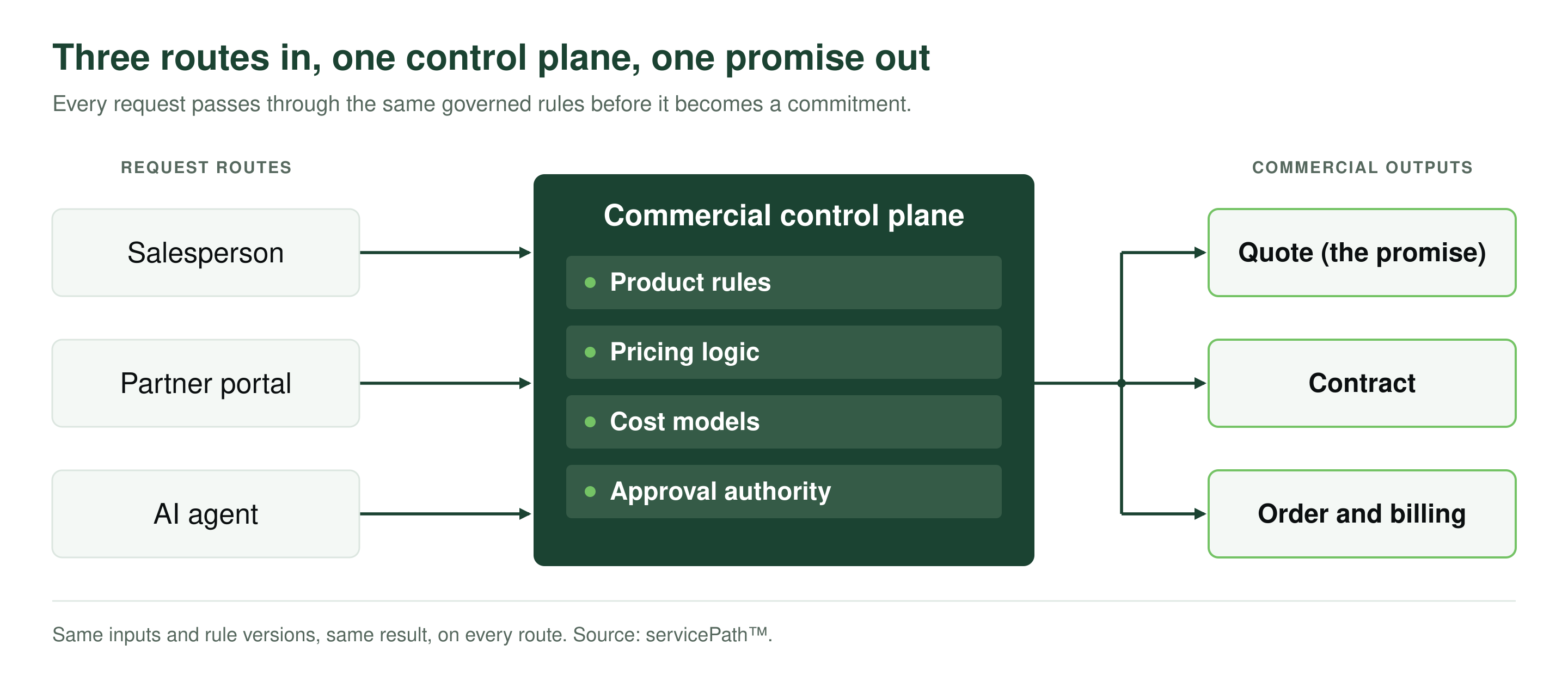
What AI quoting governance has to enforce on every route
It has to work on every route. A salesperson, a partner portal, an AI agent calling an API: same inputs, same rule versions, same answer. That means the number comes from a deterministic engine operating on governed context, not from a model.
A model can draft the narrative and explain the result. It cannot be the thing that computes the price, because two runs with the same inputs must produce the same answer, and the answer must be reconstructable later.
A prompt is not a pricing policy. The system that calculates the number enforces the policy, or the policy is a suggestion. An agent’s recommendation does not get to expand discount authority or bypass an approval, silently or otherwise. Increasingly the requester is a buyer-side agent, and it will never see the warning banner on the seller’s screen. Make the vendor demonstrate each route you intend to use, and get it in writing.
And it has to remember. Reopen a historical quote after today’s prices and rules have changed. Can anyone show the configuration, cost assumptions, applicable rules, exceptions, and approvals used at the time?
If the answer is an afternoon of exports, you have an audit trail in name only. An AI-generated explanation can help a reviewer understand events. The underlying evidence must establish what actually happened.
What a rule cannot tell you about governed pricing
AI depreciates, context appreciates. Apply that to a deal approved under an outdated rule.
A system enforces every rule correctly while those rules permit an economically weak commitment.
That is not a model failure. It is a management responsibility.
Did the proposal follow policy? Good. Is that policy still producing deals we want? That is the harder question, and no vendor’s AI will ask it for you, because the vendor is not paid to.
A low-margin deal can be a deliberate investment. In that case the problem is accepting the exposure without recording who owns it, why it is justified, and when it will be reviewed. A concession for one strategic customer is not a new price book. Record whether approval covers one deal or changes policy, and who can authorize that change.
Then measure the right things. Measure speed alongside cost freshness, approved margin exceptions, and the gap between quoted and delivered margin.
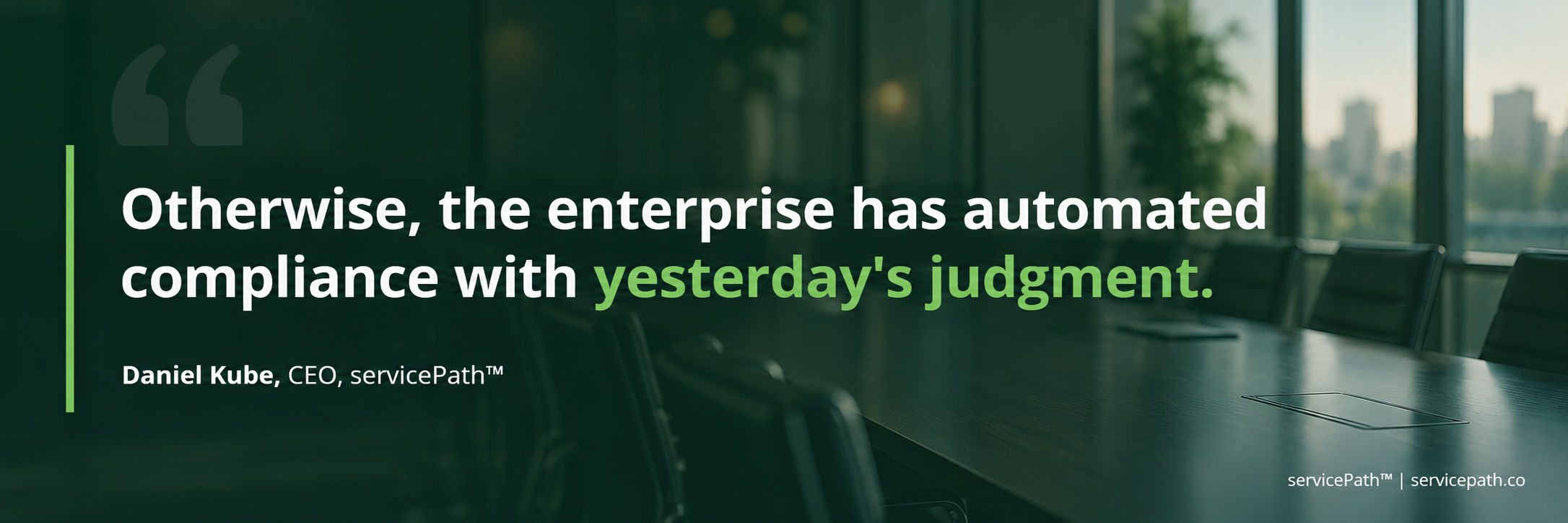
Otherwise, the enterprise has automated compliance with yesterday’s judgment.
What I would do this quarter
Five things, none of which need a project. Together they are most of AI quoting governance.
- Put a name on every cost table and price list, with a review date. Unowned means stale. Treat it that way.
- Put the margin threshold and the exception authority in the system, not in a PDF. An agent cannot read a PDF and a rep can forget one.
- Pull the ten largest quotes from last quarter and reconstruct each one: configuration, cost basis, rules, approvals. Time it. That number is your audit readiness, and it is usually worse than the policy says.
- Run one real quote through every route you intend to automate, including the partner portal and the API, and confirm the same approval fires on each.
- Compare quoted margin to delivered margin on every contract that passed its first anniversary. Separate the deliberate investments from the unexplained leakage, then change the rules the leakage points to.
Do the five and the next AI-generated proposal arrives into a system that can tell you whether to send it. Skip them and it arrives faster. That is the whole difference.
Routine deals should move quickly. Finance owns margin exceptions. Delivery leaders own feasibility. Name the person responsible for keeping the underlying assumptions current, or the speed is the only thing you governed.
Then test the vendor, including us
A useful evaluation of AI quoting governance starts with a real commercial scenario, not a demo script. Give every shortlisted vendor the same three-year service agreement, including a product dependency, customer-specific pricing, implementation costs, and variable usage assumptions.
Then change a supplier cost, request a discount that breaches the margin threshold, and introduce a missing input. Run the same deal through the partner portal and through an API call, not only the seller’s screen.
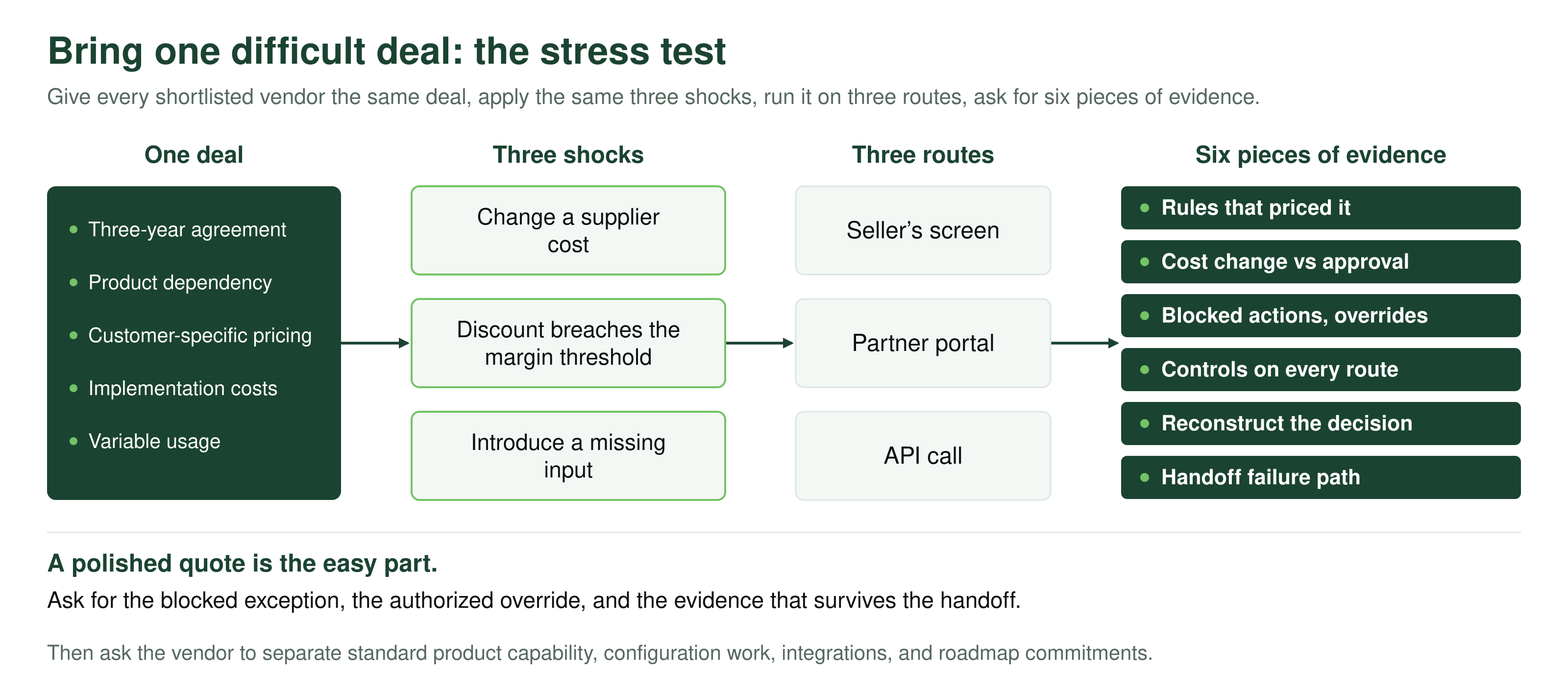
A polished quote is the easy part. Show me the blocked exception, the authorized override, and the evidence that survives the handoff. Then make the vendor separate standard product, configuration work, integrations, and roadmap, because the demo will blur them and the contract will not.
From servicePath™: See governed quoting in production. Download the Telent and Dell Technologies case studies.
One more thing to ask any vendor, us included: what data and rules you can export, what remains dependent on the vendor, and how customer information and AI interaction data may be retained or used. Product dependencies, pricing formulas, supplier economics, and negotiated exceptions are how your business makes money. They should outlive the interface.
If you plan to build it yourself, run the same test on your own team. AI may reduce initial development effort; hosting, security, monitoring, recovery, integration maintenance, and support still need accountable owners and an operating budget.
Does CPQ governance slow quoting down?
So run that on us. We wrote the test, and it is fair to ask whether we pass it. If you already run servicePath™, start by reviewing catalog ownership, cost freshness, approval policies, and the evidence retained for a historical quote.
servicePath™ CPQ+ holds the four things AI quoting governance needs in one place: the configuration rules that say what can be sold, the cost-to-service model behind each price, the approval workflow that decides who can say yes, and the audit log that remembers who did.
None of that is exotic. What is rarer, in fact, is that they run as one decision, so a cost change shows up in the margin before the approver sees the quote, not after the contract is signed.
Two things from customers, with their limits stated. Dell Technologies, in our published case study, took complex partner-enabled proposals from a full day to 15 minutes with the rules in place. That study predates AI quoting. Its point is narrower and more useful: governance was never what made quoting slow.
Telent’s Hannah Buckley, Sales Operations Manager, on what the platform has to absorb:
“Most CPQ solutions are built for simpler environments and are not engineered to account for this rate of adjustments. We have found that servicePath not only handles great complexity, but also constant change.”
Her rate of adjustments is vendor pricing and technology moving under a signed quote. That is the condition AI quoting makes worse.
AI can prepare the promise. Leadership still owns whether it should be made.

Frequently asked questions
Can an AI agent generate quotes without creating commercial risk?
Yes, if the platform it quotes through enforces current prices, costs, and approval authority on the agent’s route, not only on the seller’s screen. The risk is not hallucination. It is an agent applying stale inputs correctly, so the controls have to live in the system that calculates the number. That is AI quoting governance in one sentence.
What is a commercial control plane?
It is the governed foundation for product rules, pricing logic, cost models, and approval authority that every quoting route, human or agent, must pass through. servicePath™ uses the term for its approach to commercial governance: configuration, cost-to-service modeling, financial visibility, and approval workflows operating as one decision.
How should a CFO evaluate AI quoting governance in CPQ software?
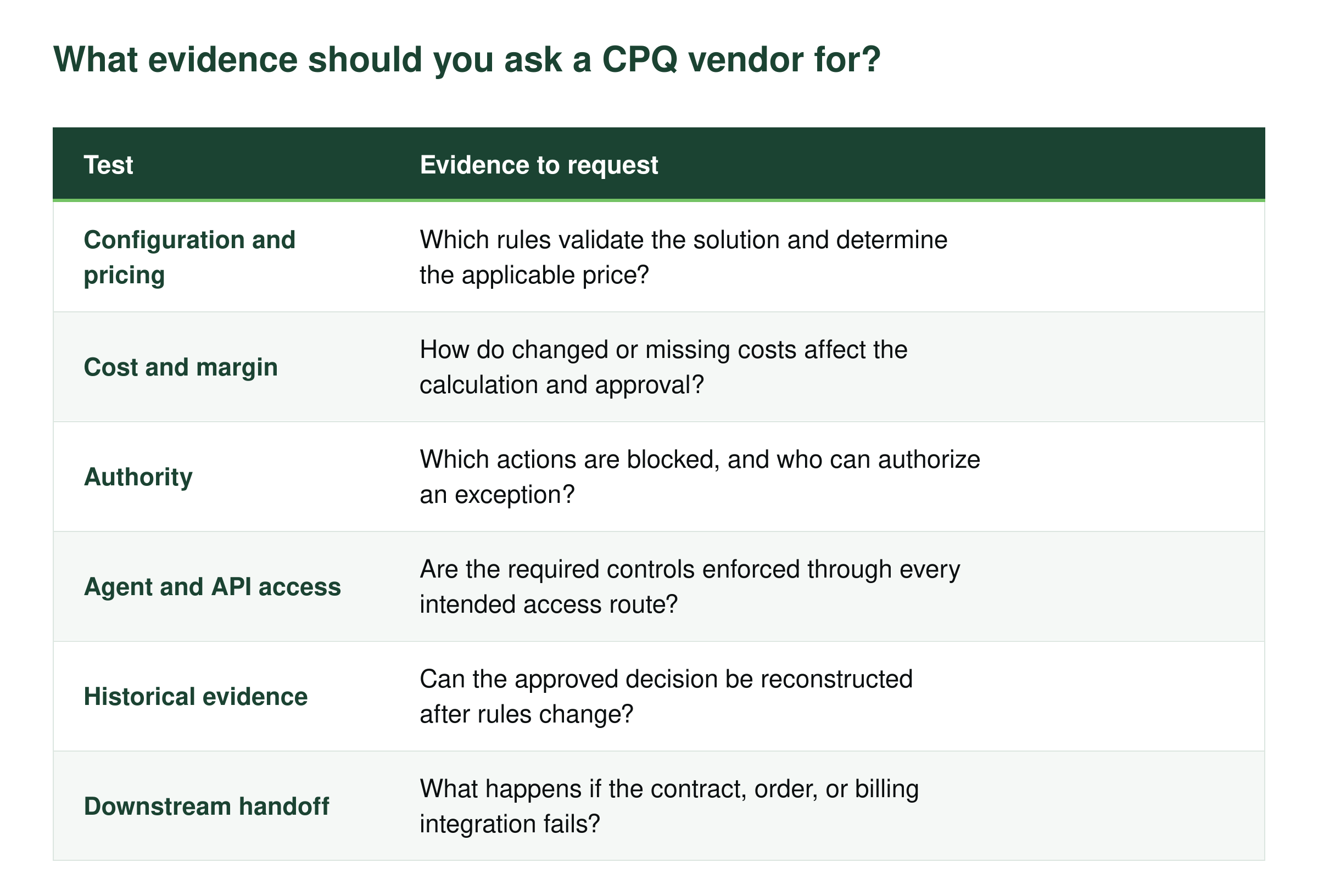
Bring one difficult deal and ask for six pieces of evidence: which rules priced it, how a changed cost alters the approval, which actions are blocked and who can override, whether the same controls apply through the API and partner portal, whether the approved decision can be reconstructed after the rules change, and what happens when the billing handoff fails.
From servicePath™: Bring servicePath™ a deal your team finds difficult to quote. Include the pricing exception, cost uncertainty, or configuration dependency that usually sends it back to finance or engineering. We will show how CPQ+ handles the decision, what requires configuration, and where integrations or additional controls are needed.