

Two managed services deals can book the same number and have opposite futures. Six signals, all visible at the quote, tell them apart before you sign.
What is good revenue, and how do you spot it before you sign?
The short answer
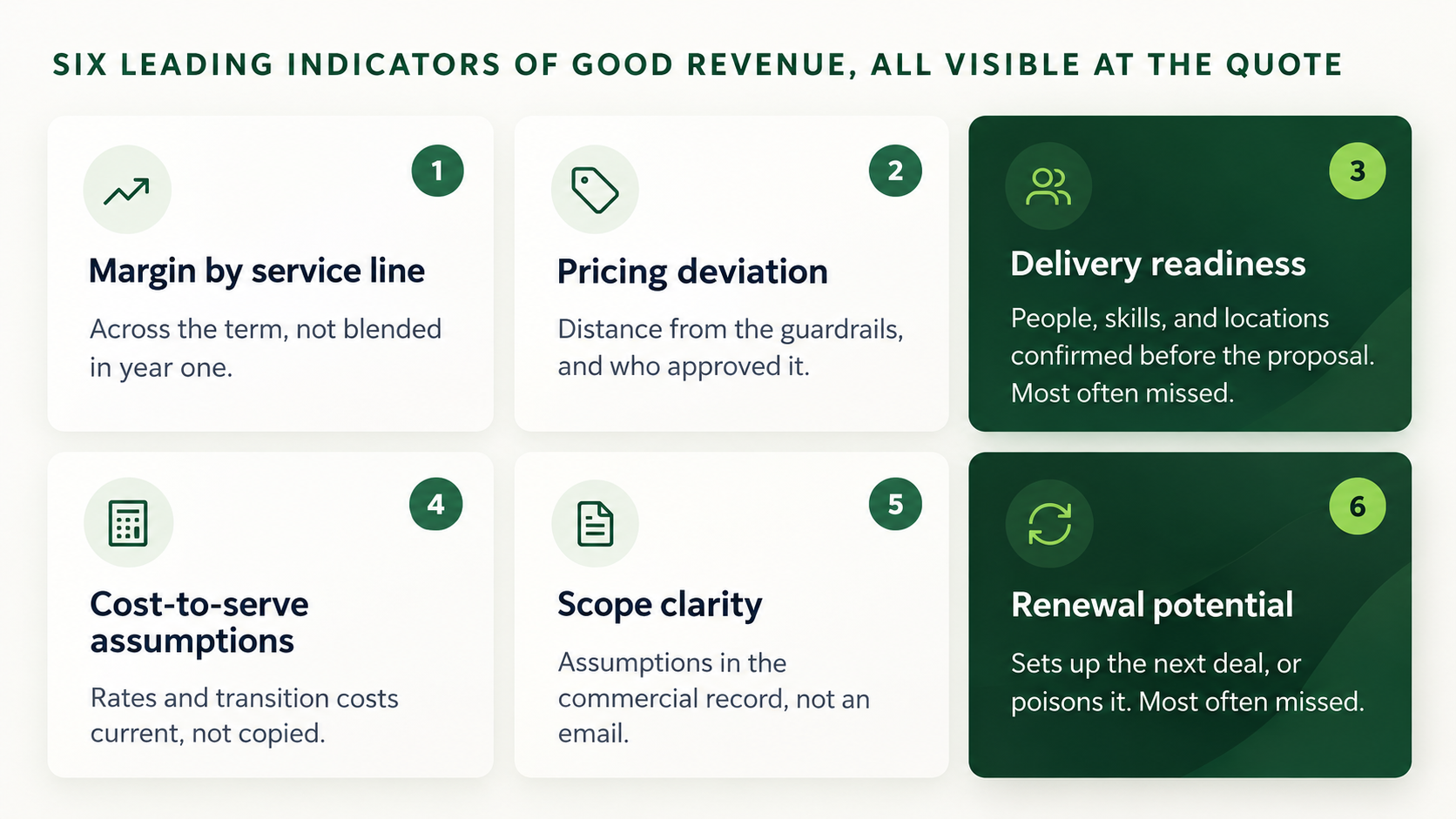
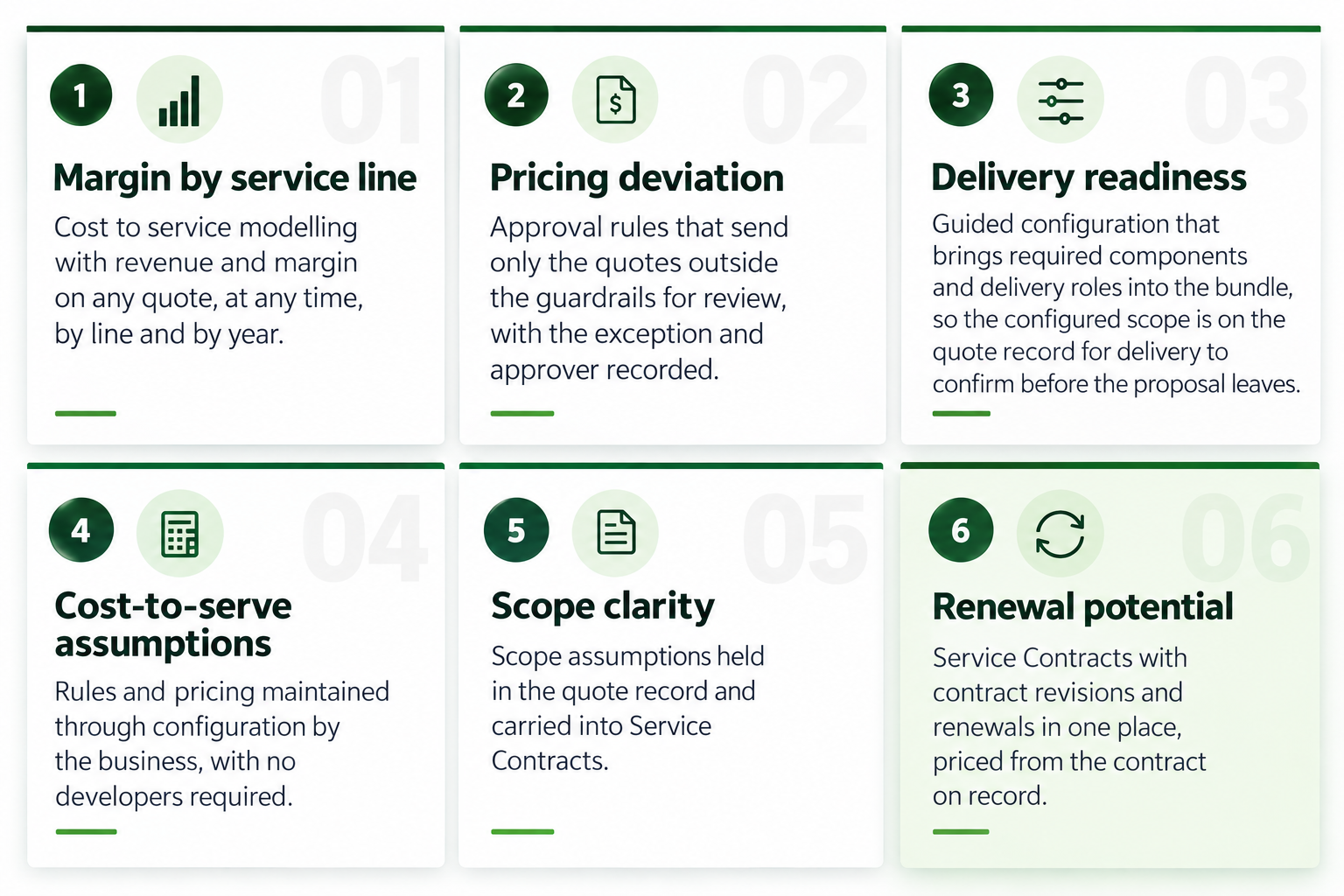
Good revenue is revenue that is still profitable after it is delivered. For a managed services provider, six signals predict it, and all six are visible at the quote: margin by service line, pricing deviation, delivery readiness, cost-to-serve assumptions, scope clarity, and renewal potential. A bookings report shows none of them.
Two deals can close in the same quarter at the same contract value and have opposite futures. One carries the margin the approver signed. The other is a problem the company has just agreed to deliver. The quarterly scorecard cannot tell them apart, because it reports what happened. The six signals below report what is coming.
‘
Why does this matter more in 2026?
Because the price is falling faster than the cost. In its Technology Report 2026, Bain found that customers are already factoring in productivity gains before they arrive, demanding as much as 20% efficiency improvements at renewal and awarding new work on assumptions of at least 30% lower delivery costs.
In Everest Group’s April 2026 research, new IT and BPO contracts increasingly require AI-enabled productivity gains from day one, with measurable outcomes embedded into pricing and delivery models.
The growth is not keeping pace. The ISG Index for the third quarter of 2026 put managed services growth at 2.1%, against 68% for as-a-service.
Steve Hall, who leads the ISG Index, said providers “have not yet captured the same growth economics as the technology providers.”
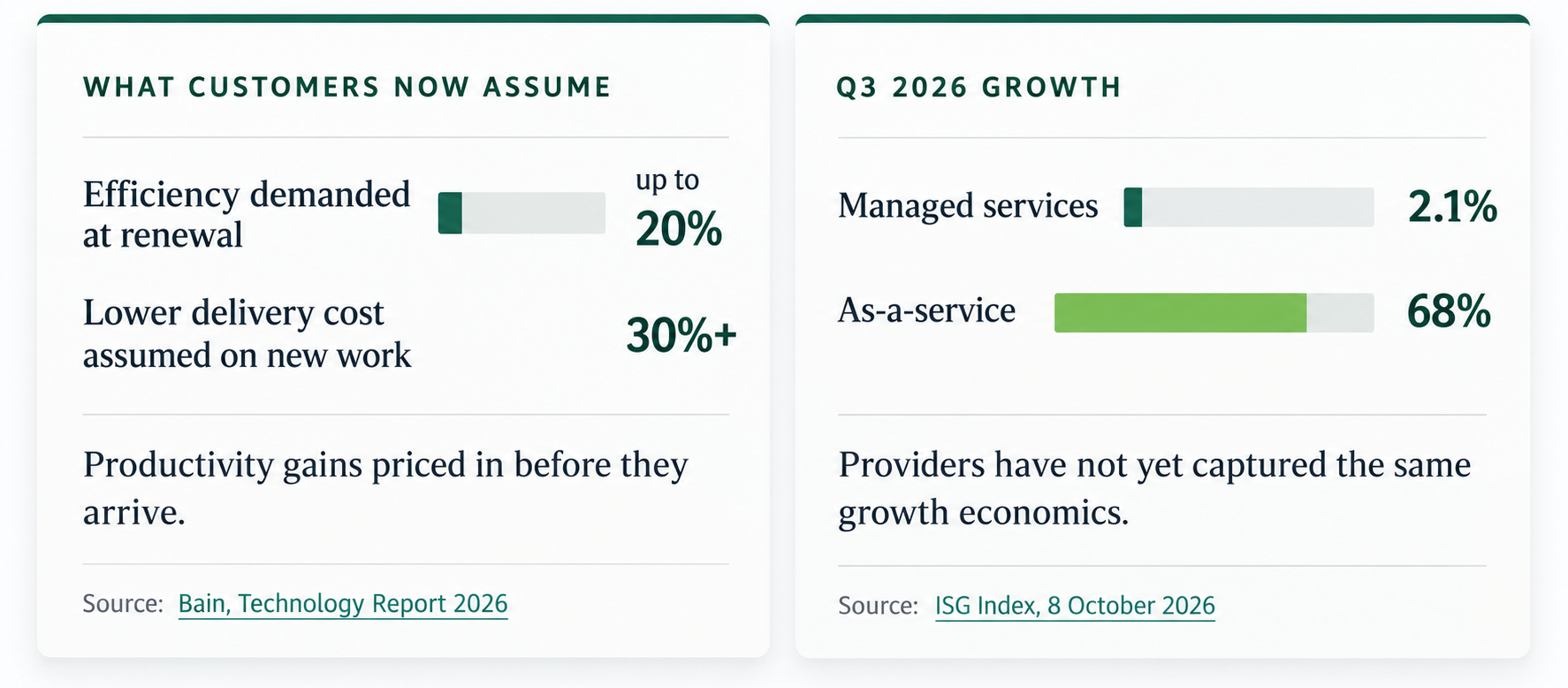
When a customer prices in savings you have not made yet, every deal carries more risk than the last one. The place to read that risk is the quote, before signature, not the QBR after it.
1. How do you check margin by service line before signing a managed services deal?
A blended margin hides the tower that loses money. A deal can show 25% overall while the service desk runs at a loss and the project work carries it. By year two, when the project work is done, only the loss is left.
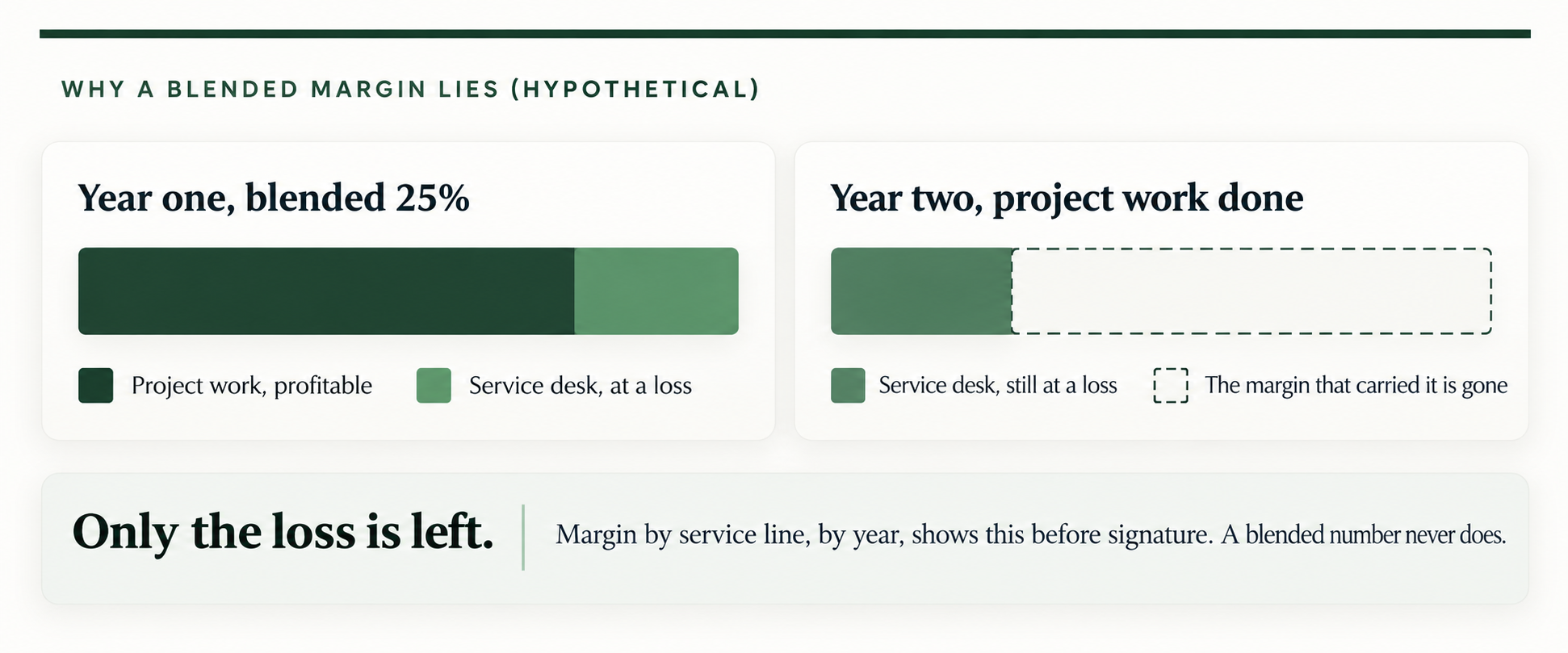
What to look for: margin for each service line, for each year of the term, on the quote itself. Not an average, and not year one only.
What goes wrong without it: the approver signs a number that is true on average and false in every line. Delivery discovers which line in month four.
The question to ask: which tower in this deal makes the least margin, and what happens to the total when the others ramp down?
This is what cost to serve is for. Price is what the customer pays. Margin is what you keep, and it has to be visible line by line before anyone commits.
2. How far is the price from the guardrails, and who approved the gap?
Pricing deviation is the distance between the quote and your own rules, and the name of the person who allowed it. Both matter. A 12% discount inside a pre-approved band is a decision. The same discount outside it, approved by nobody in particular, is a leak.
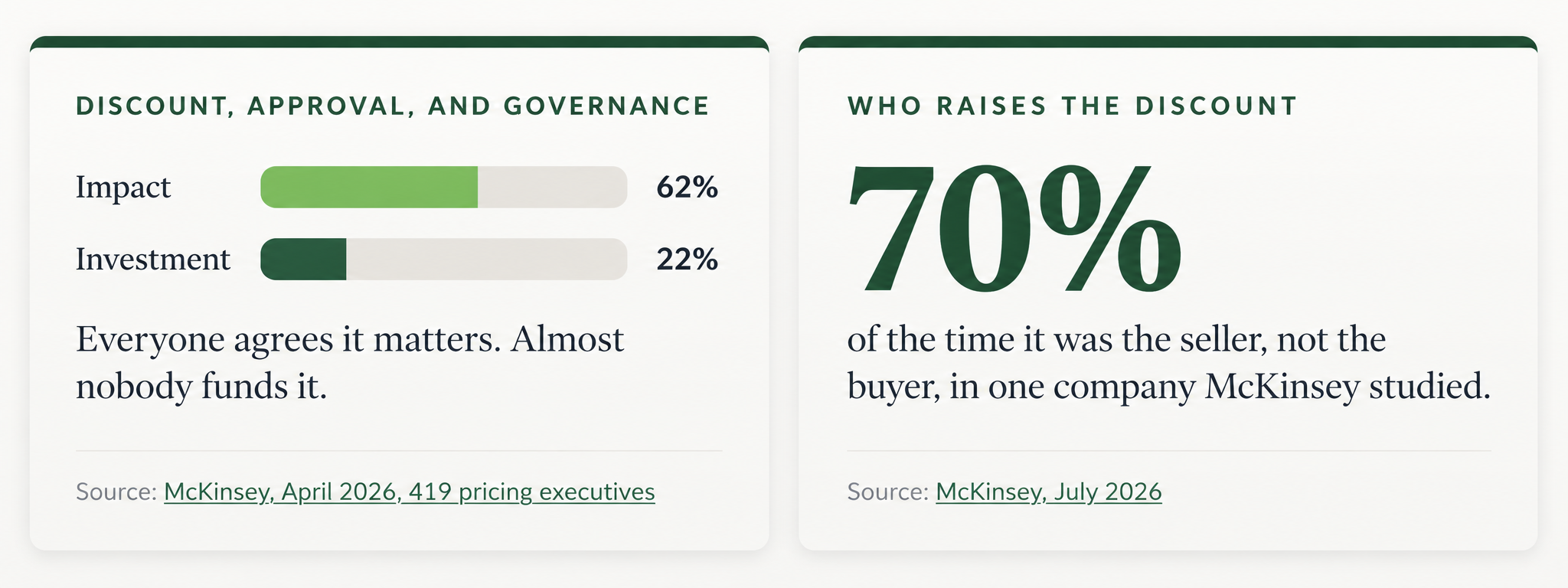
This is where governance is weakest, and the funding shows it. In McKinsey’s April 2026 survey of 419 pricing executives, discount, approval, and governance scored 62% for impact but just 22% for investment.
And in one company McKinsey studied in July 2026, when discounting came up in a sales conversation, the seller raised it 70% of the time, not the buyer.
What to look for: the discount expressed against a guardrail, and an approval record attached to any exception.
What goes wrong without it: every deal becomes an exception, the deal desk rechecks all of them, and the quarter-end queue does the discounting for you.
The question to ask: if this discount were a rule, would we apply it to the next ten deals?
Want to see margin by service line and guardrails on a live quote? Talk to a CPQ architect.
3. Can delivery actually deliver what the quote promises?
Delivery readiness is whether the people, skills, and locations exist on the day the contract starts. It is the signal sales and delivery most often never look at together, because they rarely look at the same screen before signature.
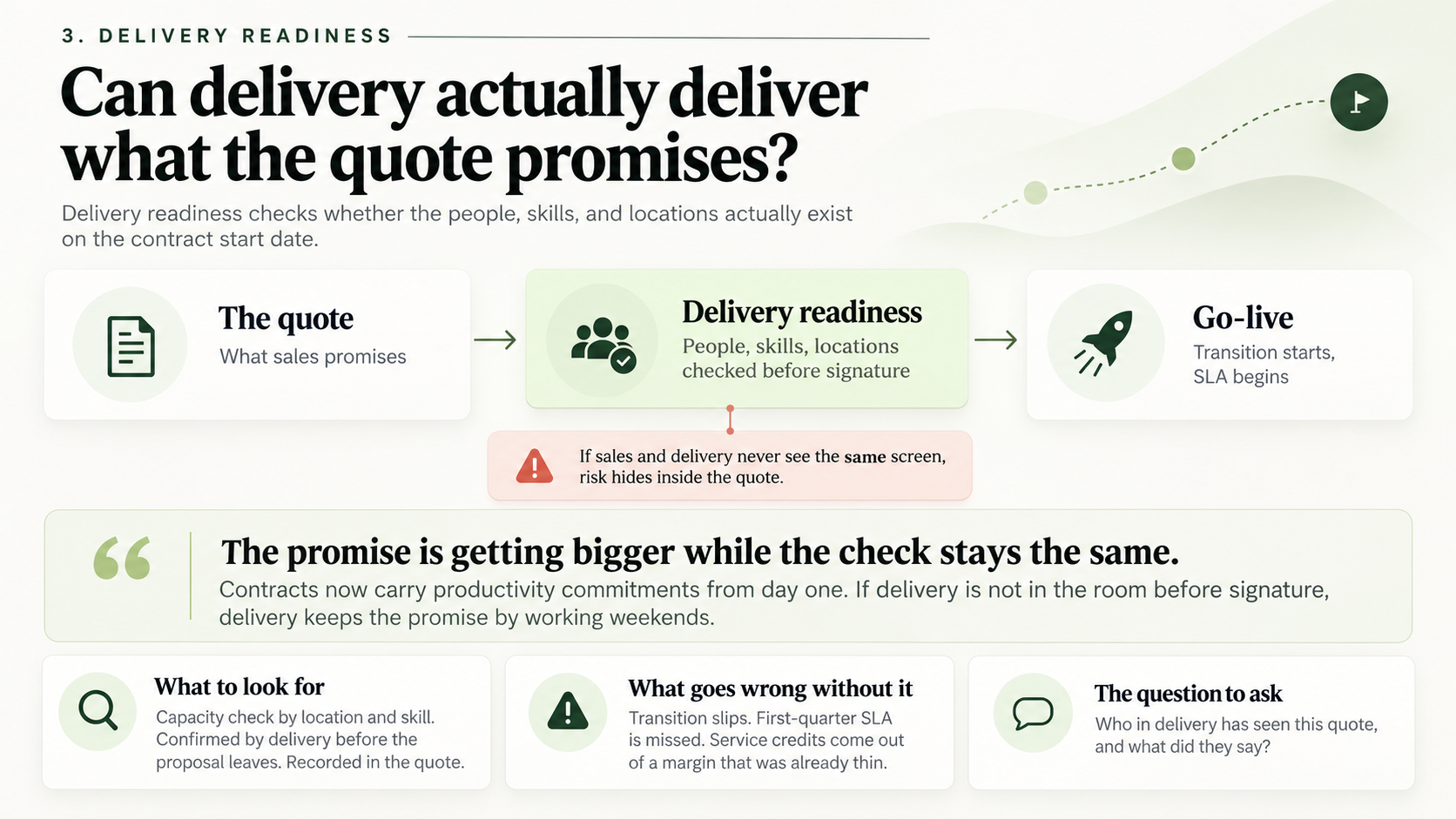
The promise is getting bigger while the check stays the same. Contracts now carry productivity commitments from day one, and a promise of day one productivity made without delivery in the room is a promise delivery will keep by working weekends.
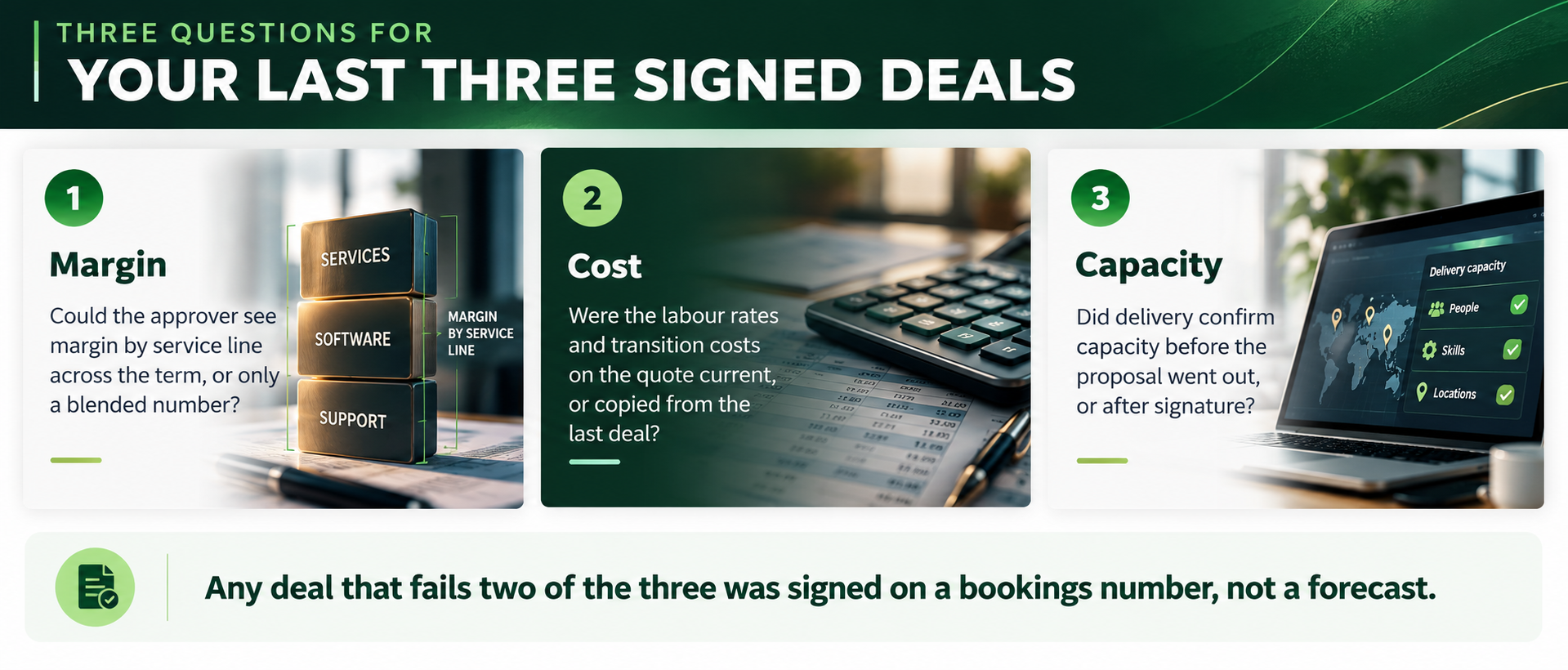
What to look for: a capacity check by location and skill, confirmed by delivery before the proposal leaves, and recorded in the quote.
What goes wrong without it: the transition slips, the SLA is missed in the first quarter, and the service credits come out of a margin that was already thin.
The question to ask: who in delivery has seen this quote, and what did they say?
4. Are the cost-to-serve assumptions current, or copied from the last deal?
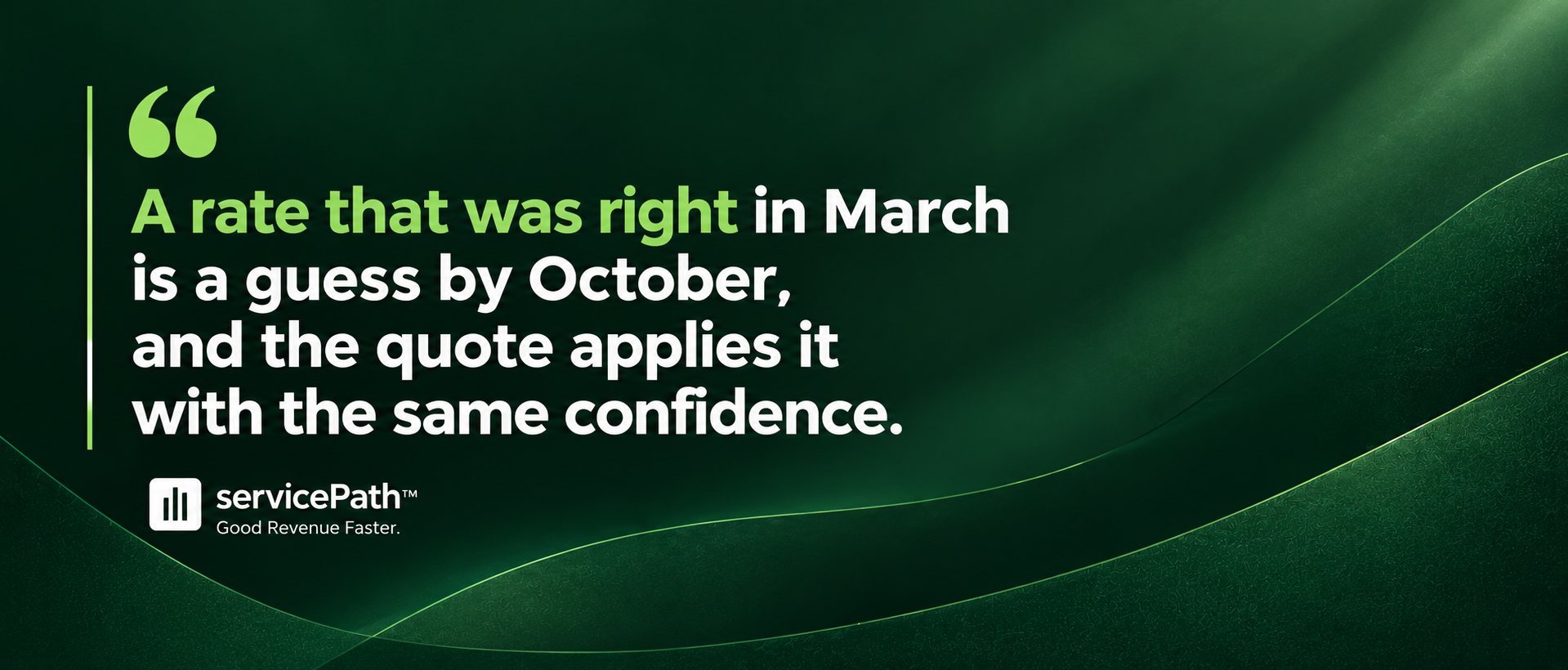
Most services quotes start life as a copy of the previous one. The headcount changes. The labour rates, transition costs, and tooling assumptions underneath it often do not. A rate that was right in March is a guess by October, and the quote applies it with the same confidence.
This is the services version of what Daniel Kube calls the forecaster who trusted historical patterns: the spreadsheet shows what the last deal looked like and assumes this one will behave the same way.
What to look for: labour rates by location, transition cost, and tooling cost with a date on them, maintained by the people who run delivery rather than by whoever last opened the file.
What goes wrong without it: the customer’s price is current and your cost is not. In a market where customers assume at least 30% lower delivery costs on new work, the gap lands on your margin.
The question to ask: when was the rate card behind this quote last updated, and by whom?
5. Are the scope assumptions written into the commercial record?
Scope clarity is whether the assumptions the price depends on live in the quote, or in an email thread nobody will find in month nine. Ticket volumes, supported sites, hours of cover, what counts as a change request: every one of them is a price assumption, and every one of them is a dispute if it is not written down.
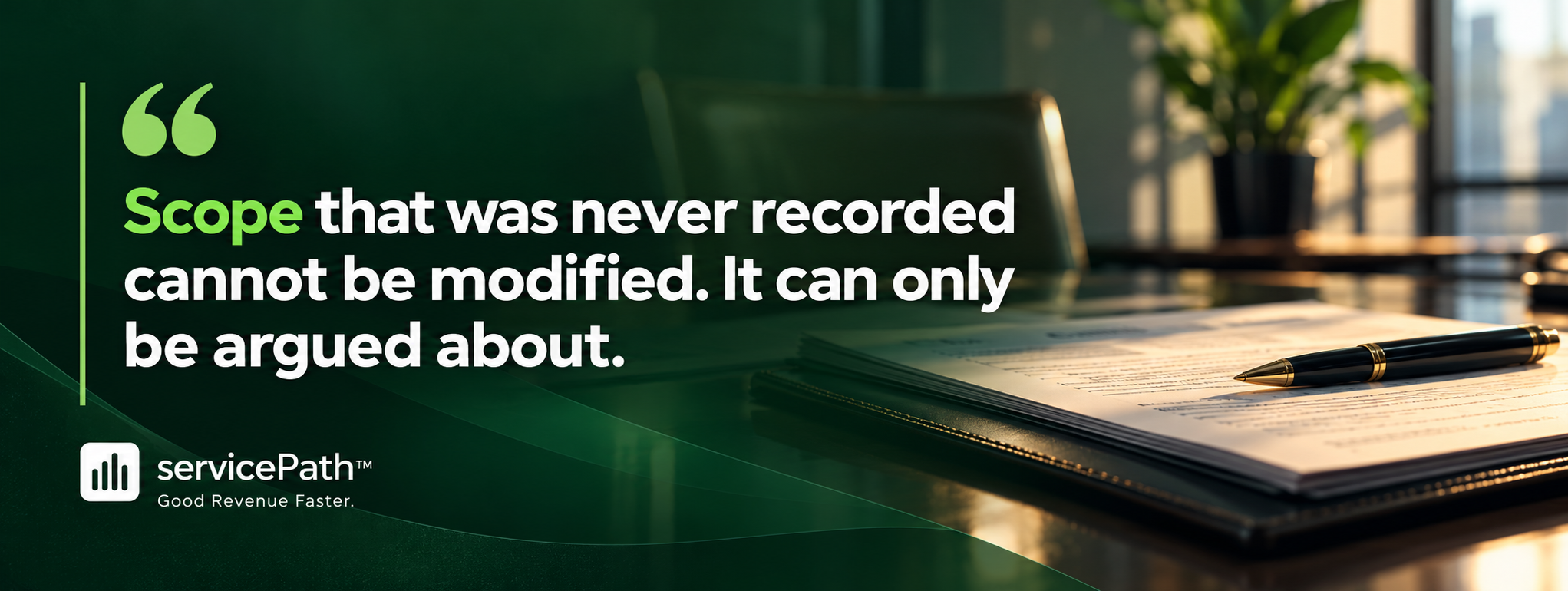
The accounting side is less forgiving than the commercial side. Under ASC 606, a change to the scope or price of a signed contract is a contract modification, and EY’s September 2026 revenue guide sets out when that change counts as a separate contract and when it rolls into the original. Scope that was never recorded cannot be modified. It can only be argued about.
What to look for: the assumptions as structured fields on the quote, carried into the contract unchanged, visible to delivery and finance.
What goes wrong without it: the customer remembers the price and not the assumptions. Delivery absorbs the difference until the renewal, when it becomes a negotiation.
The question to ask: if the customer doubles ticket volume in month six, does this quote say what happens?
6. Does this deal set up the renewal or poison it?
Expansion and renewal potential is the signal that feels like a year three problem on the day the deal closes. It is decided on that day. A deal priced below cost to win the logo is a renewal already lost, because the customer remembers the price, not the cost overrun, and expects the same number again.
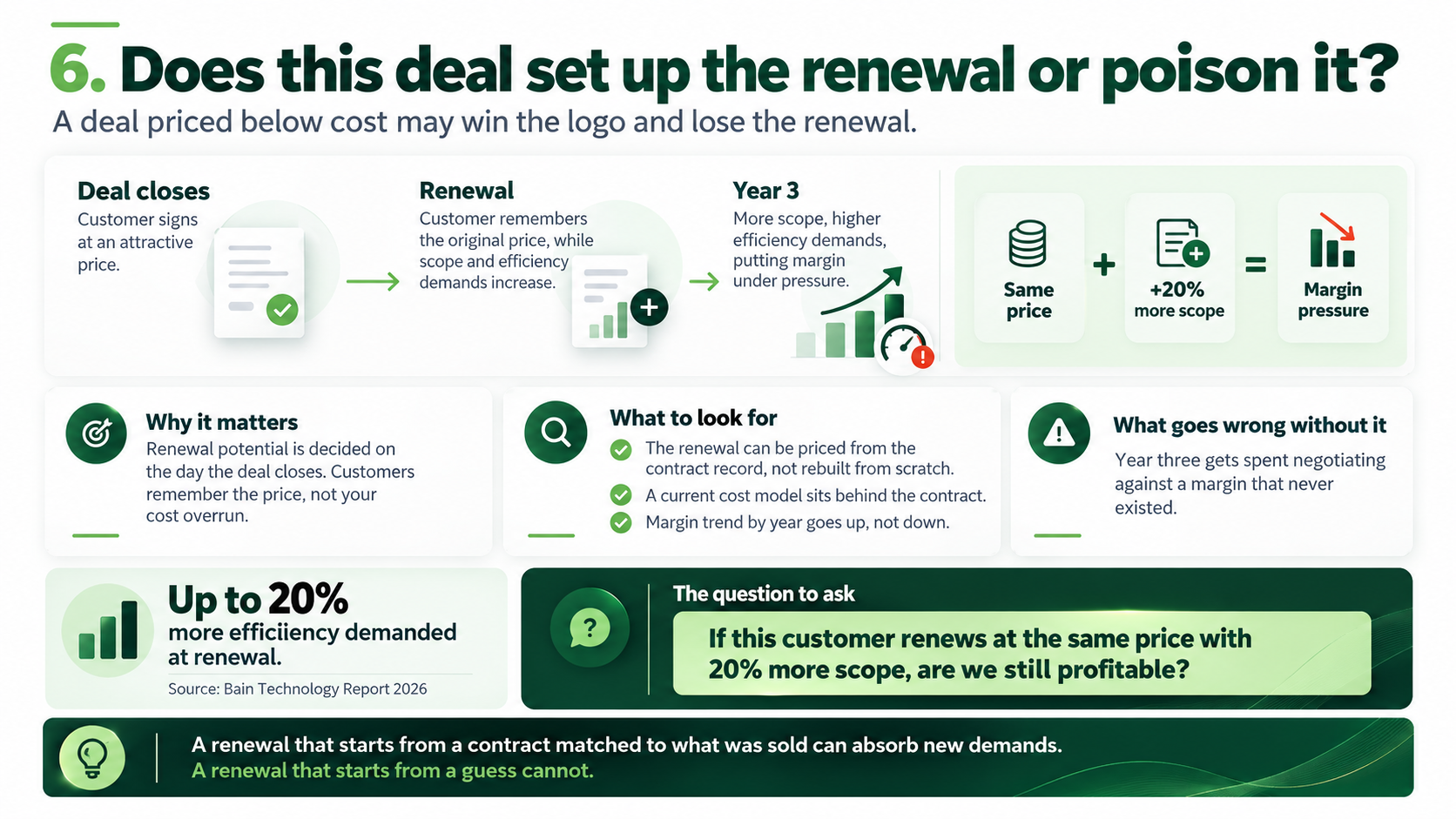
The renewal is where the customer’s new assumptions arrive in writing. A renewal that starts from a contract matching what was sold, with a current cost model behind it, can absorb a demand for 20% more efficiency. A renewal that starts from a guess cannot.
What to look for: a renewal that can be priced from the contract record without rebuilding the deal, and a margin trend by year that goes up, not down.
What goes wrong without it: year three is spent negotiating against a margin that never existed.
The question to ask: if this customer renews at the same price with 20% more scope, are we still profitable?
For the full argument behind these six, read Daniel Kube’s Executive Conversations edition on what a D-Day forecast teaches revenue leaders, and our insights on revenue governance.
Which two signals get missed most often?
Delivery readiness and renewal potential. The first because sales and delivery rarely look at the same screen before signature, so capacity is assumed rather than confirmed. The second because it feels like a year three problem on the day the deal closes. Both are decided at the quote, and both are the ones that turn a good quarter into a bad year.
What does one missed signal cost? A worked example
Take a hypothetical $1M managed services deal at a 25% planned margin. The rep discounts 18% to get it over the line. The delivery cost does not move, so the full $180,000 comes out of a $250,000 margin. The deal still looks fine on the bookings report. Nearly three quarters of the profit is gone before the first invoice, and that is one signal out of six.
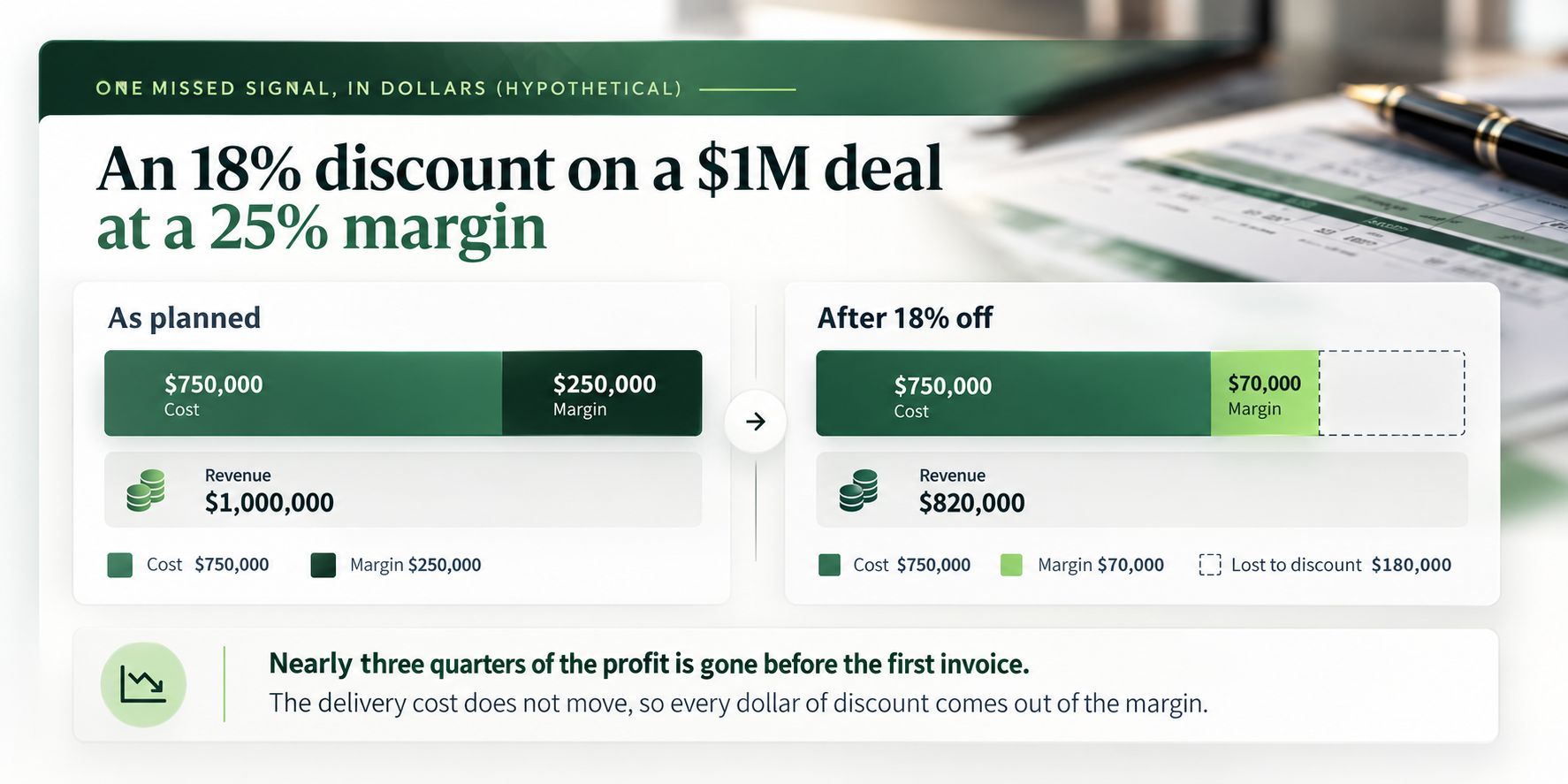
McKinsey’s April 2026 pricing research restates a long-standing figure that explains why: on average, a 1% price increase translates into an 8.7% increase in operating profit, assuming no loss of volume. Run that backwards and an unexplained 18% discount is rarely survivable.
How do you test your own deals?
Pull your last three signed services deals and ask three questions of each.
Where should governance happen?
At the quote. It is the last point where scope, price, and transition can still change cheaply, and the one place sales, finance, and delivery can look at the same deal before it becomes an obligation.
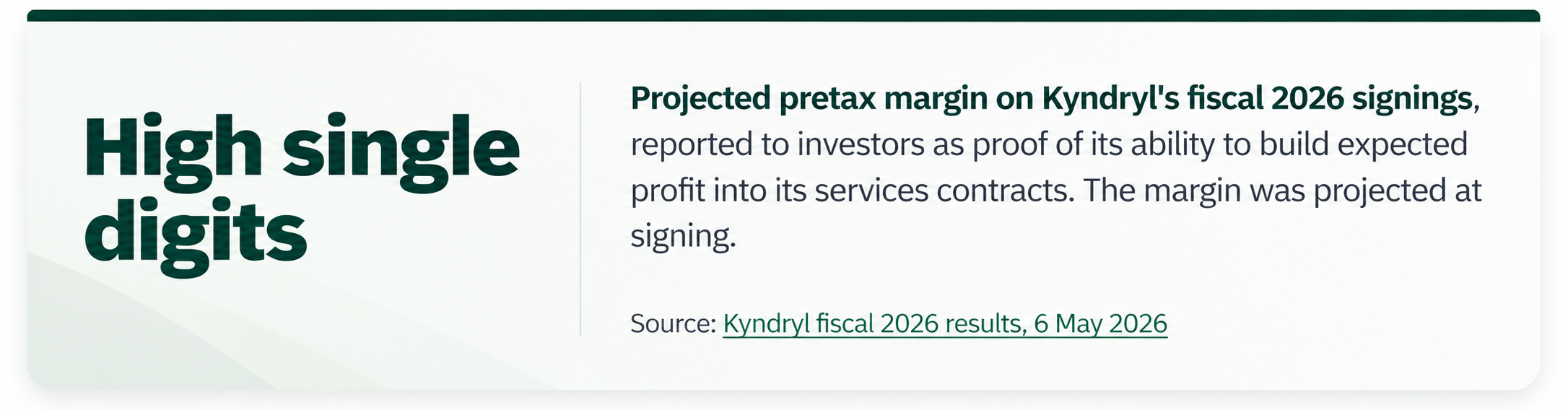
The public companies that do this well say so in their numbers: Kyndryl told investors in its fiscal 2026 results that the projected pretax margin on its signings was in the high single digits, demonstrating its ability to build expected profit into its services contracts. The margin was projected at signing.
Why servicePath™
servicePath™ is a revenue lifecycle management platform built on a governed, no-code CPQ foundation for technology services firms. It puts all six signals on the quote before signature.
The proof is published. Telent, a UK technology services firm, came to servicePath™ after a failed CPQ implementation. Its case study describes salespeople who can now model deals, predict payback, and ensure profitability, with a dashboard showing win rates and margins on each deal.
Dell Technologies, in a case study published when it was still Dell EMC, reported complex changes to proposals taking as little as 15 minutes instead of a day, and summed up its result in four words: “No more bad quotes.”
Frequently asked questions
How do you know if a managed services deal is profitable before signing?
Check six signals on the quote: margin by service line across the term, how far the price sits from your guardrails and who approved it, whether delivery has confirmed capacity, whether the labour and transition costs are current, whether scope assumptions are written into the quote, and whether the deal can renew at a margin. A deal that shows all six is good revenue. A deal that shows a bookings number is a guess.
What are the leading indicators of deal quality?
Margin by service line, pricing deviation from guardrails, delivery readiness, cost-to-serve assumptions, scope clarity, and expansion or renewal potential. Bookings, win rate, and quota attainment are lagging indicators. They report what happened. The six leading indicators report what is coming, and all six exist before signature.
Why can’t a dashboard tell a good deal from a bad one?
A dashboard reports on deals already in it, using lagging indicators. Two deals with the same contract value look identical there. The signals that separate them exist earlier, when the deal is shaped, and only reach the dashboard if the quoting process captured them.
Does deal governance slow down an MSP’s sales cycle?
Not when it is designed well. Guardrails let a deal inside them go straight through, and send only the exceptions for review, with the reason attached. What slows deals is the manual rechecking that happens because nobody trusted the quote in the first place. Governance at the quote removes the reason to check.
Sources
- Bain: Tech Services, Technology Report 2026 29 September 2026
- Everest Group: Crisis is the new normal 15 April 2026
- ISG Index, third quarter 2026 8 October 2026
- McKinsey: B2B pricing, the next phase of the AI revolution 7 April 2026
- McKinsey: The future of B2B sales 16 July 2026
- EY: Revenue from contracts with customers (ASC 606) September 2026
- Kyndryl fiscal 2026 results (SEC filing) 6 May 2026