
Memory, cloud, and supplier costs are moving faster than multi-year contracts. Nine checks to keep pricing risk out of your next quote.
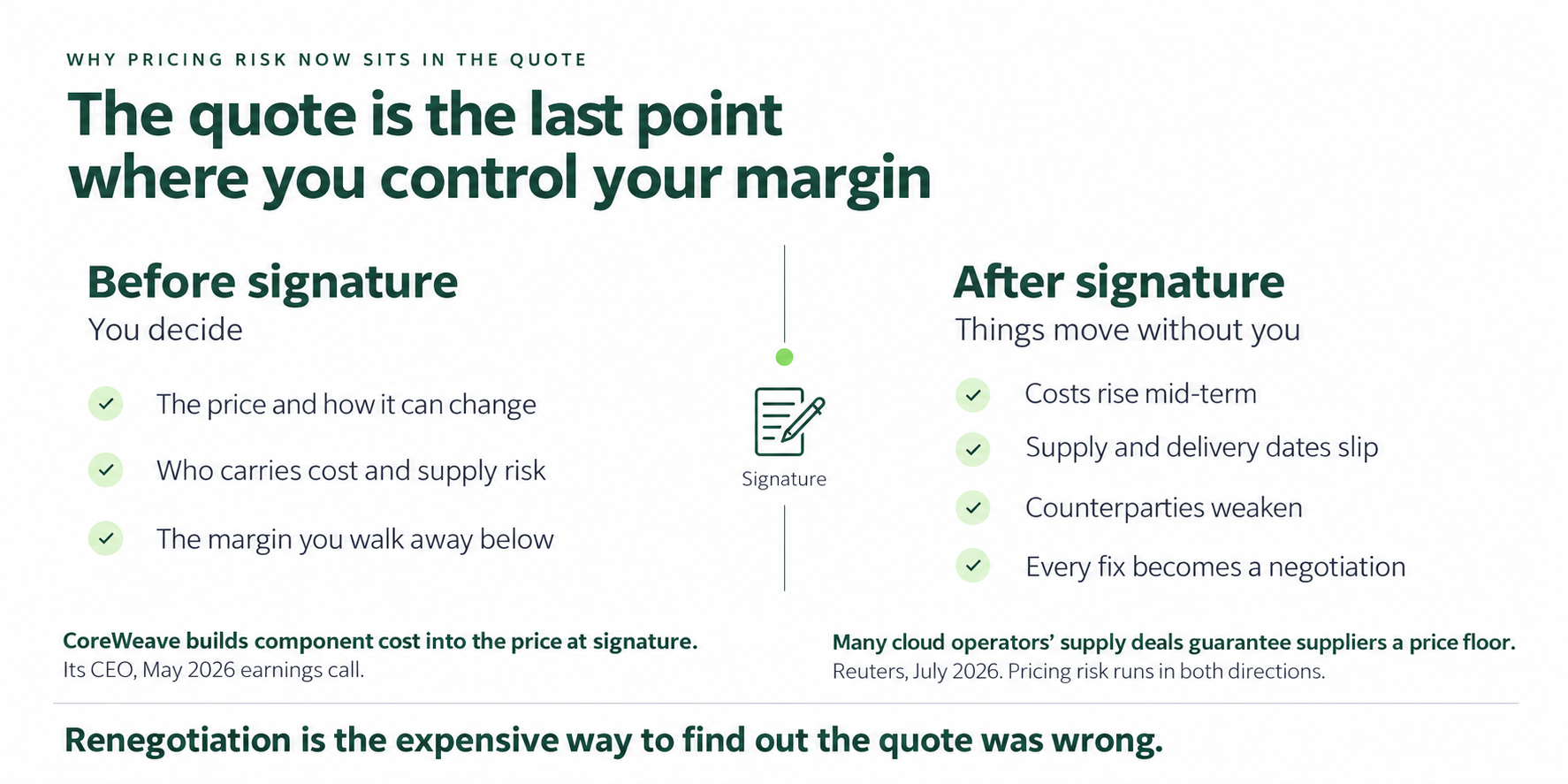
Why pricing risk now sits in the quote
When costs, supply, and counterparties can all move after signature, the quote is the last point where you control your margin. Price it loosely and you have not won a deal. You have signed up for its risk.
Renegotiation is the expensive way to find out the quote was wrong.
This month, CoreWeave, one of the best known AI cloud providers, saw its credit default swaps hit distress levels. Its five-year swaps reached a record 1,194.5 basis points on 15 October, a price Benzinga reported implies a more than 60% chance of default within five years.
Days later, HSBC said debt market woes and moderating LLM revenues exacerbate structural concerns.
In May, CoreWeave’s CEO named the delivery constraints himself: “It’s labor, it’s memory, it’s storage, it’s our ability to bring up infrastructure.”
JPMorgan argues the business is sound, calling the concerns overdone relative to CoreWeave’s fundamentals and pointing to long-term take-or-pay contracts. We are not here to pick a side.
We are here because the pattern underneath is not unique to AI infrastructure. Long, committed contracts on one side. Volatile costs, supply, and partners on the other. Most mid-market and enterprise businesses selling multi-year deals have the same exposure, at a smaller scale and with a thinner balance sheet to absorb it.
What CoreWeave’s own contracts show
I find CoreWeave’s contracts more useful than its bond price. It prices component cost in at signature, and its supply deals are where the risk sits.
On its first quarter 2026 earnings call, CEO Michael Intrator said: “we build our contracts to incorporate the cost of all of the components that are necessary to deliver infrastructure.”
The supply side is harder, though. Reuters reported that cloud operators, CoreWeave among them, have signed long-term memory and storage deals, and that many of these deals guarantee suppliers a price floor for memory and storage chips. If memory prices fall, the floor still gets paid.
Pricing risk runs in both directions.
The back-to-back problem
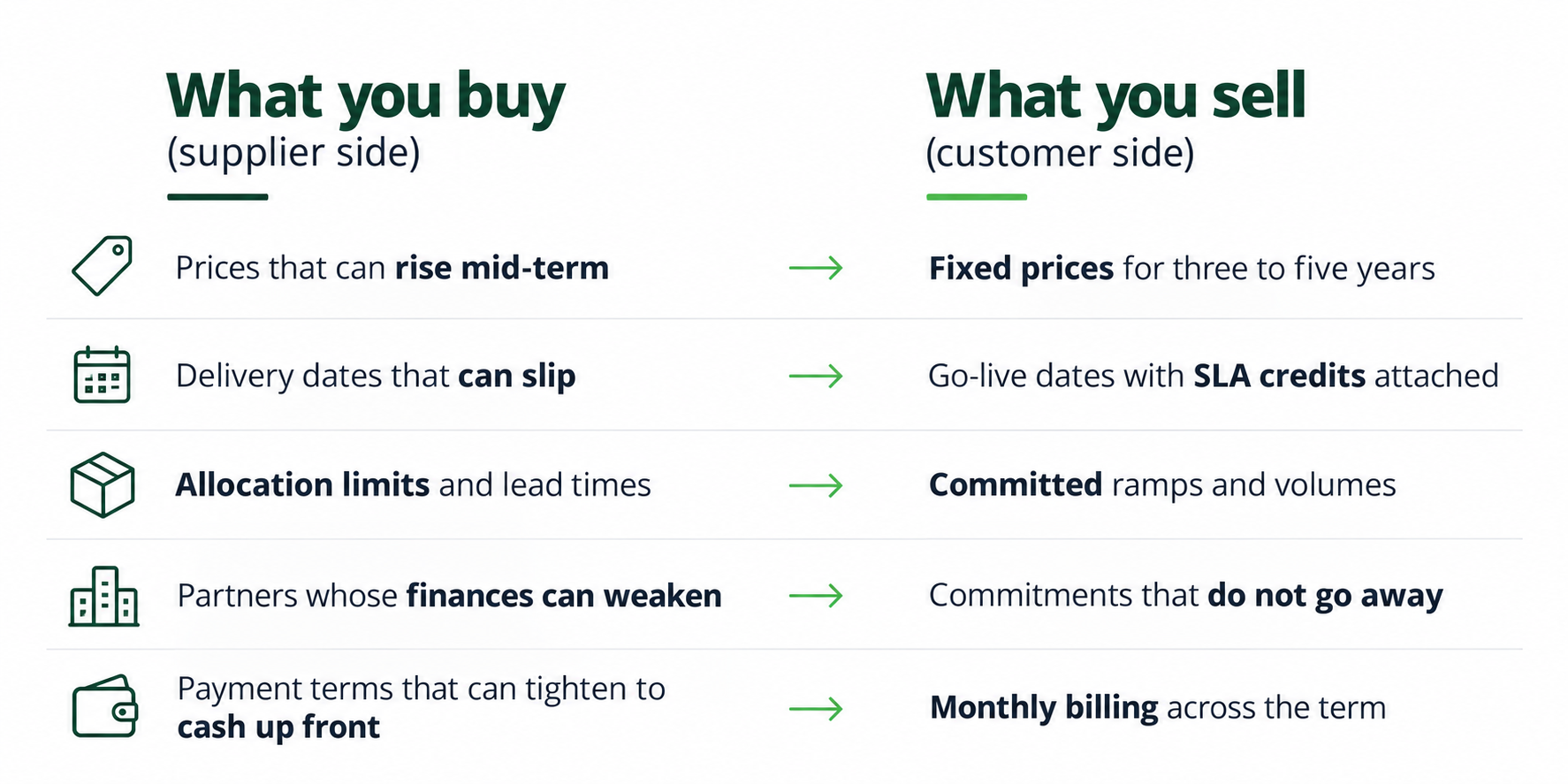
Most B2B companies sit in the middle of a chain. You buy from suppliers on their terms and sell to customers on yours. In a stable market the two line up well enough. In a volatile market they drift apart, and the gap lands in your margin.

Where pricing risk comes from in 2026
The input cost side is already moving. DRAM prices were expected to double in Q1, and hosting and cloud providers have been passing increases through. HPE’s CEO Antonio Neri told analysts in March that “RAM and NAND now make up over half of the bill of materials cost of a traditional server.” Memory and storage are also two of the constraints Intrator named.
Labour has not gone away. It made a new appearance on CFOs’ list of most pressing concerns in the third quarter, according to the Richmond Fed CFO Survey. But wage costs move slowly, and they show up in the budget first. This year the shock is in what you buy.
If your customer contract has no way to respond, you absorb the difference for the rest of the term.
Your suppliers have already moved their risk
This year HPE amended its quoting terms “with the right to reprice existing orders for commodity cost increases between quoting and shipment.”
Dell Technologies COO Jeff Clarke was blunter still. “We’re repricing, it feels like, every day,” he said on Dell’s earnings call on 29 May. (CIO Dive)
Telecom carries the same exposure, because its equipment makers reprice too. In July, Ericsson said it was increasing prices for new and existing network contracts. If you sold a three-year managed network at last year’s equipment prices, you are carrying that difference.
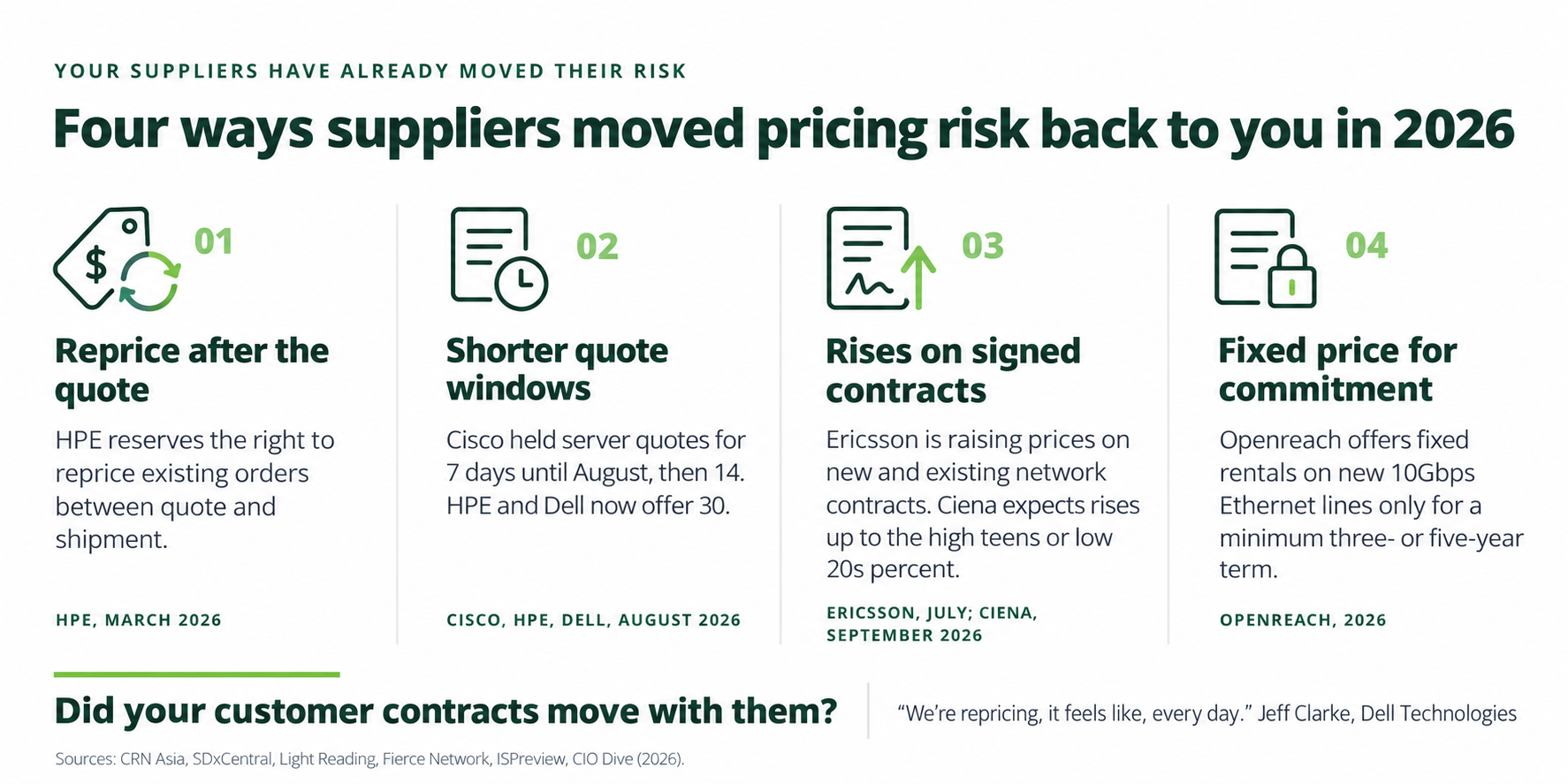
I do not blame any of them. Every one of those vendors is protecting its margin, because that is their job. CoreWeave does the same when it builds component cost into its contracts. If you did not do the same with your customers, you quietly took the pricing risk they handed you.
Why you will not pass all the pricing risk on
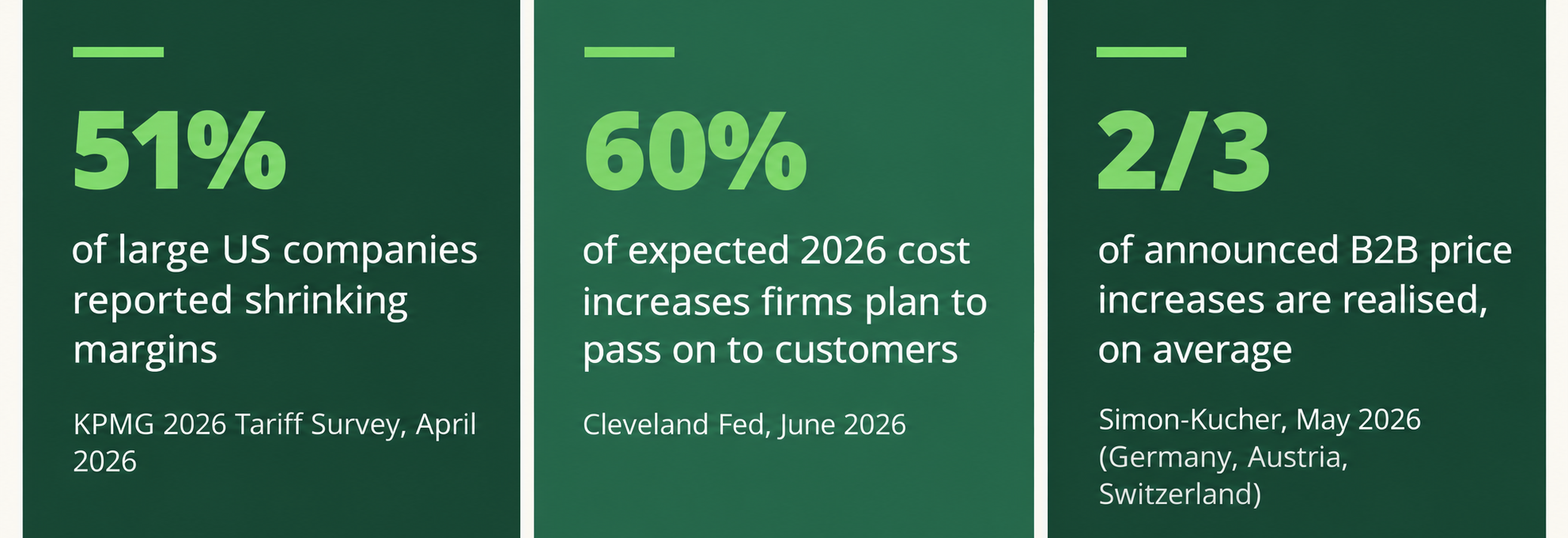
Passing costs on is harder than most pricing committees assume. In the KPMG 2026 Tariff Survey, 51% of the large US companies surveyed reported margin declines, even as the share passing most tariff costs to customers rose from 13% to 34%.
Firms surveyed by the Cleveland Fed also expect to pass through only 60% of their 2026 cost increases by raising prices. Simon-Kucher found that companies in Germany, Austria, and Switzerland realise only about two-thirds of the price increases they announce. So plan the margin on the part you will recover.
What it looks like on the quote desk
On r/msp, one IT buyer described a server quote of about $22,000 that became $52,000 by the time the order went in. Another replied: “this quote is valid for 86 seconds, do you want it?” (r/msp)
Most providers never decided to bet on memory prices, but they made the bet anyway when they bundled hardware into a fixed fee. Dave Sobel, who hosts Business of Tech, calls that having “taken a position in the memory market.” His summary: “You are short silicon.”

Who should be wary
If you sell multi-year, committed, or bundled deals and buy anything whose price or supply can move, this applies to you. Technology service providers (TSPs) feel it first. They are not the only ones.
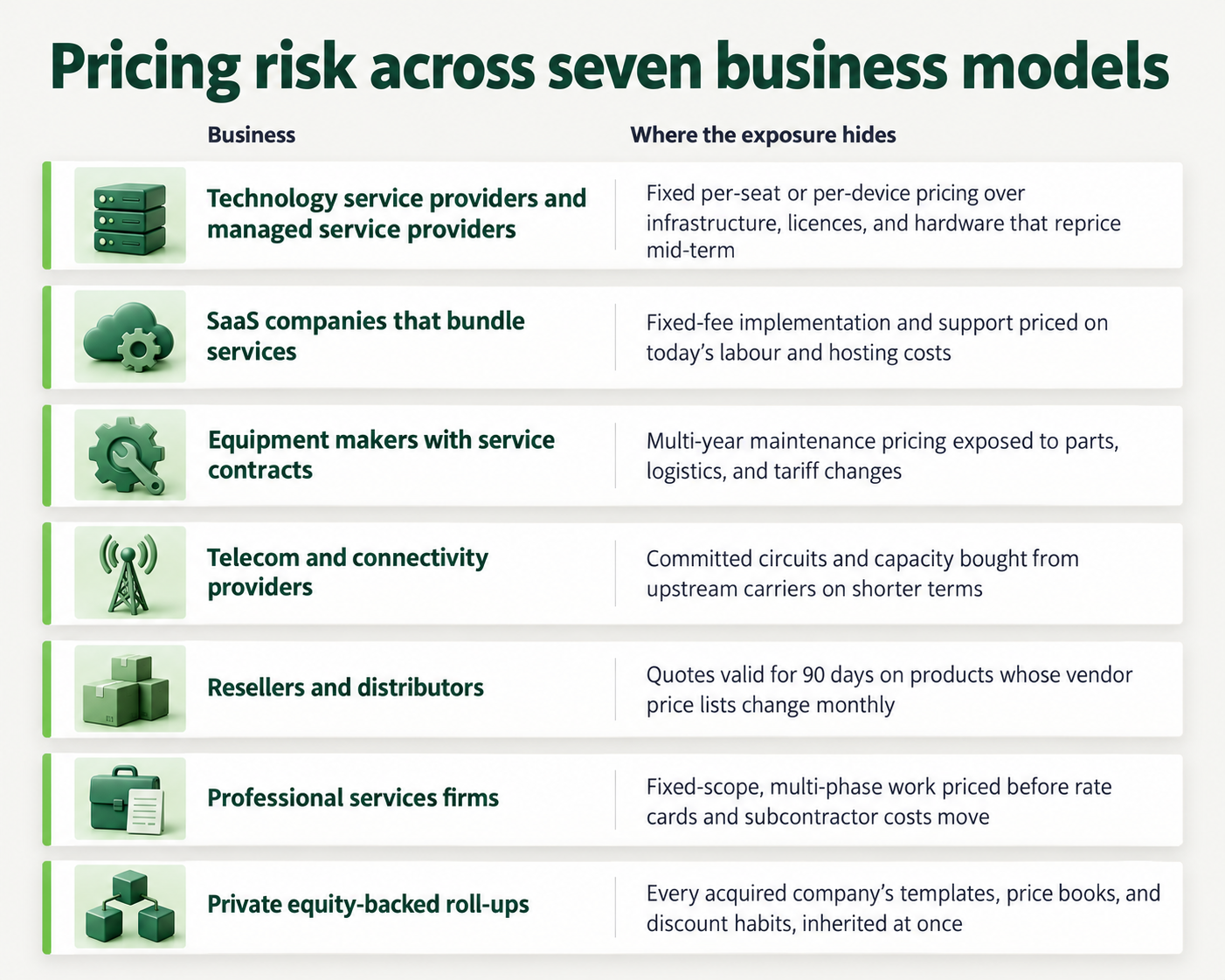
The common thread is a commitment made today against costs you will pay tomorrow. The larger the deal and the longer the term, the more a small pricing error compounds. So the biggest contracts carry the most pricing risk, and they get the least scrutiny once they are signed.
How much can pricing risk cost on a single deal?
On the hypothetical deal below, it costs $172,500, almost a quarter of the profit the deal was approved on. Take a managed services contract priced before this year’s increases. It runs three years at $1 million a year and was priced at a 25% gross margin, so the plan is $750,000 of gross profit over the term.
Add two assumptions, both labelled. First, 30% of the cost to serve is hardware, hosting, and licences that reprice. Those inputs then rise 25% from year two. Lewis Silkin says its clients have seen increases of 35% to 50% on existing supply arrangements, so 25% is the gentle case. Second, SLA credits run at 2% of revenue a year, and nobody priced them.
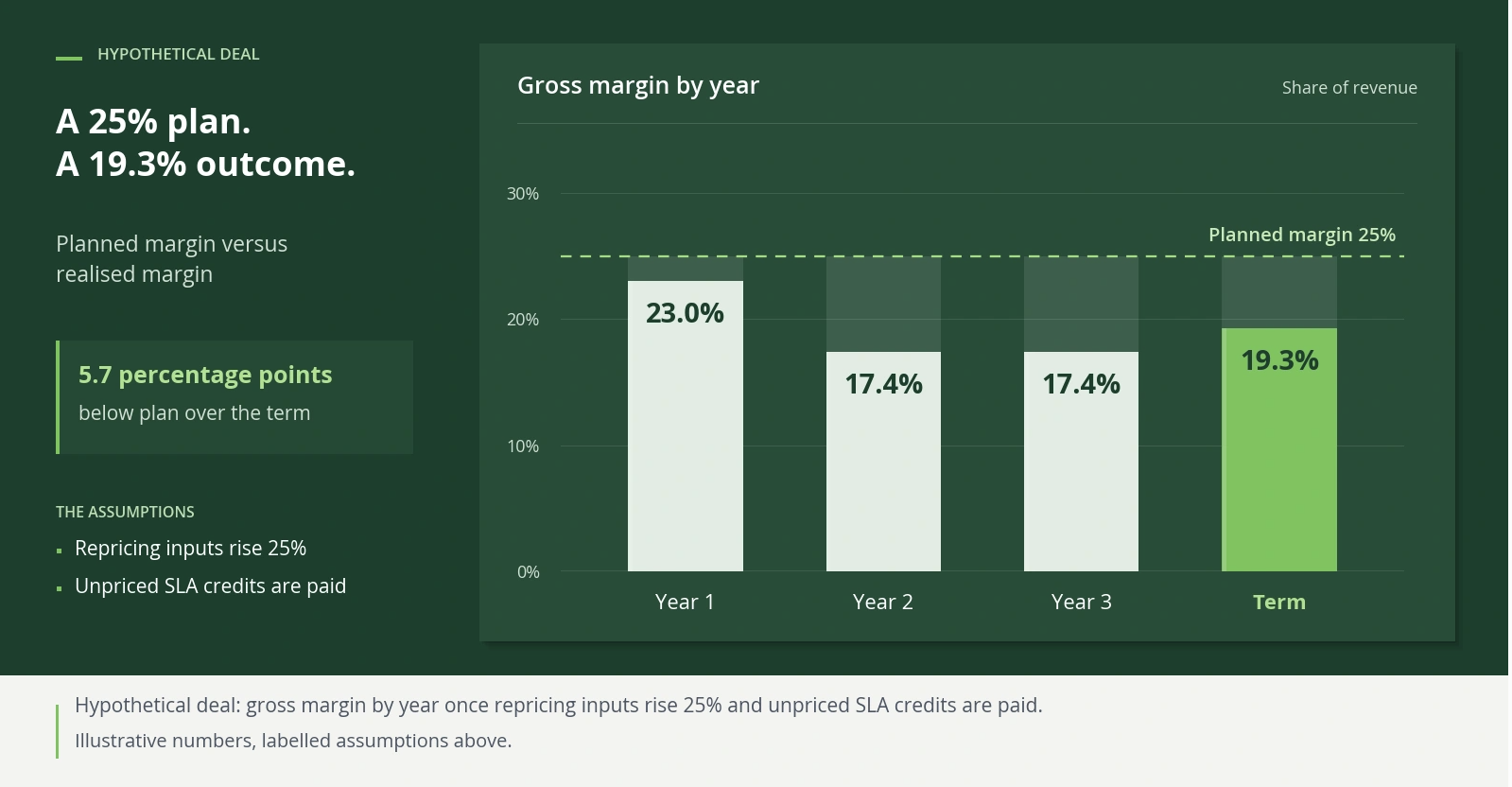
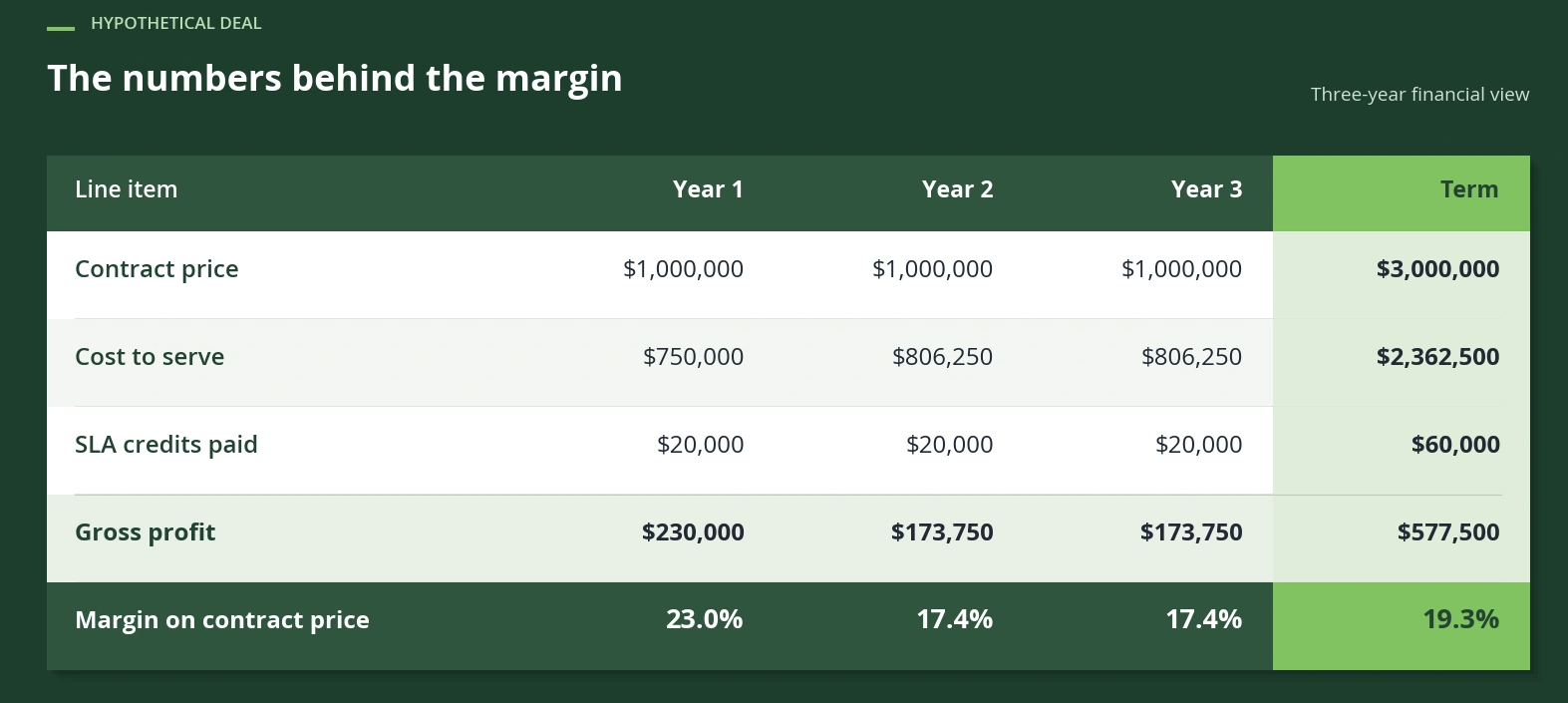
Nobody made a bad decision after signature. The loss was written into the quote on day one.
If those inputs rise 40% instead of 25%, term gross profit falls to $510,000, a 17% margin. Close to a third of the planned profit is gone on a deal that looked healthy when it was approved.
A pass-through clause changes the sum. Input costs account for $112,500 of the loss, while unpriced SLA credits account for the rest.
Assume the clause recovers 60% of the input cost rise, in line with what Cleveland Fed respondents expect to pass through. Then $67,500 comes back, lifting term gross profit to $645,000. That still leaves the deal $105,000 short of plan, and $60,000 of that is SLA credits nobody priced.
Run the pricing risk test on your own book
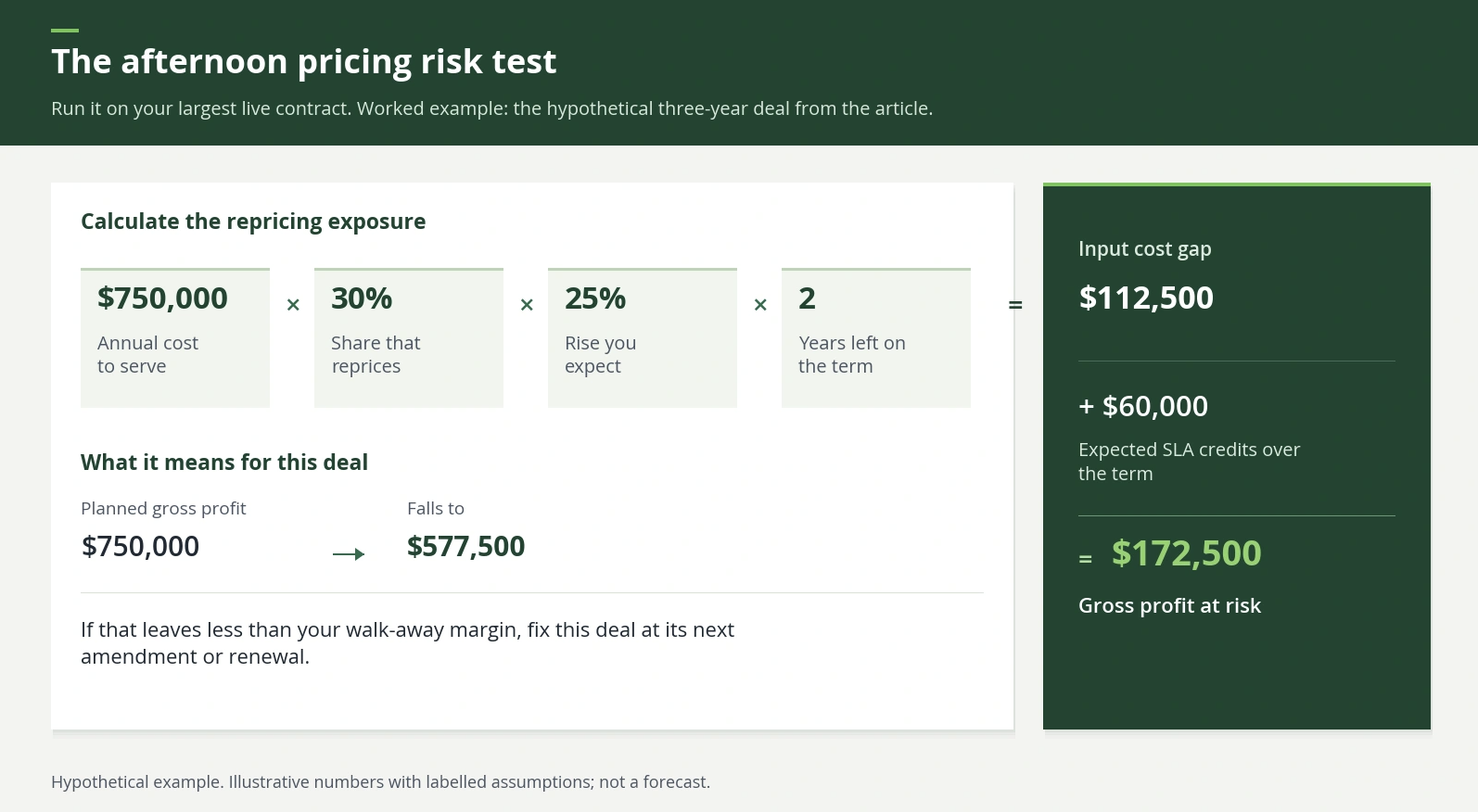
You can run the same sum on your largest live contract this afternoon. First, multiply annual cost to serve by the share that reprices, the rise you expect, and the years left on the term. Then add expected SLA credits for the term, and take the total off planned gross profit.
If the margin left falls below your walk-away margin, you have found the first deal to fix at its next amendment or renewal. In a roll-up, run it first on the largest contract in each acquired company. If the sum takes you longer than an afternoon, that is your first finding.
Proof from two complex sellers
Telent: “Salespeople can model deals, predicting payback and ensuring profitability.” Dell Technologies: complex changes to proposals take as little as 15 minutes vs a day.
Nine checks before your next multi-year deal
Each one moves pricing risk from after signature to before it. You can run these against your current book this week. None of them needs new software to start.
Start with the book and the template
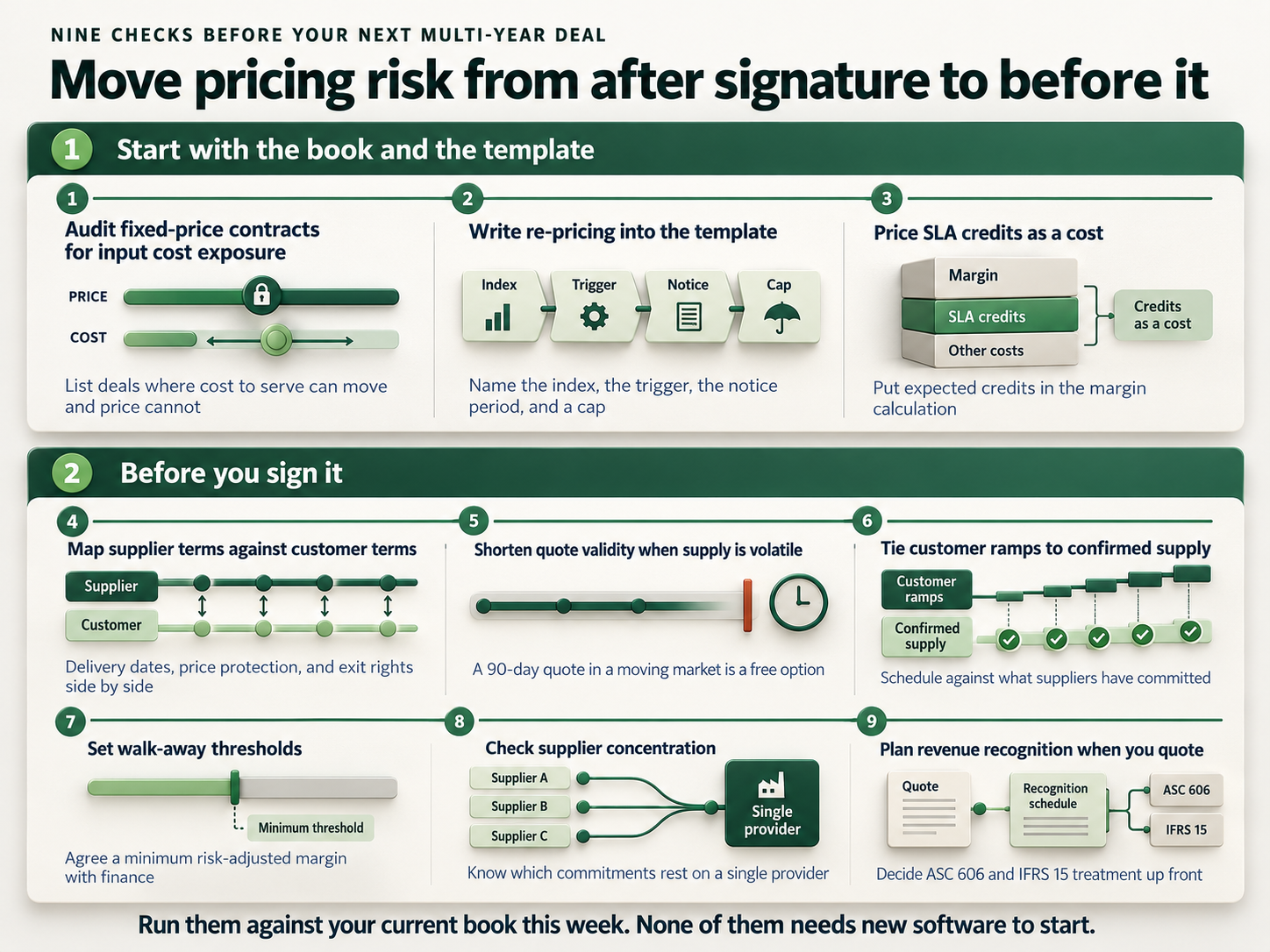
1. Audit fixed-price contracts for input cost exposure. List every deal where your cost to serve can move and your price cannot. Rank them by remaining term and value.
2. Write re-pricing into the template. Add indexation, pass-through, or re-price triggers to your standard terms, in every business unit and acquired entity, so they are not renegotiated deal by deal. Name the index, the trigger, the notice period, and a cap, because customers will ask for one.
Of his own price rises, Cisco’s CEO Chuck Robbins said: “Customers get it. And while they may not like it, they understand that it’s a dynamic that we’re all dealing with.”
3. Price SLA credits as a cost. Estimate expected credit exposure and put it in the margin calculation, not just the contract.
Before you sign it
4. Map supplier terms against customer terms. Compare delivery dates, price protection, and exit rights side by side. Close the gaps before you sign. If your supplier can reprice between order and shipment, your customer terms need an answer to that.
5. Shorten quote validity when supply is volatile. A 90-day quote in a moving market is an open option you gave away for free.
6.Tie customer ramps to confirmed supply. Schedule volumes and go-live dates against what suppliers have committed, not what they hope to deliver.
7. Set walk-away thresholds. Agree a minimum risk-adjusted margin with finance. Not every deal is a good deal.
8. Check supplier concentration. Know which customer commitments depend on a single provider, and what happens if that provider stumbles.
9. Plan revenue recognition when you quote. Ramped, variable, and bundled deals need ASC 606 and IFRS 15 treatment decided up front, not untangled after signature. That matters because expected SLA credits and index-linked price changes are variable consideration under both standards. Both standards then limit what you can recognize to the amount unlikely to face a significant reversal later, so finance needs that estimate at quote time.
Where CPQ and RLM fit
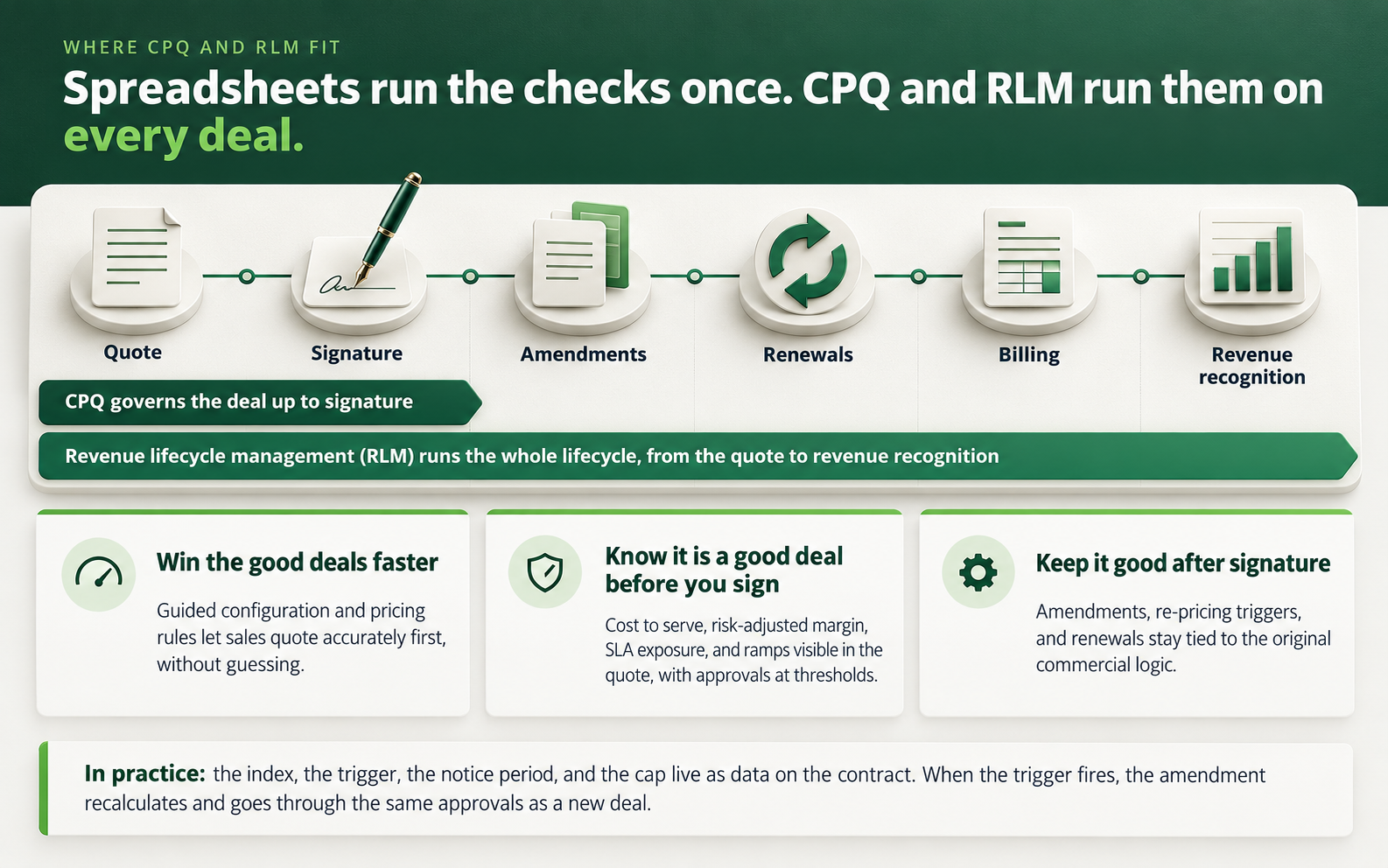
Spreadsheets can run these checks once. They cannot run them on every quote, every amendment, and every renewal. That is the job of Configure, Price, Quote (CPQ) and revenue lifecycle management (RLM).
Most of what our category publishes this year is about two things: AI agents that quote faster, and discount controls at signature. But both stop at the contract. Very little of it deals with the cost base moving underneath a signed three-year deal, even though that is where margin goes in 2026.
Win the good deals faster. When capacity or budget is scarce, the provider who can quote accurately first usually wins. Guided configuration and pricing rules let sales move quickly without guessing.
Know it is a good deal before you sign. Cost to serve, risk-adjusted margin, SLA exposure, and ramps modelled as quantities over time, all visible in the quote, with approvals when a deal crosses a threshold.
Keep it good after signature. Amendments, re-pricing triggers, and renewals stay tied to the original commercial logic. What you quoted is what you deliver, bill, and book.
I hold any system to one test. Do the index, the trigger, the notice period, and the cap live as data on the contract? If they do, the amendment recalculates when the trigger fires and goes through the same approvals as a new deal, so nobody re-prices from memory.
Do not take a software vendor’s word for that, including ours. L.E.K. Consulting, citing MGI Research, estimates that leaks after signature cost at least 3 to 5% of revenue. When the price and its rationale appear while the deal takes shape, it says, “deviating becomes a recorded override rather than a silent one.”
Why AI pricing needs a deterministic engine
AI helps here, but only when it sits on a deterministic pricing engine. A contract with penalty clauses needs the same answer every time.
McKinsey’s 2026 B2B pricing research ties greater AI automation to decisions with “clear rules, auditability, and reversibility.” I would not hand a pricing decision to AI on less.
An AI agent that suggests a price inherits every error in the cost model underneath it, so the model comes first. If the cost model has not caught up with this quarter’s memory prices, the agent will quote yesterday’s margin with total confidence.
That is the difference between more revenue and the right revenue. At servicePath™ we call it Good Revenue Faster.
Why servicePath™
Software will not fix a bad contract template. But it makes sure the good one gets used on every deal, by every rep.
servicePath™ is a revenue lifecycle management platform for complex technology and service providers. It is no-code, so when a supplier moves, your pricing and cost rules change through configuration instead of a development project.
Supplier prices kept current. The Data Parsing Engine imports vendors’ product data and pricing, so a supplier’s new price list reaches the next quote before your customer signs it.
Contracts that can move. Service Contracts brings renewals and mid-term revisions into one place, so a re-price starts from the deal you signed.
Cost before price. Cost-to-serve modelling and deal dashboards show revenue and margin on any quote, at any time.
Telent went live after an 8-week implementation, with “accurate quotes out of the gate in minutes.”
Frequently asked questions about pricing risk
What is back-to-back contract risk?
Back-to-back contract risk is the gap between what you commit to customers and what suppliers commit to you. It shows up when supplier prices, delivery dates, or terms change but customer contracts cannot. The seller in the middle absorbs the difference until the contract ends.
How do I protect margin on multi-year fixed-price deals?
Build re-pricing mechanics into the quote, such as indexation or pass-through clauses. Model cost to serve over the full term and set a minimum risk-adjusted margin before approval. Expected SLA credits are a real cost. Include them in the margin calculation at quote time rather than treating them as a contract footnote.
How does CPQ reduce pricing risk in volatile markets?
CPQ applies the same pricing rules, cost models, and approval thresholds to every quote. That makes risk visible before signature and keeps amendments and renewals consistent with the original deal. CPQ governs the deal up to signature. Revenue lifecycle management (RLM) governs it after: amendments, renewals, billing, and revenue recognition.
Go deeper
Cost-to-serve, margin leakage, and contract adjustment, defined.
The quote is the cheapest place to fix this
After signature, every fix is a negotiation. Before signature, it is a line in the quote.
Costs will still be moving in 2027. Your suppliers have already decided who carries that pricing risk on their side. Decide yours.

Talk to a CPQ architect