
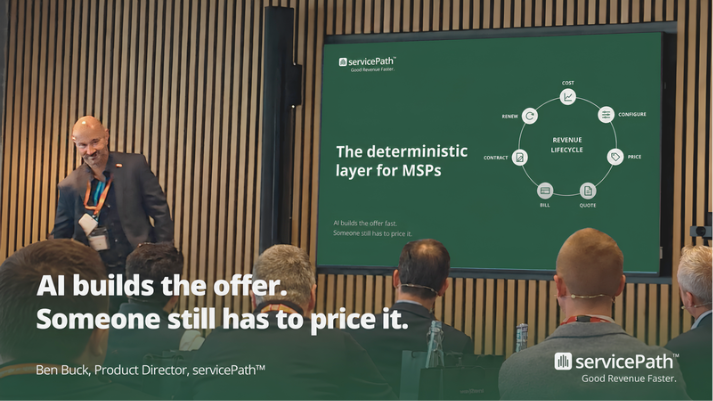

At Node4 Channel First in Birmingham on 20 October 2026, servicePath™ Product Director Ben Buck argued that AI quoting only works on top of deterministic pricing rules. His own review of about 5,000 AI interactions found that roughly one in seven needed a correction.
“AI can build an offer in an afternoon,” Ben told the partners in the room. “Somebody still has to price it, and the price has to be right.”
What Node4 Channel First covered
The event, at BT Snowhill in Birmingham, gave him plenty to point at. Most of the other speakers spent the day describing new things to sell.
Node4’s partner keynote started with the accounts partners already hold, where it said most of their untapped revenue sits. Ask wider questions about renewals, hosting decisions, vendor price rises, manual reporting, and AI plans. Find the pain, put a cost on it, and find the deadline that forces a decision. Then pivot into capability the customer needs next: data, hybrid cloud, colocation, and Microsoft services.
The keynote also cited an Omdia forecast that has global AI services spending set to climb from $85 billion this year to $347 billion in 2031. Node4’s afternoon AI session argued for human-led AI, where people validate what goes in and can trace how an answer came out. The speaker pointed straight back to Ben’s morning session on guardrails.
Most hybrid estates Node4 sees were never designed, according to the hybrid cloud session. Customers bought a different platform for each project. Node4’s answer is one operating model across public cloud, sovereign platforms, and colocation, with spend and security posture visible in one place.
On the partner panel, one firm started 42 years ago pulling cable and now sells networking, enterprise video, access control, and computer vision. The other moved its entire hosting business between data centers over Node4’s links with zero downtime. Three minutes offline, its speaker said, and the phones would have been ringing off the hook. It now builds custom AI applications.
All of that adds lines to somebody’s price book, and every line ends up on a quote.
Why AI quoting still needs someone to own the price
Ben took the keynote’s four words (maximize, pivot, modernize, simplify) and traced every one back to the quoting surface. Selling more into existing customers only works if each sale doesn’t take a whole order cycle. “It needs to be really fast.”
And the quote is only the start: “It’s not just quoting. It’s contract management, renewals, and revisions.”
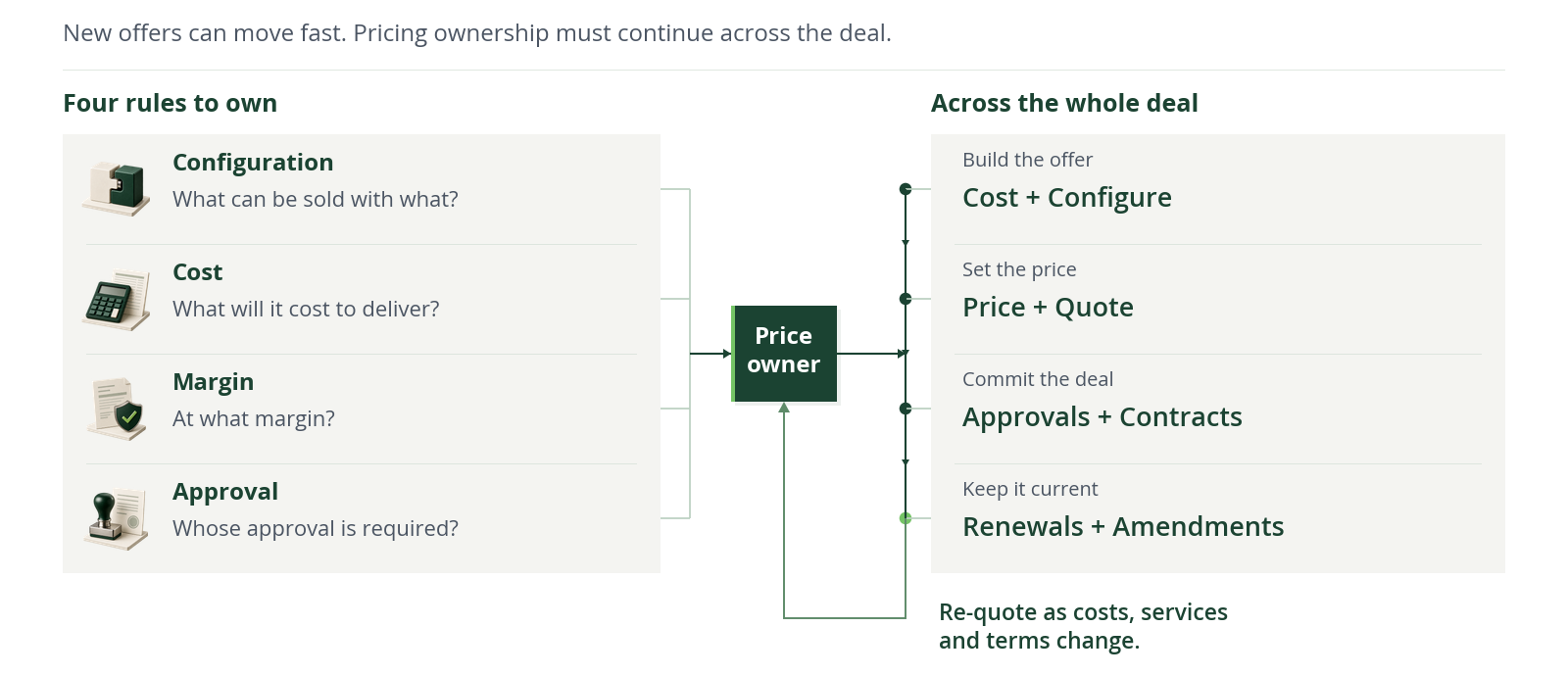
His one-sentence version of servicePath™ ran the length of a deal, much like quote-to-cash: cost, configure, price, and quote, then approvals, contracts, renewals, and amendments. He guessed that a lot of the work done in that room is re-quoting existing customers, which he called one of the platform’s real strengths.
Costs change. Services make up most of the deal, and some of them are hard to estimate. With every acquisition comes another price book. A Telent testimonial on his slide named the same challenge: constant change in technology and pricing. Most CPQ systems, Ben said, were built for simpler environments.
The businesses he described as the best fit for servicePath™ sell bundled hardware and cloud services, negotiate multi-year deals across currencies, and want deep financial analysis of every deal they sign.
What’s new, in his view, is how fast AI moves. A team can come up with a new offer quickly, and somebody still has to keep hold of the pricing and the rules behind it: what can be sold with what, at what cost, at what margin, and with whose approval.
“Somebody has to own these parts of the business,” Ben said, “and that’s what the servicePath™ platform does for you.”
One correction in every seven
The way Ben uses software has changed in the last six months. “Rather than clicking into the software and using the user interface, I’ve moved much more into running my life inside an LLM.” His AI connects to the systems he uses, and he asks it to do the job.
In his words, “it’s brilliant, but it’s confidently wrong.”
He used the phrase at the Canadian High Commission at the start of the year, when business leaders were still working out what AI could safely do. Since then, he reckons, it has become part of how people talk about AI. They know it can produce something that looks amazing and still be full of mistakes, and that “there’s got to be some guardrails around that.”

Before he came up to speak, Ben ran a quick analysis of his own AI use over the last six months. Roughly 5,000 interactions. About one in seven was him correcting a mistake: a wrong inference, a wrong conclusion, or something the model had made up.
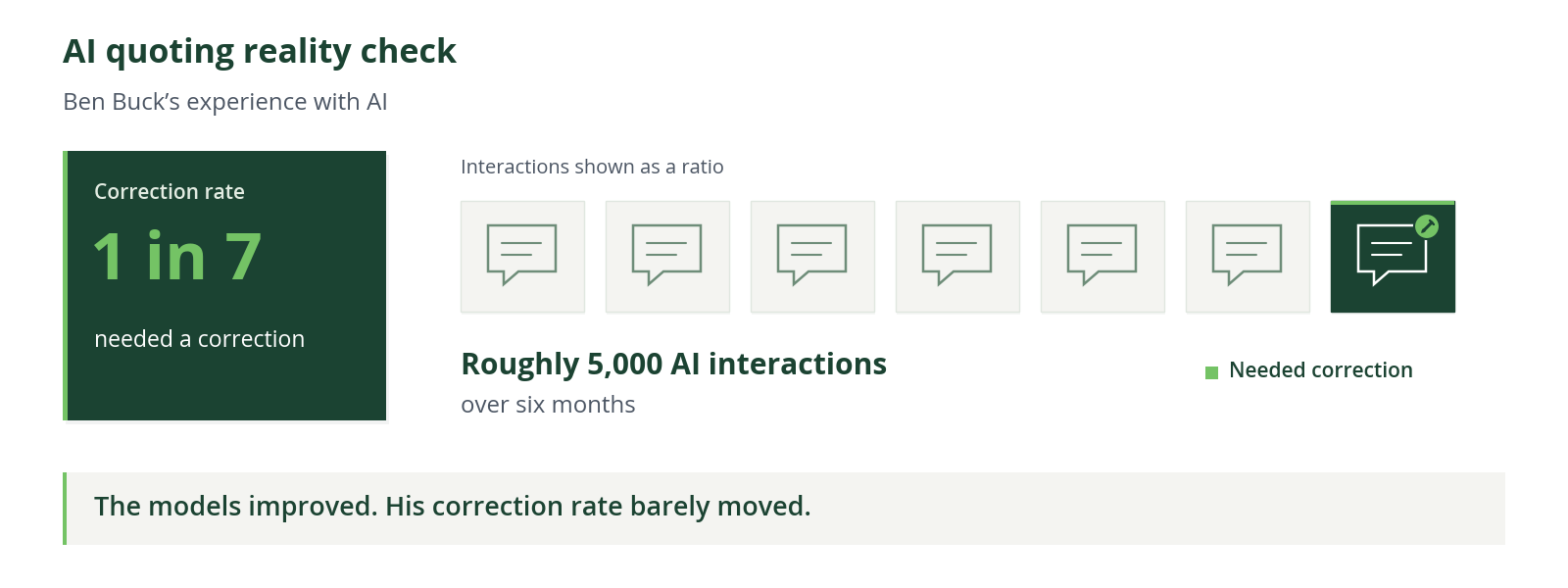
Over those six months the models kept getting better, release after release. His correction rate barely moved. That was the part that surprised him.
His rule for now: “I need to check the work before I can send it out. I don’t trust it to do it.” He would like a world where AI does these jobs autonomously. “Right now it just isn’t that place.”
What happened when AI quoting met an order flow
Those 5,000 interactions were everyday work. A quote is less forgiving. It commits the business to a price, a margin, and a term. Even a much lower error rate has to be caught before a customer sees it, and the more quotes AI drafts, the harder that gets to do by eye.
When the servicePath™ team first linked AI to quoting in testing, the model created a quote, then created an order, and pushed it through without any approvals.
In a live business, that would have been a committed order at a price nobody had signed off. An AI connected to quoting needs the same rules, thresholds, and approvals as a person, and the system has to enforce them. After that test, the team built an interface layer that applies the platform’s rules to everything the AI does.
Pricing complex service deals with AI in the loop? Talk to a CPQ architect
Where the rules live in AI quoting
Deterministic models in servicePath™ define the products, the pricing, the approval rules, and, in Ben’s words, “everything about how you can price and configure a product.” The AI works on top of those models and cannot go around them.
Those models cover four things:
- Configuration. Guided selling rules for what goes with what, and what is allowed to be sold.
- Price and cost. The full financial model of the deal, so cost, price, and margin sit side by side, including ramped and usage-based pricing.
- Service. The service definitions and terms attached to everything quoted.
- Approvals and thresholds. The AI can see the approval workflows and use them while it builds a quote. If it gets something wrong and a deal crosses a threshold, approval still goes to a human.
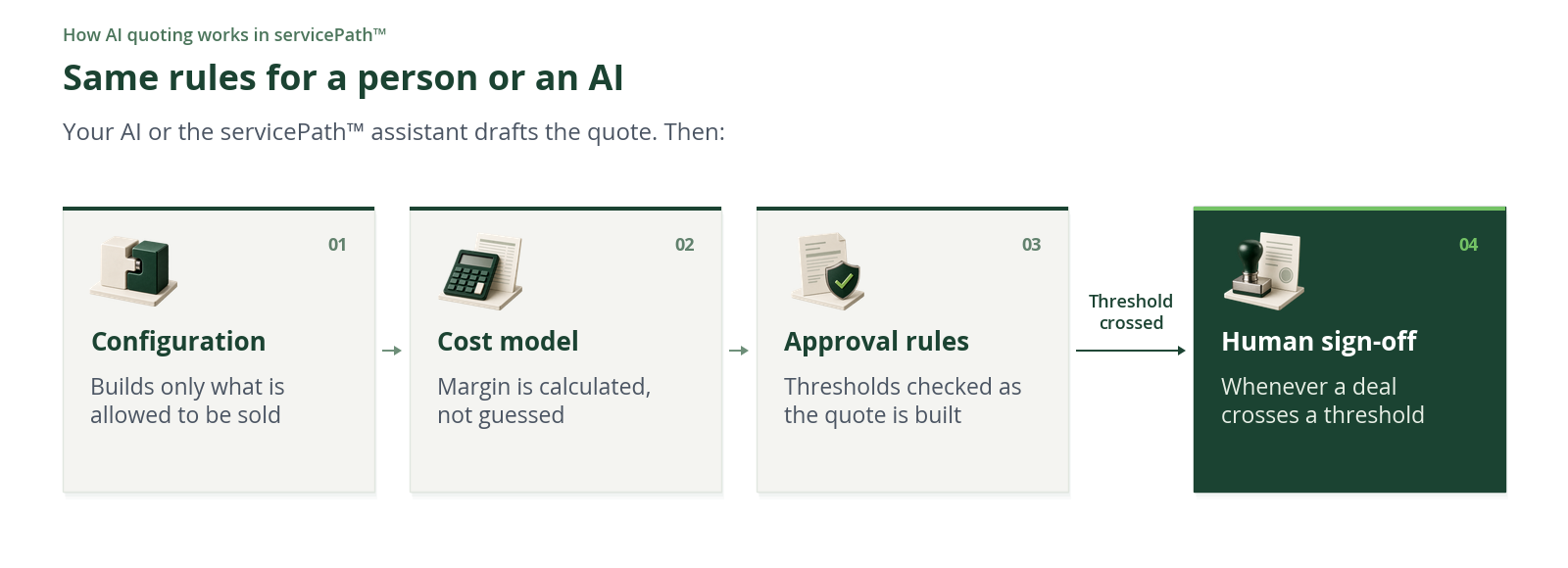
Few quoting platforms model the financials this fully, according to Ben, and that is what puts the margin in front of a seller before a deal goes out.
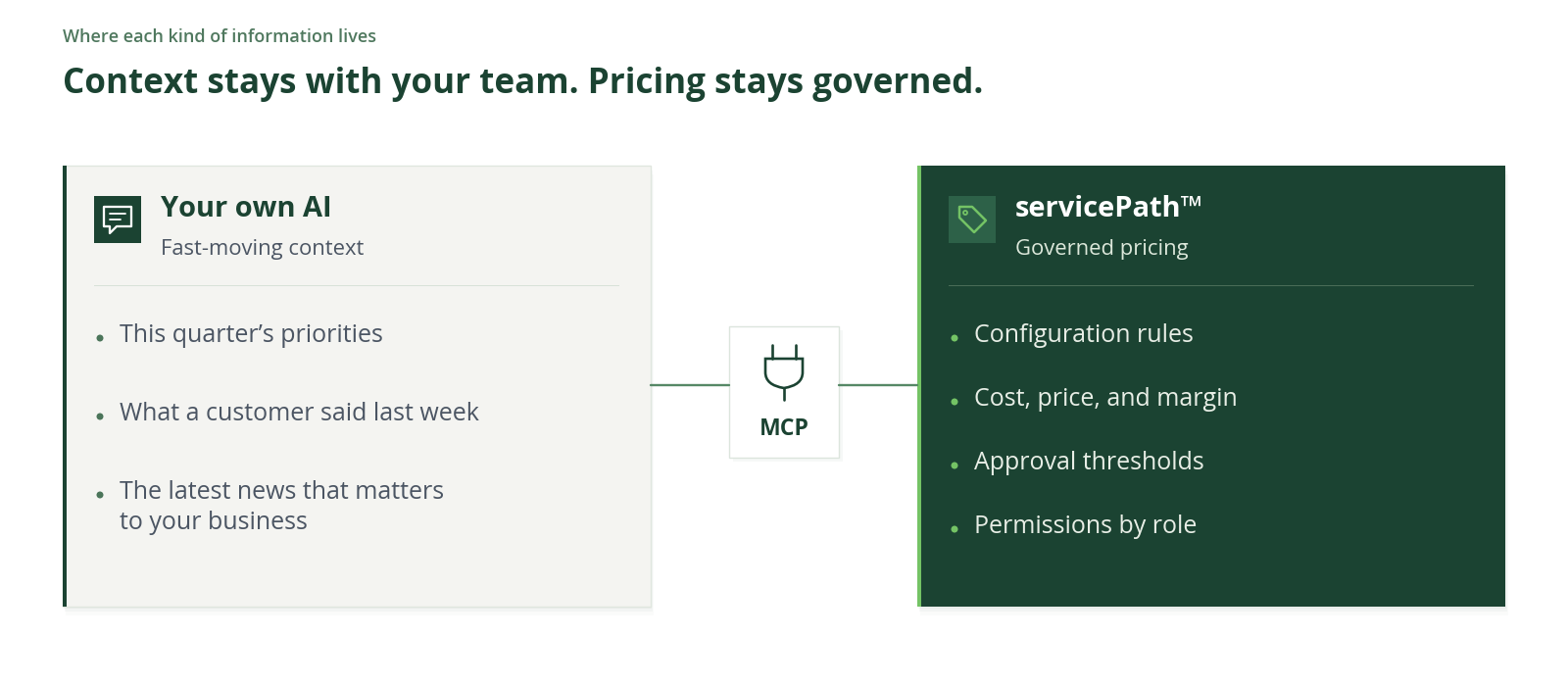
Permissions follow the user. If someone’s role does not allow them to see cost or margin, the AI working for them cannot see it either.
Fast-moving context stays in your own AI
Some things don’t belong in the platform at all, in Ben’s view. What you are pushing this quarter, or what a customer told you last week, moves too fast to codify. Some of it may become a rule one day. Until then it can live in your own AI, which talks to servicePath™ through MCP, on top of the same deterministic rules. The fast-moving context stays with your team, and the pricing stays governed.
Partners had already seen those rules at work. Node4’s new partner portal, launched in the keynote just before Ben spoke, gives each reseller that signs up its own area in servicePath™, the platform Node4 uses internally for configure, price, and quote. In the demo, a guided-selling sales configurator walked a partner through a colocation deal: the number of racks, then everything that belongs with them. Node4 called it the “do you want fries with that” moment. The output was a PDF quote with pricing, the bill of materials, terms, and the service description.
Want more on governing AI in pricing? Read the servicePath™ insights
Three ways to work with AI quoting
Ben also showed where the platform is heading. Studios are where teams will set up the rules: commercial, configuration, workflows, and integration, with a migration tool that checks every change before it reaches production. Workspaces are where people will sell, with commercial dashboards that show sellers the figures they need to judge a deal.
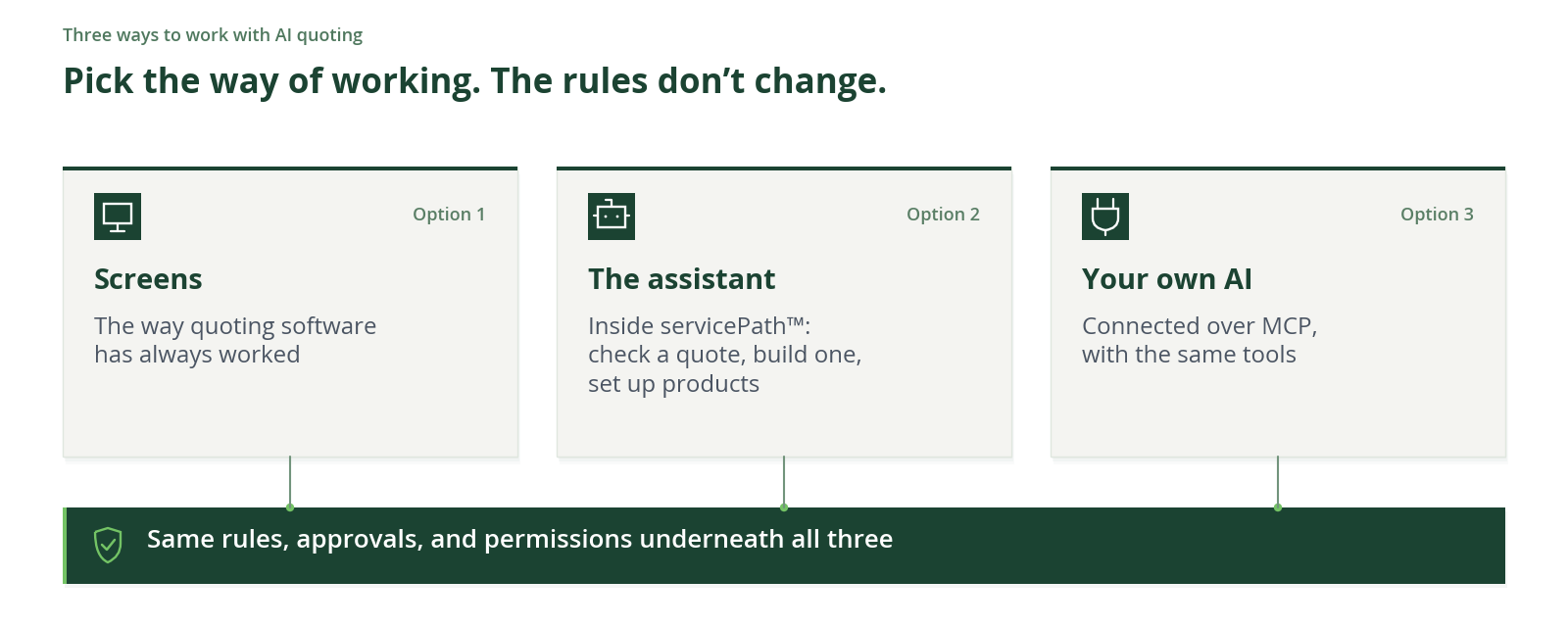
Across both sits an AI assistant that uses the same interface an outside AI can reach. That gives three ways to work:
- Through the screens, the way quoting software has always worked.
- With the assistant inside servicePath™, which can interrogate a quote, build one, or set up products.
- From your own AI, connected over MCP, with the same tools, rules, and governance.
The first two work together, so a seller can build a quote on screen and ask the assistant to check it.
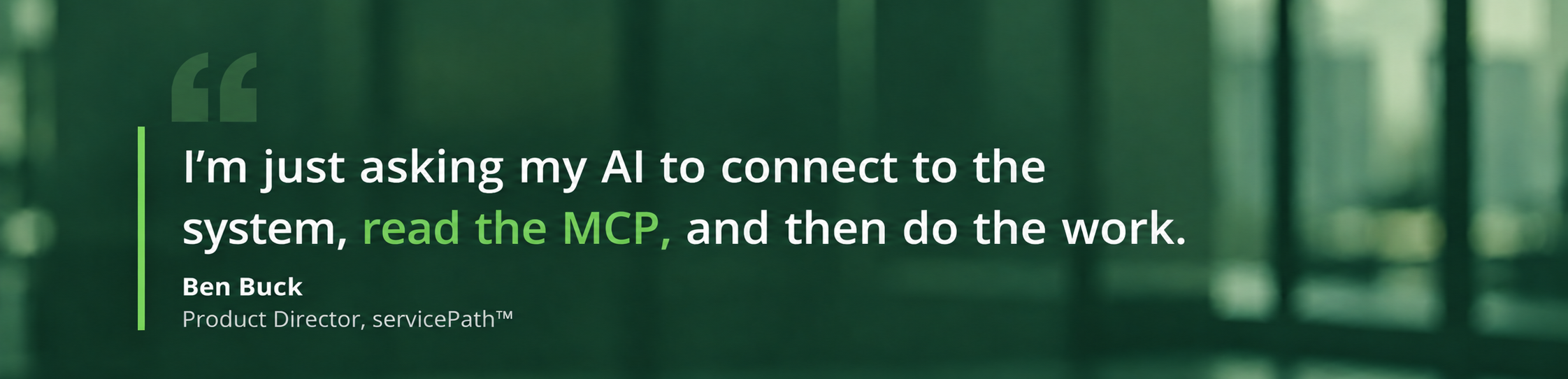
Ben mostly works the third way. He asks his AI to connect to the system, read what the MCP offers, and do the work. He didn’t assume the room would want the same, so he closed by asking partners how they would rather work day to day. A six-question survey sat behind a QR code, and he offered to email the results to anyone who left an address.

Our take
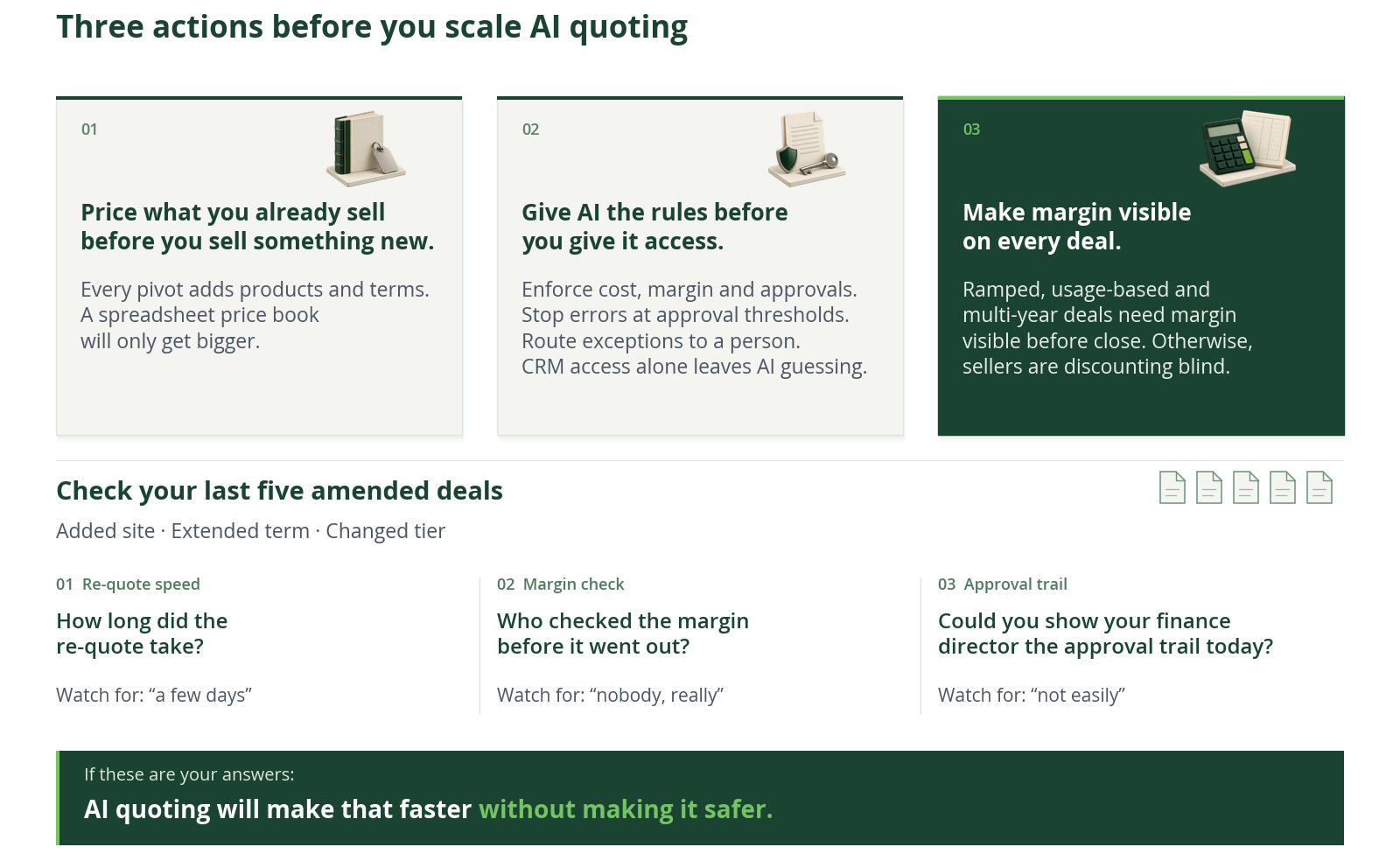
Price what you already sell before you sell something new. Every pivot the speakers described adds products and terms. A price book that lives in spreadsheets today will still be there tomorrow, only bigger.
Give AI the rules before you give it access. Connect it to a system that enforces cost, margin, and approvals, so a wrong answer stops at an approval threshold and lands with a person. An AI that can see your CRM but not your pricing rules will fill the gap with a guess.
Make margin visible on every deal. Ramped, usage-based, multi-year deals are where margin is hardest to see, and they are the deals partners are pivoting toward. Sellers who only see margin after the deal closes are discounting blind.
Try this on the last five deals your team amended: an added site, an extended term, a changed tier. For each one, ask three questions. How long did the re-quote take? Who checked the margin before it went out? Could you show your finance director the approval trail today? If the answers are “a few days”, “nobody, really”, and “not easily”, AI quoting will make that faster without making it safer.
Thank you to Node4 for hosting us, and to everyone who came by the stand.
See the proof behind Ben’s numbers.Download the Dell Technologies and Telent case studies
Frequently asked questions about AI quoting
What does “confidently wrong” mean in AI quoting?
It describes AI output that looks finished and authoritative but contains errors. Ben Buck found that about one in seven of his own AI interactions over six months needed a correction.
What is a deterministic pricing layer?
It is a rules engine that defines configuration, cost, price, margin, and approvals the same way every time. AI can use it but cannot override it.
Why does re-quoting matter so much in the channel?
Much of a partner’s commercial work is changing existing contracts: added sites, extended terms, swapped services, and renewals. Each one needs the original pricing logic, costs, and approvals to still hold.
How does AI quoting connect to servicePath™?
Through the assistant inside the platform, or from your own AI over MCP, an open standard for connecting AI assistants to other software. Both work under the same rules and permissions as the user.