

Seven platforms compared for technology service providers, telcos, and systems integrators, with what Salesforce has and has not announced.

This guide compares seven Salesforce Revenue Cloud alternatives for technology service providers, telcos, and systems integrators in 2027: servicePath™, Conga CPQ, DealHub CPQ, Oracle CPQ, ServiceNow CPQ (Logik.ai), Tacton CPQ, and Zuora CPQ. None is ranked, so servicePath™, the publisher, goes first and the other six follow alphabetically. Salesforce CPQ is “end of sale, not end of life”, says Salesforce, whose pricing page sells Revenue Cloud while its end-of-sale FAQ still says Agentforce Revenue Management.
Is Salesforce CPQ end of life?
What Salesforce says
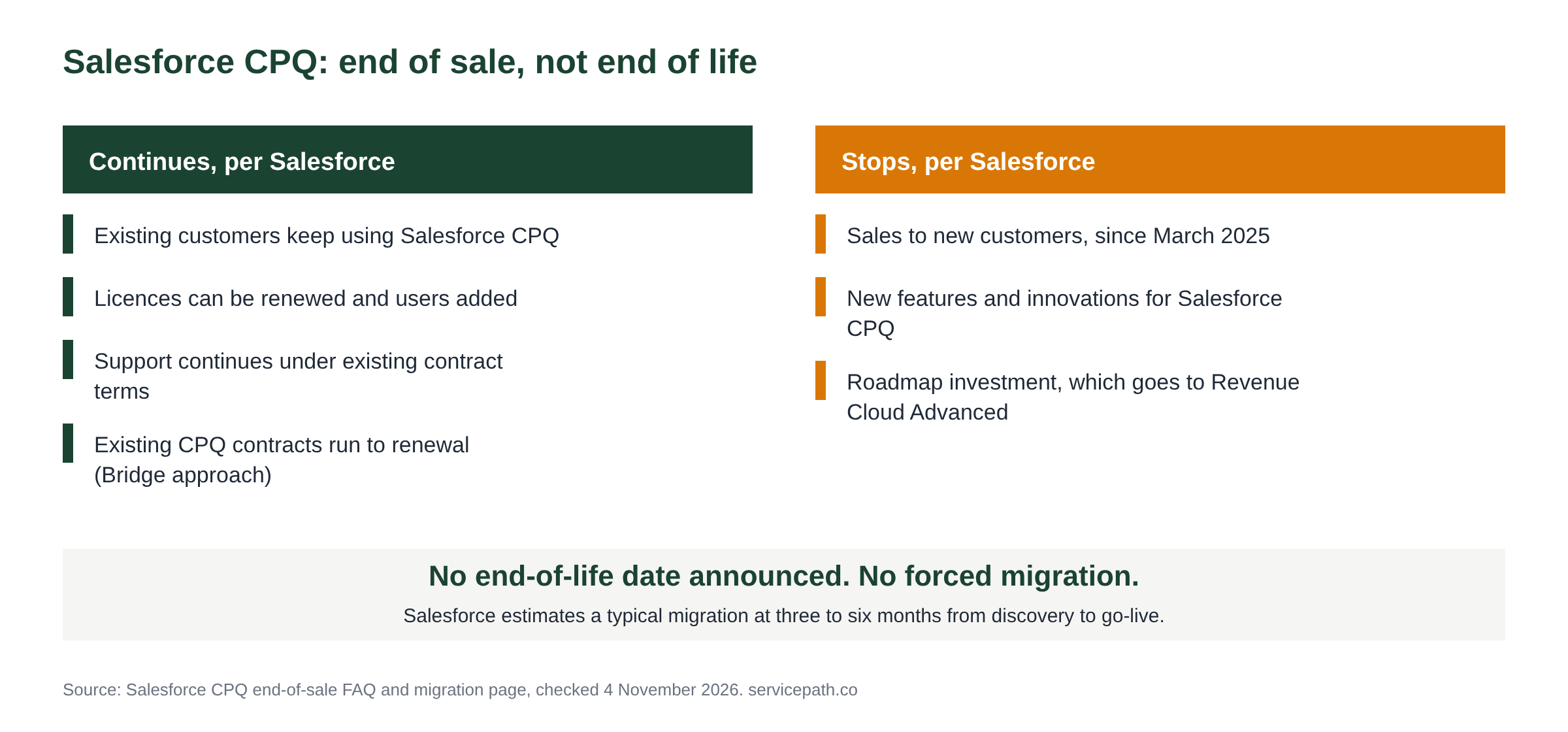
Existing customers “can continue using Salesforce CPQ, buy additional users, renew licenses, and receive support” (end-of-sale FAQ). CPQ “will not receive new features or innovations.”
Salesforce also estimates a typical migration at three to six months from discovery through go-live (FAQ).
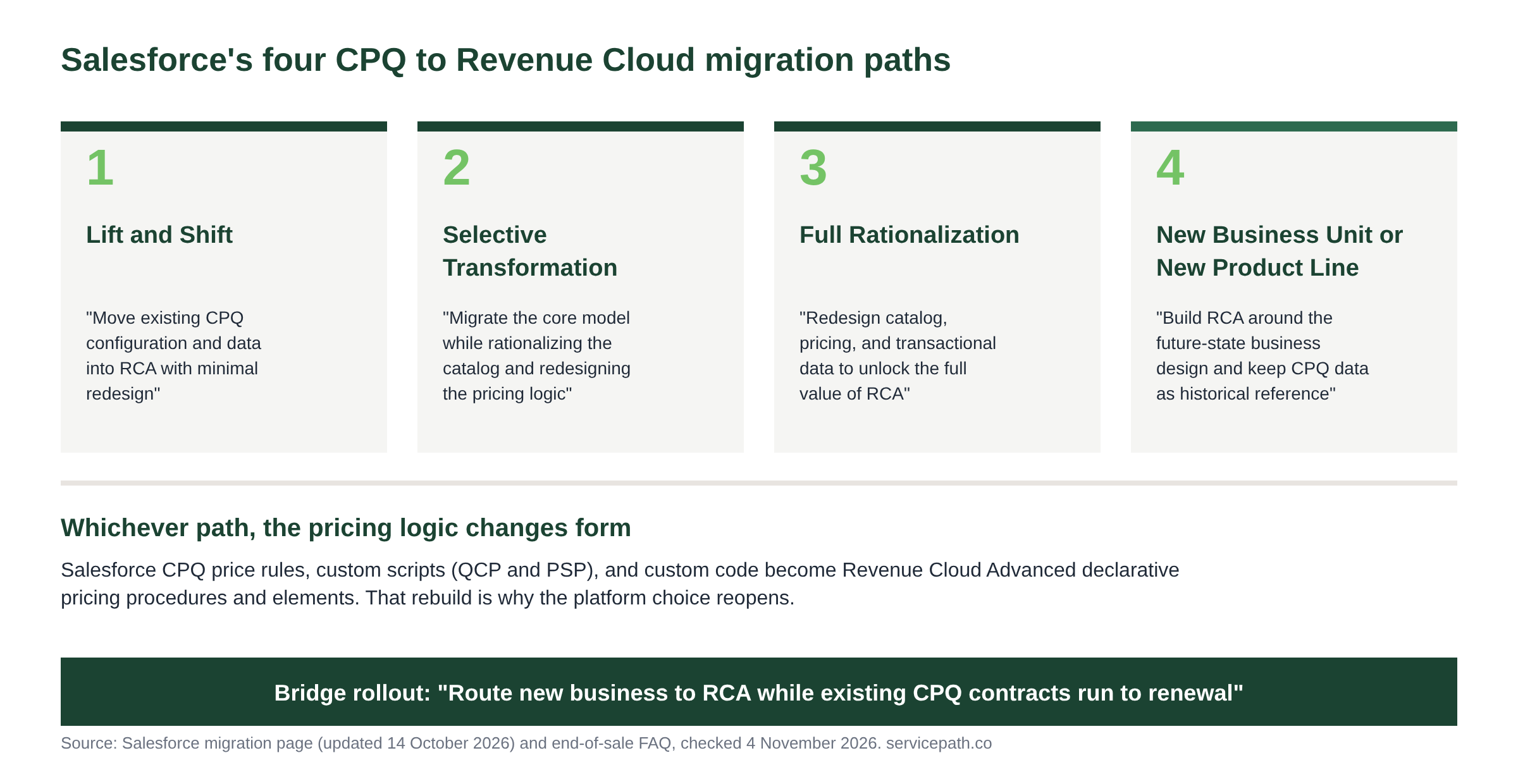
In addition, Salesforce names four migration paths: Lift and Shift, Selective Transformation, Full Rationalization, and New Business Unit or New Product Line (migration page).
Revenue Cloud Growth lists at US$150 per user per month and Revenue Cloud Advanced at US$200, both billed annually (pricing page).
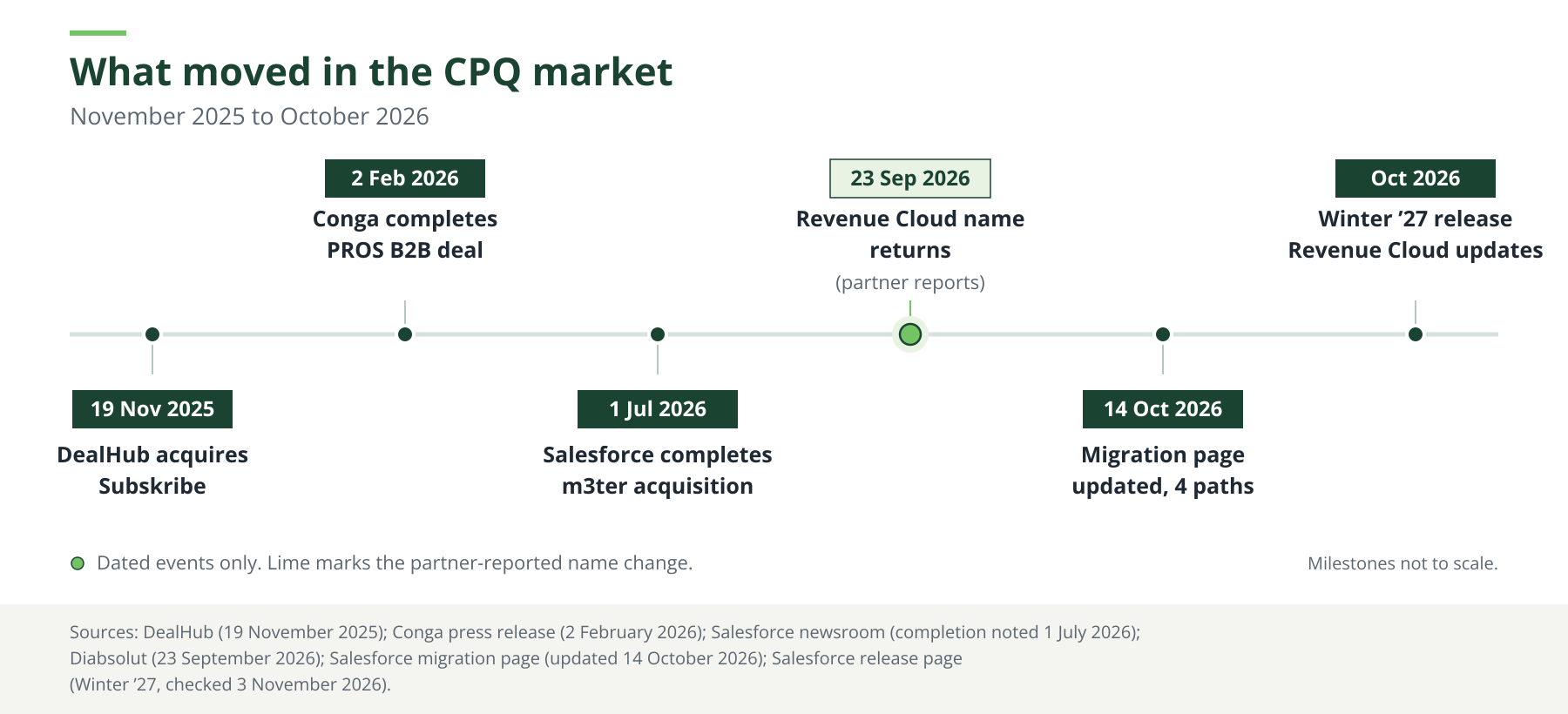
Finally, the Winter ’27 release (October 2026) lists Revenue Cloud features to “Handle large transactions with ease” and “automate compounding price uplifts” (release page, checked 3 November 2026).
What Salesforce has not announced
“Salesforce has not announced an end-of-life date for CPQ” (FAQ).
Moving is the customer’s choice, because “There is no forced migration from Salesforce CPQ to Agentforce Revenue Management” (FAQ).
No Salesforce-built migration tool is named; instead, the FAQ points to partner tools from Forsys (RevRamp), IdeaHelix, and Prodly.
Reported by third parties
“Revenue Cloud is back as the product name”, partner Diabsolut wrote , though Salesforce has issued no formal renaming announcement.
A migration assistant is a December 2026 roadmap item, per CRM Hacker on 17 September 2026, but no Salesforce page mentions it.
Why are Salesforce CPQ customers evaluating Salesforce Revenue Cloud alternatives now?
Salesforce CPQ customers are evaluating Salesforce Revenue Cloud alternatives because moving to Revenue Cloud means rebuilding pricing, and a rebuild reopens the platform choice just as 2027 budgets lock. CPQ remains supported, so the timing is yours to set.
Is migrating from Salesforce CPQ to Revenue Cloud an upgrade?
Not in the version-update sense, because it is a re-implementation on a different data model. Salesforce’s end-of-sale FAQ sets CPQ’s “Price rules, custom scripts (QCP/PSP), custom code” against Revenue Cloud Advanced’s “Declarative pricing procedures and elements”, so the pricing logic changes form. Swantide’s engineering team (27 August 2026) maps subscriptions to assets and notes that custom Apex and Flows tied to CPQ break when the managed package is removed.
Live contracts can wait, since Salesforce’s migration page describes a Bridge approach where “existing CPQ contracts run to renewal”.
Pinkus Partners (8 October 2026) quotes SteelBrick founder Max Rudman on closed deals: “Don’t even try to migrate past transactions, just archive and reference them.”
How did we compare Salesforce Revenue Cloud alternatives?
We set seven Salesforce Revenue Cloud alternatives that state Salesforce integration beside Revenue Cloud itself, using only what each vendor publishes about itself. “Not stated” means the vendor’s page is silent, so it is not proof the product lacks the capability.
We do not rank or score, because the right weighting depends on each buyer’s deals.
Telecom-specific CPQ sits outside this list of Salesforce Revenue Cloud alternatives. That leaves out Salesforce’s own Communications Cloud, which lists “Industry configure-price-quote (CPQ)”, and CloudSense, which says it is “native to Salesforce” (both checked 3 November 2026).
Review sites restrict vendors from republishing competitors’ ratings, so profiles paraphrase review themes and link to the source. The Insight, Best for, Where it fits, and Ask lines, however, are servicePath™’s own reading.
Salesforce Revenue Cloud alternatives in each vendor’s own words
Table 1. Vendor self-statements, linked from each platform name.
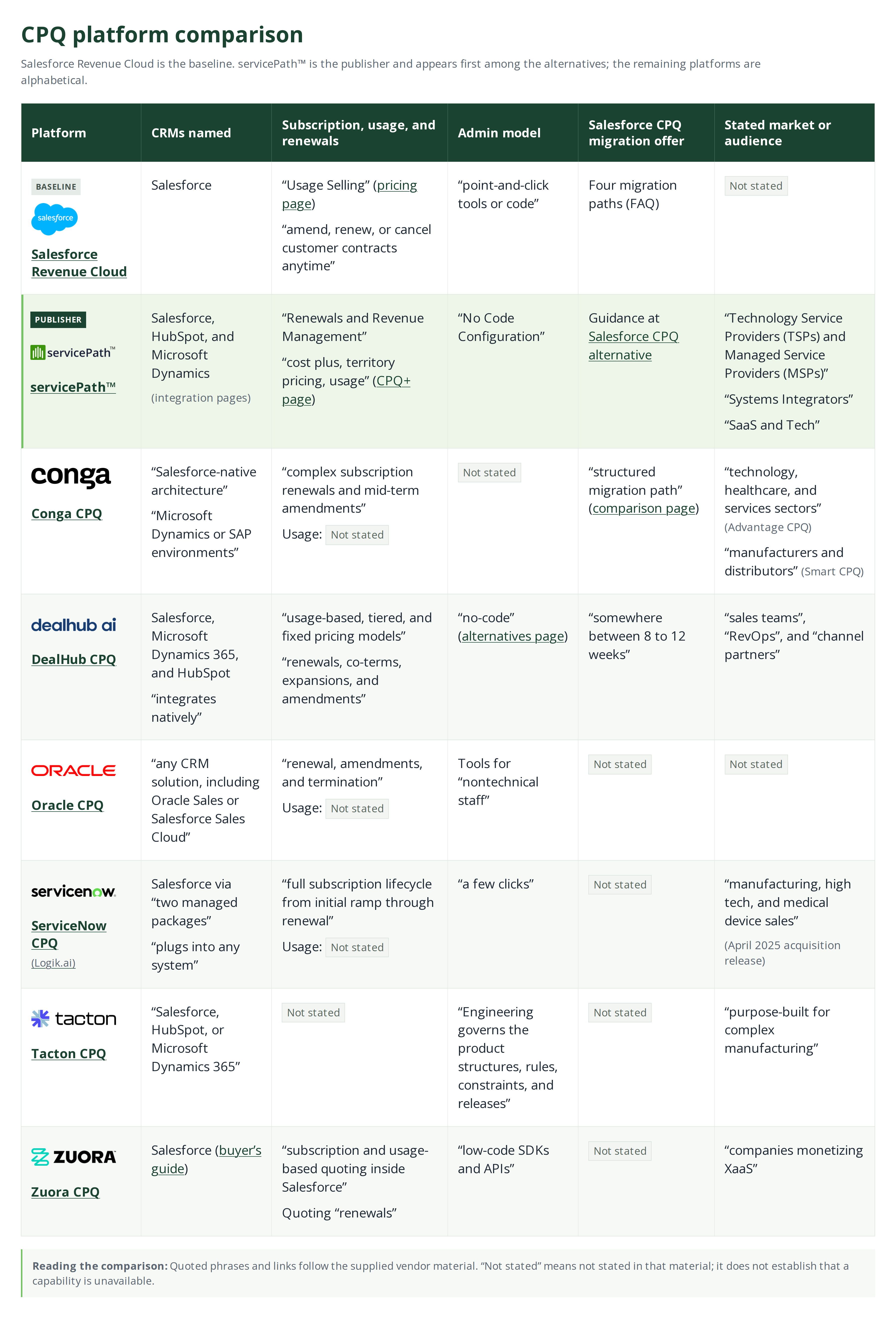
Seven Salesforce Revenue Cloud alternatives, compared
All seven Salesforce Revenue Cloud alternatives below follow one order, so the blocks compare like for like. Four spec lines quote the vendor’s own pages, checked 4 November 2026, then come review themes, our Insight, and three fit lines.
1. servicePath™: CRM-agnostic CPQ for technology service providers
servicePath™ is no-code CPQ and revenue lifecycle management that prices each line against cost to serve, especially for TSPs, telcos, and systems integrators.
- CRMs stated :
- Salesforce, HubSpot, and Microsoft Dynamics 365, with “Real-time synchronization of Organization, Contact and Opportunity”
- Pricing models stated:
- “Usage-based models and subscription renewals” (Salesforce CPQ alternative page)
- Admin model:
- “maintain and adapt the system without relying on developers”
- Salesforce CPQ migration offer:
- “Migrate core logic and approval rules without rebuilding from scratch”

Reviewers say: 4.6 out of 5 from 53 reviews on G2, checked 4 November 2026. Source: G2.com, Inc.
Insight: Rules live in servicePath™ rather than the CRM. Scanco’s March 2026 case study pairs it with “Native Dynamics CRM Integration”, so a CRM change leaves pricing intact.
Best for: TSPs and telcos quoting services as well as hardware, and amending contracts mid-term.Where it fits beside Revenue Cloud: Salesforce keeps the forecast while pricing moves to an engine that outlives it.Ask :Which quote fields write back to Salesforce, and when?
2. Conga CPQ: Salesforce-native CPQ and contracts from one vendor
Conga sells two CPQ engines on its product page, namely Advantage CPQ for Salesforce and Smart CPQ, “a software-agnostic engine”.
- CRMs stated:
- “Run Salesforce-native or deploy independently of your CRM and ERP” (comparison page)
- Pricing models stated:
- “automate renewals and agreement updates” (product page); usage Not stated
- Admin model:
- Not stated (product and comparison pages)
- Salesforce CPQ migration offer:
- “Conga’s team maps your existing pricing rules and product catalogs to an engine built for scale”
Reviewers say: G2 reviewers like how closely it follows Salesforce, and report slow pricing on large quotes and unpredictable upgrades.
Insight: Native keeps accounts and opportunities in place, so only pricing logic moves. Conga also completed its PROS B2B acquisition on 2 February 2026, so a telco signing five-year renewals needs to know which engine they will run on.
Best for: Salesforce estates that want contracts and CPQ from one vendor.Where it fits beside Revenue Cloud: The nearest swap among these Salesforce Revenue Cloud alternatives, since quoting stays on the Salesforce data model.Ask: Which engine carries the roadmap for Salesforce customers through 2029?
3. DealHub CPQ: no-code quoting with billing through Subskribe
DealHub CPQ is the quoting product in DealHub AI, which its CPQ page says “brings agentic capabilities to quoting”.
- CRMs stated:
- “Quote, product and deal data sync in real time between DealHub and your CRM”
- Pricing models stated:
- “Scale revenue with automated renewals, co-terminations, and flexible bundling”
- Admin model:
- “RevOps can safely own pricing rules, product catalogs and approval policies”
- Salesforce CPQ migration offer:
- “DealHub AI typically goes live in 8 to 12 weeks” (Salesforce CPQ alternative page, modified 5 October 2026)
Reviewers say: G2 reviewers most often credit support and time saved, and name workarounds once customization runs out.
Insight: The Subskribe acquisition of 19 November 2025 added subscription management as well as consumption metering and billing. A telco that bills from its own BSS or ERP is therefore buying a billing engine it may never switch on.
Best for : SaaS and sales-led teams with subscription and consumption deals.Where it fits beside Revenue Cloud: Quoting moves to DealHub, while reps still “build quotes from the opportunity” in Salesforce.Ask: Do the 8 to 12 weeks hold if invoices stay in our own billing system?
4. Oracle CPQ: cloud CPQ for Oracle ERP estates
Oracle CPQ “is a cloud-based application that helps sellers configure the right mix of products or services” (product page).
- CRMs stated:
- “Connect CPQ to your CRM so sales teams can access customer order histories”
- Pricing models stated:
- “subscription products, software licenses, support agreements, renewals”; usage Not stated
- Admin model:
- “Speed through configuration with reusable product models and easy-to-use screens”
- Salesforce CPQ migration offer:
- Not stated (product page)
Reviewers say: G2 reviewers credit discount rules that enforce themselves, but also report a dated interface and custom scripts that are hard to maintain.
Insight: Oracle CPQ “works with more than 20 leading ERP systems”, so its strength is back-office order and cost data. G2 reviewers also report an average of six months to implement , which a Salesforce estate without Oracle applications spends standing up a second platform.
Best for: Oracle ERP and Oracle Sales estates that already run beside Salesforce.Where it fits beside Revenue Cloud: Salesforce keeps the opportunity, while Oracle CPQ prices from ERP data.Ask: Which Oracle applications must we license before quotes price from live ERP cost?
5. ServiceNow CPQ (Logik.ai): rules-based CPQ that also installs in Salesforce
ServiceNow CPQ (Logik.ai) arrived through the Logik.ai deal announced in April 2025, and its product page now says it “uses AI and logic to solve the most complex product and pricing rules”.
- CRMs stated:
- a base package “for CPQ interacting with Salesforce”, plus a “CPQ Extension for Salesforce CPQ” (documentation)
- Pricing models stated:
- “subscriptions, renewals and ramps”; usage Not stated
- Admin model:
- “Update configuration, pricing, rules, or bundles in a few clicks”
- Salesforce CPQ migration offer:
- Not stated (product page)
Reviewers say: G2 reviewers credit guided selling for cutting quote corrections, though some flag bugs between Salesforce and Logik.ai.
Insight: ServiceNow’s documentation, updated 12 March 2026, lists a second package that extends Salesforce CPQ, the product Salesforce no longer sells. Find out which package your quotes depend on before you plan Salesforce CPQ’s retirement.
Best for: ServiceNow estates, including telecom sellers, whose Telecom Order Management page offers “tailored service bundles”.Where it fits beside Revenue Cloud: Logik.ai prices inside the Salesforce quote, so the quote stays the record.Ask: Without Salesforce CPQ installed, does the base package still write price and quantity to the quote?
6.Tacton CPQ: CPQ for complex manufactured equipment
Tacton CPQ serves the ten equipment industries its CPQ page lists, from “Fluid Handling” to “Electronics and IT Infrastructure”.
- CRMs stated:
- Salesforce gets “real-time data sharing and an embedded selling experience” (integrations page)
- Pricing models stated:
- subscription, usage, and renewals Not stated; the CPQ page names “volume-based pricing”
- Admin model:
- “Engineering governs the product structures, rules, constraints, and releases”
- Salesforce CPQ migration offer:
- Not stated (CPQ page)
Reviewers say: G2 reviewers describe knowledgeable support, and still want better error tracing in constraint models and faster bulk editing.
Insight: Engineering owns the rules, which suits a machine builder but slows a services seller whose prices move whenever a supplier file lands. G2 reviewers also report an average of eight months to implement , time that pays back only where the product is the hard part.
Best for: Equipment makers whose engineers already own the product rules.Where it fits beside Revenue Cloud: On a services shortlist only if you sell configured hardware.Ask: Can a pricing analyst change a services price on an equipment quote without engineering?
7. Zuora CPQ: subscription and usage quoting inside Salesforce
Zuora CPQ “configures, prices and quotes complex subscription and usage deals inside the sales process”, says its product page.
- CRMs stated:
- Salesforce, where reps “quote natively” (buyer’s guide, 27 August 2026)
- Pricing models stated:
- “new business deals, upsells, cross-sells, and renewals”
- Admin model:
- “Greater value, less code with Zuora’s new SDK and APIs”
- Salesforce CPQ migration offer:
- Not stated (product page and buyer’s guide)
Reviewers say: G2 profiles Zuora as a whole platform, so Zuora CPQ’s own reviews sit on Peer Insights, whose terms keep us from summarising them here.
Insight: Quotes flow “straight through to billing”, so Zuora CPQ earns its place when Zuora Billing sends the invoice. Meanwhile, Salesforce completed its m3ter acquisition on 1 July 2026, which puts metering in Salesforce’s own portfolio and leaves Zuora’s usage case resting on billing.
Best for: Subscription businesses that run Zuora Billing, or plan to.Where it fits beside Revenue Cloud: Salesforce stays the quoting screen and then hands each signed quote to Zuora Billing.Ask: Without Zuora Billing, what does Zuora CPQ add to a usage deal that Revenue Cloud does not?
When does staying on Salesforce Revenue Cloud make sense?
Staying makes sense, and the Salesforce Revenue Cloud alternatives above can wait, when quoting runs in one Salesforce org on a clean catalogue, or when usage billing is next on your roadmap.
The catalogue is tidy. Salesforce’s FAQ estimates three to six months to migrate, and its Lift and Shift path runs “with minimal redesign” (migration page).
Usage billing is on your roadmap. Revenue Cloud Advanced lists “Consumption & Invoicing”, with Invoice Management marked “Available for purchase” (pricing page), and Salesforce completed its acquisition of metering platform m3ter on 1 July 2026 (Salesforce).
You want to move on your own clock. No end-of-life date is announced, so the Bridge approach runs existing contracts to renewal.
How do you choose among Salesforce Revenue Cloud alternatives?
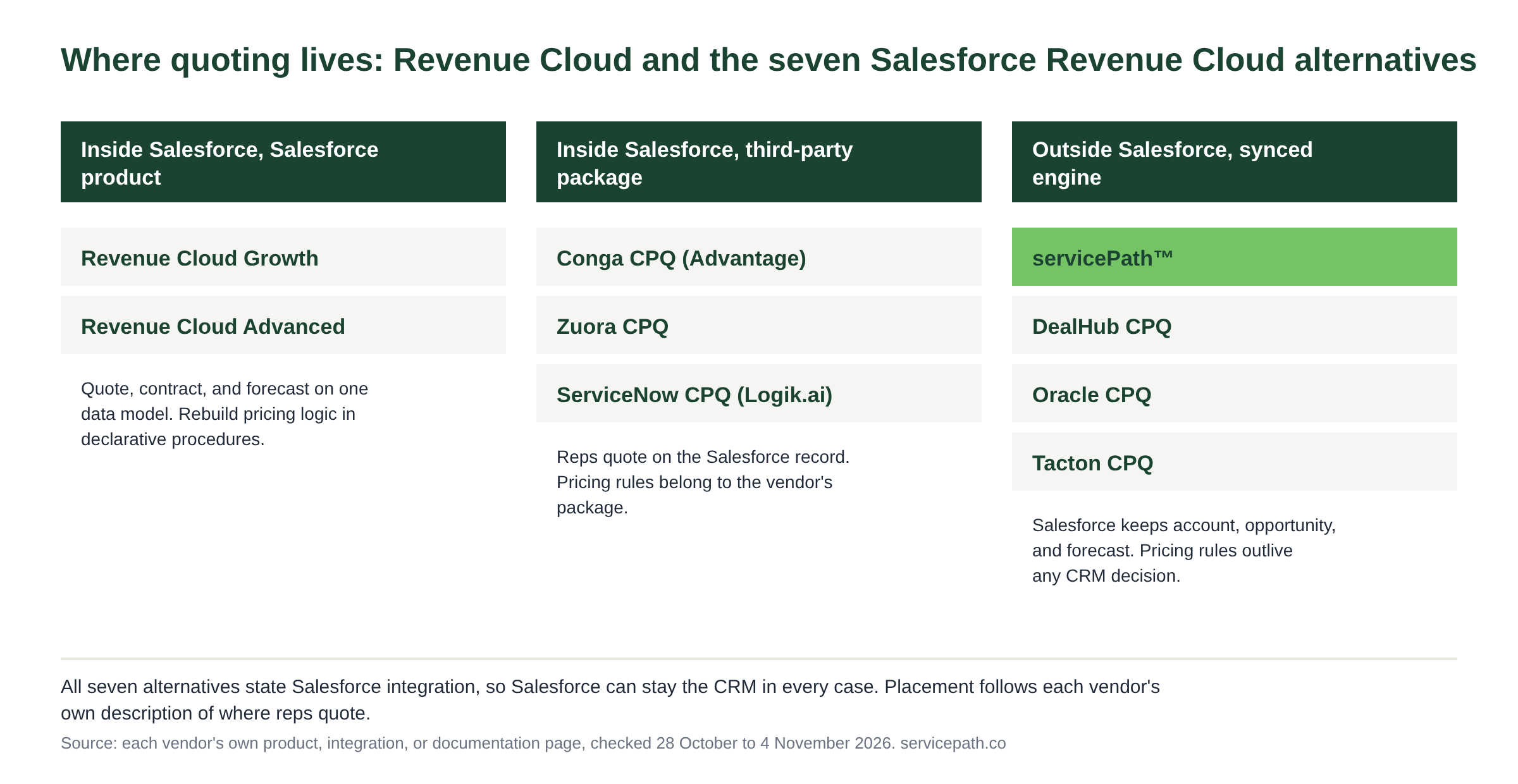
Put the same six questions to every vendor, Salesforce included, so the answers compare. Replacing Salesforce CPQ alone? In that case, our sister piece, Salesforce CPQ alternatives for 2026, compares six platforms.
- Bring three price rules and one Flow tied to the CPQ package, so the vendor can show where each lands, and get the mapping in writing.
- Where do closed quotes and live contracts sit after go-live, and who reports on them until renewal?
- Send a supplier price file beforehand, then ask how it loads for multi-vendor quoting and how often it can refresh.
- Show an evergreen contract on a quarterly billing cadence, then ask which system owns the invoice schedule.
- Can a pricing analyst change a deal governance approval threshold live, rather than through a developer?
- What is the three-year cost, including licence overlap during parallel running?
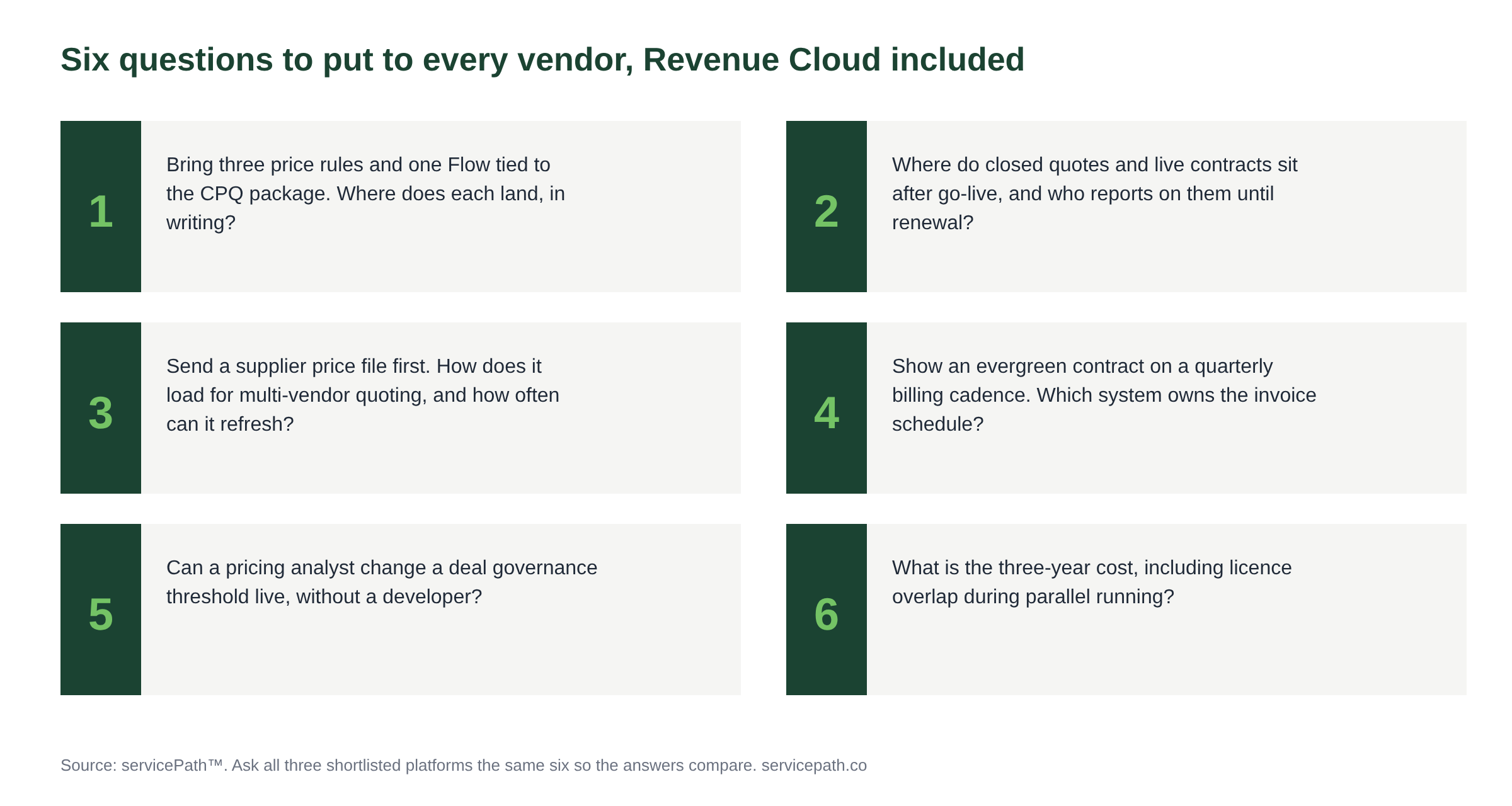
What timeline gets you to a December decision?
Mid November to the end of December is about six weeks, so keep the scope to inventory and testing.
By mid November: list price rules, approvals, and open amendments, then test each against the five conditions that make a CPQ legacy.
By end November: shortlist two Salesforce Revenue Cloud alternatives and put the six questions to all three, Revenue Cloud included.
In December: choose the target model and the CPQ foundation it needs, and plan without the reported migration assistant until it ships.
Why servicePath™ for complex technology sales?
Dell Technologies reports complex proposal changes taking “as little as 15 minutes vs a day”, and servicePath™ brings over 15 years of hands-on experience with technology service providers and MSPs.
Every profile above, ours included, is self-reported, so check the published proof on the servicePath™ case studies page.
That experience shows after signature, because a telco or TSP deal rarely ends there: supplier prices move, a tower gets amended mid-term, and the renewal inherits the original margin. servicePath™ carries that work in features a comparison table cannot see, such as cost to serve on every line, Real Time Profitability Insights, and Renewals and Revenue Management.
Talk to a CPQ architect , and bring that deal.
Salesforce Revenue Cloud alternatives: three quick answers
Is Salesforce CPQ being discontinued?
No. Salesforce’s end-of-sale FAQ announces no end-of-life date and no forced migration, while new features go to Revenue Cloud.
Is Agentforce Revenue Management the same as Salesforce Revenue Cloud?
Yes. Salesforce moved the suite name back from Agentforce Revenue Management to Revenue Cloud in September 2026, so the editions are Revenue Cloud Growth and Revenue Cloud Advanced, and contracts and help pages may show either name.
Can you keep Salesforce as your CRM and use a different CPQ?
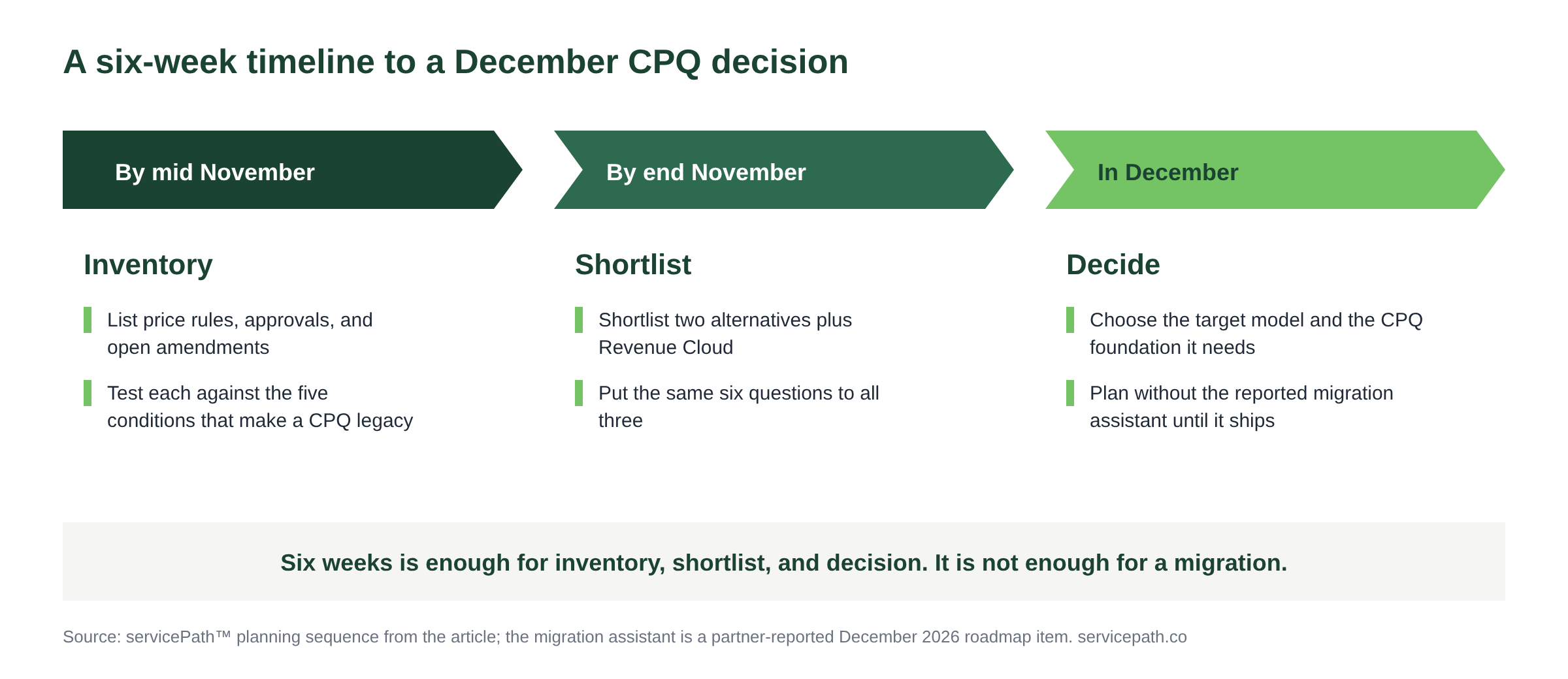
Yes. servicePath™, Conga CPQ, DealHub CPQ, Oracle CPQ, ServiceNow CPQ, Tacton CPQ, and Zuora CPQ all state Salesforce integration, so Salesforce can stay the CRM while quoting moves to another platform.
Next steps
Read the Dell Technologies and Scanco case studies
Read the Salesforce CPQ end-of-sale series on the servicePath™ blog
Then bring the six questions above to the first call.
Sources
- Salesforce CPQ end-of-sale FAQ · Salesforce CPQ migration paths (updated 14 October 2026) · Salesforce Revenue Cloud pricing · Revenue lifecycle management page
- Salesforce acquires m3ter (8 June 2026; completed 1 July 2026)
- Diabsolut on the Salesforce name changes (23 September 2026, verified 15 October 2026) · CRM Hacker Dreamforce 2026 Revenue Cloud recap (17 September 2026)
- Swantide (27 August 2026) · Pinkus Partners (8 October 2026) · SOLVD (15 October 2026) · Folio3 (updated 28 July 2026)
- Conga completes acquisition of PROS B2B (2 February 2026) · Conga CPQ vs Salesforce RCA · Conga CPQ product page
- DealHub acquires Subskribe (19 November 2025) · DealHub CPQ · DealHub Salesforce CPQ alternative
- Oracle CPQ · Oracle CPQ price list (1 November 2024)
- ServiceNow to acquire Logik.ai (3 April 2025) · ServiceNow CPQ · ServiceNow CPQ docs
- Tacton platform · Tacton integrations
- Zuora CPQ · Zuora enterprise CPQ guide (27 August 2026)
- servicePath™ case studies · Dell Technologies case study PDF · Scanco case study PDF