


In a working session last week on why generic AI keeps failing at pricing precision, I landed on four words.
In a working session last week on why generic AI keeps failing at pricing precision, I landed on four words: AI depreciates, context appreciates.
I posted them without explaining them. Here is what I meant.
If your business quotes anything complicated, this is already costing you. McKinsey finds inconsistent information across teams is the biggest reason B2B buyers switch suppliers (McKinsey, 16 July 2026). Not price. Not service. Two people telling a customer two different things.
AI depreciates, context appreciates. That idea should change how leaders think about AI investment.
The model an enterprise chooses today will not remain the best model forever. Capabilities improve, costs fall, vendors change. An AI decision that feels strategic today may become a replacement exercise sooner than expected.
The knowledge required to construct a valid, profitable customer commitment follows a different curve.
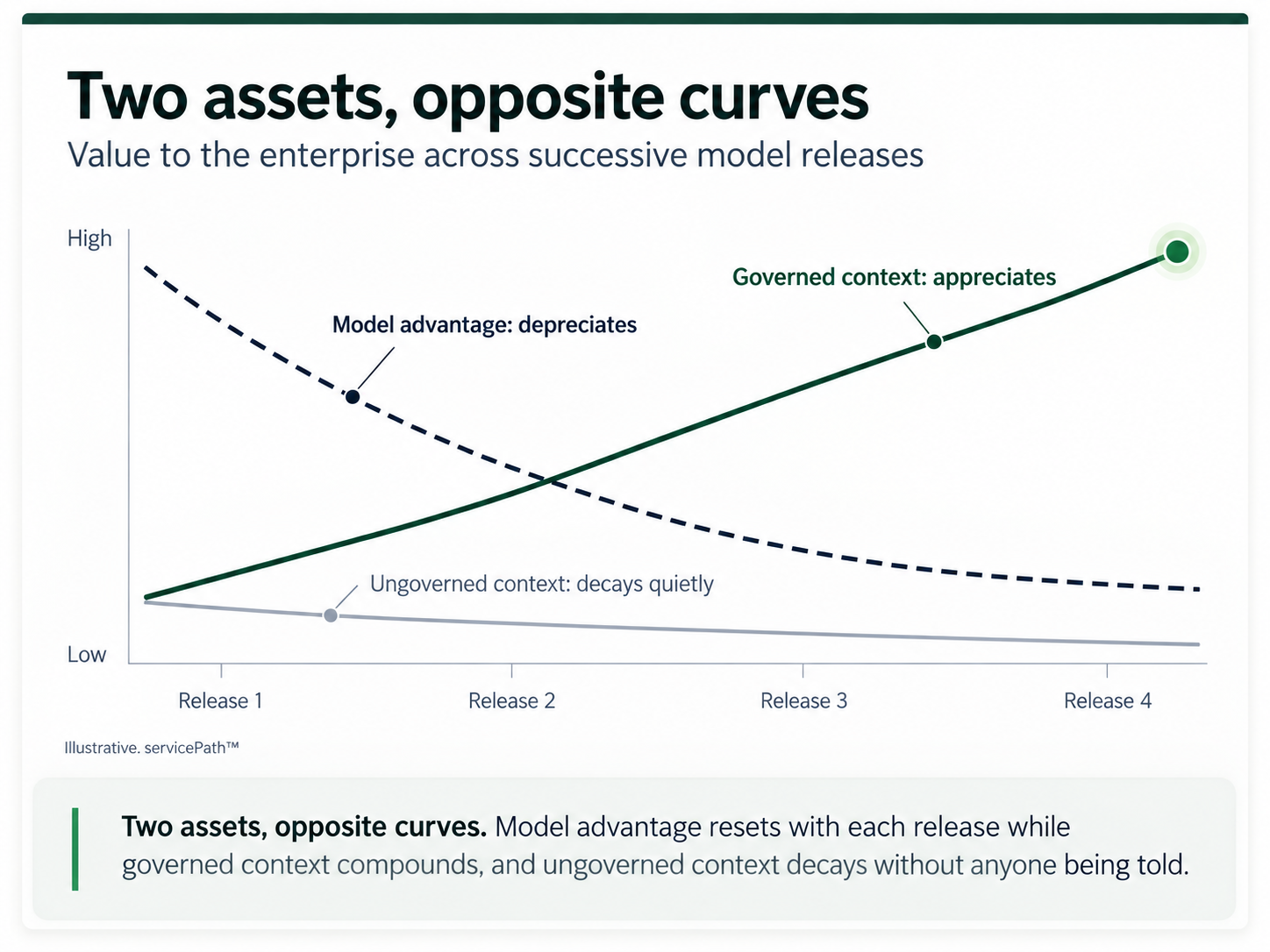
It grows as the enterprise adds products, refines pricing, negotiates terms, and renews relationships. It compounds with every quote, revision, and renewal, if it is governed. Left in spreadsheets and inboxes, it decays.
Every competitor can rent the same model. What they cannot rent is your context: the pricing rules, product dependencies, customer terms, approval logic, and contract history that make a commercial decision valid.
Most AI strategies focus on which model the company should select.
That is not the most important decision.
Model selection is procurement. The strategic decision is what the enterprise will still own after the model changes.
That is the enterprise durable advantage.
Rent the model. Own the context.
Where “AI depreciates, context appreciates” came from
I coined “AI depreciates, context appreciates” on 3 September 2026, in a working session at servicePath™ on why generic AI keeps failing at pricing precision, and posted it on LinkedIn the next day. I am dating it deliberately: if the phrase travels, the record should be checkable.
It came not from thinking about AI but about what makes a quote true, which no model release has made easier.
Executive summary: AI depreciates, context appreciates
- Model capability has converged: the top four models now sit within 25 Elo points, down from roughly 97 a year earlier (Stanford HAI).
- Enterprise financial impact has not moved: 37% of organisations report any EBIT effect from AI, unchanged from 2025, while 80% of individuals say AI made them faster (McKinsey, 25 August 2026).
- The gap is context, not intelligence: Gartner says success depends on giving agents governed, contextual access to the right data. And context depreciates too, silently, unless somebody owns it.
- There is a test at the end you can run without a vendor.
What I mean by “AI depreciates”
I do not mean the models are getting worse. They are getting better, and if your quoting is simple a good model and a good prompt will get you most of the way there. Every model is a depreciating asset. The moment a better one ships, and one always ships, whatever advantage it gave you transfers to everyone who can pay for an API call.
You are renting intelligence on someone else’s release schedule.
Today’s leading model will be challenged by a better one. Capabilities that appear differentiated now will become faster, cheaper, and widely available. Enterprises building their AI strategy around a particular model, assistant, or vendor are building on rented ground.
The model may be powerful, but it is not yours. Your business context is.
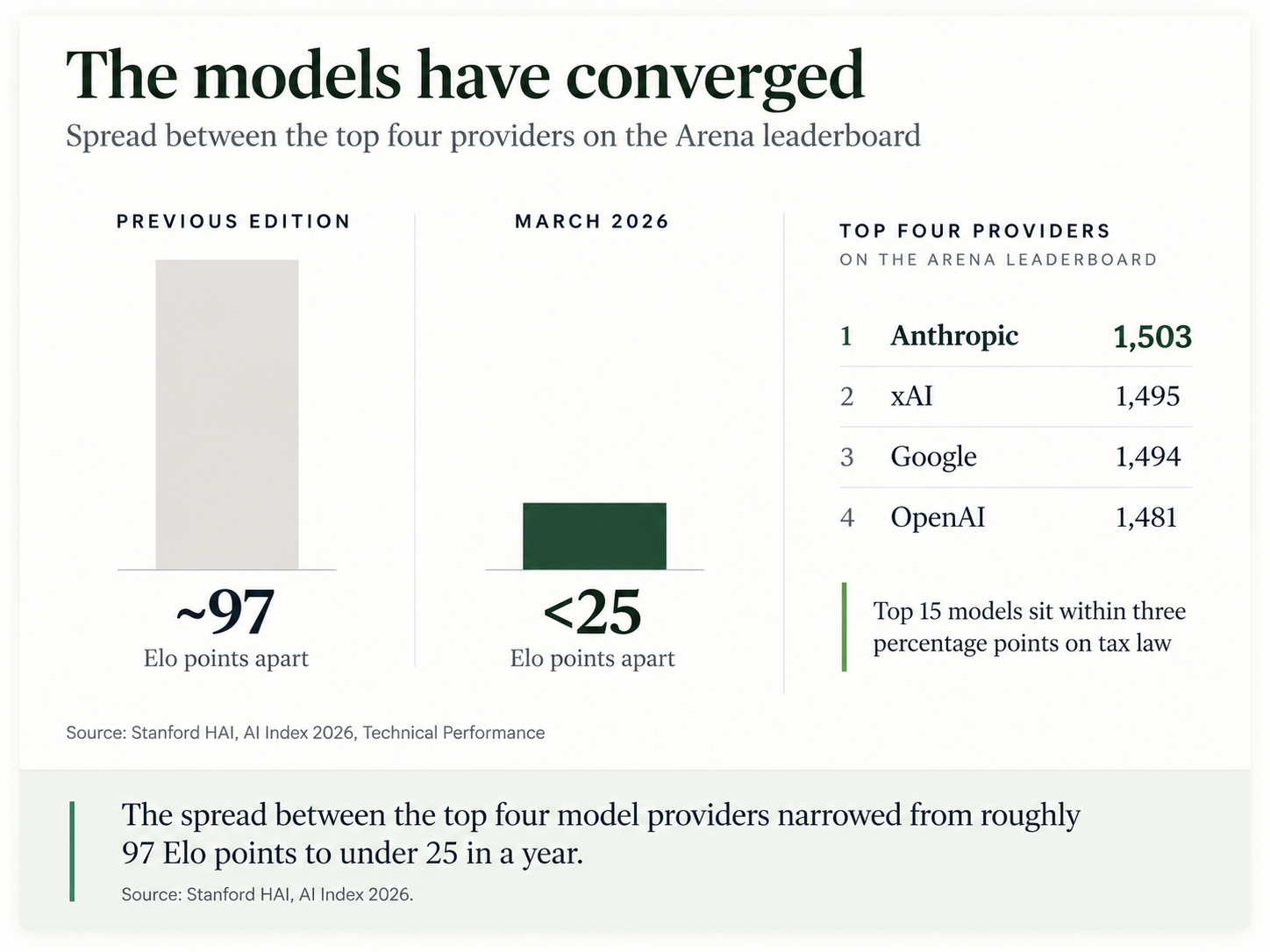
Stanford’s AI Index reports that as of March 2026 the top four models sit within 25 Elo points on the Arena leaderboard, against roughly 97 a year earlier, and that across tax, mortgage, corporate finance, and legal evaluations the top 15 models are separated by as little as three percentage points, so with “capability no longer a clear differentiator,” competition shifts to cost and reliability (Stanford HAI, AI Index 2026).
When 15 models land within three points of each other on tax law, you are choosing between invoices.
Gartner forecasts that by 2030, inference on a one-trillion-parameter model will cost providers over 90% less than in 2025 (Gartner, 25 March 2026). A model subscription buys intelligence competitors can also purchase.
The model is not your moat
Generative AI creates a compelling first impression. It can summarize an opportunity, draft a proposal, and suggest a configuration, producing what looks like a finished quote in seconds.
But enterprise revenue is not judged on whether a quote looks plausible, and a credible-looking quote is not necessarily a valid quote.
A general-purpose AI model does not inherently know that a customer’s ramp agreement changes in month 14, or that a service cannot be delivered in a region without an approved partner. It may know how businesses generally quote. It does not know how your business should quote this deal.
Without that context, greater fluency can simply produce more convincing mistakes.
Generic AI tools often fail inside complex enterprises not because they lack intelligence, but because they lack the governed context that makes intelligence reliable. Generic AI is context-starved, not intelligence-starved. Without a governed source of commercial truth, a more fluent model produces a more convincing wrong answer. Those are not language problems. They are commercial authority problems.
Nor does a bigger context window fix it. Stanford finds the gap between what a model accepts and what it can use is wide, and on tau-bench, which tests policy adherence, the best model reaches 70.2% and none exceeds 71% (Stanford HAI, AI Index 2026). Pasting your price book into a prompt is not governance.
The model can propose. The context layer must decide.
What I mean by “context appreciates”
Your context is the appreciating asset. It is the pricing rules, product dependencies, negotiated terms, approval chains, and contract history that determine whether a quote is actually valid.
The accumulated knowledge of how your enterprise configures, prices, approves, contracts, and delivers complex solutions cannot be downloaded from an AI provider. It is built through years of products, customers, negotiations, exceptions, and decisions. When that knowledge is structured, governed, and applied consistently, it becomes more valuable with every transaction. That is the difference between buying AI and building an advantage for the AI era.
Every competitor can rent access to the same model. They cannot buy your accumulated knowledge of how products fit together, which prices apply, what customers have negotiated, where delivery constraints exist, or who may approve an exception.
No model release erodes it. Every model release makes well-governed context more valuable, because better intelligence acting on your rules beats better intelligence guessing.
A model can make a quote sound right. Only context can make it true.
Governed context is not another word for data
Most enterprises do not have a data shortage. They have a context problem.
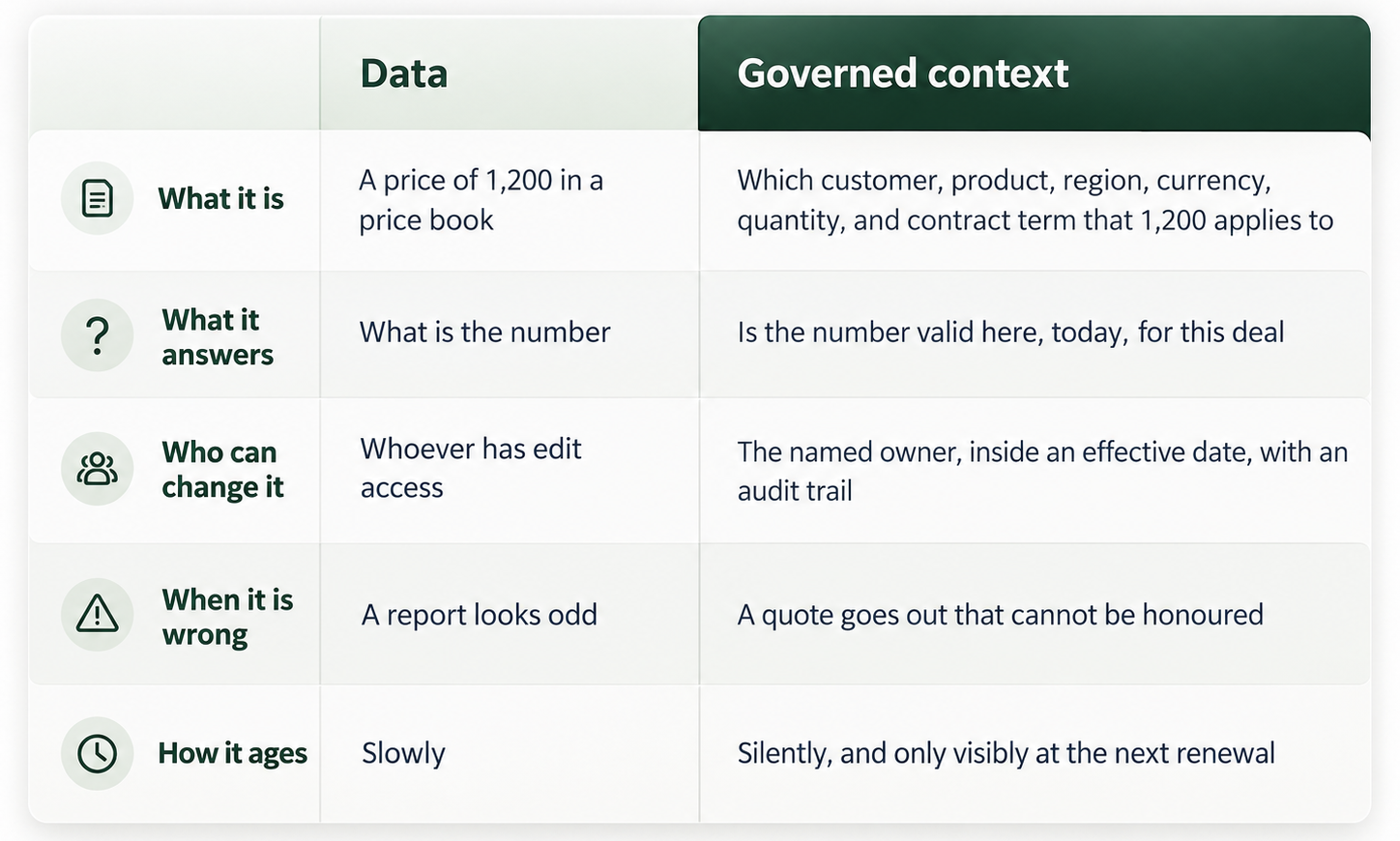
A number in a price book is data. A contract clause is data. A cost is data. An AI system may retrieve some of it, but retrieval is not governance.
I would rather point at somebody with no product to sell. In April 2026, Gartner published shifts for data leaders through 2030, one titled “Establish Context as Critical Infrastructure,” and in the same release Gartner’s Chief of Research states that “D&A success in 2030 is not about better models” (Gartner, 16 April 2026).
A month earlier it forecast semantic layers being treated as critical infrastructure by 2030 (Gartner, 11 March 2026). Gartner is describing a data and analytics problem. Mine is commercial. Same asset, narrower application.

The word doing the work is “governed”
But context does not appreciate automatically.
Unowned rules become stale. Customer exceptions become buried in email. Price books are copied into spreadsheets. The pricing rule that lives in one person’s head does not compound, and neither does the concession nobody wrote down after the renewal negotiation.
Information fragments, ages, and becomes unreliable. It becomes context debt: the growing cost and risk created when the business cannot reliably find, understand, or reuse its own commercial knowledge.
Governed context behaves differently. It has ownership, effective dates, version history, permissions, and an audit trail. That turns information into an enterprise asset.
I use governed context and commercial context to mean the same thing here. Commercial context is the analysts’ term; governed is the part that matters.
What governed context leaves out
Ownership, dates, versions, permissions, and an audit trail tell you a rule is current. They do not tell you if it is still right.
Ronald Powell, a product and technology executive who has served as CPTO and CIO, made that point in the comments under the LinkedIn post: “Context is appreciated when it is connected to evidence and outcomes.” An organisation, he wrote, “may have decades of pricing rules, contracts, customer interactions, exceptions and institutional knowledge. But if that context remains fragmented across systems, documents, and people’s heads, its potential value exceeds its usable value.”
His loop for pricing runs context, recommendation, decision, commercial outcome, learning, better context. “Now the organisation is not simply giving AI more information. It is creating a proprietary learning system that becomes richer with every decision and outcome.”
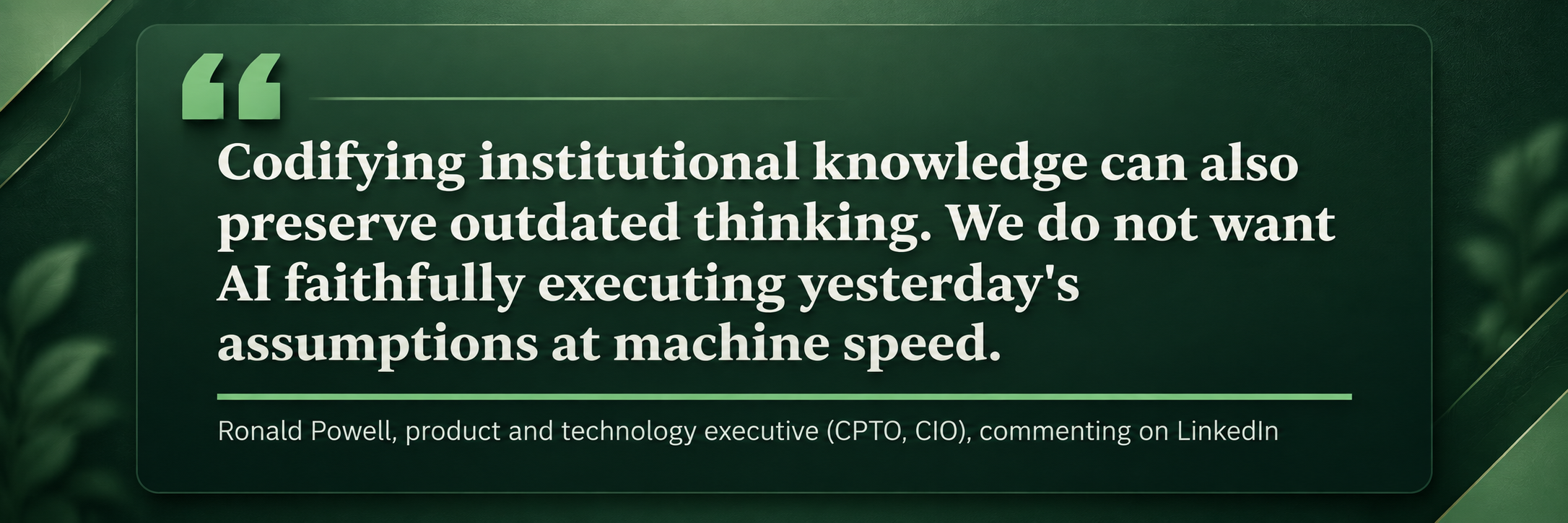
He put the failure case in one sentence: “If three people know why a pricing exception exists but the AI only sees the price, it has data without the decision context that made that data meaningful.”
Capture the why, not just the rule
So capture, in his words, “not only what the rule is, but why it exists, who owns it, what evidence supports it, where exceptions apply, when it was last validated, and what outcomes it produced.” Not everything. “The challenge is rarely capturing all institutional knowledge. It is identifying the knowledge that is material to a decision and making it governable.”
That makes this, again his phrase, “a living evidence system, not a one-time knowledge-management exercise.” The test is not getting context into the model. It is whether the context “remains current, attributable, challengeable and connected to outcomes.”
What I mean by “context appreciates”
Your context is the appreciating asset. It is the pricing rules, product dependencies, negotiated terms, approval chains, and contract history that determine whether a quote is actually valid.
The accumulated knowledge of how your enterprise configures, prices, approves, contracts, and delivers complex solutions cannot be downloaded from an AI provider. It is built through years of products, customers, negotiations, exceptions, and decisions. When that knowledge is structured, governed, and applied consistently, it becomes more valuable with every transaction. That is the difference between buying AI and building an advantage for the AI era.
Every competitor can rent access to the same model. They cannot buy your accumulated knowledge of how products fit together, which prices apply, what customers have negotiated, where delivery constraints exist, or who may approve an exception.
No model release erodes it. Every model release makes well-governed context more valuable, because better intelligence acting on your rules beats better intelligence guessing.
A model can make a quote sound right. Only context can make it true.
Context depreciates too, and nobody sends a release note
This is the part my “AI depreciates, context appreciates” post on LinkedIn did not say, and it is the more useful half of the idea. Context depreciates too, just silently.
Context does not appreciate on its own. The pricing rule that lives in one person’s head, the concession nobody wrote down after the renewal: that context depreciates faster than any model.
It walks out of the building.
A model’s depreciation gets announced by someone else’s launch. Yours announces itself six months later, in a quote nobody can honour. And only one is replaceable with money: a better model is a purchase order away, but the rule that left with the person who knew it is not for sale.
Governed context is the appreciating asset. Ungoverned context is just institutional memory with a resignation risk attached.
Gartner’s March 2026 predictions put a mechanism under this: ungoverned decisions using large language models will cause financial or reputational loss, and by 2030 half of AI agent deployment failures will trace to insufficient governance enforcement at runtime (Gartner, 11 March 2026).
In a Gartner survey of 360 IT leaders, only 23% said they are very confident in their ability to manage security and governance when deploying generative AI tools (Gartner, 16 April 2026).
What ungoverned commercial context costs you
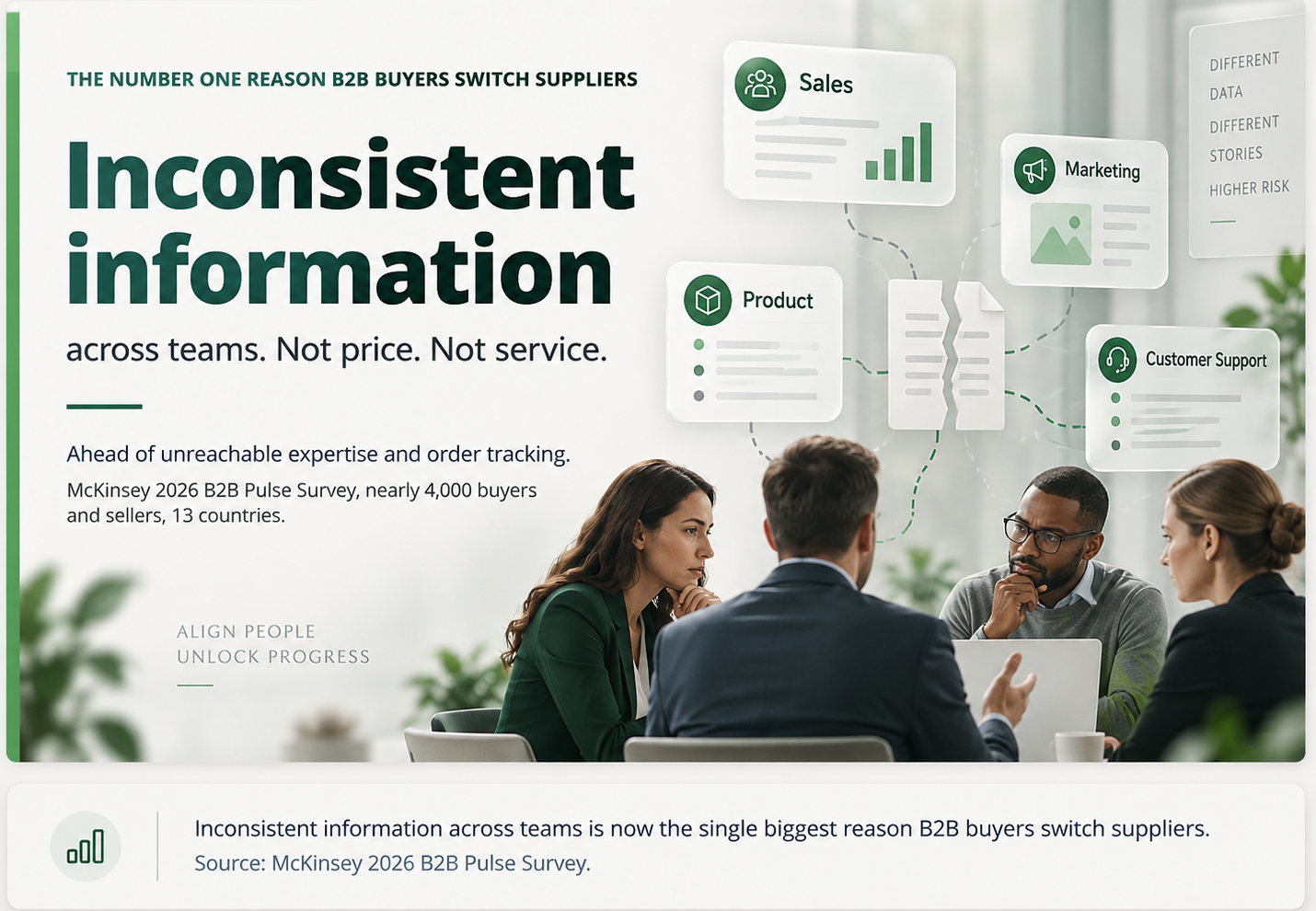
In their 2026 B2B Pulse Survey of nearly 4,000 buyers and sellers across 13 countries, inconsistent information across teams is now the biggest reason B2B buyers switch suppliers, ahead of unreachable expertise and order tracking (McKinsey, 16 July 2026).
So the most common reason you lose a customer is not price and not service. It is that two people in your business told them two different things.
That is context debt with a customer attached.
The same report describes the pricing workflow in terms I could have written: static price lists, reps disconnected from live signals, variance nobody spots until after the deal closes.
Buyers do not punish different prices. They punish unexplained prices.
That lands in three places a CFO already tracks: rework before the deal closes, realised margin against list, retention at renewal. It does not create a new line item, it changes three you already report.
McKinsey’s conclusion matches Gartner’s: agents cannot produce trusted recommendations while customer, product, pricing, and interaction data stay fragmented. The binding constraint is not the model.
Why the money has not followed the models
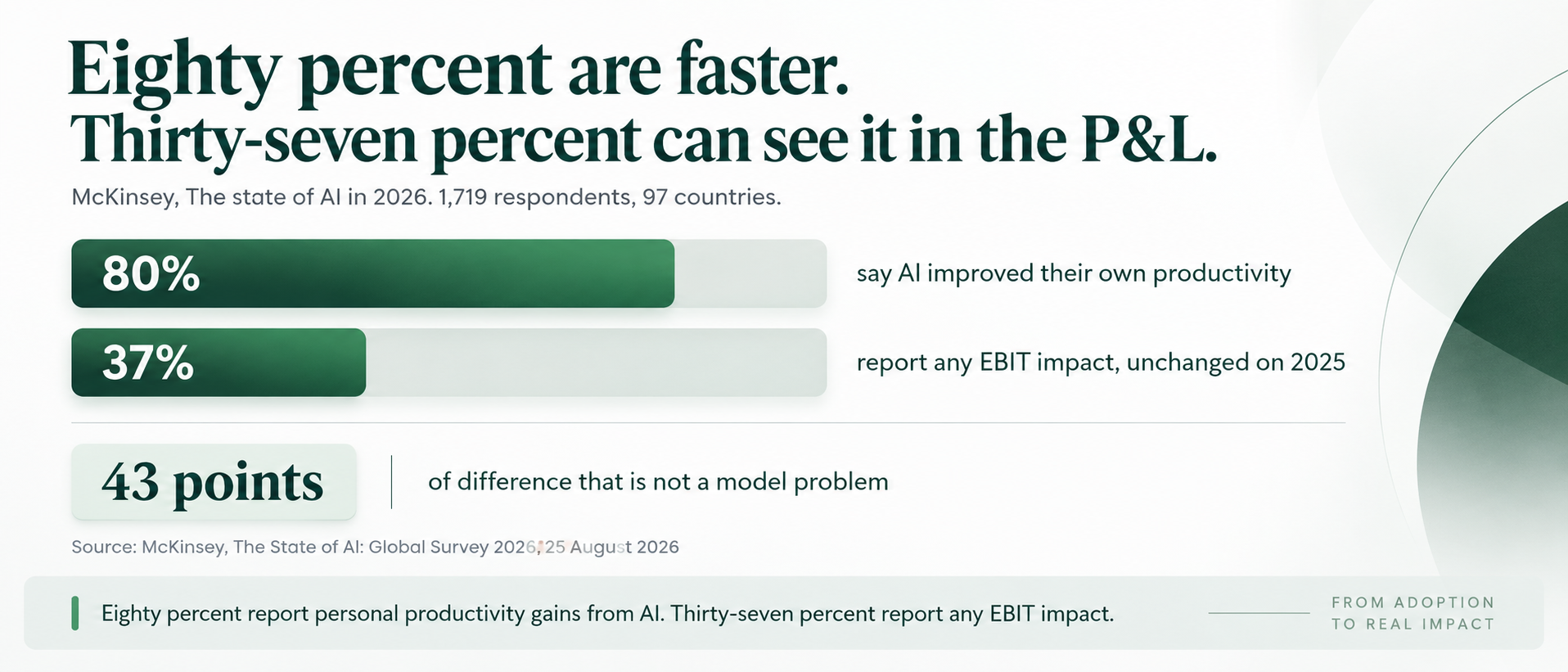
If intelligence were the constraint, the returns would have arrived. McKinsey’s 2026 survey of 1,719 leaders found 80% say AI improved their productivity, while 37% say it has contributed to EBIT, about the same share as last year. The group attributing 5% or more of EBIT to AI has held flat at roughly 6%. McKinsey’s summary: “conviction in AI is growing faster than the immediate financial returns” firms can attribute to it (McKinsey, 25 August 2026).
Eighty percent of people are faster. Thirty-seven percent of companies can see it in the P&L.
The 43 points between are not a model problem.
Put your own numbers against it. Take a hypothetical business quoting $400M a year at 15% margin: losing 50 basis points to unexplained variance costs it $2M a year. The point is not the answer but that you can do the arithmetic, which requires knowing your realised prices.
Governed context is not free
Governing context is a standing cost. Somebody owns each rule. Somebody maintains effective dates. Someone reviews the exceptions and decides which become policy and which were mistakes. The alternative costs more and the bill arrives later, because rebuilding institutional knowledge after a resignation is not a line item anyone budgets for.
McKinsey’s model is the most concrete: data ownership in the business rather than IT, one team accountable per domain, each with a named owner. They also note that a dollar deploying AI may need three on change management (McKinsey, 16 July 2026).
A traditional view of CPQ treats each quote as an output. A context-driven view treats each quote as both a transaction and a contribution to institutional knowledge. Some exceptions are strategic. Some are genuinely customer-specific.
Others are mistakes that should never be repeated. Context appreciates when the enterprise can distinguish among them. The purpose is not to automate judgment out of the business. It is to make judgment visible, explainable, and reusable.
A test you can run without us
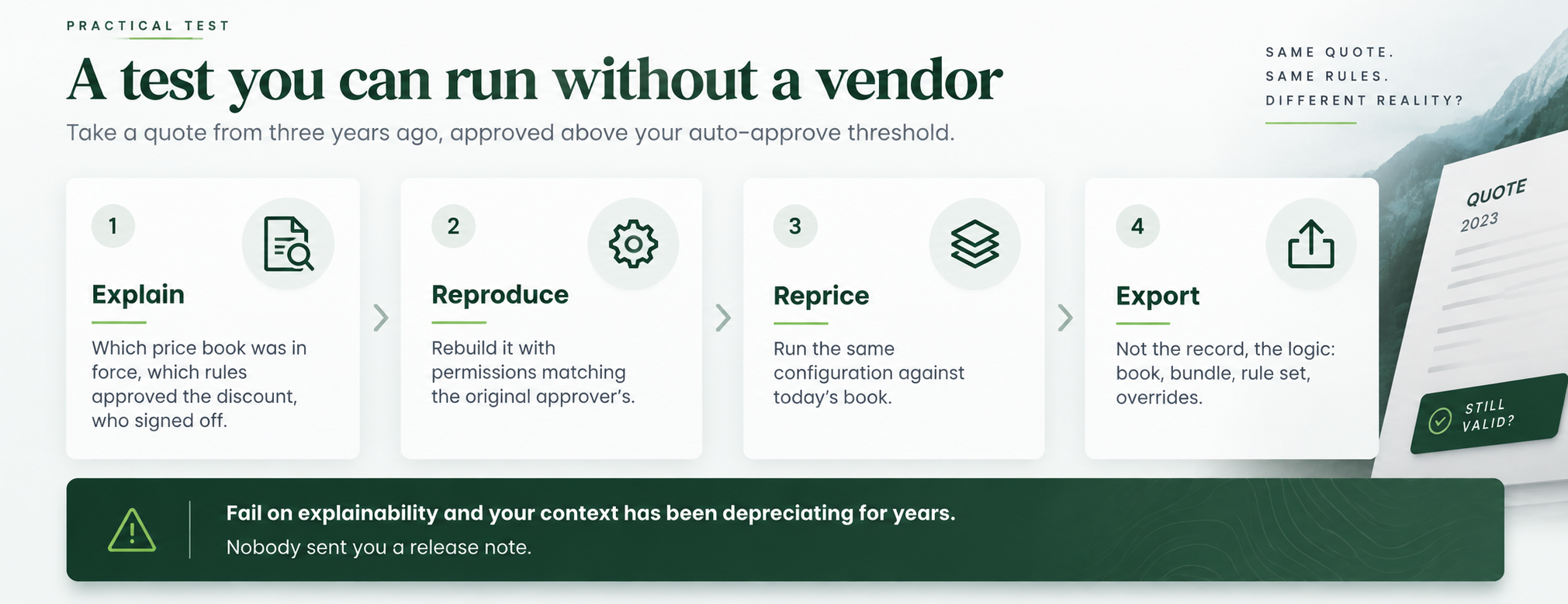
The claim is worth nothing unless you can check it. Take a quote from three years ago, approved above your auto-approve threshold, and answer four questions.
Can you explain it. Not retrieve the total, explain it: which price book was in force, which rules approved the discount, who signed off.
Can you reproduce it, in your current system, with permissions matching the original approver’s.
And can you reprice it against today’s book.
Can you export it. Not the record, the logic. Export your quote history and you get records. You do not get the price book in force that day, the bundle at that version, or the rule set that approved the discount.
A stored total is a record. The logic that produced it is the asset.
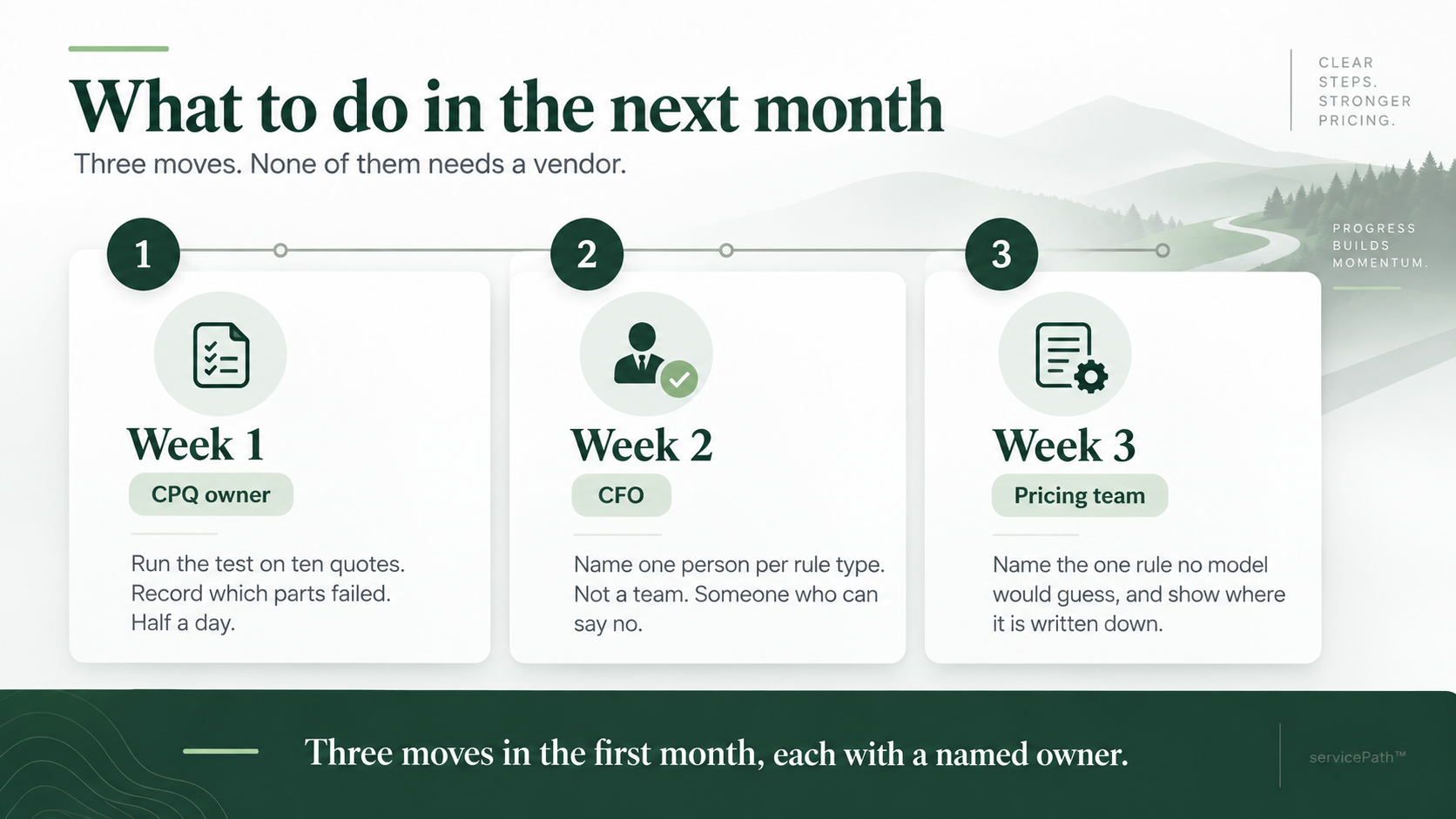
We named it the Golden Quote Continuity Test, set out in full in Your CPQ Vendor Was Acquired. Run it on ten quotes, not one.
If you fail on explainability, your context has been depreciating for years and nobody sent you a release note.
And it does not stop while you decide. Every quarter another approver moves on, another price book gets copied into a spreadsheet, another exception goes unwritten. The bill arrives at a renewal.
Then give the rules an owner
Then name an owner for each of the five rule types: pricing, product dependencies, customer terms, approval authority, contract history. Not a team, a person who can say no.
Then ask them to name the one rule no model would ever guess. Every company I ask has one rule that no model could infer, and the best pricing teams I talk to can name it in a sentence and show where it is written down.
A team that cannot explain, reproduce, reprice, and export ten historical quotes cannot credibly threaten to migrate, which means the vendor knows what your alternatives are worth before you do.
What can we sell, what did we promise, what will it cost to deliver
Those four questions are hard to pass because the quote is only the first state of the deal.
The moment an enterprise creates an offer is the moment its business model becomes real. A company’s business model can look simple on a strategy slide. It becomes real when the company puts a price against a configured solution and promises to deliver it to a customer.
That is why CPQ occupies a more important position than its name suggests. The CRM may record the relationship. The ERP may record the financial outcome. But CPQ determines what can be sold: what, at what price, under which conditions, with what expected margin, and with whose approval.
Volumes ramp, locations are added, services are upgraded or dropped. Most stacks lose continuity right there: the opportunity closes, the proposal becomes a PDF, and delivery costs sit in a spreadsheet nobody has opened since.
The commercial model must survive the sale
The enterprise retains documents, but it loses the commercial model behind them. Service Contracts carries the commercial record forward, so a mid-term change is evaluated against what the customer already has and what was approved. A small request can have consequences invisible in isolation: adding a service may affect a volume tier, removing a component may invalidate an SLA dependency, moving a renewal date may change a price escalation. The answer depends on the history of the relationship, not just the latest request.
That is commercial context appreciating over time.
Three views of one commitment
servicePath™ connects what the enterprise can sell, what it has promised, and what it will cost to deliver.
Together they answer three connected questions: what can we sell, what have we committed to, and can we deliver it profitably? These are not three unrelated product features. They are three views of the same customer commitment. CPQ governs the offer. Service Contracts preserves the relationship. Cost-to-Serve keeps the economics visible.
Revenue is incomplete without Cost-to-Serve
A correctly configured deal can still be a bad deal. But price is not profit. A renewal can preserve recurring revenue while weakening margin, an expansion can scale poor unit economics, and a customer can look valuable at the top line while becoming expensive to support. Without cost context, the business sees commercial activity. With Cost-to-Serve, it sees commercial quality.
The result is not simply a faster quote. It is a more complete representation of how the enterprise creates revenue. Over time the enterprise develops a governed commercial memory: it knows not only the final price but why it was valid.
One more concession. Governed context does not prove governance caused a margin improvement, because too much else moves over three years. What it does is make the decision explainable, which is the precondition for improving it.
Own the context
Boards should ask a different question when evaluating AI investments. Not: which model should we adopt? But: what are we building that will remain valuable regardless of which model wins? If AI depreciates and context appreciates, the answer is not a model.
Those are not generic AI capabilities. They are enterprise assets. Not that it remains unchanged, but that technological change makes it more useful rather than obsolete. The durable advantage is the enterprise context that makes intelligence commercially reliable.
The model can change. The interface can change. The AI provider can change.
The enterprises that win in the AI era will not be the ones that selected the perfect model. No model remains perfect for long. The enterprise that can change models without losing the knowledge of how its business works is in a stronger position, renting intelligence while accumulating the asset that makes it useful.
AI will not replace CPQ
It is tempting to assume that increasingly capable AI will eventually replace systems such as CPQ. The opposite is more likely. AI can create options. The enterprise still needs to know which option can be sold, at what price, under which terms, with what margin, and with whose approval.
The model can handle language, interpretation, and interaction, but it should not silently invent a binding price, waive an approval, or determine an entitlement from incomplete information. The governed commercial system should handle authority, and the enterprise preserves model choice without surrendering commercial control.
Model choice is procurement. Context ownership is strategy.
The model improves. The context remains. AI depreciates, context appreciates.
For complex revenue, the durable advantage begins with CPQ, compounds through Service Contracts, and is protected by Cost-to-Serve.
Rent the model. Own the context.
That is the enterprise durable advantage.

Why servicePath™
servicePath™ holds product, pricing, dependency, approval, and contract logic outside any single CRM, which is what lets a quote be explained, reproduced, repriced, and exported years later. Integration, mapping, and testing still apply.
servicePath™ was positioned as a Visionary in the 2026 Gartner® Magic Quadrant™ for Configure, Price and Quote Applications, the fourth consecutive year in that position (Gartner, Magic Quadrant for Configure, Price and Quote Applications, by Mark Lewis and Luke Tipping, 22 January 2026).
Hannah Buckley, Sales Operations Manager at Telent, described the underlying problem in a published case study: “For our business, a huge challenge is constant change in technology and pricing.”
There is a second published case study with Dell EMC.
Questions I get asked
Who coined the phrase “AI depreciates, context appreciates”?
I did. The phrase came out of a working session at servicePath™ on 3 September 2026, on why generic AI keeps failing at pricing precision without governed business context, and I published “AI depreciates, context appreciates” on LinkedIn on 4 September 2026. I am Daniel Kube, CEO of servicePath™.
What is the difference between governed context and data?
A price in a price book is data. Context is which customer, product, region, currency, quantity, contract term, and effective date that price applies to, and whether an exception to it needs approval.
What does poorly governed commercial context actually cost?
Three ways that compound: quotes that cannot be honoured at the price promised, margin lost to variance nobody can explain, and customers who leave because two people told them two different things. Rework, renewal, churn.
AI depreciates, context appreciates.
Run the four-part test on ten of your own quotes first. If it fails on explainability, that is the conversation to have.
