
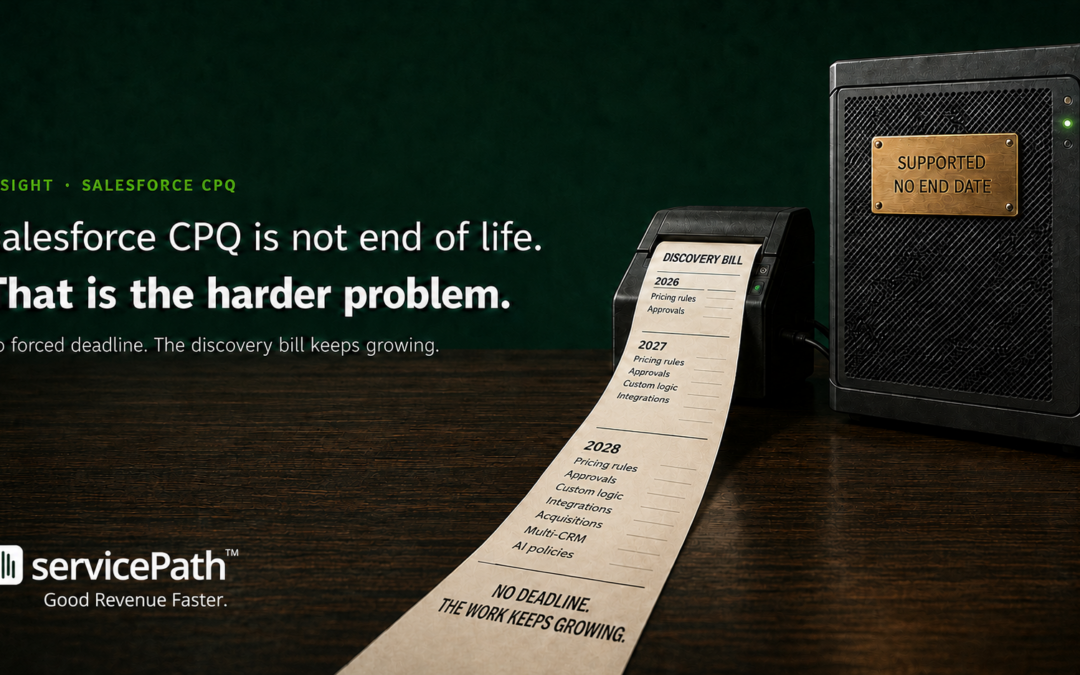

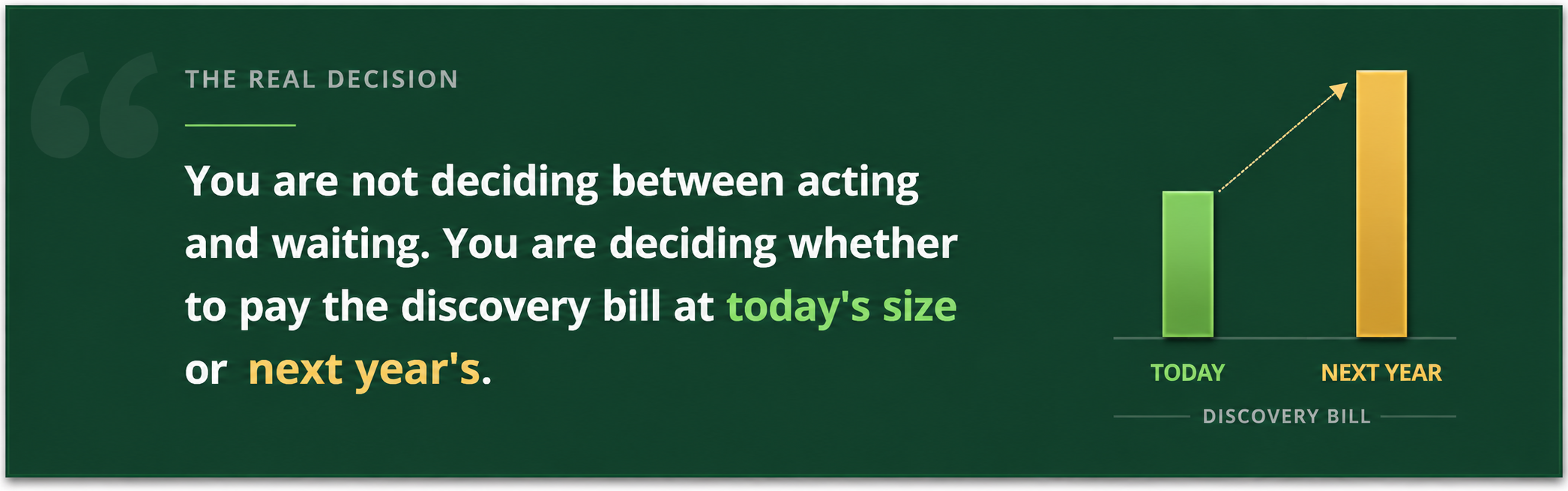
Salesforce CPQ end of life has no date, so the decision defaults to later, every year, while the discovery bill grows. Decide at today’s size.

Salesforce just took the deadline off the table, and that is the worst news your quoting roadmap has had all year.
Read the reassurance the way Salesforce wrote it. Keep your licenses. Add users. Renew. No forced migration. No announced end-of-life date. Now read it again as the sponsor trying to get a line item into the FY27 plan. Every sentence removes a reason to act.
But if you run one CRM with light customization and little change, the architecture problem may be smaller, and our February piece on the end-of-sale announcement covers that case. This article is for enterprises where complexity, custom logic, acquisitions, or AI make the decision harder. Two numbers decide how hard: how many CRMs you will run in three years, and, since August, how many interfaces your sellers will quote from.
Executive summary
Salesforce CPQ is end of sale and in a maintenance phase, not end of life. Support continues while the platform ships releases that deliver no new features to the package. The gap that opens is architecture divergence, and its price is the discovery bill: the cost of finding and re-expressing commercial logic before any move. The real deadline is economic, not contractual. The CRM does not have to own the commercial rules. AI raises the standard: probabilistic recommendations still need deterministic enforcement.
Is Salesforce CPQ end of life? What Salesforce actually said
No. Salesforce CPQ is end of sale, not end of life. Salesforce states that end of life “has not happened with Salesforce CPQ,” that support and critical fixes continue, and that there is no forced migration to Agentforce Revenue Management.
That answer is accurate, and it is why this decision keeps missing your budget cycle. The worksheet below prices the miss.
The load-bearing language, verbatim, from Salesforce’s own end-of-life page, published 10 July 2026 and last updated 28 August 2026, accessed 31 August 2026:
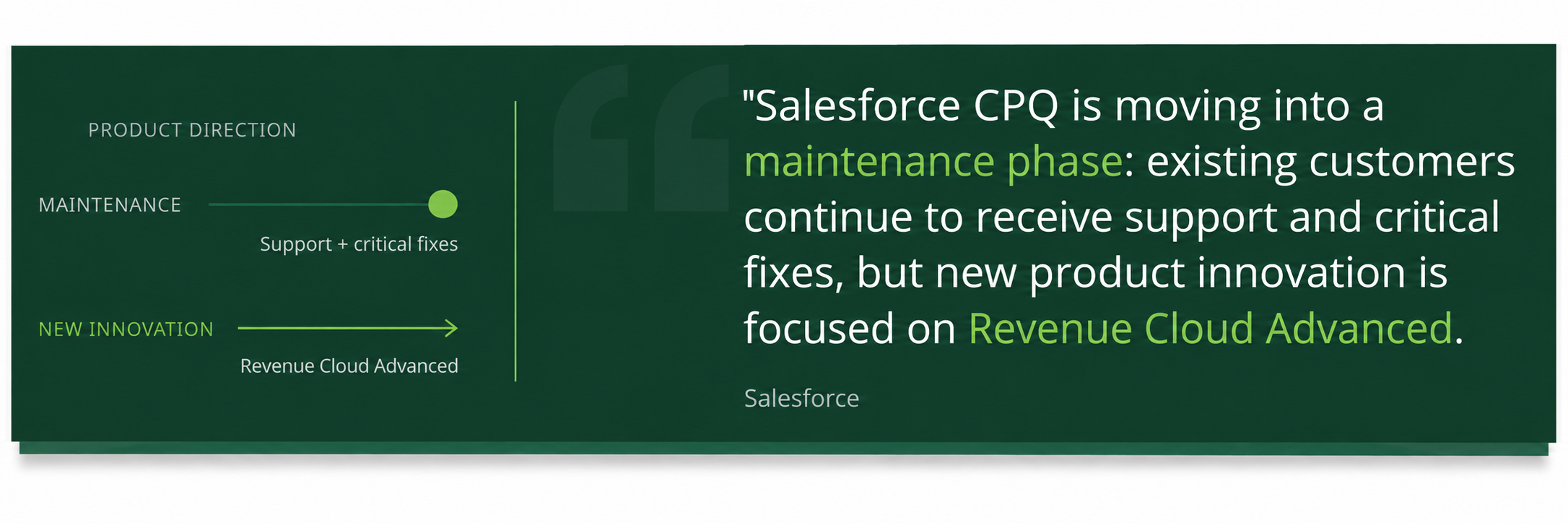
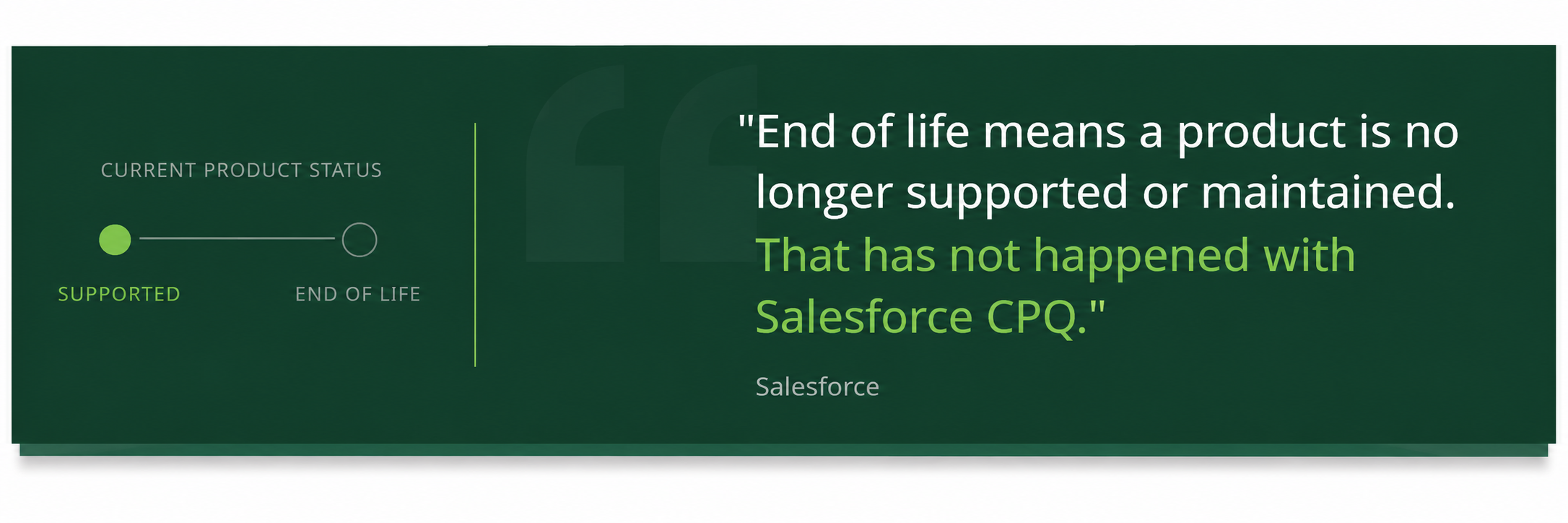
The same page adds that customers can renew and add users, with no forced migration, and that investment has shifted to Revenue Cloud Advanced.
End of sale is a commercial status. Maintenance phase is a product status. Salesforce CPQ end of life is a date that does not exist.
The architectural fact, in Salesforce’s own words
Meanwhile, Salesforce Help calls the product what it is: the Salesforce CPQ managed package, Salesforce Help release 262.0.0 dated 30 August 2026, which “continues to be available for existing customers, however, there is no longer any new feature development.” Forward investment sits in Revenue Cloud Advanced. Note what does not change in that move: the quoting logic stays inside the CRM, the property that made this migration expensive in the first place.
Salesforce ships three seasonal releases a year, per its own releases page, accessed 31 August 2026. Between this fall and the end of 2028 that is seven generally available releases, named in the figure below. On Salesforce’s current published status, none of the seven will deliver new CPQ features.
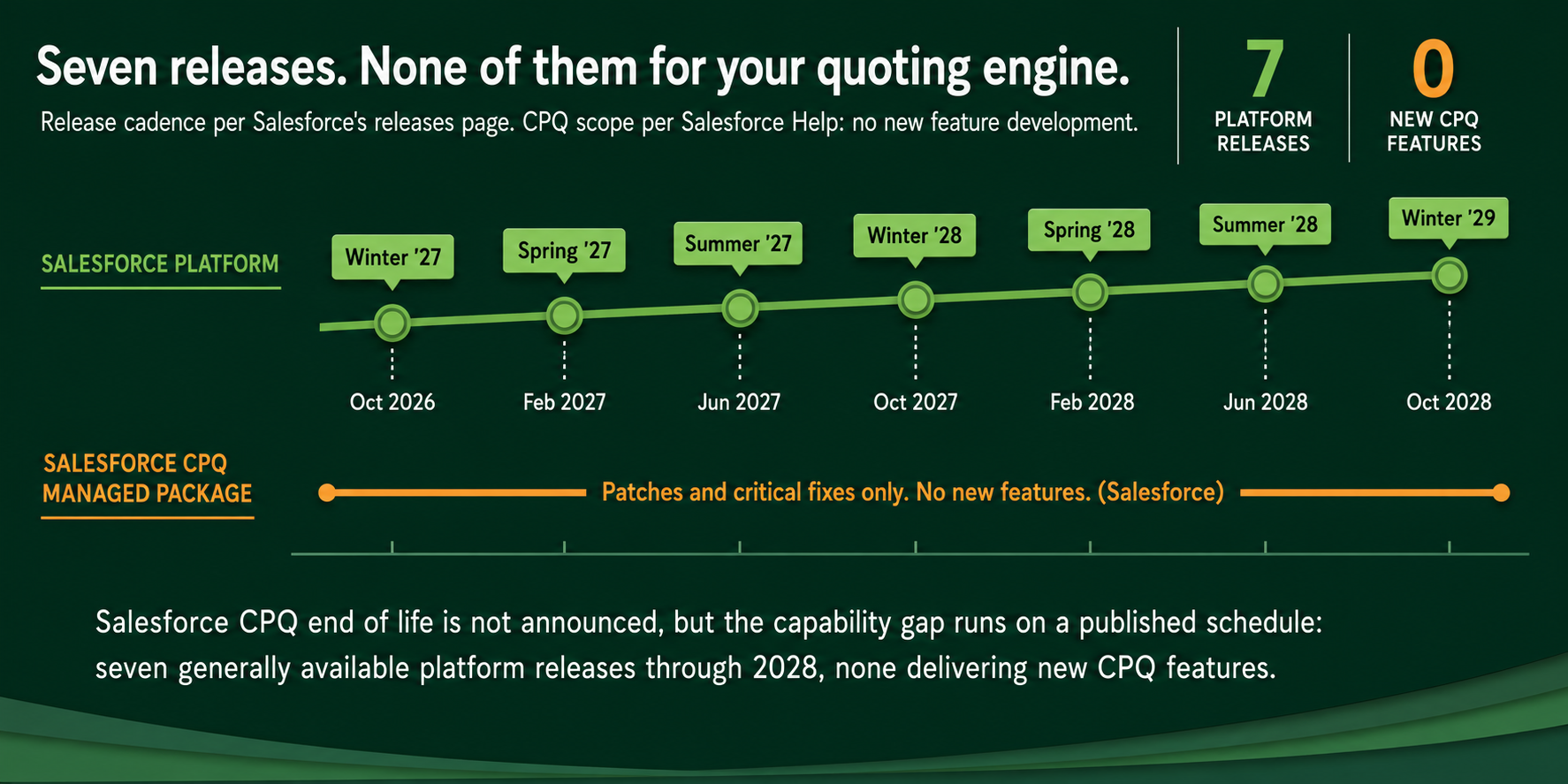
But the package still receives patches, and platform innovation keeps improving the surroundings of the quoting engine because quotes live in the org. The engine itself, by Salesforce’s own statement, gets none of it. So do not take my word for it: open the Salesforce CPQ section of the next release notes. Fixes, retirements, compatibility updates, and no new capability on the current status.
Still, nobody can waive a packaging boundary for you. So “no forced migration” and a widening capability gap are both true at once, because the constraint is architectural rather than contractual. The question is not whether Salesforce CPQ reaches end of life. It is what the gap costs while it does not.
The decision that gets made by not being made
Meanwhile, the calls you get now sell the migration, not the renewal. None carries a deadline, which is why none of them makes it into a budget.
Salesforce CPQ maintenance phase: what it means for your roadmap
Because there is no deadline, a decision with no forcing function gets made by default, in three familiar shapes.
- The budget cycle passes without a line item, and the default renews for another year.
- An acquisition arrives, the estate fragments, and next year’s decision is strictly larger.
- An AI initiative gets scoped for action, meets the policy layer, and quietly descopes to reporting. It looks like an AI decision. The constraint underneath is architectural.
The third shape is growing fastest. McKinsey’s April 2026 pricing research finds 65 to 85 percent of organizations expect to adopt gen AI or agentic AI in pricing over the next one to three years, and Gartner predicted in July 2026 that AI agents will outnumber sellers ten to one by 2028. Those expectations land on whatever quoting layer you run, which is why AI-native CPQ became an architecture conversation.
AI agents meet the Salesforce CPQ maintenance phase
One principle holds. AI can be probabilistic in recommendation. Revenue enforcement must remain deterministic. For example, an agent may suggest 17 percent off. Commercial policy decides whether 17 percent is permitted, who approves it, and what evidence remains. A maintenance-phase managed package is where that deterministic layer stops evolving: the AI initiative can descope because the policy layer cannot move.
Why Salesforce CPQ end of sale lands in this budget cycle
So the clock runs on your calendar, not Salesforce’s. FY27 budgets are built in September and October and locked by roughly November. A line item needs a sponsor, and the sponsor needs a number before the lock. That constraint comes from your own finance function, not any vendor.
Framing decides whether the line item survives. Forrester’s 2027 budget guidance, July 2026, tells leaders to eliminate initiatives lacking governance, ownership, success criteria, or a path to scale. Under that logic, a generic replacement request is harder to defend than revenue governance with a named owner.
In fact, the deadline is not the Salesforce CPQ end of life date. It is the point at which architecture divergence costs more than changing course. The discovery bill is its price tag, and a CFO can govern that threshold.
Nobody schedules the meeting where you decide not to decide. It happens in the gap between planning cycles, and it happens every year.
What staying on Salesforce CPQ past end of sale actually costs
Meanwhile, your own systems already know what deferral costs. Five lines, all yours.
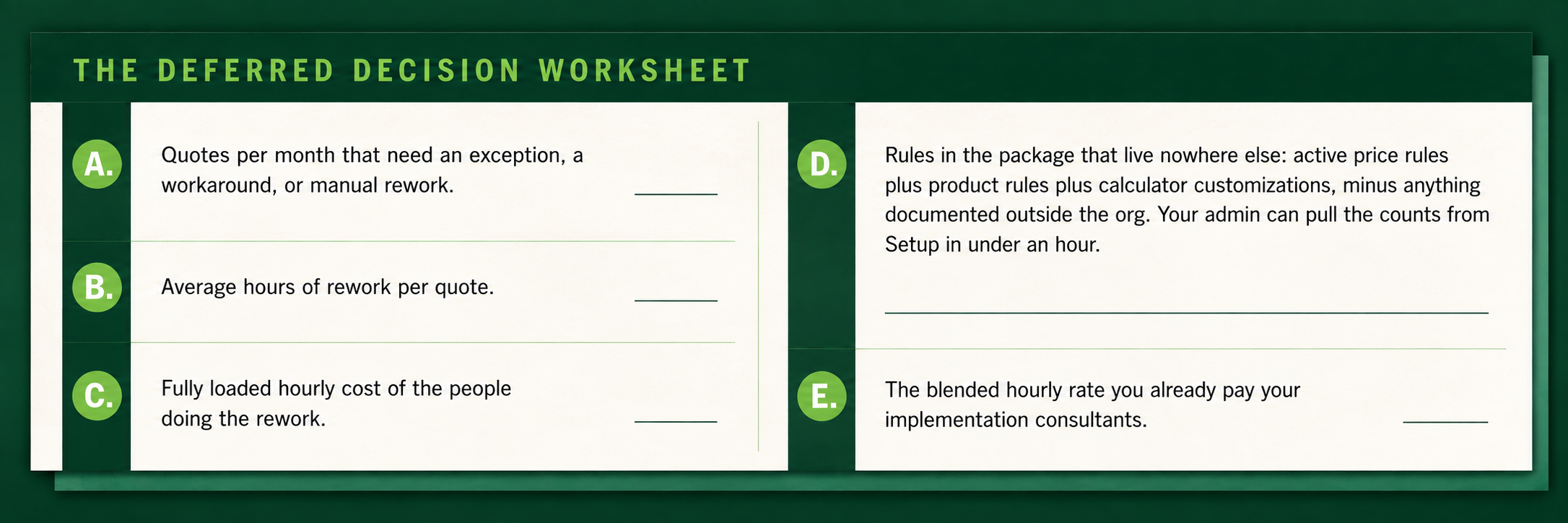
Five lines, all yours: the deferred decision worksheet
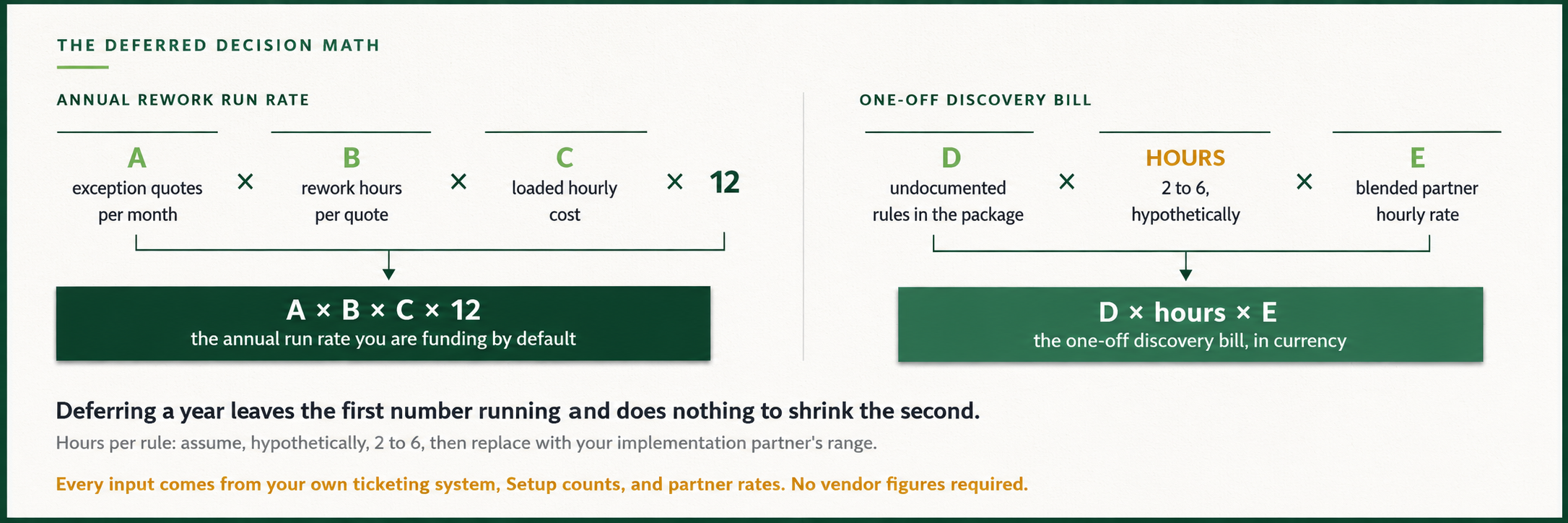
The worksheet as one picture: five inputs from your own systems, two numbers for the budget meeting.
Two numbers to bring to the budget meeting
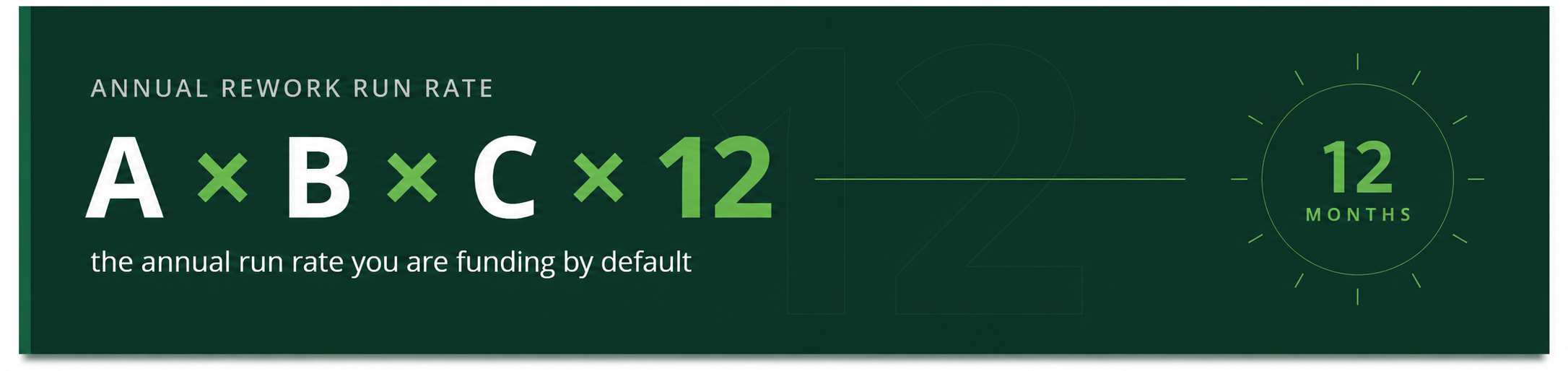 Not the cost of deferral, because a migration year pays it too. It is what the status quo already costs, approved by nobody. You are simply paying without a transformation budget.
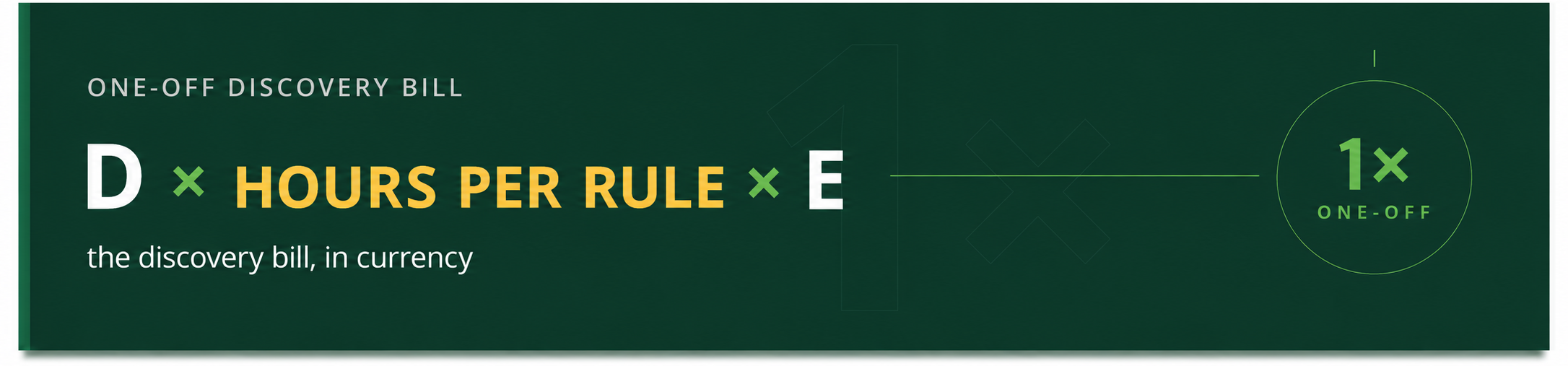
Assume, hypothetically, two to six hours per undocumented rule to find, re-express, test, and document, then replace our range with your implementation partner’s. This bill is payable on any move, in any direction, including to Revenue Cloud Advanced and including to servicePath™. And it buys triage: discovery sorts every rule into logic that matters, logic to simplify, and logic to retire, which you never pay to rebuild.
And D grows: count last quarter’s exceptions resolved by bending a rule. The count is in your ticketing system.
Running more than one CRM? Run the five lines per estate, then add the line only you have: monthly hours reconciling pricing, discounts, and approvals across estates, times the blended C, times 12. That is your integration tax, and the walkthrough below puts a figure on it.
The other side of this ledger is the new platform’s subscription and implementation cost, numbers any vendor, including servicePath™, must put in writing.
A Salesforce migration partner, whose revenue depends on customers migrating, wrote in January 2026 that years of custom price rules and workarounds have left legacy orgs brittle. They sell the migration. They still say that.
Hypothetical walkthrough, invented for this article
One company through the worksheet
Northline Technology Group is a hypothetical company we invented for this walkthrough: roughly 2,000 people, three Salesforce orgs inherited from two acquisitions, quoting connectivity, hardware, and managed services across four entities and three currencies.
In this walkthrough, Northline sees 240 exception quotes a month (A), each eating 4 hours of rework (B), at a fully loaded 95 dollars an hour (C) blending deal desk, sales engineering, and the finance approvers: a default-funded run rate of roughly 1.09 million dollars a year. Confidence check that before you trust it. Four hours on 240 quotes is about six full-time people. If you cannot find six in your estate, your A or your B is wrong.
Because it runs three orgs, Northline also carries the multi-estate line: 110 hours a month reconciling pricing and approvals across the orgs, hours your B does not already contain, a further hypothetical 125,000 dollars a year of integration tax no cost center owns.
Its admins pull the Setup counts in an afternoon, then spend a second one deciding which are documented anywhere else: 1,120 active rules and customizations across the three orgs, 240 in Confluence, so D is 880. At the hypothetical two to six hours per rule and a blended rate of 210 dollars (E), the discovery bill runs 370,000 to 1.11 million dollars.
One more year on Salesforce CPQ past end of sale, in Northline’s numbers
Now the comparison. Deciding this fall prices the bill at a hypothetical D of 880. Waiting prices it at 1,032, once roughly 152 more rules join D at last quarter’s pace of 38 rule-bending exceptions, which puts next fall’s hypothetical bill at 433,000 to 1.30 million. That year of waiting also costs another 1.09 million of default-funded rework, in the same invented numbers.
Then read the two sides together: in the walkthrough, Northline funds roughly 1.22 million a year, approved by nobody, while the one-off bill for changing course sits at 370,000 to 1.11 million and grows each quarter it waits. The status quo is not the cheap option. It is the expensive option with no budget line attached.
That is not a savings claim. I cannot tell you what your run rate looks like after a move, and any vendor who does is guessing. It is a statement about which of the two numbers has a budget line.
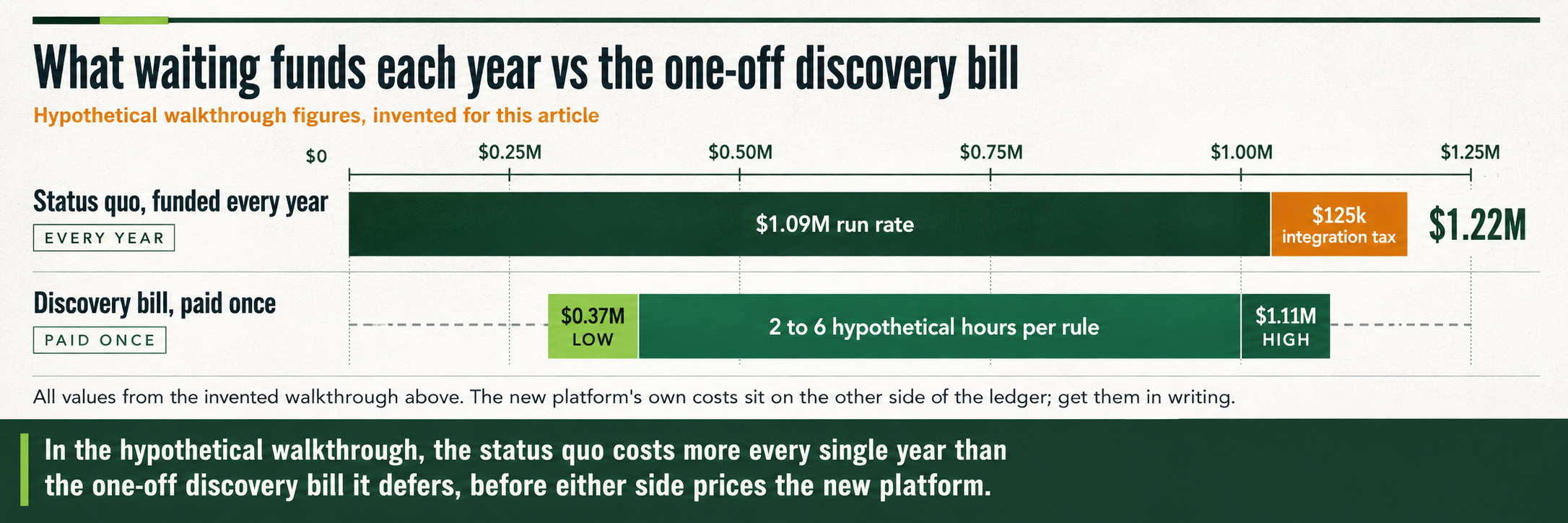
Northline’s numbers are ours by construction. Yours will not be. None of this arithmetic needs a vendor’s inputs: every line maps to your ticketing system, your Setup counts, and your partner’s rates.
The false binary, the third option, and what it does not fix
So the market offers two options: rebuild on the vendor’s new stack, or stay put. Before I offer a third, two concessions.
An external quoting layer relocates the dependency. It does not remove it. You are choosing between a vendor whose exit path you can test in a demo this quarter and one whose exit path is itself a migration project.
And second, Salesforce ships a staged path, and for a single-CRM estate with light customization it is often correct. If that is your path, the worksheet and four questions work unchanged, and criterion 5 is worth demanding from Salesforce too.
Where the staged path breaks
- Heavy CPQ customization carrying commercial logic no migration tool can interpret, because it was never written down anywhere else.
- Multi-CRM estates, usually post-acquisition. A multi-org Salesforce strategy addresses Salesforce environments. It does not govern commercial policy across Salesforce, Dynamics, HubSpot, and whatever front end arrives next. A layer above CRM does.
- Quotes carrying hardware plus recurring services plus third-party pass-through, across entities and currencies.
The third option is a vendor-agnostic quoting layer above CRM, so the CRM decision and the quoting decision stop being the same decision. The architecture is written up in Revenue architecture 2.0, the five-criterion test in the revenue control plane edition, and the pattern itself in our glossary entry on composable revenue architecture.
The CRM should know the customer. That does not mean it should own the commercial brain of the enterprise.
This migration is expensive because quoting logic was stored inside a CRM-bound package. Moving it into another CRM-bound package preserves the property that made it expensive. Transform rather than lift and shift is a statement about where the logic lives.
The four questions that decide the framing
So this is not a migration checklist. These four questions decide scope before scope decides you.
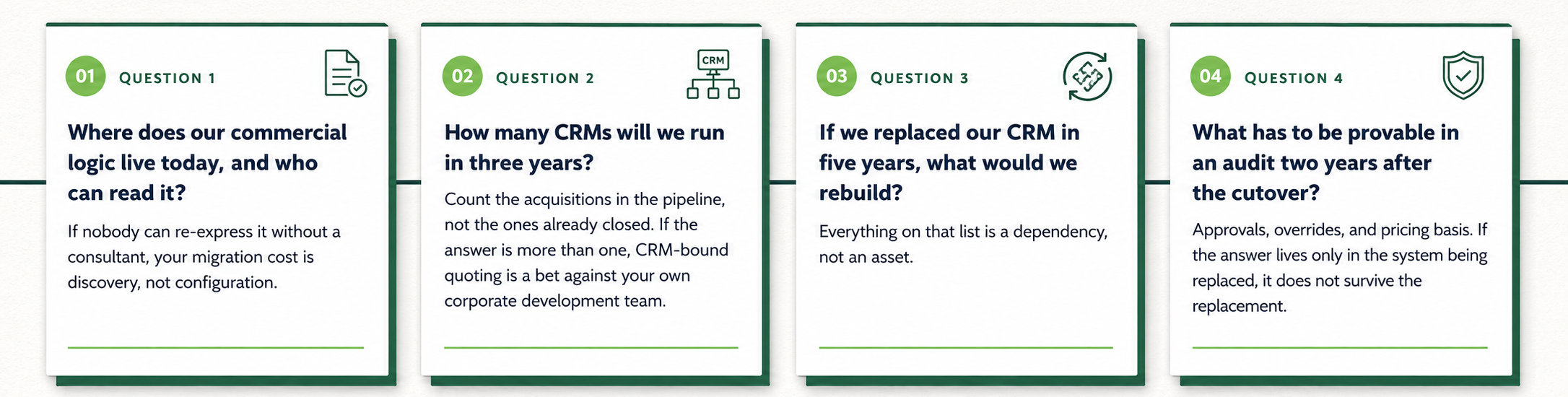
The predictable counter is that Salesforce has a staged path, so why complicate this. Notice what the staged path answers to question 3: rebuild everything. That is an answer, not a rebuttal.
Framed as revenue governance rather than a migration, the same project changes owner, budget line, and success criteria, and lands in the revenue office, because CPQ is where pricing authority gets exercised.
Two framings of the same project
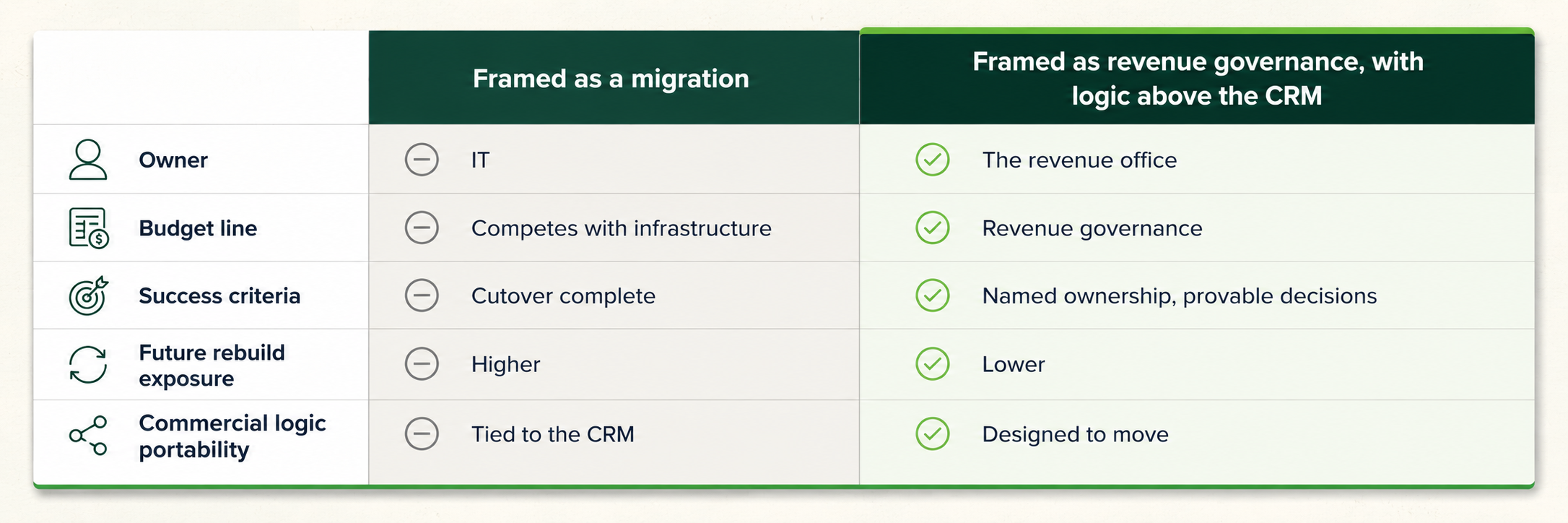
Run the four questions with Finance, RevOps, and Enterprise Architecture in one room. If the answers disagree, that disagreement is the project.
What to put in the RFP, and how to test each one in the demo
Because criteria without tests are marketing, note this. Five of each, plus the dodge you will hear. Score every vendor, including servicePath™.

Test : one quote against records in two different CRM systems, live, with the records created during the demo, no recordings.
The dodge : “we support that via our integration framework.” Support is a roadmap word. Watch it happen or score a fail.

Test : change one discount rule once and show it take effect across both CRM systems, prior version retained and revertible. Single-org rule changes with no deploy are table stakes.
The dodge: a single-org demo of exactly that.

Test : produce the approval chain and pricing basis for a quote from eighteen months ago, including who overrode what.
The dodge : a report built last night. Ask when the entry was written and how edits would show.

Test : name the customer, the acquisition, and the elapsed days. A reference call under NDA counts. A slide does not.

Test : show the export. Complete logic, machine-readable, no services engagement required.
The dodge : “available through our services team.” That is the lock-in, restated as a feature.
Where vendors negotiate: criterion 5
My answer to criterion 5, since I just told you to demand one: the export exists, machine-readable, no services engagement required. So ask for it in the first call, before pricing.
Criterion 5 is the one vendors negotiate around. Do not let them. Exitability is what makes dynamic quoting claims testable: logic you cannot export is logic you cannot verify.
Why servicePath™ belongs in the Salesforce CPQ end of sale decision
Meanwhile, servicePath™ holds quoting logic above CRM, ERP, and billing rather than inside any one of them, the property that makes the next CRM decision survivable rather than repeatable.
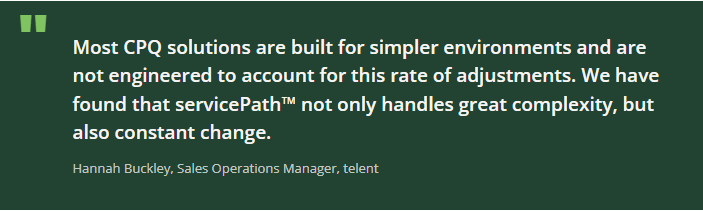
Meanwhile, published proof, honestly bounded: telent, a UK critical-infrastructure technology firm, completed an eight-week servicePath™ implementation after roughly a year on a legacy CPQ project, and cut quote times by roughly 90 percent.
External recognition
Gartner does not endorse any vendor, product or service depicted in its research publications, and does not advise technology users to select only those vendors with the highest ratings or other designation. Gartner research publications consist of the opinions of Gartner’s research organization and should not be construed as statements of fact.
servicePath™ · Good Revenue Faster. · External claims are dated in the text above; Salesforce pages are access-dated with archive links added on publication day. Northline Technology Group is a hypothetical company invented for the walkthrough.