
End of sale, not end of life. Your renewal sets the deadline. Six options, five points each, every fact linked to its source.
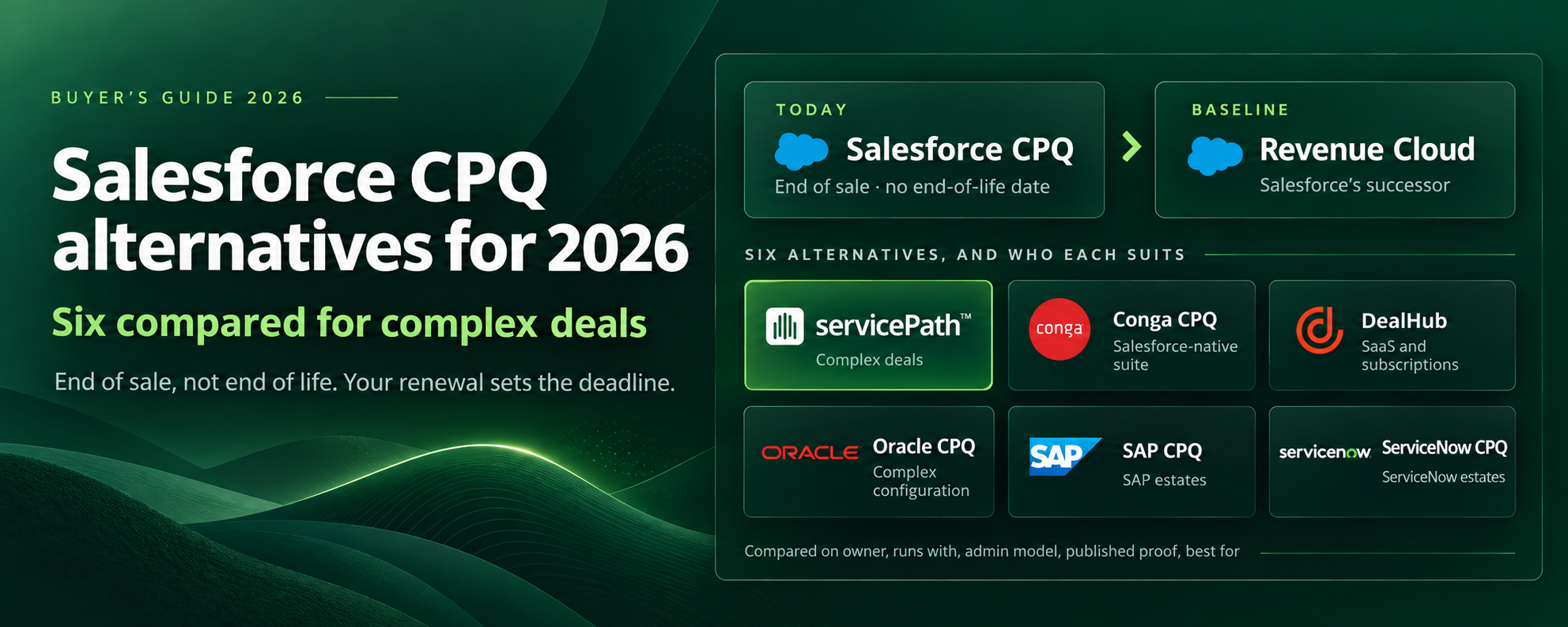
The Salesforce CPQ alternatives worth evaluating in 2026 are servicePath™, Conga CPQ, DealHub, Oracle CPQ, SAP CPQ, and ServiceNow CPQ (formerly Logik.ai), with Salesforce’s own Revenue Cloud as the baseline. Salesforce confirmed in March 2025 that Salesforce CPQ is no longer sold to new customers. It has set no end-of-life date, and existing customers can still renew licences and buy additional users. So your renewal date sets the deadline.
Executive summary
What is happening. Salesforce stopped selling Salesforce CPQ to new customers in March 2025 and has put the status in writing: end of sale, not end of life, no forced migration, and renewals continue.
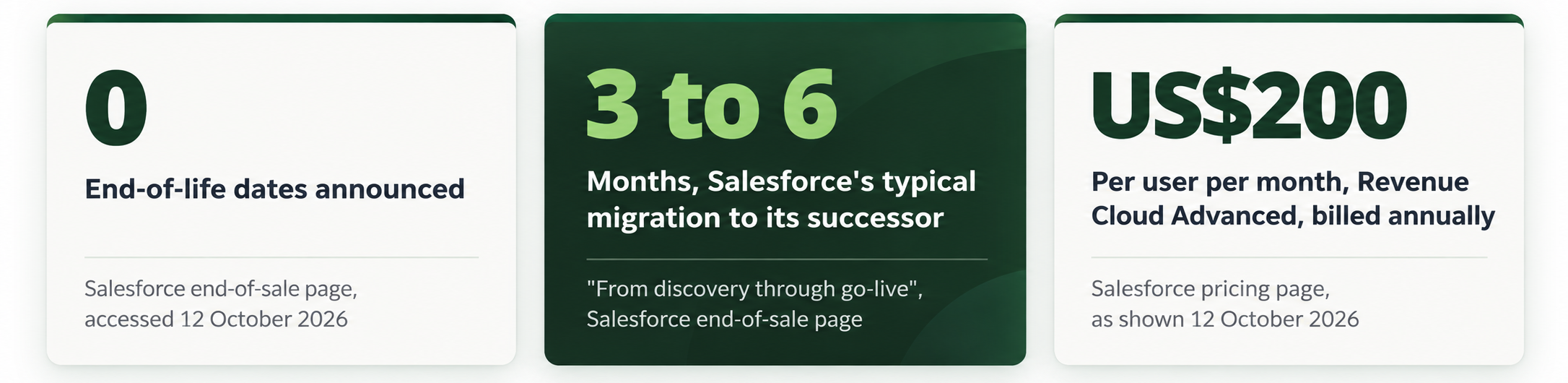
What is expected. New quoting work goes into the successor, Revenue Cloud, a paid add-on at US$150 or US$200 per user per month on top of a Sales Cloud, Service Cloud, or CRM licence, with a typical migration that Salesforce puts at 3 to 6 months.
What it means. Your renewal date sets the deadline, because Salesforce has not. The successor is one option among seven, and the right one depends on your catalogue, your CRM plans, and who owns pricing after go-live.
What to do. Answer the three questions in this guide, then test the six Salesforce CPQ alternatives below on the same five points, every fact linked to its source. servicePath™ is on the list, and the criteria come first so you can re-rank it yourself. Last checked: 12 October 2026.
What Salesforce says about Salesforce CPQ
Salesforce’s own end-of-sale page, written by its VP of Product Marketing and undated, is the document to read first, before any vendor’s summary, including this one. The confirmation itself came earlier, in March 2025, when a Salesforce spokesperson told SalesforceBen that current customers “will continue to receive full access, including customer support, and can renew and add additional licenses.”
What does Salesforce’s end-of-sale page say?
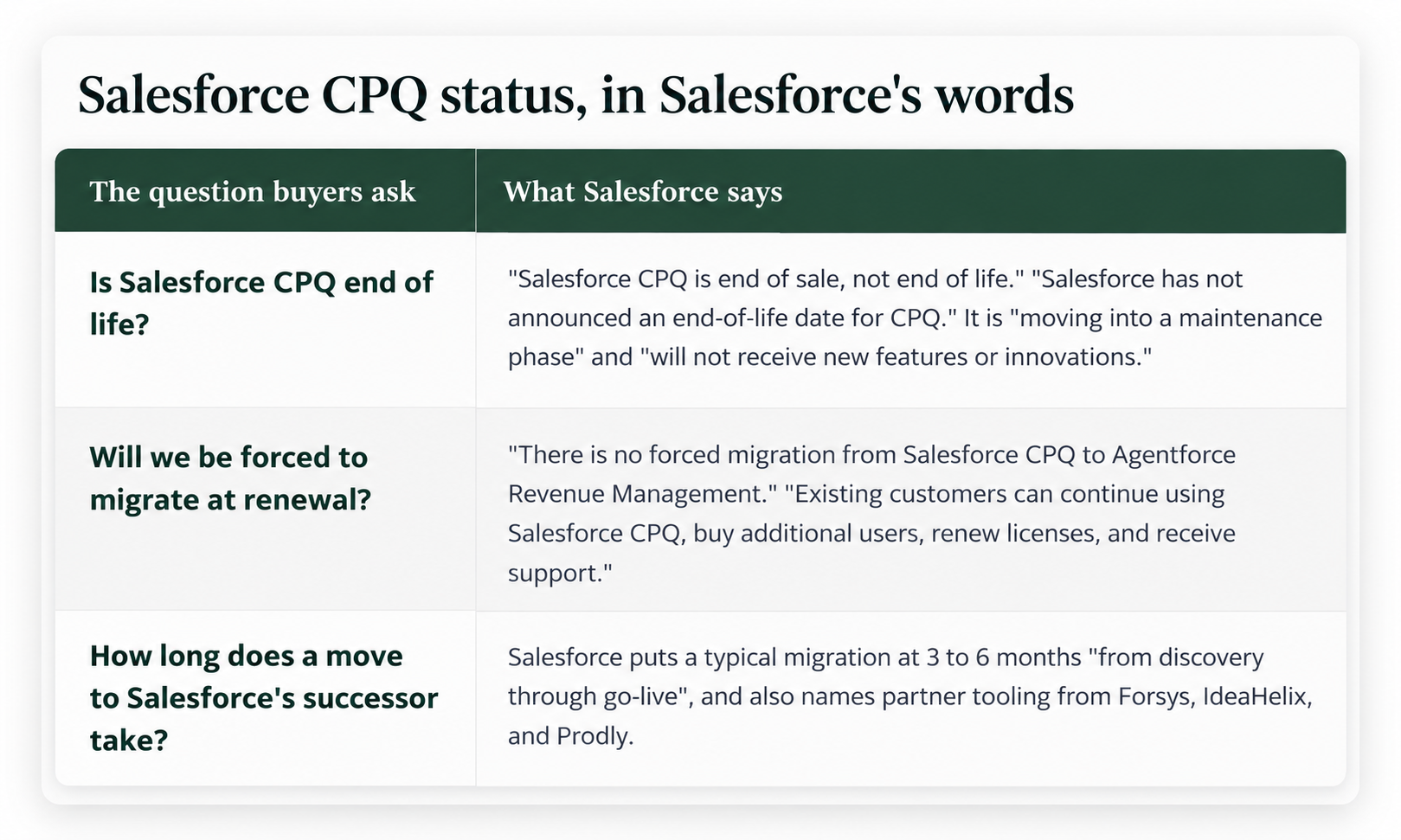
Two smaller 2026 changes matter to anyone still running the product. On 10 July 2026 Salesforce moved the CPQ help documentation to a downloadable PDF; the notice also says support entitlements are unchanged. Then, on 31 August 2026, Salesforce’s Winter ’27 announcement added quoting for buyers, partners, and account executives under Revenue Management, but it does not mention Salesforce CPQ. Read together, both changes match the end-of-sale page: the product stays supported, while new quoting work goes into the successor.
What does Revenue Cloud cost on top of your CRM?
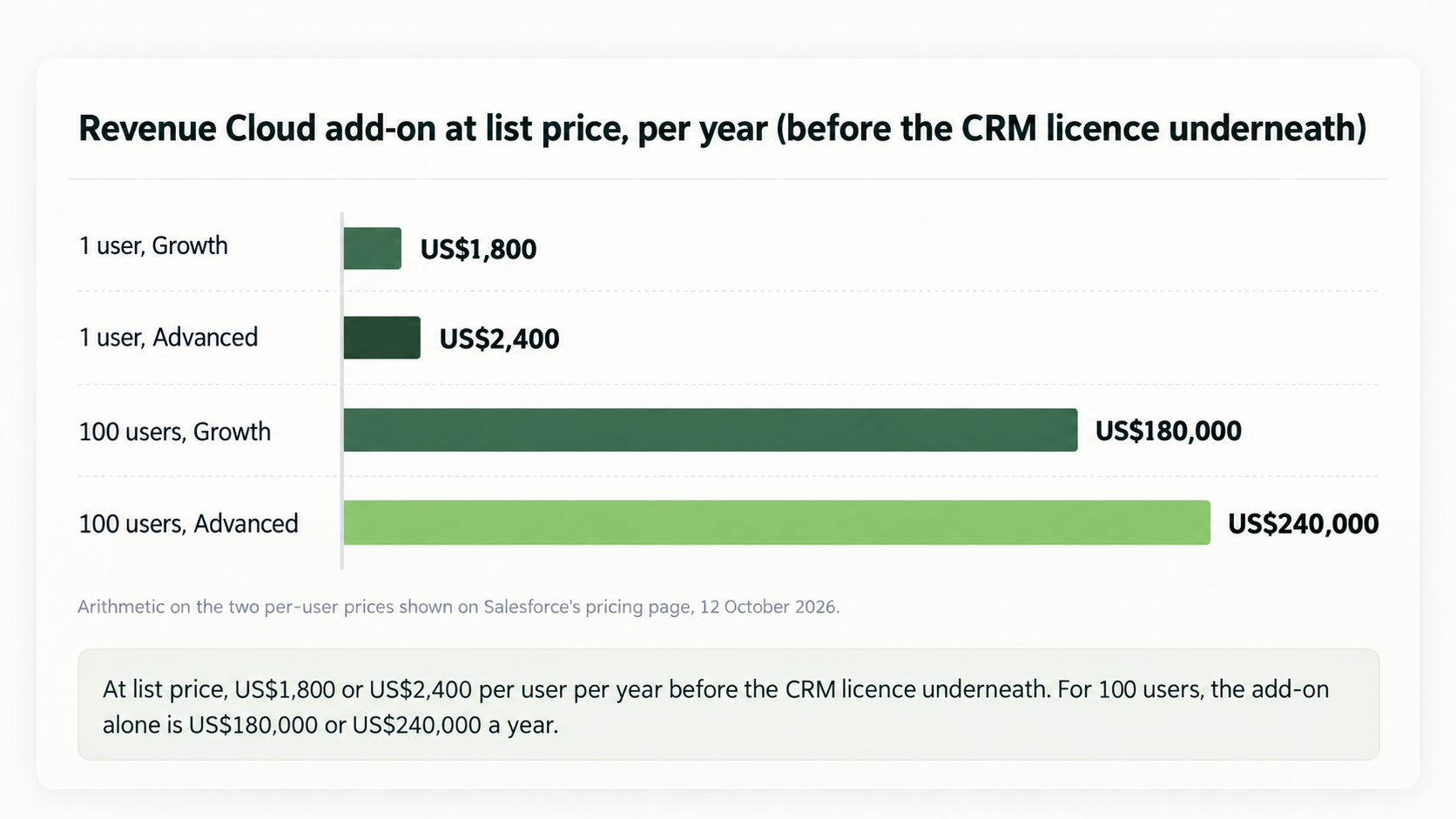
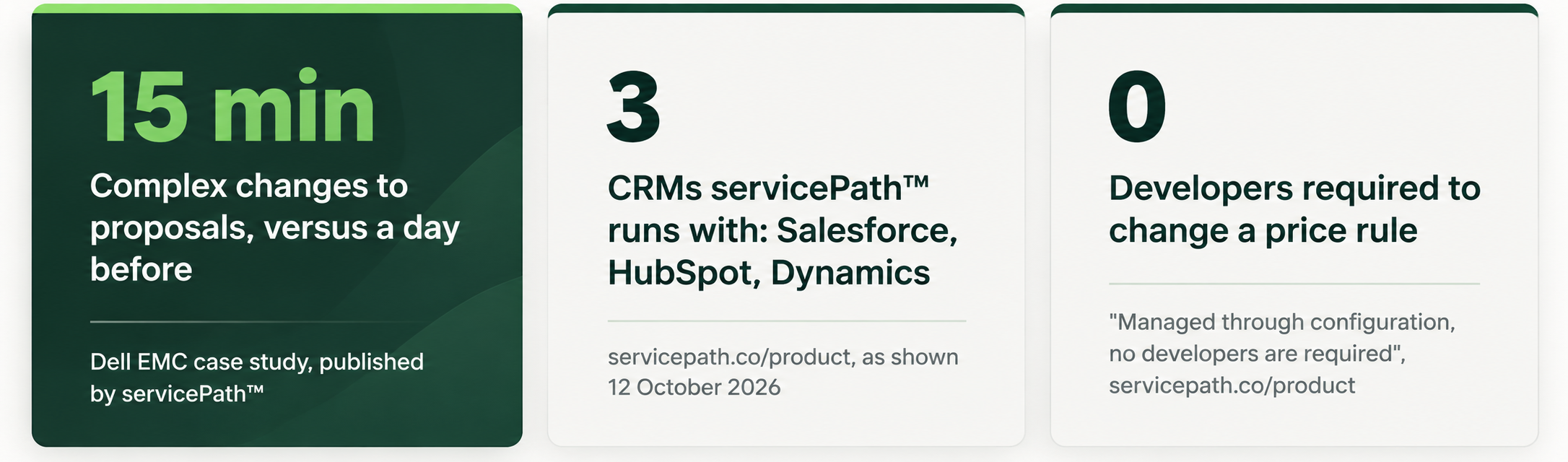
Revenue Cloud costs US$150 per user per month for Growth or US$200 for Advanced, billed annually, and it is an add-on. Salesforce’s pricing page calls it “a paid add-on” that “requires a Sales Cloud, Service Cloud, or CRM license.”
At list price, that is US$1,800 or US$2,400 per user per year before the CRM licence underneath it. For 100 users, the add-on alone is US$180,000 or US$240,000 a year. Put your own seat count in, then set the result beside your current Salesforce CPQ line, because that difference is the number your renewal conversation will turn on.
One naming note, so you search the right page: Salesforce’s end-of-sale page calls the successor Agentforce Revenue Management, while its pricing page calls it Revenue Cloud. Both are Salesforce’s own pages.
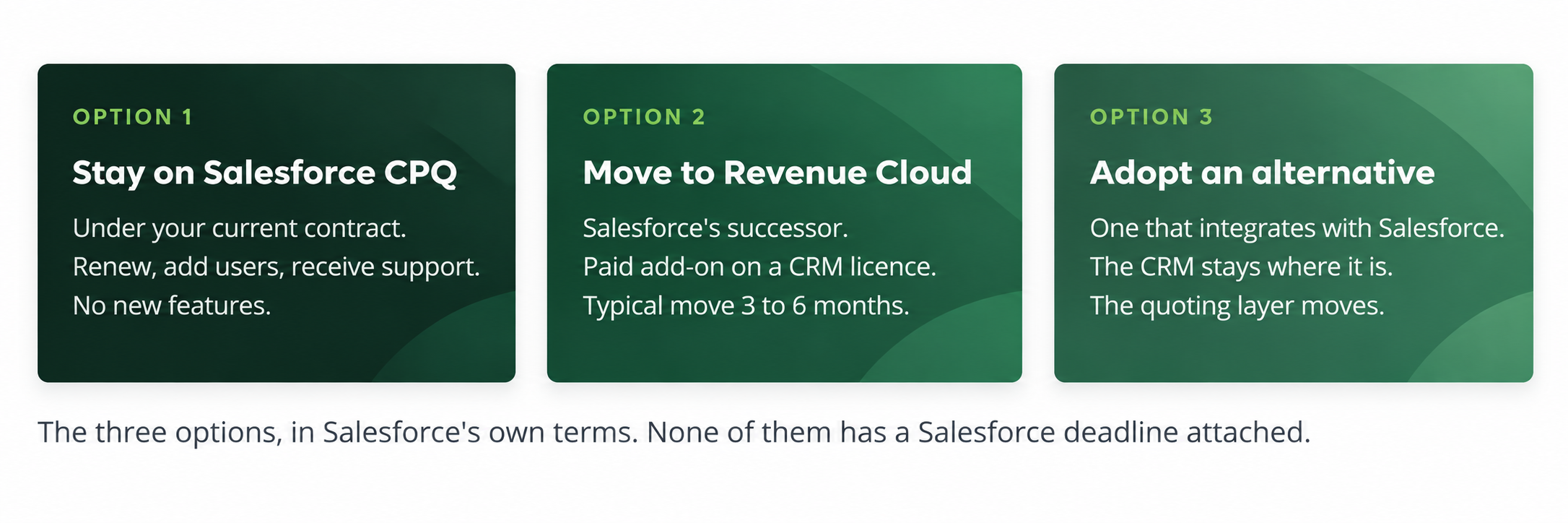
That leaves a Salesforce CPQ customer three options: stay on Salesforce CPQ under your current contract, move to Revenue Cloud, or adopt one of the Salesforce CPQ alternatives that integrates with Salesforce and leaves the CRM where it is.
Why is your renewal date the real deadline?

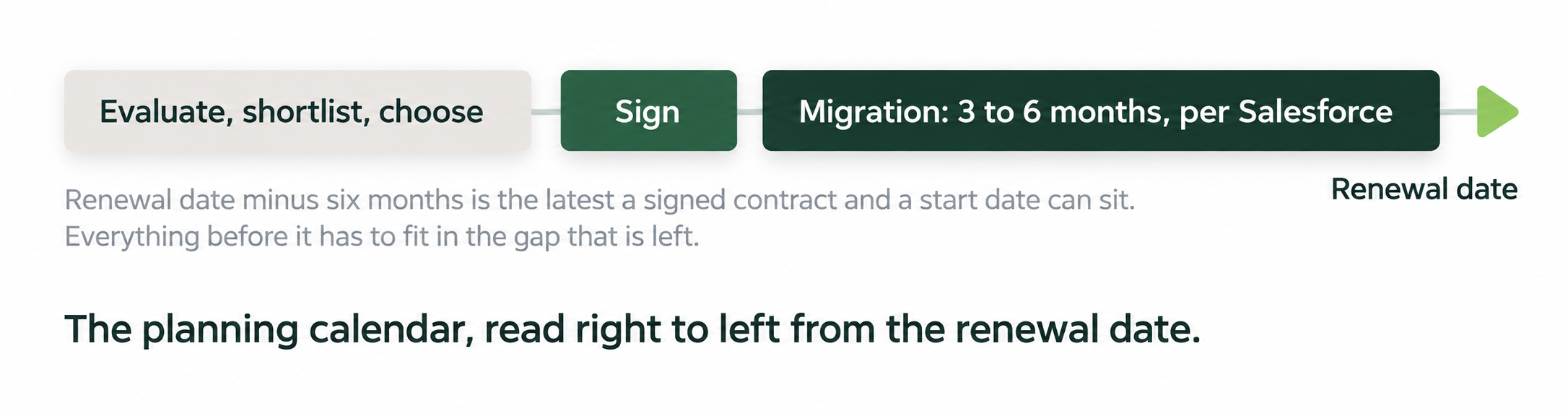
CPQ end of sale is a scheduling problem, so work backwards from the renewal date. Salesforce’s own estimate for a move to its successor is 3 to 6 months from discovery through go-live, and that clock does not start until you have evaluated, chosen, and signed.
Take your renewal date, subtract six months, and that is the latest point a signed contract and a start date can sit if you want to be live before you renew. Everything before it, the shortlist, the demos, procurement, and legal, has to fit in the gap that is left.
A renewal signed under pressure is the most expensive one you will sign. If your renewal is inside 12 months, start now and talk to a CPQ architect. If it is further out, you can run the evaluation at your own pace and decide on evidence rather than on a deadline. Our July post on the planning calendar sets out the steps.
How we compared the Salesforce CPQ alternatives

Every entry, and the table, covers the same five points, so you can re-rank the list yourself: owner as of October 2026, what it runs with, the admin model as the vendor describes it, published proof, and who it is best for.
Each point comes from the vendor’s own site or from a filing or announcement, linked. Where a vendor publishes no figure, the entry says so instead of filling the gap.
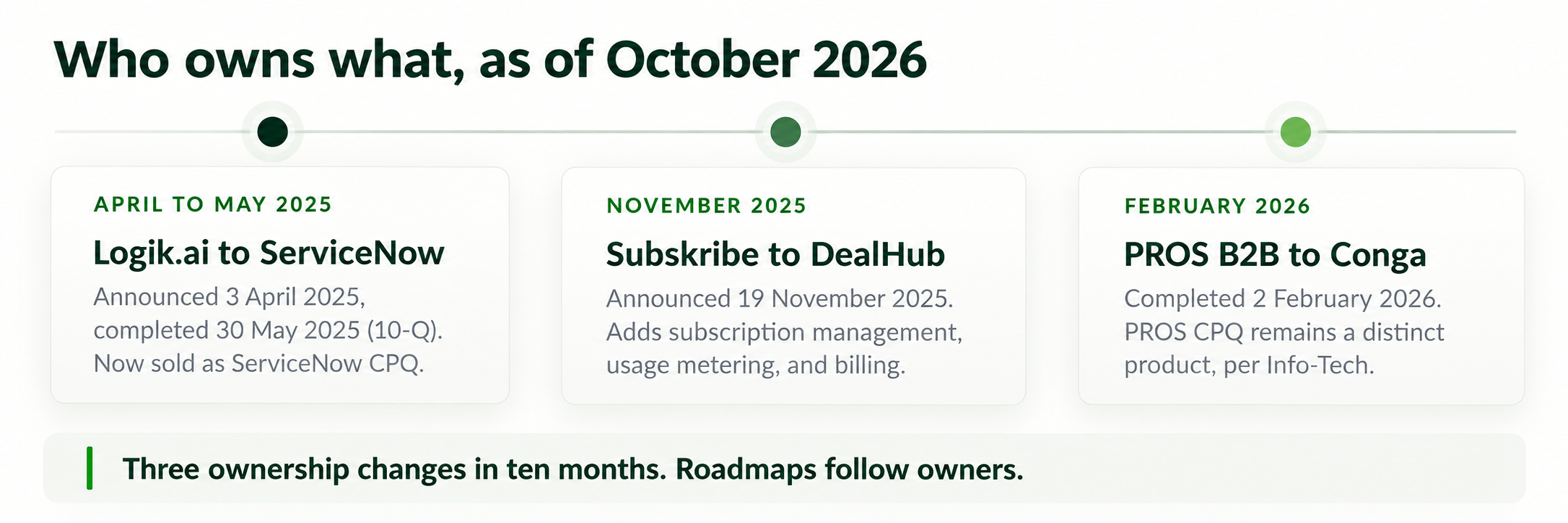
Ownership gets its own column because three products on this list changed owners between April 2025 and February 2026: Logik.ai, Subskribe, and the PROS B2B business. Roadmaps follow owners, so ask any recently acquired product for its published roadmap.
Why these six Salesforce CPQ alternatives?
These six cover every path a Salesforce CPQ customer can take in 2026, measured against Salesforce’s own successor, Revenue Cloud, as the baseline.
- Platform vendors’ CPQ: Oracle CPQ, SAP CPQ, and ServiceNow CPQ.
- Salesforce-native suite: Conga CPQ.
- No-code option for subscription businesses: DealHub.
- Independent built for complex, multi-component deals: servicePath™.
Longer lists also include Zuora CPQ, Tacton, Experlogix, and Epicor CPQ.
The six Salesforce CPQ alternatives for 2026
Every option below has to beat the baseline first. Revenue Cloud is the product Salesforce now sells instead of Salesforce CPQ, and for a team standardising on the Salesforce platform it is the default. Salesforce puts a typical move at 3 to 6 months. Test that figure against your own catalogue.
servicePath™ is ours, so it comes first, and the other five follow alphabetically on the same five points. Read the Runs with line before anything else. If your CRM is missing, move on. Where Salesforce is named, ask whether quoting runs inside your org or beside it. A “not stated” line means the pages checked were silent, so put the question to the vendor.
One test belongs in every demo: your hardest price rule, rebuilt while you watch.

servicePath™ is best for tech-enabled enterprises whose deals mix services, subscriptions, and hardware across business units, and whose CRM estate may change. It is a revenue lifecycle management platform with CPQ built in. One quote carries recurring and one-time charges, with service contracts and renewals attached. Multi-stage approvals run as automated workflows, and the people who sign get deal dashboards.
- Owner : independent.
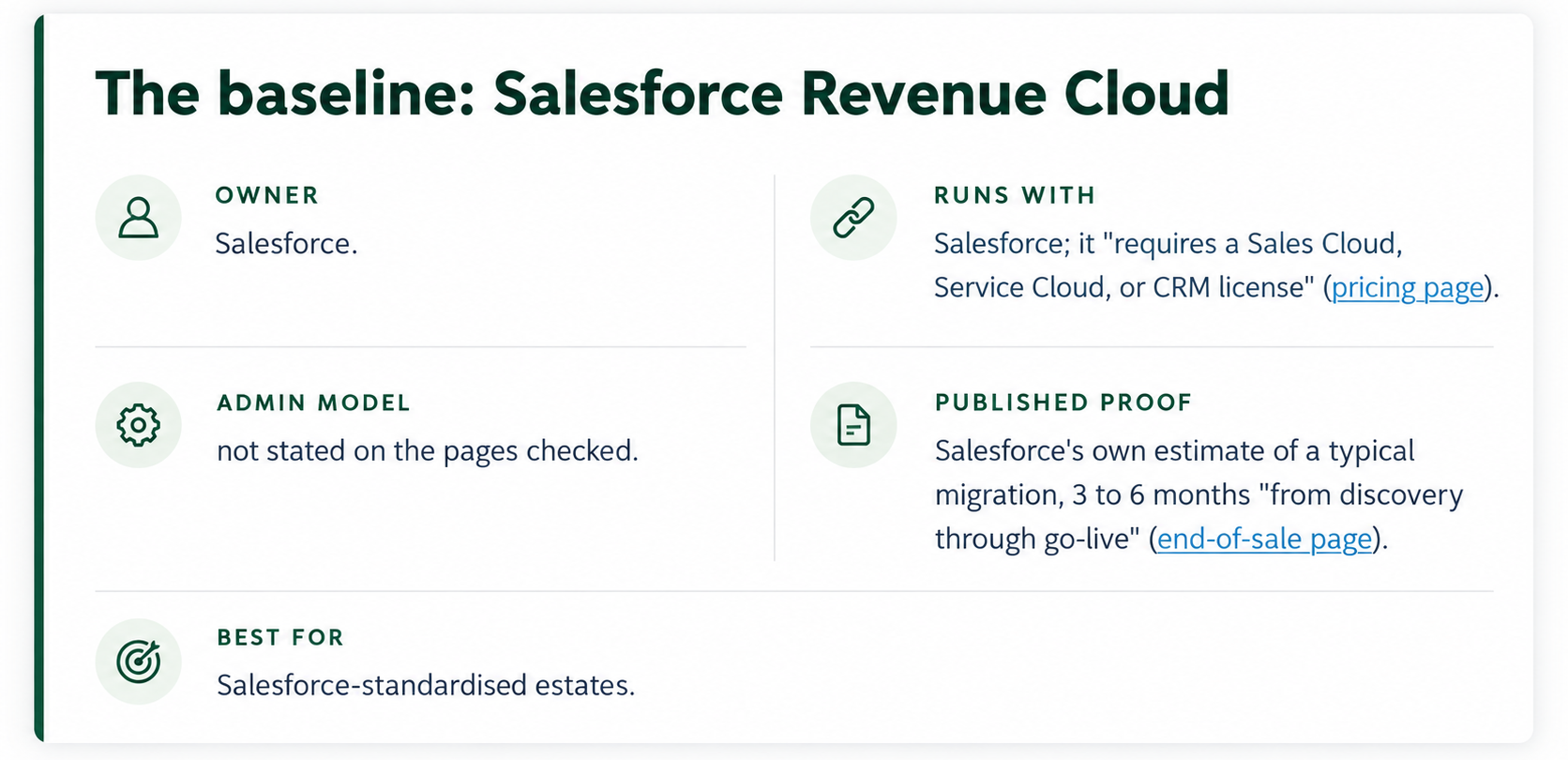
- Runs with : Salesforce, HubSpot, and Dynamics (integrations). The CRM stays while the quoting layer moves.
- Admin model: no-code configuration, with no developers required, so RevOps owns pricing changes after go-live.
- Published proof: Dell EMC, where “complex changes to proposals take as little as 15 minutes vs a day” and “many partners can now generate their own proposals” (case study).
Best for: complex multi-component enterprise deals, whether or not Salesforce stays the CRM. Ask to see one quote that carries services, subscriptions, and hardware together, then read servicePath™ for Salesforce CPQ teams.

Conga CPQ is best for Salesforce-centric enterprises that want CPQ and contract lifecycle management from one vendor. Conga describes the product as born on the Salesforce AppExchange.
- Owner : Conga, which completed its acquisition of the PROS B2B business on 2 February 2026. Per Info-Tech’s March 2026 note, “PROS CPQ will remain a distinct product, separate from Conga CPQ”.
- Runs with: the Salesforce platform, per Conga.
- Admin model: admins work in “the CPQ Admin console to manage products and its related components such as options, attributes”, per Conga’s CPQ for Salesforce documentation (May 2026).
- Published proof :IBM, with “50,000 quotes created, saving 37,000 hours (YTD)” and “over 30% of quotes” including automated recommendations (customer story, June 2026).
Best for: Salesforce-native suite buyers. Ask which of the two products your contract would cover, and request the published roadmap for both.

DealHub is best for SaaS and subscription businesses that want quoting and subscription billing from one vendor, since it acquired Subskribe.
- Owner : DealHub, which acquired Subskribe, a subscription management, consumption metering, and billing platform. Subskribe announced the deal on 19 November 2025.
- Runs with: Salesforce, HubSpot, and Microsoft Dynamics 365, per DealHub’s integrations page.
- Admin model: changes “without the need for coding”, per DealHub, and its CPQ page says RevOps can “own configuration without waiting on IT”.
- Published proof: Fleet Complete, where “reps have saved over 70% of their time in building quotes”, per DealHub’s CPQ page.
Best for: SaaS and subscription catalogues. Ask to see the roadmap for DealHub quoting and Subskribe billing.

Oracle CPQ is best for enterprises with heavy product configuration and asset-based ordering, whether or not they run an Oracle estate. Oracle says it brings “even the most complex configuration, bundling, and asset-based ordering online” (Oracle CPQ).
- Owner : Oracle, unchanged.
- Runs with: “any CRM solution, including Oracle Sales or Salesforce Sales Cloud” and “more than 20 leading ERP systems”, per Oracle.
- Admin model: tools for “nontechnical staff” to “handle most routine business processes”, per Oracle.
- Published proof: DNV, where “quote processing time dropped by 92%, order activation time fell by 95%” (customer story).
Best for: complex configuration and asset-based ordering. If Salesforce stays your CRM, ask who maintains the Sales Cloud connector across releases.

SAP CPQ is best for SAP-centric enterprises with large, configured catalogues. SAP says it can “generate quotes of 10,000 lines or more in seconds with automated approval and exception workflows” (SAP CPQ).
- Owner: SAP, unchanged. SAP News in February 2026 calls SAP CPQ “an essential component of the SAP product portfolio”.
- Runs with: “preconfigured integration to SAP Sales Cloud and other SAP solutions” and “integration with third-party CRM offerings”, per the SAP CPQ page. For Salesforce, partner CLARITY sells an adapter that “directly integrates SAP CPQ with Salesforce CRM” (CLARITY, April 2026).
- Admin model: “business administrators can leverage tools and guardrails”, and SAP promises “margin-protecting guardrails” against rogue discounting, per the SAP CPQ page.
- Published proof: Cleaver-Brooks “cut time to quote from four hours to 15 minutes”, per the SAP CPQ page and SAP’s Cleaver-Brooks spotlight. EXFO “has increased the number of quotes created per month by 70 percent”, per SAP News (February 2026).
Best for: SAP estates and manufacturing catalogues. If Salesforce stays your CRM, ask who supports the connector, SAP or a partner, and watch a finished quote land in your Salesforce org.

ServiceNow CPQ, formerly Logik.ai, is best for organisations that run on ServiceNow and carry complex configuration rules. Its data sheet covers “simple to highly complex configurations” and “subscription, usage-based, tiered, ramped, and multi-year deals”.
- Owner: ServiceNow. Per its filing, it acquired all outstanding shares of Logik.io, the company behind Logik.ai, on 30 May 2025. The April 2026 release adds a Configuration AI Agent through CPQ Pro.
- Runs with: ServiceNow natively, and “two managed packages for Salesforce (SFDC) orgs”, per ServiceNow’s docs.
- Admin model: “administer configuration and pricing logic without code”, per the ServiceNow CPQ data sheet.
- Published proof: Keysight, with a “40% decrease in quote processing time” and “50 to 80% reduction in configuration setup and maintenance time” (customer story).
Best for: ServiceNow-centric organisations and manufacturers. If Salesforce stays your system of record, ask which of the two managed packages your org needs and what each one installs.
How do the six Salesforce CPQ alternatives compare?
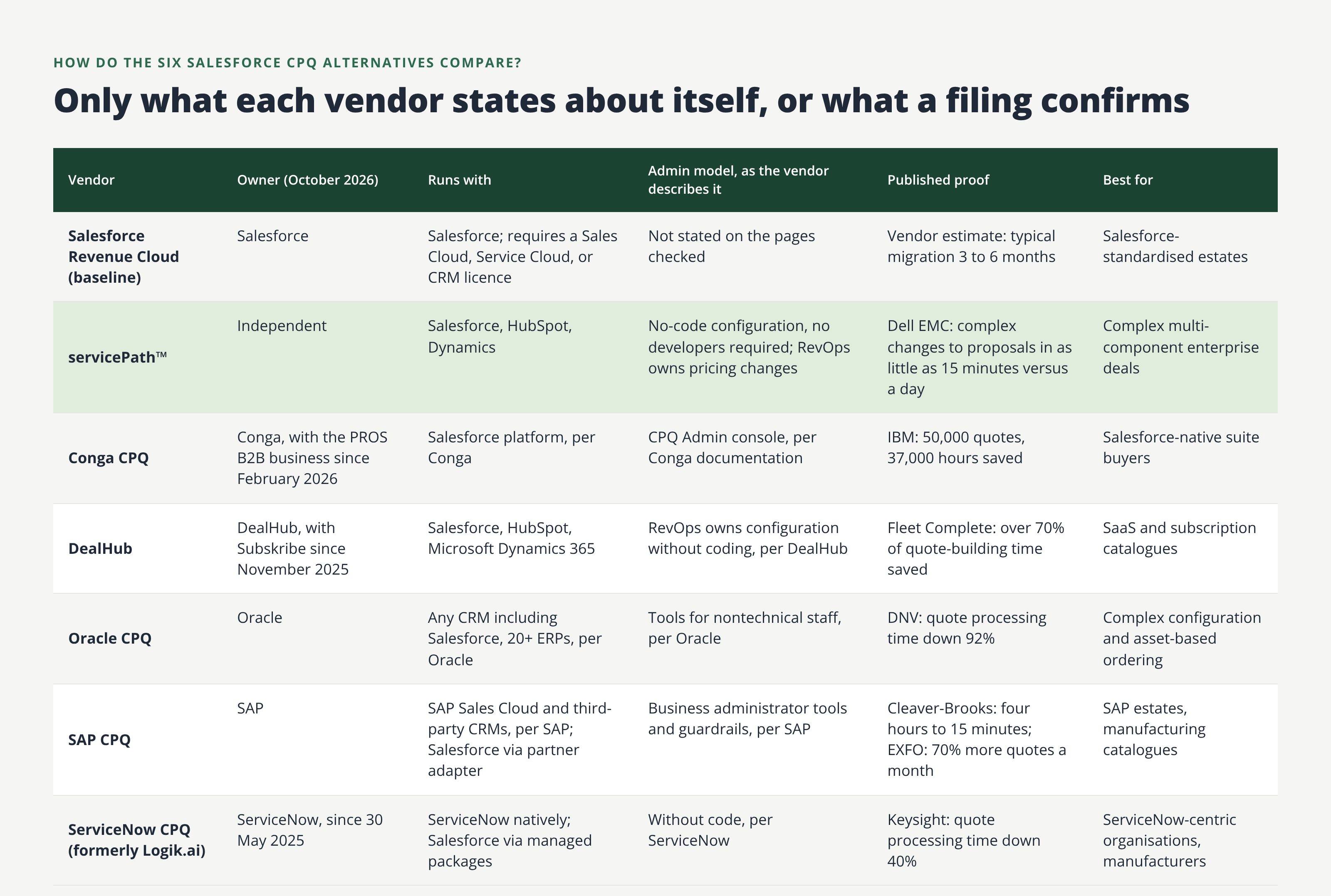
The table sets the Salesforce CPQ alternatives side by side, and it carries only what each vendor states about itself or what a filing confirms, so anything a reader cannot click is left out.
For the wider field, see the top five CPQ platforms for technology service providers and our other comparisons.
How should you read the published proof column?
Read it vendor by vendor, because each one chose its own measure: quote processing time for DNV and Keysight, time to quote for Cleaver-Brooks, quote-building time for Fleet Complete, quote volume and hours saved for IBM, and complex proposal changes for Dell EMC.
With different starting points, a bigger number proves little on its own. When you weigh Salesforce CPQ alternatives on proof, match the problem each customer solved to your own.
How to choose: three questions to ask before you shortlist
These three questions decide which vendor fits. Answer them before taking a single demo, because each answer takes vendors off the list.
Do your quotes mix services, subscriptions, and hardware?
If yes, this question does most of the shortlisting for you.
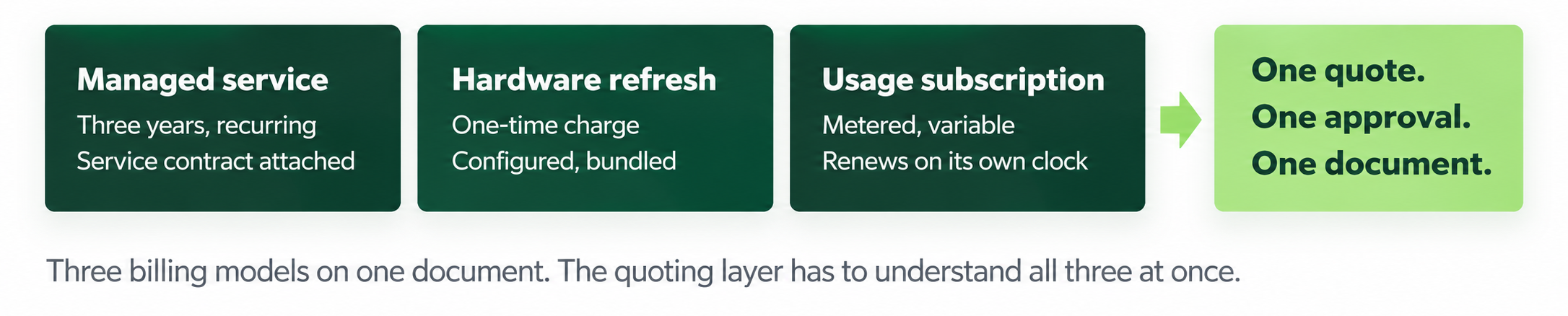
A quote that carries a three-year managed service, a hardware refresh, and a usage-based subscription puts three billing models on one document, so the quote-to-cash process behind it has to understand all three at once. Weight product configuration depth, service contract handling, and approval workflow depth above everything else.
Will your CRM stay the same for five years?
Nobody knows. Still, acquisitions bring CRMs with them, and they are common: three of the six vendors on this list were party to one between April 2025 and February 2026. If your CRM estate may change, a quoting layer that works with Salesforce, HubSpot, and Dynamics at once is worth more than one native to any of them.
We made the multi-CRM case in December.
Who will own pricing changes after go-live?
If the answer is RevOps, the admin model is the tiebreak. A pricing change that needs a developer ticket is a pricing change that waits, so ask every vendor the same five questions:
Who changes a price rule on a Tuesday afternoon, and how long does it take?
How are our price rules, product rules, bundle and option constraints, Advanced Approvals rules, and Quote Calculator Plugin logic rebuilt, and by whom?
What happens to subscription, amendment, and renewal history, and to historical quotes and contracts?
What does the quote feed today, such as billing, ERP, or contract records, and who rebuilds those connections?
Which of those steps are in your published migration guidance, and which are services?
When you have the answers, read what migrating from Salesforce CPQ involves for the platform you are leaning towards, and why legacy CPQ is breaking RevOps.

Why servicePath™ among the Salesforce CPQ alternatives
Of the Salesforce CPQ alternatives above, servicePath™ is built for mid to large tech-enabled enterprises with complex pricing. If your deals are simpler than that, the questions above will point you to a better fit.
servicePath™ has developed beyond CPQ into revenue lifecycle management: the quote, the service contract, the renewal, and the deal dashboards that show a CFO where margin went. A strong CPQ foundation is what any AI tooling you add later depends on.

The Dell EMC case is the one to read: complex changes to proposals that took a day now take as little as 15 minutes, and many partners generate their own proposals. The second result matters as much as the first, because it puts quoting closest to the deal. Both are in the published Dell EMC case study.
With servicePath™, Salesforce stays the system of record for accounts and opportunities. servicePath™ integrates with it, so quoting moves without rebuilding Salesforce around a new package. Historical quotes and contracts still need a migration plan, and the migration page covers it.
Do not take our word for any of it. servicePath™ is reviewed on G2, where servicePath CPQ+ showed 4.6 out of 5 , and on Capterra, SourceForge, and Gartner Peer Insights.

Quick answers
Is Salesforce CPQ being discontinued?
No. Salesforce confirmed in March 2025 that Salesforce CPQ is no longer sold to new customers, and describes it as end of sale, not end of life. Existing customers can still renew licences, buy additional users, and receive support. As of October 2026, no end-of-life date has been announced.
What are the best Salesforce CPQ alternatives for complex enterprise deals?
servicePath™, Conga CPQ, DealHub, Oracle CPQ, SAP CPQ, and ServiceNow CPQ, alongside Salesforce’s own Revenue Cloud. Which one is the right Salesforce CPQ replacement depends first on whether your quotes mix services, subscriptions, and hardware, whether your CRM will change, and who owns pricing after go-live.
Do we have to move to Revenue Cloud?
No. Salesforce says there is no forced migration from Salesforce CPQ, and existing customers can still renew. The successor is Revenue Cloud, also called Agentforce Revenue Management, and Salesforce puts a typical move at 3 to 6 months. The three options, then, are to stay on Salesforce CPQ under your current contract, move to Revenue Cloud, or adopt one of the Salesforce CPQ alternatives that integrates with Salesforce.
If a term here is unfamiliar, the servicePath™ glossary defines it.