

Ten controls make a CPQ foundation strong. Two tests tell you whether yours is, before you buy the next tool.

Executive summary
Complex quoting has not changed, and neither has the CPQ foundation underneath it. It still comes down to a catalog somebody maintains, rules somebody wrote down, a threshold somebody owns, a cost model that reflects what delivery costs, and a record of what was decided.
Add ten tools to that base and you get leverage. Add the same ten tools to a base where none of the five has an owner, though, and you have bought ten more definitions of the price.
Ten controls make a CPQ foundation, those five and the five that keep them honest. Independent analyst MGI Research puts CPQ implementation failure at 30 to 35 percent, and blames how buyers choose rather than what they chose. Technology does not create commercial discipline. Instead, it operationalises whatever is already there.
A CPQ foundation, defined
A CPQ foundation is the commercial operating model that configure, price, quote software encodes: the product catalog, the pricing and configuration rules, the approval authority, the cost model, the contract record, the audit trail, and a named owner for each. The software executes that model, although it never supplies it. When the foundation is strong, every tool you add reads from the same truth. When it is weak, every tool brings a version of its own.
The bombardment, and the number nobody prints
The tools are arriving faster than anyone is governing them. Zylo’s 2026 SaaS Management Index, published in January, found that expense-based software spend rose 267% year over year, with ChatGPT now the most expensed application. Zylo’s reading is that AI tools are entering organizations outside formal procurement and governance. Business units now control 81% of SaaS spend. IT directly manages 15%.
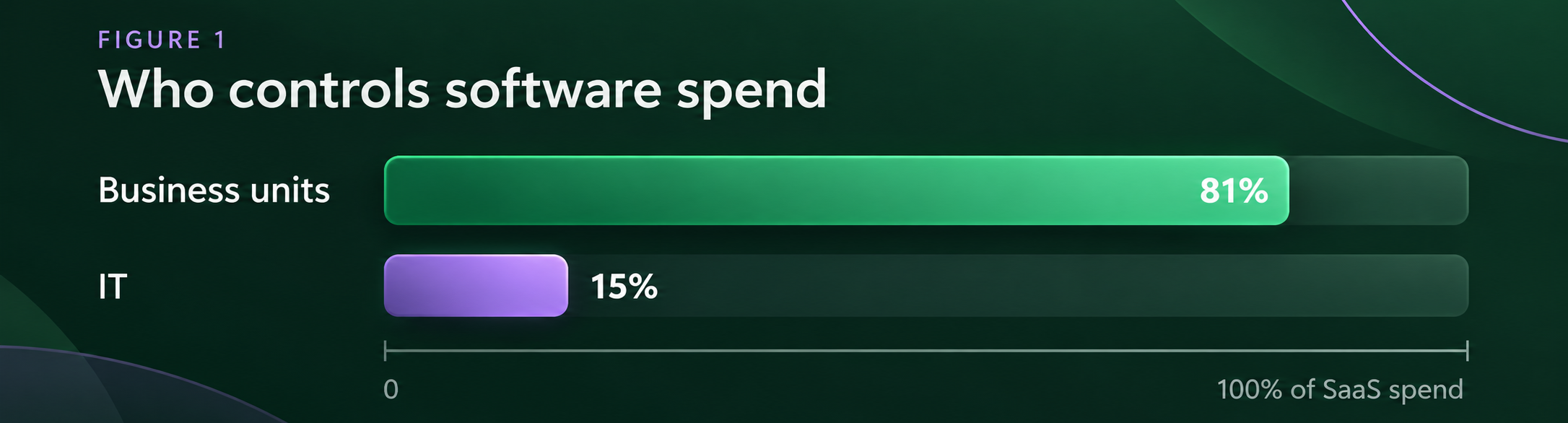
Source: Zylo 2026 SaaS Management Index, January 2026. The remaining share is unattributed in the source, so the two bars do not sum to 100.
So the software is landing in the business, outside IT, without a governance review.
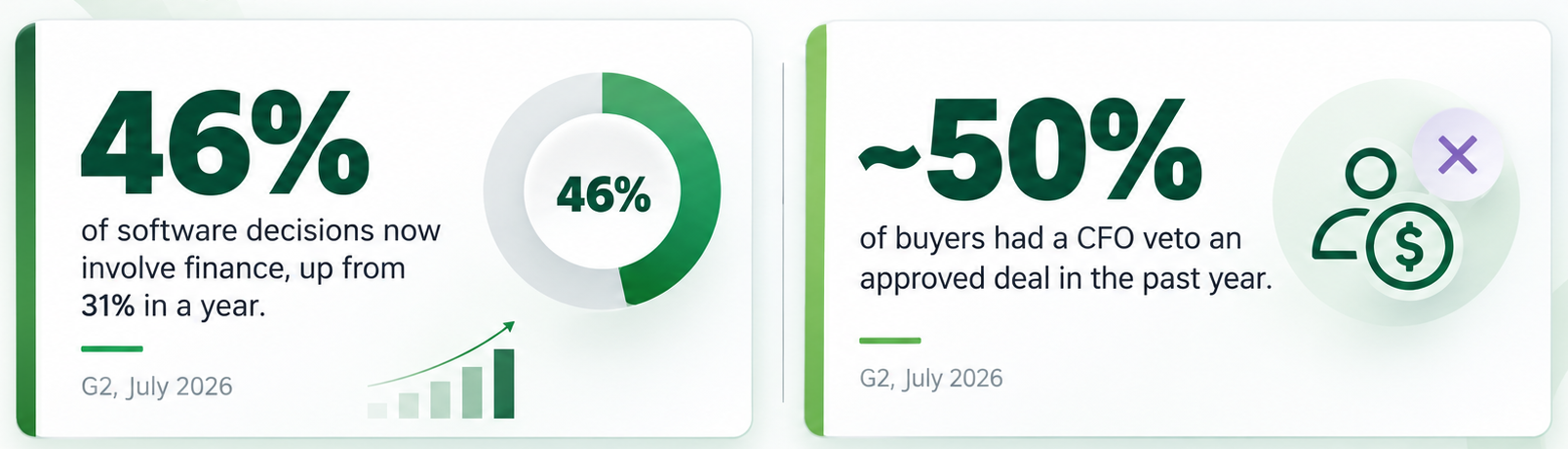
The person paying has noticed, too. G2’s 2026 Buyer Behavior Report, from July, found that nearly half of software buyers had a CFO veto an approved deal in the past year, while finance involvement in software decisions jumped from 31% to 46%.
The failure rate that follows a weak CPQ foundation
MGI Research, an independent analyst firm covering quote-to-cash software, opens its 2026 CPQ Buyer’s Guide with the finding that 30 to 35 percent of CPQ implementations still fail. MGI does not blame the category. Instead, it blames buyers who select on demos and marketing hype rather than requirements, use cases, and long-term fit.
A third of the projects fail, and the cause MGI names is upstream of the software. In other words, it is what the buyer did before choosing it.
telent, a UK infrastructure provider, had already been through a failed CPQ implementation before it came to us. Hannah Buckley, its Sales Operations Manager, described the reason in their case study: most CPQ solutions are built for simpler environments and are not engineered to account for this rate of adjustments. So that is the problem: buying a capability whose dependency you do not own.
telent is not the only one that rebuilt on a stronger base. See how telent, Dell EMC, and Scanco did it, in their own numbers: download our case studies.
Your CPQ foundation is not the software
We stopped calling these things features. We call them architecture now, or a control plane, or governed context. The vocabulary got better. The list, however, did not change.
A margin floor is an approval rule. A guardrail is a business rule. Explainability is an audit log. Provenance is version control on a catalog. Every abstraction the category has invented resolves, when you press it, to a line item on a CPQ requirements document from long before anyone said agent.
The new vocabulary works because the old list was right.
The dependency chain only runs one way
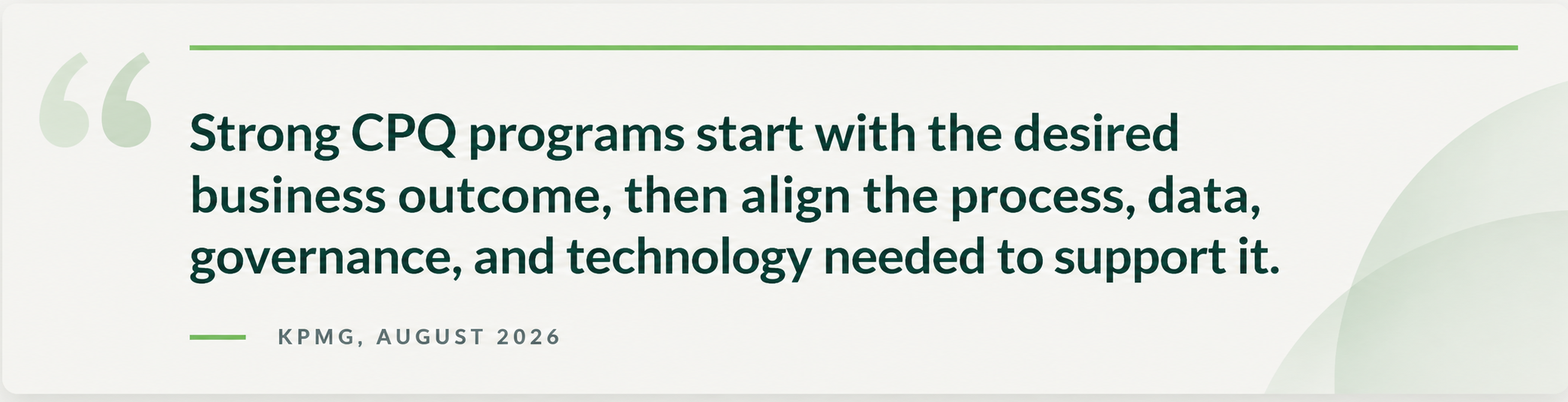
KPMG’s August 2026 analysis of integrated CPQ puts it this way: strong CPQ programs start with the desired business outcome, then align the process, data, governance, and technology needed to support it. Technology is fourth.
The dependency runs one way, and a CPQ foundation sits in the middle of it.
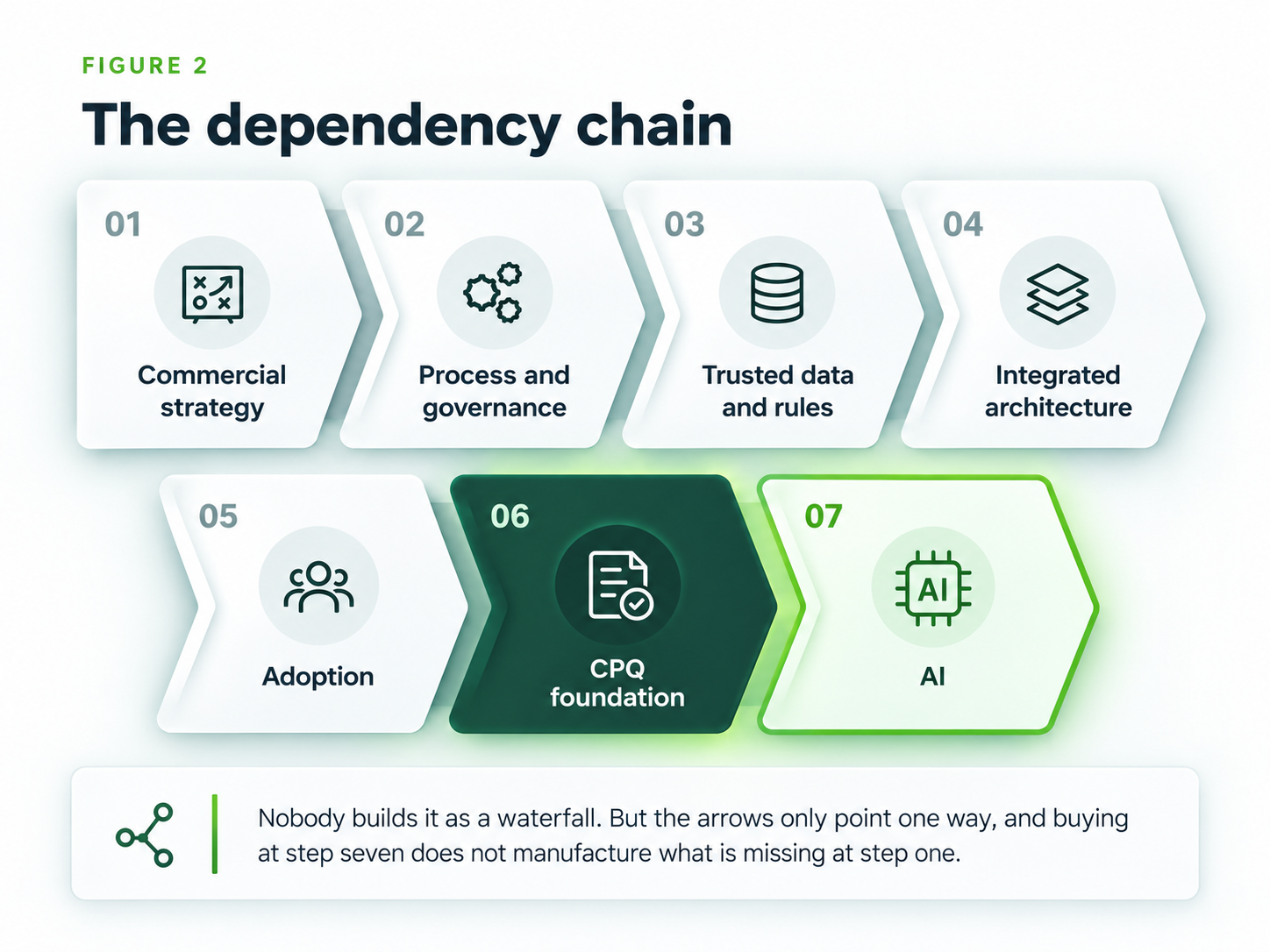
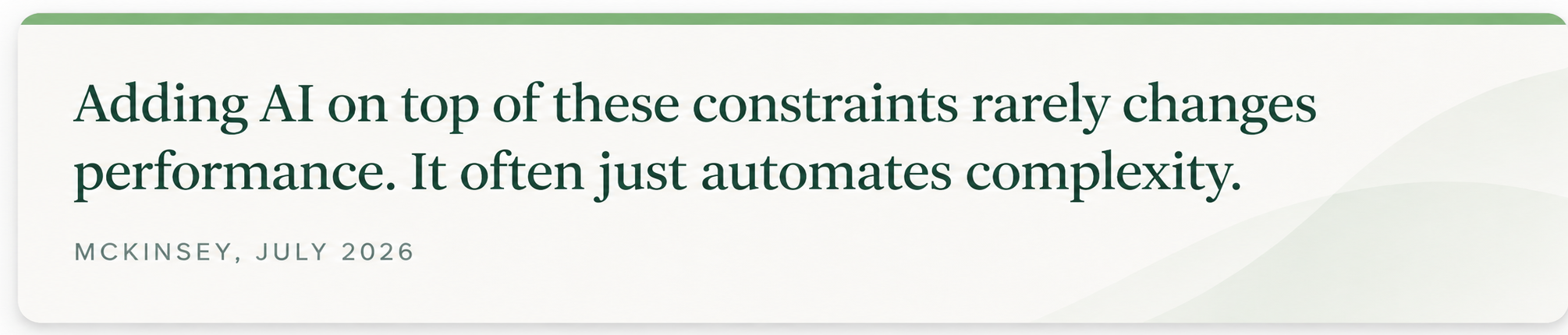
Buying at the right-hand end does not manufacture the logic missing at the left. McKinsey’s July 2026 research on B2B sales: adding AI on top of these constraints rarely changes performance. It often just automates complexity. The same paper is direct about why: agents cannot create trusted recommendations if customer, product, pricing, or transaction data remain fragmented or poorly governed.
Forrester’s assessment of the CPQ market, written alongside its Q2 2026 landscape, describes CPQ as having evolved from a point solution into a core platform capability connected to CRM, ERP, order management, and billing. Forrester’s word is capability.
This is not the lazy version of the argument, which says process beats technology. Architecture matters. A platform that cannot hold your pricing model will push that model somewhere it cannot be governed, and you lose the control whatever your process says. The software is the execution layer for the foundation, and a powerful execution layer cannot compensate for commercial logic nobody has defined.
Check the claim against your own shortlist
Do not take my word for any of this. Take theirs instead.
Open the implementation guide of every vendor on your shortlist. Not the product page, not the AI page. The document they show you after you have signed. I will tell you what you will find, and you can hold me to it. Each one puts the catalog structure, the pricing rules, and the discount authority before configuration begins. Ours does too. We compete on almost everything else.
The ten controls of a strong CPQ foundation
Not one of these is new. They are controls rather than features because each decides what the business is allowed to sell, at what price, on whose authority, and with what evidence. The first five define the offer. The second five keep the first five honest.
Controls one to five: what you sell, and at what price
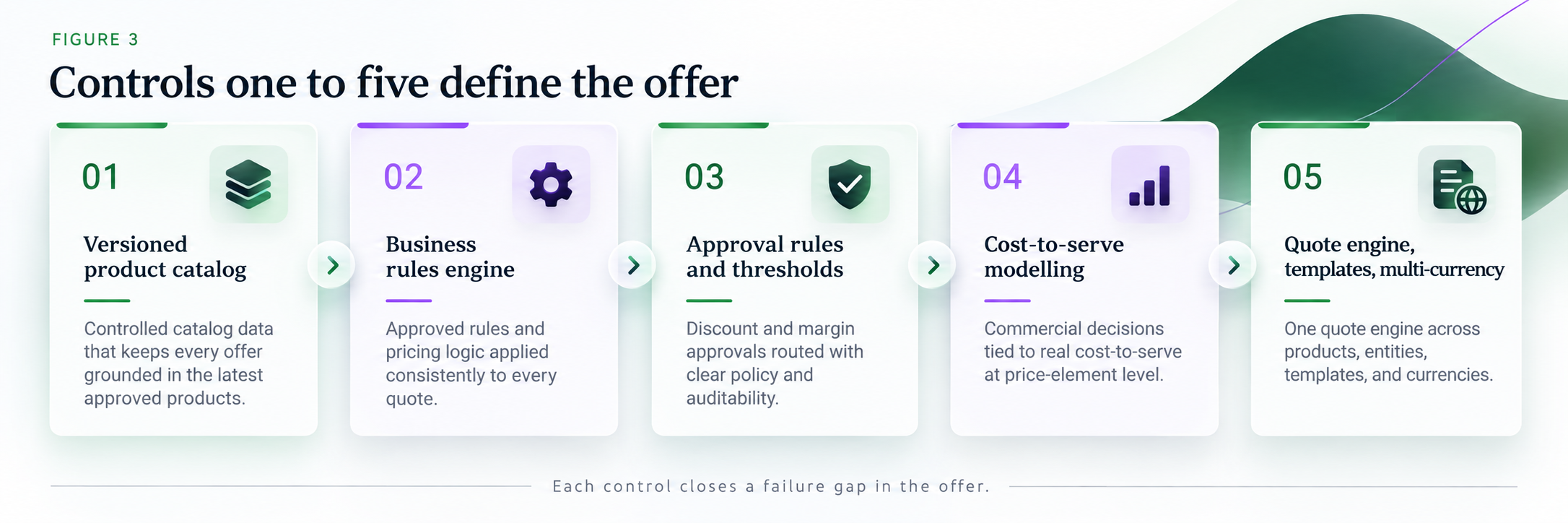
01 Versioned product catalog
Vendor catalogues under version control, a data parsing engine with parsers for Avaya, Cisco, Juniper, Microsoft, Mitel, Unify, Extreme, and HP Enterprise, and 4.6 million products from 400+ distributors
- Without it : Quotes built from a catalog that went stale last quarter, at whatever speed your newest tool runs
- Evidence : Gartner, April 2026: successful AI initiatives invest up to four times more in data quality and governance
02 Business rules engine
Rules, configured solutions, and pricing built into the platform so every quote runs on approved logic
- Without it : A configuration that looks valid, prices cleanly, and cannot be delivered
- Evidence : McKinsey, July 2026: AI on a weak base often just automates complexity
03 Approval rules and thresholds
Threshold-based approvals routing by discount, margin impact, and deal size, with alerts and escalations on business events
- Without it : Discount authority living in an inbox, and an exception process nobody can reconstruct
- Evidence : McKinsey, April 2026: enforcing discount policy and routing approvals delivered more than 50 basis points of margin improvement
04 Cost-to-serve modelling
Detailed cost-to-service modelling with real-time deal financials down to the price-element level
- Without it : Deals that are correct, fast, and unprofitable
- Evidence : Deloitte and IMA, May 2025: only 38% of organizations use cost-to-serve analysis
05 Quote engine, templates, multi-currency
One engine merging product, pricing, and requirements into a branded document, with multi-currency and cost-plus, territory, and usage models
- Without it : The same offer priced three ways across three entities
- Evidence : McKinsey B2B Pulse, May 2026: inconsistent information across teams is the leading reason buyers switch suppliers
Controls six to ten: what keeps the first five honest
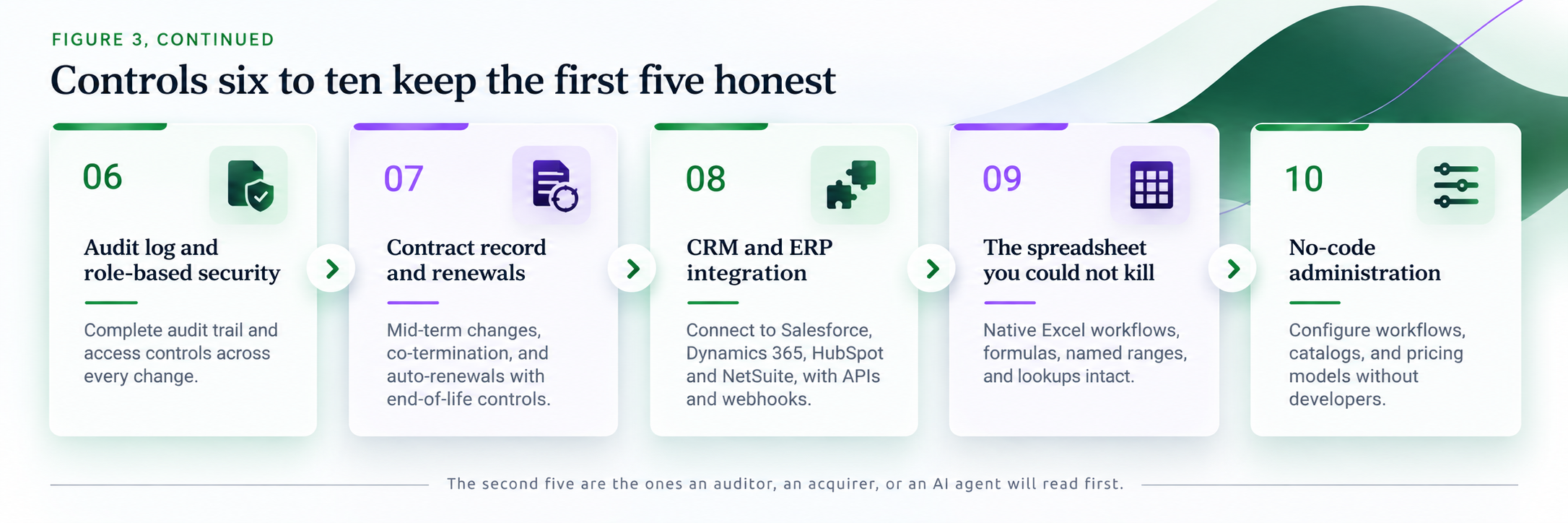
06 Audit log and role-based security
Complete audit log, user and role-based security, SOC 2 Type II
- Without it : The quote nobody can reconstruct when the auditor, the acquirer, or the customer asks
- Evidence : COSO, February 2026, via Deloitte: controls over automated outputs require logging of version, inputs, outputs, and approvals
07 Contract record and renewals
Service Contracts: mid-term revisions, co-termination, auto-renewals with end-of-life controls, DocuSign
- Without it : A mid-term change priced with no memory of what the customer already has
- Evidence : World Commerce and Contracting, June 2026: average contract value erosion of 8.6%, worst performers above 20%
08 CRM and ERP integration
Adapters for Salesforce, Dynamics 365, HubSpot, and NetSuite, an integration hub, a REST API, and webhooks into billing
- Without it: The pricing brain trapped inside one CRM the enterprise is about to replace
- Evidence : Bain, June 2026: large acquisitions frequently take 36 months or more to integrate
09 The spreadsheet you could not kill
Spreadsheet Calculator runs the native Excel workbook, formulas, named ranges, and lookups intact, with no rebuild
- Without it : Your most complex pricing model living outside the catalog, the approvals, and the audit log
- Evidence : AFP, May 2025: 57% of finance teams with planning systems use spreadsheets to bypass them
10 No-code administration
Workflows, catalogs, and pricing models maintained through configuration menus, no developers required
- Without it : Rules that go stale because changing one needs a dev ticket
- Evidence : Nalpeiron, June 2026 (vendor research): only 25% ship a pricing change in under a month
Price is not profit
A correctly configured deal can still be a bad deal. A renewal can preserve recurring revenue while weakening margin, and the customer who looks best at the top line is often the one costing the most to support. That gap between price and profit is where revenue leakage hides.
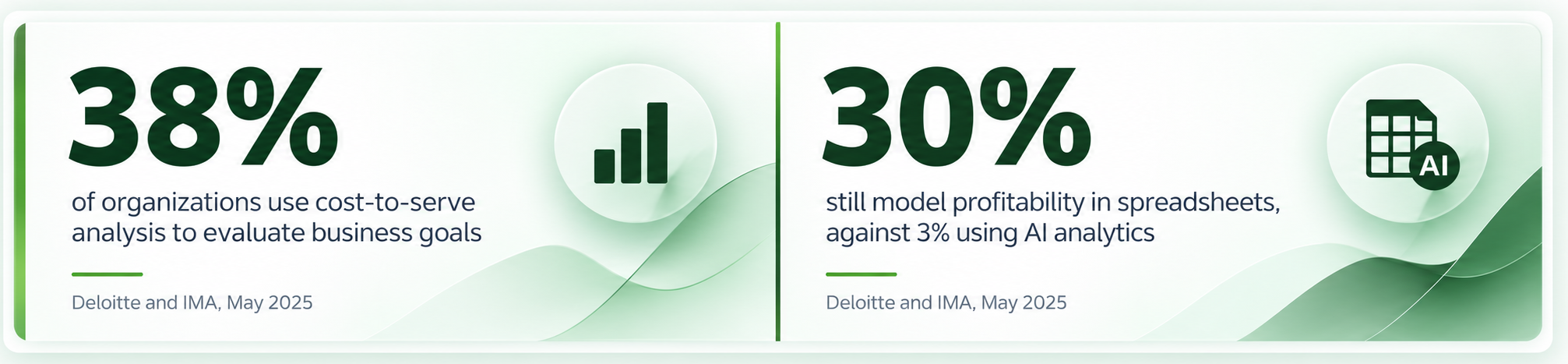
Most CPQ platforms price the offer. Costing the delivery is treated instead as a finance discipline, done after signature, in a different system. The Deloitte and IMA survey, published in May 2025, found that only 38% of organizations use cost-to-serve analysis to evaluate business goals. Spreadsheets remain the most common profitability modelling tool at 30%. AI analytics sits at 3%.
The pressure has not eased since. Deloitte’s CFO Signals survey for the first quarter of 2026 found 48% of CFOs citing shrinking margins as the reason they are prioritising cost management. Gartner’s finance analysts said in May 2026 that product-level profitability shows which offerings quietly dilute margin, and that consistent cost allocation is the precondition.
We built cost-to-serve into the quote because that is where the decision is made. Margin is visible while the quote is built, down to the individual price element, before anything is signed. Without cost context the business sees commercial activity. With it, the business sees commercial quality instead.
The spreadsheet you could not kill
Every CPQ vendor tells you to get out of Excel. We did too, for years.
Then we built a feature that runs your Excel workbook inside the platform, formulas and lookup tables intact. You do not build that unless you have lost the argument.
The models stayed because the model was usually better than the rule engine meant to replace it. So it stayed in a workbook, outside the catalog, the approvals, the audit log, and anything an agent could read. Banning the spreadsheet did not govern it. It exiled it.
The Association for Financial Professionals reported in May 2025 that among teams which own an enterprise planning system, 85% use spreadsheets alongside it and 57% use spreadsheets to bypass it. Not around the edges of the system. Around it.
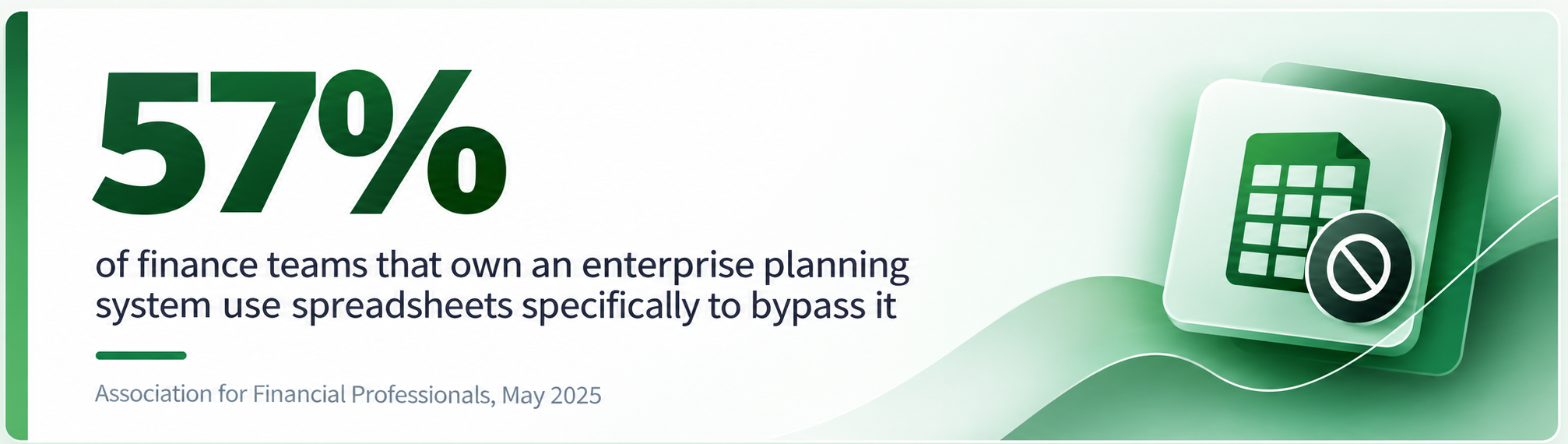 Association for Financial Professionals, May 2025
A rule people evade is not a weaker version of a rule. It is a rule that is not there, plus a report that says it is.
David Redondo, Catalog Manager at Scanco, described the starting point in their case study: before servicePath™, most quotes were created in Excel spreadsheets, which gave salespeople complete control over everything, and there was significant risk with that approach. Scanco now updates a catalog of more than 20,000 SKUs in 30 to 60 minutes rather than days.
The checkbox that became a requirement
The audit log used to be the least interesting line on a CPQ requirements document. It was a compliance checkbox, and nobody bought a platform because of it.
Then, in February 2026, COSO published guidance on internal control over generative AI. Deloitte’s summary of it lists the building blocks: logging and traceability of the model version, the prompts, the key inputs and outputs, and the approvals. Outputs that could affect material amounts in the financial statements need human oversight and evidence. Set-and-forget is over, and that is the argument for deterministic governance of the quoting layer.
A month later, in March 2026, the law firm Goodwin published an alert on algorithmic pricing under competition law. It advises organizations to keep records of the inputs each algorithm considers, the logic it applies, and the outputs it generates, with controls embedded from inception rather than retrofitted.
The people who will ask you to reconstruct the quote are automating, too. Gartner’s January 2026 survey of 119 chief audit executives found 83% of audit functions piloting or using AI, with a further 12% planning to within the year.
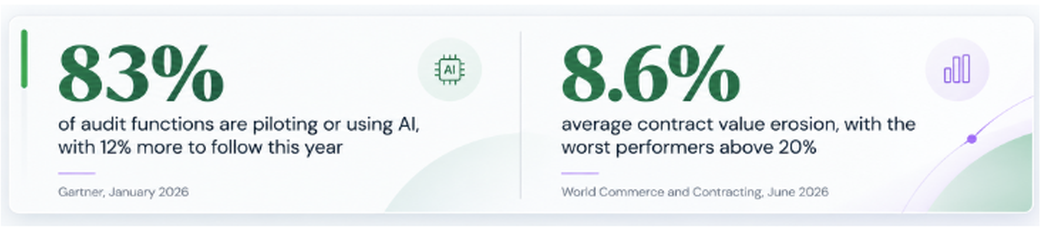
Gartner, January 2026 World Commerce and Contracting, June 2026
The checkbox became the requirement. Same field, same table, same feature we shipped years ago.
What we built into our CPQ foundation
servicePath™ was founded by people who had managed multi-million dollar quotes in spreadsheets at managed service providers and telcos. Three choices in the platform follow from that.
Built for solutions that keep changing. The platform is built for technology and managed service providers selling hardware, software, network access, and professional services as one solution, where a customer’s configuration is revised several times a year and every revision has to stay inside the rules. That is a narrower problem than quoting in general, and the narrowness is the point. It is also the rate of change that broke telent’s first CPQ.
The pricing brain is not locked to one CRM. One instance serves Salesforce, Dynamics 365, HubSpot and NetSuite at once. CRM-native CPQ assumes a consolidation that, on Bain’s June 2026 numbers, frequently takes 36 months or more after a large acquisition. An acquired business should quote against the same rules on day one while keeping its own CRM.
Business teams change the rules, not developers. Nalpeiron’s June 2026 survey of 255 B2B software leaders, a vendor study, found only 25% can ship a pricing change in under a month, with engineering bandwidth the top barrier. A control that needs a release window is a control you will stop using.
What AI changes, and what it does not
AI raises the cost of a weak CPQ foundation. It does nothing, however, to build a strong one. That holds equally for AI inside the CPQ and for the agents now being sold on top of it.
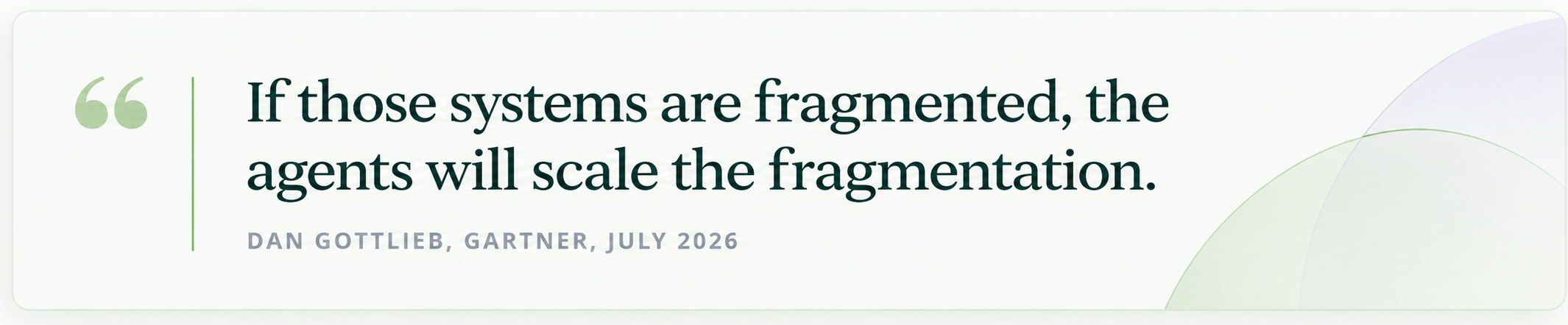
KPMG’s analysis: a faster quote may simply move the problem downstream, faster. Gartner’s Dan Gottlieb said the same thing in July 2026. Gartner expects AI agents to outnumber sellers ten to one by 2028, and fewer than 40% of sellers to say the agents improved their productivity. Gottlieb’s reason: if those systems are fragmented, the agents will scale the fragmentation.
BCG’s May 2026 work on AI in B2B pricing warns that relying on tools alone may improve efficiency while it undermines pricing effectiveness, because AI recommendations lack commercial context, get overridden, or go stale. Their August 2026 follow-up on why pilots fail is blunter: if processes are complex before AI, the technology will simply solidify that complexity instead of eliminating it.
The clock is not yours. Forrester’s 2026 predictions, published in October 2025, expect one in five B2B sellers to face AI-powered buyer agents demanding dynamic counteroffers this year. The buyer’s agent does not wait for your catalog to be clean.
Fix the CPQ foundation before you replace the platform
None of this says replace your CPQ before you add AI. Usually you should not. Fix ownership and catalog currency first, because those are free. Replace the platform only when it cannot hold the pricing model your business actually uses. If your most important pricing logic lives in a workbook because the platform could not take it, that is the signal. Otherwise the work is governance, not procurement.
Same tools on a strong CPQ foundation and a weak one
Take a hypothetical services business: $250 million of revenue at an 8% operating margin, so $20 million of operating profit. Then deploy the same new tooling twice. One foundation has an owned catalog, one rules engine, and thresholds with named owners. The other has pricing in three systems and approval by email.
Both get the same cycle-time improvement, because the tooling is not the variable. The difference is whether realized price holds. McKinsey’s April 2026 pricing research restates a long-established sensitivity: a 1 percent price increase translates into an 8.7 percent increase in operating profits, assuming no loss of volume. Run it backwards, and one point of realized-price drift on this business moves operating profit by roughly $1.74 million a year.
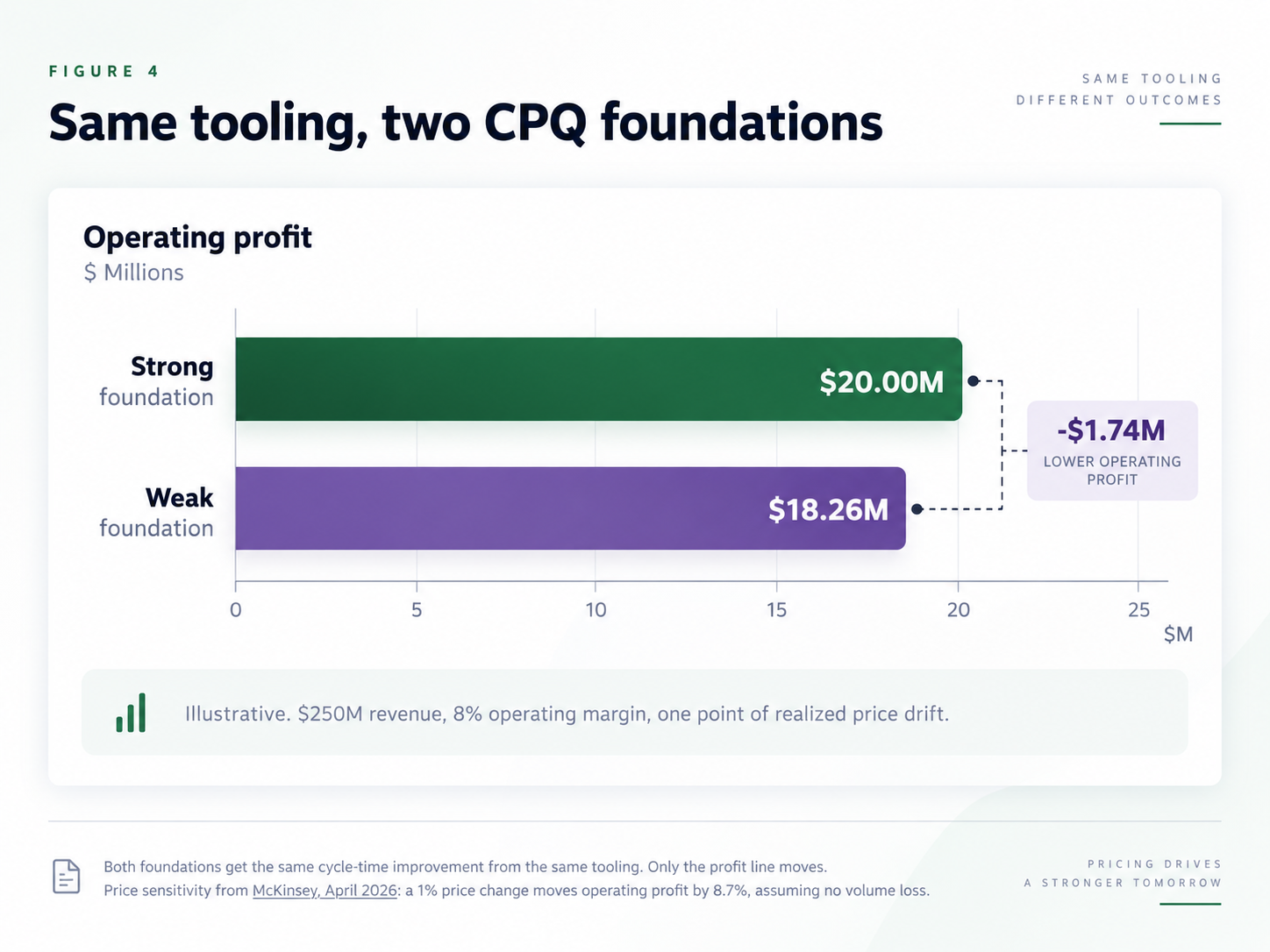
Read the first row before the last. The speed is identical, because speed was never the variable.
Where the other four fifths of the effort goes
BCG put numbers on the same finding. In its May 2026 pricing research, change management is about 70% of the effort behind sustained pricing effectiveness, the tools about 20%, and the algorithmic recommendations about 10%. The part you buy is a fifth of the work. The other four fifths is the commercial context and governance around it.
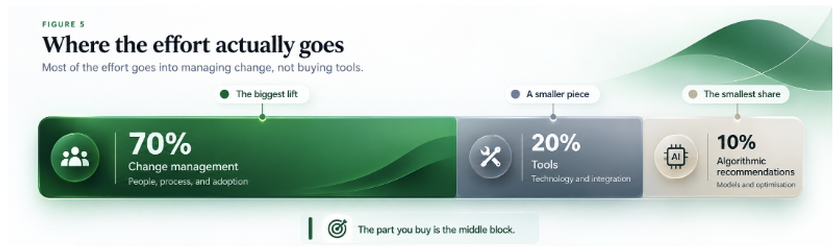
Source: BCG, 8 May 2026. BCG’s estimate is for AI-enabled B2B pricing rather than CPQ implementation, but the direction holds.
Gartner’s April 2026 finding is the same table drawn from the other side. Organizations reporting successful AI initiatives invest up to four times more, as a share of revenue, in data quality, governance, people, and change management. The winners are not buying different tools. They are spending on the base.
Two ways to test your CPQ foundation
Test one: what does the tool read?
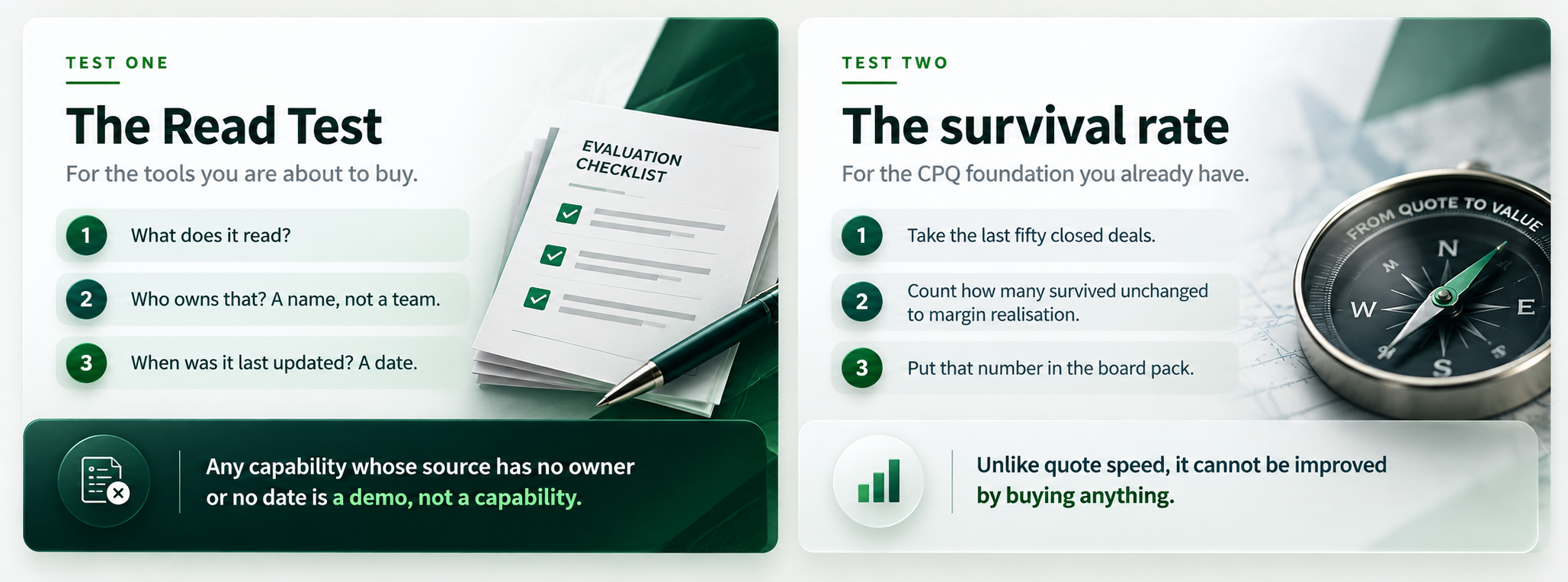
The first test is for the tools you are about to buy, and it works backwards from them into your CPQ foundation. For every capability on the roadmap, answer three questions. What does it read? Guided configuration reads the catalog, discount guidance reads the thresholds, margin alerts read the cost model. Who owns that? A name, not a team. When was it last updated? A date.
One rule, then: any capability whose source has no owner or no date is a demo, not a capability. It will work in the vendor’s environment and degrade in yours, silently.
Test two: quote survivability
The second test is for the CPQ foundation you already have, and it is the one that belongs in a board pack. Call it quote survivability: stop measuring how fast the quote is produced, and measure how much of it survives.
First, take the last fifty closed deals. Count how many made it through contracting, order creation, fulfilment, invoicing, revenue treatment, renewal, and margin realization without the commercial intent changing. Everything after signature is the missing mile of the revenue lifecycle. That percentage is your survivability rate, and it is the only quoting number I would put in front of a board.
Quote speed measures how quickly you made a promise. Survivability measures whether the promise was true. The first can be improved by buying something. The second cannot.
KPMG describes the failure: the quote still goes out in minutes, but the errors surface after approval, when they are costlier to fix. The Hackett Group’s July 2026 benchmarks show the other end, where order quality is fixed at intake: invoice corrections roughly halve. Nobody has published how often a B2B quote changes between signature and cash, so count yours.
Both tests come out of work we have already published on CPQ governance, deterministic AI, and what happens to a quote after it is signed. Read our blogs.
What would change my mind
First, if tooling gets good enough to detect that a catalog is stale without being told, the currency problem solves itself and half of this argument goes with it. Second, if a business sells a small, stable set of things at published prices, this governance layer is overhead, and the fast tool is simply the right purchase.
Neither is true of complex services today, although both are worth watching.
Why servicePath™
Gartner’s published assessment says our market presence is small next to the Leaders. That is accurate, and it is the fair price of having built for one problem rather than every problem. The customers who chose us anyway have this on record.
telent, a UK ICT infrastructure provider, replaced a failed CPQ implementation with servicePath™, went live in eight weeks, and now quotes £50 to £60 million a year through the platform. That is what MGI’s 30 to 35 percent looks like from the inside, and what recovery looks like.
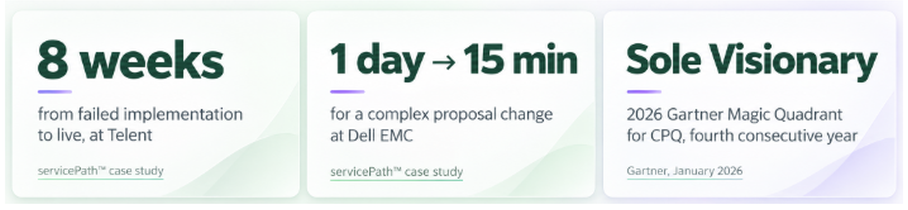
Dell EMC cut complex proposal changes from a full day to fifteen minutes, while partners generate their own configurations.
Gartner named servicePath™ the sole Visionary in its 2026 Magic Quadrant for Configure, Price and Quote Applications, our fourth consecutive year as a Visionary. (Gartner, Magic Quadrant for Configure, Price and Quote Applications, Mark Lewis and Luke Tipping, 22 January 2026.)
Info-Tech’s SoftwareReviews also named servicePath™ a 2026 CPQ Data Quadrant Champion with a +93 Net Emotional Footprint and top feature scores in workflow and approvals, configuration, discounting, and cost of serve. All four are on the list above, scored by customers.
Frequently asked questions
What is a CPQ foundation?
A CPQ foundation is the commercial operating model the software encodes: the product catalog, the pricing and configuration rules, the approval authority, the cost model, the contract record, and the audit trail. A strong CPQ foundation is one where every one of those has a named owner and a current date.
Why do CPQ implementations fail?
MGI Research’s 2026 Buyer’s Guide puts the failure rate at 30 to 35 percent and attributes it to buyers selecting on demos and marketing hype rather than requirements and long-term fit. The failure is upstream of the software: undefined rules, unowned catalogs, and discount authority in an inbox.
What are the ten controls of a strong CPQ foundation?
A versioned product catalog, a business rules engine, approval rules and thresholds, cost-to-serve modelling, a quote engine with templates and multi-currency, an audit log with role-based security, a contract record with renewals, CRM and ERP integration, governed spreadsheet models, and no-code administration. Each one needs a named owner and a current date.
How do you measure a CPQ foundation?
Two tests. First, the Read Test: for every capability you plan to buy, ask what it reads, who owns that source, and when it was last updated. Second, quote survivability: count how many of the last fifty closed deals reached margin realization with the commercial intent unchanged.
Talk to a CPQ architect
Buy the tools. They are better than they were, and the productivity is real. Just know what they are reading, and who updated it last.
Run either test this quarter. If the result surprises you, talk to a CPQ architect.