
Building a commercial second brain starts with five questions about your last multi-year deal.
From the book I am writing, The Shifting Strategy Floor. The introduction named four capabilities a business needs when AI moves the ground every quarter. This piece is about the second, context ownership, and where it lives when the agents arrive.
Executive summary
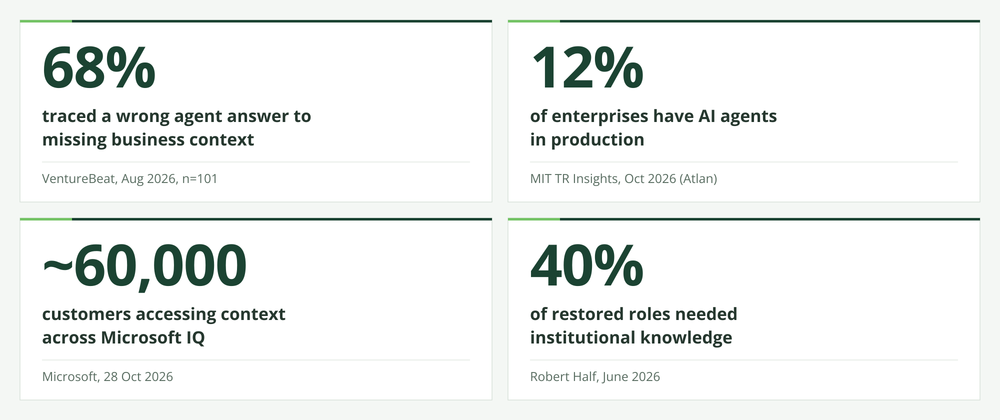
The market has named the bottleneck. “Agents are only as effective as the context they receive,” Forrester wrote on 19 October 2026. A day later, Gartner named AI context platforms a top 2027 trend. Microsoft reported nearly 60,000 customers accessing context across Microsoft IQ, up 25% quarter-over-quarter. Yet an MIT Technology Review Insights report, sponsored by Atlan, found just 12% of enterprises have AI agents in production.
A quoting agent will read what your systems hold: the list price. The exception, its reason, and its approver sit in a DM and two people on the deal desk. That is your enterprise second brain.
So it quotes the list price. Billing repeats it until renewal, and every review passes it, because the invoice matches the contract.
Run the five-question test on a closed non-standard deal. If people hold most answers, I would keep agents out of that motion. Then give it one quarter: capture exceptions, name owners, turn repeats into rules, switch on one agent.
You can build that brain yourself. But a brain filled after the fact falls a quarter behind every quarter. One that sits in the quoting path keeps itself current, and it stops a wrong quote before the customer sees it.
Own the context. Rent the model.
What is an enterprise second brain?
It is the knowledge an AI agent draws on that the model itself does not contain. The idea started as a personal one. Tiago Forte’s Building a Second Brain has sold more than 400,000 copies, by his own count in June 2026. Then, in 2026, Forte pointed his own idea at AI.
His reading of it in March: “the new bottleneck isn’t AI capability, but your ability to give AI the right information at the right time”.
Then Gartner named the category, listing AI context platforms among its top strategic technology trends for 2027 on 20 October 2026. Gene Alvarez, speaking to TechTarget: “AI context platforms govern the agent’s ability to work within the organization’s context”.
Gartner’s category is a platform. The enterprise second brain is what goes into it, and that is a practice, not a product. You capture what changes a decision. You keep it where the next decision can find it.
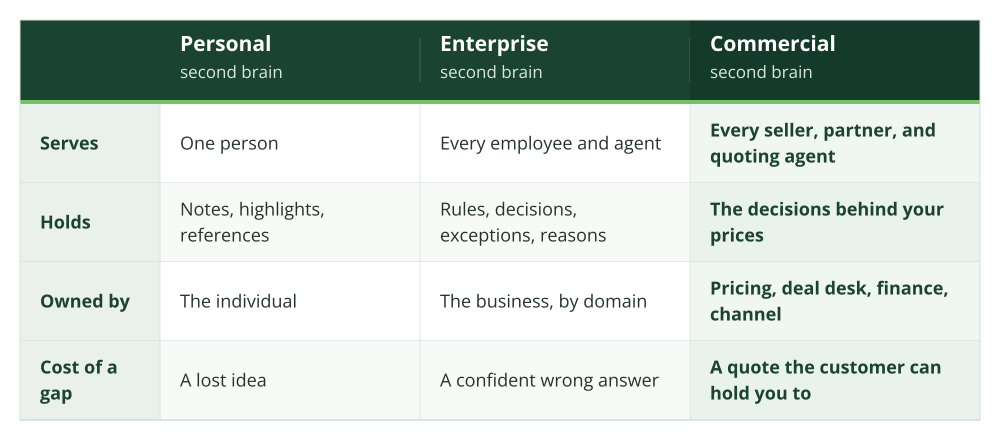
Personal, enterprise, commercial
Forte’s own definition, from his 2023 guide, is “an external, centralized, digital repository for the things you learn and the resources from which they come.” Take it to company level and three versions appear.
Why is context, not the model, the bottleneck?
Because the model is the part everyone can rent.
Forrester’s Charlie Dai, Leslie Joseph, and Indranil Bandyopadhyay put it in one line on 19 October 2026: “Agents are only as effective as the context they receive”.
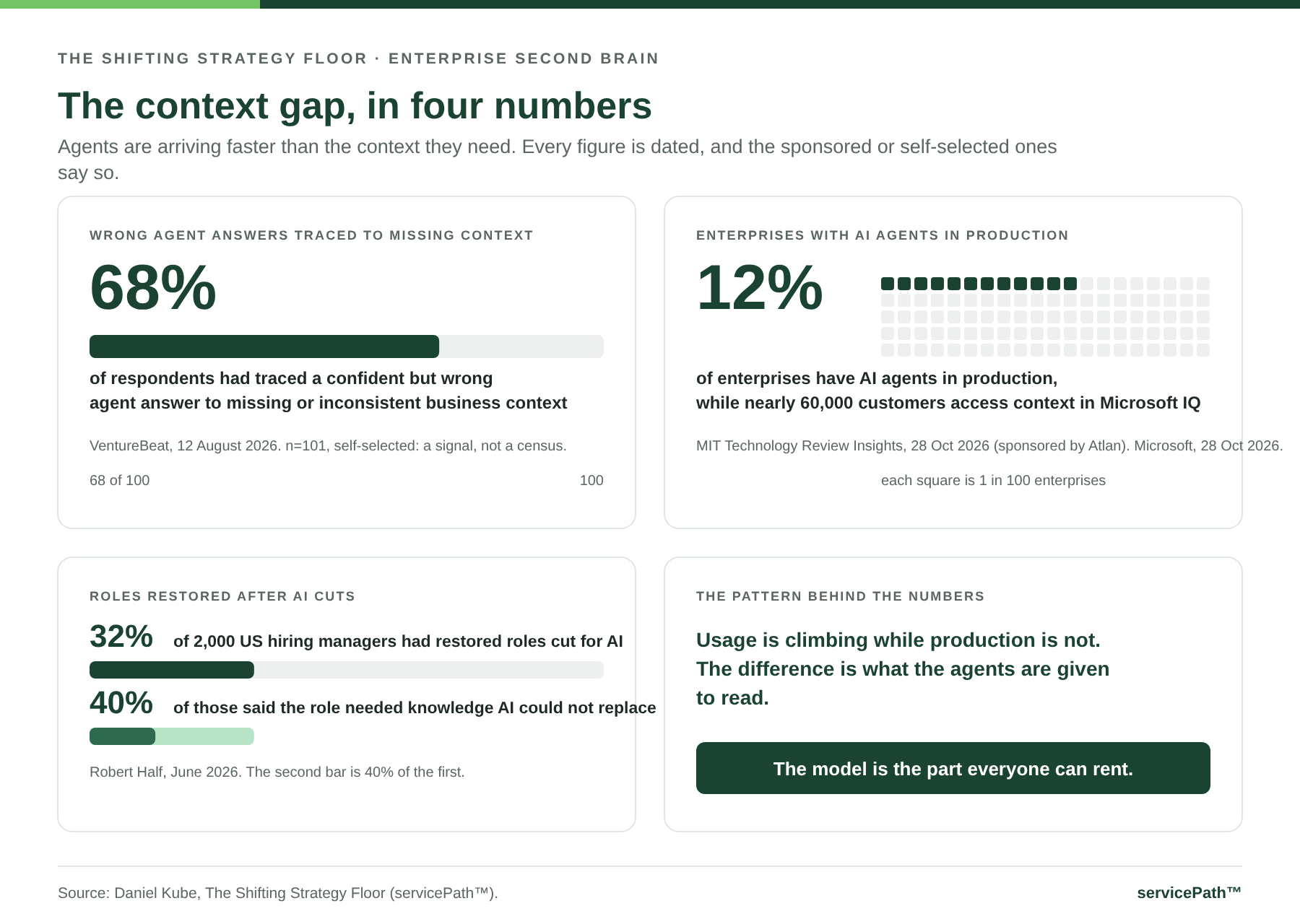
On Microsoft’s 28 October 2026 earnings call, Satya Nadella reported that “nearly 60,000 customers are accessing context across Microsoft IQ, up 25% quarter-over-quarter”. Production is still rare. An MIT Technology Review Insights report sponsored by Atlan found that “just 12% of enterprises have AI agents in production”. Context tools are selling. Agents in production are not. Buying the pipe does not fill it.
AI depreciates. Context appreciates. The tools get cheaper and better every quarter. What holds its value is the governed knowledge and logic underneath them, and the people who own it.
I wrote that line in September. So the enterprise second brain is where the appreciating asset sits.
From servicePath™AI moves the ground every quarter. Governed revenue logic is the part that should not. Read the introduction to The Shifting Strategy Floor.
Where does the commercial second brain live in a technology service provider?
Not in the knowledge base. The policies, product sheets, and onboarding guides most context projects start with are the part a model can already read. The context that decides whether a deal makes money sits somewhere else. I call it the commercial second brain.
The commercial second brain is the set of decisions behind a company’s prices: the approved exception and why it was granted, the price list in force on the quote date, the partner tier, the ramp and indexation on a multi-year contract, the usage rate, and who approved each one.
Forrester’s Charles Betz said in April 2026 that consequential decisions “happen in phone calls, hallway conversations, and meetings that may or may not produce notes”. Nobody takes minutes in a hallway.
Six pieces of commercial context and where they sit today
Quoting exceptions. The non-standard discount, the free month, the waived setup fee. Lives in DMs and email between the seller and the deal desk.
Price lists with effective dates. Which version applied when the quote went out. Lives in several spreadsheets, and only one person knows which is current until someone asks.
Approvals. Who said yes, under which authority. Lives in inboxes, because the approval workflow ran through reply-all.
Partner tiers and discounts. What this reseller is entitled to, and the side letter that changed it. Lives in the partner portal if you have one, otherwise in the channel manager’s head.
Multi-year ramps and indexation. Year two and year three pricing. Lives in the contract PDF and in a three-year promise nobody reopens until renewal.
Usage rates. What a unit of consumption costs this customer under usage-based pricing. Lives in the billing system, so the quoting agent has never read it.
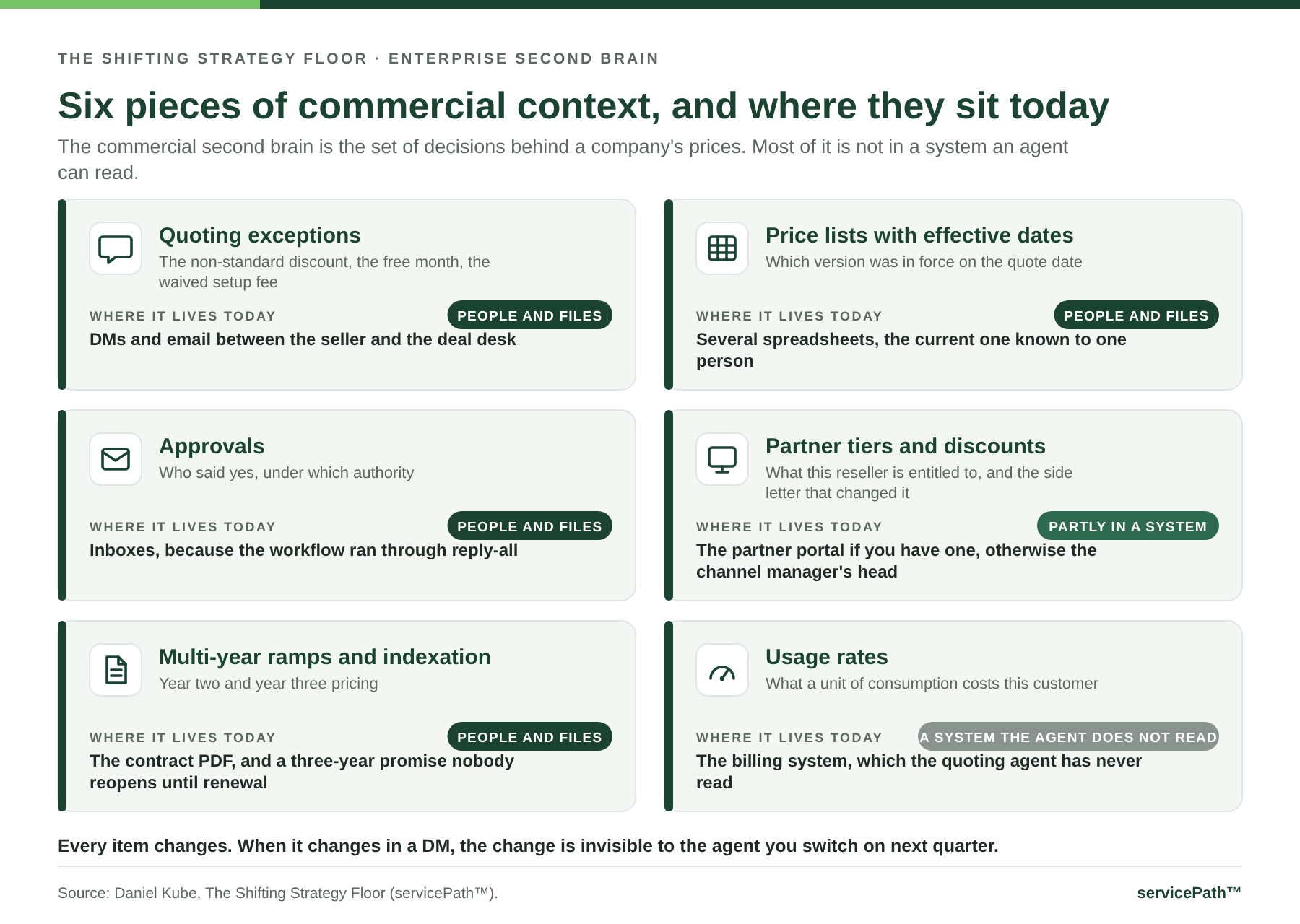
Telent’s Hannah Buckley, in our published case study, named the condition: “constant change in technology and pricing.” Every item on that list changes. When it changes in a DM, no agent you switch on next quarter will see it.
Pricing risk in a volatile market is a context problem before it is a pricing problem.
What happens when an AI agent quotes without it?
It applies the rule it can see, then misses the exception it cannot. No hallucination required.
The model did its job. Nobody gave it the enterprise second brain before it quoted.
In a VentureBeat survey published on 12 August 2026, 68% of respondents had traced a confident but wrong agent answer to missing or inconsistent business context. The sample was 101 practitioners and self-selected, so treat it as a signal, not a census. Anthropic, explaining on 22 October 2026 why it built Agent Skills, said the assistant “often lacked the procedural knowledge that real business tasks need”.
A quote is procedural knowledge. The agent that drafts it knows the list price, because that is in a system. It does not know that this customer’s renewal was priced on a margin floor agreed in a call eighteen months ago, unless somebody wrote that down where it could read it.
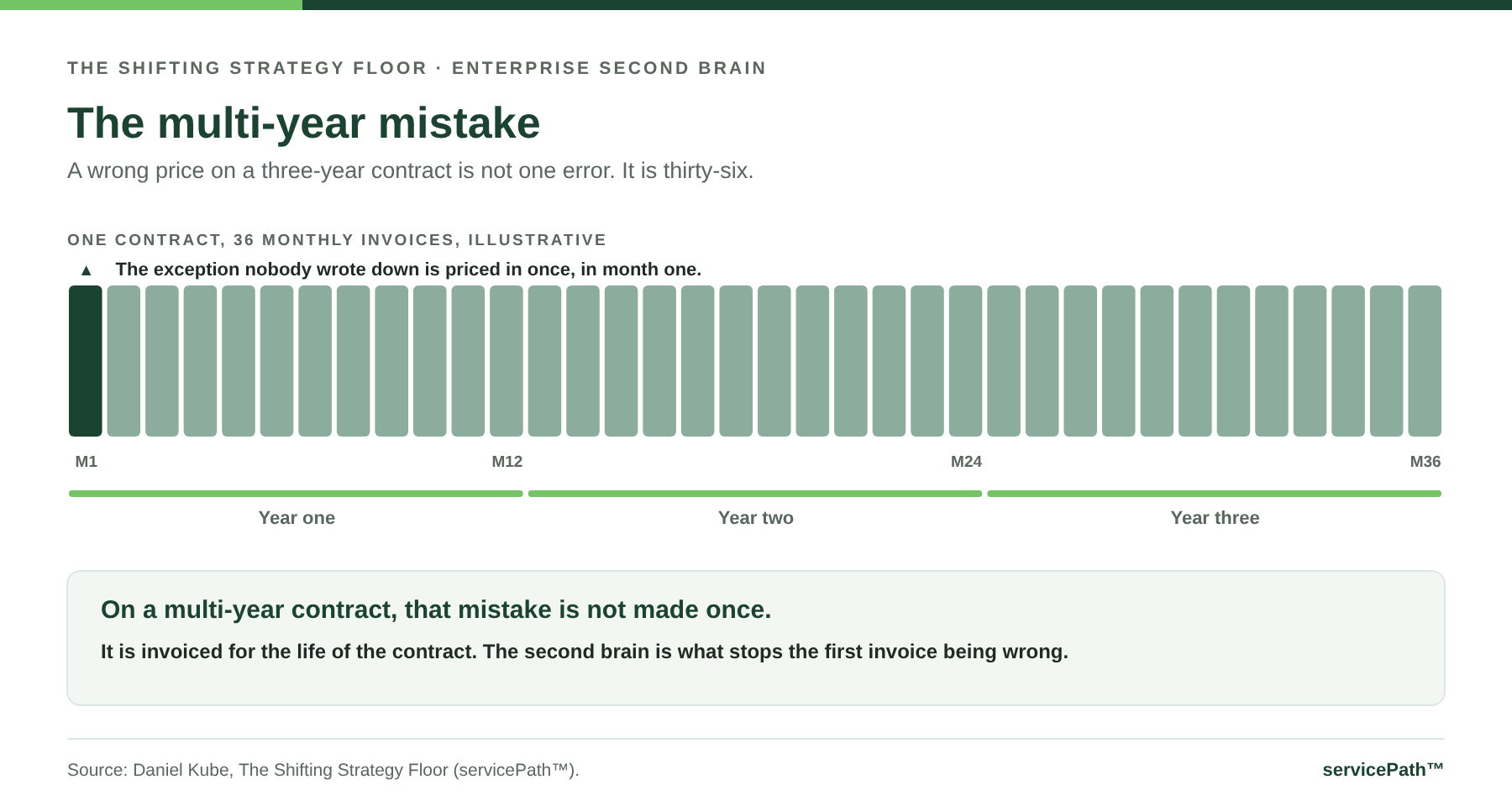
The agent makes that mistake once. The billing run repeats it every cycle until renewal. It passes every review, because the invoice matches the contract.
The quote is the point of control. The second brain is what the control reads before it says yes.
What happens when the person who knows leaves?
Robert Half surveyed 2,000 US hiring managers in June 2026. Of them, 32% had restored roles cut for AI, and 40% of those said the role required institutional knowledge or context AI could not replace.
The rules can still be rebuilt from a contract. The reasons leave with the person.

Can an AI agent have too much context?
Yes. Drew Breunig described an enterprise that was “loading 600 skills for every engineer at startup” in October 2026. The agents got worse.
Andrej Karpathy gave the engineering version in June 2025: context engineering is the “delicate art and science of filling the context window with just the right information for the next step”. The operative word is “just.”
A quoting agent needs the price list in force on the quote date, this customer’s live exceptions, this partner’s tier, and the approval authority for the discount it is about to propose. Everything else is noise it will confidently misuse. Last year’s price list is the worst kind of noise, because it looks right. Scoping is a governance decision. So it belongs to the people who own the rules.

Who is already building one?
The companies getting value did the dull part first.

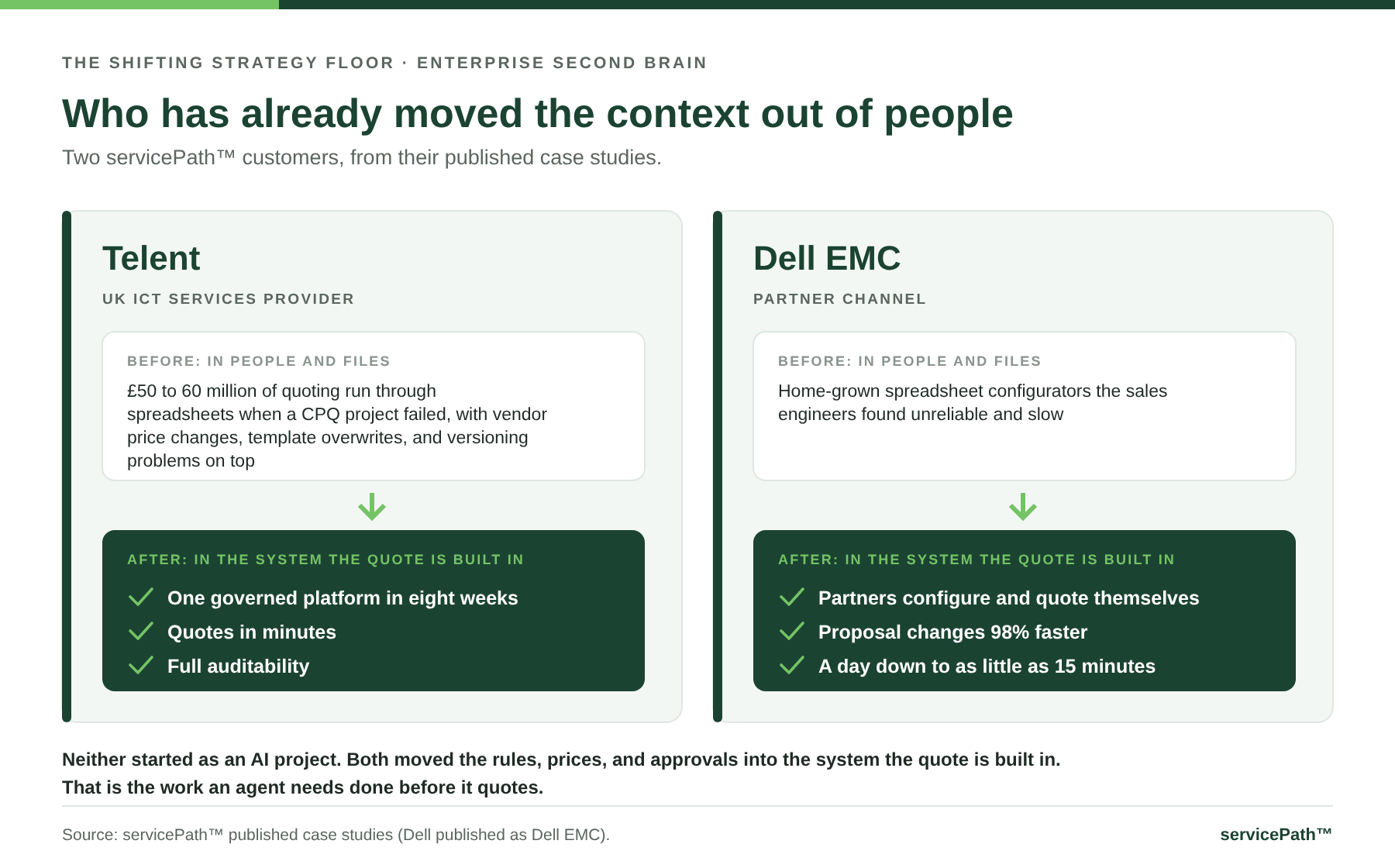
At Telent, the commercial second brain lived in files until an eight-week rollout. Vendor price changes and versioning problems had piled on top. Dell Technologies, then Dell EMC, moved its partner channel onto the same rules its sales engineers use, so a proposal change that took a day now takes as little as 15 minutes.
Outside quoting, Telstra grounded Ask Telstra in its own knowledge bases before putting it in front of frontline staff in late 2023. At Morgan Stanley, the head of firmwide AI, Jeff McMillan, said: “This technology makes you as smart as the smartest person in the organization.”
Telent and Dell Technologies governed their pricing logic. Telstra and Morgan Stanley grounded AI assistants in their own knowledge before anyone used them. A commercial second brain needs both halves, so point them at pricing.
Your smartest deal desk analyst, on every quote, even when they are on leave.
What do leaders get wrong before they start?
Four assumptions send enterprise second brain projects to the wrong place.
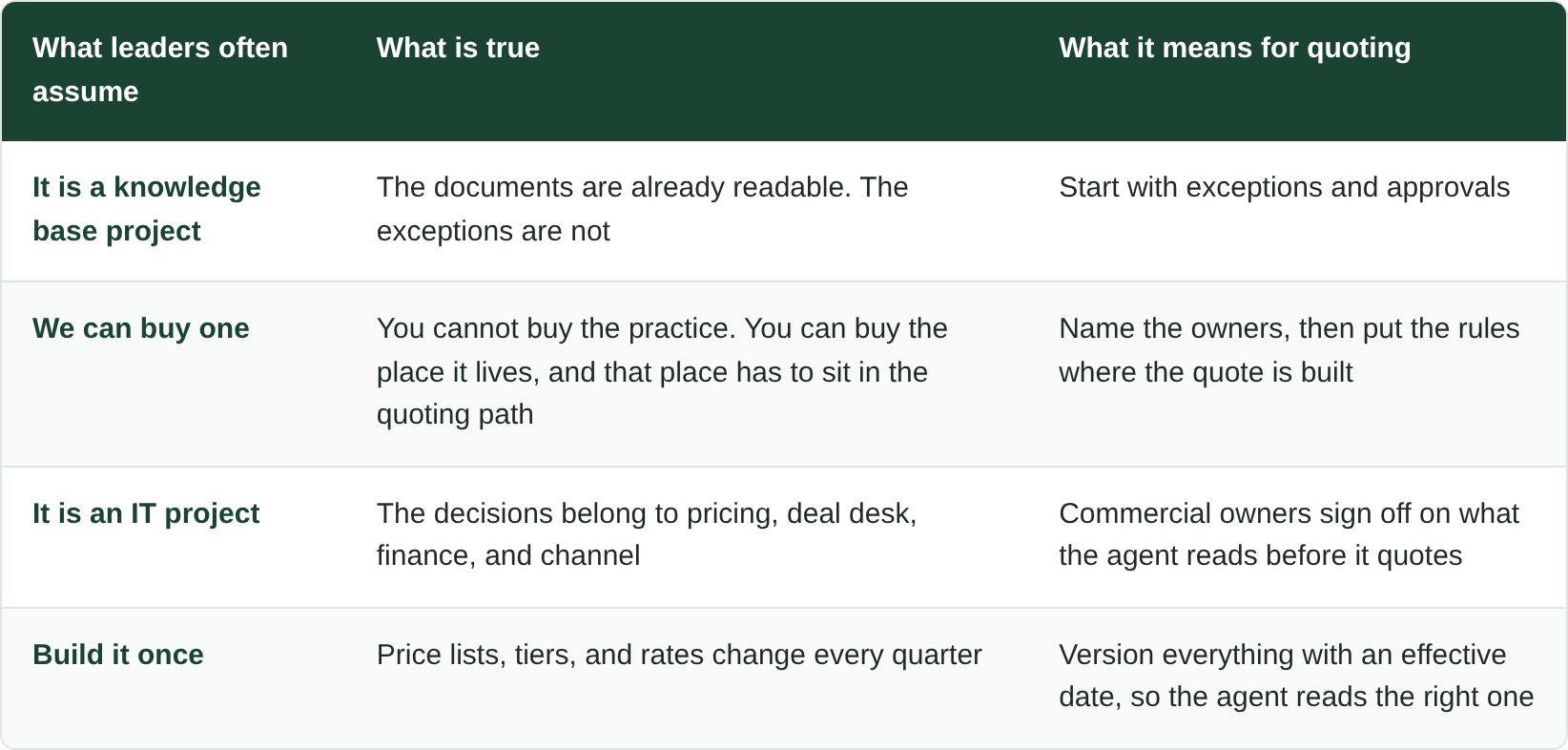
The last row matters most. On the shifting strategy floor, a snapshot of your commercial context is out of date the quarter after you take it.
What are the five parts of a commercial second brain?
No single step reads all five. All five have to exist before an agent goes live.
- Product and configuration rules, versioned, so the agent cannot assemble what delivery cannot deliver.
- Price lists and cost tables, each with an effective date and a named owner, so “which price was in force” has one answer.
- Exceptions, recorded with the reason and whether they apply once or change policy, so the one-off stays a one-off.
- Approvals, with a name and a role, for discounts, partner tiers, and contract ramps alike, so “who said yes” is never a search of someone’s inbox.
- The ability to reopen any quote after the rules have changed and see the other four as they stood that day.
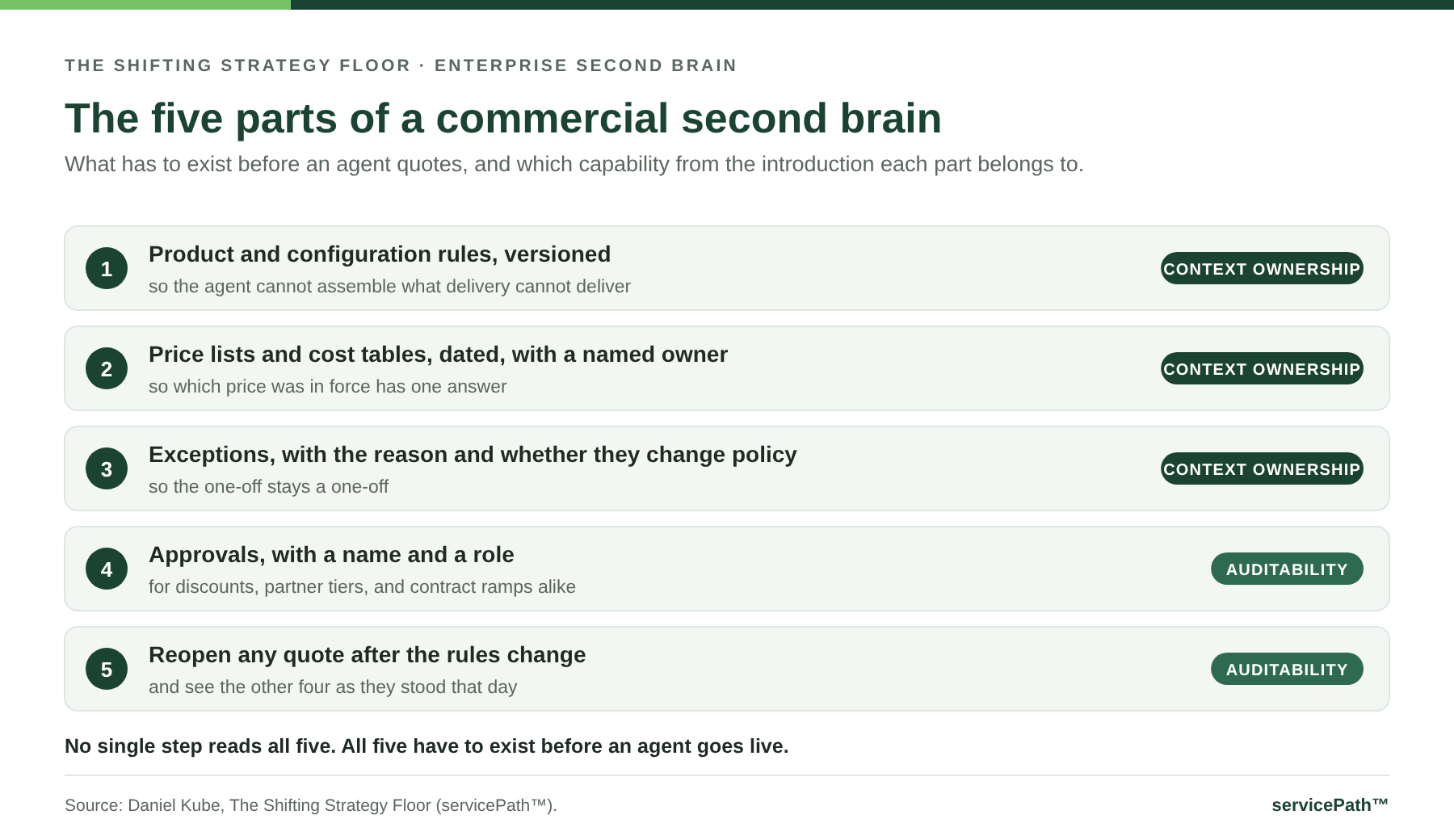
Parts one to three are context ownership from the introduction: “owning the context (pricing logic, product rules, customer terms, approval authority) while renting the model that reads it.” Parts four and five are auditability: “every material decision reconstructable months later by someone who was not in the room.”
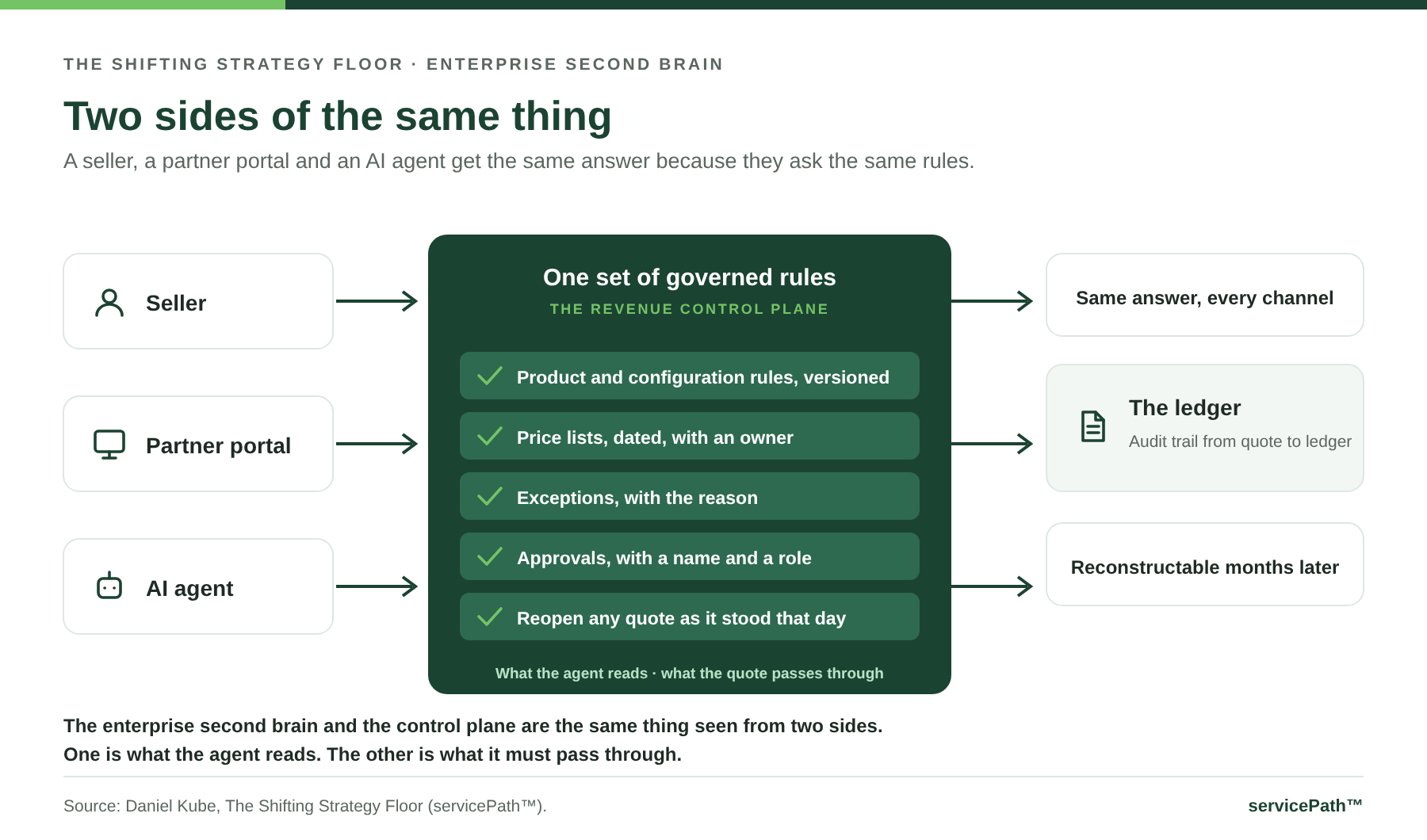
Together they describe a revenue control plane, with an audit trail from quote to ledger.
The enterprise second brain and the revenue control plane are the same thing seen from two sides. One is what the agent reads. The other is what it must pass through.
How do you test your enterprise second brain this week?
Take your last closed multi-year deal with a non-standard price. Hand it to someone who was not in the room, with access to the quoting and contract systems but nothing else. Not you. You were in the room. Then ask five questions.
- What was the exception?
- Which price list version was in force on the quote date?
- Who approved it?
- Why?
- Was it a one-off, or did it become policy?
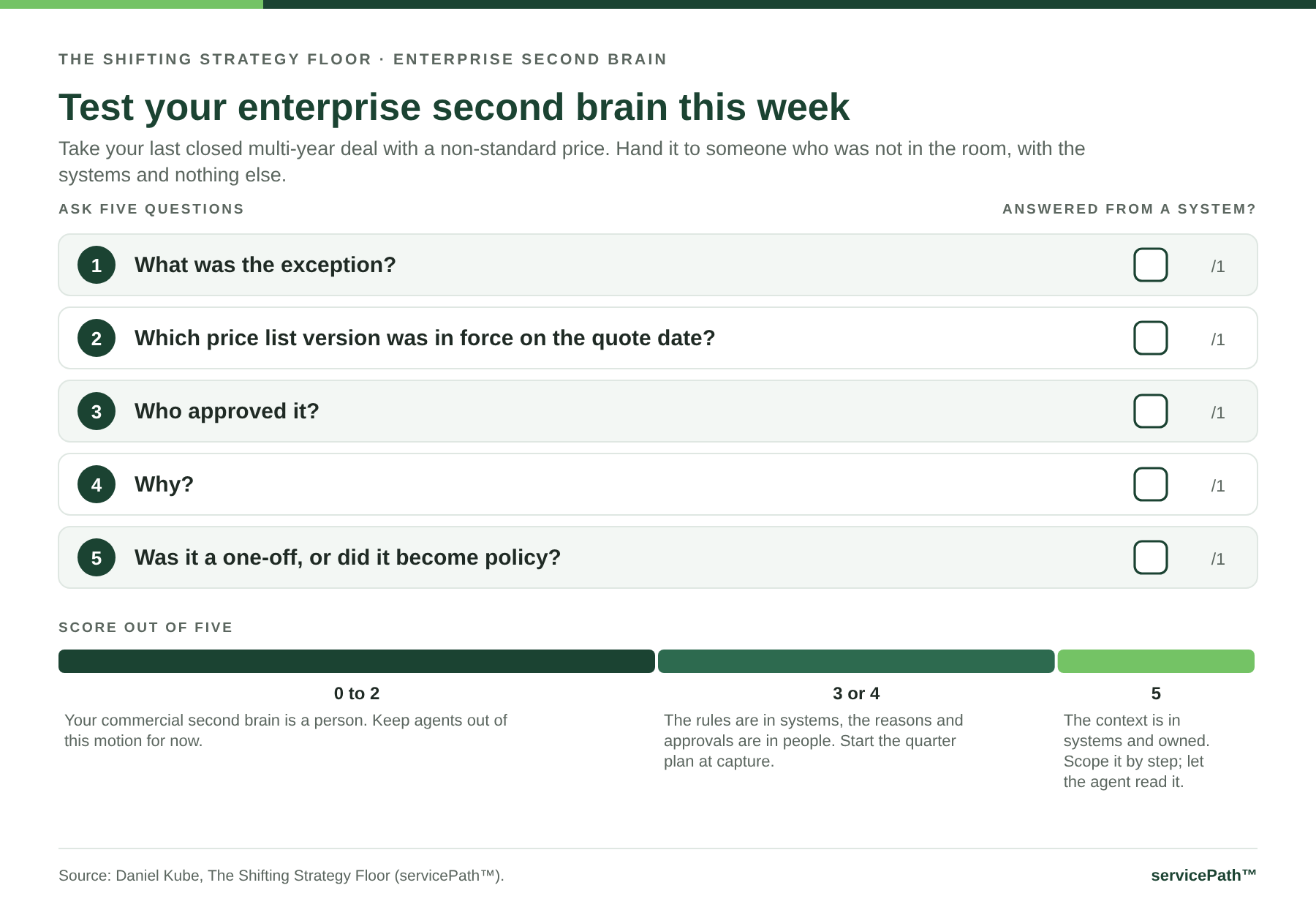
Score it out of five. Every question they cannot answer from the systems is context that still lives in a person or a DM.
So the agent you are about to switch on will not see it either.

Talk to a CPQ architect :Scored below 5 on the test? Talk to a CPQ architect about where the missing answers should live before an agent needs them. Book the conversation.
How do you set up a commercial second brain in one quarter?
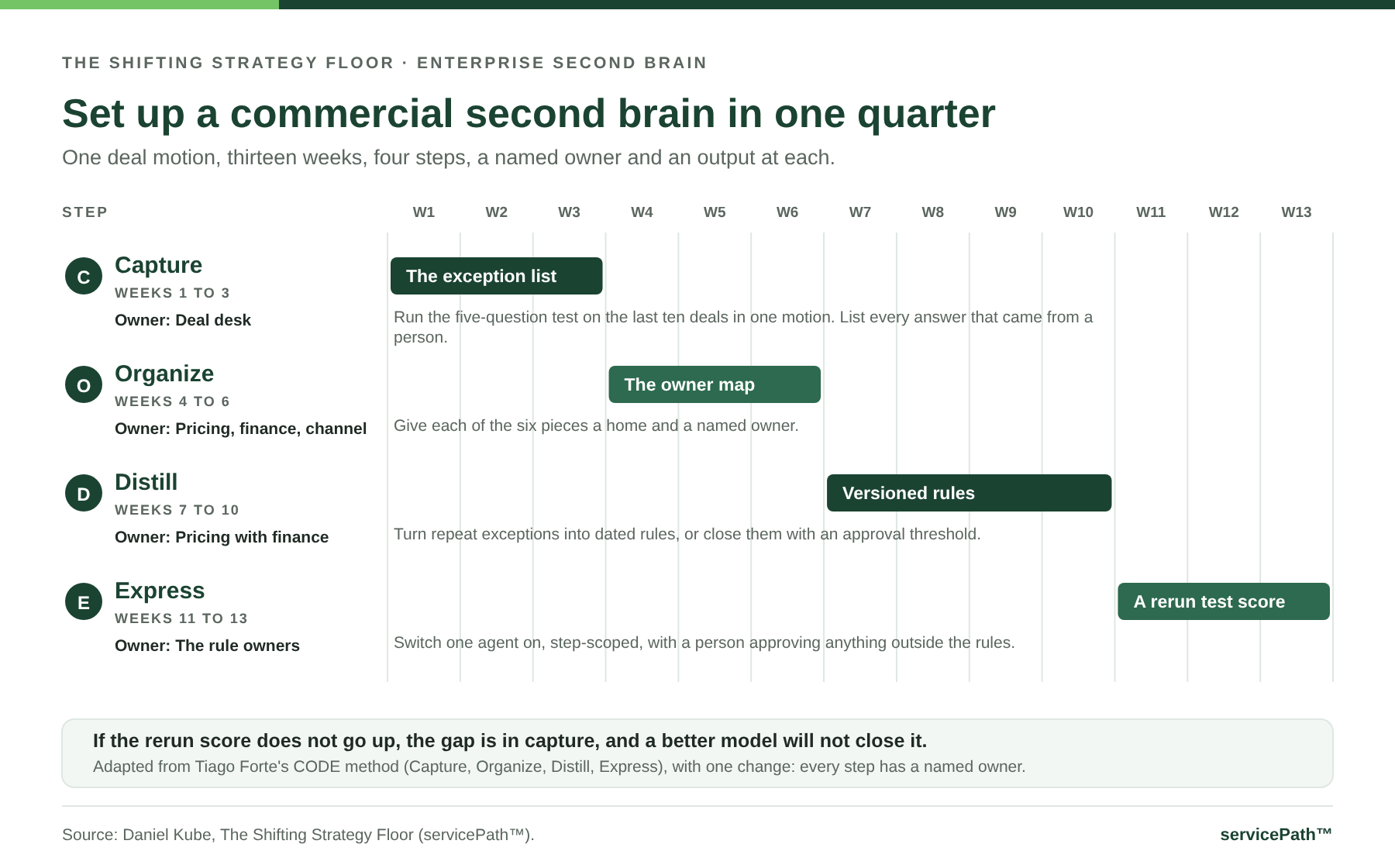
Forte’s method has four steps, Capture, Organize, Distill, and Express. They carry over to a commercial second brain, but with one change: every step has a named owner. Start small: one quarter, one deal motion.
Weeks 1 to 3: capture the exceptions
Pick the deal motion where an agent will go first: renewals, partner deals, or one product line. Run the five-question test on the last ten closed deals in it, not one. Every answer that came from a person instead of a system goes on a list with the deal, the exception, and who knew. Fix nothing yet. That list is your commercial second brain as it really is, before anyone tidies it.
Weeks 4 to 6: organize by owner
Give each of the six pieces a home and a named owner, then decide what the agent reads from each.
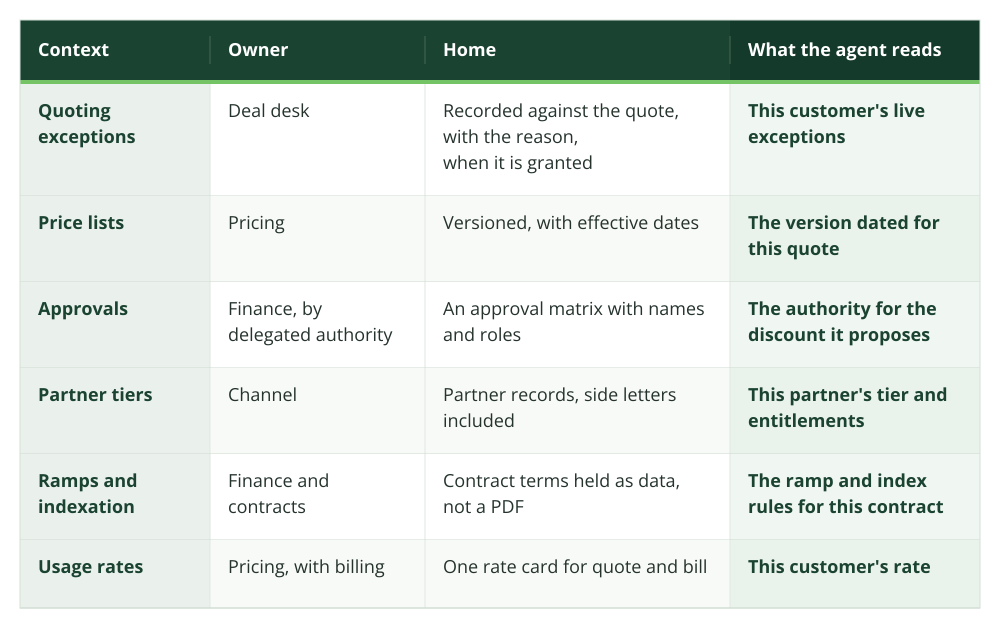
Fill the owner column first. A price list without an owner goes stale in any system.
Weeks 7 to 10: distill exceptions into rules
An exception that has happened more than once is either a rule nobody wrote down or a leak nobody closed. Write the first as a rule with an effective date, then close the second with an approval threshold. A true one-off stays on record with its reason, so the next person can see why it was granted.
Weeks 11 to 13: express it through one agent
Switch the agent on in that one motion, with step-scoped context and a person approving anything outside the rules, until the rerun says otherwise. Then rerun the five-question test on the deals it touched. If the score went up, widen to the next motion.
If it did not, the gap is in capture, and a better model will not close it.
Should you build your own commercial second brain?
You can. Most teams that try end up with a snapshot.
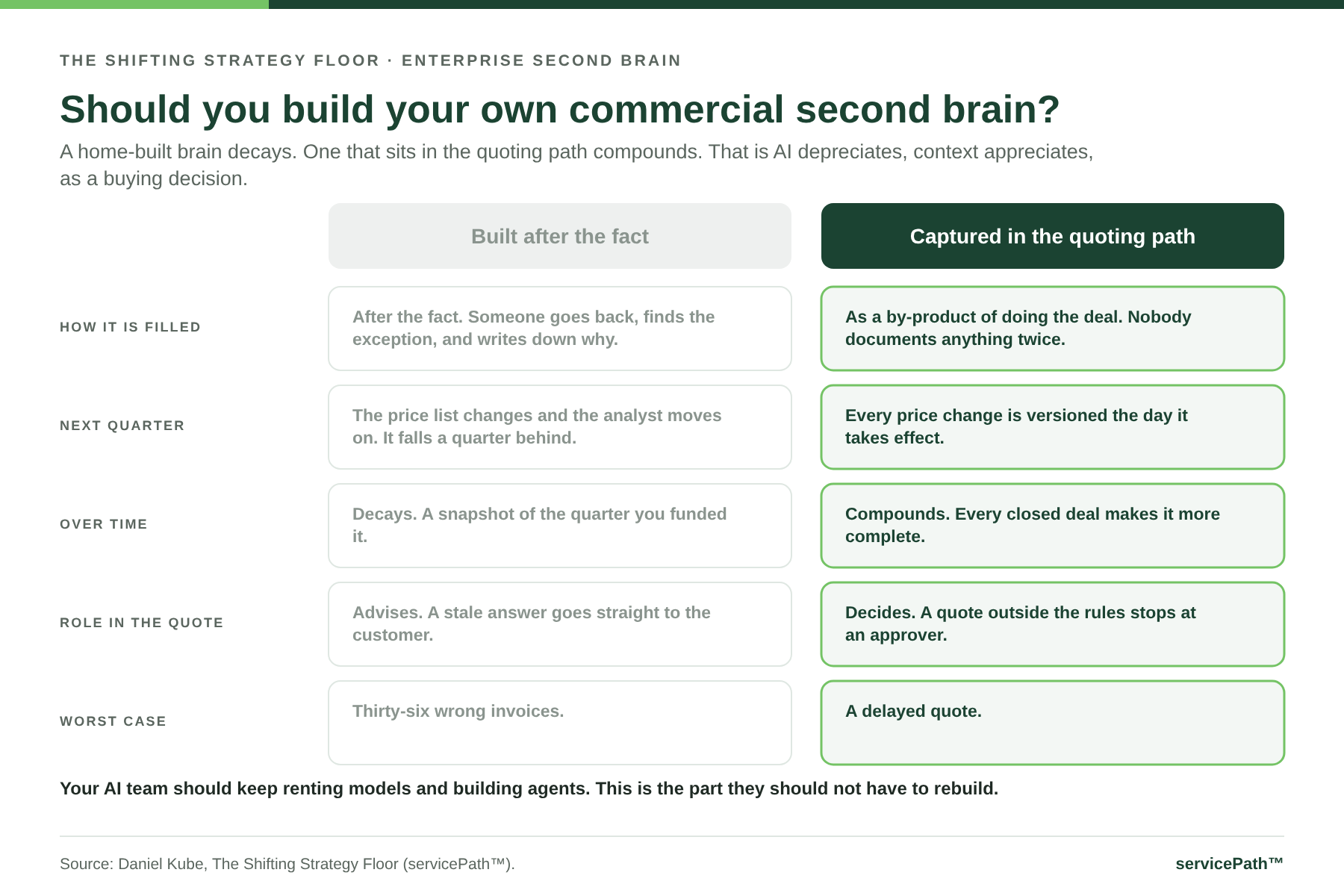
A brain you build yourself is filled after the fact. Someone has to go back, find the exception, and write down why. That works in the quarter you fund the project. Then the price list changes, the deal desk analyst moves on, and the brain is a quarter behind the business. On the shifting strategy floor, a quarter behind is wrong.
The alternative is to capture the context where the decision is made. When the quote, the exception, and the approval run through one governed system, the record is a by-product of doing the deal. Nobody documents anything twice. Every closed deal makes the context more complete, and every price change is versioned the day it takes effect. That is an evolving context machine. It compounds while the home-built one decays.
It also limits your exposure. A home-built brain advises, so when it is out of date the wrong answer goes straight to the customer. A revenue control plane decides. A quote outside the rules stops at an approver before it leaves the building. Your worst case becomes a delayed quote instead of thirty-six wrong invoices.
Your AI team should keep renting models and building agents. This is the part they should not have to rebuild.
Where servicePath™ fits
servicePath™ is CPQ+ for technology service providers: one set of product, pricing, and approval rules that sellers and partner portals quote through today, with every exception, approval, and price list version kept, and an audit trail from quote to ledger.
Agent quoting is on our roadmap, and it will run through those same rules. So the context an agent needs is already being captured by the people quoting now. Read how Telent and Dell EMC use it to quote complex, multi-element deals.
What happens to the DM when the agents arrive?
Nothing, because the agents never read it.
Your enterprise second brain already exists. It is in a Slack DM, several spreadsheets, and two people on the deal desk.
So capture the exception with its reason, the price list with its date, the approval with its name. Keep them where every seller, partner, and agent reads the same rules.
Then ask the question I keep coming back to: who checks what your AI quotes?
Talk to a CPQ architect : Before the first agent quotes for you, talk to a CPQ architect about where your commercial context should live. Book the conversation.
Frequently asked questions
What is a commercial second brain?
A commercial second brain is the set of decisions behind a company’s prices, stored where an AI agent can read them: the approved exception and why it was granted, the price list in force on the quote date, the partner tier, the ramp on a multi-year contract, the usage rate, and who approved each one. It is the part of an enterprise second brain that decides whether a deal makes money. Yet in most technology service providers it lives in DMs, spreadsheets, and a few people on the deal desk.
How is an enterprise second brain different from a personal one?
The difference is governance. A personal second brain, in Tiago Forte’s sense, is the notes and references one person captures so they can find and reuse them. An enterprise second brain is the knowledge an AI system draws on that the model does not contain, held at company level with versions, owners, and approvals, so people and agents work from the same rules.
How much context should an AI quoting agent be given?
Only the part of the enterprise second brain the step needs: the price list in force on the quote date, this customer’s live exceptions, this partner’s tier, and the approval authority for the discount it is proposing. Loading everything makes agents worse. Scope by step, then keep the rules versioned.