
By the servicePath™ Strategy Team .Published: December 16, 2025. Reading Time: 12 Minutes
Executive Summary
Mergers and acquisitions are the lifeblood of growth, but they create a predictable technology hangover: CRM fragmentation. For the C-suite and Private Equity sponsors, the post-acquisition landscape is often a tangled web of Salesforce, Microsoft Dynamics, and HubSpot instances.
The traditional playbook offers two losing options:
The Costly Consolidation: Force a multi-year, multi-million dollar CRM migration that stalls momentum and frustrates teams.
The Speed-Over-Synergy Trap: Operating in silos is often chosen for speed, but it creates a permanent “synergy tax.” By failing to unify commercial logic early, you sacrifice pricing integrity and delay the 20-30% revenue lift possible from cross-selling—effectively capping the deal’s value before the ink is dry.
Both destroy value. This article presents the definitive alternative: You don’t need one CRM to run a unified revenue engine. You need one CPQ and pricing brain that can serve many CRMs.
For the C-Suite & Sponsors, This Means:
Accelerate post-acquisition monetization without waiting for CRM consolidation.
Enforce one source of truth for pricing, reducing errors and improving sales forecast accuracy by 42%.
Avoid a massive, upfront implementation project—enterprises with 1,000+ employees spend ~$174,000 on average on CRM implementations.
Enable AI-guided cross-sell, leveraging technology that can boost sales productivity by 25% or more.
The Strategic Concept Hook (The “Before & After”)
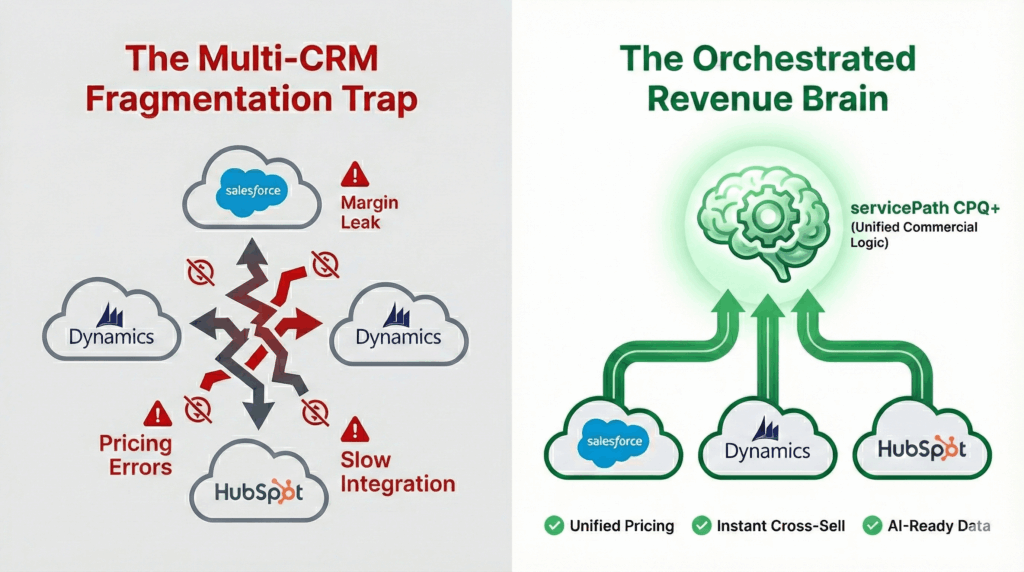
TL;DR: The 2026 Revenue Snapshot
-
The Context: As we approach 2026, M&A activity is surging, driven by $2.5 trillion in unallocated private equity capital (Deloitte M&A Index 2025).
-
The Problem: Integrating these acquisitions is failing. Traditional “Standardize on One CRM” mandates cost millions, take 18+ months, and kill sales momentum.
-
The Shift: “Agentic AI” (AI that takes action) is the top trend for 2026. It requires unified data, not unified CRMs.
-
The Solution: Do not migrate. Orchestrate. Use servicePath™ CPQ+ as a “Central Revenue Brain” that pushes logic to multiple CRM “bodies” (Salesforce, Dynamics, HubSpot).
-
The Payoff: This pulls revenue synergies forward from Year 3 to Month 3, creating immediate cross-sell capabilities without the IT nightmare.
1. The Inevitable Multi-CRM Landscape in Modern Tech
Growth through acquisition is the primary lever for mid-to-large enterprises in 2025. However, this strategy inherently creates a “Multi-CRM Reality.” From the vantage point of the C-suite, this fragmentation makes three critical questions unanswerable:
What is our true consolidated margin?
Where are we leaking discounts across the portfolio?
Are we actually achieving the revenue synergies promised to the board?
The Fragmentation Trap
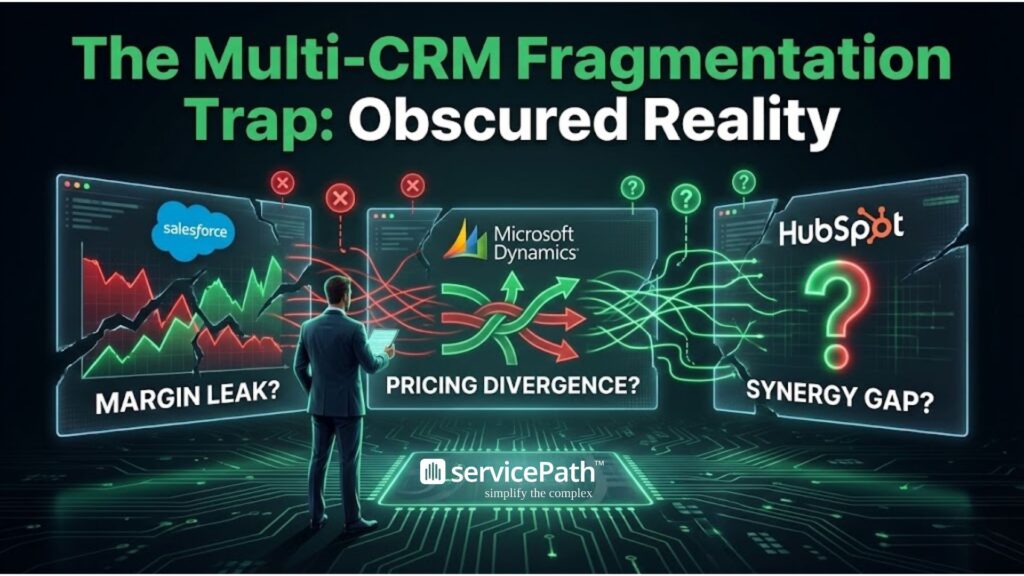
The core problem is not the choice of CRM. Whether a subsidiary uses Salesforce or Microsoft Dynamics 365 is irrelevant to the bottom line. The problem is that the commercial logic—the products, pricing, bundles, and approvals—is duplicated and diverging across every instance.
Analyst Note: As Dan Swan, Senior Partner at McKinsey, noted in a recent 2025 operations podcast: “We are seeing real differentiation between people who are winning with technology… and people who are just spending a lot of money and not getting a ton of value for it.” (McKinsey Operations Insights 2025).
When commercial logic lives in silos, you create risk. You obscure visibility. You lose control.
2. Why “Standardize on One CRM” Is a Value Trap
The mandate to “standardize on one platform” sounds logical in a boardroom presentation. In practice, it is often a strategic misstep that destroys value.
2.1 The Rip-and-Replace Money Pit
Let’s look at the financials. CRM implementations represent a massive annual spend—over $4.6 billion globally.
-
The Cost: For a large enterprise (1,000+ employees), a full migration involves implementation services that consume 40-60% of total migration budgets, often pushing costs over $1 million.
-
The Time: These projects consume 18+ months of critical post-close momentum.
-
The Hidden Risk: Hidden costs frequently double initial estimates due to data cleaning and integration complexity.
2.2 Siloed Operations: The Silent Killer
If you choose not to migrate, you often choose the alternative: leaving them alone. This creates silos.
-
The Forecast Gap: Studies consistently show that effective CRM governance can improve sales forecast accuracy by 42%. Silos destroy this capability (Nutshell CRM Stats).
-
The Result: You cannot rely on your pipeline data. You cannot see where margin is leaking until the quarter closes.
2.3 The servicePath™ Difference: A Unique Market Position
This is where the paradigm shifts. While legacy CPQ tools require you to standardize your stack (i.e., “You must be on Salesforce to use Salesforce CPQ”), the servicePath™ Multi-CRM Adapter is engineered for heterogeneity.
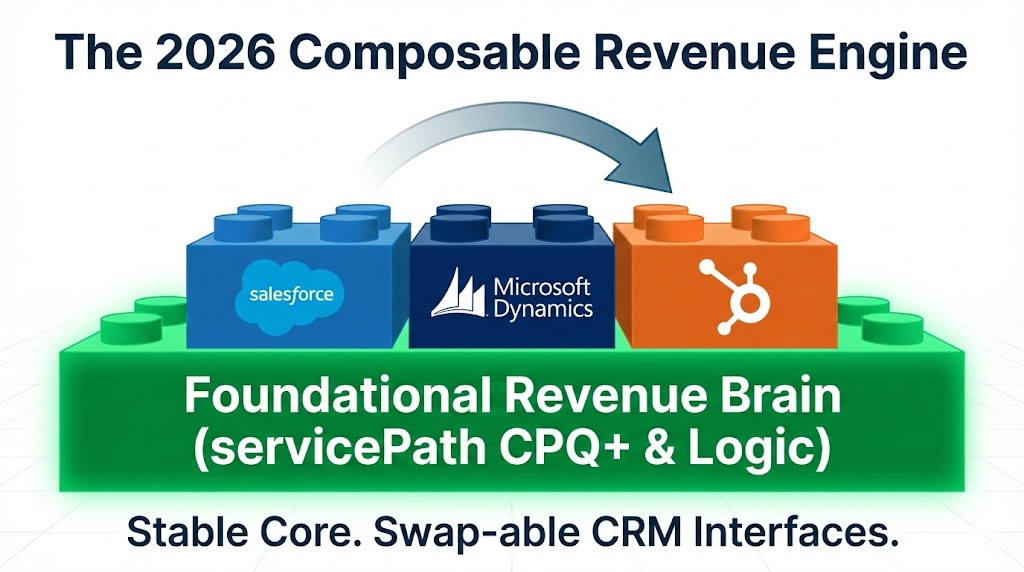
We turn a perennial integration problem into a managed, strategic advantage. We allow the “bodies” (CRMs) to differ, while the “brain” (CPQ) remains unified.
3. The New Pattern: One Revenue Brain, Many CRMs
A resilient 2026 architecture separates where sellers work from how the enterprise sells.
The Decoupled Architecture
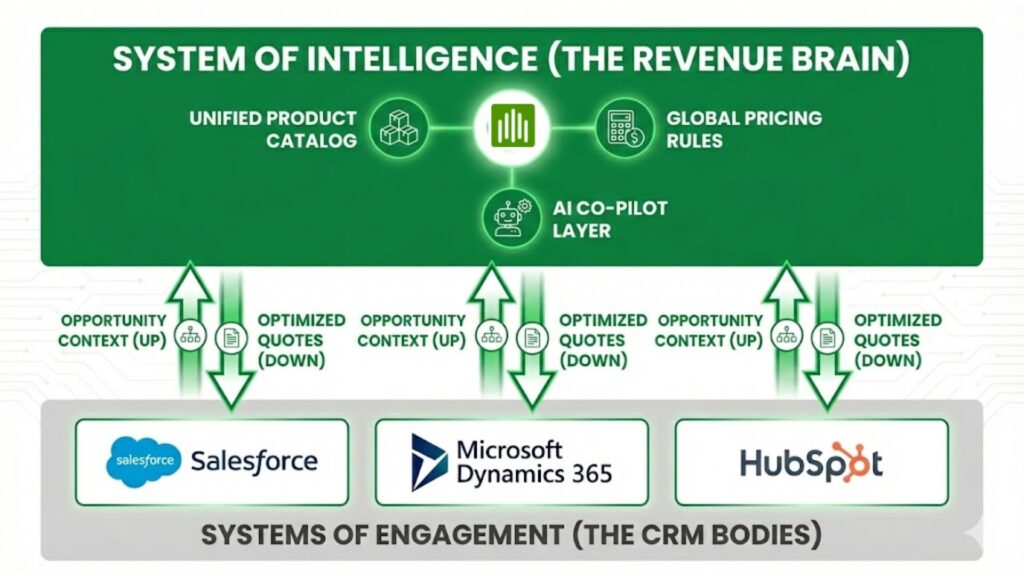
The Core Architecture Diagram (The “Brain & Body”)
-
System of Engagement (The Body): CRMs (Salesforce, Dynamics, HubSpot) remain the daily interface for sellers. They manage relationships, activities, and contacts.
-
System of Intelligence (The Brain): servicePath™ CPQ+ becomes the central engine. It holds the “Golden Record” of products, pricing rules, and approval workflows.
Why This Works
Imagine a neurological system. You have hands and feet (CRMs). They don’t need to be identical; they just need to receive instructions from the same brain. By centralizing the CPQ function, you ensure that a sales rep in the UK using Dynamics sees the same pricing rules and cross-sell prompts as a rep in the US using Salesforce.
4. Quantified Strategic Value for the C-Suite & Sponsors
This is not just an IT architecture discussion. This is a valuation lever backed by 2025 industry data.
4.1 Accelerated Time-to-Synergy & Revenue Lift
-
The Problem: Traditional integration pushes revenue synergy timelines to years 2 through 5.
-
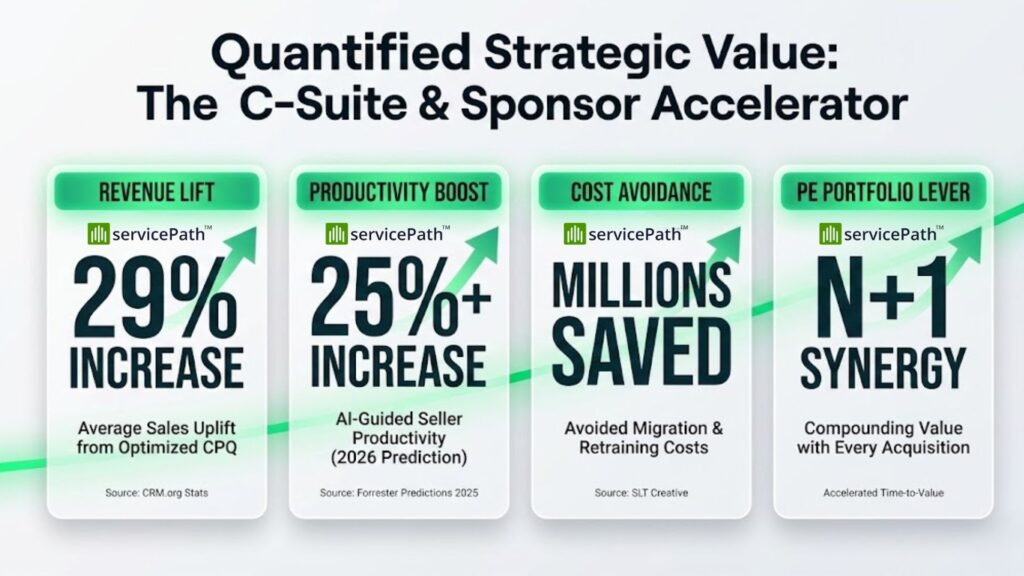
The Verified Lift: Businesses using optimized CRM/CPQ stacks see an average 29% increase in sales (CRM.org Statistics).
-
The Strategy: A Multi-CRM CPQ core allows you to target this cross-sell uplift immediately post-acquisition. You aren’t waiting for a migration to finish; you can enable the new portfolio products in the CPQ engine on Day 1.
4.2 AI-Powered Productivity & Seller Ramp-Up
-
The Problem: Seller proficiency on new, complex tech products takes 3-6 months.
-
The Verified Lift: New data from Forrester predicts that AI-integrated systems will increase sales productivity by 25% or more in 2026 (Forrester Predictions 2025).
-
The Strategy: Our AI will provide “just-in-time” coaching. If a seller adds a core product, the AI suggests the compatible high-margin add-on, regardless of which CRM the seller is using.
4.3 Substantial Cost Avoidance & Operational Efficiency
-
The Problem: Capital conservation is critical.
-
The Verified Savings: Enterprise CRM licenses cost between $150-$300 per user/month, plus millions in implementation fees.
-
The Strategy: By avoiding a full migration, you save millions in direct costs and avoid the “productivity dip” that accompanies retraining. Furthermore, optimized CRM workflows save employees 5-10 hours per week (SLT Creative).
4.4 The Portfolio-Level Lever for Private Equity
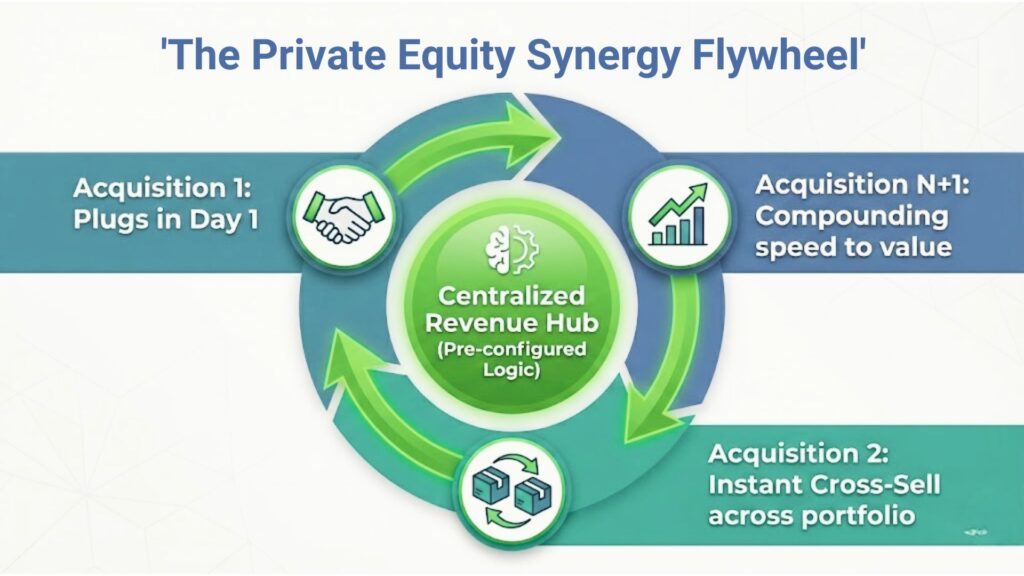
For PE firms, this transforms a cost center into a value-creation asset:
-
New acquisitions plug in with their existing CRM on Day 1.
-
Compounding Synergy Acceleration: Cross-sell creates revenue in months, not years. Crucially, this architecture creates a permanent integration asset: every future acquisition simply “plugs in” to the existing revenue brain, inheriting the group’s full pricing logic and catalog on Day 1. The more you acquire, the faster you monetize.
-
CRM consolidation becomes optional: It turns into a long-term IT project, not a blocker to financial synergies.
5. Inside the servicePath™ Multi-CRM Adapter
How does this actually work technically? Our Multi-CRM Adapter is a strategic enhancement to servicePath™ CPQ+, designed specifically for these heterogeneous environments.
5.1 Centralized Identity & Context Switching
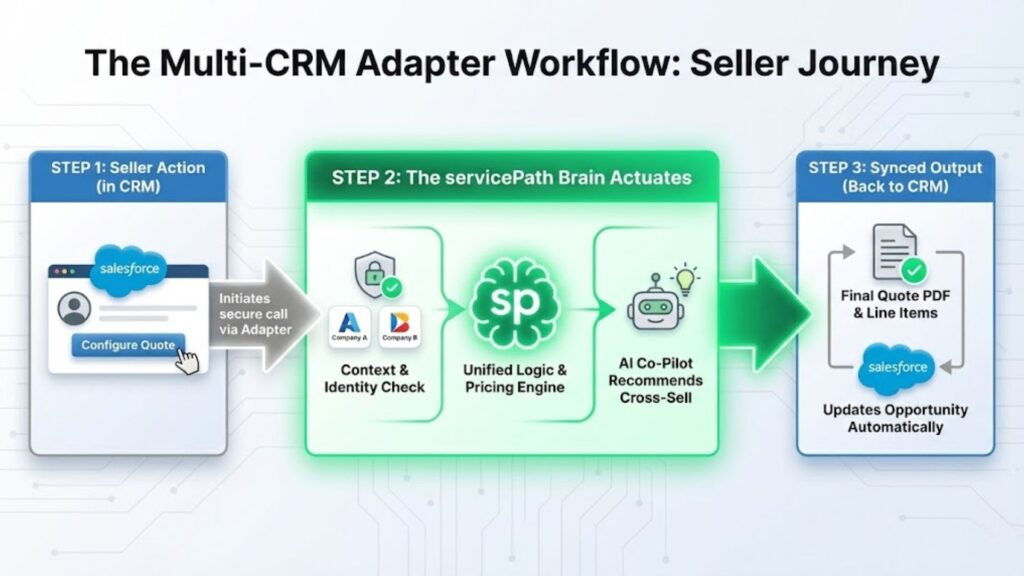
Security is paramount. Users can switch seamlessly between organizational contexts (e.g., “Company A” vs. “Company B”) with full data segregation. A seller in the parent company can be granted permission to quote products from the acquired company without needing a license for the acquired company’s CRM.
5.2 Independent CRM Synchronization
Each CRM syncs data independently to the servicePath™ brain.
-
Salesforce updates the opportunity stage.
-
Dynamics updates the account details.
-
servicePath™ takes these inputs, configures the quote, and pushes the final PDF and line items back to the respective CRM.
5.3 AI Co-Pilot: The Synergy Accelerator
This is where theory becomes revenue. Gartner’s Top Tech Trend for 2025 is “Agentic AI”—AI that can plan and take action (Gartner Top Trends 2025).
The servicePath™ AI layer will sit inside the “brain.” It will analyze the combined product catalog. When a rep in Dynamics quotes a server, the AI recognizes a cross-sell opportunity for a security package that originated from the Salesforce-using division. It prompts the rep. The rep adds it. Revenue synergy is achieved.
6. The Financial Impact Model: Building the Business Case
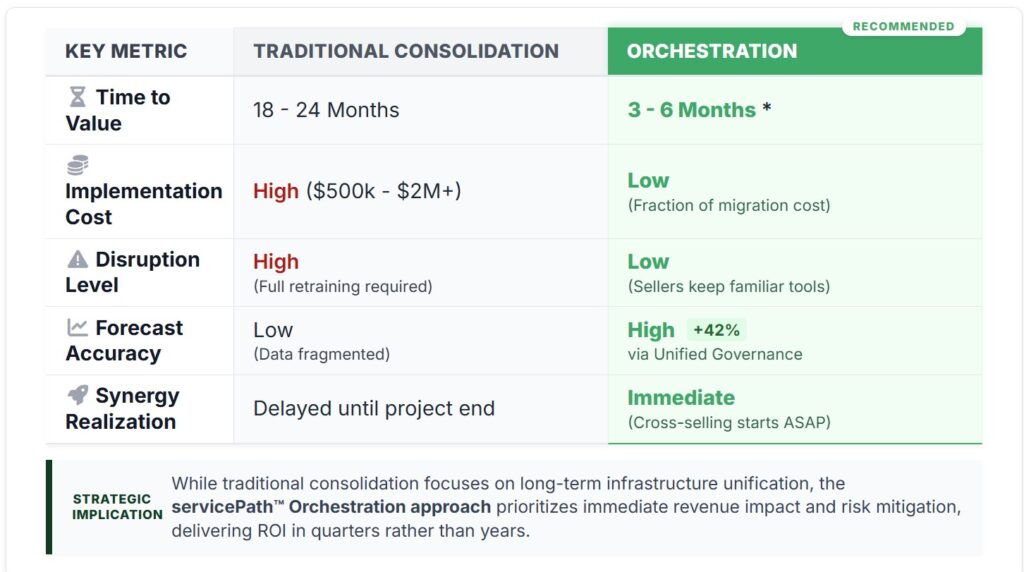
Note on Timeline: The “3-6 Month” timeline is based on Gartner’s Market Guide benchmarks for “Headless/API-first” CPQ implementations (typically 90-120 days), which bypass the data cleansing and migration phases that bloat traditional CRM projects to 18+ months.
The Cost of Inaction
For a $100M revenue company, a 1% margin leak due to siloed pricing logic equals $1M in pure EBITDA lost annually. At a 15x valuation multiple, that is $15M in Enterprise Value destroyed by poor data governance.
7. Looking Ahead: The 2026 Strategic Landscape
As we close out 2025, the writing is on the wall. The “Tech Stack Monolith” is dead. The era of the Composable Revenue Engine has arrived.
Our research team, drawing on the latest 2026 forecasts from Gartner and Forrester, identifies three massive shifts that make Multi-CRM orchestration mandatory, not just optional.
Shift A: “Agentic AI” Demands Unified Logic
The Trend: Gartner predicts that by 2028, 15% of day-to-day work decisions will be made autonomously by AI agents, up from 0% in 2024 (Deloitte Tech Trends).
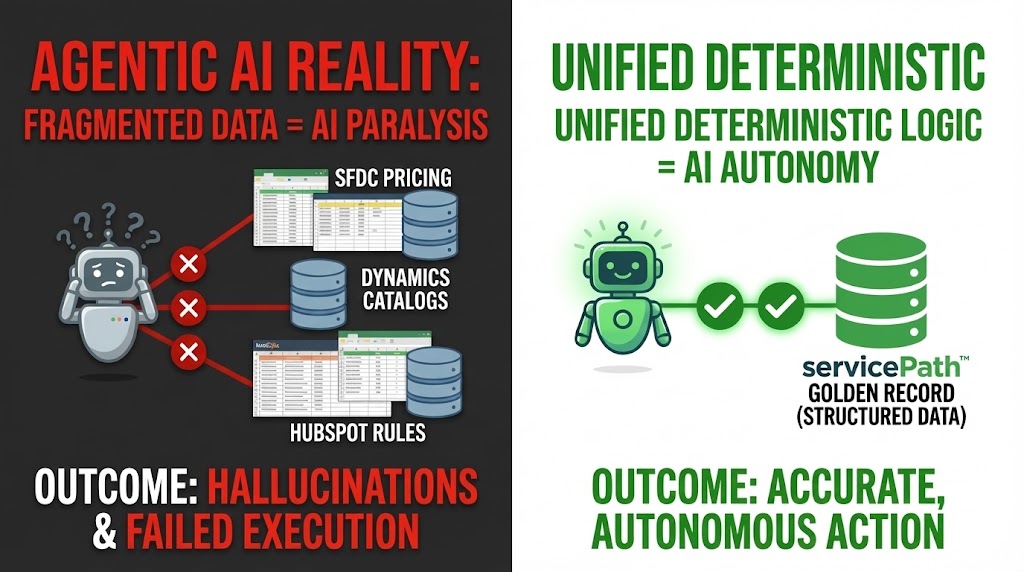
The Multi-CRM Reality: AI Agents cannot navigate chaos. In a Multi-CRM environment, if pricing rules differ between Salesforce and Dynamics, an AI agent is paralyzed. It cannot “guess” which rule is right.
The Fix: You must take the highly accretive, non-AI action of unifying your commercial logic first. Implementing servicePath™ establishes a layer of deterministic logic—a single “Commercial Brain” that creates order out of Multi-CRM entropy. This immediate structural cleanup protects margins today, while building the only infrastructure that allows future AI agents to “travel” seamlessly between your disparate systems.
Shift B: The Rise of “Agent-to-Agent” Commerce
The Trend: Forrester predicts that in 2026, 20% of B2B sellers will be forced to engage in agent-led quote negotiations (Forrester Predictions 2026).
The Implication: Your customers will soon have AI bots negotiating on their behalf. These bots will ping your systems for pricing, specs, and discounts instantly.
The Fix: If your quoting engine is slow or manual, you lose the deal before a human even sees it. A unified CPQ brain allows you to expose API endpoints to these buyer agents, enabling automated, profitable negotiation at machine speed.
Ready to Act? Your Next Steps
1. See What “One Revenue Brain” Looks Like
If your sellers live in different CRMs, your margin shouldn’t. In 15 minutes, we’ll show how servicePath™ CPQ+ sits above Salesforce, Dynamics, and HubSpot to standardize what matters most.
→ Book an Executive Discussion
2. Validate Your Tech Stack Connectivity
The Multi-CRM strategy relies on seamless integration, not duct tape. View our library of pre-built connectors for Salesforce, Microsoft Dynamics 365, and HubSpot to see exactly how we slot into your existing architecture.
3. Decode the 2026 Revenue Language
Confusion is the enemy of speed. Ensure your RevOps, Finance, and Sales leaders are speaking the same language. Visit our glossary to define critical terms like Revenue Synergies, Agentic AI, and Composable Business.
→ Visit the servicePath™ Glossary
Glossary of Terms
Agentic AI:
The 2026 trend of AI systems that can autonomously plan and execute actions (like configuring a complex quote) rather than just generating text.
Composable Business:
A Gartner-coined term referring to an organization made from interchangeable building blocks. In this context, it means swapping CRMs without breaking the revenue engine.
CPQ (Configure, Price, Quote):
Software that helps companies generate accurate quotes for complex products.
Deterministic Logic:
A system where the output is determined strictly by the input (no “hallucinations” or guessing). This is the required data foundation for safe Enterprise AI.
Golden Record:
A single, well-defined version of a data entity (like a Product or Price) that is treated as the source of truth across all systems.
Revenue Synergies:
The additional revenue generated from a merger that would not have been possible if the companies operated independently (e.g., cross-selling).
Tech Debt:
The implied cost of future reworking required when choosing an easy, short-term solution instead of a better long-term approach.
Frequently Asked Questions (FAQ)
Q: What is a Multi-CRM CPQ architecture?
A Multi-CRM CPQ architecture allows an enterprise to run several CRM platforms or instances while centralizing product, pricing, and quoting logic in a single CPQ+ platform.
Q: Does servicePath™ support connecting multiple instances of the same CRM?
Yes. You can connect multiple distinct Salesforce Sales Cloud orgs (for example, separate orgs for EMEA and North America) to a single servicePath™ CPQ+ instance.
Q: Which CRMs are supported?
The Multi-CRM Adapter currently supports Salesforce Sales Cloud (multiple orgs), with support for Microsoft Dynamics 365 and HubSpot CRM.
Q: How is this different from CPQ that lives inside a single CRM?
Many CPQ tools are tightly coupled to one CRM platform. In a Multi-CRM enterprise, that often leads to duplicated configurations or heavy middleware. servicePath™ CPQ+ is architected to be platform-agnostic at the core, so one CPQ instance can serve multiple CRM orgs while still providing native-feeling experiences inside each.
Q: Is data secure between organizations?
Yes. Role-based access controls apply uniquely per organization. A user linked to “Org A” cannot see quotes or opportunities from “Org B” unless explicitly authorized, ensuring strict data segregation between business units.