
Beyond Eliza 2.0: At What Point Does an AI Guess Become a Contract?
Deterministic revenue architecture is the framework every revenue leader needs before the August 2 EU AI Act deadline. This piece is the playbook.
Executive Summary
In short: The opportunity in front of us is staggering. The market for AI-driven solutions is opening faster than anything I have seen in my career. But the gap between hype and results is widening fast. The enterprises that win will not be the ones deploying the most AI. They will be the ones that contain it.
DRA is a deliberate hybrid with one non-negotiable rule: AI handles discovery, a deterministic system of record handles delivery. AI proposes. Hard rules dispose. No hallucinated number ever reaches a customer
With $2.52 trillion in AI spending, only 12% of CEOs seeing returns, and 40% of agentic projects headed for cancellation, the enterprises that win will be the ones that build hard pricing limits and audit trails before AI-suggested prices reach customers.
I want to start with one question. It is the question I bring to every executive conversation, and it is the question that should be on every CEO whiteboard in 2026:
At what point in your daisy chain does a probabilistic guess become a deterministic contract, What’s the risk?

In plain language: at what point in the workflow where one AI’s output feeds the next system’s input does a guess become a number a customer actually sees?
If you are a CFO, CRO, or revenue leader at a tech-enabled enterprise, and that question cannot be answered with a specific system, a specific gate, and a specific audit trail, this piece is for you.
If your CIO has told you AI governance is handled but you have never seen a per-transaction audit trail for a single AI-influenced deal, this piece is especially for you.
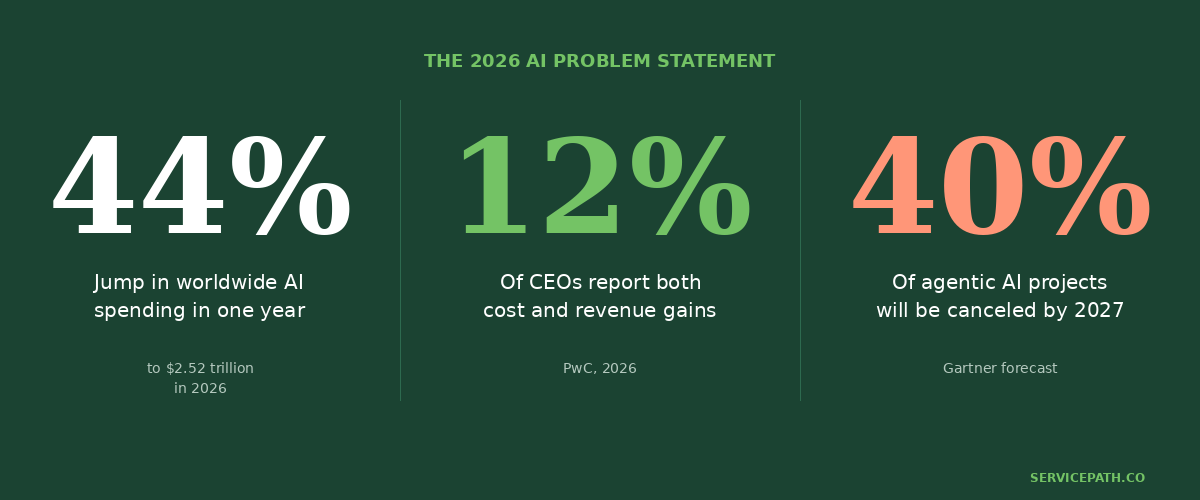
The numbers are not subtle. Worldwide AI spending will hit $2.52 trillion in 2026, a 44% jump in a single year, according to Gartner. Yet PwC found only 12% of CEOs say AI has actually delivered both cost and revenue gains.
Gartner projects over 40% of agentic AI projects will be canceled by the end of 2027. Forty-four. Twelve. Forty. That is the problem statement no analyst will dispute.
I have written about this before:
“The cure isn’t more AI power. The cure isn’t more sophisticated pricing models. The cure is deterministic economics. We need systems that ensure repeatable, auditable profitability floors, so that AI’s brilliance is contained and amplified by CPQ’s economic control.” “The Bigness of Little Things,” servicePath™.co, November 2025
What I called “deterministic economics” in that piece, I am now naming Deterministic Revenue Architecture (DRA): a hybrid where AI handles discovery and a battle-tested system of record handles delivery.
At servicePath™ we have called the underlying risk the Eliza Haze. This piece names the systemic, agentic-era version of it the Eliza 2.0 Effect: the Stockholm Syndrome of enterprise AI.
Departments become so dependent on a chain of AI models that they begin to protect and justify its output even when it is flawed, simply because the workflow now depends on it.
An entire enterprise outsourcing judgment to models that can never, by design, be 100% right, with no single system checking the math before it reaches a customer.
The cure is not to slow down. It is to build the architecture.
The August 2 EU AI Act enforcement clock is real, and so is the revenue already leaking before then. Build the gate. Defend the math.
How Does Ungoverned AI Actually Cost Enterprises Money?
In short: AI is making pricing and quoting decisions that nobody can trace, explain to auditors, or reverse. With $2.52 trillion in AI spending and only 12% of CEOs reporting returns, most enterprises have not measured the damage. Over 40% of agentic AI projects will be canceled by 2027.
Every CEO I talk to is feeling the same pressure. Move fast or get eaten. Bain’s 2025 Technology Report puts it bluntly: AI leaders are already pocketing 10% to 25% EBITDA gains, and “if you’re still piloting, you’re dangerously behind.” Bain is right. But here is what most boards are not hearing.
McKinsey’s State of AI survey (November 2025) found only 39% of organizations report any EBIT impact. The follow-up 2026 AI Trust Maturity Survey was more sobering:
“In the age of agentic AI, organizations can no longer concern themselves only with AI systems saying the wrong thing; they must also contend with systems doing the wrong thing, such as taking unintended actions, misusing tools, or operating beyond appropriate guardrails.” McKinsey, State of AI Trust 2026, March 2026
Deloitte projects gen-AI fraud losses in the U.S. alone will balloon from $12.3 billion in 2023 to $40 billion by 2027.
Forrester’s 2026 predictions estimate ungoverned generative AI will cost B2B companies more than $10 billion in lost enterprise value in 2026.
Brian Weiss, CTO of Hyperscience, framed it in CFO Dive: “In 2026, enterprises will grapple less with building AI and more with trusting it. Enterprises are realizing that a single hallucinated answer can derail entire workflows.”
A single hallucinated answer. Now ask yourself how many of those answers are flowing through your quote-to-cash pipeline right now.
Has anyone in your organization actually measured it?
Here is the part that does not show up in any dashboard. We say please and thank you to our AIs. That politeness lowers our critical thinking threshold.
We stop verifying because the interface feels like a colleague. The Eliza 2.0 Effect is not just a technical risk. It is a cognitive bias that compounds every other risk in the chain.
Why Do AI Pricing Models Fail? The Probabilistic Decay Problem
In short: LLMs guess the next most likely token. They do not know anything. Stack three at 98% accuracy in a chain and end-to-end accuracy drops to 94%.
In a quote-to-cash workflow, that is a pricing error nobody can trace, an audit trail that does not exist, and a number the CFO has to explain to the board.
Here is the math nobody on the AI keynote circuit wants to walk through.
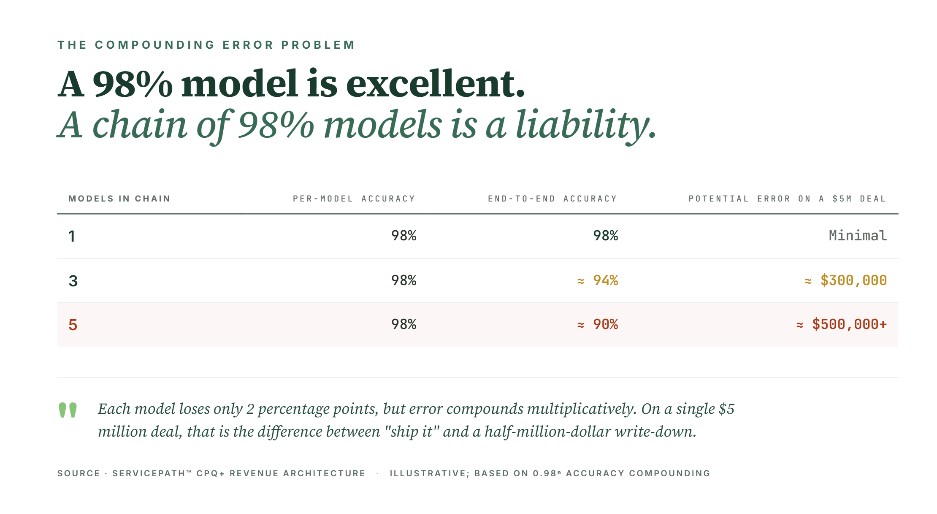
LLMs predict the next most likely token. They do not know anything. Stack three of them at 98% accuracy in a daisy chain, and end-to-end accuracy drops to 94%. In a quote-to-cash workflow, six points of drift is not a glitch.
It is a fiduciary event a CFO has to explain.
The data for the table block:
Three cases that prove the liability is real. You may have heard the first two.
1. Air Canada, February 2024.
A chatbot makes up a bereavement refund policy. The widower acts on it. The airline argues in court that the chatbot is its own legal entity. The tribunal ruled: “It should be obvious to Air Canada that it is responsible for all the information on its website. It makes no difference whether the information comes from a static page or a chatbot.”
The AI is the company. Every time. Forever.
2. Arup, early 2024.( Revenue for the year 2025 was approx. $2.8 billion.)
A finance employee in Hong Kong joins a video call with the CFO and colleagues. The CFO authorizes a $25 million transfer. Every face on the call except the employee’s was an AI-generated deepfake. Twenty-five million dollars. Gone.
These are not edge cases. They are early warnings of what happens when probabilistic outputs reach customers without a deterministic check.
3. Cursor, April 2025. ( $60 Billion Valuation)
This is the one that should be on every boardroom wall. Cursor’s AI support bot hallucinated a one-device-per-subscription policy that did not exist. Real customers cancelled real subscriptions over a policy an AI invented.
Cassie Kozyrkov, formerly Google’s chief decision scientist, wrote that “this mess could have been avoided if leaders understood that (1) AI makes mistakes, (2) AI can’t take responsibility for those mistakes (so it falls on you), and (3) users hate being tricked by a machine posing as a human.”
McKinsey’s 2025 survey says 51% of organizations using AI have already had at least one negative consequence.
Gartner’s Anushree Verma: most agentic AI projects are “early-stage experiments driven by hype and often misapplied,” preventing organizations from seeing the real cost at scale.
If you run a complex sales motion, you are losing money to this right now. You just have not measured it yet.
What Is Deterministic Revenue Architecture and Why Does It Matter?
In short: DRA is a hybrid where AI handles discovery and a deterministic system of record handles delivery. AI proposes. The rules engine disposes. No hallucinated discount touches a customer.
Here is the principle behind everything we do at servicePath™. It is simple enough for a sticky note:
Use AI for Discovery. Use Deterministic Revenue Architecture for Delivery.
AI is fantastic at the front of the funnel: articulating needs, exploring configurations, summarizing bids, drafting emails. But the moment a probabilistic guess needs to become a price, a clause, a binding configuration?
It must pass through a deterministic engine (a rules-based system that produces the same output every time for the same input, with a complete audit trail) that runs on hard-coded logic.
If A, then B. No drift. No hallucinated discount. The system either succeeds or it errors out clean. Discovery is where AI earns its valuation. Delivery is where deterministic systems protect the balance sheet.
I am not the only one making this case. Camunda CEO Jakob Freund said the same thing: ( size of them)
“In 2026, enterprise agentic automation will bridge the gap between the vision and reality of agentic AI by enabling organizations to scale beyond isolated pilots and safely automate complex, exception-heavy, or cognitive work through dynamic AI, deterministic guardrails, and human-in-the-loop checkpoints.”
McKinsey reached the same conclusion in B2B Pricing:
Navigating the Next Phase of the AI Revolution(January 2026): decisions executed with “clear rules, auditability, and reversibility” allow agentic AI to scale safely, with humans overseeing strategy and exceptions while AI agents manage transaction flow within defined guardrails.
That is DRA described by McKinsey. The architecture is no longer up for debate.
This matters more in 2026 because the user interface is going extinct. Stripe and Tempo launched their Machine Payments Protocol in March 2026 with Visa as a design partner, for AI-to-AI transactions with no human in the loop.
Gartner says by 2028, 90% of B2B buying will be AI-agent intermediated, pushing more than $15 trillion through agent exchanges. In that world, the deterministic gate is the only thing standing between an AI agent and a shareholder lawsuit.
What Is Deterministic Revenue Architecture and Why Does It Matter?
In short: DRA is a hybrid where AI handles discovery and a deterministic system of record handles delivery. AI proposes. The rules engine disposes. No hallucinated discount touches a customer.
The principle is straightforward:
Use AI for Discovery. Use the DRA framework for Delivery.
Given the amazing number of solutions and products coming to market right now, the need for exact pricing and configuration is greater than ever. There is real value in separation.
AI is fantastic at the front of the funnel: articulating needs, exploring configurations, summarizing bids, drafting emails. But the moment a probabilistic guess needs to become a price, a clause, a binding configuration?
It must pass through a deterministic engine (a rules-based system that produces the same output every time for the same input, with a complete audit trail) that runs on hard-coded logic.
If A, then B. No drift. No hallucinated discount. The system either succeeds or it errors out clean. Discovery is where AI earns its valuation. Delivery is where deterministic systems protect the balance sheet.
I am not the only one making this case.
Camunda CEO Jakob Freund said the same thing: “In 2026, enterprise agentic automation will bridge the gap between the vision and reality of agentic AI by enabling organizations to scale beyond isolated pilots and safely automate complex, exception-heavy, or cognitive work through dynamic AI, deterministic guardrails, and human-in-the-loop checkpoints.”
McKinsey reached the same conclusion in B2B Pricing: Navigating the Next Phase of the AI Revolution (January 2026): decisions executed with “clear rules, auditability, and reversibility” allow agentic AI to scale safely, with humans overseeing strategy and exceptions while AI agents manage transaction flow within defined guardrails.
That is DRA described by McKinsey. The architecture is no longer up for debate.
This matters more in 2026 because the user interface is morphing /abstracted higher . Your systems of record will be accessed in headless ways, through new interception surfaces from applications you never thought of before.
In addition, Stripe and Tempo launched their Machine Payments Protocol in March 2026 with Visa as a design partner, for AI-to-AI transactions with no human in the loop, the UX has been removed with the machine to machine interaction.
Gartner says by 2028, 90% of B2B buying will be AI-agent intermediated, pushing more than $15 trillion through agent exchanges. The need for accuracy is paramount. In that world, the deterministic gate is the only thing standing between an AI agent and a shareholder lawsuit.
How Does AI Pricing Risk Hit MSPs, Telcos, and Enterprise Tech Companies?
In short: For an MSP or telco managing 14,000 SKUs across multiple CRMs, AI pricing risk is not theoretical. It looks like unapproved discounts nobody caught, procurement bots negotiating without human oversight, and renewal contracts built on numbers nobody can trace back to a source.
An illustration at the enterprise level
14,000 SKUs across three CRMs and a homegrown billing engine. Engineers configuring solutions in spreadsheets at 11pm.
A sales rep using an AI assistant to draft a quote that violates the margin floor by 8 points because the model never saw the latest cost-to-serve update.
A procurement bot on the buyer side will, by Q3 of next year, negotiate 90 cents of every revenue dollar with no human in the loop.
A renewals team operating on a CRM record an upstream agent updated 90 minutes ago using stale logic, and nobody knows which version of truth is now in the contract.
That is what happens at quarter-end for a tech-enabled enterprise. It is not a dramatic deepfake. It is the steady accumulation of small drift events, none of them catastrophic on their own, all of them eating operating margin while the dashboards stay green.
Until the EU AI Act audit. Or the customer-induced lawsuit. Or the activist investor letter on inability to forecast. This is the population the Deterministic Revenue Architecture pattern was built for.
How Do NemoClaw, OWASP, and CPQ Fit Into Enterprise AI Governance?
In short: NVIDIA’s NemoClaw sandbox stops AI agents from taking unauthorized actions. A deterministic CPQ engine stops AI-suggested prices from reaching customers without approval.
You need both, at different layers. OWASP’s LLM Top 10 2025 confirms that unauthorized agent actions and prompt manipulation are the top agentic risks.
OWASP’s Top 10 for LLM Applications 2025 blew up Excessive Agency (when an AI agent takes actions beyond what it was authorized to do, classified as risk LLM06). Prompt Injection (when a malicious input hijacks the AI’s behavior, risk LLM01) remains the top risk. A CIO analysis (November 2025) was blunt: current soft guardrails are “easily bypassed by an agent’s core capabilities” and the imperative is to move to “continuous, deterministic control.” MIT Technology Review drove it home: “Rules fail at the prompt, succeed at the boundary.”
NVIDIA answered on March 16, 2026 at GTC with NemoClaw, an open-source sandbox introducing three controls the agent cannot override: a kernel-level sandbox, an out-of-process policy engine, and a privacy router. Honest disclosure: NemoClaw is in early alpha and NVIDIA states “this software is not production-ready.”
Here is the part that matters for revenue leaders.
NemoClaw is a personal-AI-agent sandbox. It is not an enterprise revenue governance layer. But the architectural pattern it pioneers is exactly what the revenue layer needs.
NemoClaw secures the behavior of the agent. Deterministic Revenue Architecture, anchored in a battle-tested CPQ engine, secures the math of the deal. You need both, at different layers, doing different jobs.
I call this the Double-Lock: one layer that controls what the AI agent can do, and a second layer that controls what numbers the AI agent can commit to.
What does deterministic governance actually run on?
Three architectural primitives.
1. The kernel sandbox enforces what an agent can touch at the OS level.
2. The out-of-process policy engine (a separate system that checks every AI action against your business rules, running outside the AI itself so the AI cannot rewrite its own guardrails) evaluates every agent action against business rules in a runtime the agent cannot rewrite.
3. The privacy router controls how sensitive data moves and produces a per-transaction audit log. Together they make every decision attestable, meaning every quote and every clause carries a signed log showing exactly which rule approved it and when.
What does an attested transaction look like? Three lines, one illustrative example:
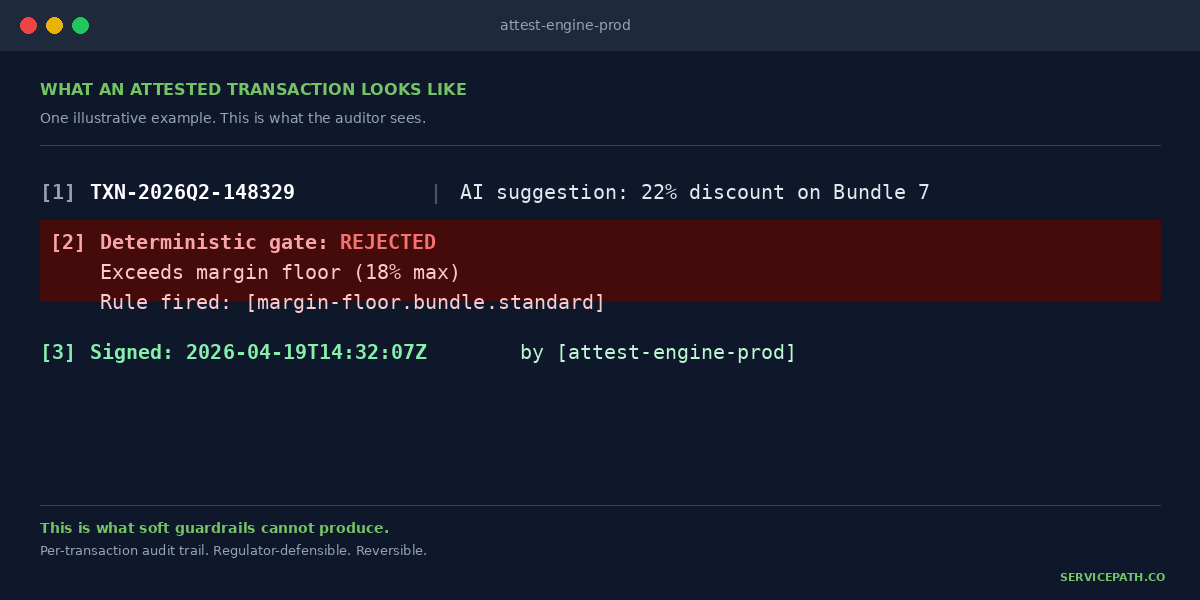
That is what the auditor sees, what the CFO can defend, and what soft guardrails cannot produce.
The Architecture Maturity Ladder
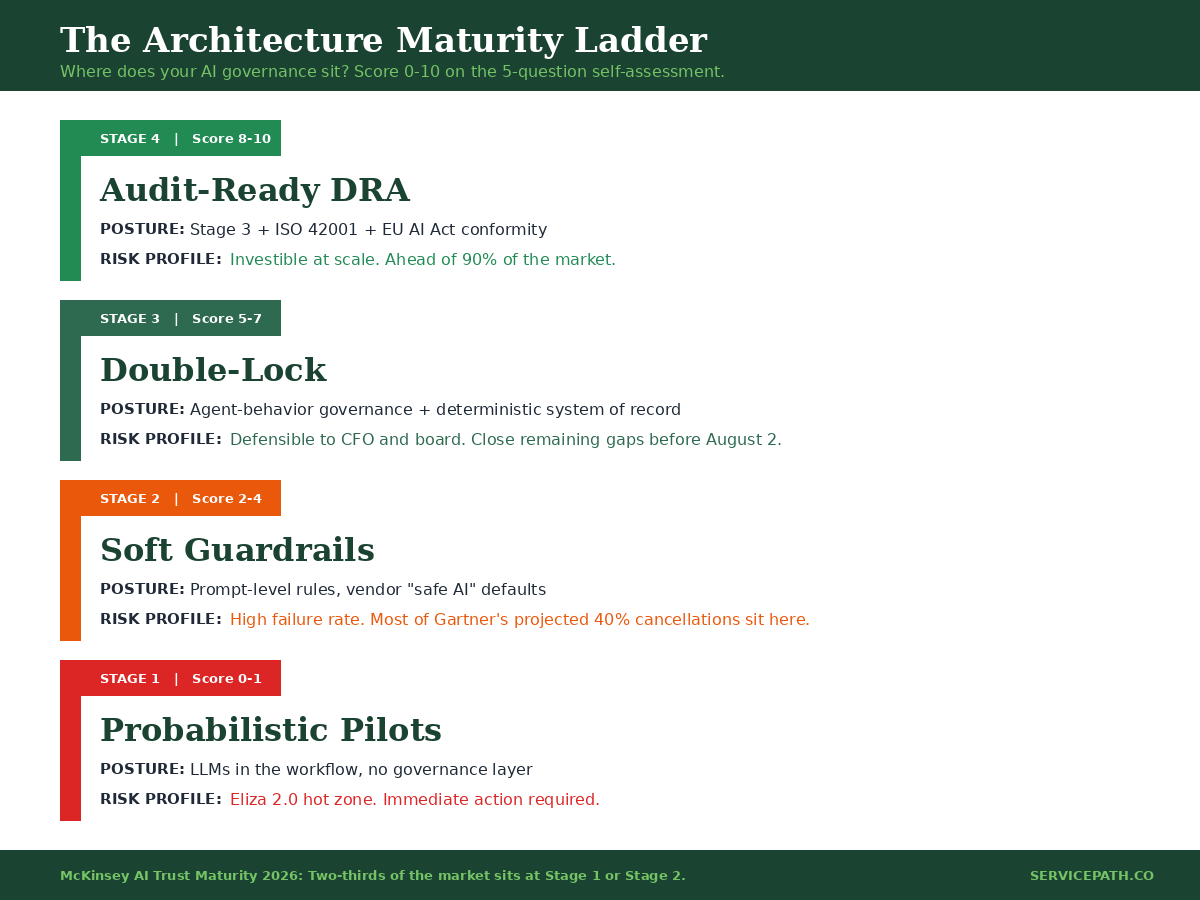
McKinsey’s 2026 AI Trust Maturity survey found two-thirds of the market is sitting at Stage 1 or Stage 2. The August 2 EU AI Act enforcement deadline cares about one thing: can you produce a per-transaction audit trail when asked?
What AI Governance Standards Apply to Enterprise Revenue Systems in 2026?
In short: ISO/IEC 42001:2023 is the first certifiable AI Management Systems standard. The EU AI Act enforces on August 2, 2026, with penalties up to 35 million euros or 7% of global turnover. Both require per-transaction audit trails that soft guardrails cannot produce.
Boards waiting for the regulatory landscape to “settle down” before investing in governance: it is settled.
ISO/IEC 42001:2023 is the world’s first certifiable international standard for AI Management Systems. Microsoft’s M365 Copilot, SAP’s Joule, and Cornerstone OnDemand have all secured certification this year.
Stacey Harris, Chief Research Officer at Sapient Insights Group: “Responsible AI governance is quickly becoming a prerequisite, not a differentiator.”
The EU AI Act is the deadline most CEOs are underestimating. As of August 2, 2026, obligations for high-risk AI under Annex III come into full force. Penalties exceed GDPR: up to 35 million euros or 7% of global annual turnover.
Finland turned on enforcement in January. Meredith Whalen, IDC’s chief product officer, framed the inflection in IDC’s FutureScape 2026: this new class of AI is reshaping how work gets done and how industries will grow.
IDC adds that 89% of CIOs say agentic AI is a strategic priority and AI investment will hit $1.3 trillion by 2029. The capital is committing. The governance is not.
Can Fine-Tuning, Vendor Guardrails, or Hyperscaler Governance Solve This?
In short: No. Fine-tuning narrows the range of wrong answers but does not eliminate them. Vendor guardrails are themselves black boxes. Hyperscaler governance secures data and identity but cannot enforce your specific pricing limits or contract rules.
I hear three objections in every boardroom. Here is why none of them hold.
“Our model is fine-tuned, so it is reliable.” Fine-tuning narrows the distribution of wrong answers. The hallucinations that escape are precisely the ones the training data did not anticipate, which is exactly the population that matters at quarter-end.
“Our vendor’s guardrails handle this.” Soft guardrails baked into an LLM are themselves probabilistic, “easily bypassed by an agent’s core capabilities.” Trust the boundary, not the prompt.
“We will let our hyperscaler handle this.” Hyperscaler governance secures data residency, identity, and model access. It cannot enforce a specific margin floor or configuration rule unique to your business. Platform governance is necessary. It is not sufficient. Only deterministic revenue architecture closes the gap.
What Should Leadership Do This Quarter? A Deterministic Revenue Architecture Roadmap
In short: Audit every AI workflow for unchecked gaps. Put hard pricing limits at every revenue touchpoint. Shift from tweaking prompts to building real governance architecture. And educate the board: AI error is not a bug you can patch. It is a property of the technology.
The right question is not “how do we make the AI accurate?” It is “how do we build a system that catches the AI when it is wrong?”
Four steps. This is what I am taking to my own board this quarter.
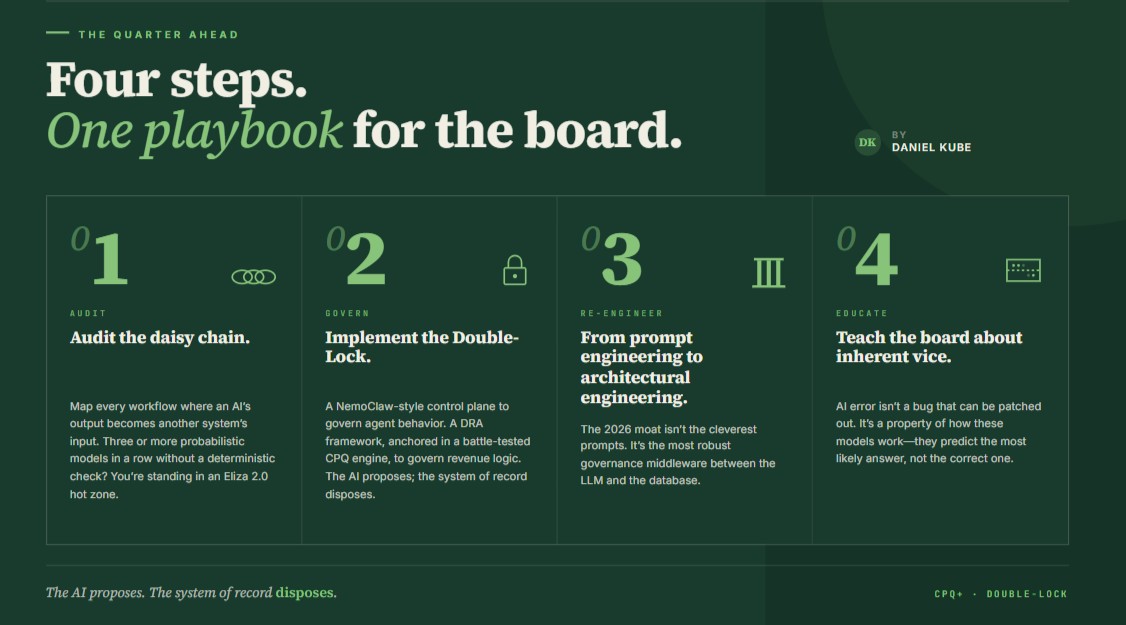
One: Audit the daisy chain. Map every workflow where an AI’s output becomes another system’s input. Three or more probabilistic models in a row without a deterministic check? You are standing in an Eliza 2.0 hot zone.
Two: Implement the Double-Lock. A NemoClaw-style control plane to govern agent behavior. A DRA framework, anchored in a battle-tested CPQ engine, to govern revenue logic. The AI proposes. The system of record disposes.
Three: Shift from prompt engineering to architectural engineering. The competitive moat in 2026 is not who has the cleverest prompts. It is who has the most robust governance middleware between the LLM and the database. (See our piece on AI-native codeless CPQ for 2026 for the playbook in revenue systems.)
Four: Educate the board on inherent vice. AI error is not a bug that can be patched out. It is a property of how these models work: they predict the most likely answer, not the correct one.
The right question is: “How do we build a system that stays 100% accurate even when the AI is wrong?” And boards need to understand Shadow AI: when a department lead buys an unapproved AI plugin that solves a headache, that team will stop questioning its accuracy within 30 days. Every ungoverned plugin is a new node in the daisy chain that nobody mapped.
ePlus CFO Elaine Marion captured the financial discipline in CFO Dive: “CFOs in 2026 will need to direct AI budgets toward targeted investments with clear expectations for ROI and value to the business. Making the right investment at the right time is essential, as acting too early or too late can significantly affect outcomes.”
Is Your Enterprise Ready? The Truth Test for AI Revenue Governance
In short: One question for the next leadership offsite: at what point in your workflow does an AI suggestion become a number a customer sees? If you cannot point to a specific system that checks it, a specific rule that approved it, and a specific log that recorded it, you do not have revenue governance. You have hope. And hope is the most expensive line item on the P&L.
Back to the question I opened with.
Take it to your next leadership offsite: At what point in your daisy chain does a guess become a contract?
If you cannot answer that with a specific system, a specific gate, and a specific audit trail, you do not have a revenue architecture. You have hope. And hope is the most expensive line item on your P&L.
Mohamed Kande, Global Chairman of PwC: “2026 is shaping up as a decisive year for AI. Only a small group of companies are already turning AI into measurable financial returns.” Are you in that small group? Or are you watching them pull away?
The Stripe-Tempo Machine Payments Protocol is live. Google added an AI-agent shopping cart to its Universal Commerce Protocol in March. Visa is extending agent-to-agent payments through Trusted Agent Protocol.
What your systems can prove, audit, and execute deterministically is the only moat that matters. Everything else is decoration.
Your buyer’s procurement agent will negotiate with your seller’s pricing agent in milliseconds, with no human watching either side. What your systems can prove, audit, and execute deterministically is now your competitive moat. Everything else is decoration.
I said it in our Gartner Magic Quadrant announcement earlier this year, and it bears repeating:
“We believe this placement reflects a growing recognition that enterprise revenue models have changed faster than the systems designed to support them. The real risk today is anchoring complex revenue to tools that can’t evolve. Our focus is helping enterprises make better decisions upstream, before a quote becomes a contract.” servicePath™ Gartner MQ announcement, February 2026
The dividing line will be the architectural one. In enterprise pricing and revenue, mostly right is 100% wrong. Deterministic revenue architecture is how you get on the right side of it. Build the gate. Defend the math. Win the decade.
A Red Team on My Own Argument
The strongest counter is that deterministic gates will slow the deal cycle. The premise is half right. Old CPQ was rigid because it hard-coded business logic into proprietary code that took quarters to change. Modern DRA is composable: rules configurable by business owners, version-controlled like code, updateable in hours. The speed problem is not deterministic logic. It is undocumented logic.
How Do You Score on the 5-Question Eliza Self-Assessment?
Score each question 0 (no), 1 (partially), or 2 (yes). Total the score and locate where your organization sits on the maturity ladder.
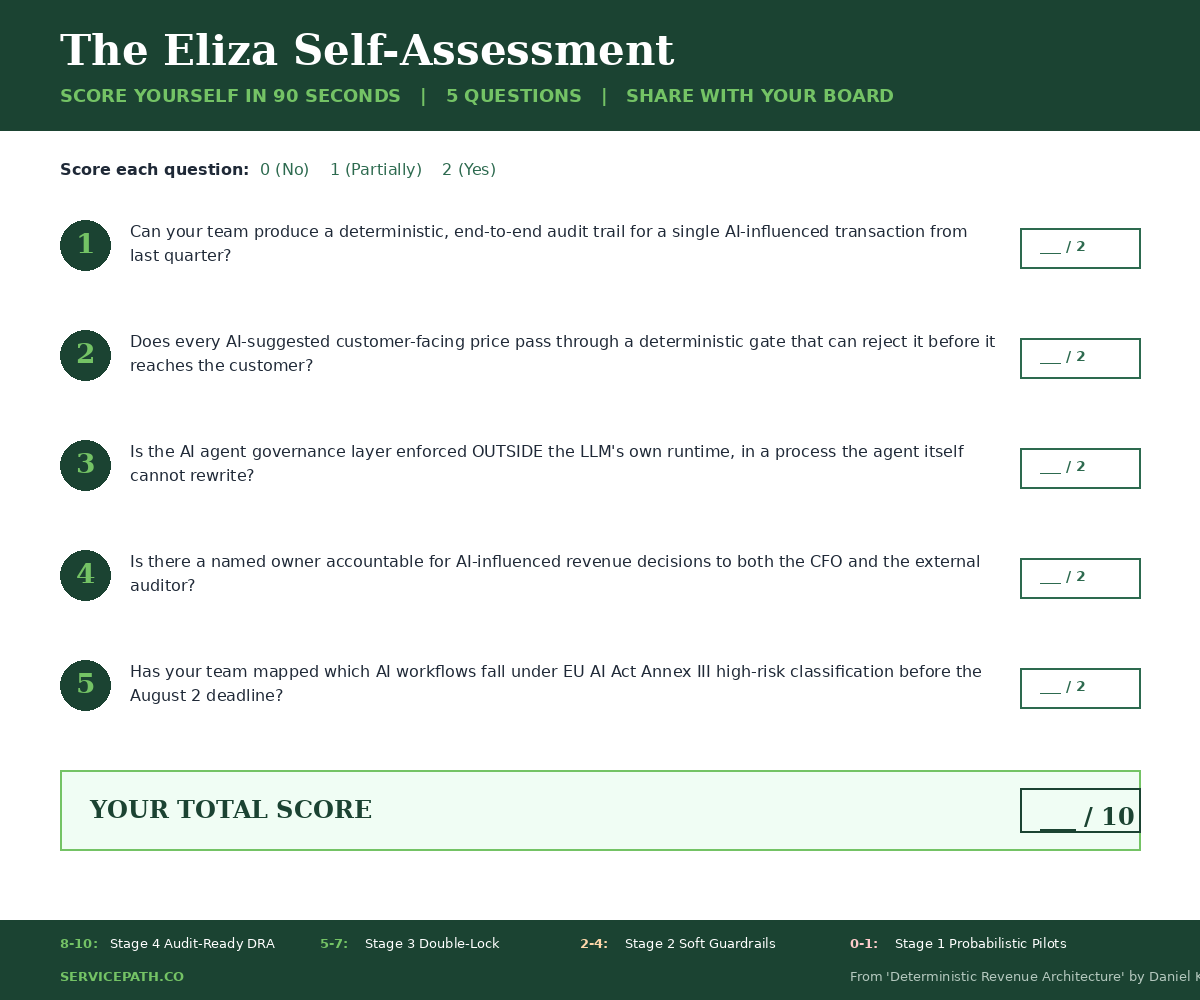
8-10: Stage 4. Audit-Ready DRA. You are ahead of more than 90% of the market.
5-7: Stage 3. Double-Lock in flight. Close the remaining gaps before August 2.
2-4: Stage 2. Soft Guardrails. A governance review is overdue.
0-1: Stage 1. Probabilistic Pilots. The Eliza 2.0 Effect is your operational risk profile.
Download the Eliza Self-Assessment
Score your organization on all five questions above, then download the one-page Eliza Self-Assessment PDF to share with your leadership team. The PDF includes the maturity ladder, scoring guide, and a pre-formatted slide for your next board deck.
Download the Eliza Self-Assessment PDF
What Comes Next
The opportunity is real. So is the risk. The enterprises that define the next decade will be the ones that paired AI’s creativity with deterministic math at the moment it mattered most. That moment is now.
I would rather help shape this conversation with you than at you.
If this piece raised questions about your own quote-to-cash stack, your own AI governance gaps, or your own EU AI Act exposure, here are three ways to go deeper:
Go deeper on the research. We publish regularly on AI governance, revenue architecture, and the intersection of CPQ and agentic AI. Every piece is built on the same standard as this one: verified sources, zero hallucination, practitioner-first. Read the servicePath™ Insight blog.
Join the conversation. Revenue, Growth and Tech for Execs is where we unpack these issues with the CFOs, CROs, and architects who are living them. No fluff. No vendor theater. Just the people building deterministic revenue systems in real time. Subscribe to the newsletter on LinkedIn.
Learn the language. If terms like daisy chain, attestability, margin leakage, or quote-to-cash showed up in this piece and you want the full definition with context, our glossary is built for revenue leaders, not engineers. Explore the servicePath™ Glossary.
The August 2 enforcement deadline is real, and the gap between where most enterprises are and where they need to be is wider than their boards realize. I would rather help you find your gaps now than read about your fine in six months.
Score your organization with the 5-question self-assessment above first. Then let us know where you landed.
Start the conversation at servicePath.co.
FAQ
Q1: How do I tell if my company’s AI governance is real or theater?
Ask three questions. “Show me the audit trail for one AI-influenced transaction.” Real governance produces it. “What happens with input the model has never seen?” A real deterministic gate errors out. “Where is the final decision made?” If it is the LLM, that is probabilistic governance in enterprise clothing.
Q2: What is the smallest first move to make this quarter?
Install the pricing floor gate. Never let an LLM make the final call on a customer-facing price. Every AI-suggested quote passes through a deterministic CPQ engine that checks against hard-coded margin floors. “The AI told me to” will not survive an EU AI Act audit.
Q3: Vendors claim agent governance is built in. How do I avoid being sold a story?
Demand the architectural pattern, not the brand. Three components: a sandbox the agent cannot escape, an out-of-process policy engine, and a deterministic system of record at the outcome layer. If a vendor cannot demonstrate all three working together, that is not governance. That is hope.
Vocabulary
Eliza 2.0 Effect: Outsourcing enterprise judgment to a daisy chain of probabilistic models that can never, by design, be 100% right.
Deterministic Revenue Architecture (DRA): A hybrid where AI handles discovery and a deterministic system of record handles delivery.
Supporting terms:
- Double-Lock refers to agent-behavior governance plus revenue-logic governance operating at different layers.
- Attestability is a deterministic decision carrying a signed audit trail back to the rule that approved it.
- A daisy chain is a workflow where one AI model’s output becomes the next system’s input, compounding error.
- Agentic intermediation describes AI agents negotiating and executing transactions on behalf of buyers and sellers.
Daniel Kube is the CEO of servicePath™, the CPQ platform powering complex technology sales for MSPs, telecom providers, and enterprise technology companies, with native integrations into Salesforce, Microsoft Dynamics, and HubSpot. servicePath™ has been recognized as a Visionary in Gartner’s Magic Quadrant for CPQ Applications for four consecutive years (2023 to 2026), three years standing alone, and an IDC Major Player. Learn more at servicePath.co.