
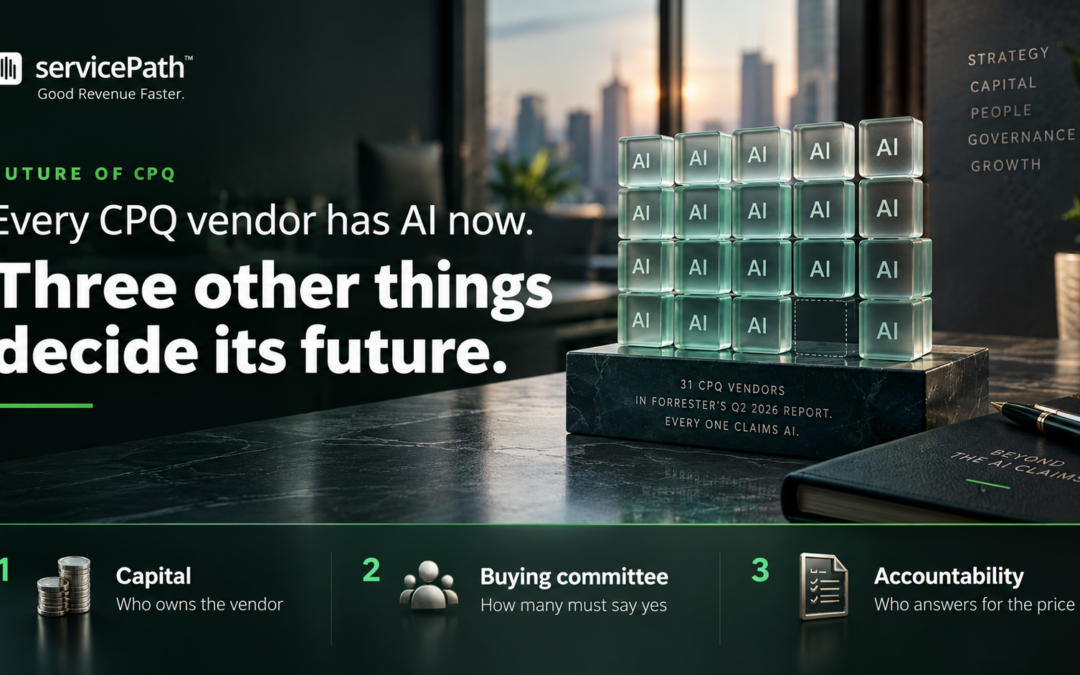
Capital, the buying committee, and accountability, not AI claims, will decide which of Forrester’s 31 CPQ vendors survive. The 2026 evidence, and seven questions to put to any vendor this week
Executive Summary
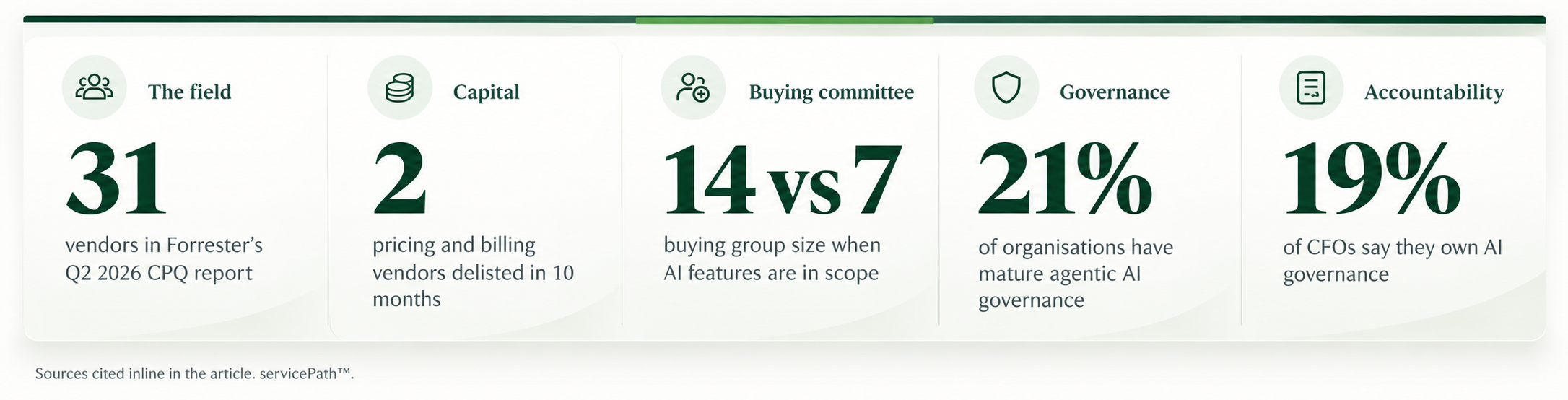
Forrester’s Q2 2026 report on configure, price, quote (CPQ) software counts 31 vendors and calls core CPQ “table stakes”. I work for one of the 31, so weigh what follows accordingly. Every one of us now claims AI, so AI no longer tells us apart.
The future of CPQ turns on something else, because someone has to answer for a price and a model cannot. Three other forces decide it: who owns the vendor, how many people must say yes, and who answers for the price.
- Capital decides who stays independent. Two public pricing and billing vendors delisted inside 10 months, and private equity did the buying.
- The buying committee decides how long a sale takes. Forrester finds that when a purchase includes generative AI features, the buying group doubles, from seven people to 14.
- Accountability decides who wins. Whoever signs for CPQ owns every price it produces, so only a vendor that can show which rule produced each price is safe to sign.
The incumbents did ship real product, and no reported court decision has held a company to an AI-generated quote. Both cut against the argument, so both are in the article, with a seven-question test you can run this week.
Every vendor claims AI, so AI no longer decides the future of CPQ
In July 2025 Salesforce introduced Agentforce for Revenue, with a constraint-based logic engine and a configurator that handles quotes of more than 1,000 line items. That is product. The large platforms are building, so anyone who tells you otherwise is selling.
Why AI puts your CPQ vendor’s future at risk
Gartner’s 1 July 2026 release puts up to $234 billion of enterprise application spend, about 20% of SaaS spending, at risk from agentic AI by 2030. The risk is substitution, since an agent does the work the seats were bought for. Its 2 April 2026 prediction goes further: software companies that bolt AI onto legacy applications, rather than redesigning for agentic execution, face margin compression of up to 80% by 2030. My inference, not Gartner’s: compressed margins get a vendor sold.
So what decides the future of CPQ is what happens when the AI is wrong. Who catches it, who answers for it, and whether the vendor still exists when it happens.
Private equity and platforms are buying up CPQ vendors
Capital is the first force. CPQ market consolidation is the defining fact of 2026, and even when a rival does the buying, a private equity firm owns the rival.
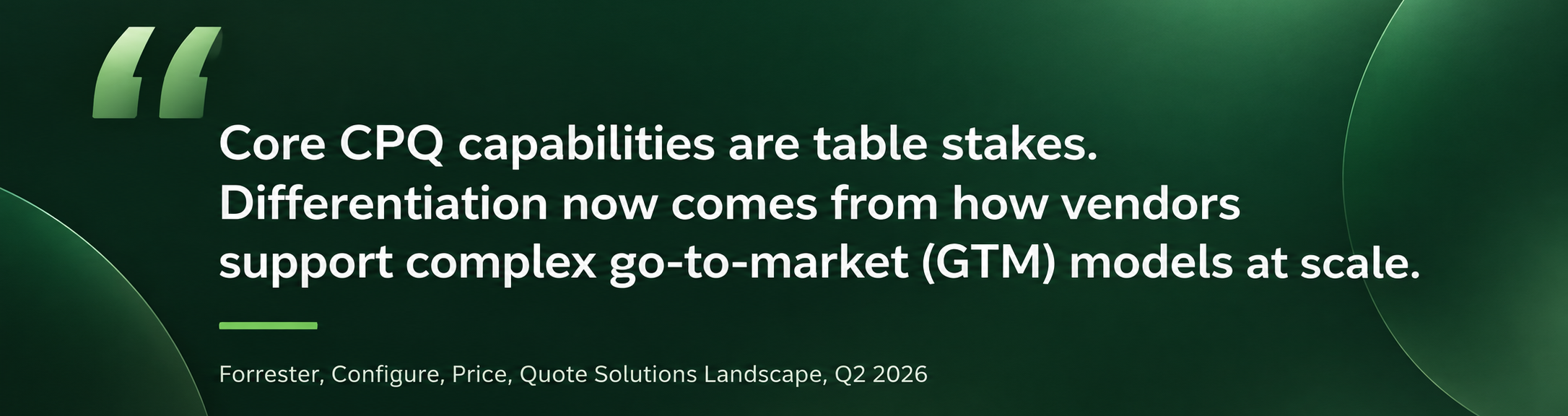
Forrester’s Configure, Price, Quote Solutions Landscape, Q2 2026 is blunt: “Core CPQ capabilities are table stakes. Differentiation now comes from how vendors support complex go-to-market (GTM) models at scale.”
Who bought which CPQ vendors, 2024 to 2026
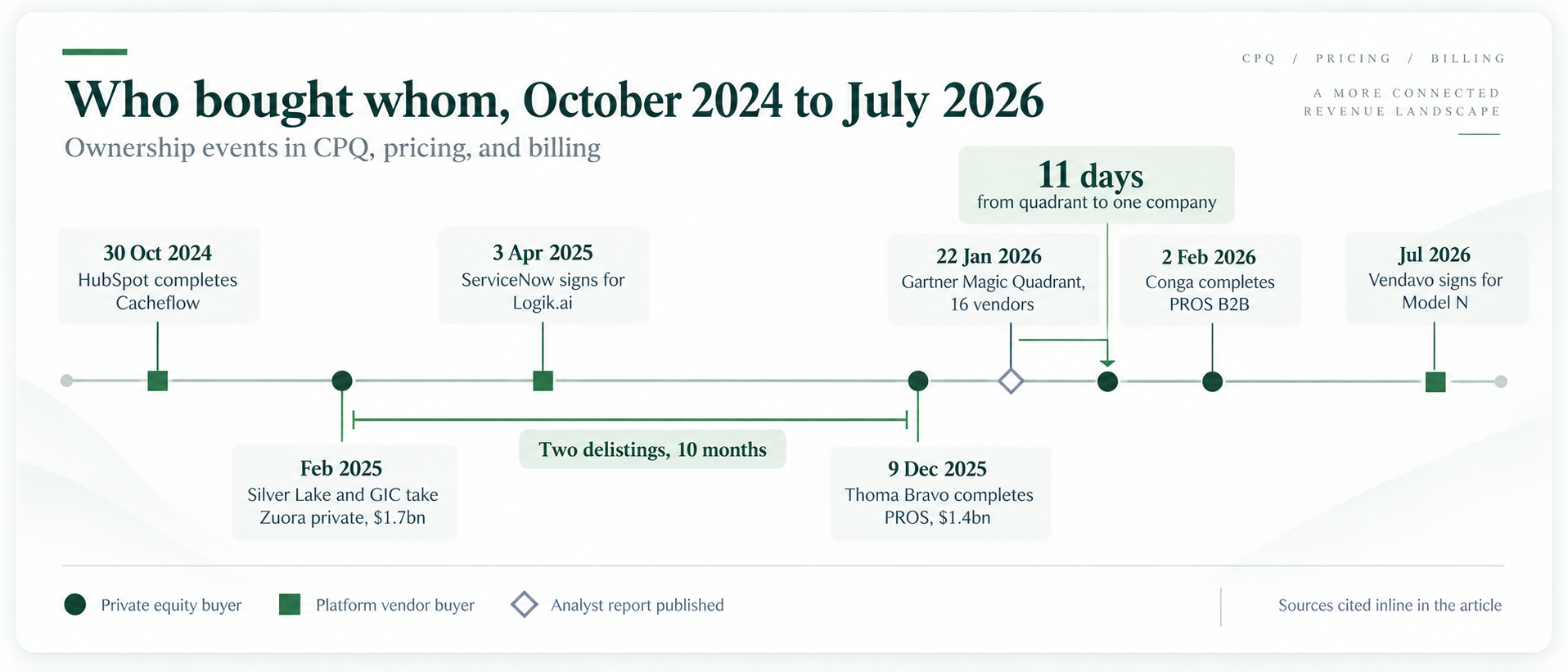
Thoma Bravo completed its acquisition of PROS on 9 December 2025 for about $1.4 billion, and PROS left the NYSE. On 2 February 2026, 55 days later, Thoma Bravo portfolio company Conga completed its acquisition of the PROS B2B business.
Earlier, Silver Lake and GIC had taken Zuora private in a $1.7 billion deal, completed February 2025. In July 2026 Vendavo, a Francisco Partners portfolio company, signed an agreement to buy Model N’s high-tech business, subject to closing.
Platforms are also absorbing CPQ as a feature. ServiceNow agreed to acquire Logik.ai on 3 April 2025. Before that, HubSpot completed its acquisition of Cacheflow in October 2024.
Read Gartner’s CPQ Magic Quadrant alongside the ownership record
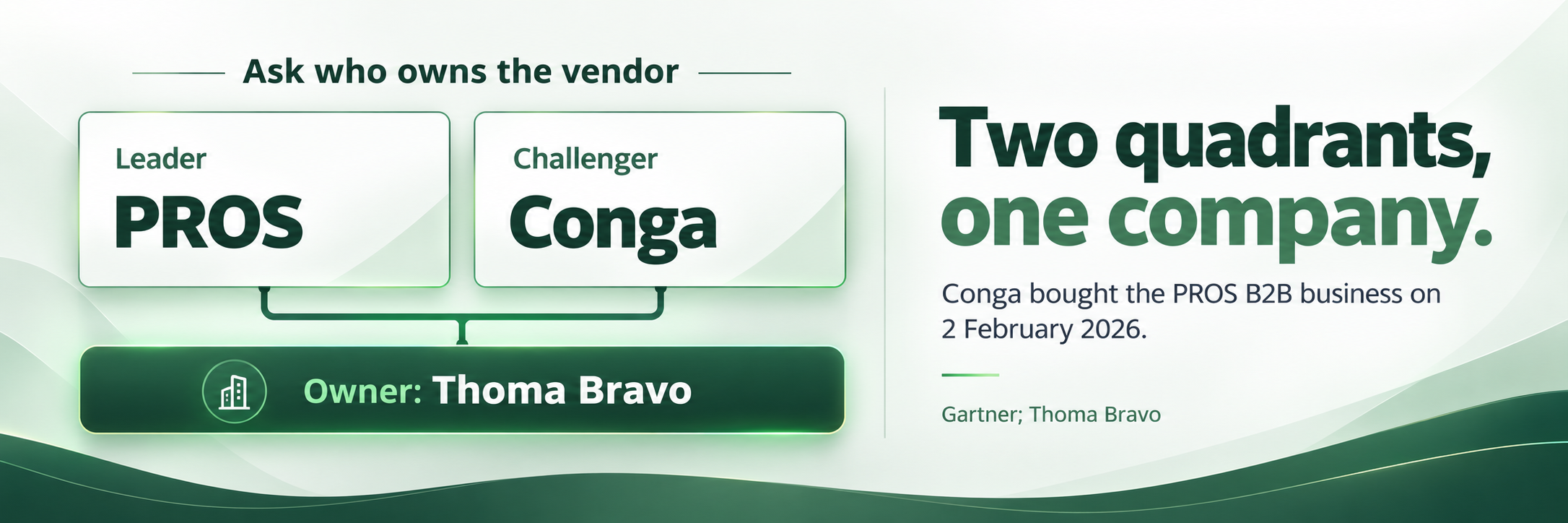
Gartner published its Magic Quadrant for Configure, Price and Quote Applications on 22 January 2026, covering 16 vendors. Spotlight’s independent summary records that Gartner named PROS a Leader and placed Conga in Challengers. By then Thoma Bravo already owned both. Eleven days after publication, on 2 February, Conga completed its purchase of the PROS B2B business. A placement and an ownership record answer different questions, and a buyer needs both.
PitchBook reported on 25 June 2026 that platform deals fell to 41% of private equity software deal value, a decade low, while add-ons rose to about 45%. So private equity sponsors are bolting more onto companies they already own. On its own, that proves little about CPQ.
Beside two delistings in 10 months, though, it is hard to read another way. PwC’s June 2026 technology deals outlook said the quiet part: “Sponsors are underwriting fewer software assets as they assess exposure to AI disruption.” Your vendor’s AI claims are now a diligence question, and not the flattering kind.
MGI Research’s February 2026 CPQ Top 35 Buyer’s Guide 2026 reads it the other way: the CPQ market “is hyper-fragmenting” and vendor specialisation is accelerating. Both are true.
Fragmentation counts logos. Consolidation counts owners.
A buyer who judges the product and ignores the owner is reading the wrong half of the market, because the future of CPQ is being written in the other half.
AI features double the size of the buying committee
On the 2026 evidence, AI is more likely to lengthen a CPQ sale than shorten it, because every AI feature adds people to the buying committee. That is the second force shaping the future of CPQ.
Forrester’s February 2026 analysis of B2B buying finds that for purchases with generative AI features, the buying group doubles in size, from seven members to 14.
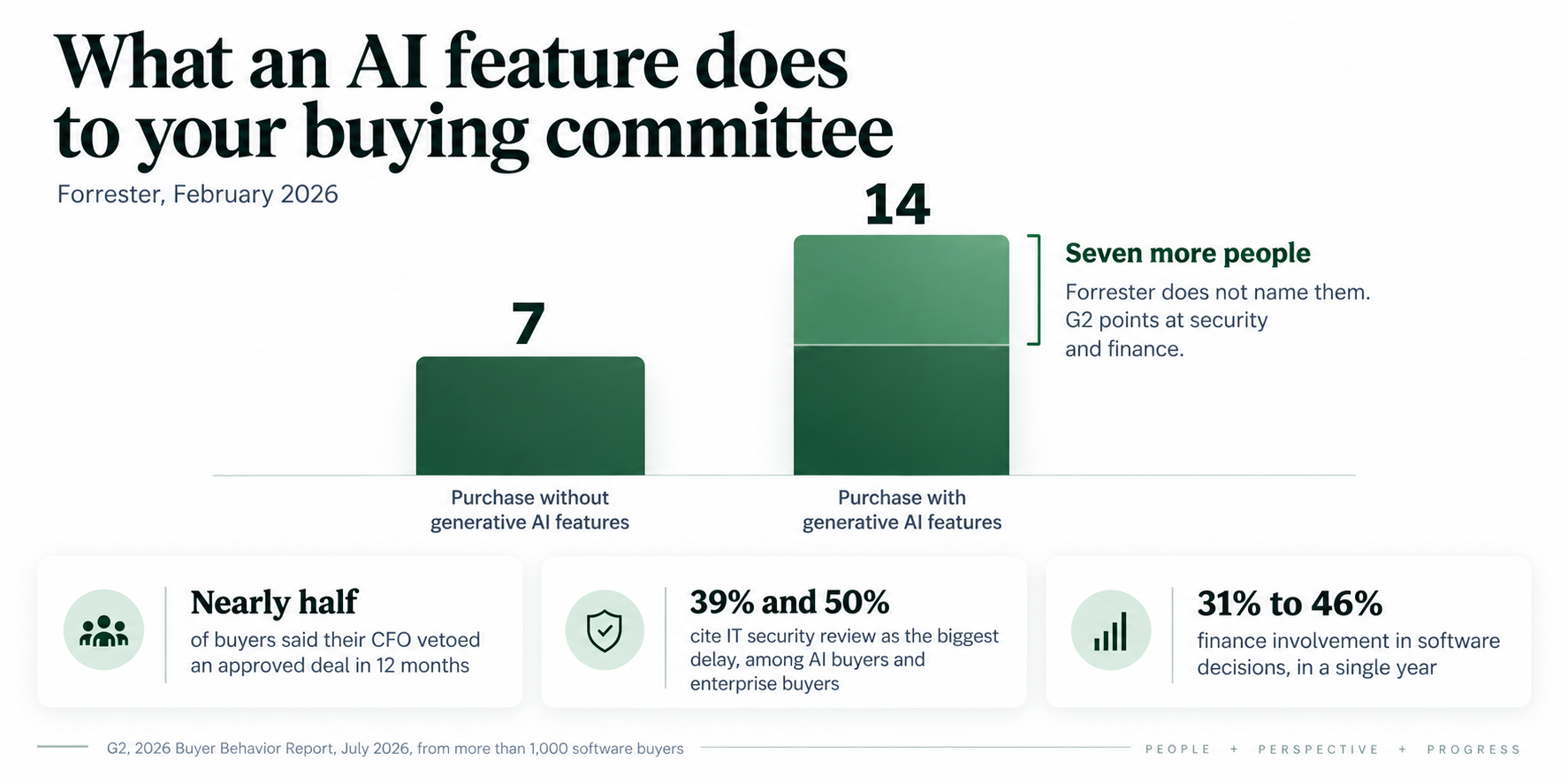
Who does an AI feature add to the buying committee?
Security and finance, on G2’s data, though Forrester does not name them.
G2’s 2026 Buyer Behavior Report, July 2026, from more than 1,000 software buyers, finds both already slowing deals. Nearly half of buyers said their CFO vetoed an already approved deal in the last 12 months. IT security review is the biggest source of delay, cited by 39% of buyers and 50% of enterprise buyers.
A demo moves none of them. Evidence does: a data-flow diagram, the fields the model can never write, a log they can sample, a human gate they can point to. That evidence pack is how a vendor shows who answers for the price.
My inference: the vendors who win on AI will be those whose champion gets the extra seven to yes without a second business case. That is a documentation problem, not a modelling one. And a vendor whose new owner cut the compliance team cannot fund the evidence pack.
Someone has to answer for the price
A better model can make fewer pricing mistakes. It still cannot answer for one. That gap is the third force, accountability, so rules rather than models must set the price.
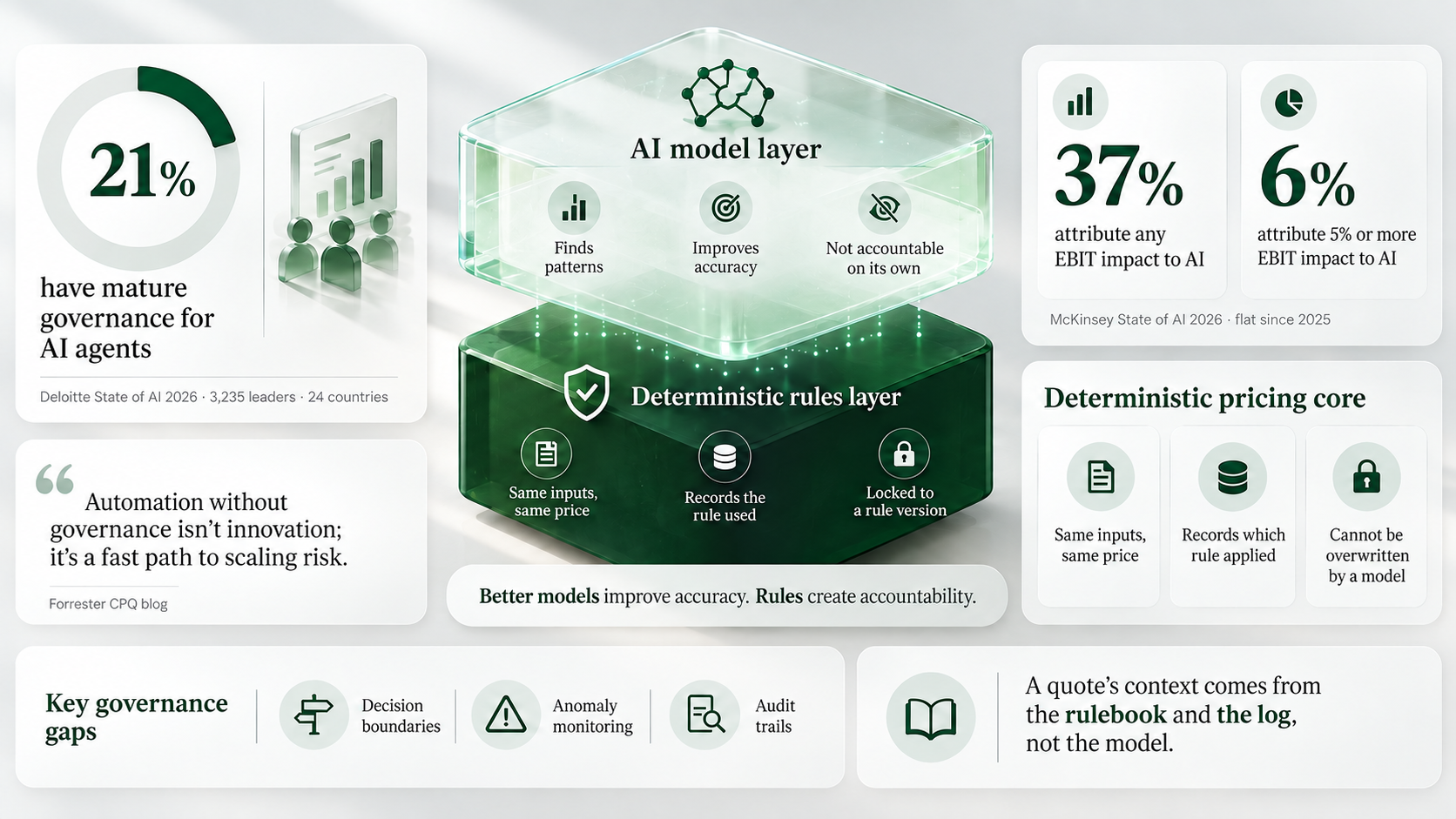
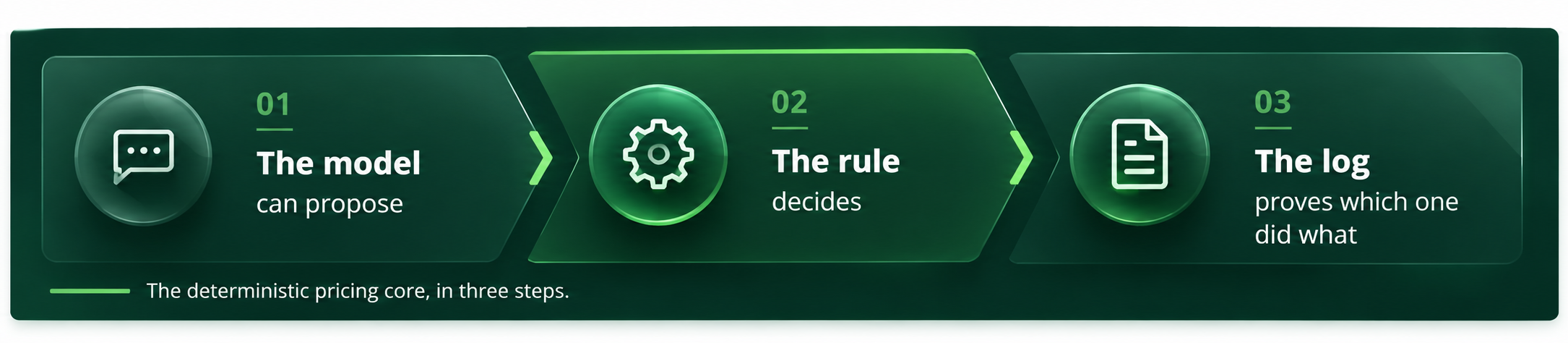
A deterministic pricing core is that rules layer. Give it the same deal under the same rule version, and it returns the same price. It records which rule applied, and no model can overwrite it. The model proposes, the rule decides, and the log proves who did what.
Why accountability, not accuracy, decides the future of CPQ
Forrester’s CPQ blog draws the line: “automation without governance isn’t innovation; it’s a fast path to scaling risk.”
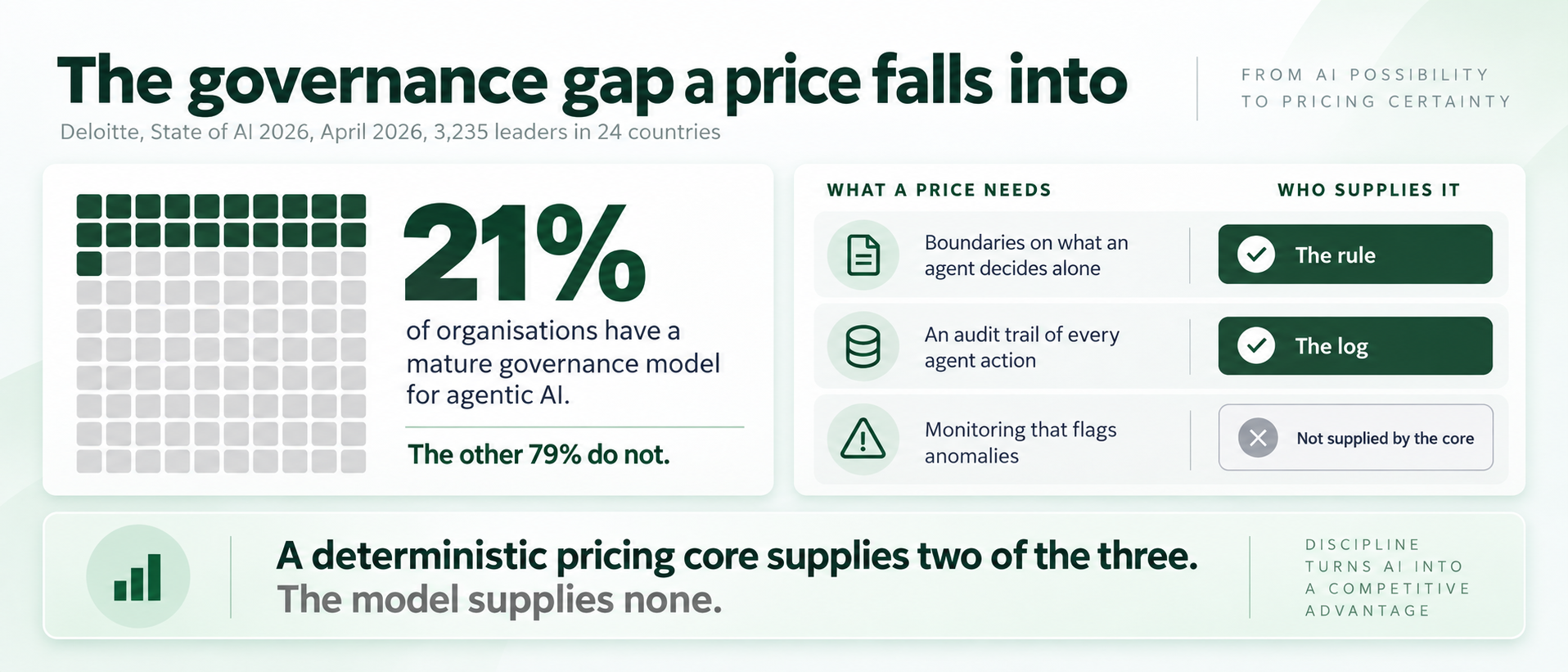
Most organizations have not drawn it yet. Deloitte’s State of AI 2026, April 2026, surveyed 3,235 leaders in 24 countries. Only 21% have a mature governance model for agentic AI.
The missing pieces are what a price needs most: boundaries on what an agent decides alone, anomaly monitoring, and a full audit trail of agent actions. A deterministic core supplies two of the three, because the rule is the boundary and the log is the trail.
The model is the part every vendor now claims. AI depreciates and context appreciates, and a quote’s context is the rulebook and the log. Neither comes from the model.
What two agent attacks teach a CPQ buyer
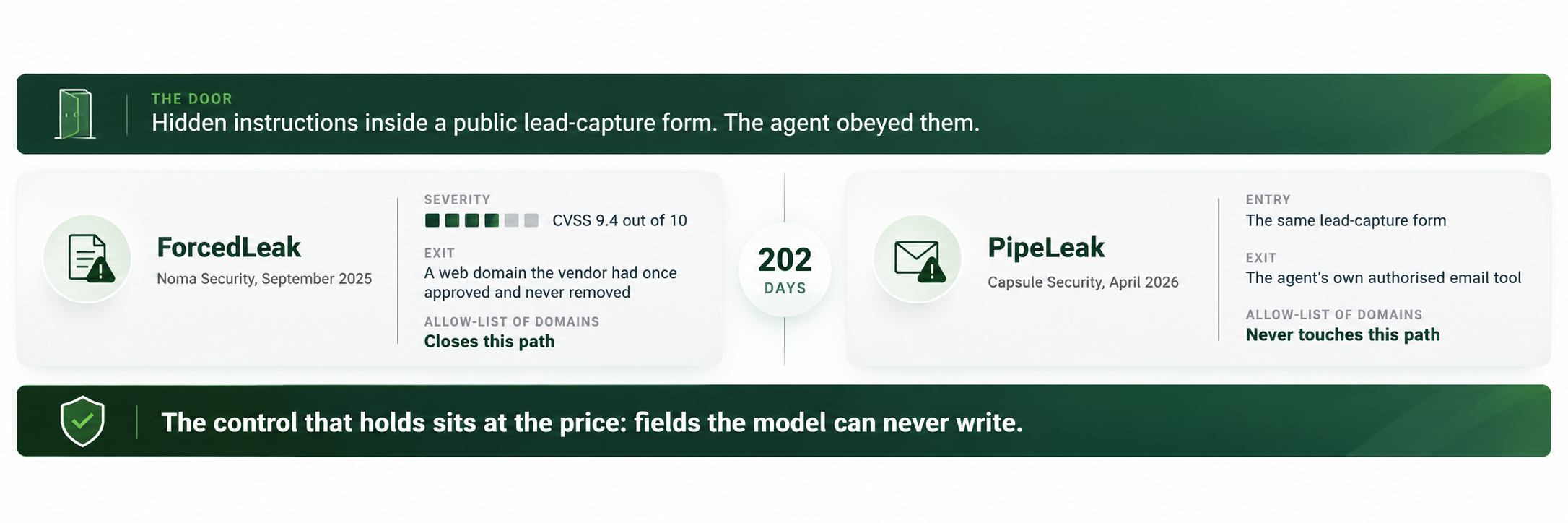
Two disclosed attacks show the failure that matters: the agent obeyed the wrong person.
ForcedLeak, disclosed by Noma Security in September 2025, scored 9.4 out of 10 on the CVSS severity scale. It hid instructions inside a public lead-capture form. The agent obeyed them, then sent customer data to a web domain the vendor had once approved and never removed.
PipeLeak, from Capsule Security in April 2026, used the same entry point and left through the agent’s own authorised email tool. Same door, 202 days apart. Neither yet has a public vulnerability ID (CVE), and neither is CPQ-specific.
My read, not the researchers’: a list of approved domains closes the first path but not the second. The second is a tool the agent is meant to use. So the control sits at the price: fields the model can never write.
A clean vulnerability record proves little, because OWASP, the open security project, says in its Q1 2026 exploit round-up that these risks “are often systemic and architectural rather than discrete code flaws.”
What the law has not yet decided about AI quotes
Two 2026 episodes, neither about a B2B price, put an AI’s words on the company that deployed it.
On 12 June 2026 the Munich Regional Court held Google liable for what its AI Overviews said about companies. The court called the summaries “independent, new, and substantive statements” by Google, and a disclaimer did not change that. Still, it was a German defamation case, not a contract.
In June 2026 a Toronto BMW dealership’s chatbot offered a customer $27,162.79 for a trade-in, thousands above the intended figure. The dealer honoured it after CBC News called. Commercial pressure did that, not a court.
No reported decision has held a company to an AI-generated B2B quote. Astraea Counsel’s July 2026 analysis is “aware of no court that has yet applied” the electronic-agent statutes, the laws that let software form contracts, to a generative AI agent. Nor does the EU AI Act yet treat B2B quoting as high-risk under Annex III, and the Digital Omnibus deferred that regime to December 2027.
Unsettled is not the same as safe. A price is a promise, and a company that cannot say who made one will not be trusted to keep it.
The antitrust question to put to your CPQ vendor
California’s AB 325, in force since 1 January 2026, bars using a “common pricing algorithm” as part of an agreement to restrain trade. It defines one as a method “used by two or more persons, that uses competitor data” to influence “a price or commercial term”. It also covers B2B.
So a pricing engine running only your rules on your data sits outside AB 325. But a model trained on competitor data pooled across a vendor’s customers is a question for counsel. Before signing, ask the vendor in writing whether your pricing data trains a model serving its other customers.
Who owns the price in the future of CPQ?
Deloitte’s Q2 2026 CFO Signals survey of 200 North American CFOs finds only 19% say they hold the greatest responsibility for AI governance. So the price an agent proposes sits in a vacuum. Finance answers for it but rarely governs the AI behind it.
But that vacuum will not last. Gartner’s Top Strategic Predictions for 2027 and Beyond predicts that by 2030, 80% of Global 500 companies will contractually name their CIO or chief AI officer the “Evidence Custodian” for AI accountability. The job is custody of evidence, not of models, and a price is the output that gets audited first.
So name the owner now, before a contract names one for you. Then make the rule enforce what they decided.
Can a buyer’s AI agent request a quote from you today?
Only inside a procurement suite. Agent-led B2B buying is real inside the suites and, so far, absent outside them, so the risk sits with sellers whose only quote path is a web form.
Agent-to-agent quoting is a buyer’s software agent requesting, receiving, and negotiating a price from a seller’s system with no human on either side.
What procurement suites have shipped, and where they stop
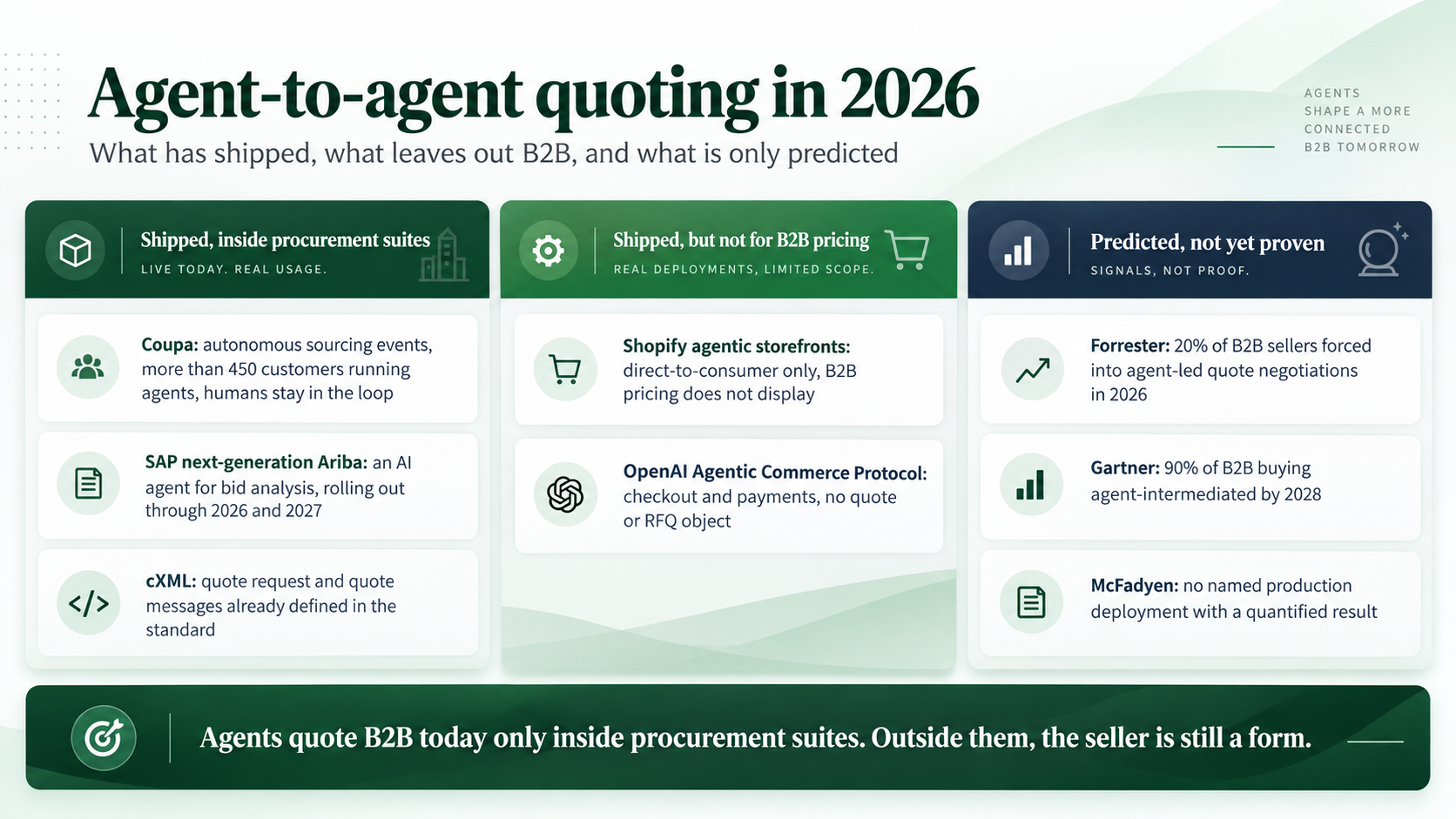
Coupa’s September 2026 release adds autonomous sourcing event creation and reports more than 450 customers running its agents in production. Coupa says humans still “stay in the loop for oversight and approval,” and Forrester’s read of Coupa’s roadmap is cooler: “Workflow will be initiated by humans, not AI.”
SAP’s next-generation Ariba, rolling out through 2026 and 2027, adds an AI agent for bid analysis. Both work inside the buyer’s platform against pre-qualified suppliers, and the seller still answers through a portal.
Outside the suites, the consumer shopping protocols exclude you. Shopify’s own documentation says its agentic storefronts “support only direct-to-consumer (D2C) sales” and that “B2B pricing doesn’t display.”
OpenAI’s Agentic Commerce Protocol covers checkout and payments, with no quote, request for quotation (RFQ), or negotiation object.
The cXML procurement standard already defines quote request and quote messages. The plumbing exists.
What analysts forecast for AI agents and the future of CPQ
Forrester predicted in October 2025 that in 2026 “twenty percent of B2B sellers will be forced to engage in agent-led quote negotiations,” answering “via seller-controlled agents.”
Gartner predicted at its October 2025 Symposium that 90% of B2B buying will be agent-intermediated by 2028, with over $15 trillion passing through agent exchanges. Both forecasts look ahead.
McFadyen’s September 2026 analysis looked at today, for an outside agent buying on its own against contract pricing on credit terms, and found “no named production deployment with a quantified result.”
Say your only quote path is a web form and a three-day turnaround. No agent can reach you, so none threatens you today. But that is the problem. When a buyer’s Ariba or Coupa agent builds a sourcing event, you are not a pre-qualified supplier with a machine-readable price. You are a form. Once that agent can compare four suppliers’ policy-checked quotes in an hour, a three-day turnaround drops you off the shortlist without anyone deciding to remove you.
Seven questions to put to any CPQ vendor
D is for the demo, C for the vendor’s CEO. One point per pass, and zero in total if question one fails.
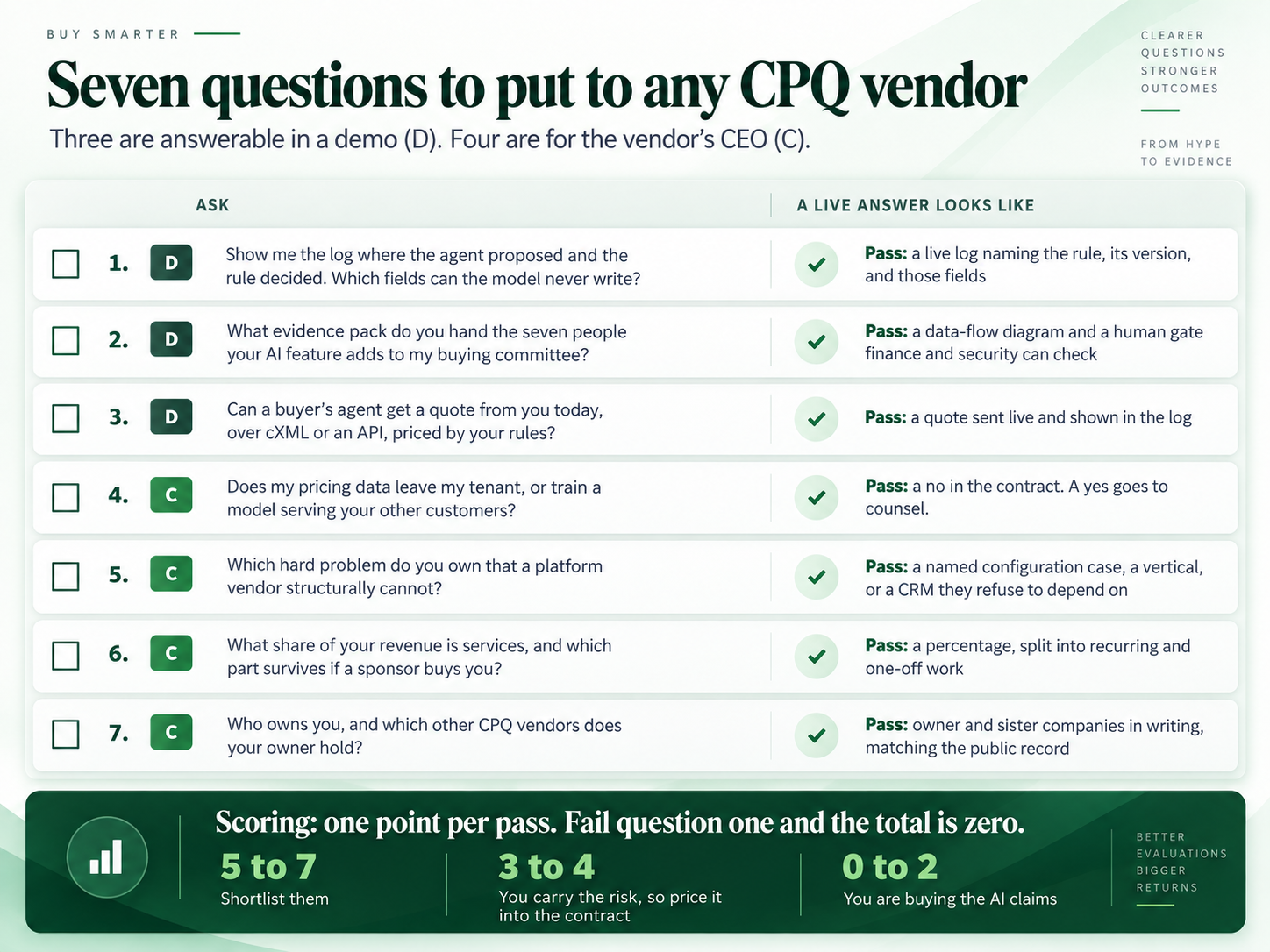
Run all seven this week on every shortlisted vendor.
The future of CPQ has fewer vendors in it
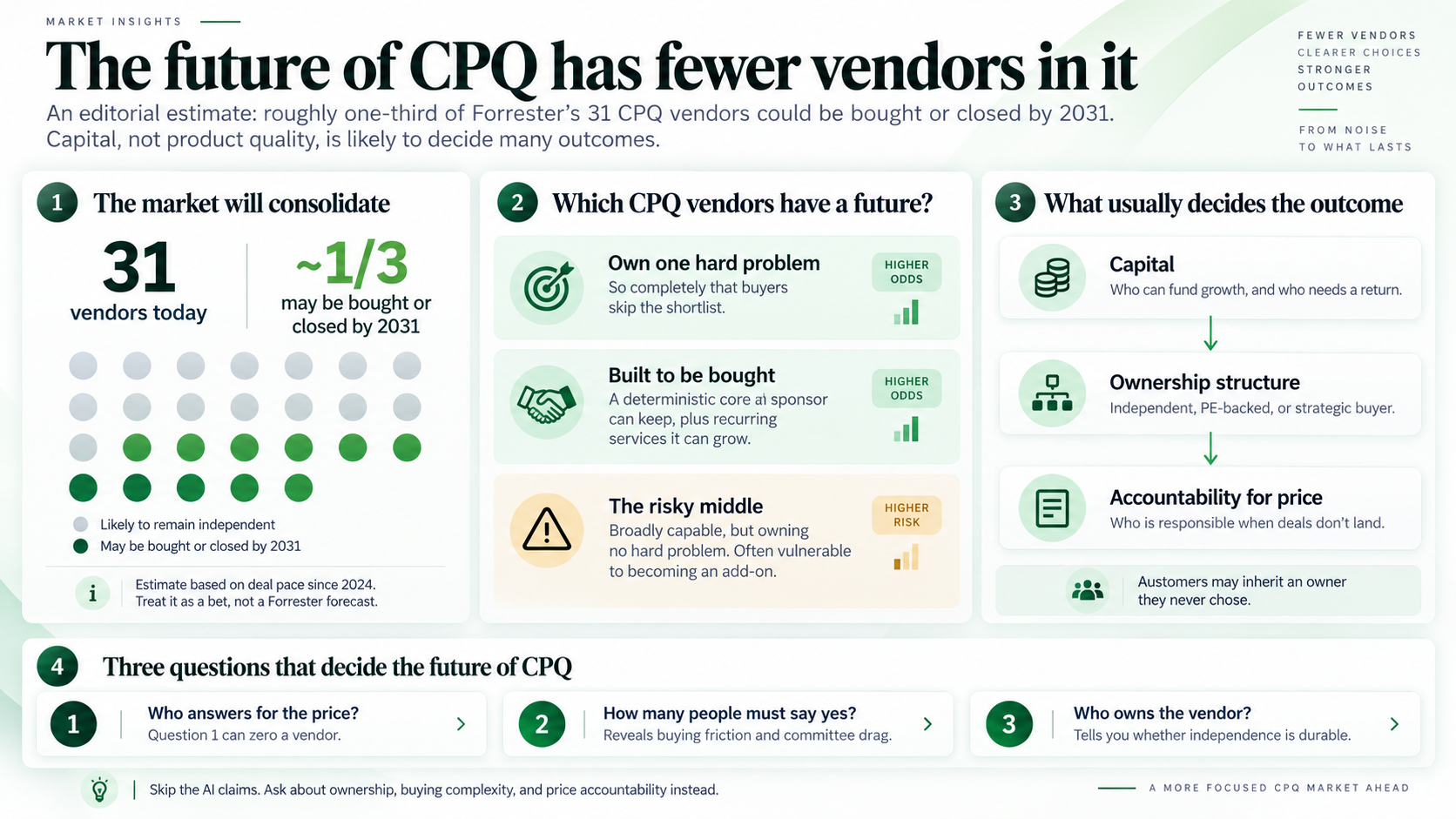
My estimate, not Forrester’s: a third of its 31 vendors will be bought or closed by 2031. It rests on the deal pace since 2024, so treat it as a bet. Capital, not product quality, will decide which ones.
Which CPQ vendors have a future?
My answer: two kinds, and only one stays independent. The first owns one hard problem so completely that buyers skip the shortlist. The second is built to be bought: a deterministic core a sponsor can keep and recurring services it can grow. Its product has a future, but its independence has an end date.
A broadly capable vendor that owns no hard problem is neither. My read of PitchBook’s add-on figures: a sponsor bolts that vendor onto a portfolio company. Its customers then inherit an owner they never chose.
So skip the AI claims. Then ask who owns the vendor, how many people must say yes, and who answers for the price. Those three decide the future of CPQ. Questions seven, two, and one test them, and only question one can zero a vendor.


Read more at servicePath™ Insight. Start with Salesforce CPQ end of sale and AI depreciates, context appreciates, then browse the CPQ insight archive.
Download the servicePath™ case studies. Published proof, not positioning. Read the case studies.
Frequently asked questions about the future of CPQ
What is the future of CPQ?
Fewer owners and more products. Ownership is consolidating while products fragment, so the future of CPQ turns on who owns the vendor, how many people AI adds to the buying committee, and who answers for the price.
What CPQ acquisitions have been announced since 2024?
Thoma Bravo took PROS private in December 2025, then its portfolio company Conga bought the PROS B2B business. Earlier, Silver Lake and GIC took Zuora private in February 2025. HubSpot bought Cacheflow and ServiceNow agreed to buy Logik.ai. Vendavo signed for Model N’s high-tech unit, subject to closing.
Will AI replace CPQ software in the future?
Not on current evidence. Agents that request quotes work inside procurement suites against pre-qualified suppliers, and the consumer protocols exclude B2B pricing. The future of CPQ software is machine-readable quoting, not no quoting.
Is CPQ high-risk under the EU AI Act?
Not as of September 2026. Annex III of the Act reaches creditworthiness and life and health insurance for individuals, so B2B quoting sits outside the high-risk regime, whose obligations begin on 2 December 2027. Other parts already apply, so check with counsel.