


Agent identity decides who may act. Only a written rule decides the price, the margin, and the term your business commits to.
Executive summary
Today your deal desk decides what a non-standard price may be. Soon a quoting agent will decide it too, and far faster. Neither can tell you which rule it applied, unless somebody wrote the rule down first. AI agent pricing governance is what closes that gap.
In March, an auditor will ask who approved a 31% discount on a four-year bundle. Your agent platform will show what the agent did. It will not show whether the agent had the right to do it. Nobody wrote your price rules and margin floors into a form a machine can check. Agentic quoting moves faster than the sign-off chain behind it, and most CPQ governance still stops at a human approval screen.
What is AI agent pricing governance?
AI agent pricing governance is the set of machine-readable commercial rules, sign-off checks, and evidence that decides whether an AI-generated quote may go out. Agent identity answers who is acting, and under whose delegated authority. Commitment governance, a servicePath™ term, answers the next question. Do the proposed price, margin, term, entity, and exception fall inside that authority?
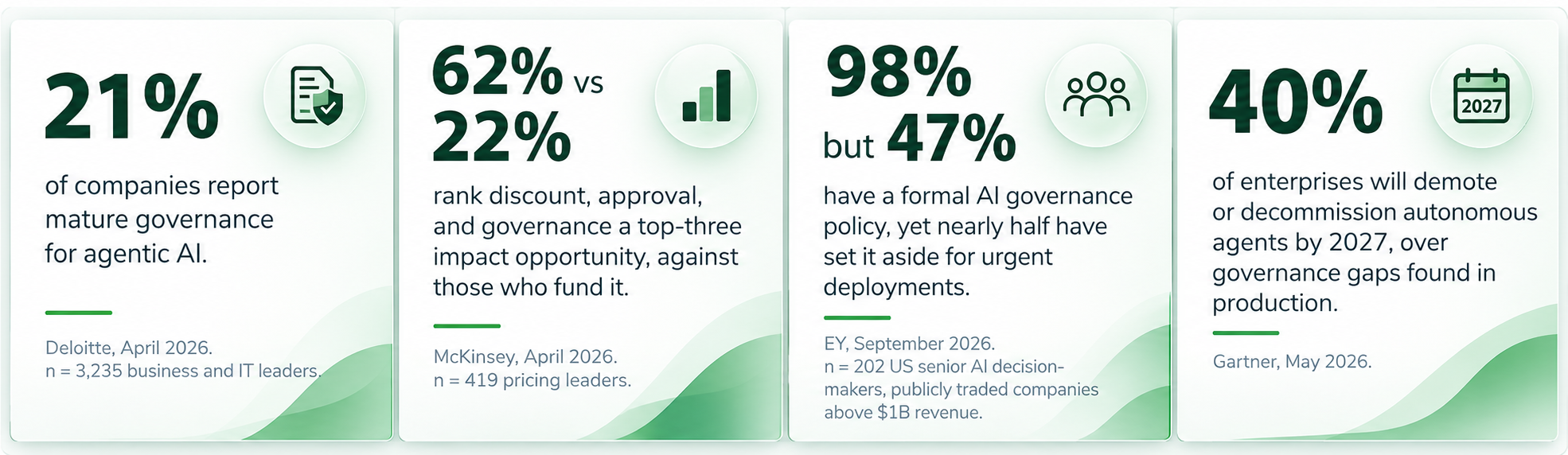
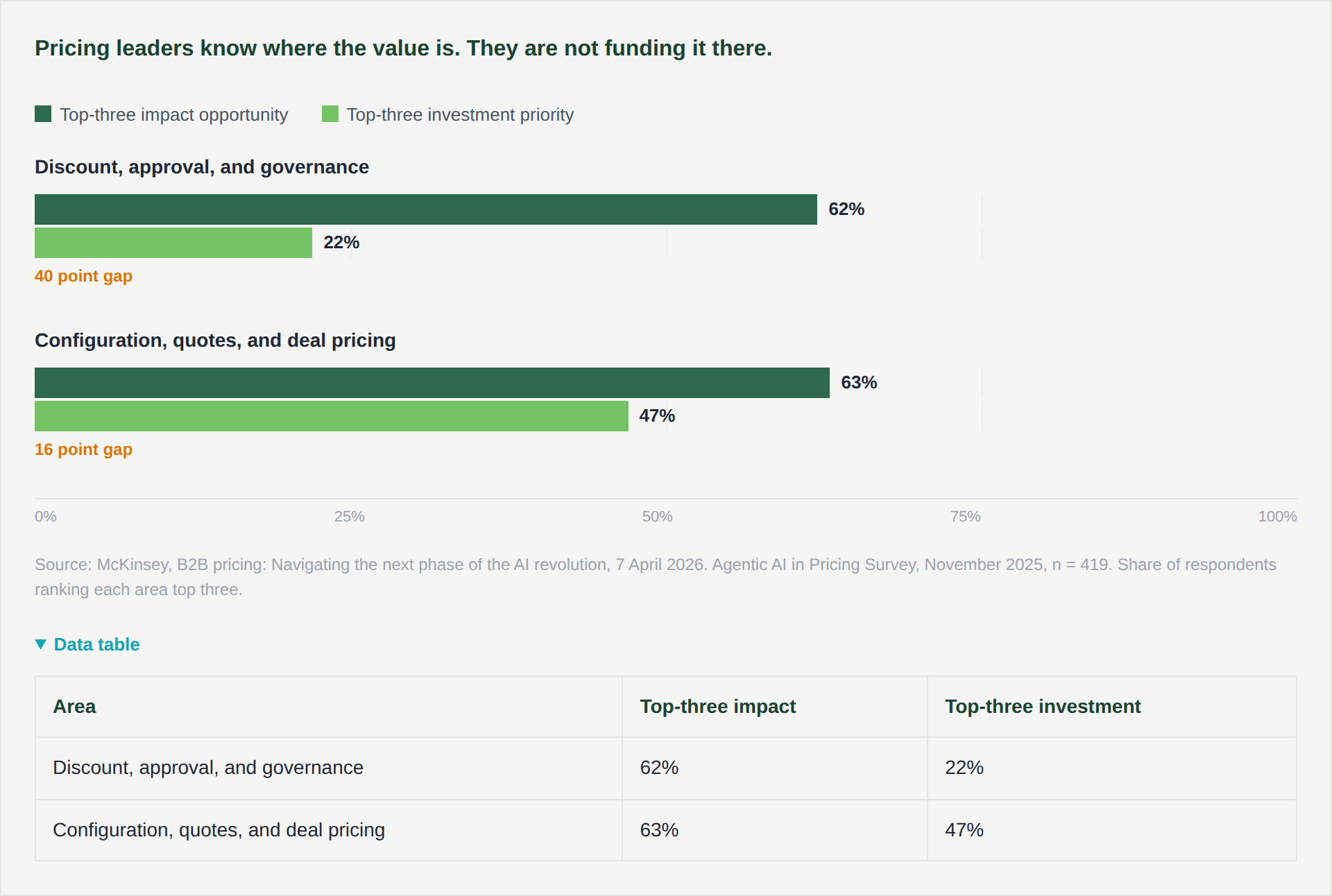
Most enterprises have the first layer and not the second. McKinsey surveyed 419 pricing leaders in late 2025. Some 62% ranked “discount, approval, and governance” a top-three impact opportunity. Only 22%, though, made it a top-three investment priority. Likewise, only 21% of the 3,235 leaders Deloitte surveyed reported mature governance for agentic AI.
This is not an argument for keeping agents out of pricing. Rather, it is an argument for writing authority down before you hand it over. So this article sets out four things.
- First, a four-layer control model.
- Second, the re-performance standard that makes a decision defensible.
- Third, a reference model for who owns what.
- Fourth, four tests plus one gate question your deal desk can run on your own systems this week.
Where does discount authority actually live?
In people, in most companies. Authority sits in sign-off chains, price books, and spreadsheets. It also sits in the memory of whoever said yes last time. The same McKinsey study found pricing teams still “track discounts, deal scores, and approvals in spreadsheets or emails.” Some approval workflows then sit on top of that.
What does the deal desk actually look like?
The patterns are familiar to anyone who has run a deal desk. An eight-step discount sign-off lives in an email thread. The same SKU sits in three price books at three numbers. So the rep picks the one that closes. Someone builds a non-standard deal in a spreadsheet, then pastes it back into the CRM.
Then someone asks “can you pull the approval on that deal.” The answer is “let me ask Sarah.”
Four deal desk scenarios, and what an agent does with each
Every deal desk will know these four. In each, authority sits in a person rather than in a rule.
The left column is a judgement call. The right column is what happens when the judgement is not written down.
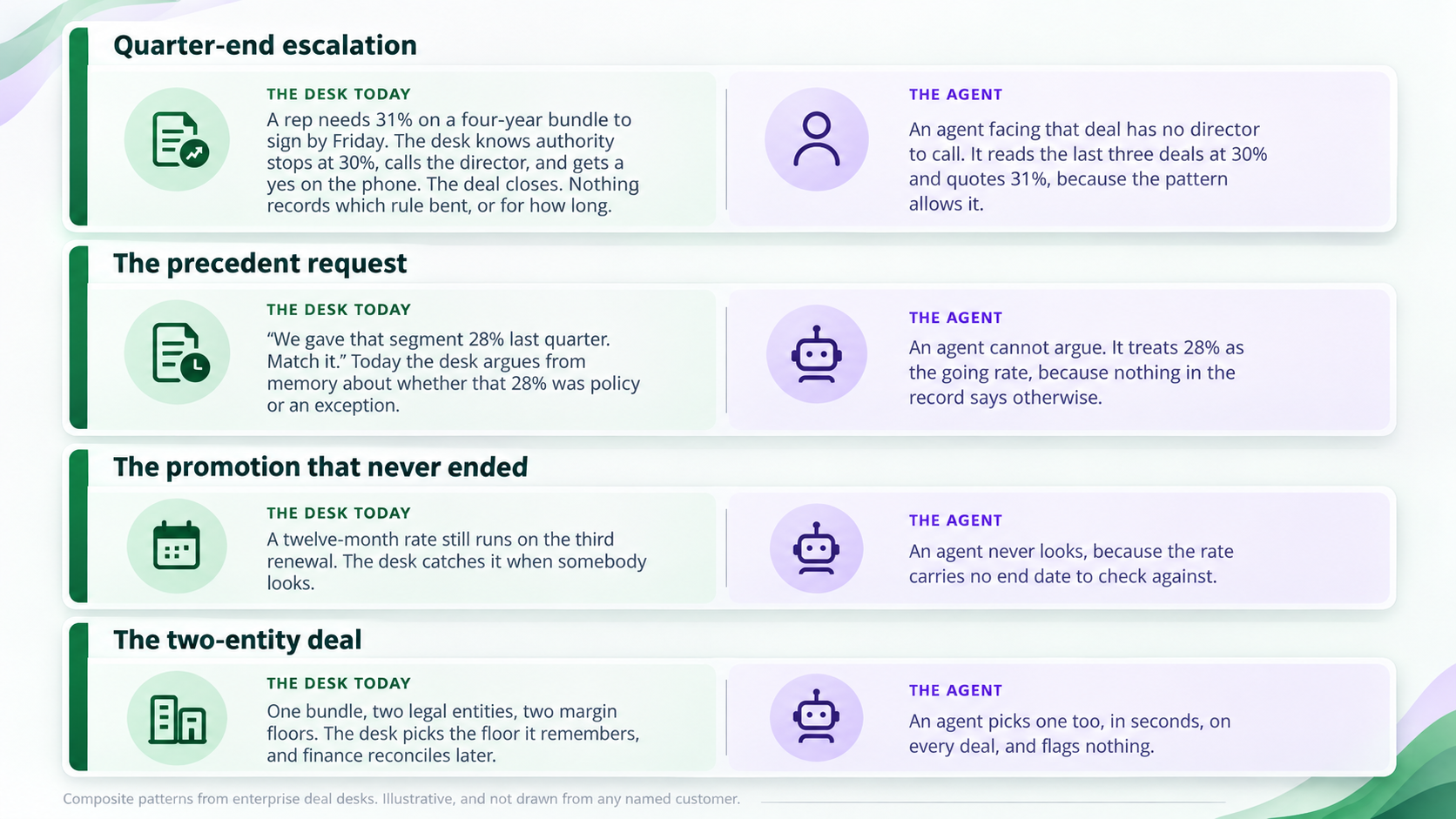
In all four, the deal desk is the control. Take the desk out of the loop and the control leaves with it, unless somebody wrote the rule down first.
Policy on paper behaves the same way under pressure. EY surveyed 202 senior AI leaders at large US public companies in mid-2026. Some 98% had a formal AI governance policy. Even so, 47% said their organisation had not applied it for urgent deployments. Quarter-end is always urgent.
Why this is not a rep problem
Reps work around a system that cannot tell them what they may say yes to. So they ask the person who said yes last time. BCG puts it plainly. “Rules-only approaches become unscalable when sales and pricing teams are unwilling or unable to keep following them.” The rules exist, but not where the work happens.
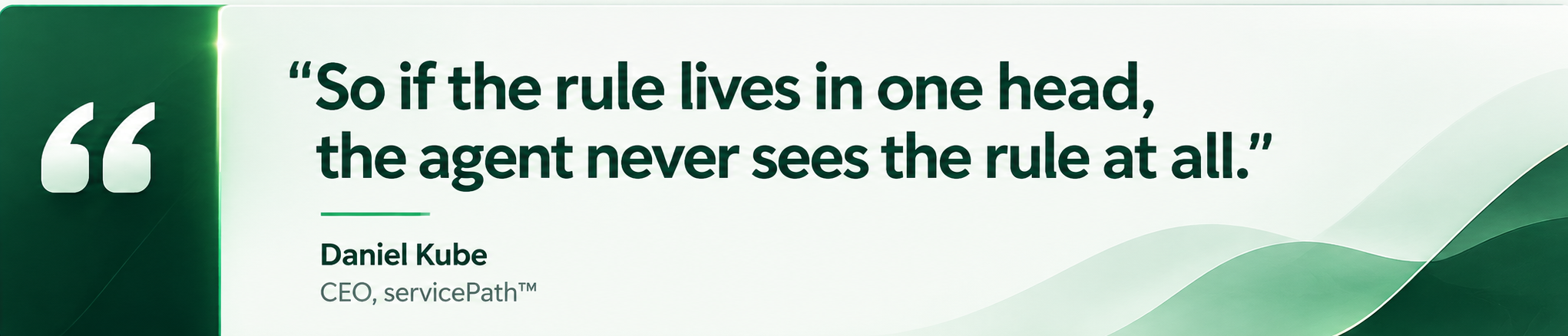
That works, slowly, because people are patient and remember things. An agent is neither. It does not ask Sarah, and it reads only what you put in front of it. So if the rule lives in one head, the agent never sees the rule at all.
This is the third piece on the commercial control plane.The first two set out what a commercial control plane is, and who owns the price when an agent quotes it. Read our blogs for the first two.
What are the four layers of AI agent pricing governance?
Agent governance and commercial rules are not rivals. Nor are they the whole system. AI agent pricing governance has four layers. Each asks its own question, makes its own artifact, and usually has its own owner.
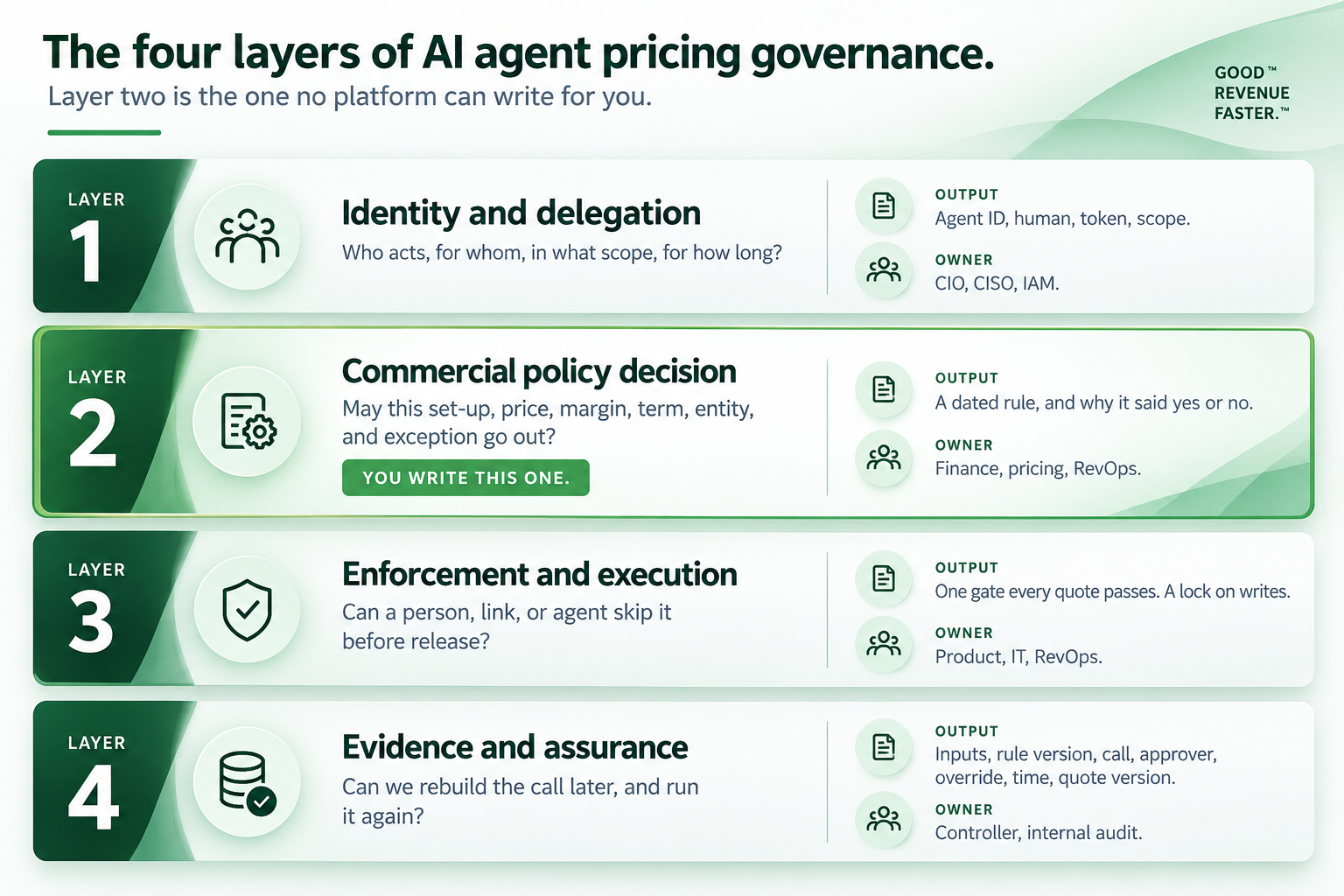
The first layer is well served. NIST’s initial public draft on software and AI agent identity and authorisation asks the right questions. “What are the mechanisms for an agent to prove its authority to perform a specific action?” Vendors build to that layer now.
No platform can supply the second layer for you, though. It cannot invent your agreed price for this bundle, your margin floor in this entity, or your longest term in this segment. Your finance and pricing teams write those rules, version them, and keep them current. That is what we mean by commitment governance. The name matters less than the fields.
Where does the enforcement point sit?
One design question decides whether layer two means anything. Can any human, integration, or agent publish, send, or write back a quote without passing the same commercial check? If yes, the control is only advice, however complete the rule book looks. So map every write path first: the CRM screen, the API, bulk loads, partner portals, and the agent itself. Each one has to hit the same gate.
Why is logging not enough?
Because a log proves activity, not control. Six months later, an authorised reviewer should be able to take the same inputs. They then apply the rule version that was in force, and get the same result. That is what auditors mean by re-performance. To do that you need the human principal, the agent identity, the scope you handed over, and the rule version.
You also need the commercial inputs, the decision, the approver or override, the time, and the final quote version. Miss any of those and you cannot run the check again. Then the record proves that something happened, but not that the control worked.
This is not a servicePath™ standard. It is the audit profession’s. PCAOB AS 2201 ranks the evidence that control tests produce
“from least to most: inquiry, observation, inspection of relevant documentation, and re-performance of a control.”
COSO’s 2026 guidance, as the Journal of Accountancy reported in February, grounds AI governance in “established internal control principles” so that systems are “both adaptable and audit-ready.”
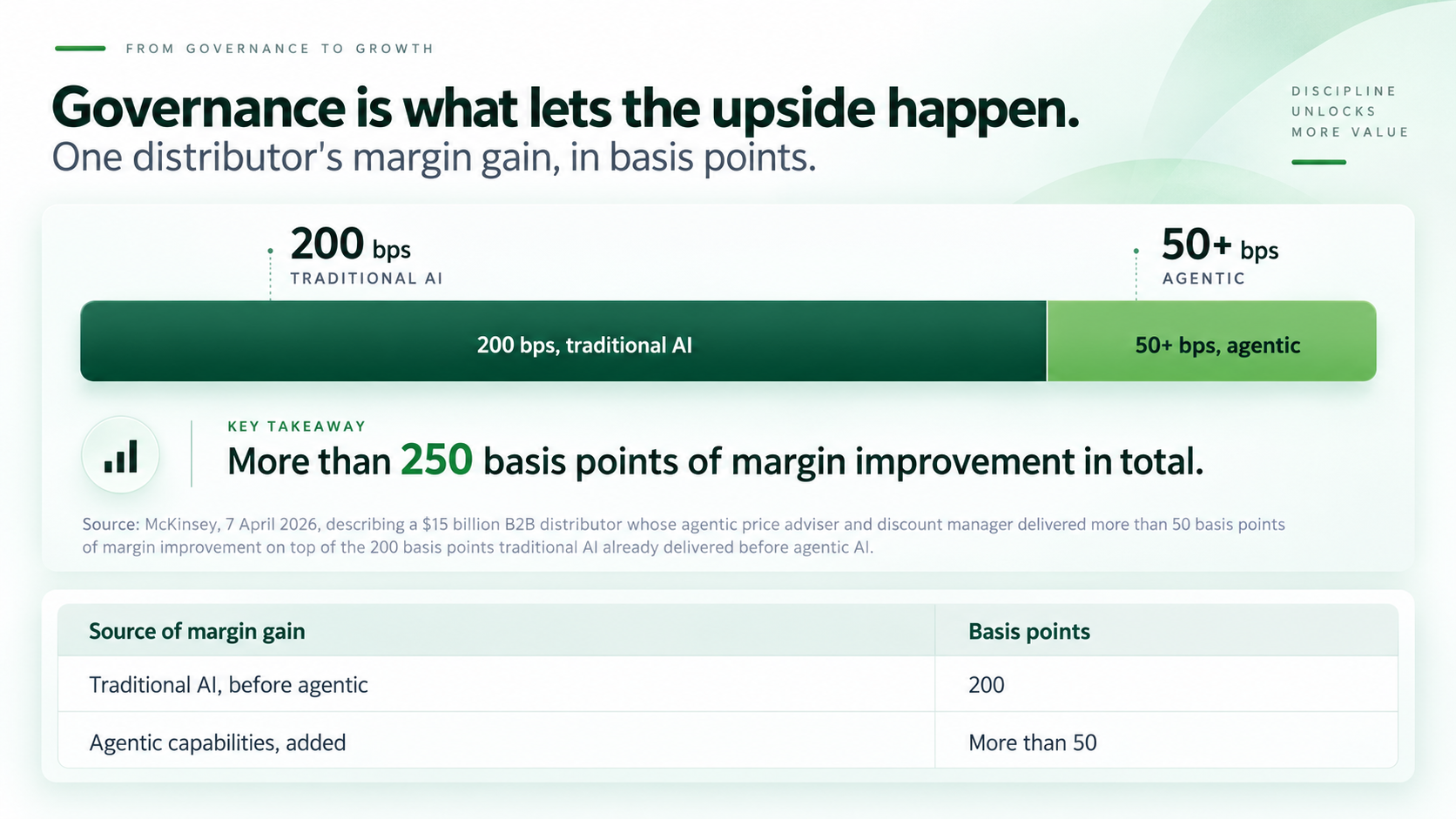
So the control objective is not restraint. Rather, it is to let the agent move fast inside clear authority. Good rules speed the agent up, and slow it down only where a person has to look.
What happens when the buyer’s agent negotiates?
Your agent is not the only one in the room. Deloitte surveyed more than 1,000 US suppliers and buyers in 2026 and found that “nearly 40% of B2B buyers already use agentic AI in purchasing”, including for “benchmarking prices.”
In April 2026, Google donated its Agent Payments Protocol to the FIDO Alliance. The protocol now covers “Human Not Present” payments, which “will allow agents to securely execute payments autonomously”. In June 2026, Mastercard launched Agent Pay for Machines. Mastercard says firms “can set authorization rules and spending limits that are programmatically enforced, ensuring transactions stay within defined parameters”.
Treat both as emerging standards, not as plumbing already in the ground. Neither says who has taken it up, or how far. Still, the payment rail is gaining limits a machine can hold. The price that travels over that rail is not.
That is the gap AI agent pricing governance has to fill. A buyer’s agent may hold a hard cap on spend. If your side holds no hard floor on price, the two are not evenly matched. So write your floor down, and put it where a machine can read it.
Who owns each control?
Not one function, and not sales alone. Sales can ask for an exception and argue for it. It should not hold the right to approve one by default. BCG’s June guidance for finance functions agrees. “AI executes and humans are accountable. Decision rights must be explicitly defined.”
It adds that segregation of duties “must be preserved in agentic design.” Treat the table below as a reference model rather than a universal RACI. Each company still has to name its owners and set its sign-off limits.

Does a human approver fix this?
Only under conditions. Gartner’s four autonomy levels run from observe and advise, through act with approval, to act alone. It also warns that without “clear approval workflows with audit trails, and agent-specific incident response procedures, approvals can degrade under time pressure or approval fatigue, creating a false sense of safety.” A June 2026 preprint that models a reviewer who tires as the queue grows finds an inverted U, in which “more human oversight can make a system less safe”.
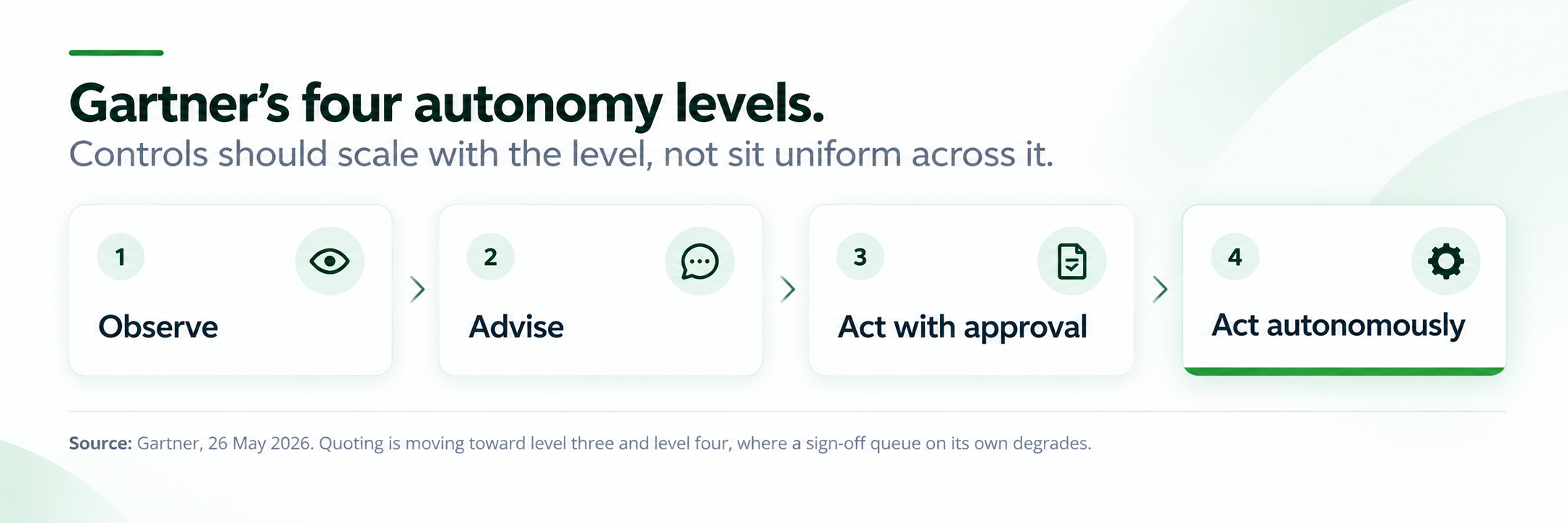
So a human gate means something only under four conditions. The reviewer has to see the rule that was broken, the money at stake, the context that matters, and how long the exception lasts.
What does the exposure actually cost?
Separate three things that often get rolled into one number. Every figure below is illustrative.
Quoted control exposure. Annual quoted list value, times the non-standard share, times the unauthorised discount gap. This is value exposed to a rule gap before win rate or accounting effects.
Realized concession on won deals. Quoted control exposure times the win rate. This estimates price concession on signed deals if mix and volume hold.
Gross margin and lifetime effect. Model cost-to-serve, volume, term, renewal, indexation, and churn. You cannot infer this from a discount gap.
Take a hypothetical enterprise quoting $500M of list value a year across three legal entities. Assume authority of 20% for a rep and 30% with director approval. Put 15% of quoted list value in the non-standard book. Then assume the deal history the agent reads carries an average concession of 28%.
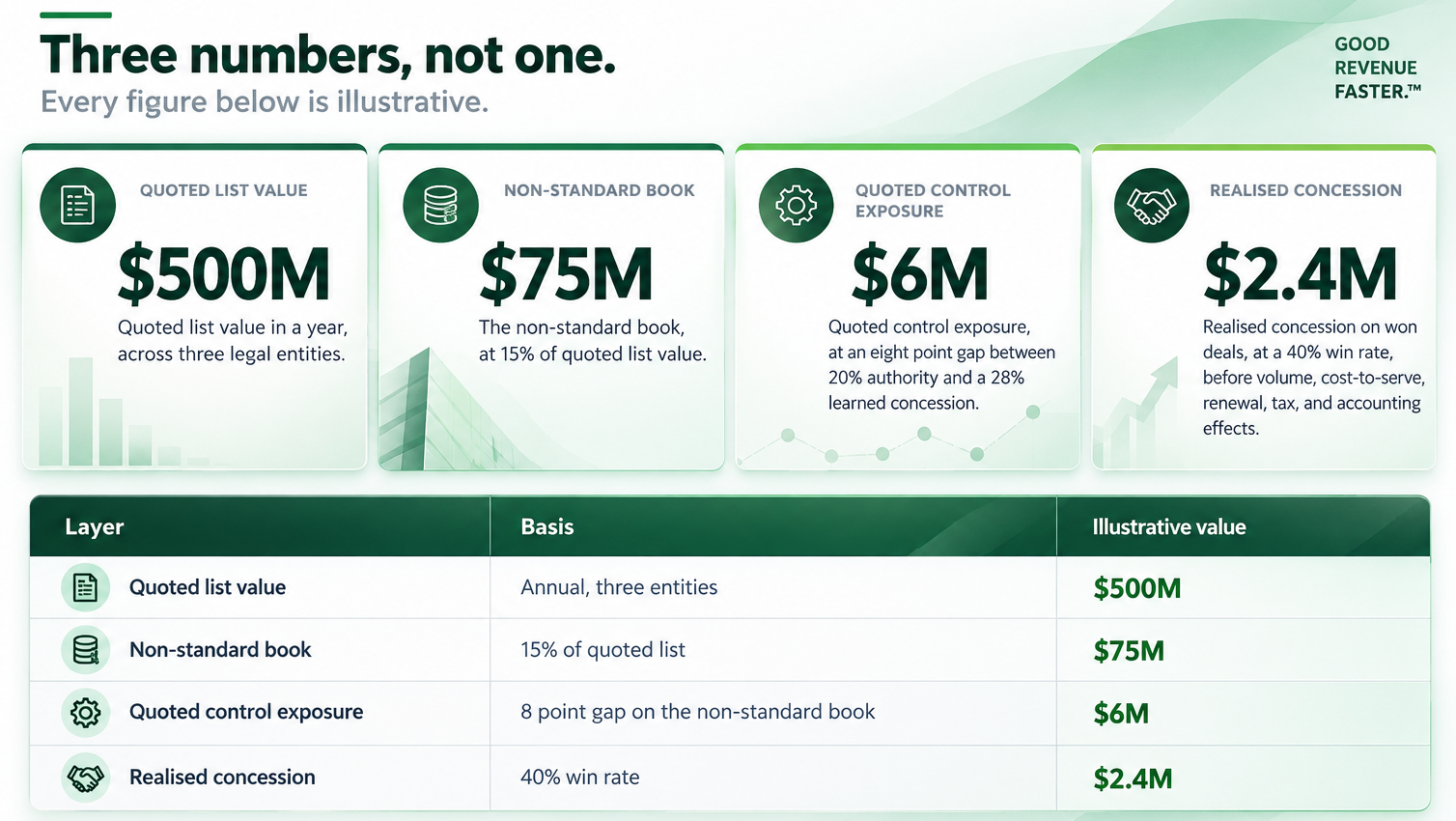
Eight points of gap on $75M is $6M of quoted control exposure in a year. At a 40% win rate, the realised concession would be about $2.4M. That is before volume response, cost-to-serve, renewal, tax, and accounting effects. Now run the same three lines on your own book.
The arithmetic is not the point. The gap has a size you can work out, and that is what makes AI agent pricing governance a budget item rather than a worry.
One caution on the denominator. A discount percentage only means something if the list price is current and controlled. A stale or inconsistent list price makes the percentage a poor measure of authority or leakage.
What would an auditor actually do with this?
Less than the arithmetic suggests, and more than nothing. An unauthorized discount path is a control issue to assess, not automatically a material weakness or a public reporting matter. Its severity turns on the risk and likely size of misstatement, on the design and daily operation of the control, and on any compensating controls. The immediate test is narrower. Can the company show that the approval control worked as designed?

Talk to a CPQ Architect
The four-question test, and the gate before it
These are the deal desk’s tests. Run them while the desk still holds the answers, because an agent will inherit whatever it finds. Start with the gate, because it decides whether the other four matter. The whole run takes an afternoon, and most of it is chasing people for reports.
Gate. Can any human, integration, or agent publish, send, or write back a quote without passing the same commercial policy check? If yes, your control is advisory. Then the questions below measure a document rather than a system.
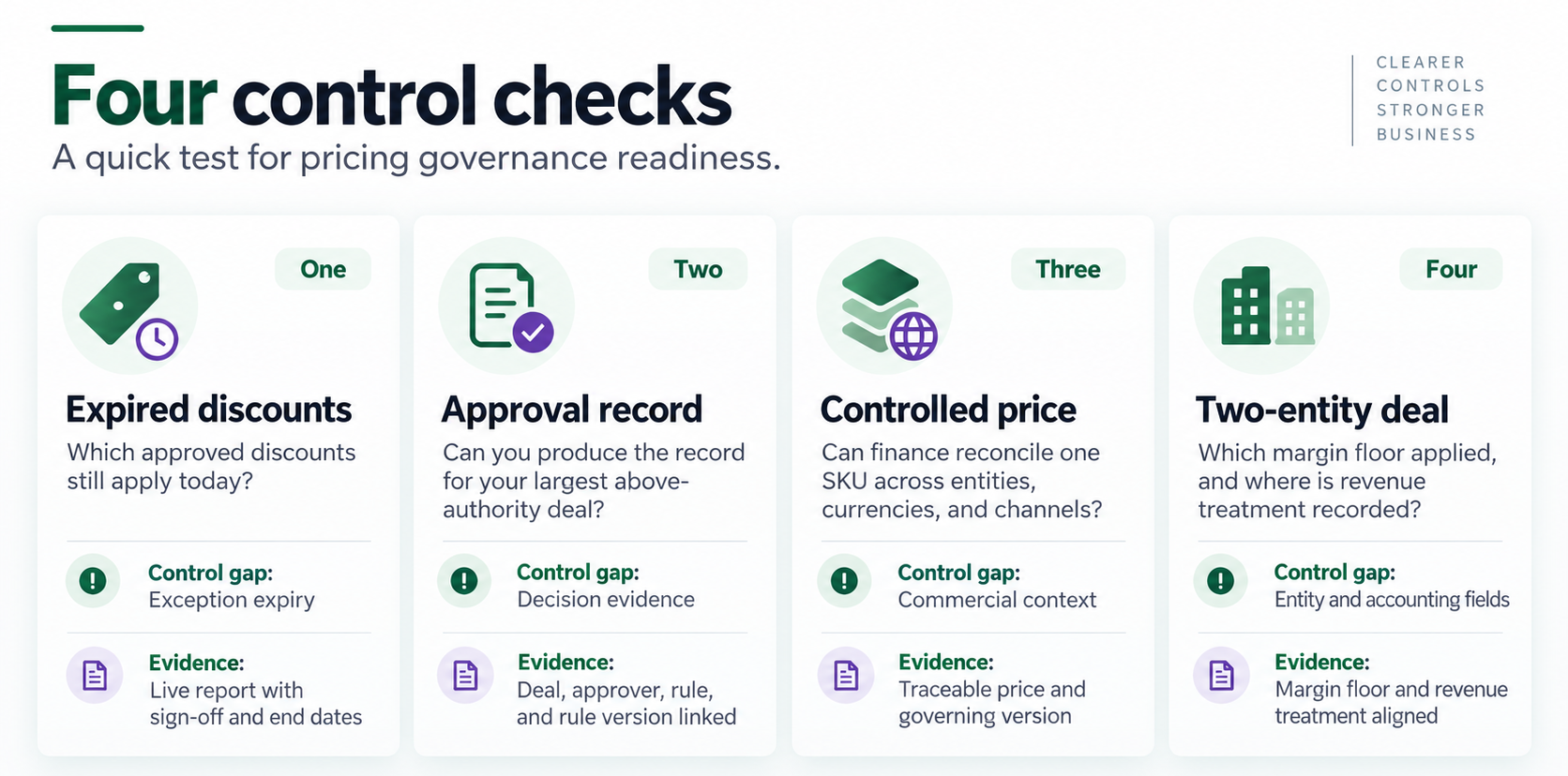
One. Which discounts approved last year still apply today? The control gap is exception expiry. The evidence is a report of live discounts with sign-off dates and end dates. If someone has to build that report by hand, expired exceptions are live precedent.
Two. Can you produce the approval record for your largest above-authority deal without asking a person? The control gap is decision evidence. The evidence is a record linking the deal, the approver, the rule, and the rule version. If it is an email, you cannot run the check again once the approver leaves.
Three. For one SKU, can finance reconcile the controlled price across every entity, currency, channel, segment, and start date? And can it say which version governed the quote? The control gap is commercial context. Different prices are legitimate. Untraceable ones are not.
Four. For a deal spanning two legal entities, which margin floor applied? And where do you record the revenue treatment? The control gap is entity and accounting fields. If two systems disagree, so will the agent and the auditor.
Those five answers are the whole of AI agent pricing governance in practice. Each one is either a fact you can pull from a system, or a story you get from a person.
How should you score it?
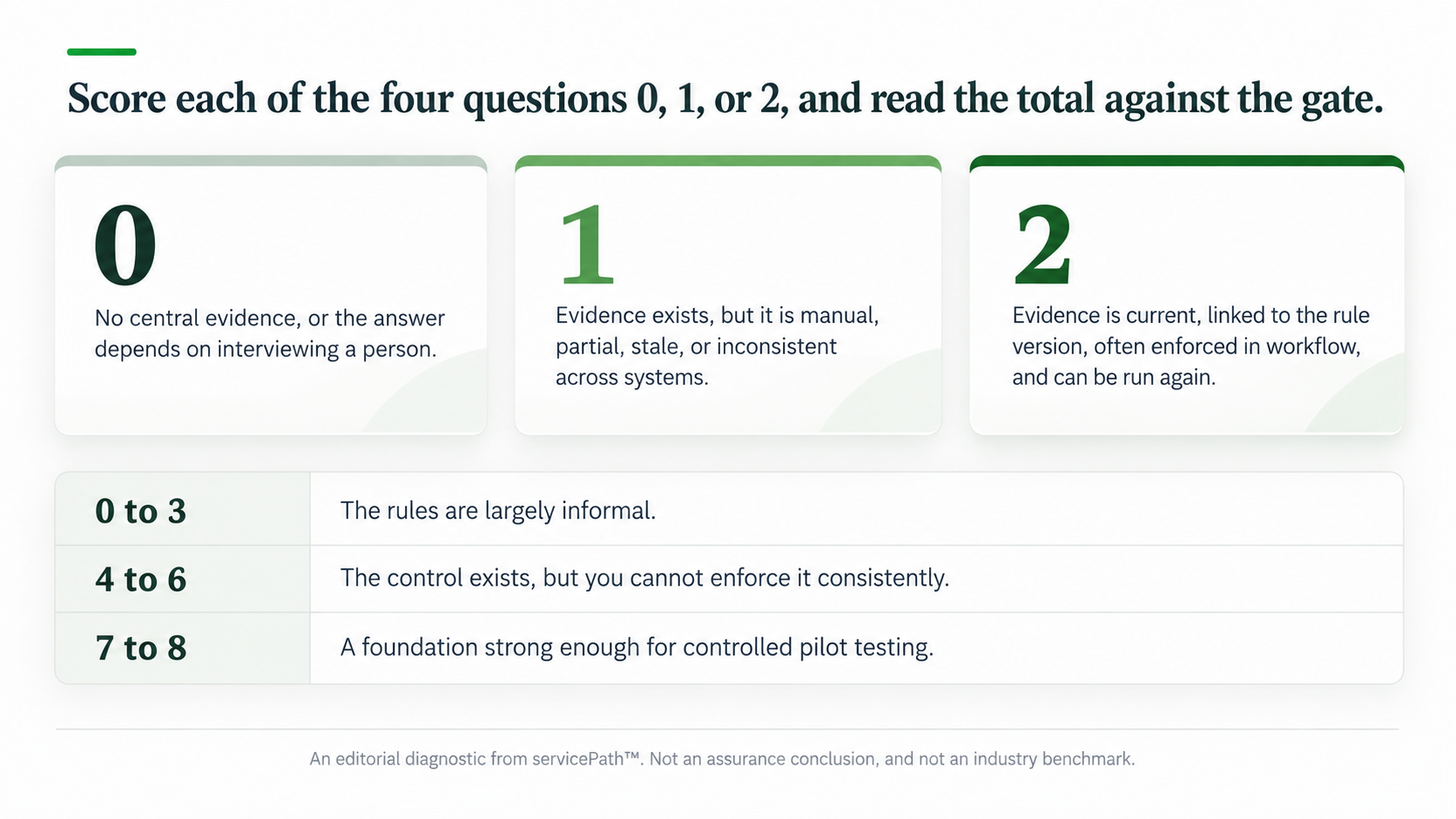
Score each answer 0, 1, or 2. Zero means no central evidence, or the answer depends on asking a person. One means evidence exists, but it is manual, partial, stale, or at odds across systems. Two means the evidence is current, tied to the rule version, enforced in the workflow, and easy to run again.

Then do three things in order. First, write the authority down, with named owners and sign-off limits from the reference model above. Second, put that description at one enforcement point that every quoting path passes through. Third, make every decision easy to run again, with a rule version and an expiry on every exception.
That also answers the question in the title. Neither the desk nor the agent should control the price. The written rule should, and both must pass it.

Gartner has positioned servicePath™ as a Visionary in the Magic Quadrant for Configure, Price and Quote Applications for four consecutive years.
Frequently asked questions
Is commitment governance just CPQ?
CPQ can be the enforcement layer, but only under four conditions. First, the rules have to carry a version. Second, every human and agent path has to route through it. Third, exceptions have to carry an expiry. Fourth, you have to be able to run the decision again months later. A CPQ system that routes approvals without recording the rule in force is a queue, not a control.
Can we just keep a human in the loop?
Only if the loop is designed. Approval means something when the reviewer sees the rule that was broken, the money at stake, and how long the exception lasts. Gartner’s warning about approval fatigue applies directly here. A queue of undifferentiated approvals produces fast clicks, not judgement. So design the workflow to surface the few decisions that deserve a person.
Our agent platform will add policy-as-code for commercial actions. Does that cover this?
It gives you the enforcement point, which is the right instinct. A June 2026 preprint on policy-as-code found that prompt-based guardrails “offer no formal guarantees”; in its tests a compiled policy blocked prohibited actions where the unguarded baseline blocked none.
But your finance and pricing teams still have to write the rules, version them, and keep them current across every system an acquisition brought in. That is the hard half of AI agent pricing governance, and no vendor can do it for you. So ask the vendor one thing. Which component decides whether a 31% discount in your German entity on a four-year term is authorized, and where does it store that rule’s start date and approver?
Talk to a CPQ architect
Bring your gate answer and your four scores. A servicePath™ CPQ architect will walk through which of your systems hold a version of your discount authority, where they disagree, and what a single enforcement point would involve. If you scored eight with a clean gate, you will hear that too.
Find out which system holds your discount authority.
A servicePath™ CPQ architect will walk through where your rules live, where they disagree, and what a single enforcement point would involve.
Related reading
On the argument: what we mean by a commercial control plane, who owns the price when an agent quotes it, and why this quarter’s discount authority is next year’s audit file.
On the evidence layer: immutable audit trails in CPQ.
Every term used here is defined in the servicePath™ glossary, and customer evidence is on the case studies page.