
Executive summary
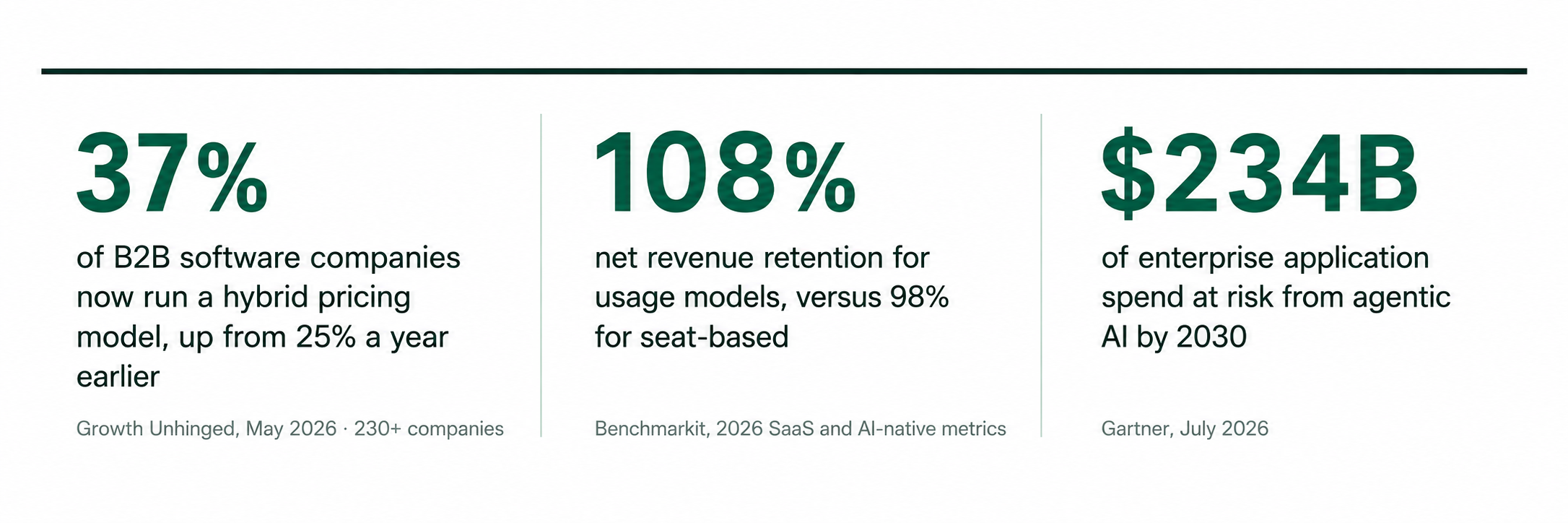
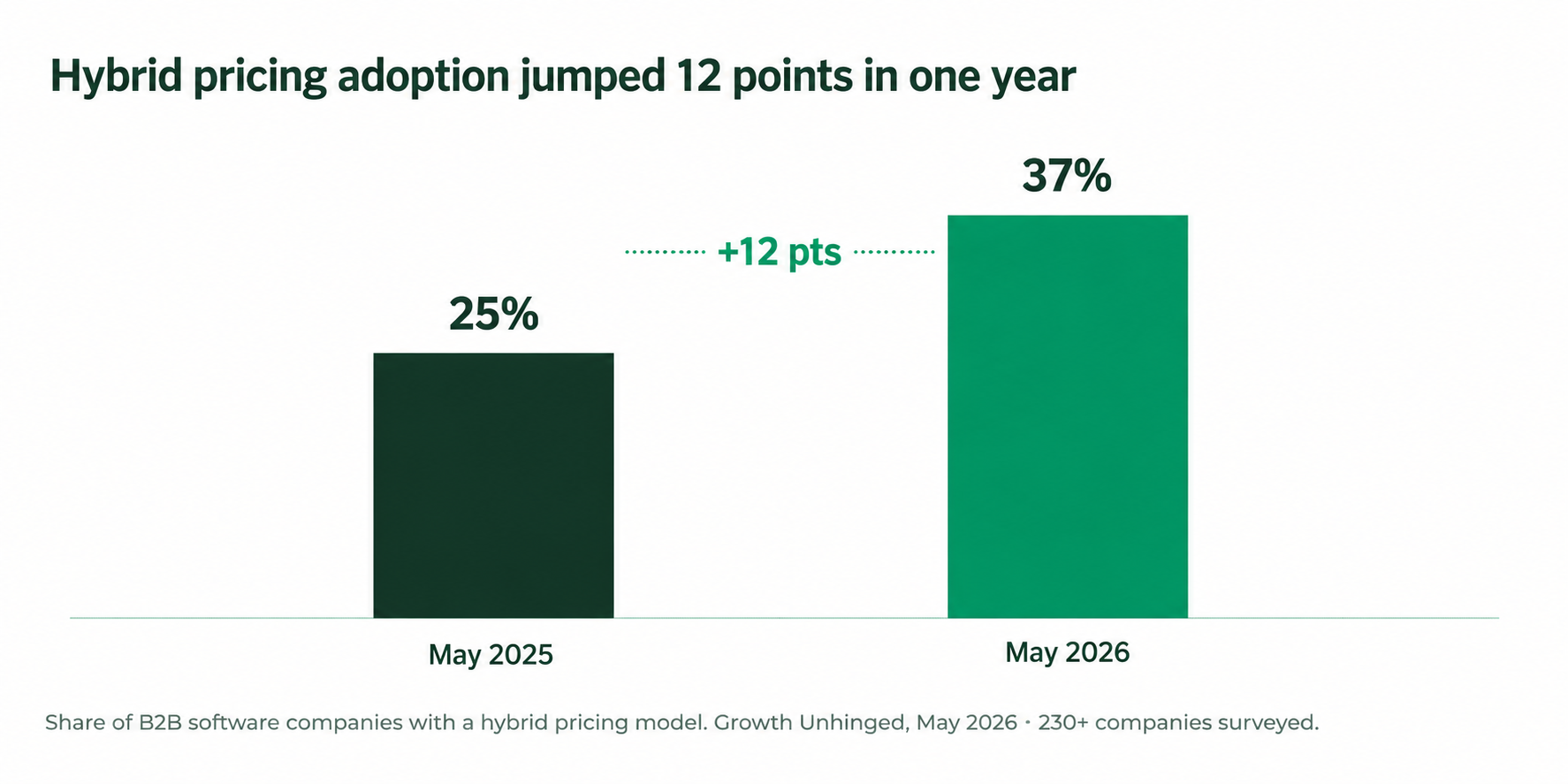
Hybrid pricing won the argument. In the twelve months to May 2026, the share of B2B software companies running a hybrid model went from 25% to 37%, per Growth Unhinged’s survey of 230+ practitioners, and Benchmarkit’s 2026 metrics put net revenue retention on usage models at 108% against 98% for seats. The adoption case is settled. What is not settled is who pays for the governance it requires, and when.
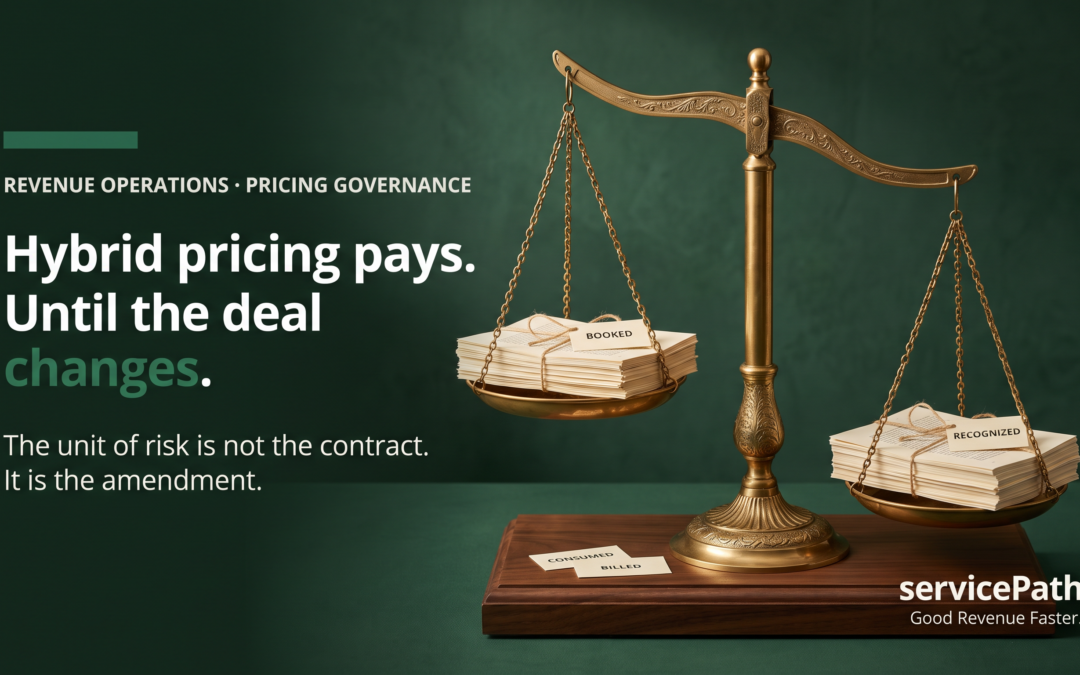
Here is what the model debate skipped. The unit of risk in hybrid pricing is not the contract. It is the amendment. Ramp schedules, usage tiers, and mid-term changes create competing versions of the same deal, and few quote-to-cash stacks hold booked, billed, recognized, and consumed in one line of sight. Count your amendments per quarter. That number is your audit surface and your forecast error surface.
In its April 2026 Spotlight, the PCAOB reported that audit committee chairs consistently named revenue recognition as a fraud risk, citing its complexity and its openness to manipulation.
Below: where hybrid contracts break, a 24 hour test you can run on one of your own amendments this week, and the fix. Every market source is dated 2026.
If you would rather run the test and grade the result with someone: Talk to a CPQ architect
The market picked hybrid pricing. Nobody asked the back office.
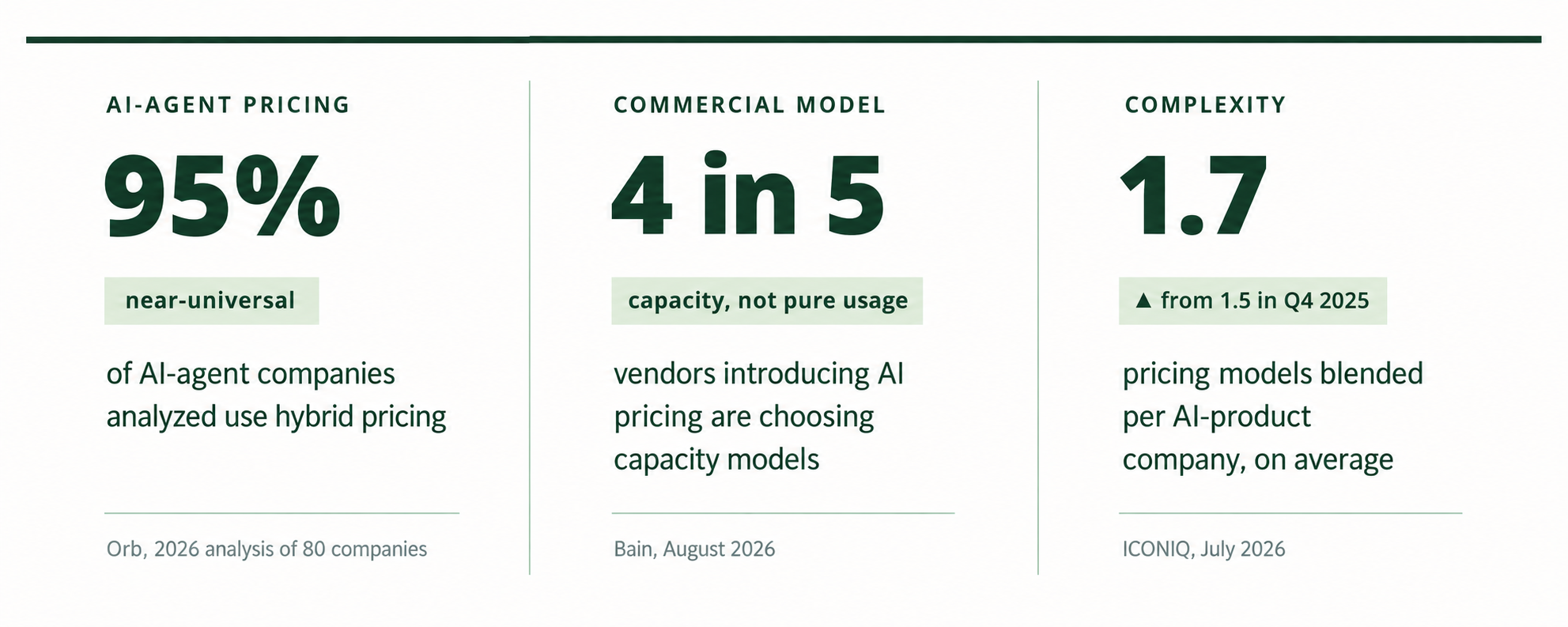
The model debate is all but over. Growth Unhinged’s May 2026 report found another 29% of companies letting customers choose between multiple pricing models, up from 21%. And per ICONIQ’s July 2026 data, companies building AI products now blend 1.7 pricing models at once. The money is voting for the model with the most moving parts.
What is hybrid pricing?
Hybrid pricing is a commercial model that pairs a fixed subscription base with a variable component priced on usage or outcomes in the same contract. The label hides several structures:
- A platform fee plus metered consumption
- Credits plus overages
- Committed capacity plus a true-up
- Seats plus an AI allowance
- A subscription plus outcome fees
Each creates different forecasting, billing, and accounting questions.
Hybrid pricing vs usage-based pricing
Usage-based pricing bills on metered consumption alone; hybrid pricing keeps a committed subscription floor under the meter, so the customer gets budget predictability and the vendor protects a revenue base. Bain’s August 2026 analysis separates the meter (effort, output, or outcome) from the commercial model (direct usage or committed capacity), and much of what the market calls usage-based pricing is capacity pricing with an allowance and an overage.
The oldest hybrid contract in the market
This article reads like a SaaS story. The pattern is older than SaaS. Service providers have run hybrid pricing for decades without calling it that: a fixed monthly recurring charge, plus metered consumption, plus time and materials, plus one-time install and professional services, with SLA credits running the other direction. A managed services contract is the original hybrid deal.
An amendment to a service contract moves cost to serve, not just price: add a site, change a device count, upgrade an SLA tier, and margin moves even when the price does not.
Parent MSAs and child SOWs drift apart on renewal dates nobody tracks. SLA credits are refunds you must estimate before you owe them, variable consideration in reverse, which drags them into the same ASC 606 and IFRS 15 questions. And with third-party pass-through (circuits, hardware, resold licences), margins are thin enough that a rating error is not a dent. It can run as negative margin for the remaining term.
It is the contract shape behind the Telent story in the proof below. If you sell services, read everything twice.
AI natives sprint, incumbents hedge with hybrid pricing
The same Bain analysis found only about one in five AI-native software companies still relying mostly on per-seat licensing, and “about four out of every five vendors introducing AI pricing are choosing capacity models.” Bain’s field note is the one to underline: vendors find outcome-based deals “complex and time-consuming to negotiate, and difficult to bill at scale.” The pricing innovation is outrunning the machinery that negotiates and invoices it.
Bessemer’s February 2026 playbook adds the deadline: many of those contracts hit their first renewal cycles in 2026, where pricing has to reflect “actual value, not merely potential or promise. And Gartner’s July 2026 analysis puts up to $234 billion of enterprise application spend at risk from agentic AI by 2030. When the seat stops being the unit of value, the meter takes over. And the meter has to be governed.
So the model got more variable, the metering more granular, and the pricing tooling is being rebuilt mid-flight. Together they are a governance problem wearing a growth costume.
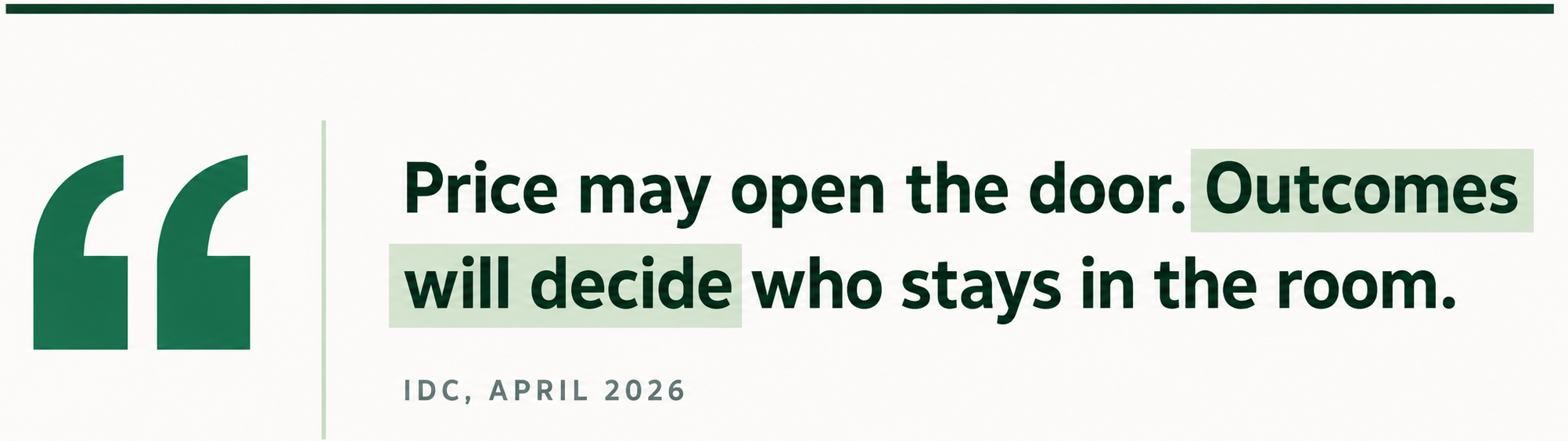
The trade nobody wrote down
I will concede the upside first, because it is real. Hybrid pricing gives the customer a floor they can budget and a meter that tracks value, and Benchmarkit’s 2026 metrics back it: usage models retain revenue at 108% versus 98% for seat-based.
Their conclusion: “Pricing architecture is not a neutral commercial choice. It determines whether revenue compounds or decays.”
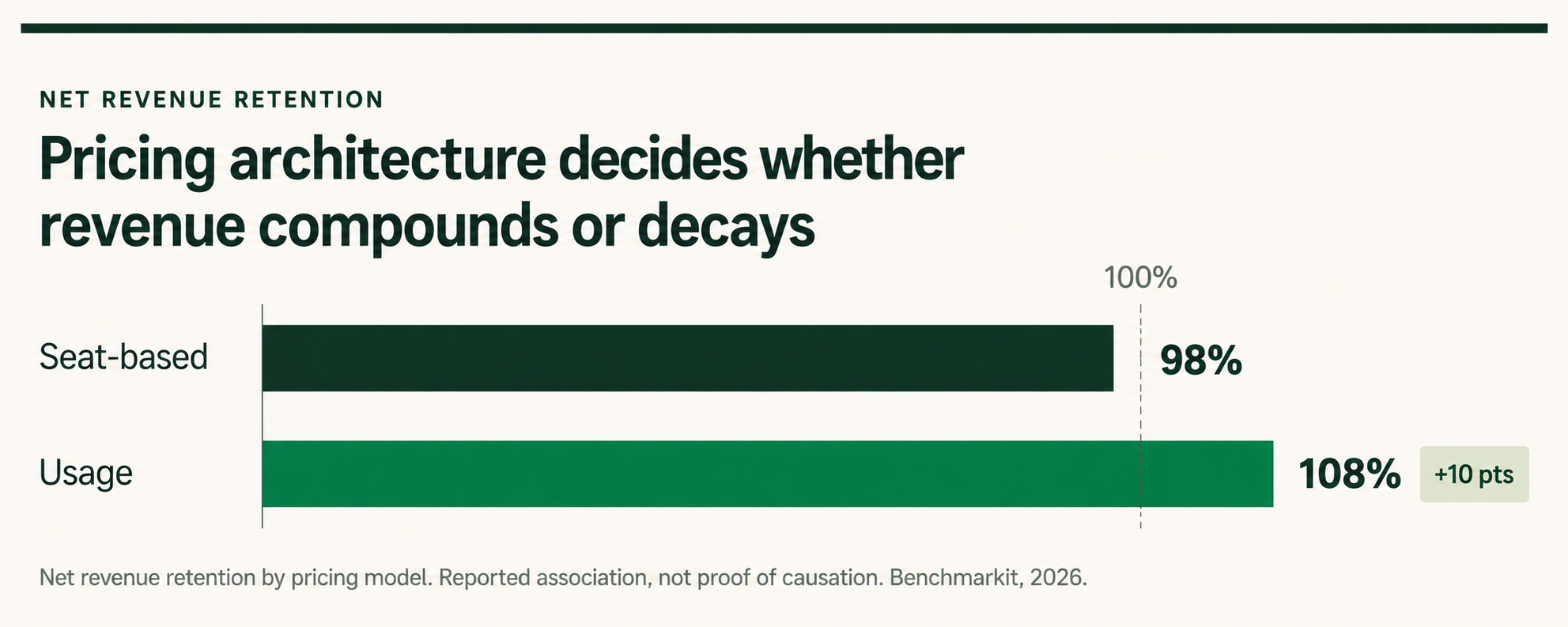
The caveat: Benchmarkit measures usage models against seat models, not hybrid directly, and it is an association, not proof that changing the meter causes retention. Products that expand naturally through usage may simply have stronger economics to begin with. The defensible version is narrower: hybrid pricing can align price with realized value and open an expansion path. It earns that upside only when customers understand the meter, can forecast their spend, and trust the invoice.
The condition in the fine print
Samantha Greenberg, CFO of AlphaSense ($600M+ ARR), told CFO Dive in July: “as we evolve towards consumption business model, consumption pricing, it’s very important to have the data science and the forecasting infrastructure that supports being able to price and package our product.”
The CFO adopting the model names the infrastructure as the precondition, not the afterthought.
Hybrid pricing did not remove the forecasting problem. It moved it into your deal desk, your close, and your renewal motion.
So write the meter specification before launch, in language a customer, an engineer, and a controller can all read:
- The meter itself: billable event, unit, source, aggregation window, duplicate rule, late events, corrections, dispute path.
- The commercial behavior around it: allowance, rollover, overage, cap, true-up, amendment effective date.
Stripe’s own billing documentation treats meters, event recording, and aggregation as distinct components. If a buyer cannot recreate a sample charge from the usage report and the contract terms, the commercial design is unfinished.
Even the usage-billing vendors say so. Metronome, June 2026: “Auditors don’t accept black-box usage estimates anymore.”
So steal their test question: can you trace a line item on a $100k enterprise invoice back to the usage events that generated it? Every clause in a hybrid contract is rational. Every one of them is another moving part your quote-to-cash stack has to govern for three years.
Where hybrid pricing actually breaks
Not at signature. Signature is the easy day. The quote is where control gets installed; the amendment is where you find out whether it was. Hybrid pricing breaks in month seven, when the deal changes shape and your systems disagree about what it changed into.
Three ledgers, drifting. And a fourth.
A ramp contract with seat expansion. A usage tier that kicks in mid-term. An amendment that changes both at once. After the ink dries, that deal exists in three places: the terms that were booked, the invoices that get billed, and the revenue that gets recognized. In a governed stack, those three reconcile on demand. Ungoverned, they drift.
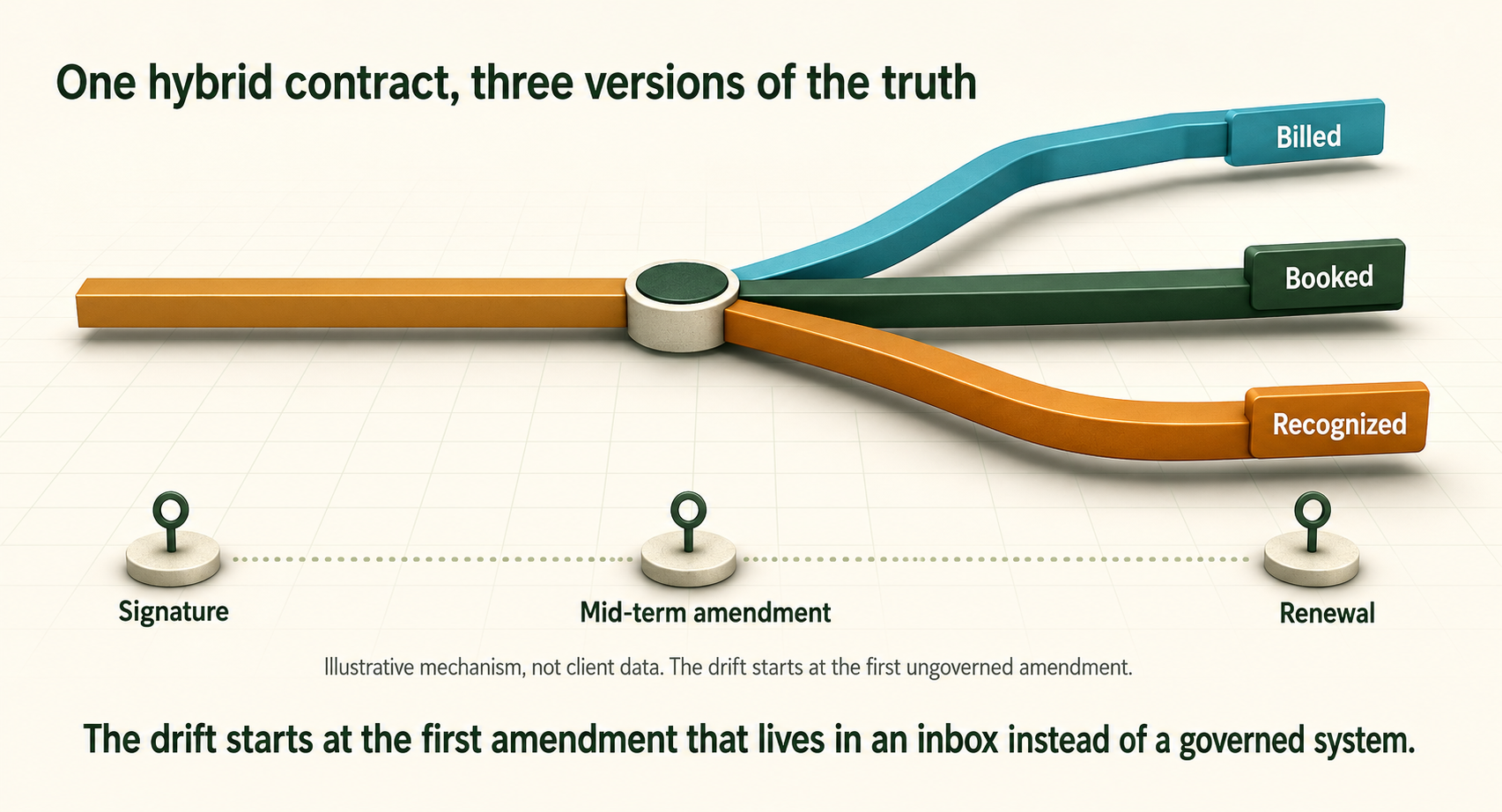
And a hybrid deal has a fourth record the three-ledger view misses: entitlement and consumption. Booked, billed, and recognized can reconcile to one another and still be wrong, because the usage record underneath was incomplete, duplicated, late, or priced against an outdated entitlement.
It is why Stripe’s billing documentation and AWS Marketplace’s metering service treat usage events and dimensions as first-class records. So the control objective is what we at servicePath™ call the four-record model: booked (what the customer agreed to), consumed (what they could and did use), billed (what they owe), and recognized (what finance recorded).
Those records do not have to live in one application. They need shared identifiers, effective dates, and a reconciliation that repeats. One system is an implementation preference. One governed chain of evidence is the requirement.
You know the shape if you run finance or the deal desk. Controls cover the contract at signature. The amendment path is where control walks off: the side letter, the non-standard true-up, the exception approved in a thread. When the auditor asks for the trail, the honest answer starts with “let me reconstruct that.”
The amendment is the unit of risk
Here is the reframe that took me too long to see. The unit of risk in hybrid pricing is not the contract. It is the amendment. The deal creates the exposure every time it changes shape and the change lands somewhere ungoverned. So count your amendments per quarter. That number, not your contract count, is the true size of your governance surface.
Then give the surface an owner. Product owns the meter, finance owns guardrails and policy, engineering owns event integrity, revenue operations owns execution. One executive still owns the end-to-end chain, because shared participation without a single owner is how the chain fails. Then measure it:
- Amendments per quarter
- The share needing manual intervention
- Quote-to-invoice variance
- Unbilled or disputed usage
- Time to reconstruct an amended deal
If you sit in the revenue seat rather than the finance seat, the same count is your forecast error. Every ungoverned amendment is a delta between what the CRM says renews and what the customer thinks they signed.
What the drift costs
The leak is quiet. It shows up eighteen months later as margin erosion nobody can explain, baked into revenue you already reported (the CRM-to-ledger version is its own article). And the drift is not only an audit problem. The 2026 renewal wave lands on companies whose own systems disagree about what the customer bought. Your renewal rep cannot defend a price they cannot reconstruct, and the customer’s procurement team only needs to be right once.
Put a number on the hybrid pricing gap
Illustrative numbers. Real mechanism. One disclosure first: no top-tier firm has published a 2026 revenue leakage benchmark, and I will not pretend one exists. So build the number from assumptions you can argue with.
Take a hypothetical SaaS company: $900M ARR, with 40% of the book on hybrid pricing contracts. That is $360M of revenue carrying ramp schedules, usage tiers, and amendment risk.
Now assume just 1% of that book leaks through contract-to-invoice mismatch, unbilled true-ups, and amendments that never reached billing. That is $3.6M a year, quietly, in revenue that never had a chance to hit the P&L. If you have never measured the rate, assume 3%, still hypothetical: $10.8M a year.
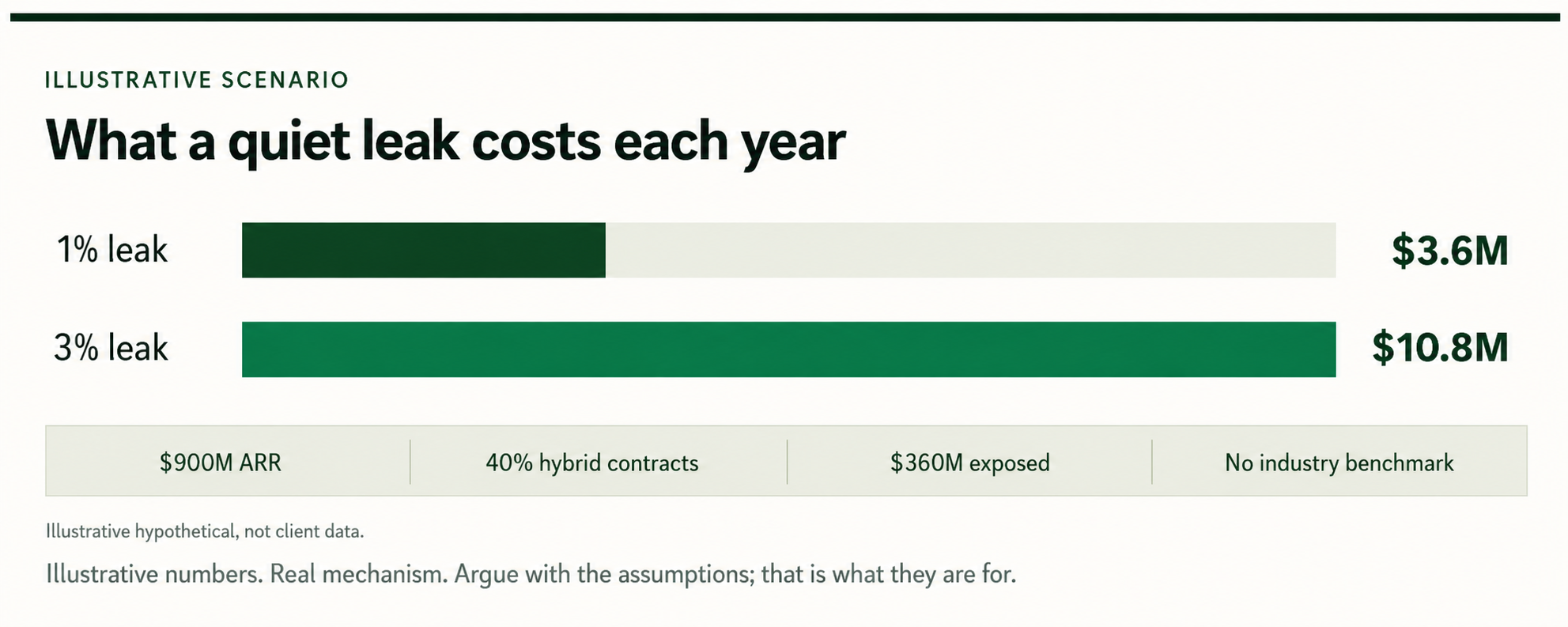
Argue with my assumptions. That is what they are for. And if your board thinks in multiples, apply yours. At an illustrative 6x, the 1% leak is $21.6M of enterprise value. The leak scales with amendment volume, not headcount, so growing faster makes it worse.
Your auditor already flagged this
First, the number that argues against me. Restatements fell 18% in 2025, to 391, the second-lowest count in twenty years, per Ideagen Audit Analytics data reported in June 2026. The risk is showing up as scrutiny before it shows up as restatements.
Revenue recognition is on the audit committee’s list
The PCAOB’s April 2026 Spotlight reports what audit committee chairs told the regulator’s staff: they “consistently flagged revenue recognition as an area of fraud risk due to its complexity and susceptibility to manipulation.”
Now the accounting reality. Hybrid pricing does not create one automatic revenue recognition answer. Under IFRS 15 and ASC 606, the analysis depends on the contract’s promises, how variable consideration is constrained and allocated, and what each modification does to enforceable rights.
The same amendment can be a separate contract, a termination and a new contract, or a cumulative catch-up adjustment. Deloitte’s June 2026 Technology Spotlight walks through exactly these judgments for outcome-priced agentic software and concludes the new models introduce “new and complex accounting questions.”
Every pricing model decision is now an accounting policy decision. Your product team shipped a usage meter. Your finance team inherited an analysis that has to survive an inspection, built from whatever commercial record your quote-to-cash stack kept.
AI speeds up the front of the funnel. The auditor does not care.
The instinct in 2026 is to point AI at the governance mess. But watch the CFOs deploying it. Deloitte’s Q2 2026 CFO Signals found 59% of CFOs naming the same top AI governance challenge: balancing pressure to deploy quickly against managing risk. Gary Bischoping, CFO of Thomson Reuters, drew the line in August 2026: “If I can’t understand it, I can’t explain it, and I won’t use it. Governance has to be built from the start.”
A model that is right 95% of the time is a miracle in a sales motion and a liability in a close process.
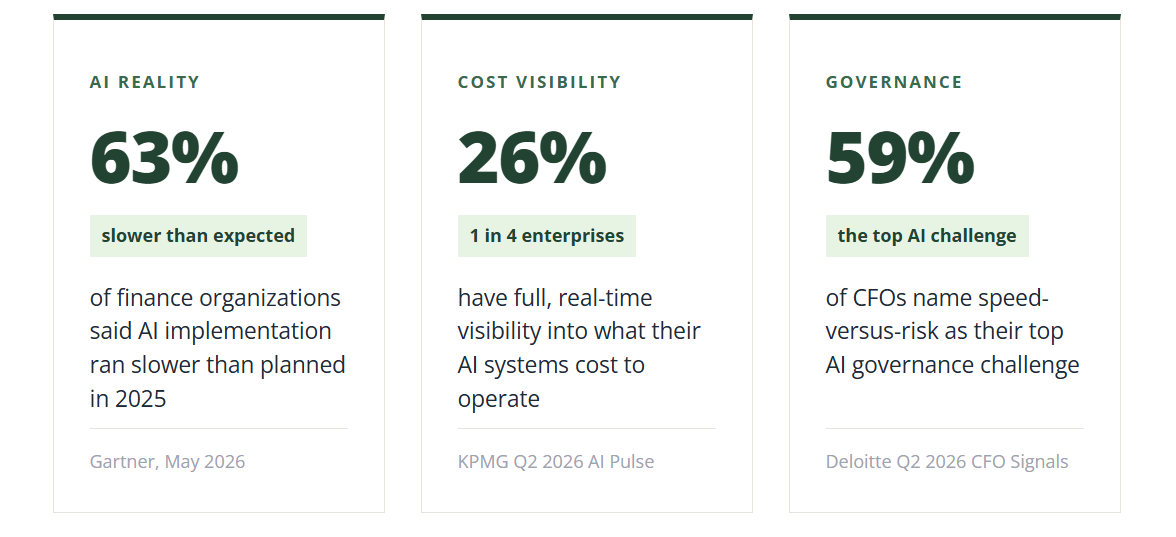
Which layer is allowed to guess
“Make it all deterministic” overreaches too. AI can extract clauses, summarize amendments, route approvals, and flag unusual usage. Monetary calculation, authorization, and posting require deterministic rules and accountable review: same inputs, same answer, provable after the fact. And some conclusions, like which accounting treatment a modification triggers, still require human judgment. The useful architecture is AI operating inside controls: probabilistic assistance at the edges, governed transactions at the core, people with authority deciding the exceptions.
The 24 hour amendment test
Do not take my word for any of this. Run the test instead.
Pick one contract your team amended mid-term last quarter. Then ask for the four records, reconciled, inside 24 hours:
- The booked terms, as amended
- The consumed usage against the amended entitlement
- Every invoice generated since the change
- The revenue recognized against it
Plus the approval trail for the change. Selling services? Ask for a fifth record: the cost to serve, as amended. Most teams I ask cannot produce it.
Then grade what comes back. If it arrives in an hour from one system, stop reading. You have this handled. Two systems with a controlled, repeatable reconciliation also passes: the test is whether the same query returns the same answer next week.
If it takes two days, three tools, and a person who “knows where the bodies are buried,” that is your governance gap, found while it is still cheap. A failed test is not a material weakness. It is the control warning you would rather grade yourself than have graded for you, in an audit or in diligence.
Run it from the revenue seat too. Does the account team’s version of the amended deal match what billing thinks the customer owes, before the renewal call does it for you?
Most teams I ask cannot do it inside 24 hours. If yours can, I would like to hear how you built it. If yours cannot, the reconstruction you just watched is the gap. Talk to a CPQ architect and bring exactly what came back, in whatever state it came back in.
Why servicePath™
servicePath™ is an enterprise CPQ platform built to govern hybrid pricing deals from first quote through every amendment and renewal, around the amendment as the unit of risk. Proof, with the receipts linked: Dell EMC runs partner quoting on servicePath™, with complex proposal changes down from a day to “as little as 15 minutes” and a three-word verdict, “No more bad quotes.” Telent went live in eight weeks after a failed CPQ implementation. Gartner has named servicePath™ a Visionary in the Magic Quadrant for Configure, Price and Quote applications four consecutive years, the sole Visionary for the last three (2026 edition). Info-Tech’s SoftwareReviews rates it a 2026 CPQ Data Quadrant Champion. The rest is in the case study library.
The honest scope
Because you will check: servicePath™ governs the quote-to-cash layer: configuration, complex time-based pricing, deal economics, approvals, amendment lineage, and renewals. It does not replace a usage meter, a billing platform, a revenue subledger, a tax engine, or your auditor’s judgment. What it does is provide the structured, effective-dated commercial record those downstream systems depend on, captured when the deal changes, not reconstructed at close. A governed amendment trail is also an automatable control: one system for your auditor to test instead of thirty spreadsheets.
We do not stretch case studies: the customer evidence proves faster, more accurate, more auditable quoting, not a measured leakage reduction. If your pricing model has outgrown what your quote-to-cash stack can govern, this is the layer we were built for. Speed from AI. Certainty from servicePath™.
Hybrid pricing FAQs
Why does hybrid pricing complicate revenue recognition?
There is no single automatic answer. Under ASC 606 and IFRS 15, treatment depends on the contract’s promises, variable consideration, and what each modification does to enforceable rights. Deloitte’s June 2026 Technology Spotlight confirms the new models raise new and complex accounting questions, and every amendment reopens the analysis.
Can AI fix quote-to-cash governance?
AI accelerates the edges: extracting clauses, comparing documents, flagging anomalies. Calculation, authorization, and posting must stay deterministic, and accounting conclusions can require human judgment. The durable pattern is AI inside controls, not in place of them.
What is the 24 hour amendment test?
The 24 hour amendment test, a diagnostic for hybrid pricing governance, takes one mid-term contract change and asks whether the four records (booked, consumed, billed, and recognized) reconcile inside a day, with the approval trail attached. Fail it and you have sized your gap before your auditor does.
The bill arrives either way
Hybrid pricing is the right model for this market. The 2026 growth and retention data say so, and I am not going to argue with it. But the model’s economics are funded by governance that seat-based stacks were never built to provide, and 2026 is the year the invoices start arriving: the first AI-era renewal wave, with revenue recognition already on audit committees’ fraud-risk list.
You can close the gap in months (Telent did it in eight weeks), on your timeline, and take the upside with it: faster amendments, cleaner renewals, a forecast built on terms that match what the customer signed. Or you can meet the same gap in an audit or in diligence, on someone else’s timeline.
Bring us one messy amendment and we will show you what governed looks like, across booked, consumed, billed, and recognized.