
Gartner says 40% of agentic AI projects will fail. The missing piece is CPQ governance. Daniel Kube, CEO of servicePath™, explains why.
Executive summary
Gartner predicts more than 40% of agentic AI projects will be canceled by the end of 2027 due to escalating costs, unclear value, or inadequate risk controls.
Deloitte’s 2026 survey of 3,235 leaders found only 21% have mature governance for autonomous agents. A McKinsey survey of 400+ B2B pricing executives found just 5 to 10 percent have scaled agentic AI in pricing today.
The problem is not the technology. The problem is that enterprises are layering AI onto sales processes without a deterministic trust layer to govern what the AI can and cannot do.
CPQ was never a sales tool. It was built as an engineering and finance governance engine, and that role has never been more critical.
AI is not dangerous because it writes bad copy. It is dangerous because it can approve bad economics.
AI will not kill CPQ. Bad CPQ will kill AI.
The CPQ market in 2026 is drowning in agentic AI announcements. Salesforce says Agentforce for Revenue lets sellers generate quotes in seconds. Oracle says embedded AI agents in Oracle Cloud CPQ can accelerate quote-to-cash execution. Every vendor demo starts with an agent producing a quote faster than a human can read it.
Useful? Absolutely. Enough? Not even close.
Because the hard part in enterprise commerce is not generating a quote. The hard part is proving the quote should exist.
Can finance trust the margin? Can delivery trust the configuration? Can legal trust the terms? Can the executive team explain why that price, discount, bundle, and service commitment were approved?
That is the real CPQ governance conversation. Not quote generation. Commercial control.
The quote is no longer the asset. The governed commercial logic behind the quote is the asset. At servicePath™, our view is simple: AI writes the quote. servicePath™ governs the rules.
The $2.4M deal that exposes the problem
Let me make this concrete. Consider a $2.4M multi-year managed services deal. A three-year ramp with usage-based compute, tiered SLA pricing, and a mid-contract technology refresh clause.
What happens without governance
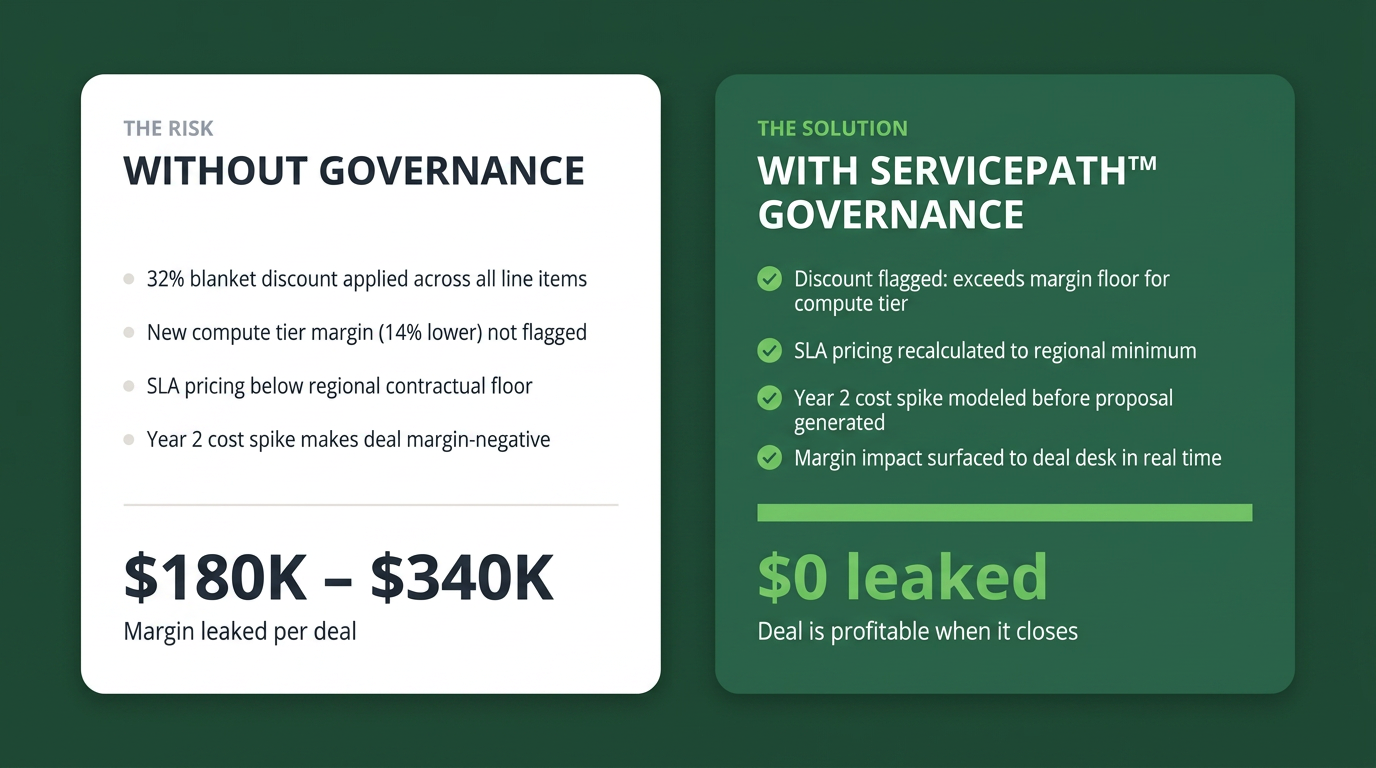
In an ungoverned AI scenario, the agent pulls the customer’s historical discount rate (32%), applies it across all line items, generates a proposal, and routes it for approval. The deal closes fast. Everyone celebrates.
Except the agent did not account for the fact that the new compute tier carries a 14% lower margin than the legacy tier. It did not flag that the SLA pricing was discounted below the contractual floor for that service region. And it did not catch that the technology refresh clause creates a Year 2 cost spike that turns the deal margin-negative.
The margin math
The margin delta on a deal like this is $180K to $340K over the life of the contract. Based on margin patterns observed across servicePath™ enterprise deployments in managed services, these gaps are common in ungoverned quoting environments.
Multiply that across 40 to 60 enterprise deals per quarter and you are looking at $7M to $20M in annual margin leakage that nobody sees until the CFO’s quarterly review.
A bad deal created slowly is a problem. A bad deal created instantly is a bigger problem.
What the same deal looks like with governed CPQ
In a servicePath™ governed scenario, the same deal runs through deterministic guardrails before the proposal is generated. The system flags that the compute tier discount exceeds the margin floor. It recalculates the SLA pricing against the regional contractual minimum. It models the Year 2 cost spike and surfaces the margin impact to the deal desk before the quote leaves the building.
The rep still moves fast. The governance happens in the background. The difference is that the deal is profitable when it closes, not just fast. (For the technical detail on how cost-first CPQ makes outcome-based pricing profitable, see Daniel’s deep dive.)

What is CPQ governance?
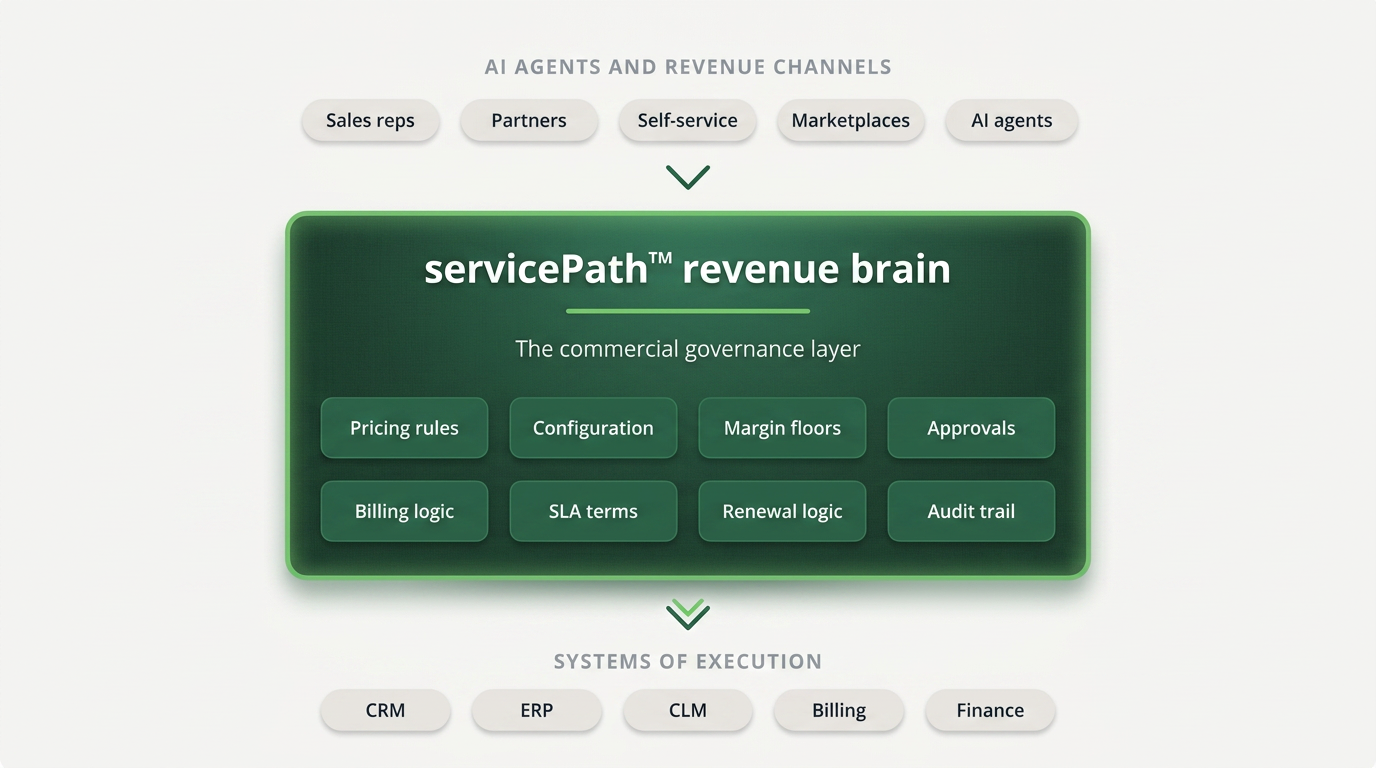
CPQ governance is the commercial control layer that governs pricing, configuration, approvals, margin, service commitments, billing logic, renewal obligations, and auditability before a quote becomes a customer promise.
That is why CPQ matters more in the age of AI, not less.
Gartner defines CPQ applications as software that helps sales organizations automate and optimize quote creation and order capture, while also addressing document creation, approval cycles, compliance, centralized tracking, audit trails, and reporting.
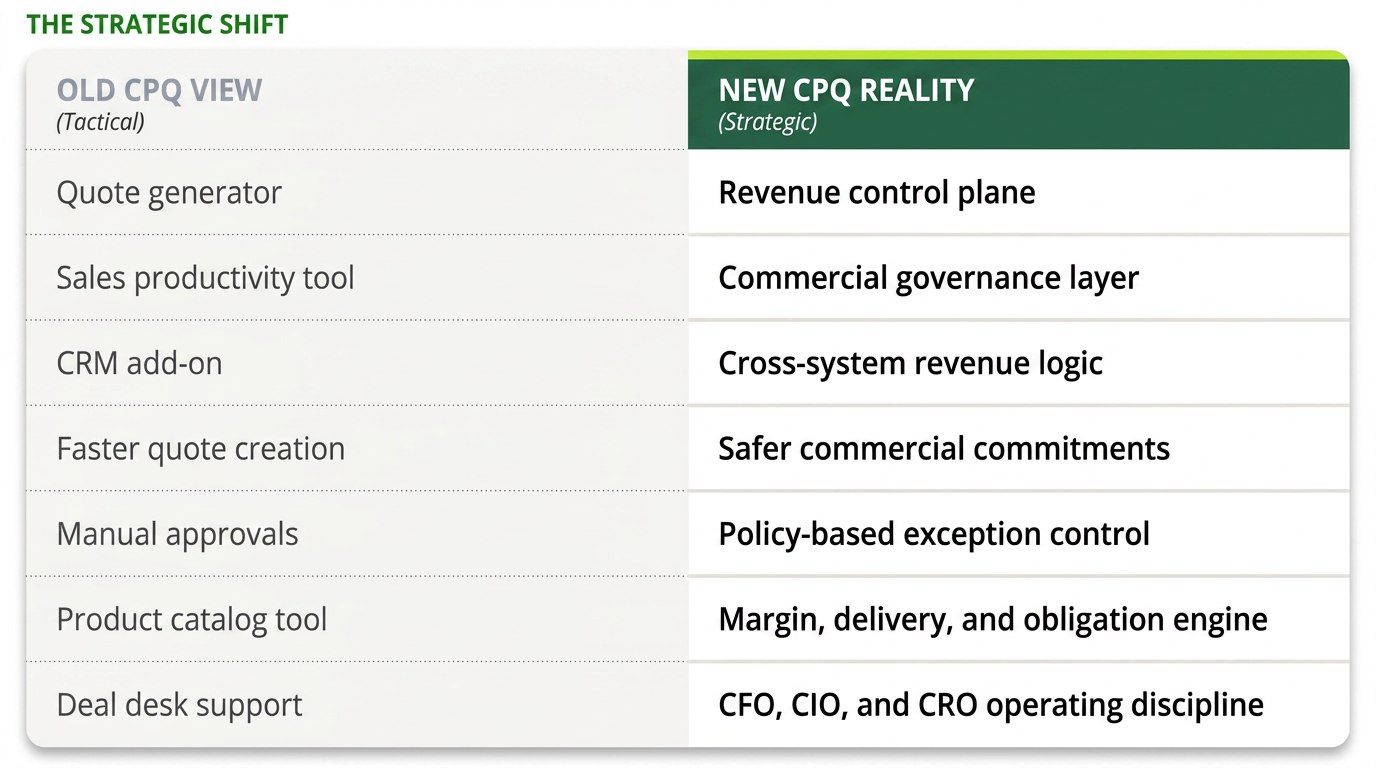
The shift from quote generation to commercial control
The industry is going through a fundamental reframe:
CPQ governance is not the same as AI governance
Let me be precise about the boundary here because this matters. CPQ governance covers pricing rules, margin floors, configuration constraints, compliance checks, and auditability. AI governance covers hallucination, bias, data privacy, and model drift.
These are different problems. servicePath™ sits at the intersection: we govern what AI agents are allowed to do within the commercial process. We are not trying to solve every AI risk.
We are solving the specific risk that an autonomous agent approves a deal that violates your commercial boundaries. (For the technical architecture behind this, see our piece on AI-native codeless CPQ and why CPQ is becoming the core system of record for AI-driven enterprises.)
Once a quote becomes a promise, the business inherits the consequences
Finance inherits the margin. Delivery inherits the scope. Legal inherits the terms. Billing inherits the structure. Customer success inherits the promise. That is why CPQ governance is not administrative plumbing. It is commercial risk management.
Why AI makes CPQ governance more important, not less
The market is moving quickly toward agentic revenue operations. The analyst data is unambiguous:
Gartner predicts more than 40% of agentic AI projects will be canceled by the end of 2027 due to escalating costs, unclear business value, or inadequate risk controls.
Their poll of 3,412 organizations found only 19% had made significant investments. Gartner also estimates only about 130 of the thousands of agentic AI vendors offer genuine capabilities. The rest are engaged in what Gartner calls “agent washing.”
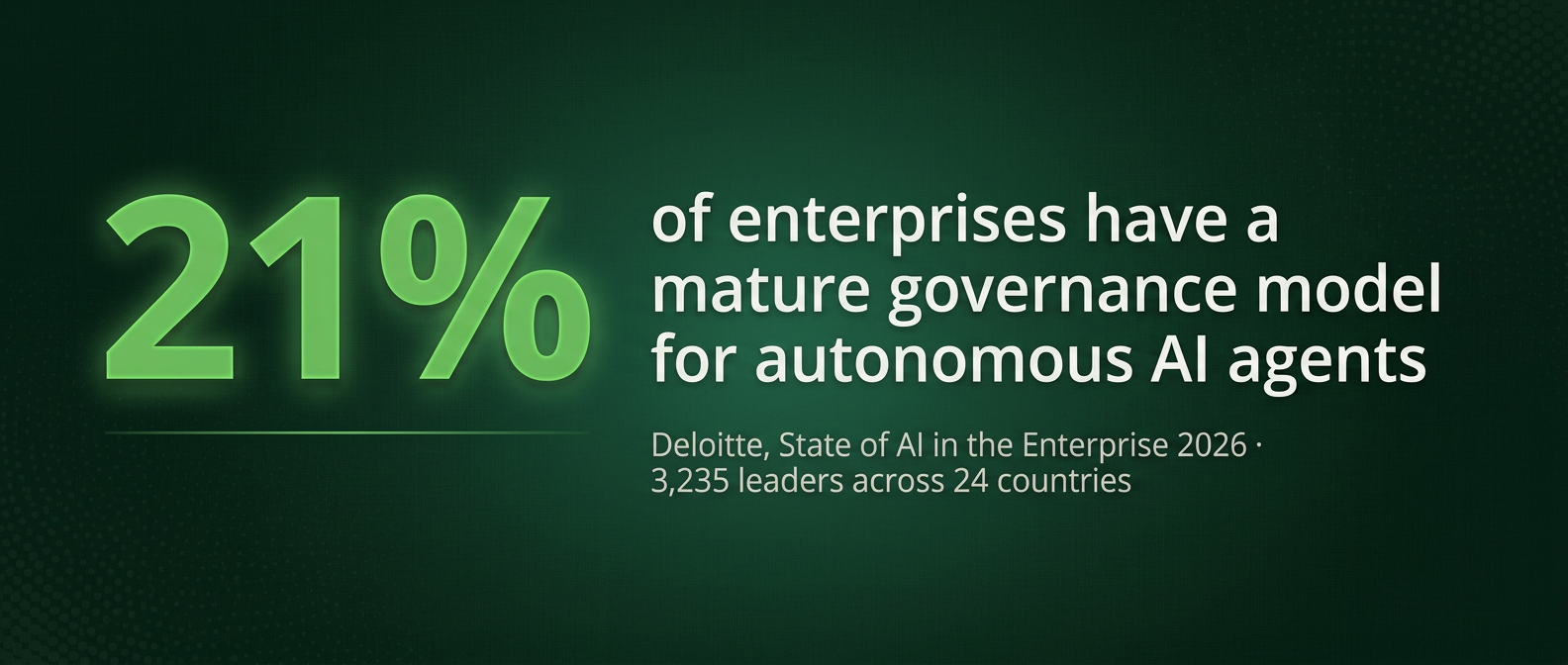
Deloitte’s full report found the top risks all relate to governance: data privacy and security at 73%, regulatory compliance at 50%, and governance capabilities at 46%.
The pricing gap specifically
A McKinsey survey of over 400 B2B pricing executives from November 2025 found that 65 to 85 percent expect to adopt agentic AI in pricing within three years, but only 5 to 10 percent have scaled it today.
McKinsey says value has been limited so far because results require workflow redesign, strong data foundations, and change management.
Bain’s 2025 pricing research found that companies confident in their pricing power realize a 3 to 11 percent profit margin premium. But competitive pressure, insufficient data, and pricing skill gaps remain barriers.

IDC’s FutureScape 2026 predicts G2000 AI agent usage will increase tenfold by 2027. IDC’s broader predictions forecast that by 2030, up to 20% of G1000 organizations will face lawsuits, fines, and CIO dismissals due to inadequate AI governance.
AI is entering pricing before many companies have cleaned up the rules pricing depends on. That is the tension.
The CFO test: five questions before AI touches pricing
Before putting AI anywhere near pricing or quoting, finance leaders should ask:
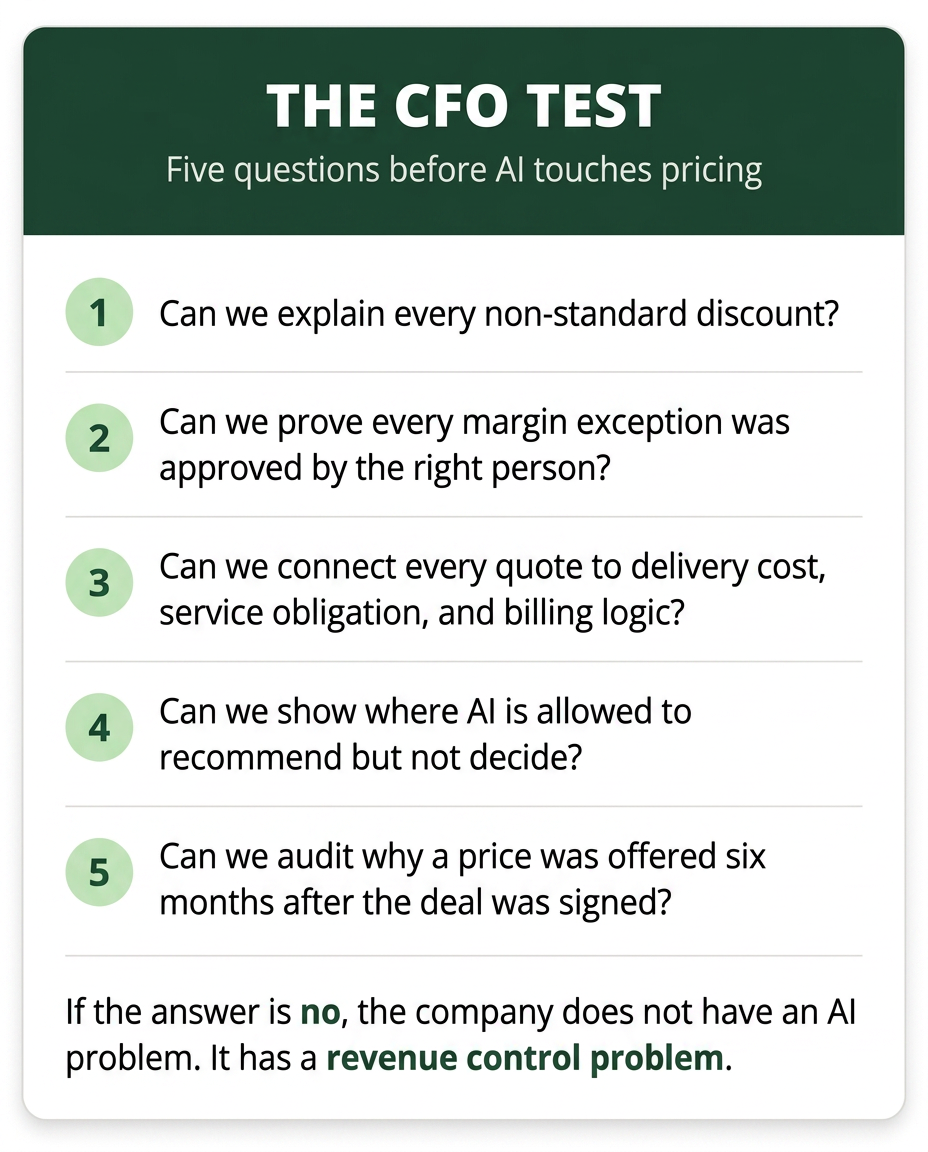
Why margin leakage scales when bad rules get automated
Pricing is not just math. It is policy, context, approval, risk, accountability, and execution. If margin controls are unclear, AI does not create discipline. It creates speed. And speed applied to bad rules is how margin leakage scales.
servicePath™ as the revenue trust layer
At servicePath™, our view is simple: AI writes the quote. servicePath™ governs the rules.
servicePath™ has been named the sole Visionary in the Gartner Magic Quadrant for CPQ Applications for three consecutive years, 2024 through 2026. Here is what that means in practice:
Platform-agnostic, codeless, and AI-native
We are platform-agnostic by design. One CPQ instance serves Salesforce, Dynamics, HubSpot, and NetSuite simultaneously through native bidirectional sync. Multi-CRM is the baseline, not an afterthought.
We are codeless. Your sales ops team can change pricing rules on Tuesday without filing a dev ticket. Business users own the rules, the catalog, and the pricing logic.
We are AI-native and model-agnostic. Bring your own LLM. Swap models via configuration. The data model was designed for AI consumption from the ground up.
And we are built for M&A. Acquired companies start cross-selling from day one without forcing CRM consolidation. (We call this framework Revenue-IT Architecture Convergence (RIAC).)
What your rep actually sees
Your rep opens servicePath™ inside their CRM. The system pre-fills data, validates configurations in real time, and surfaces margin impact as the deal is built. If a discount violates a business rule, the system shows compliant alternatives rather than blocking. Governance is invisible until it matters.
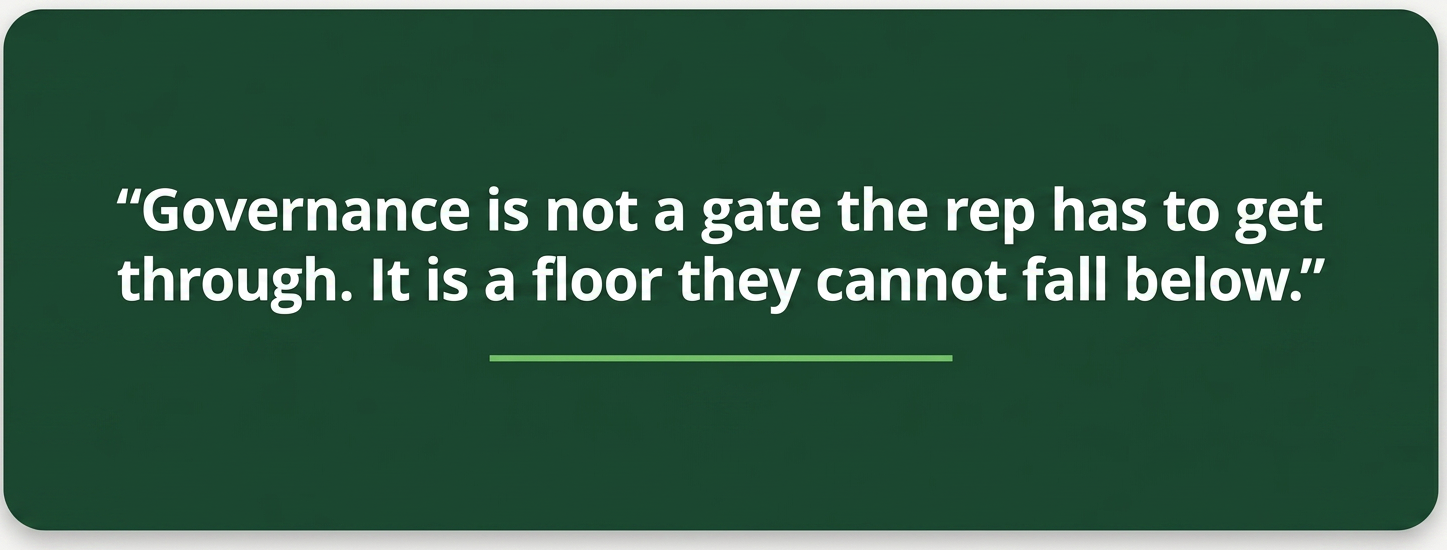
The governance layer is not a gate the rep has to get through. It is a floor they cannot fall below. (For MSP and IT services leaders, see our breakdown of how AI-powered CPQ transforms enterprise MSP operations.)
Telent and Dell EMC: governance-first CPQ in production
Telent, a UK ICT infrastructure provider managing over GBP 60 million in annual quotes across 50+ spreadsheets, replaced a failed legacy CPQ implementation with servicePath™ and went live in 8 weeks.
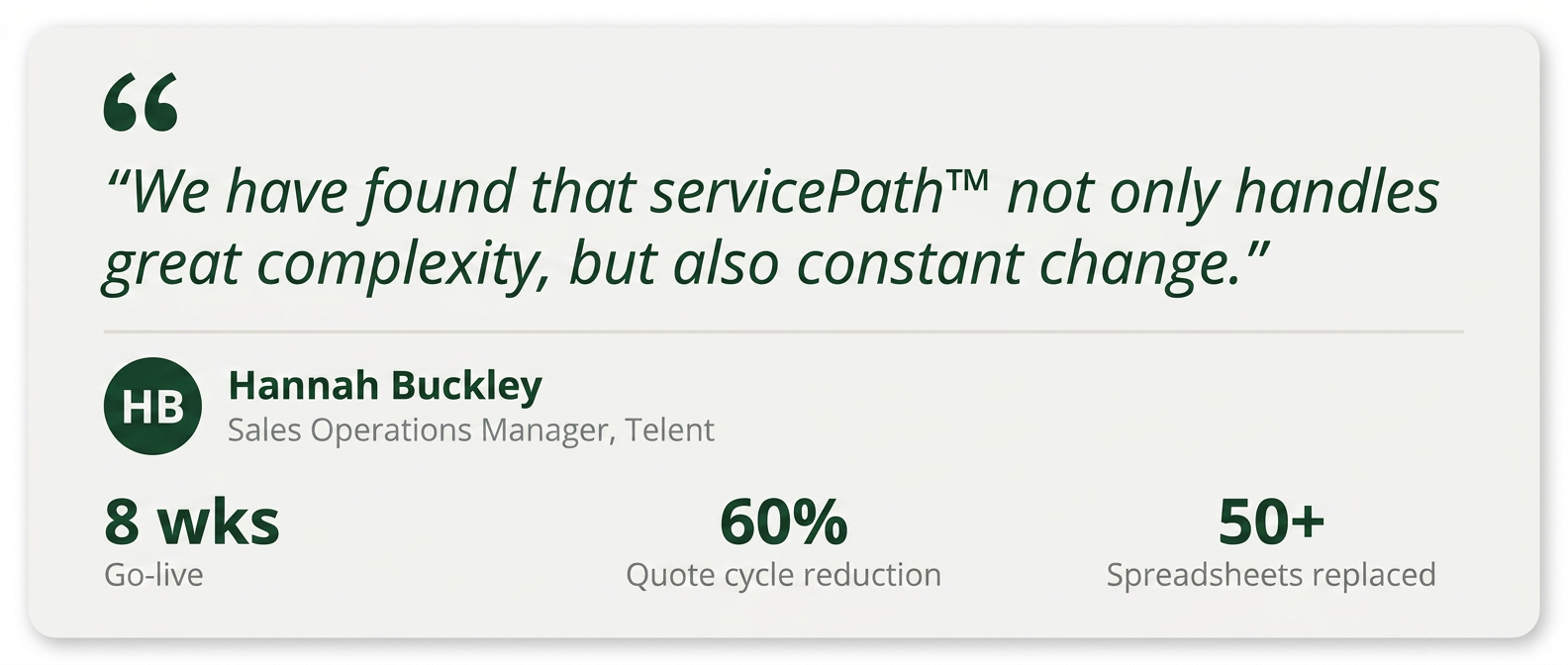
At Dell EMC, partners now generate their own proposals with complex changes taking 15 minutes instead of a full day.
Brandon DaCosta, Sales Enablement at Dell EMC: “servicePath has helped us scale our sales operations.”
From the seller’s chair, one G2 reviewer: “servicePath was up and running in weeks, integrated with our CRM, and cut our quoting cycle by half.”
What the market is doing (and what it is missing)
That is what governance looks like from the inside. Here is what the rest of the market is doing.
Salesforce CPQ entered End-of-Sale in March 2025. No major updates in over four years. AI investment is flowing into Agentforce, not into the legacy CPQ engine. (We wrote an in-depth analysis of the Salesforce CPQ End-of-Sale and the three strategic paths forward.)
Oracle received the highest strategy score in Forrester’s Q1 2025 Wave for CPQ, pushing AI-first with a one-data-model approach. Conga completed its acquisition of PROS B2B in February 2026, ranked #1 in Long-term Deal Negotiation in Gartner’s Critical Capabilities.
Forrester’s Q2 2026 CPQ Landscape examined 31 vendors and said it directly: “automation without governance isn’t innovation; it’s a fast path to scaling risk.” MGI Research’s 2026 CPQ Buyer’s Guide warns that 30 to 35 percent of CPQ implementations still fail because buyers select based on demos and hype instead of requirements and long-term fit.
The market is moving fast. The opportunity servicePath™ sees is that governance and trust have not been claimed as the primary value proposition by anyone at scale. That is where we live.
The CRO reality check
CROs do not need more bureaucracy. They need fewer bad deals. Fewer approval loops. Fewer quote errors. Less delivery rework. Less margin leakage. Less time wasted cleaning up commercial promises that never should have made it out the door.
Governance is not the enemy of speed. Governance is what lets good deals move faster because the rules are already clear.
When a rep knows the margin floor, the approved discount bands, the service levels the business can actually support, and the approval thresholds for exceptions, they do not need to send an email to deal desk and wait two days. They build the deal right the first time and it flows through. That is faster, not slower.
Three deals that expose the problem
Here is where generic quoting tools fall apart.
Multi-year ramp deals. Year one includes implementation services at low margin. Year two adds managed services. Year three expands usage and changes discount logic. The quote is not one price. It is a commercial model with changing economics over time.
Managed services with SLA penalties. The seller wants to win the deal. Delivery knows the service level requires a specific staffing model. Finance needs to understand the cost. Legal needs to see the penalty exposure. AI can draft the proposal, but CPQ has to govern whether the promise is deliverable.
Renewals with legacy entitlements. The customer has old discounts, new usage-based pricing, and a request to blend products across regions. This is not a SKU exercise. It is a revenue architecture problem.
Bain’s 2025 Commercial Excellence research found that top B2B companies delivered two times the average revenue growth of their industries in 2024. Bain says these winners deployed AI and related technologies at greater scale to optimize sales, pricing, and productivity. The point is not more gates. It is fewer gates for clean deals and sharper gates for risky ones.
The PE-backed operator view
In PE-backed environments, CPQ is not just a sales system. It is how you standardize commercial discipline across acquired businesses without forcing every company into the same front end on day one.
When each business unit has different pricing rules, approval habits, and billing processes, AI does not create consistency. It exposes the lack of it. servicePath™ estimates that multi-CRM orchestration without forced consolidation saves $250K to $500K+ in avoided migration costs per M&A transaction.
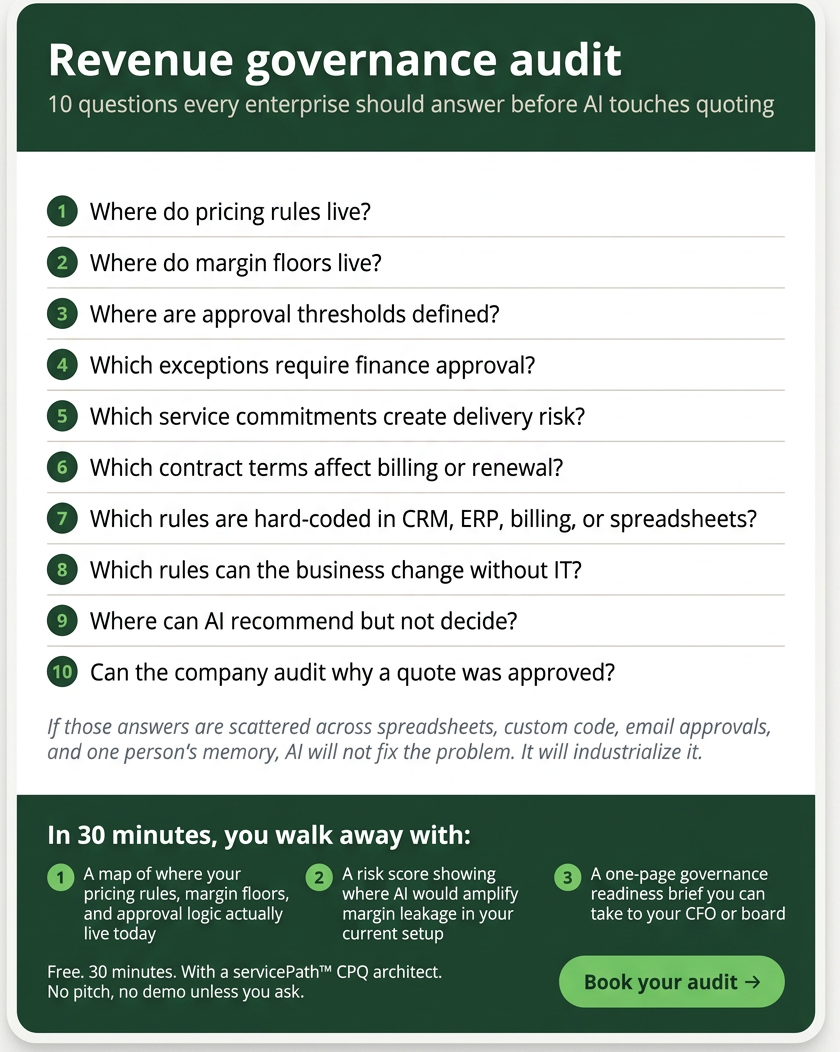
For PE-backed operators, the Revenue Governance Audit is not a marketing exercise. It is an operating control.
What EDI teaches us about what comes next
Machine-to-machine commerce is not new. EDI proved it works. It also proved that hard-to-change rules become a liability. The origins trace to 1948 during the Berlin Airlift. ANSI X12 has been developing EDI standards for over 40 years. UN/EDIFACT still exists.
EDI lasted because enterprises value certainty. No vibes. No hallucination. But too much business logic became buried in integrations and ERP customizations. A pricing change could become an IT project.
That is the warning for AI. If companies bolt agents onto brittle commercial logic, they are not modernizing revenue. They are building prettier EDI.
Why CPQ will still be here in 20 years
Twenty years from now, the quote may not look like a quote. It may be a live commercial agreement negotiated by agents, updated by usage, and executed through machine-to-machine workflows without a seller touching every step.
But the enterprise will still need to answer: What are we allowed to sell? What can we actually deliver? What price protects the business? What promise are we making? What risk are we accepting? What happens downstream in fulfillment, billing, renewal, and revenue recognition?
Agents need a constitution
IDC forecasts that by 2030, 45% of organizations will orchestrate AI agents at scale. Without a CPQ layer defining what is legally, financially, and operationally possible, those agents have no boundaries. CPQ becomes the policy engine, the constitution of enterprise revenue. And as IDC predicts seat-based pricing will be obsolete by 2028, the complexity of what constitutes a “quote” will only grow.
The black box will not survive the auditor
AI gives an answer but cannot always explain the reasoning in a way that satisfies a tax auditor, a CFO, or a regulatory body. Deloitte’s 2026 report found governance concerns topped the list of AI risks. CPQ provides an audit trail of intent.
As compliance requirements around AI-driven pricing tighten, companies will need a system that proves why a price was offered and that it was not biased or illegal.
Revenue architecture is the new ERP
For decades, ERP was the system of record. Revenue architecture, led by CPQ, is becoming the system of intelligence. McKinsey argues pricing is evolving from a human-executed discipline to one powered by AI-orchestrated systems guided by humans, but only when organizations build clear rules, auditability, and reversibility into every decision.
That is why CPQ survives. Not because the quote survives. Because commercial control has to survive. The global CPQ market is projected to reach $11.3 billion by 2026 at 13.2% CAGR. That is not a shrinking category. That is infrastructure.
The future does not belong to the company that generates the fastest quote. It belongs to the company that can prove every commercial promise is worth making.
Revenue governance audit: find the risk before AI accelerates it
Before you migrate CPQ, add AI to quoting, or rebuild quote-to-cash, run a Revenue Governance Audit.
Frequently asked questions
Is CPQ going away because of AI?No. AI will change the interface but not the need for governed commercial logic. Gartner predicts rapid adoption of AI agents in enterprise applications by the end of 2026, but their 2026 Hype Cycle shows only 17% of organizations have deployed agents so far.
Why does CPQ matter if AI can generate a quote?Because generating a quote is not the same as validating a deal. Gartner defines CPQ as supporting quote creation, approval cycles, compliance, audit trails, and reporting. In complex enterprises, CPQ governs whether the commercial promise is valid before it becomes an obligation.
What is the CFO argument for CPQ governance?Margin, risk, and explainability. Bain says almost all firms invest in AI for pricing intelligence, but data gaps and skill gaps remain barriers. CPQ gives finance a way to govern price, discount, approval, and margin discipline before the company inherits a bad deal.
Why will CPQ still matter in 20 years?Because the quote may disappear but commercial obligations will not. Forrester says CPQ now sits at the center of the commercial ecosystem, orchestrating how products are configured, priced, and sold across sellers, partners, and digital channels. That is why CPQ evolves from a quote tool into a revenue control plane.

Analyst citations reference publicly available reports and press releases from Gartner, Deloitte, Forrester, McKinsey, Bain, IDC, and MGI Research as of April 2026. servicePath™ capability claims and customer outcomes are sourced from servicepath.co. Gartner does not endorse any vendor depicted in its research.