
How to protect pricing, preserve historical quote logic, and decide whether to renew, renegotiate, or migrate.
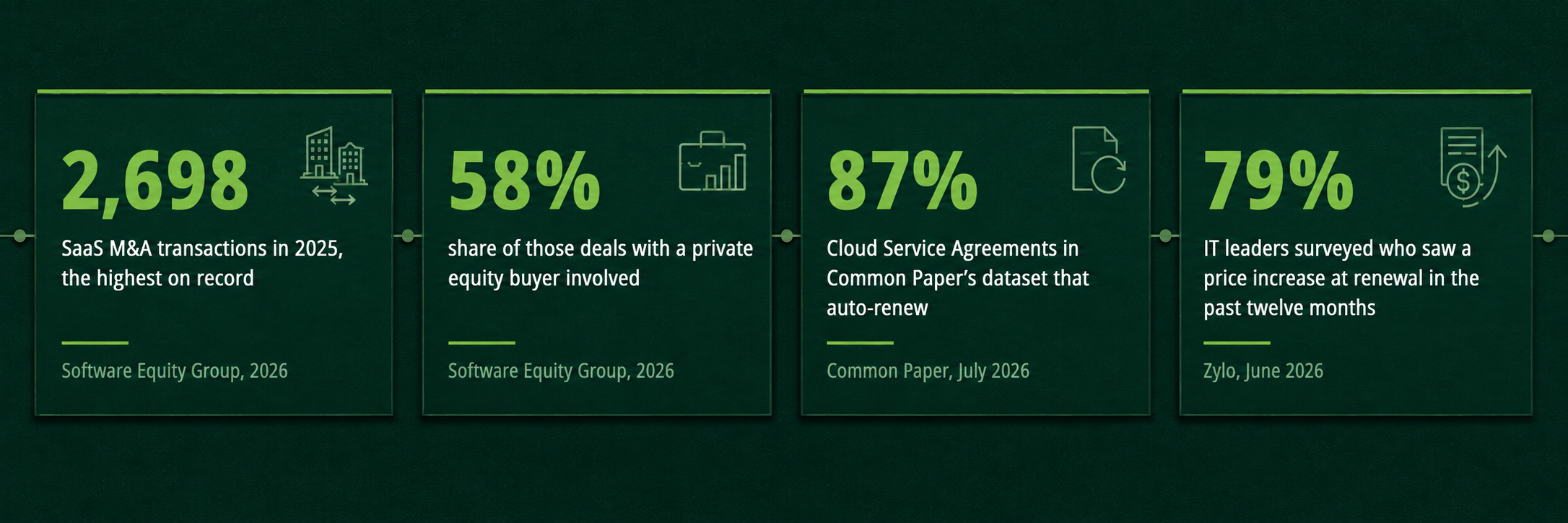
If your CPQ vendor has been acquired, check your non-renewal deadline first. A CPQ vendor acquisition does not automatically rewrite your agreement. What it can change is which of your protections survive, and that turns on the transaction structure, the assignment terms, the contracting entity, and any replacement order form.
Six of the seven questions are contract work: notice dates, assignment, price caps, migration terms. Procurement can run those. The seventh is the one only your CPQ can answer. Export your quote history and you get records.
You do not get the price book in force that day, the bundle at that version, or the rule set that approved the discount. The acquisition risk that matters most is not whether your quote records survive. It is whether the commercial logic that created them stays explainable, executable, and portable.

Executive summary
Common Paper found a 30-day notice period standard in about 70 percent of the Cloud Service Agreements in its dataset. Where you sit against that window sets the order below.
With room on the calendar, start question six, the servicePath™ Golden Quote Continuity Test, and run the contract questions alongside it. With the window closing, reduce the quote set and negotiate export rights in parallel. Past the window, establish your contractual position first.
The seven answers point to one of four outcomes: renew, renegotiate, evaluate, or migrate. If your team cannot explain, reproduce, reprice, and export ten historical quotes, migration is not a threat you can credibly make.
What a CPQ vendor acquisition looks like on the record
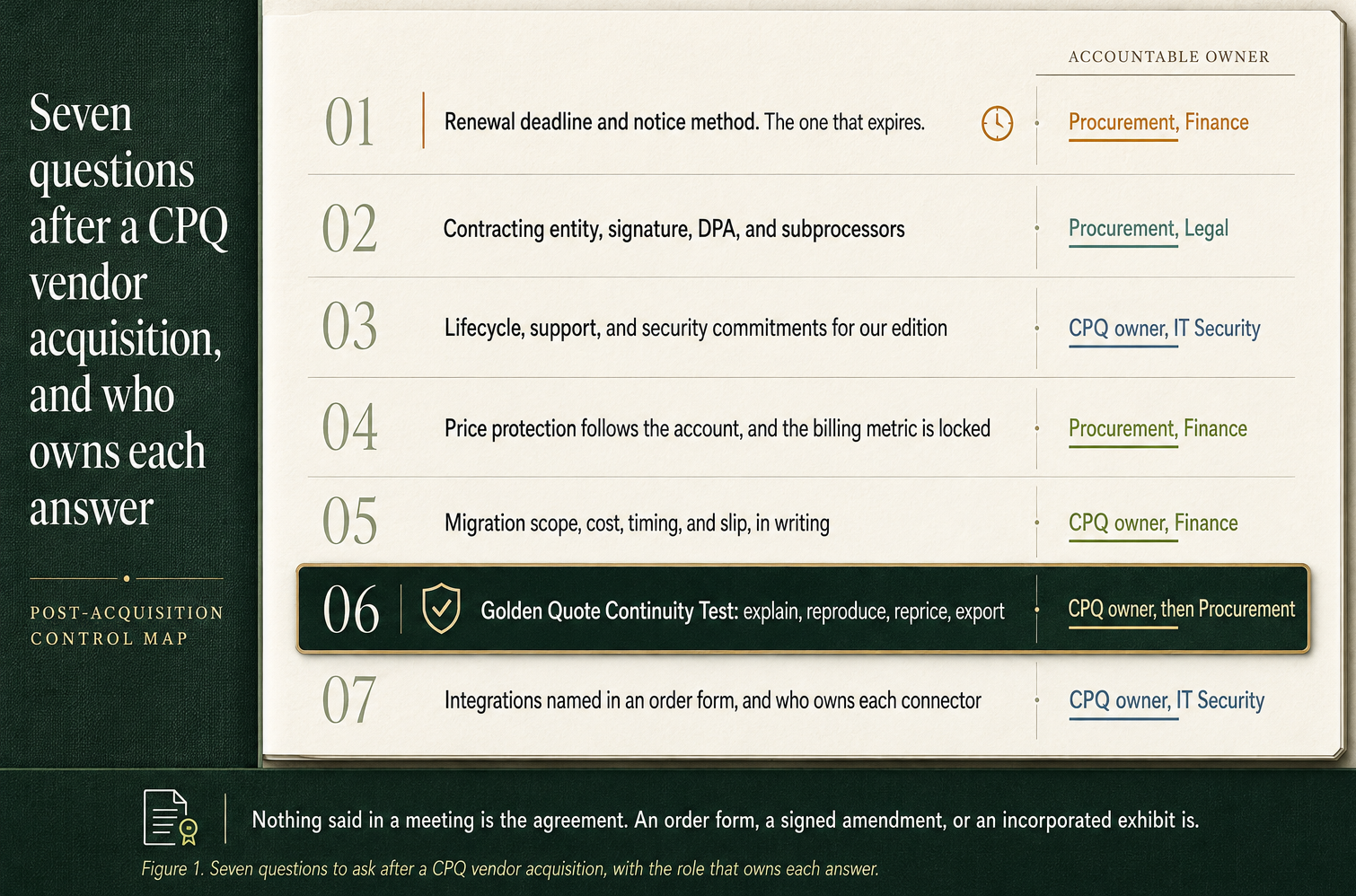
Software Equity Group’s 2026 Annual SaaS Report recorded 2,698 SaaS M&A transactions in 2025. That is the highest on record, and up 28 percent on 2024. Private equity buyers were involved in nearly 58 percent of them.
One CPQ vendor acquisition has a full public record. Conga completed its acquisition of the PROS B2B business on 2 February 2026. Thoma Bravo and PROS had announced the plan on 1 October 2025. In the completion release, CEO Dave Osborne described the company as “focused on integrating the two companies thoughtfully and swiftly with customer continuity and innovation guiding the way.” So put the seven questions to any vendor whose ownership has changed, servicePath™ included.
When a product changes direction without an acquisition
Salesforce’s own page, published July 2026, states that “Salesforce CPQ is end of sale, not end of life.” The same page rules out forced migration, and it names no end-of-life date. But a lifecycle decision is a different event from a CPQ vendor acquisition. The full account is in what Salesforce CPQ end of sale changed for existing customers.
Seven questions to ask an acquired CPQ vendor

Your contract probably renews itself. Common Paper’s 2026 SaaS contract benchmark, published 15 July 2026, found that 87 percent of the Cloud Service Agreements in its dataset auto-renew. The answers are in your agreement rather than in the acquisition announcement.
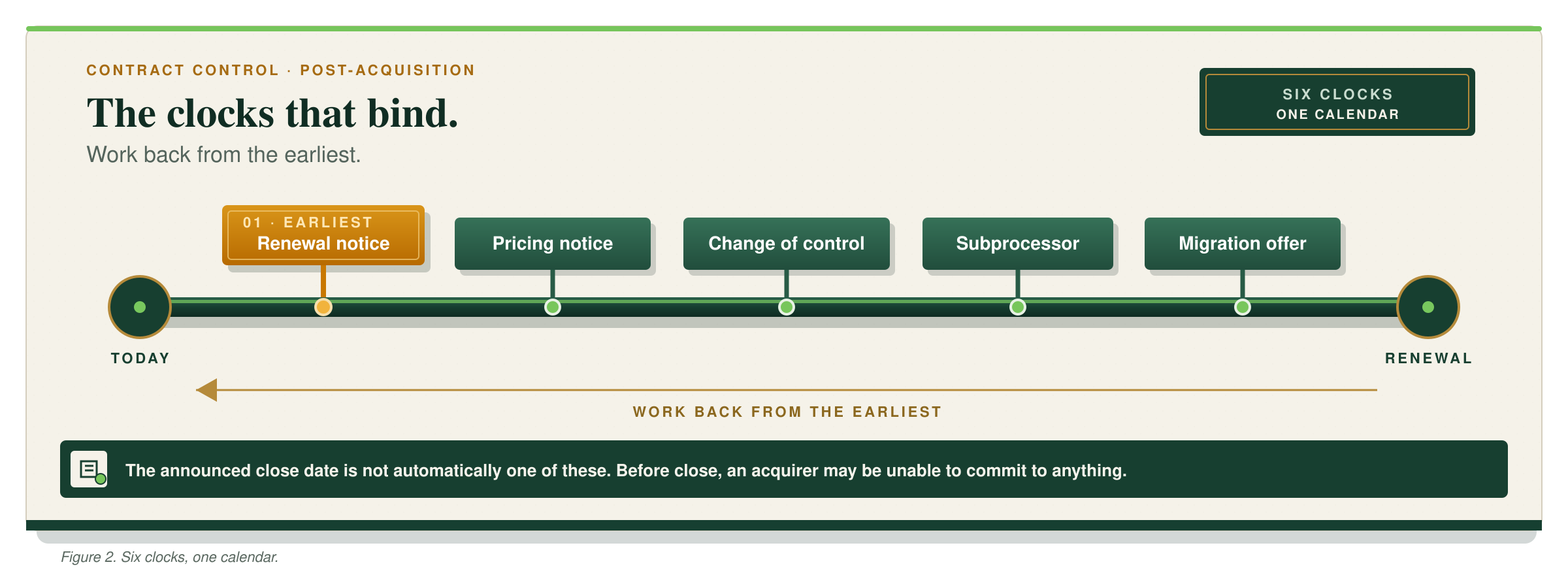
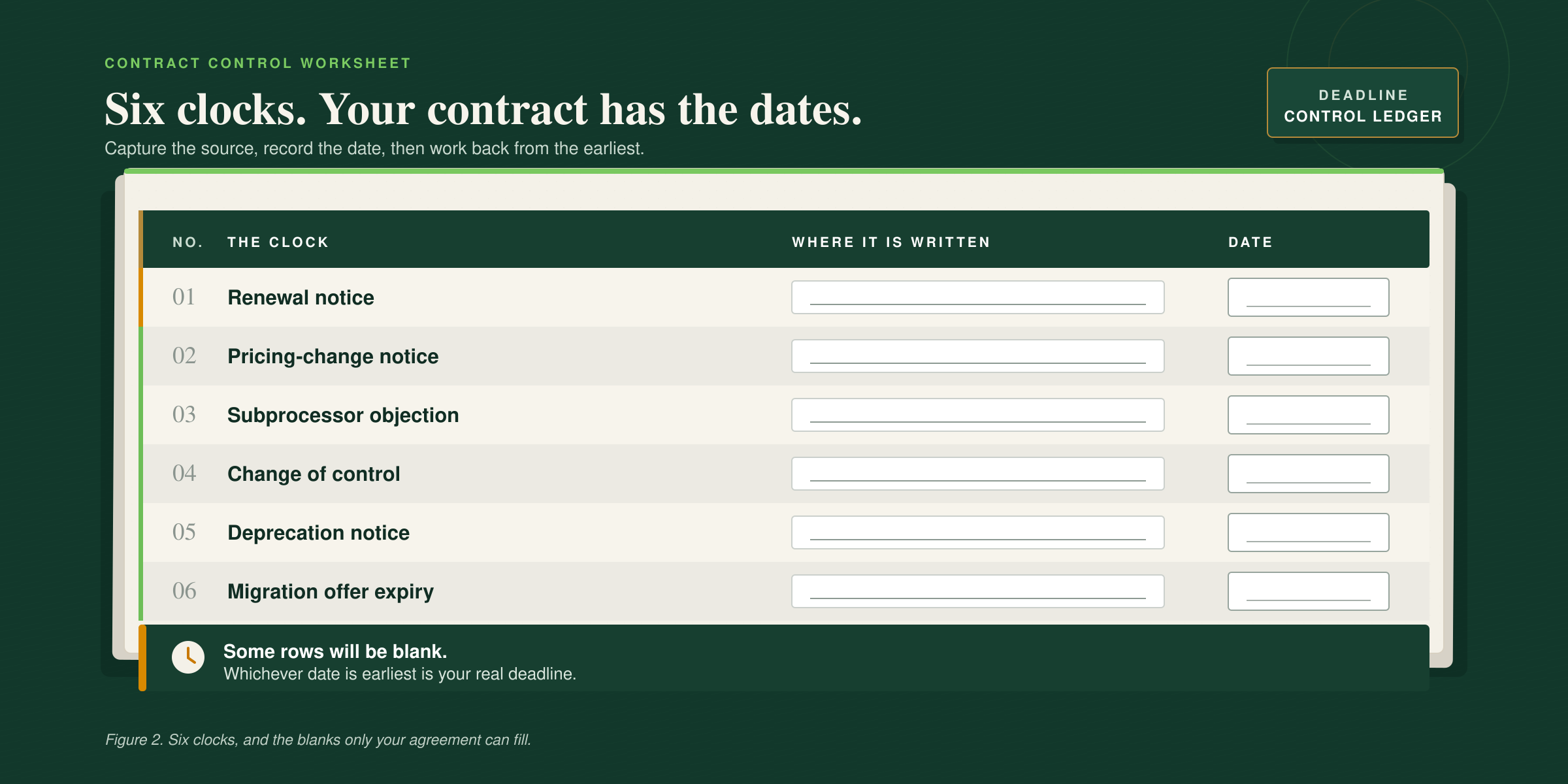
A CPQ vendor acquisition adds clocks of its own. The announced close date is not automatically one of them. Before close, an acquirer may be unable to commit to anything. Fill in the dates you have, then work back from the earliest. Check the notice method. Email to an address the agreement does not name may not count.
If notice is still open, ask counsel whether serving it now preserves your option to renew later. Past the window, the renewal is usually still negotiable, on weaker terms.
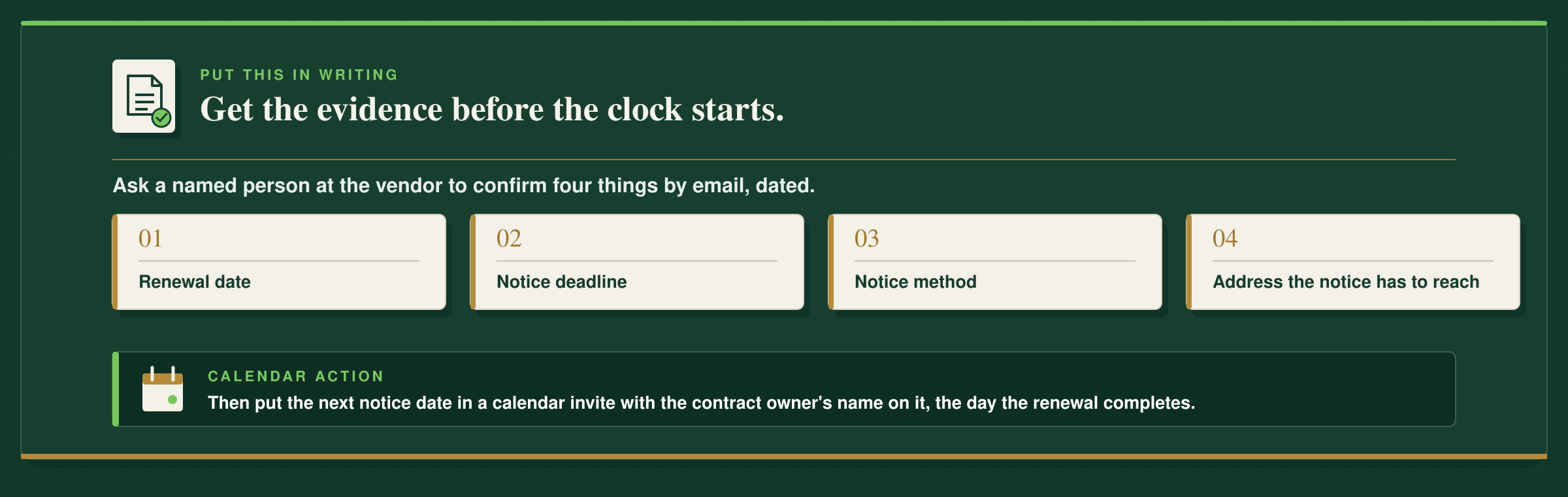

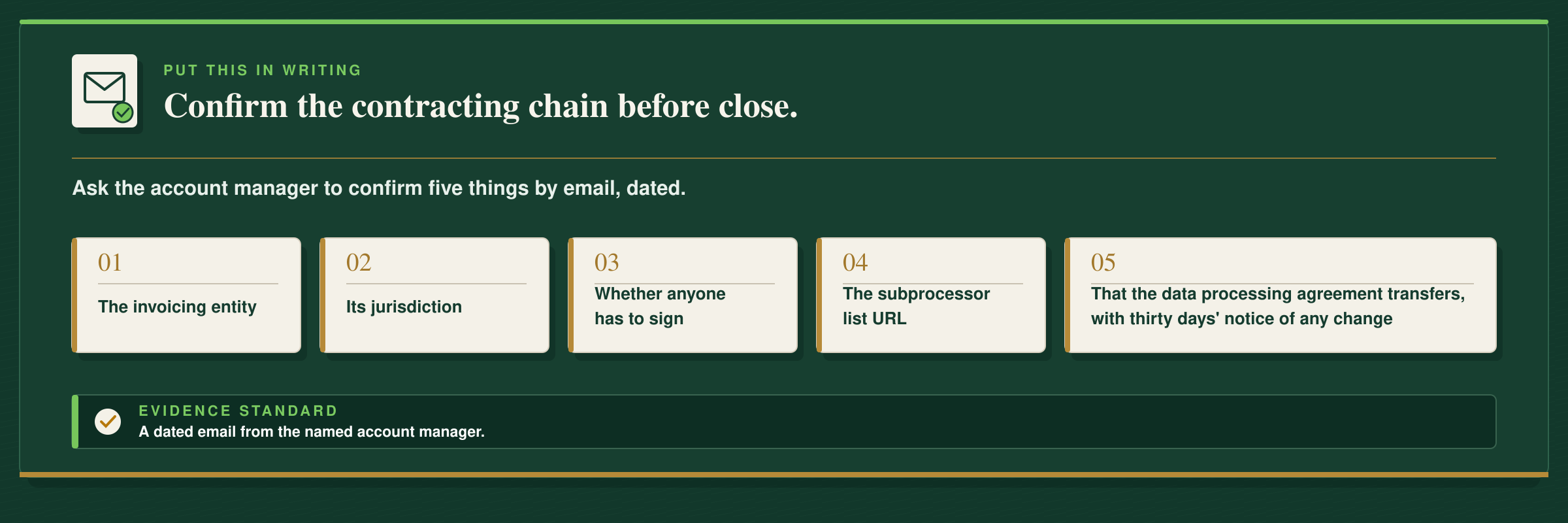
Ask the factual question and let whoever reads your contracts do the characterisation. Verrill’s Adam Nyhan, writing on 16 March 2026, notes that where the clause carries a change of control exception, a vendor “may freely assign its rights in the contract” to a company that buys it “in a merger, acquisition, or other restructuring.” Outcomes vary with the wording. So ask whether the renewal arrives on your existing paper or on the acquirer’s.
Request the data processing agreement in the same message. Data residency, AI training rights over your data, and deletion certification at exit all sit in that document.

A vendor has a roadmap answer and a lifecycle answer, and only the second exists on day one. “There are no plans to sunset the product” is a slide. A CPQ vendor acquisition can leave product direction undecided for two quarters after close. The lifecycle policy existed before the deal, and a web page can change.
Get the policy as a dated exhibit to the order form, with minimum notice before end of sale and before end of support, precedence language, and coverage of your exact product, edition, APIs, and connectors.
Support belongs in the same exhibit. An acquirer can commit to support tier, SLA target, escalation path, and support region. The escalation path has to work for an engineer who has never opened your configuration.

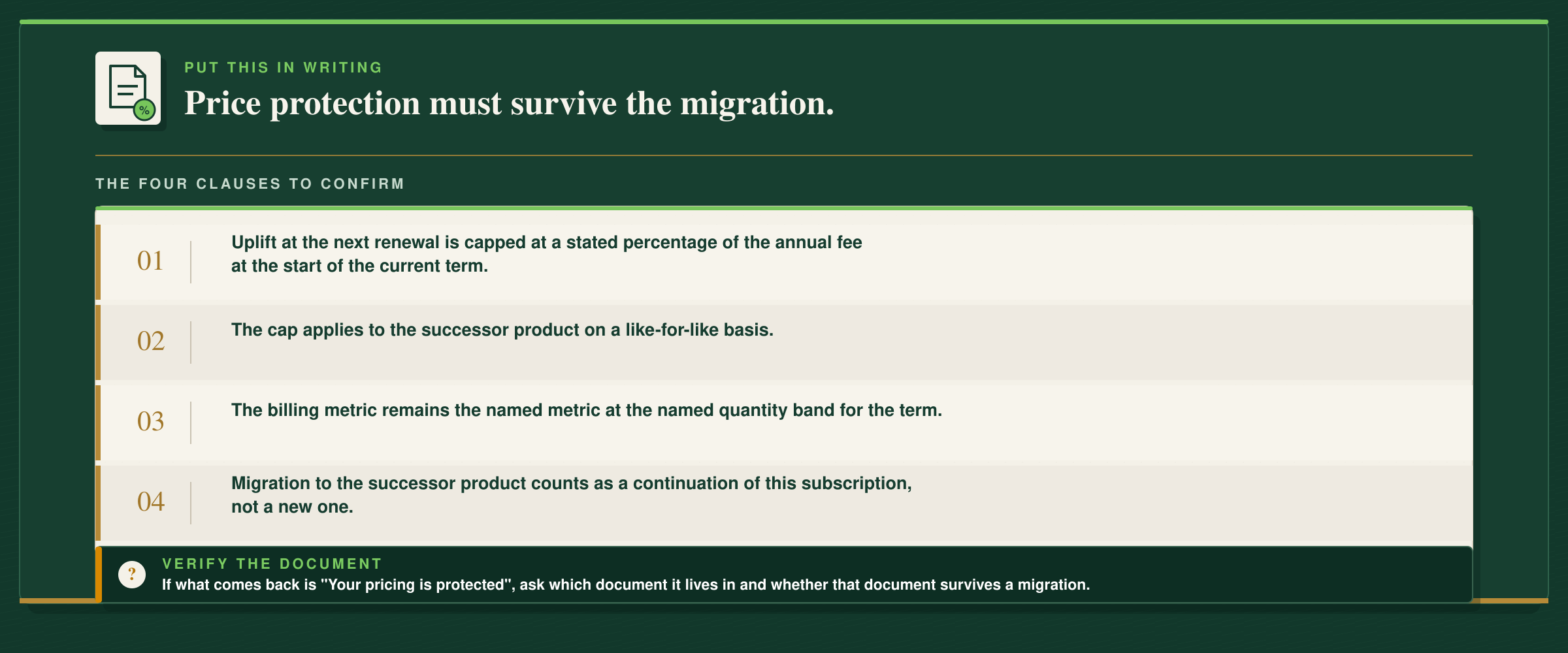
Zylo’s June 2026 survey of IT leaders found that 79 percent had seen a price increase at renewal in the past twelve months, and 61 percent cut projects because of unplanned SaaS cost increases. A CPQ vendor acquisition is a renewal with fewer places to hide. A cap lives in a document, a migration to the surviving product replaces it, and somebody has to carry the cap across by hand.
The billing metric is the harder problem. A cap on rate stops capping spend once the metric shifts underneath it. Named users become a platform fee, then consumption, and a capped percentage of a different unit is a larger number nobody has to justify to you.
So the cap has to attach to the account. The vendor names the billing metric, the quantity band, and the entitlements.

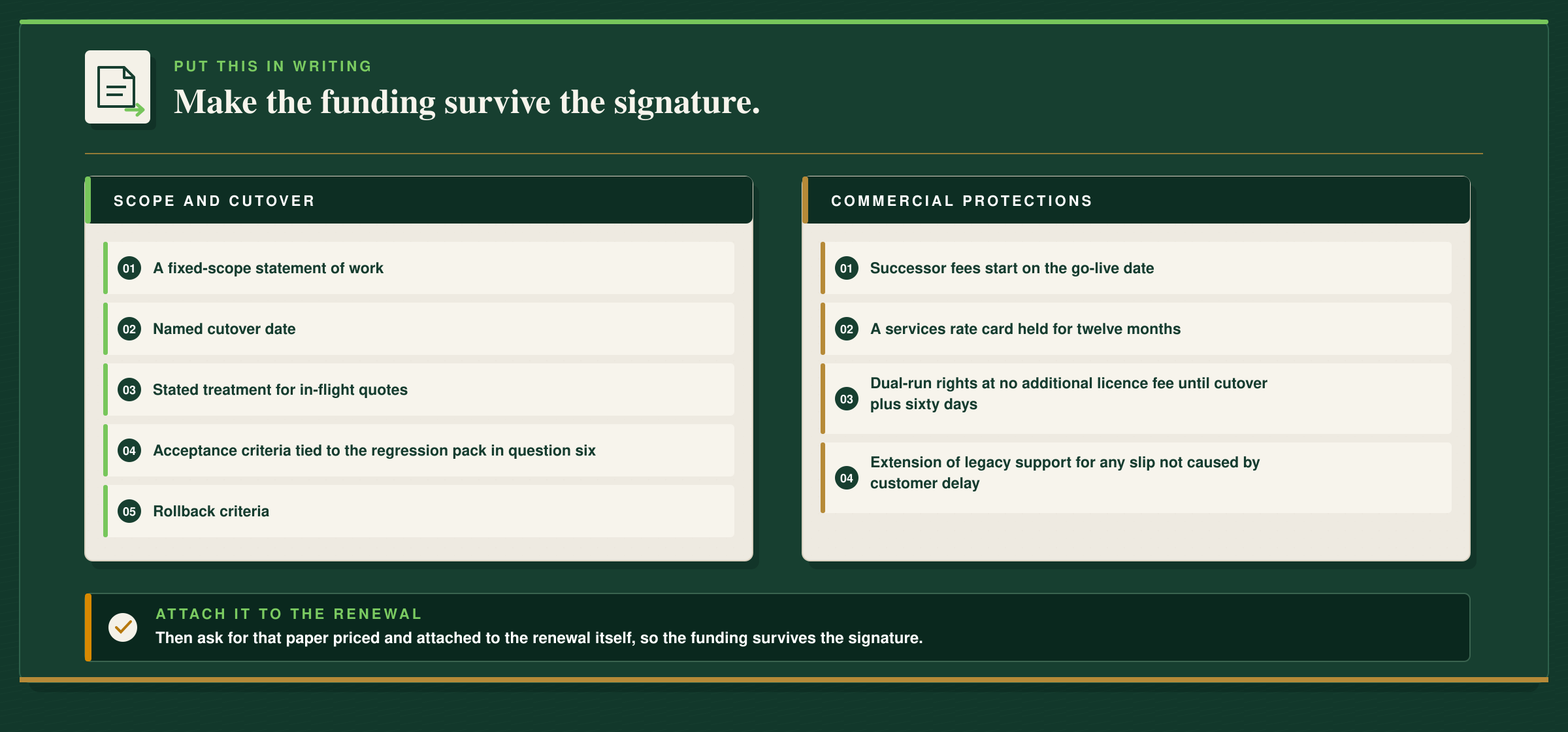
Negotiate migration funding before you sign the renewal, because after signature you have spent the leverage that would have paid for it.
“Included” covers three bills, so make the vendor say which one it pays. The vendor’s own migration tooling and license overlap. The implementation partner’s configuration rebuild, data load, integration rework, and testing, invoiced separately. Your own people: the CPQ owner, finance, and the sellers pulled into acceptance testing. A commitment that names only the first bill has left the larger two with you.
A slip has a mechanism as well as a date. Ask who carries the legacy license if cutover moves, whether the successor fee starts at signature or at go-live, and what happens to in-flight quotes. Then make the regression pack in question six the acceptance test, so cutover completes when those ten quotes reproduce on the new platform.

An export moves records, and a stored total is a record. Its inputs usually sit nowhere near it: the price book in force that day, the bundle at that version, the rule set as it stood, and the overrides with their approvers. Audit, dispute, renewal, and migration need them.
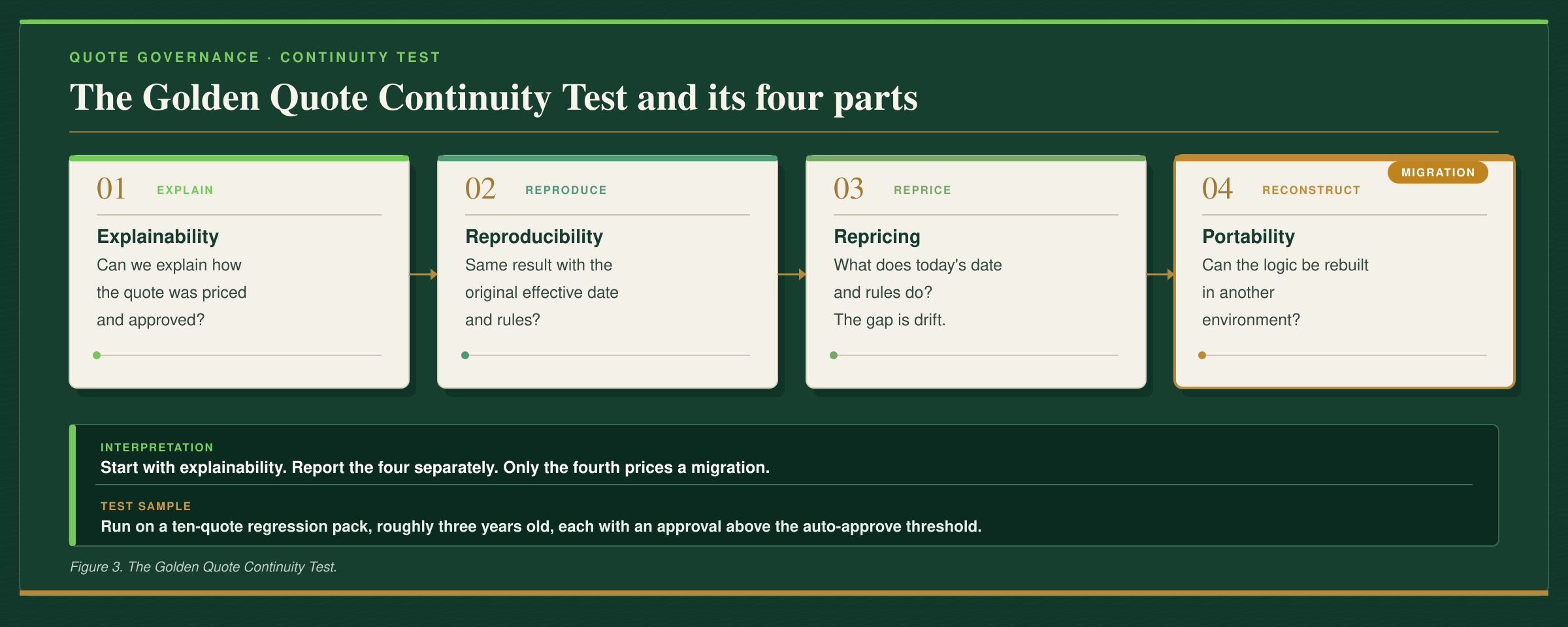
The Golden Quote Continuity Test and its four parts
The Golden Quote Continuity Test, defined by servicePath™, asks whether a CPQ can stand behind a quote it produced three years ago. Start with explainability, which needs only records you already hold. Run the rest together, and report the four separately.
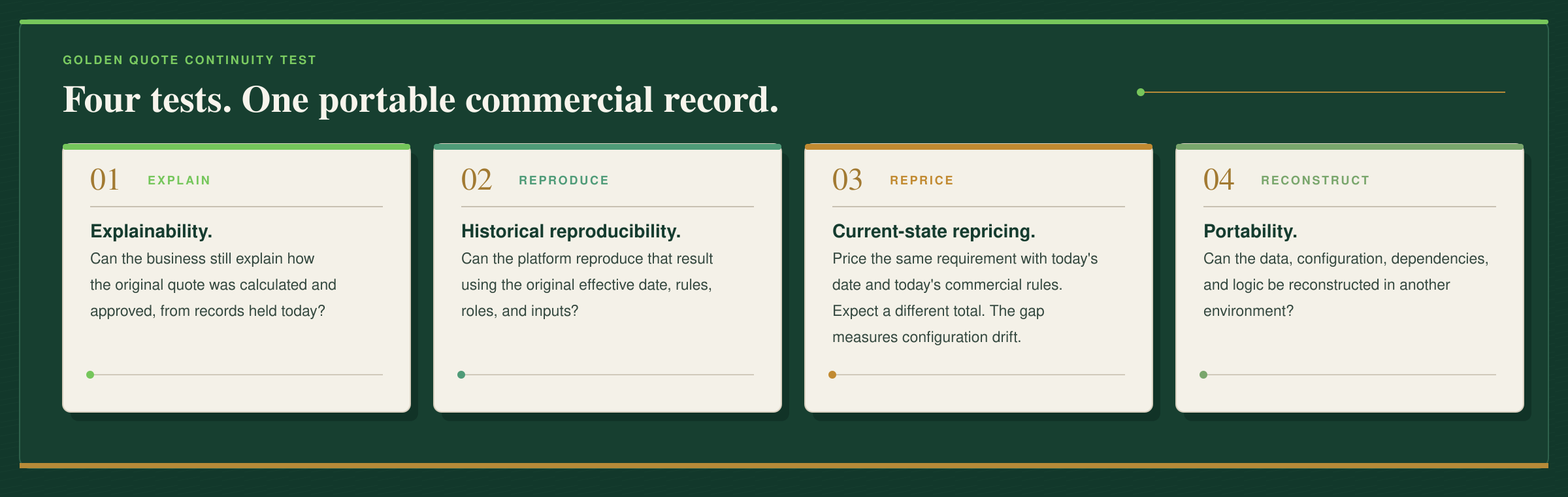
Still, one quote proves little. Use a regression pack that covers your estate: new business, a renewal, an amendment, a co-termed expansion, a multi-currency quote, a complex bundle, an exception discount, a manual override, a partner quote, and a usage or consumption quote, each roughly three years old with an approval above the auto-approve threshold.
What has to be in place
A production-like, non-production environment holding approved historical data, requested on day one because that approval takes longer than the test. A rebuild run by someone whose permissions match the original approver’s, since role names outlive their permissions.
The price book, rules, and roles as they stood on each quote’s effective date, the input most likely to be missing. Then plan on three weeks from request to result. If the vendor refuses the environment, get the refusal in writing.
Record the stored total, the reproduced total, and the input that explains any gap. Otherwise the variance is an anecdote.
How to read the results
Historical reproducibility passes.
The platform can still execute the original logic. But check how it passed: a pass that needed someone to re-key an input does not count.
Historical reproducibility fails with a different total.
Something the quote depended on changed or was never versioned: an effective date, an exchange rate, a cost feed, a tax rule, a customer-specific price, an approval threshold, a rounding rule, or a retired dependency.
The build fails outright.
A required product, rule, permission, or input is unavailable. Identify which, because a missing permission and a retired catalogue cost very different amounts to fix.
Portability fails.
The logic exists but cannot leave. What the pack could not carry out is work someone has to redo, and that is the number to set against the migration funding in question five.
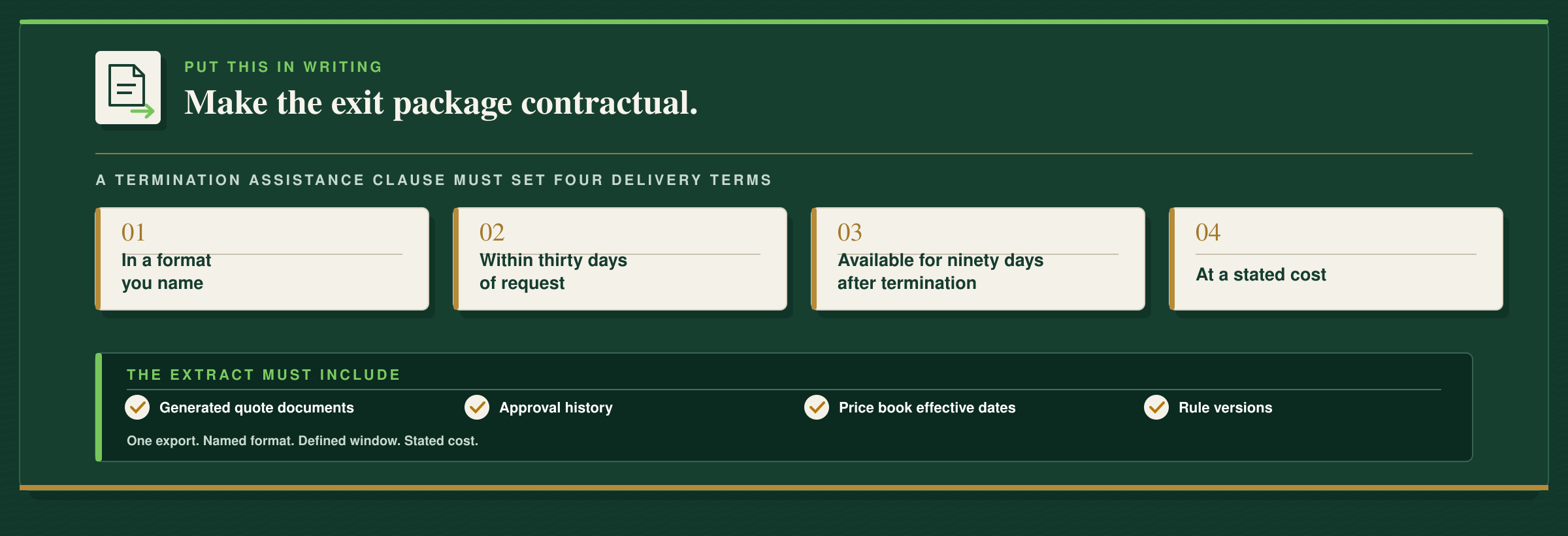

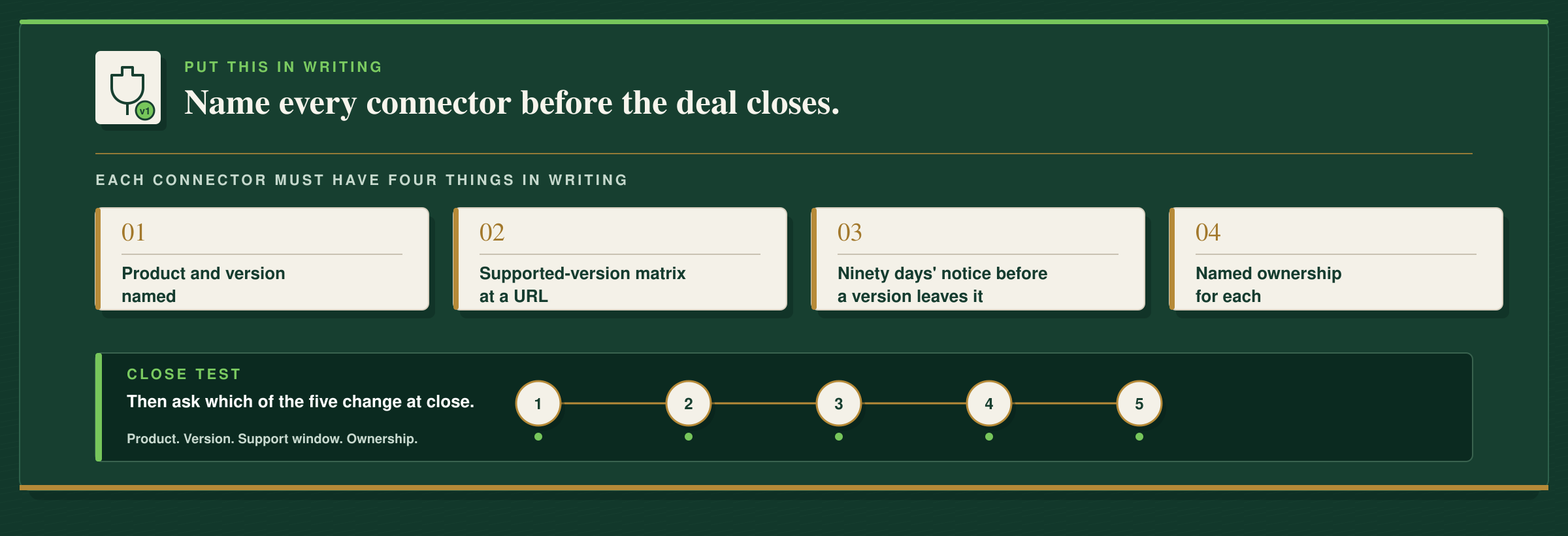
A vendor can stop supporting an integration without breaching anything. Support describes the present. The promise is a version number on an order form. So ask which of yours carries one.
List every integration, billing and ERP included, and mark each as vendor product, partner package, or something you built. Then name the API each one calls and the credential it authenticates with, because identity consolidation after an acquisition can break those credentials first. That map is the part of a composable revenue architecture that rarely gets written down. A vendor commitment about a partner’s connector covers what the vendor does not control.
Access and incident handling change on the acquirer’s schedule. So put them on the same list. Single sign-on, privileged access, audit scope, breach notification, and recovery objectives are the five to name.
How to run the conversation with an acquired CPQ vendor
With the notice window open, run the Golden Quote Continuity Test alongside the contract questions. With it closing, cut the test to fewer quotes and negotiate export rights in parallel. Past it, settle question one first.
Send the questions before the notice window closes. Each goes to the role that owns the answer, and to the acquirer’s commercial, legal, or product team.
The legacy account manager may not have answers yet. When an answer arrives with no document, send the paper you would sign and ask for redlines. Nothing said in a meeting is the agreement. An order form, a signed amendment, or an incorporated exhibit is.
Decide beforehand which two of the seven you will not trade. None of this is legal advice, and your counsel should confirm where you stand.
Renew, renegotiate, evaluate, or migrate after a CPQ vendor acquisition
The written answers arrive unevenly, and some never arrive. Decide on what is in writing the day the notice window closes, and treat silence as an unwritten answer. Then match the pattern to a row. The two questions you chose beforehand not to trade settle any case that sits between two rows.

What each decision asks of you
Renew still takes work, and it spends the leverage of a live renewal. Seven written answers mean the acquirer put its commitments on paper. File them where the next contract owner will find them. You may not be the one holding the next renewal. Then book the notice date before the account goes quiet again.
A bridge buys time, and you will pay for the time. Treat any premium on the twelve months as the cost of running the Golden Quote Continuity Test while the leverage of a live renewal is still in hand. A renegotiation with no plan for what runs inside it is a renewal with a shorter term.
Evaluate is a comparison on your own terms. Use the same ten quotes and the same integration list from question 7. Put the same written questions to every alternative, incumbent included. Evaluating commits you to nothing except hours, and those hours come out of the people who quote every day. So run it while the bridge is live, and the answer arrives before the next notice date does.
Migrating needs a number before it needs a sponsor. The portability result from question 6 sizes the rebuild, the funding answer from question 5 is what the vendor will cover, and the gap between them is your business case. Carry the dual-run and extract rights into the new agreement, because the vendor you move to can be acquired as well. Migration also moves the quoting layer itself, so read the revenue control plane argument before you commit.
CPQ vendor acquisition questions
Does a CPQ vendor acquisition give a customer the right to terminate?
A CPQ vendor acquisition usually does not, on its own, give a customer the right to terminate. That depends on the agreement’s change of control clause and on how the parties structured the deal. Find the clause, then give it to counsel with the vendor’s written statement about the contracting entity. This is not legal advice.
What changes at renewal when a CPQ contract passes to a new owner?
When a CPQ contract passes to a new owner, the terms often carry over, price cap included, though that depends on the transaction structure and the assignment wording. What changes is who sits on the other side of the signature, and a migration to a successor product can replace the paper the cap lives in.
What should you export from a CPQ system before signing a renewal?
Export enough to rebuild a quote, not just retrieve one. From a CPQ system that means price books with effective dates, bundles and option constraints, approval rules with approval history, discount matrices, quote templates, generated documents, and the amendment chain behind each historical quote, all as data.
Why servicePath™ after a CPQ vendor acquisition
No vendor can promise that its ownership will never change. What a buyer can test today, though, is whether quoting logic stays portable when the CRM underneath it changes.
servicePath™ centralizes product, pricing, bundle, and approval logic outside any single CRM. That can reduce how much commercial logic has to be rebuilt when a CRM changes, though integration, mapping, migration, and testing work still applies.
servicePath™ was positioned as a Visionary in the 2026 Gartner® Magic Quadrant™ for Configure, Price and Quote Applications, the fourth consecutive year in that position (Gartner, Magic Quadrant for Configure, Price and Quote Applications, By Mark Lewis, Luke Tipping, 22 January 2026).
Hannah Buckley, Sales Operations Manager at Telent, describes the pressure in a published case study: “For our business, a huge challenge is constant change in technology and pricing.” A second case study also covers Dell EMC.
Gartner does not endorse any vendor, product or service depicted in its research publications and does not advise technology users to select only those vendors with the highest ratings or other designation. Gartner research publications consist of the opinions of Gartner’s research organization and should not be construed as statements of fact. Gartner disclaims all warranties, expressed or implied, with respect to this research, including any warranties of merchantability or fitness for a particular purpose. GARTNER is a registered trademark and service mark of Gartner, Inc. and/or its affiliates in the U.S. and internationally, Magic Quadrant is a registered trademark of Gartner, Inc. and/or its affiliates and is used herein with permission. All rights reserved.