


In complex B2B deals, a fast first quote can be a vanity metric that quietly kills your margins. The real bleed happens in the revision loop: the messy, unmeasured middle mile where deals leak margin, consume scarce specialist hours, and stall in internal queues.
Executive summary
- Speed to first quote does not equal speed to agreement. A deal can be quoted in hours and still spend weeks moving through revisions.
- One revision is never one task. Each material change can reopen configuration, pricing, costing, approvals, documents, and delivery validation.
- The unmeasured cost has a name: the Iteration Toll. Rework time, waiting time, approval resets, margin movement, and downstream correction, accumulating between the first quote and signature. In the illustrative worked example below, margin leakage, not labor, drives 77 percent of it.
- Not all iterations are bad. The failure is being unable to separate necessary negotiation from preventable rework, because nobody records why revisions happen.
- The real bottleneck is human scarcity. Deal desks, specialist lawyers, and senior approvers are shared, finite resources. Disconnected systems force them to act as manual data integrators, capping total revenue capacity.
- CPQ should govern the whole journey to signature, not merely produce the first quote faster. Start with the five-deal iteration audit below.
I ask revenue leaders the same question in almost every conversation: how many iterations does your deal take?
Most can tell me, sometimes to the hour, how fast the first quote goes out the door. Speed to quote is the one number every revenue dashboard tracks. Yet almost none can tell me how many times that quote came back, why it came back, or how far the margin moved before signature. I’ve sat in enough deal reviews to know what that silence means. The most expensive part of the deal is the part nobody is measuring.
The dashboard is watching the wrong door
Most revenue dashboards in mid-market and enterprise technology optimize for the wrong metric. RevOps teams spend significant budget shaving hours off the first quote. But in complex B2B sales, the first quote is rarely the one that gets signed. Meanwhile, most CRM reporting ignores everything in between. It records only the creation date and the closed-won timestamp.
Where deals actually go to die
Speed to quote is a real metric and I’m not here to bury it. But it measures the entrance to your commercial process, and the deal doesn’t live there. It lives in the revision loop that follows, where time, labor, and margin quietly disappear. So this piece names that loop, prices it, and shows you how to measure it before the quarter ends.
Two deals, one number, two completely different businesses
Both of these are illustrative. If you sell complex technology or managed services, you won’t need convincing that they’re real.
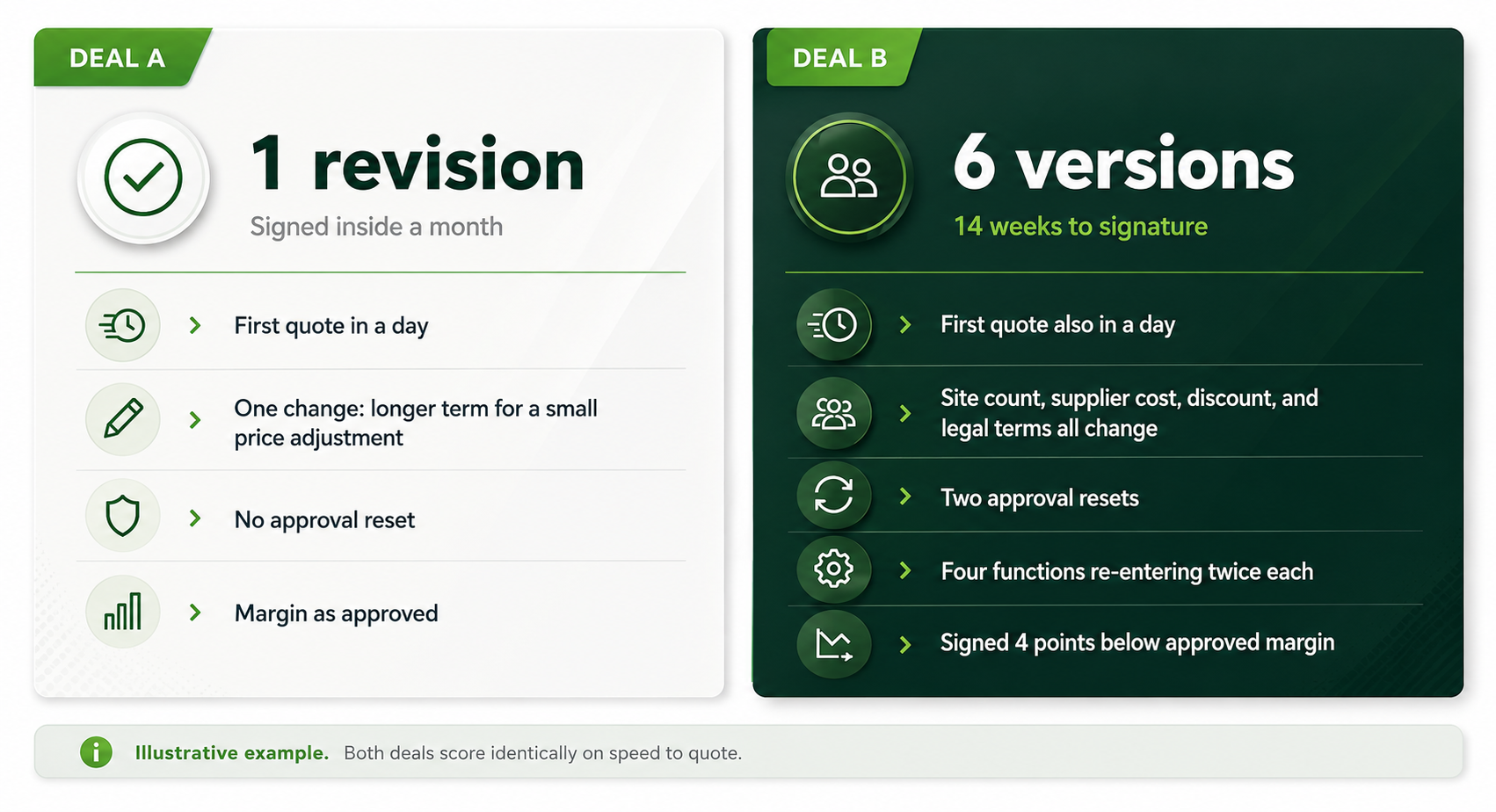
What separated Deal A from Deal B
In Deal B, the site count changed. Then a supplier cost moved. Then the discount crossed a threshold. Then legal touched the service credits. Each change rippled through the commercial model, the margin, and the approval path. Nothing about that sequence was unusual. That’s simply what complex deals do.
One metric, zero visibility
Yet measured by speed to quote, those two deals are identical. Your dashboard scores them the same.
And that’s the problem in one sentence: the metric can’t tell your best deal from your most expensive one.
The data points the same way
Directional industry research backs this up. The Optifai Pipeline Study, a 2026 analysis of 939 B2B SaaS companies, found sales cycles have stretched 22 percent since 2022. In enterprise deals, the negotiation-to-close stage alone eats 35 to 40 percent of total cycle time.
Treat those figures as indicative rather than definitive, since they come from a single sales-technology vendor. Still, the direction matches what our own customers describe. Negotiation-to-close also holds procurement, security, and legal review. But it is where much of the revision loop lives. And it is nowhere near the first quote.
Speed to quote measures the wrong end of the deal
What speed to quote gets right
Credit where it’s due. Time to first quote earned its place. It tells you whether sales can actually find accurate products and pricing. It also tells you whether the obvious administrative bottlenecks are gone. Improving it is usually the first win any quoting investment delivers, and it’s a genuine win.
It becomes a vanity metric only when it is the only thing you measure. And in most revenue organizations, it is.
What speed to quote misses
But it tells you nothing about what happens next. Nothing about the number of material versions after quote one. Nothing about the days each version sits in someone’s queue. Nothing about approvals that restart, margin that drifts, or documents that stop agreeing with each other. And nothing about the rework created by an error nobody caught in version three.
And the work it hides is not cheap. Salesforce’s State of Sales research, published in February 2026 from a survey of more than 4,000 sales professionals, found the average seller spends just 40 percent of their time actually selling.
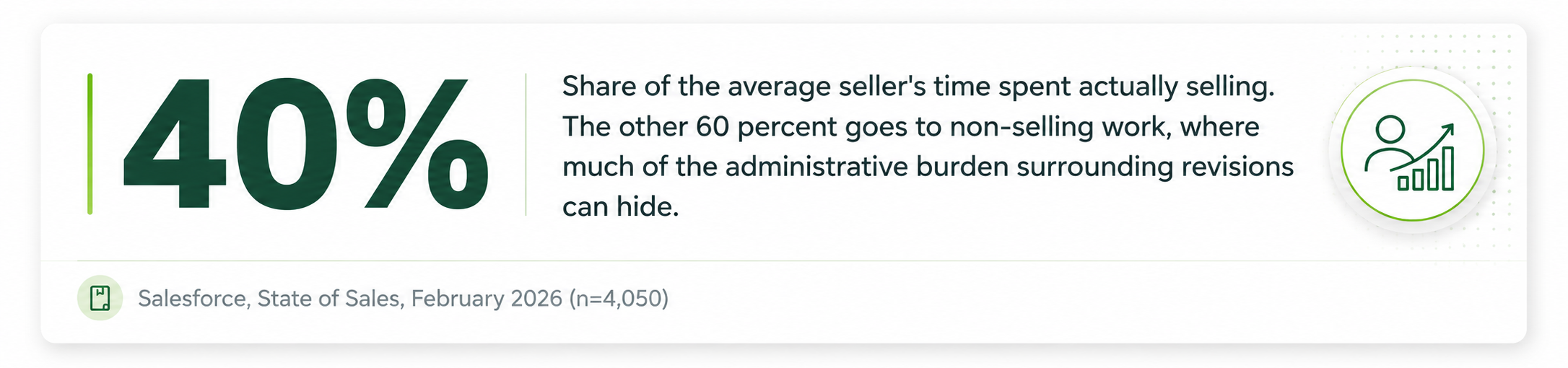
And that hidden work doesn’t sit with sellers alone. It drags solution engineering, finance, legal, deal desk, and delivery in with it. None of their hours show up on a sales dashboard at all.
Quote speed and deal velocity are not the same thing. A fast first quote sits on top of a slow, expensive deal more often than not, and the two rarely show up on the same report.
What actually counts as an iteration
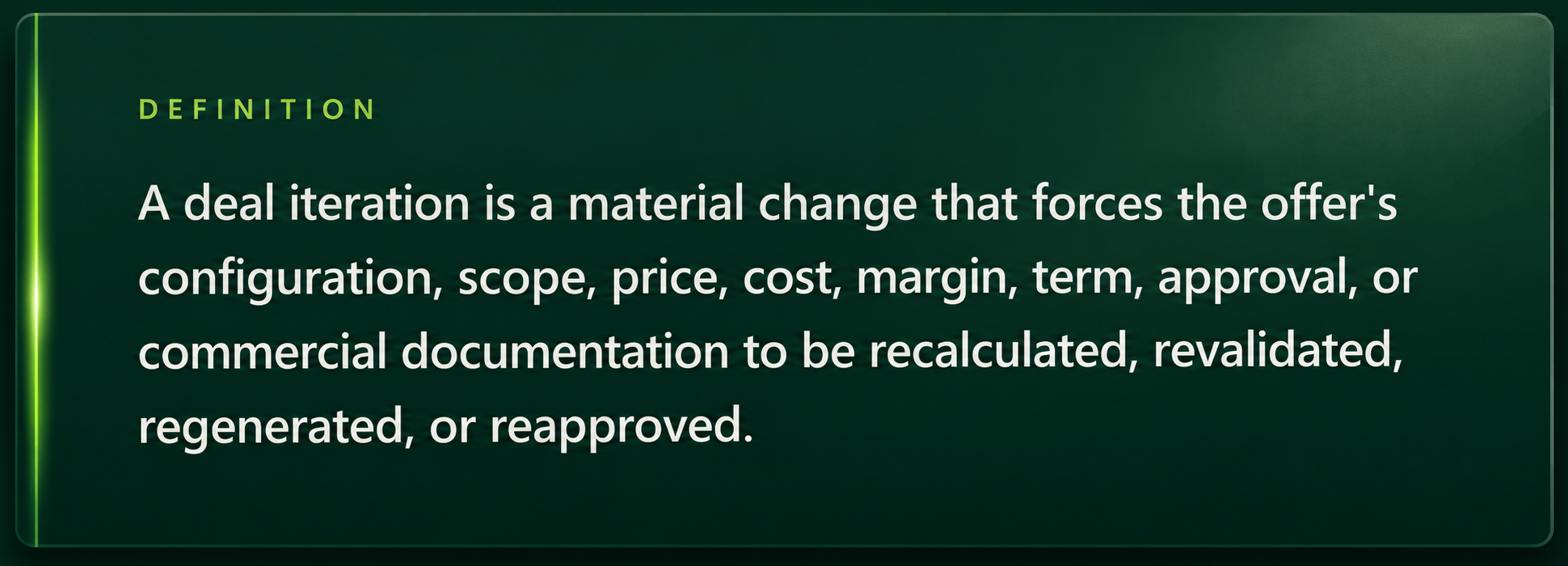
Fixing a typo in the customer’s address is not an iteration. Changing the site count is.
Here’s where most commentary on this topic gets lazy. Not all iterations are bad. Some are the deal working exactly as it should.
Necessary iterations: the deal working as designed
A necessary iteration is legitimate discovery or negotiation. The customer changes quantities, service levels, or term because their understanding of their own requirements improved. That’s not a defect in your process. That’s how complex buying works.
Every signal says it’s intensifying. Gartner’s March 2026 sales survey found 67 percent of B2B buyers now prefer a rep-free experience. The same survey found 45 percent used generative AI during a recent purchase. Gartner’s May 2026 follow-up found buyers working through an average of seven information sources. In that same study, 69 percent turned to sales reps mainly to validate what their AI research told them.
In other words, requirements now get formed, and re-formed, outside your seller’s view. When they collide with your quote, your quote changes. So plan for more mid-deal revision, not less.
Preventable rework: the iterations you pay for twice
Preventable rework is the other kind. An invalid configuration nobody caught. A supplier cost that went stale. A manual pricing error. Discovery that should have surfaced a requirement two versions ago.
The failure in most revenue organizations isn’t that iterations exist. It’s that nobody can tell these two kinds apart, because nobody records why each revision happened.
A high iteration count isn’t automatically a broken process. An unexplained one always is.
Reason codes: how to tell them apart
A single reason code won’t hold, because one revision can be customer-driven, pricing-related, and approval-triggering at once. Tag every revision on three fields instead:
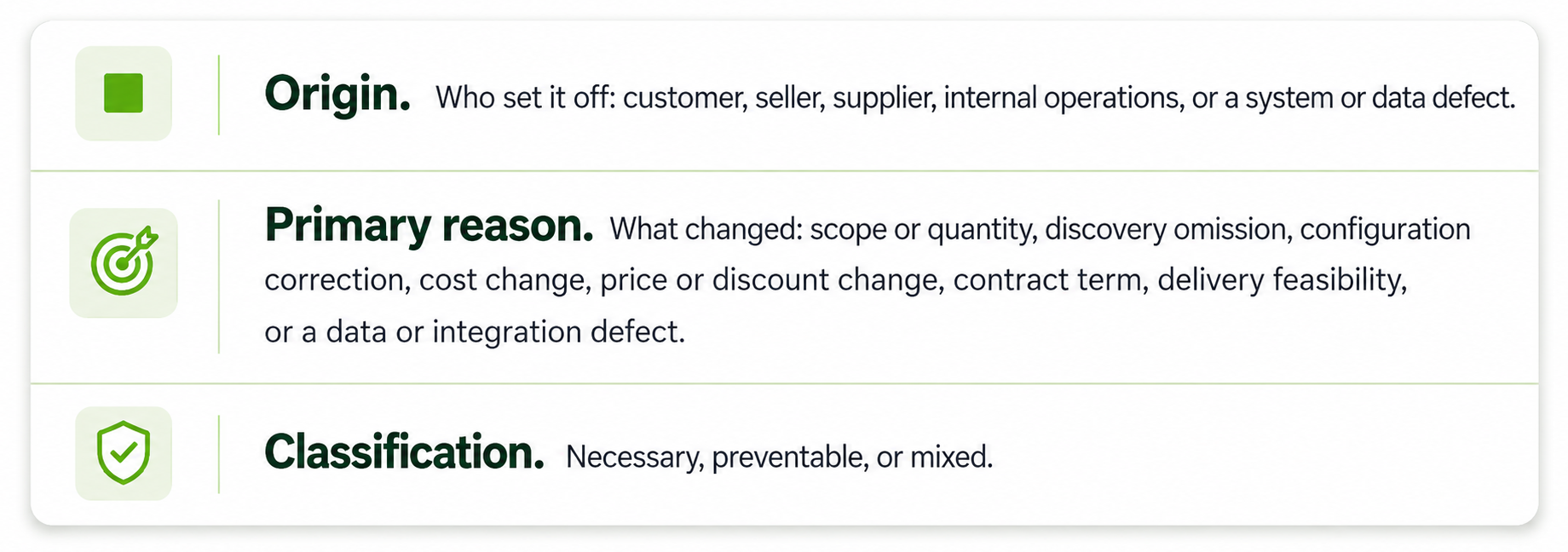
Do that for one quarter and you’ll know exactly where your commercial process is producing revenue leakage, and how much of it was preventable.
Most leaders who run this exercise are surprised by how little of the loop was ever the customer’s idea.
One revision is never one task

The customer asks for something small. A different start date. Twenty more units. A service-level upgrade at two of the 14 sites.
Watch what actually happens next.
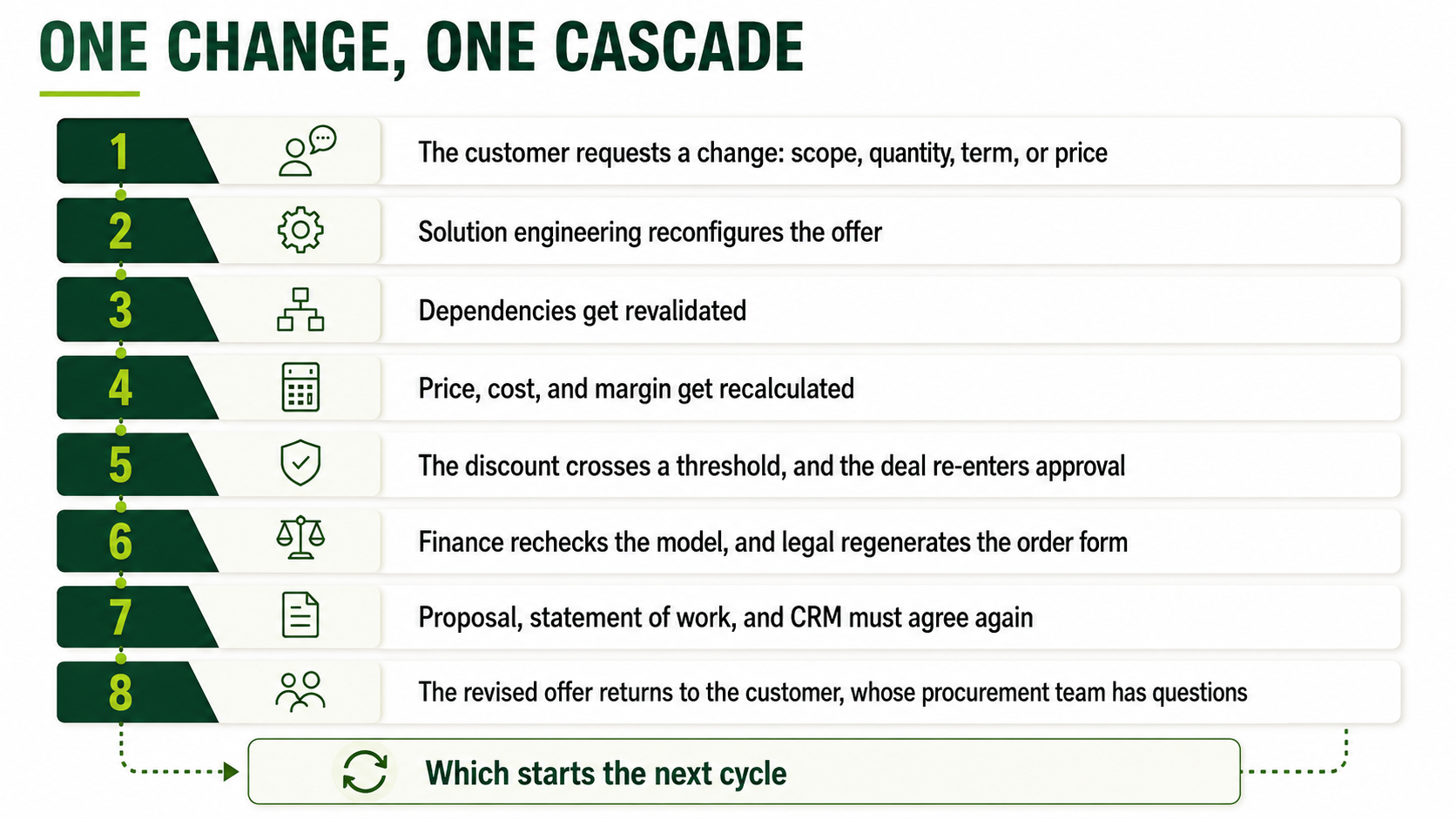
Notice what the diagram can’t show you. The approver at step five wasn’t in the original conversation, so someone rebuilds the evidence pack from scratch. The documents at step seven don’t update themselves; a person reconciles them. And the loop at the end isn’t a possibility. In complex deals, repeated loops are common.
Waiting time is the real cost
Here’s what makes it expensive: the active work in that cascade might be three hours. The elapsed time is two weeks, because the real cost isn’t effort, it’s waiting. The quote sitting in an approver’s queue. The cost update waiting on a supplier. Five functions that each touched the deal for 40 minutes, coordinated across five calendars.
And when systems are disconnected, there’s a second cascade behind the first. Spreadsheets, email threads, and downstream records get manually reconciled to whichever version is now considered true.
This is the territory I mapped in the Missing Mile: the gap between the quote and the general ledger where commercial intent gets lost before finance ever sees it.
If that sounds dramatic, consider how these deals are actually administered. McKinsey’s April 2026 research on B2B pricing, built on a survey of more than 400 pricing executives, shows current-state workflow examples where configuration, quoting, discount tracking, and approvals are still handled through spreadsheets and email. Every one of those handoffs is a place where a version waits, and where two versions quietly stop agreeing.
The Iteration Toll
Every one of those cascades costs something. Almost nobody adds it up. So we gave it a name.
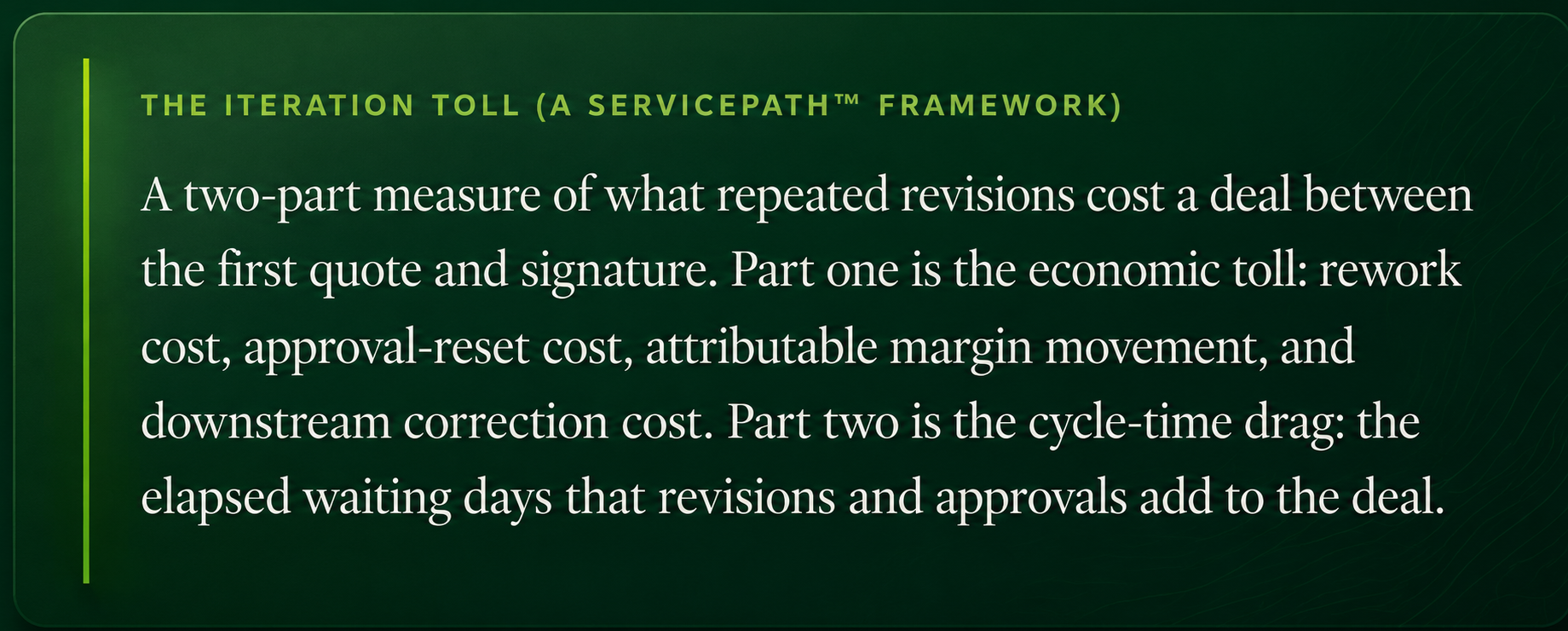
A word on the term. Iteration Toll is our language, not a standard accounting or RevOps metric, and it is not a levy of any fiscal kind.
Think of it as an umbrella that gathers measures your teams may already track in isolation, quote-to-close time, approval-cycle time, deal-desk touches, version count, discount leakage, and price realization, and forces them into one view of what your revision loop actually costs.
The point is not to invent a new number. It is to stop these costs hiding in six different reports that nobody reads together. Keeping the two parts separate matters. The economic toll is money: payroll and lost margin you can total in dollars.
The cycle-time drag is time: elapsed days that delay the deal but do not sit on a payroll line. Adding them together would double-count effort against calendar, so we report them side by side and never fold one into the other.
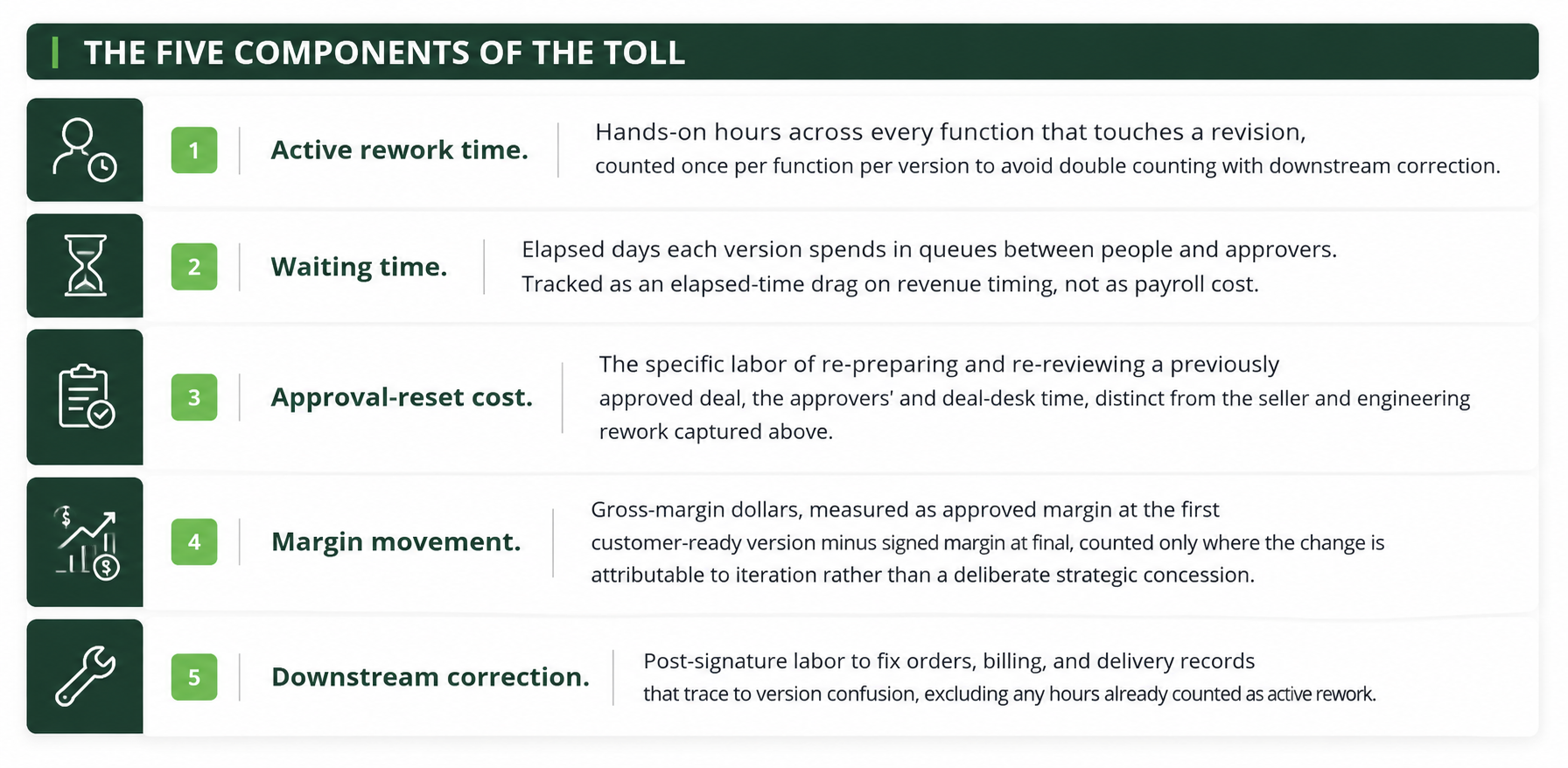
The five components of the toll
Five components, defined so finance can reproduce them:
Three layers, so a CFO can trust the number
The framework has three layers, and separating them is what stops it from being hand-waving:
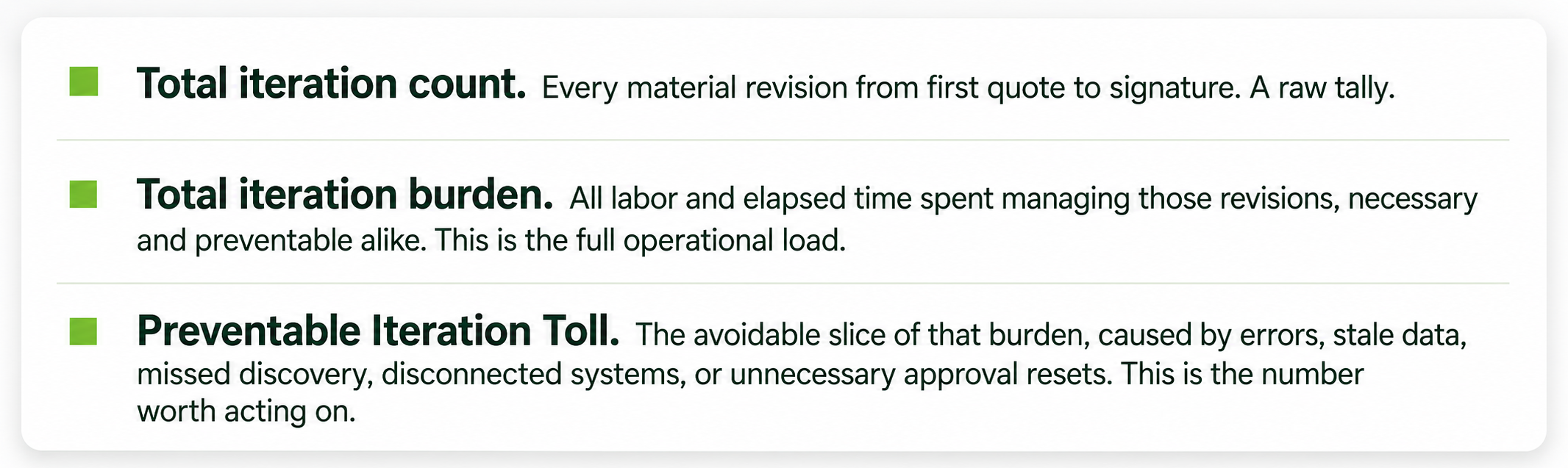
The distinction protects the framework from the obvious objection. A CFO will accept that negotiation costs money. They will not accept that normal negotiation is a toll. So the toll is the preventable layer, not the whole burden.
Legitimate negotiation shows up in the burden, where it belongs, and only its avoidable friction rolls into the toll. The audit below expresses the result against contract value and per signed deal, because a raw total tells you nothing without a denominator.
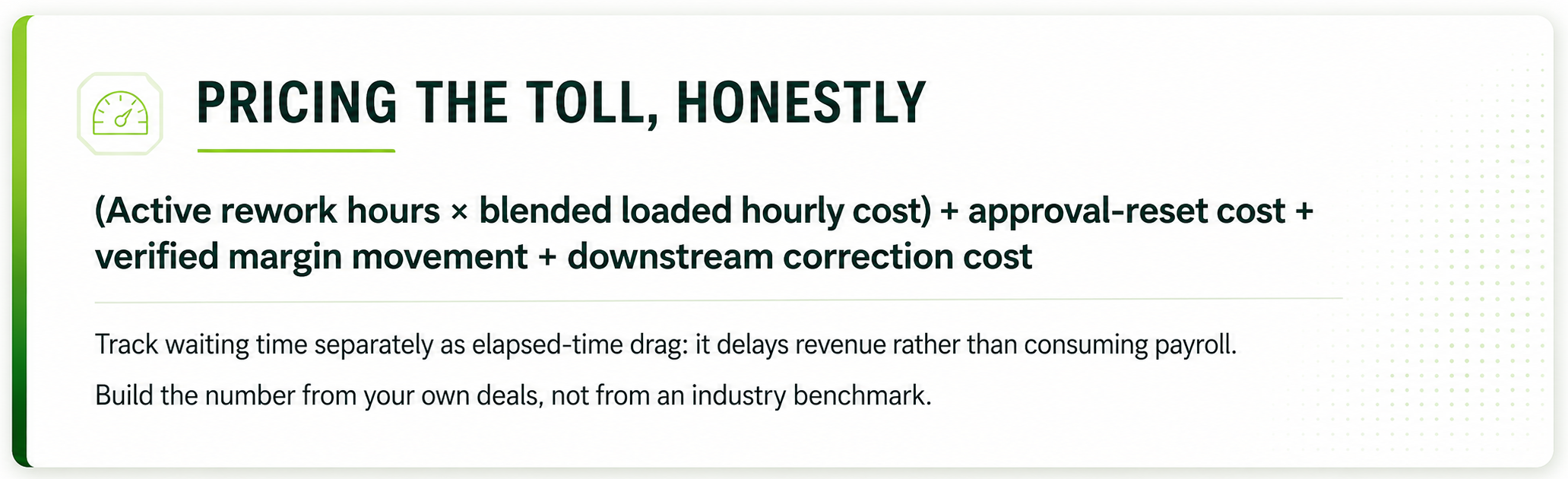
How to put a number on it
The formula card above is the whole method. The only discipline it demands is honesty: use your own loaded rates, count attributable margin movement rather than all margin movement, and keep waiting time out of the dollar total. Resist borrowing a universal benchmark from someone else’s whitepaper. A number built from your own five worst deals will do more in one CFO meeting than any industry figure ever will.
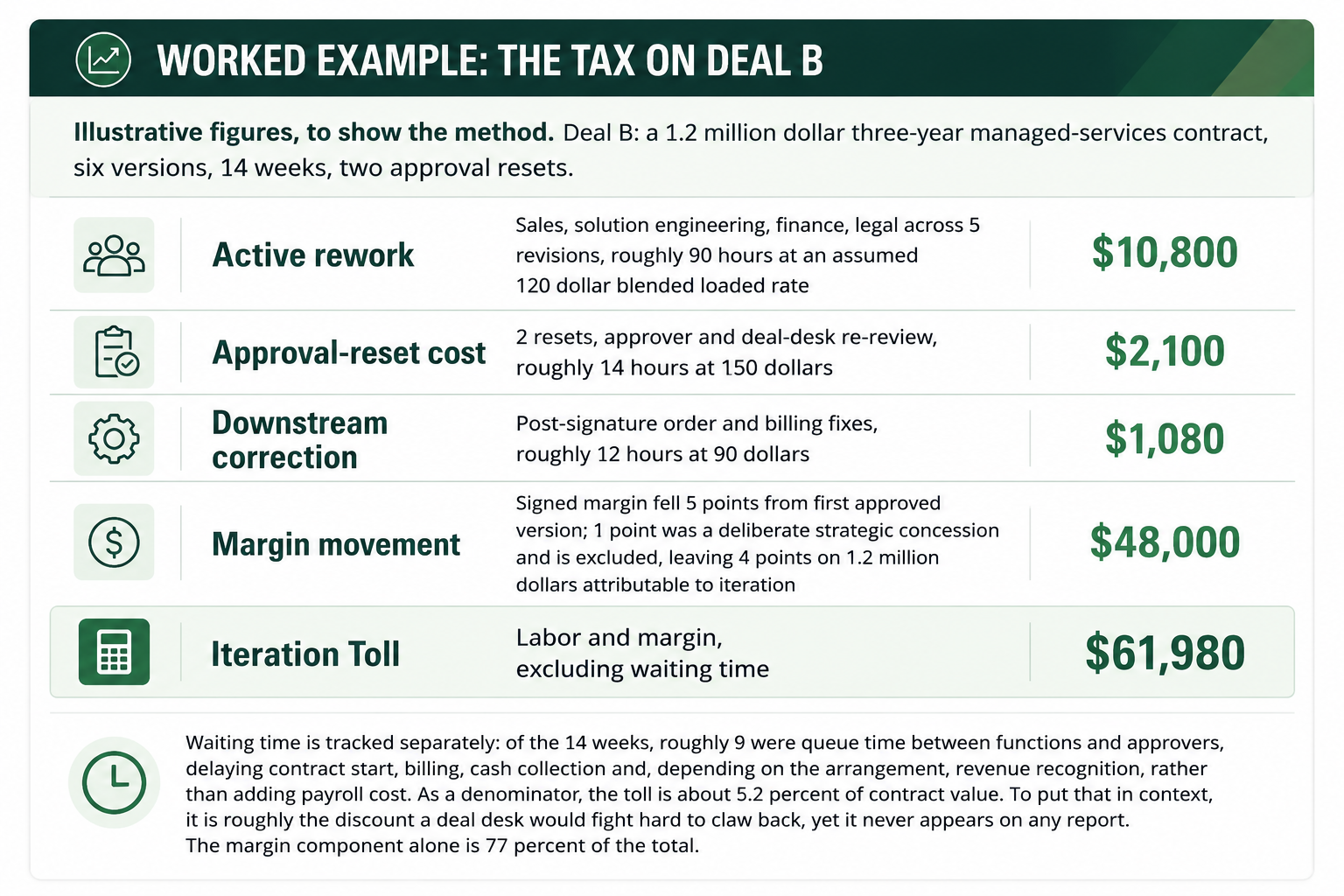
Stated plainly for the record: in this illustrative example, a 1.2 million dollar deal carried an Iteration Toll of roughly 62,000 dollars, about 5.2 percent of contract value, of which 77 percent was leaked margin rather than labor. That ratio illustrates why labor alone can materially understate the cost of repeated revisions. The expensive part was not the hours. It was the margin that leaked while the deal cycled.
The back-of-the-napkin diagnostic
The worked example above is the single-deal method. This is the portfolio version. You don’t need a software suite or a consulting engagement to know whether the Iteration Toll is hitting your P&L. You need a napkin and thirty seconds of intellectual honesty.
Across the complex technology and managed-services deals we see, three directional ranges come up again and again:
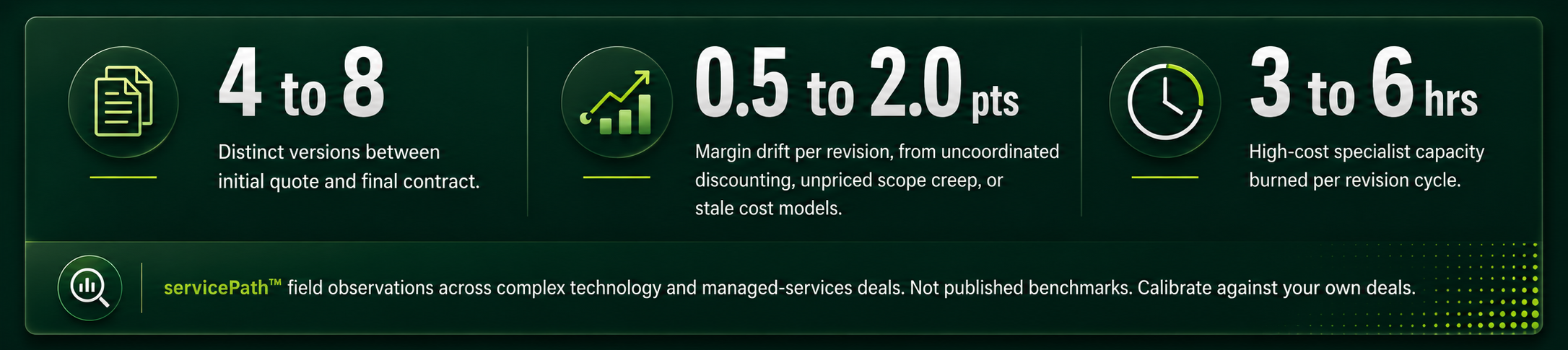
Run your own numbers
Take a conservative mid-market deal, five revisions to get it across the line, and a modest 1 percent margin drift per version:
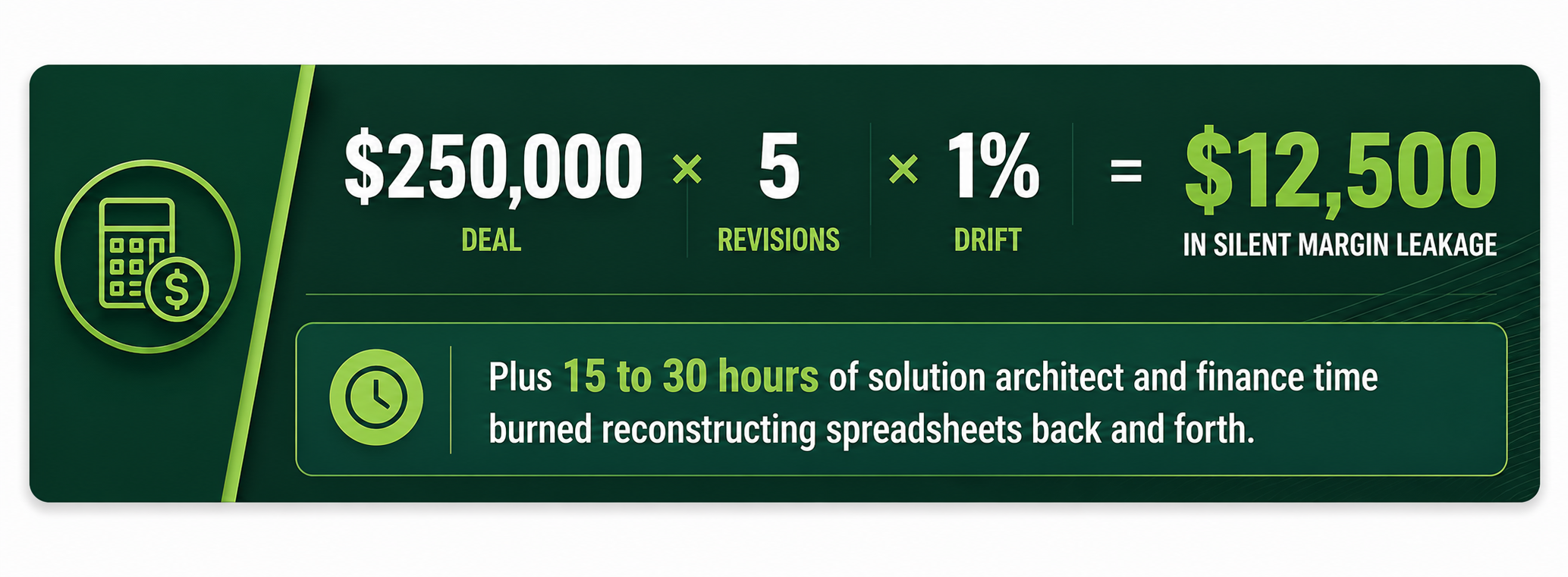
Now multiply that single-deal leakage by your quarterly deal volume.
If 1 percent per revision feels too pessimistic for your team, cut it in half and do the math again. If the result still represents a six-figure leak across your fiscal year, you don’t have a closing problem. You have a governance problem in your middle mile.
Margin drift: the most lethal drain
Margin movement compounds silently. With every successive version, reps concede small percentage points to keep momentum alive. Cost baselines go stale without being repriced. Critical implementation fees quietly get dropped. Each looks small in the version where it appears.
Across six or eight versions they stack, and pricing power evaporates. The signed margin ends up materially different from the approved one, without any single person having decided to give it away.
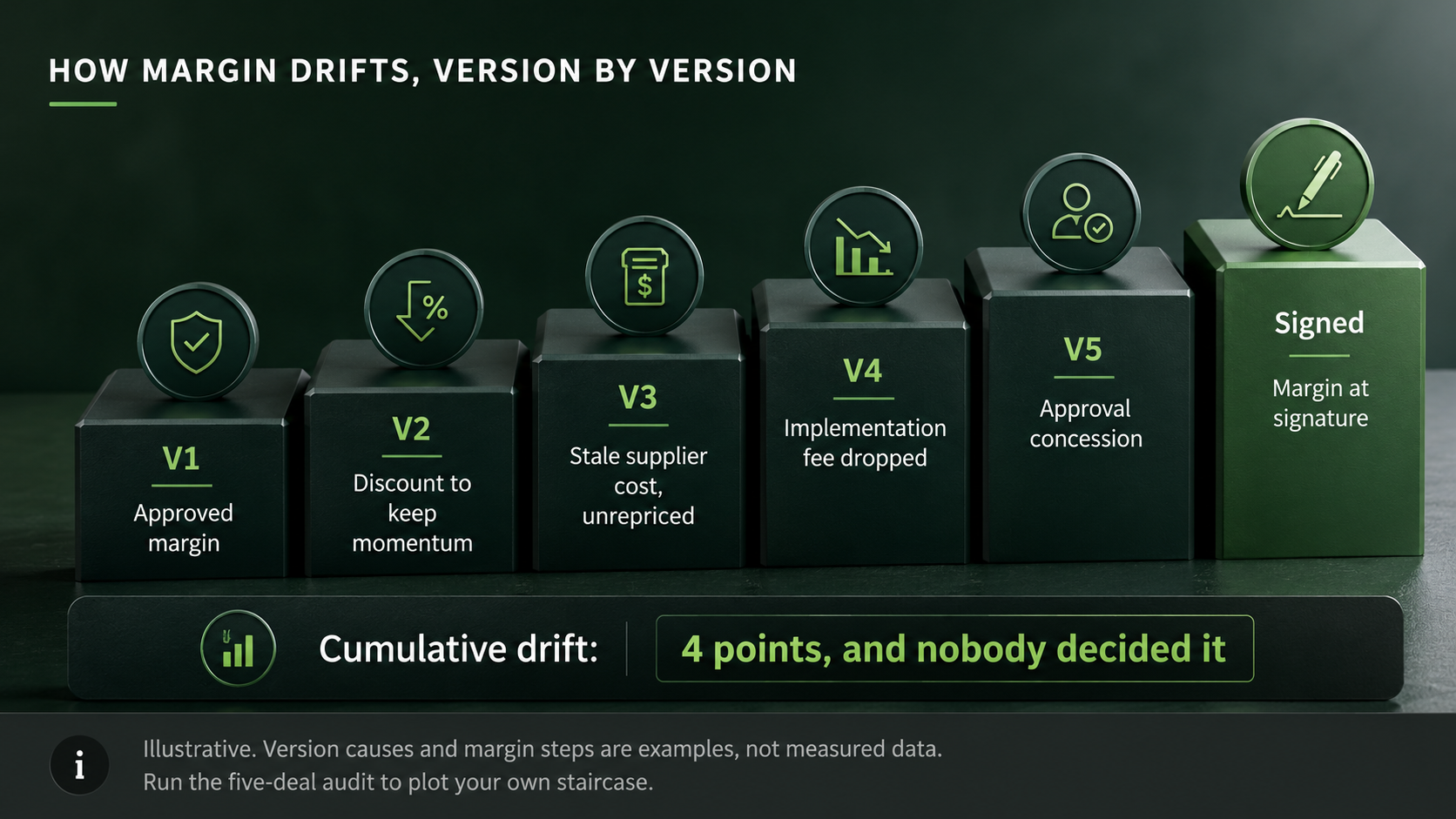
Why does a few points matter so much? Pricing sits close to the bottom line. McKinsey’s 2026 pricing research, citing a long-established finding, notes that a 1 percent improvement in realized price can lift operating profit by roughly 8.7 percent, assuming volume holds. Price and margin are not the same lever, so treat that as an illustration of pricing leverage, not a direct conversion of your drift.
The practical point stands. Because pricing is so leveraged, margin that leaks across revisions costs the bottom line far more than its size on the quote suggests. Measure the dollars on your own deals rather than applying a multiple.
Approval resets: how governance corrodes
Approval resets corrode something different: governance itself. When the same deal lands on the same executive’s desk for the fourth time, one of two things happens. Either the deal slows down again, or the approval becomes a rubber stamp. Both are failures. The first taxes velocity. The second taxes control, and it’s the one that shows up in an audit.
The costs that never hit a timesheet
The first is forecast reliability. A deal whose scope, value, and timing change with every version is a deal your pipeline can’t price.
A forecast built on unmeasured revision loops is a guess wearing a spreadsheet.
The second is customer confidence. Buyers experience your iteration burden directly, as slow responses and contradictory versions. In a competitive deal, the vendor who handles revision three cleanly can outperform the vendor that merely produced the first quote first. The buyer remembers which supplier made the changes feel effortless, not which one was first out of the gate.
The more dependent the deal, the higher the toll
The Iteration Toll isn’t distributed evenly, and this is the part I care about most, because it’s where our customers live. Contract value alone doesn’t drive it. Dependency does. A 5 million dollar standardized renewal can carry less iteration burden than a 700 thousand dollar multi-site managed-services deal with third-party costs and custom delivery.
Iteration burden scales with the number of commercial dependencies inside the deal. Count them in your biggest open deal:
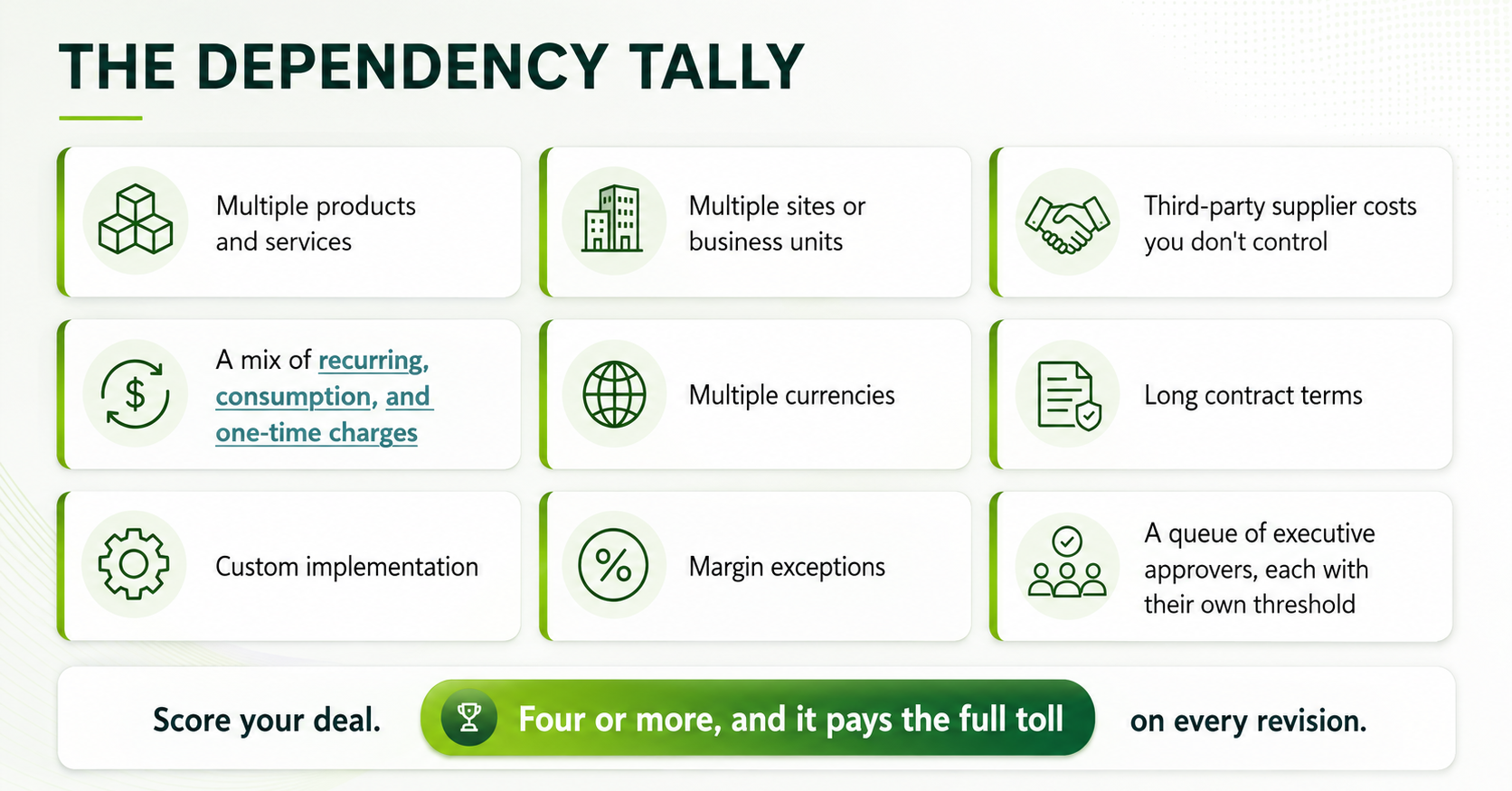
Complexity doesn’t just increase the number of decisions in a deal. It increases the number of places where one decision can break something else.
Change the term on a single-product renewal and you’ve changed one number. Change the term on a multi-site managed-services deal and you’ve changed the supplier commitments, the consumption assumptions, the delivery plan, the margin profile, and probably the approval path, all at once. Same customer request. Completely different cascade.
That’s why a simple renewal can absorb five revisions cheaply while an enterprise transformation deal pays the full toll on every single one. It’s also why the deals that matter most to your year are precisely the ones where the loop hurts most. Nobody loses sleep over iteration on a 40 thousand dollar renewal.
The deal that funds your quarter is the one bleeding quietly through version seven.
Segment your iteration metrics
One practical instruction for whoever owns your reporting: never benchmark enterprise deals against renewals. Segment iteration metrics by deal type, size, and reason code, or your averages will hide exactly the deals that are costing you the most.
The real bottleneck: human scarcity
Why do revision loops take weeks instead of days? Because modern B2B buying has changed while selling infrastructure has stayed static.
The demand side: buyers who keep changing
The Gartner buyer research cited earlier tells the demand side of the story: buyers arriving with independent, AI-assisted research across an average of seven information sources, re-forming their requirements as they go. Mid-cycle scope changes aren’t an anomaly anymore. They are the standard operational reality of enterprise selling.
The supply side: experts who don’t scale
When those changes land, they hit an internal wall of scarce human capital. Your deal desk, revenue recognition controllers, security architects, specialist lawyers, and senior approvers are shared, finite resources. When several complex deals hit their desks at once, each needing manual re-evaluation, a hidden capacity ceiling forms, and every deal in the portfolio waits behind it.

Survey of 1,200+ commerce and contracting decision-makers, reported by Distribution Strategy Group, March 2026.
This is why treating approval delays as process laziness misses the point. When pricing and scoping rules live in the disconnected spreadsheets and email threads McKinsey’s current-state examples describe, you are forcing high-cost human experts to act as manual data integrators. That isn’t a workflow annoyance. It is a portfolio constraint that caps your total revenue capacity.
And it is why the cycle-time drag in the Iteration Toll is measured in weeks while the active work is measured in hours.
Your AI just gave sellers five hours back. Where did they go?
Here’s the 2026 twist that makes this urgent rather than academic.
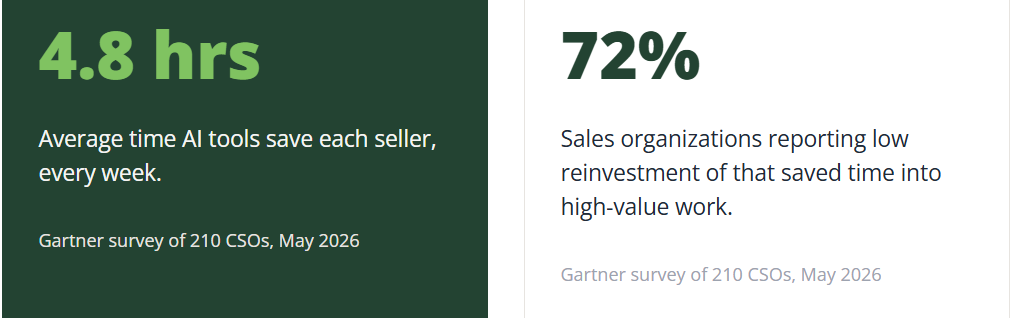
Gartner’s survey of 210 chief sales officers, released in May 2026, found AI tools now save sellers an average of 4.8 hours per week. The same survey found 72 percent of sales organizations report low reinvestment of that saved time into high-value work. Gartner calls it the reinvestment gap. The organizations that do reinvest are 2.2 times more likely to exceed their customer growth goals.
Your revision loop may be consuming the AI dividend
Gartner does not attribute the reinvestment gap specifically to quote revision. But in complex commercial organizations, the revision loop is one of the first places I would look.
AI hands your sellers five hours back. In nearly three quarters of organizations, the commercial system quietly absorbs them. Where do reclaimed hours go when the revision loop is ungoverned? Into rebuilding evidence packs for the fourth approval. Into reconciling the spreadsheet to the CRM to the order form. Into the deal that came back again.
You cannot reinvest hours into a system that eats hours.
Fix the loop first, and the AI dividend lands as selling time. Skip that step and you’ve bought expensive tools to feed an invisible toll.
What CPQ should actually do about it
I run a CPQ and Revenue Lifecycle Management company, so here is the brutal truth most software vendors won’t admit: no CPQ platform or revenue tool will magically eliminate deal friction.
If a buyer’s procurement team runs a multi-week vendor risk assessment, or their CFO freezes budgets mid-quarter, no piece of software will force a signature. Negotiation is how complex deals get built, and a customer revising your quote is a customer engaging with it. Anyone promising to remove revisions from complex selling is describing a business you don’t have.
The candid divide: what software can and cannot fix
To improve conversion velocity, separate your friction into two buckets and treat them differently:
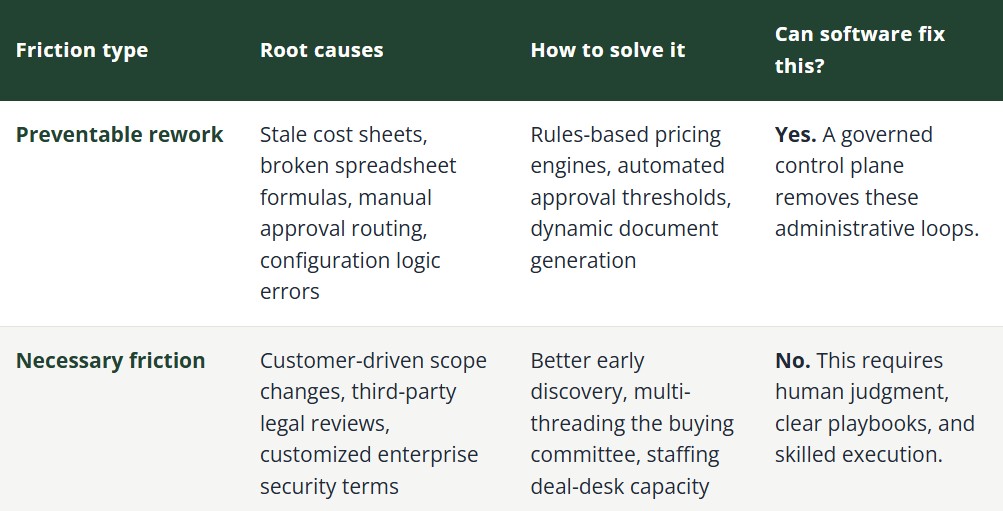
Buying technology to solve necessary friction is a waste of capital. But allowing preventable rework to consume your scarce deal-desk capacity and erode margins is operational negligence.
CPQ as an iteration-control system
So the claim I’ll make for CPQ is narrower than the one vendors usually make, and worth a lot more. The value of Configure, Price, Quote (CPQ) software was never just how fast it produces version one. It’s how safely it manages every version after that, all the way to signature.
Done properly, CPQ is an iteration-control system.
What does that mean in practice? Six tests, and they belong on your next CPQ evaluation scorecard:

Rules, not heroics. Configurations revalidated by rules on every revision, not by whoever happens to catch the error.
The investment gap is the opportunity
The market knows this is where the money is. It just isn’t acting yet. In McKinsey’s 2026 survey, 63 percent of pricing executives ranked configuration, quoting, and deal pricing among the top three opportunities for AI-driven impact.
Only 47 percent ranked it a top investment priority. For discount approval and governance, the gap was wider still: 62 percent impact, 22 percent investment.
That gap is your competitor’s blind spot or yours. Someone in your market will close it first.
This is the commercial control plane we build at servicePath™: one governed system where configuration, pricing, cost, approvals, versions, and documents stay connected, so a change in one place propagates through all of them. It’s what “Good Revenue Faster.” has always meant. Not a faster first quote. A faster, safer path to good revenue.
The five-deal iteration audit
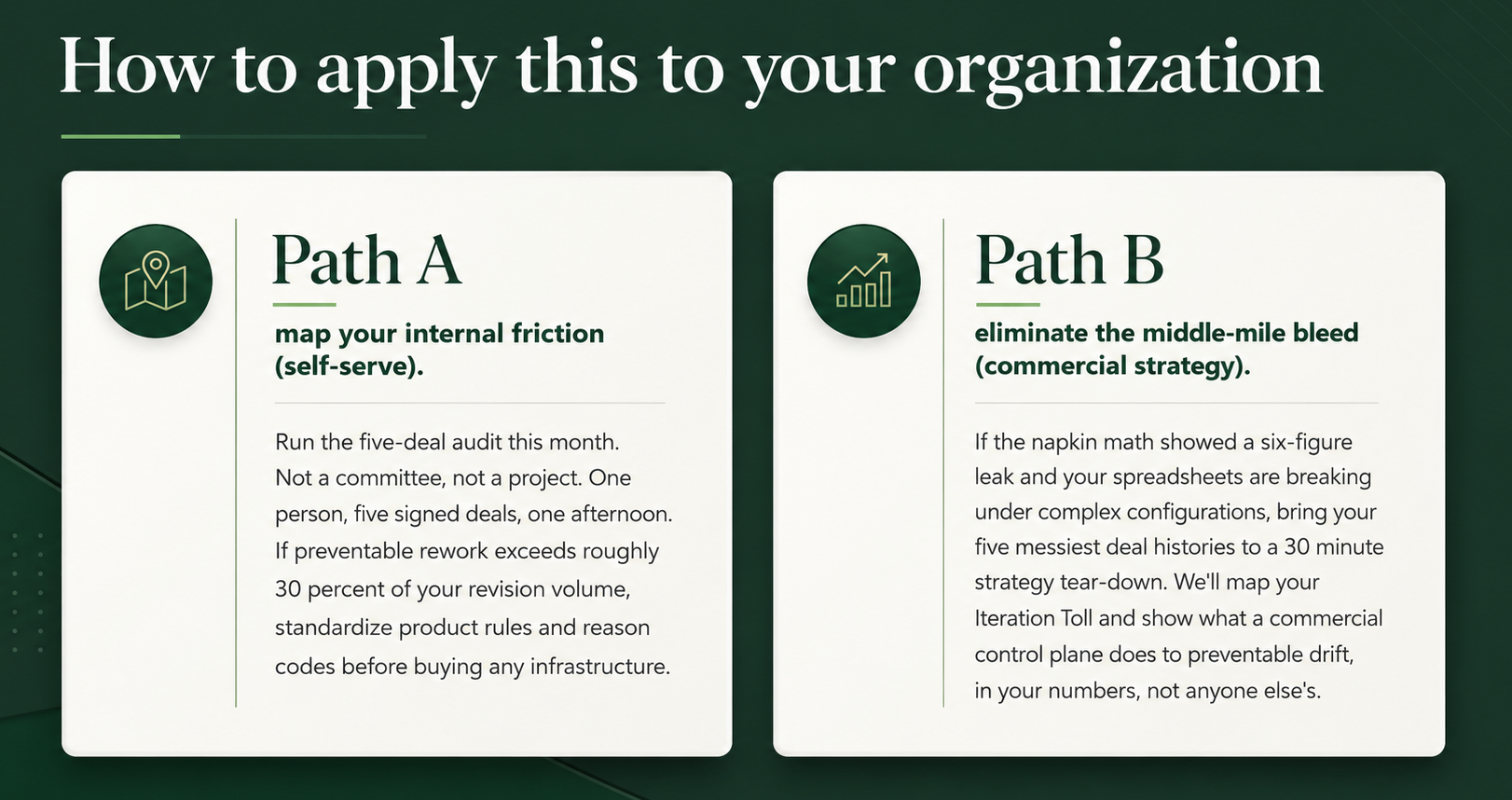
You don’t need a software project to find out whether you have this problem. You need five deals and an afternoon to establish a baseline.
Pull the last five complex, custom deals your team closed, or lost late in the cycle. Losses count: a deal that died in version seven teaches you more than one that sailed through.
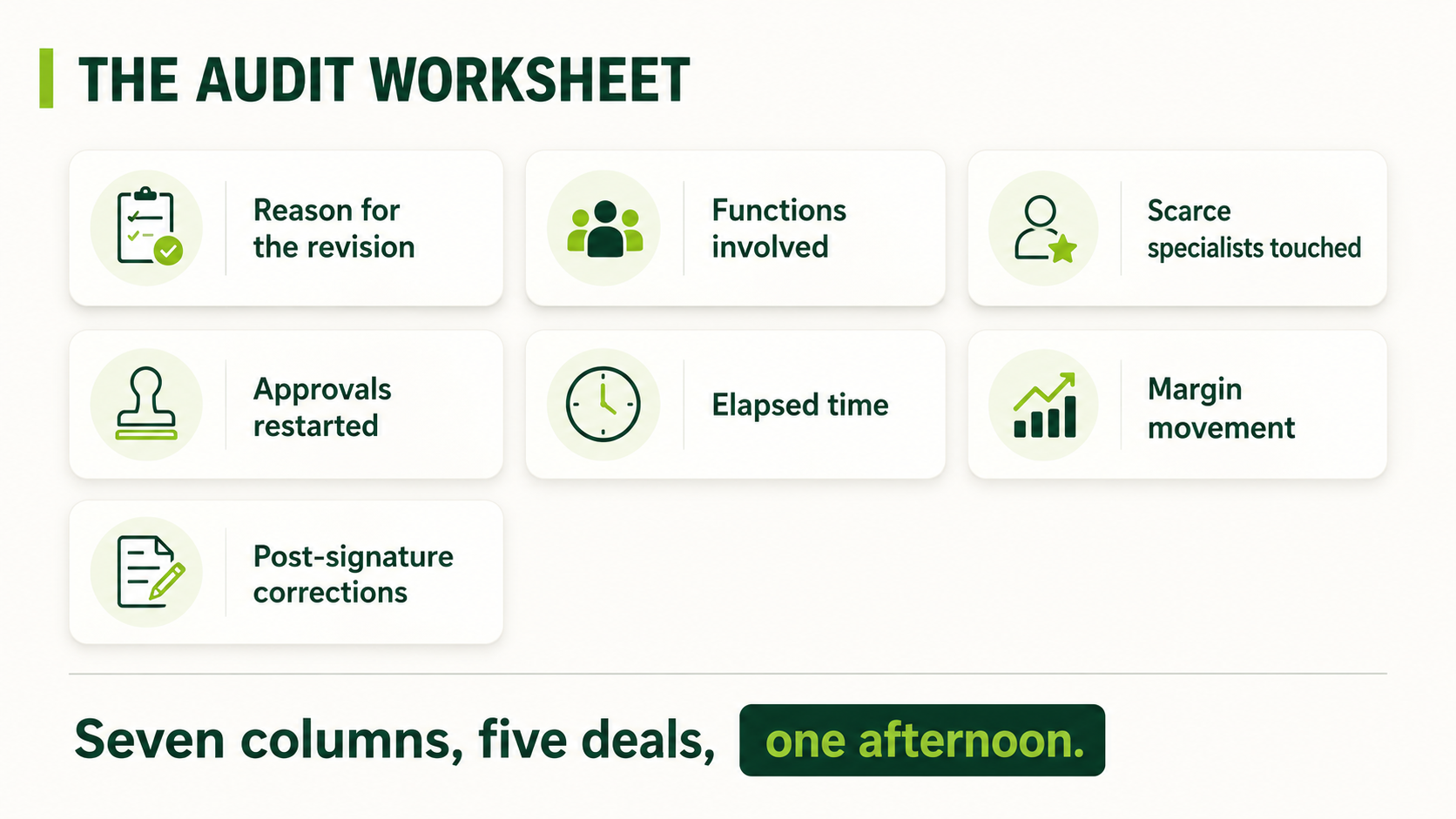
Get the account executives, solution engineers, and deal-desk analysts in a room and reconstruct the forensic trail of each deal. Count every material commercial version from first customer-ready quote to signature. Then, for every revision, record seven fields:
The spreadsheet reality check
Most organizations attempt this audit and hit a wall. Version histories live in rep inboxes. Reason codes don’t exist. Margin realization means cross-referencing three systems. That wall is the finding: record the gaps rather than reconstructing them through interviews.
If you can’t establish who touched a price or what changed between versions, you’ve found the root cause of your Iteration Toll.
And if you can’t recover it now, neither can an auditor, an acquirer, or an AI agent later.
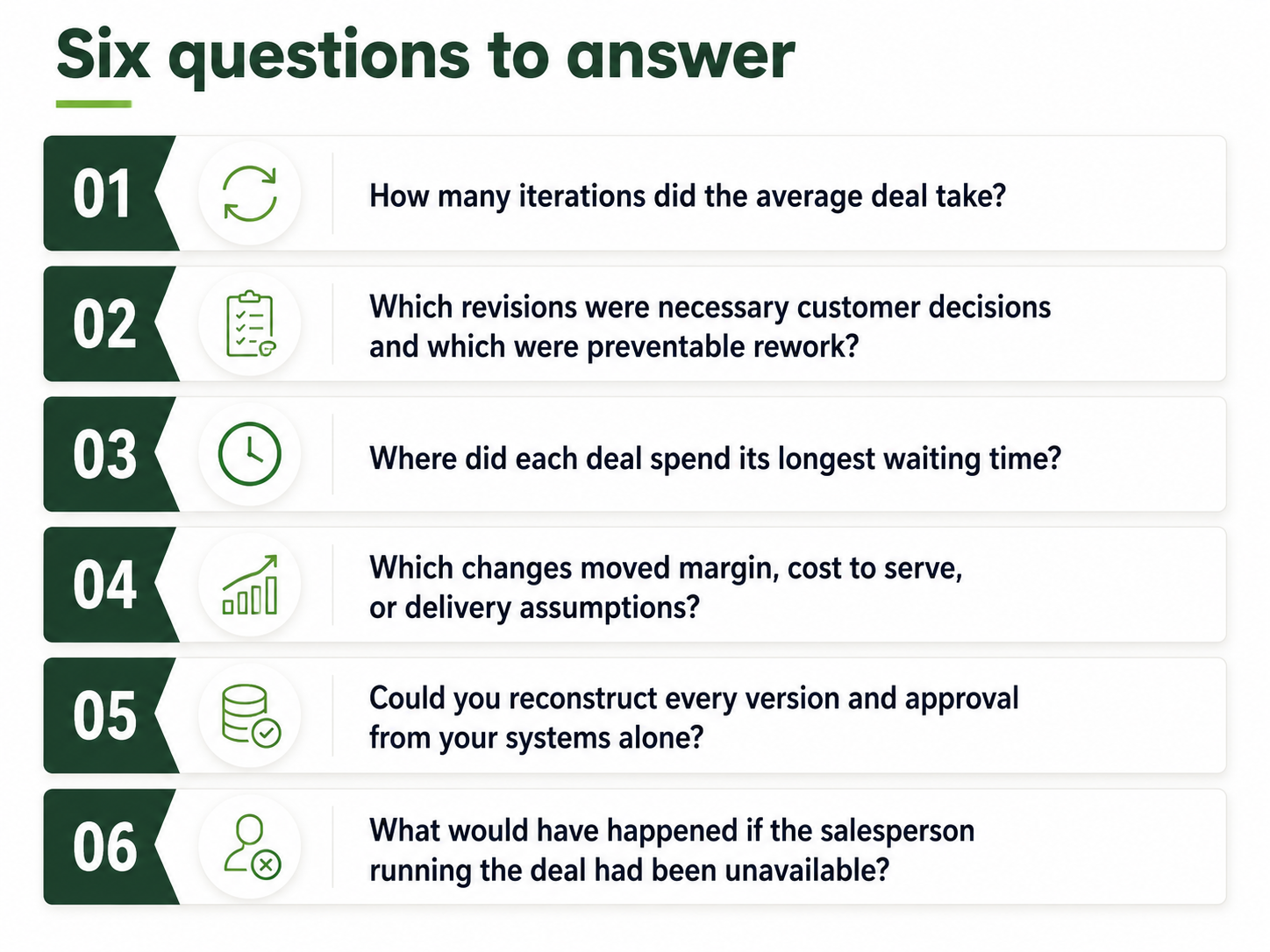
If you read our earlier piece on the Deal Reconstruction Test, you’ll recognize that last question. The two diagnostics are a pair. The reconstruction test asks whether your organization can explain the final deal. The iteration audit asks how much hidden work it took to get there.
Back to the silence
Remember the question that opens this piece: how many iterations does your deal take? The silence isn’t ignorance. It’s structural. The answer is spread across a CRM, a deal desk, six inboxes, and a rep’s memory. No system was ever asked to hold it in one place.
Speed to quote is easy to measure: one door, one day. Everything expensive happens afterward, in a loop nobody instrumented.
Name the loop, price it, and the silence turns into a number you can manage.
Leave it unnamed, and you’ll keep reporting fast quotes while your best deals leak time and margin where your dashboard can’t see. This was never about pushing reps to close faster. It’s about commercial governance that scales. Strip out the preventable rework. Your sellers stop being spreadsheet administrators. Your specialists stop drowning in manual reviews. And your pricing power holds from the front door to the final signature.
Why servicePath™
Most CPQ evaluations score first-quote speed. servicePath™ is built for everything after it: the revisions, dependencies, and approvals.
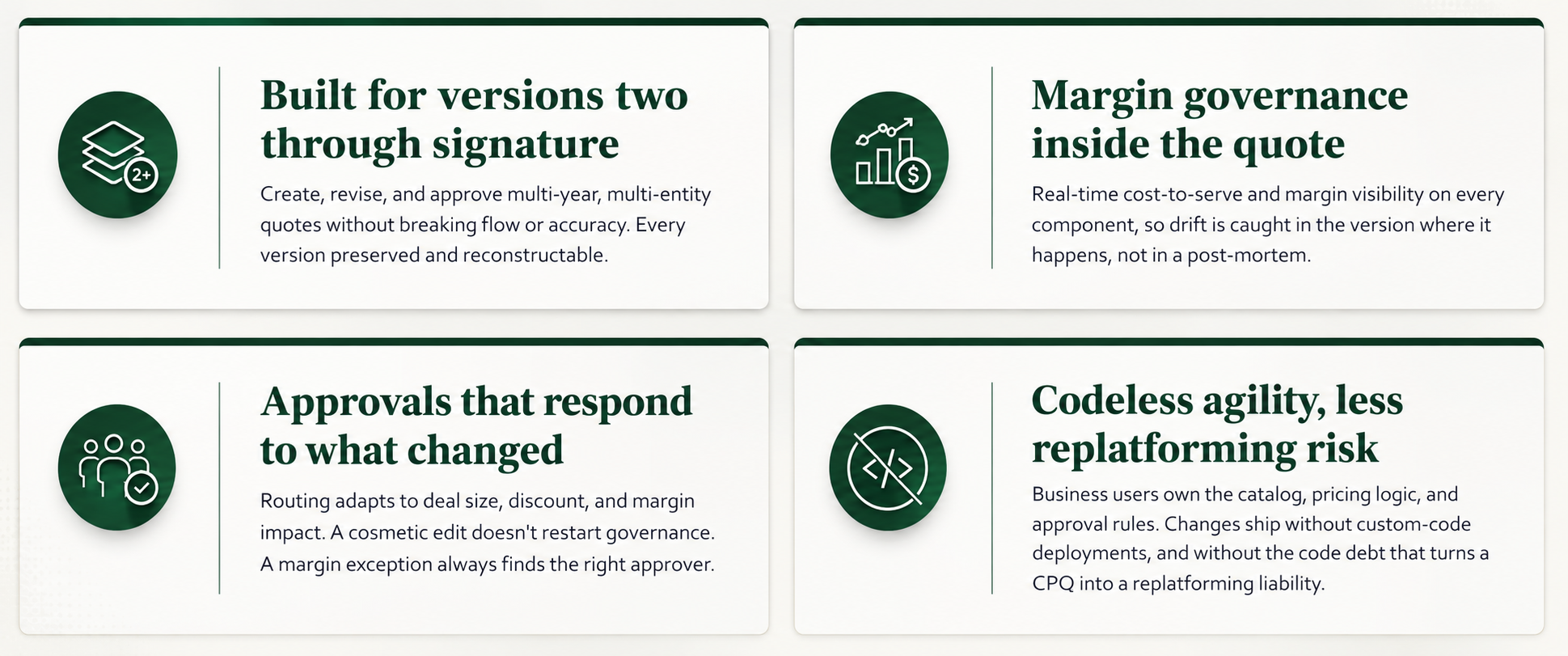
A Visionary in the 2026 Gartner Magic Quadrant for Configure, Price and Quote Application Suites, four consecutive years. Trusted by technology and managed-services leaders including telent and Dell. Read the case studies.
Frequently asked questions
What is the Iteration Toll?
The Iteration Toll is a servicePath™ framework for what repeated revisions cost a deal between first quote and signature. It has two parts: an economic toll (rework, approval resets, attributable margin movement, and downstream correction) and a cycle-time drag (the waiting days revisions add). It counts the preventable portion, not the value of legitimate negotiation.
Why is time to first quote an incomplete metric?
Because it measures only how quickly a deal enters the commercial process. It captures nothing about the rework, waiting, approval resets, and margin movement between first quote and signature, where most of a complex deal’s cost accumulates. A fast first quote can sit on top of a slow, expensive deal.
Does a high iteration count always mean a broken process?
No. Complex deals legitimately evolve through discovery and negotiation. The failure is not iteration itself but the inability to separate necessary negotiation from preventable rework, which requires recording a reason for every revision.
Keep exploring
The Missing Mile: AI risk and revenue leakage
Where margin integrity dies between the CRM and the general ledger, and the diagnostic framework for CFOs and CROs.
The bigness of little things: cost-first CPQ
Daniel on why CPQ must start with cost to serve, and how that makes outcome-based pricing profitable.
Daniel Kube on the CPQ Podcast
Daniel joins Frank Sohn to talk complex configurations, financial analysis in the quote, and where AI fits in CPQ.
The servicePath™ CPQ glossary
Plain-language definitions for the terms behind the revision loop: quote-to-cash, revenue leakage, and more.
About servicePath™
servicePath™ is the Configure, Price, Quote (CPQ) and Revenue Lifecycle Management platform for complex, tech-enabled enterprises. One connected control plane governs the full commercial lifecycle, from configuration and pricing through approvals, documents, and renewal.
Learn more at servicepath.co.
