

AI can build a quote in seconds. Then a customer asks why the price is what it is, and no one in the room can answer. 40% of enterprises will demote or decommission their autonomous AI agents by 2027, over governance gaps, not technical ones. (Gartner, 2026)

That gap is expensive. In fact, Gartner predicts that by 2027, 40% of enterprises will demote or decommission their autonomous AI agents. The reason is governance gaps, not weak technology. So if you own pricing, revenue operations, or a deal desk, this is your problem to solve. The 2026 research points to one fix, deterministic AI governance: AI proposes, approved rules dispose.
Executive summary
- Gartner predicts that by 2027, 40% of enterprises will demote or decommission their AI agents over governance gaps, not technical limits. The AI works. The accountability does not.
- The failure is rarely the model. Across 2026 research, AI stalls in revenue systems for one reason: no one can explain, prove, or contain what it does.
- The value gap is now measured. McKinsey found that 60% of companies still see no enterprise EBIT impact from AI. BCG found that only 14% have defined the profit-and-loss impact of their AI work.
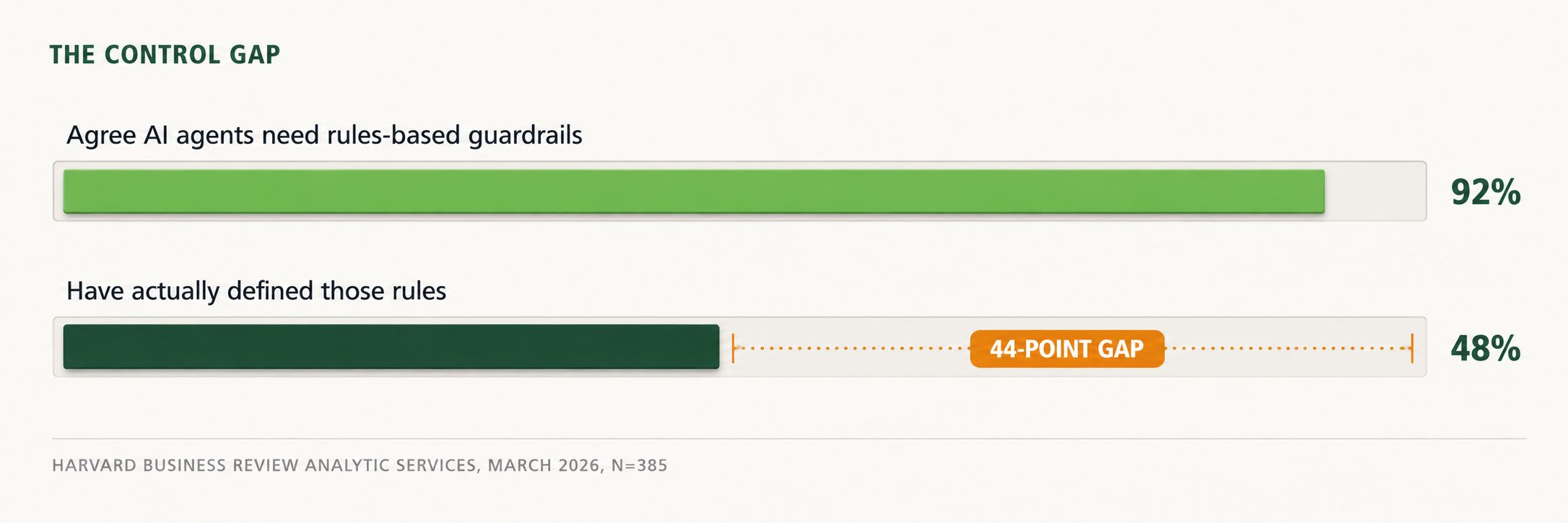
- The control gap is just as wide. In a March 2026 Harvard Business Review Analytic Services survey, 92% agreed AI agents need rules-based guardrails. Yet only 48% had defined them.
- Pricing is where the stakes peak. McKinsey reports that 65% to 85% of companies expect to use AI in pricing within three years, up from 10% to 30% today.
- The fix is deterministic AI governance: AI proposes at speed, and approved rules a human owns set the final decision.
What is deterministic AI governance?
Definition
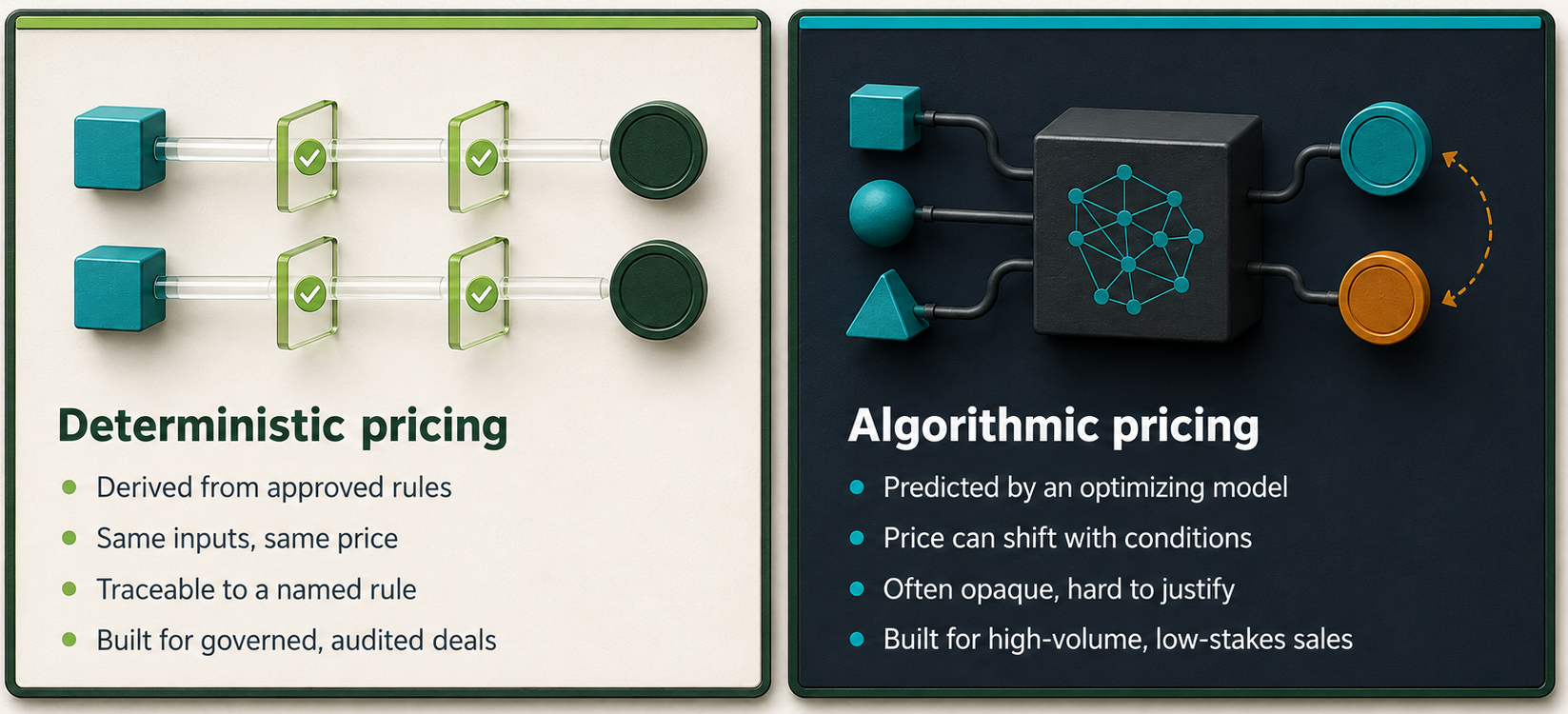
Deterministic AI governance is a framework where AI speeds up revenue decisions but never makes the final call alone. Instead, rules a human owns and can audit set every price, discount, and approval. The word deterministic comes from computing. There, a deterministic system uses no randomness and always gives the same output from the same inputs. Applied to revenue, it is simple. AI can propose, but approved logic disposes. So the model moves fast, and the decision stays accountable.
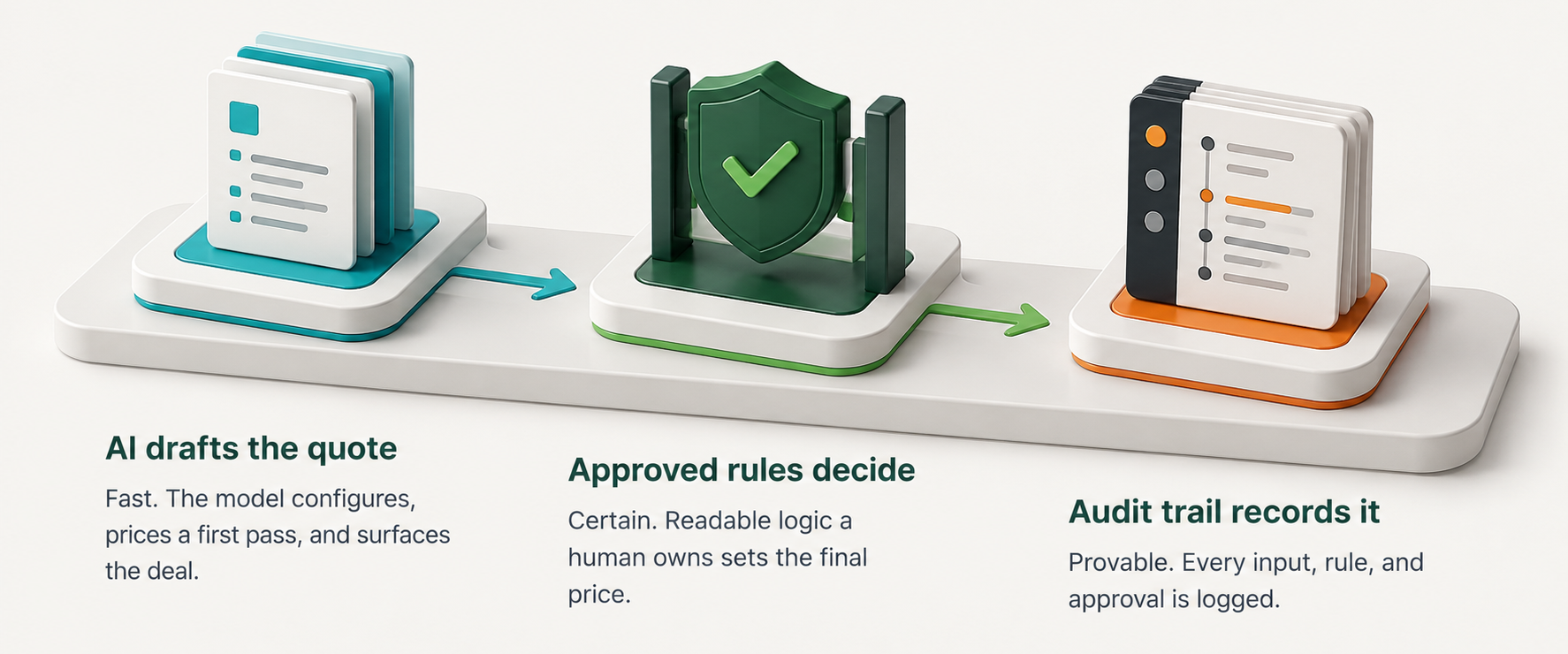
In practice it looks mundane. A rep applies a 22% discount on a multi-year renewal, and a deterministic rule either clears it or routes it to the deal desk, recording why either way. The AI drafted the quote in seconds. The rule, not the model, decided what could be committed.

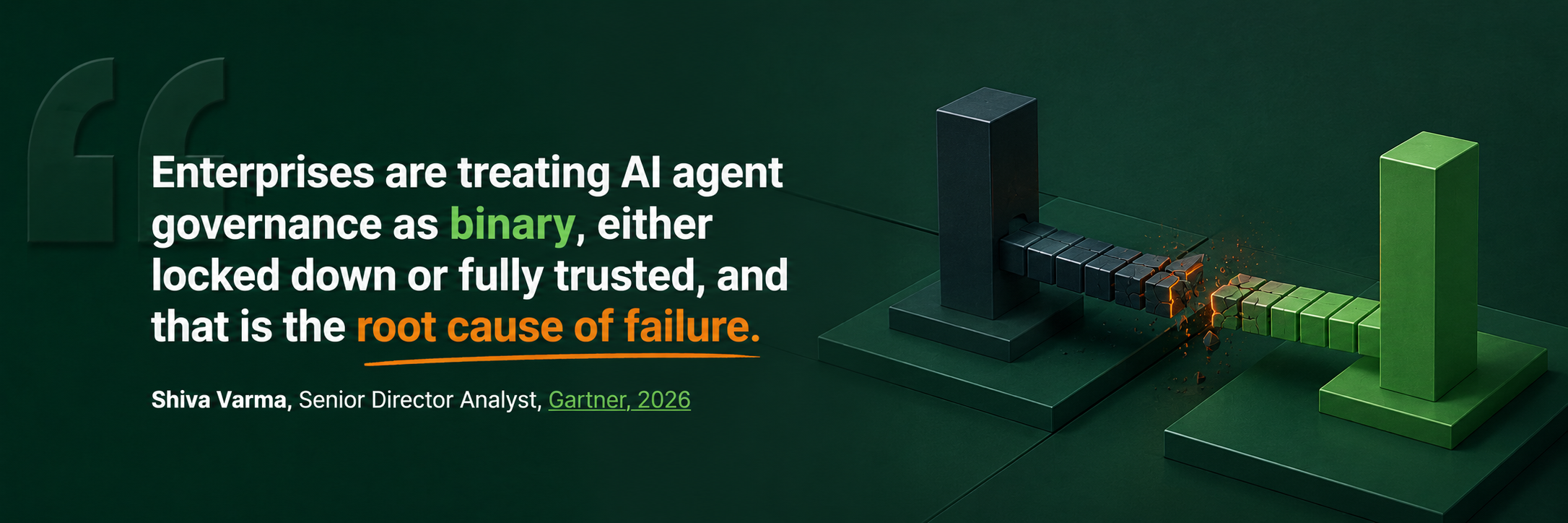
Gartner’s Shiva Varma, Senior Director Analyst, names the root cause directly. Enterprises treat AI agent governance as binary, either locked down or fully trusted. That, he says, is the root cause of failure. Locked down, the agent is too constrained to be useful, so teams route around it. Fully trusted, it can commit to a price nobody approved.
The maturity data shows how rare the middle ground is. Deloitte’s State of AI in the Enterprise 2026 found that only 21% of companies have a mature model for governing AI agents. McKinsey’s 2026 state of AI trust research agrees. Only about one-third report governance maturity at level three or higher.
And Harvard Business Review Analytic Services sharpened the point. 92% of decision-makers agree AI agents need rules-based guardrails. Yet only 48% have built them. In other words, almost everyone knows the control is needed. Fewer than half have built it.
The deterministic fix: proportional governance. Gartner recommends four autonomy levels, from observe to act autonomously. Each level gets its own guardrails, approvals, and audit trail. Pricing does not belong at the fully autonomous end.
So deterministic pricing places the agent where it earns its keep. It drafts the quote at speed, while approved rules set the final number. As a result, the AI is neither shackled nor unsupervised. It is bounded. That is deterministic AI governance in practice. It is not a ban on AI, but a boundary around it.


Value is the barrier that keeps stalling AI programs. In 2026, the research measured it from every direction. McKinsey reported in April 2026 that 60% of companies still see no EBIT impact across the business from AI.
Many, it warns, are deploying AI in ways that are “more visible than valuable.” BCG found in July 2026 that only 14% of companies have defined the profit-and-loss impact of all their AI work.
The Harvard Business Review Analytic Services survey found that only 16% report a high degree of measurable value. And inside sales, Gartner found that 31% of chief sales officers struggle to prove the return on AI-driven tools, a top challenge for 2026.
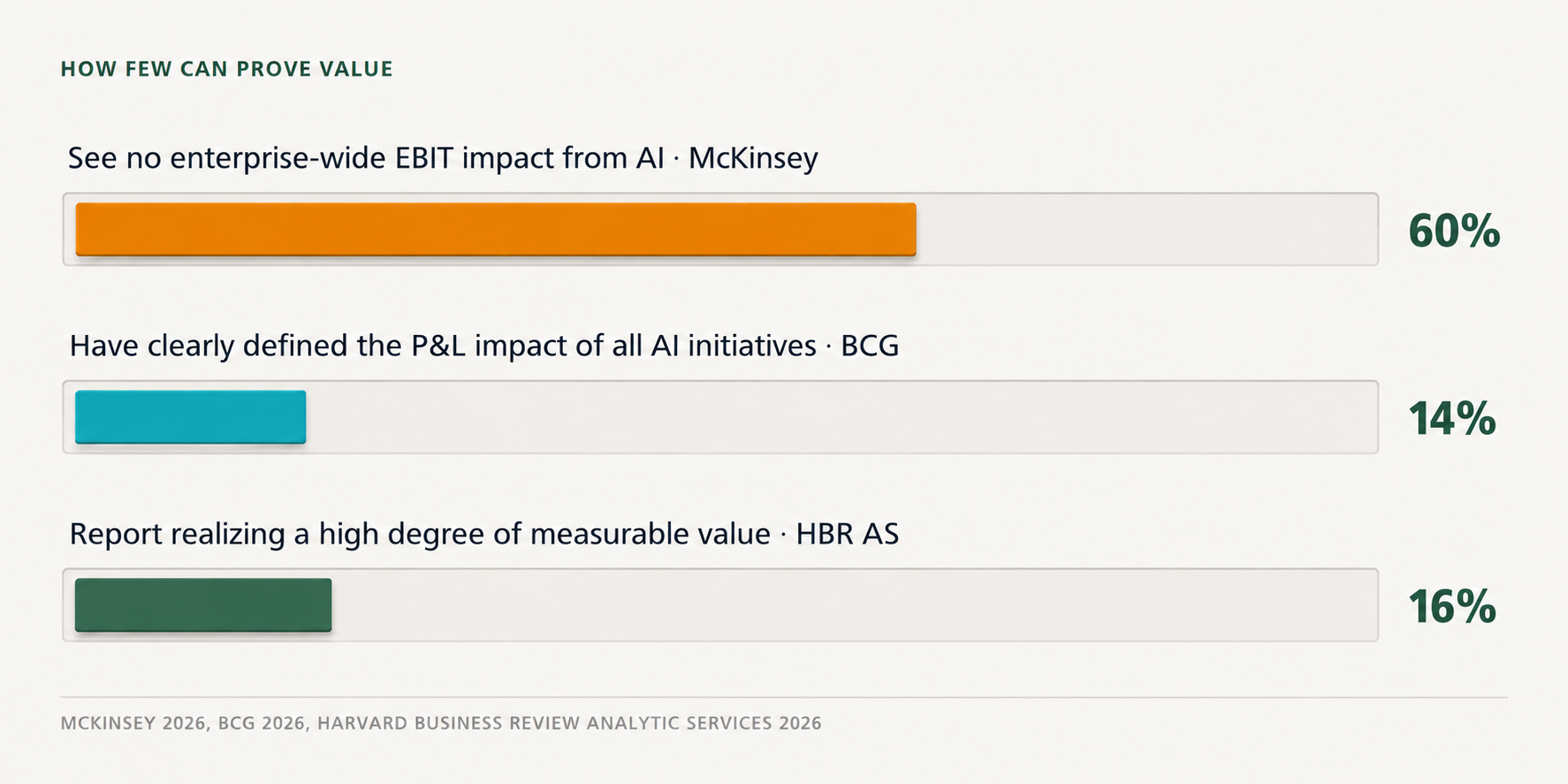
The reason is structural. When an AI sets prices inside a black box, you cannot tell the deals it improved from the ones it quietly eroded. So the return stays unprovable by design. Budgets do not survive that ambiguity for long. That is how a promising pilot becomes a cancelled project.
The deterministic fix: make the math visible. Deterministic pricing shows which rule produced which number. So margin impact becomes measurable, not assumed. When every price traces to a rule, finance can point to a cause for the gain or the leak. Then the AI’s contribution holds up like any other investment. In short, a result you can trace is a result you can fund again.

Trust, not capability, is the real bottleneck. McKinsey’s March 2026 state of AI trust research found that 74% of respondents call inaccuracy a highly relevant risk of AI. Nearly two-thirds name security and risk as the top barrier to scaling agentic AI. And that caution shows up in behavior. Gartner found that 69% of B2B buyers still turn to a sales rep to validate AI-generated insights.

An unexplainable price invites a second opinion. If a seller cannot say why the number is what it is, the buyer asks someone who can. Then the deal slows to the pace of that conversation. So every validation loop erases the speed the AI promised. The fastest tool in the stack ends up gated by human double-checking.
The deterministic fix: explainability by design. When every price traces to a named, readable rule, there is nothing to second-guess. The seller answers the “why” on the spot. The buyer trusts the number the first time. And the AI’s speed finally reaches the customer, instead of stalling in review.

Guardrails tend to arrive after the incident, not before it. Forrester’s June 2026 assessment of agentic AI is blunt. More than half of enterprises still report governance gaps. And that holds even after they adopt the NIST AI framework. On top of that, every agent action must be logged and defensible to an auditor. Most find that cost too high today.
The basic controls are thin as well. KPMG’s Q2 2026 pulse survey found that only 26% of companies have real-time visibility into the cost of running AI. Only 36% have direct usage controls. Boards have noticed too. EY reported in February 2026 that 22% of Fortune 100 companies now flag AI hallucinations, inaccuracies, or bias as material risks.

In a revenue system, a wrong number does not stay contained. It flows into a contract, an invoice, and recognized revenue. That is exactly where an error gets expensive and hard to unwind. By the time a bad price surfaces in an audit, someone has usually already signed it.
The deterministic fix: treat guardrails and the audit trail as standard equipment, not add-ons. Margin floors and discount thresholds stop a bad price before it ships. A complete, timestamped record proves what happened afterward. So auditability stops being a scramble. Instead, it becomes a byproduct of how every quote is built. In short, deterministic AI governance builds the control in, rather than bolting it on after the incident.

The stakes are climbing fastest in pricing itself. McKinsey found in April 2026 that 65% to 85% of companies expect to use AI in pricing within one to three years. Today, just 10% to 30% do. That is a fast shift, from the edges of the pricing process to the center of it.
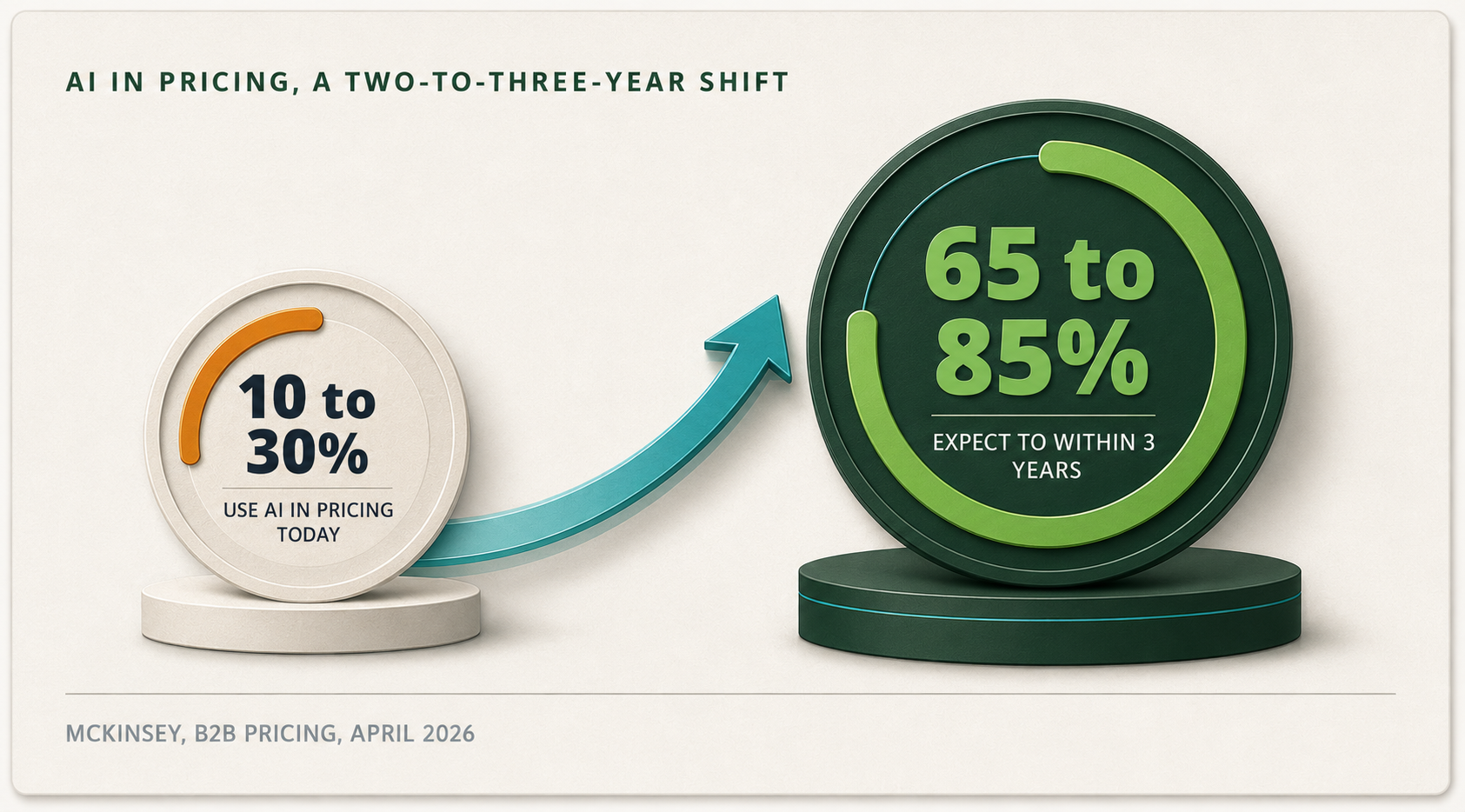
Pricing is a high-leverage place to hand a model the keys. McKinsey notes that a 1% price increase lifts operating profits by 8.7% on average, if volume holds. But the same lever works in reverse. A small, unexplainable error does not stay small. It compounds at machine speed across every quote. So as AI moves from advising on prices to committing to them, ungoverned pricing becomes existential.

The deterministic fix: put the commitment behind deterministic logic. Let agents negotiate and quote at speed, but only inside limits a human set. The boundary, not the model, decides what the agent can commit to. So autonomy and control stop being opposites. Deterministic AI governance is what makes that balance hold at pricing scale.
The pattern behind all five
Across every failure mode, the pattern is the same. The AI was not too slow or too simple. The problem is that no one could explain, defend, or contain what it did. So governance, not capability, is the constraint. And the 2026 data from Gartner, McKinsey, Deloitte, BCG, Forrester, and Harvard Business Review Analytic Services all points the same way.
Gartner’s Luke Tipping, Director Analyst, frames the goal well: “Revenue resilience isn’t disaster recovery. It’s the capability to detect change earlier, respond faster, and emerge stronger than competitors.”
Deterministic AI governance is how a revenue team keeps the speed of AI without losing the control that keeps it resilient. And the window to build it is now, while the money moving through AI-assisted pricing is still climbing rather than already lost.

Why servicePath™

servicePath™ is a CPQ platform built for complex enterprises. It is designed around the exact split this research points to. AI adds speed. Configured rules add certainty. servicePath™ positions CPQ+ as an AI-native platform. Yet the price itself runs on business rules a team owns, and teams can change them without an engineering queue. In short, that is deterministic AI governance expressed as a product, not a policy document.
- Business rules engine. Teams build rules, configured solutions, and pricing into the platform, so every quote runs on approved logic.
- Governance and legal checkpoints. Custom checks sit inside the quoting logic, so control lives where the price is set.
- Threshold-based approvals. Conditional logic and workflows route deals and discounts to the right approver by predefined thresholds.
- Pricing-model agnostic. The platform handles bundled, multi-tier, usage-based, co-termed, and renewal models, without breaking the rules that govern them.
- Real-time deal financials. Margin is visible as the quote is built, with reporting down to the price-element level.
- Audit trail and certification. servicePath™ is SOC 2 Type II certified and keeps audit trails across the platform, so every decision is provable.
Why do AI agents get decommissioned?
Gartner predicts that by 2027, 40% of enterprises will demote or decommission autonomous AI agents over governance gaps. The common causes are ungoverned autonomy, unprovable value, weak risk controls, and outputs no one can explain or defend.
Related reading
- The Missing Mile: AI Risk and Revenue Leakage
- The Executive’s Guide to AI and CPQ: Balancing Buzz and Business Value
Put deterministic governance to work on your pricing
Fast quotes, governed outcomes, and a full audit trail, run on rules your team owns. Pick the next step that fits where you are.