

Executive summary
Mature revenue organizations have long separated high-volume repeatable work from complex, high-judgment deals. Indeed, that instinct is correct. What has changed is the arrival of AI quoting agents, plus the fact that even the simple tier has become significantly more complex.
New product bundles, AI-generated configurations, rapid substitutes and dynamic pricing options are proliferating at unprecedented velocity. Indeed, the input velocity of alternatives has never been higher.The vendors, meanwhile, have done their part.
Salesforce ships quoting agents and reports its own sales team saw a 75 percent decrease in quoting time and an 87 percent reduction in clicks. ServiceNow introduced AI Specialists, chains of agents that qualify leads, generate quotes and handle renewals, escalating to humans only on exceptions.
Agentforce annualized revenue crossed 1.2 billion dollars in the May 2026 quarter. Meanwhile, consultancies are publishing agent seller-workflow guides as recently as June 30, 2026. In short, the technology conversation is over.
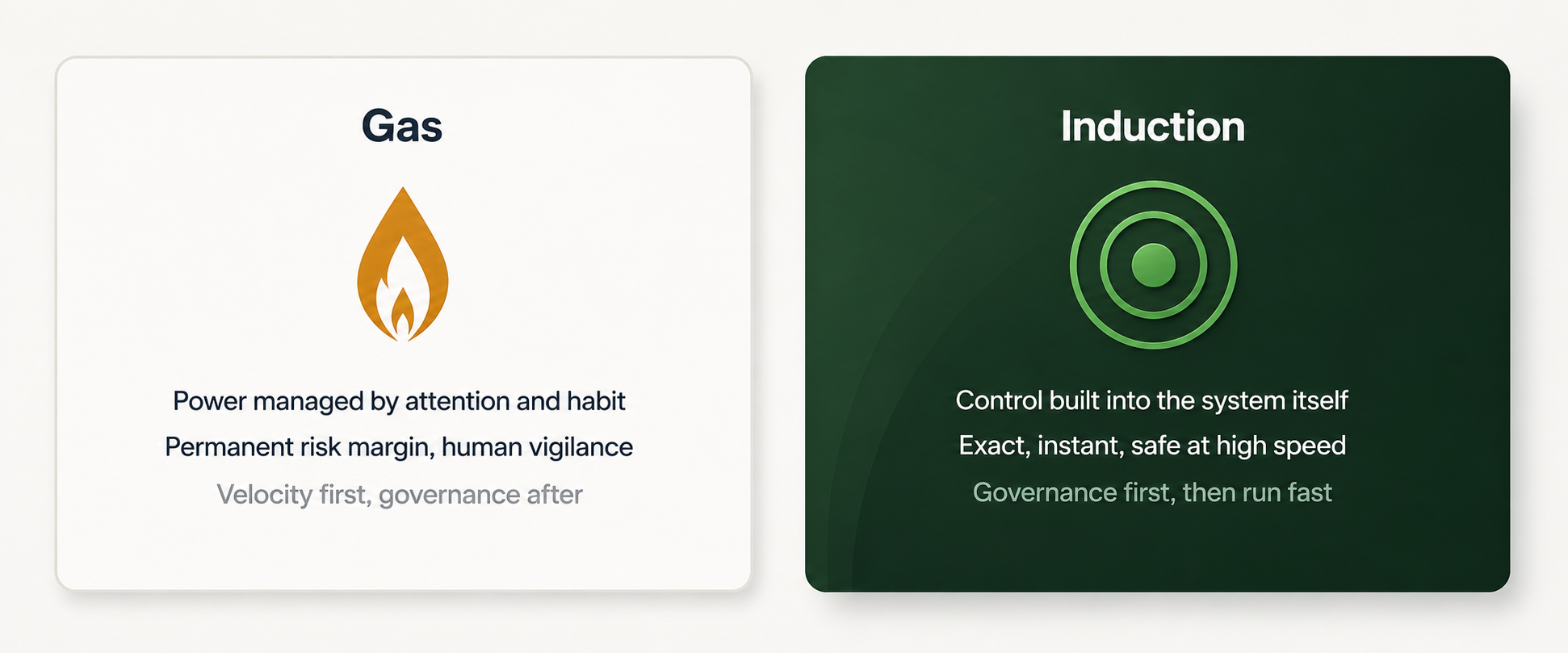
So sophisticated teams no longer want to run this on gas. They want to run it on induction: precise, controllable, efficient and safe at high speed. This post delivers the RevOps operating model that makes that possible.
The new reality for sophisticated RevOps teams
The question is no longer whether to use agents. It is how mature RevOps functions evolve their existing simple-versus-complex separation to fully leverage them without introducing new risks, and the question arrives in different costumes. The CFO asks who approved the discount on a deal nobody remembers touching. Legal asks who is liable if an autonomous quote breaches a pricing floor. A rep asks whether reviewing the agent’s draft is still their job or nobody’s. Underneath every version is the same unresolved design decision. In short, the enterprise adopted a new worker without deciding who that worker reports to.
The market context says this cannot stay unresolved for long. Gartner projects 40 percent of enterprise applications will embed task-specific AI agents by the end of 2026. Meanwhile, the platform giants themselves frame the era’s challenge as moving from AI chaos to control.
The vendors are conceding the point
Notice, too, that the vendors are quietly conceding the point in their roadmaps. For example, ServiceNow shipped an AI Control Tower for governing fleets of agents, an admission that ungoverned agents are an enterprise risk. Meanwhile, G2 reviewers of the agentic platforms consistently report that setup and customization demand real technical expertise.
In other words, the guardrails do not configure themselves. Similarly, the 2026 implementation guides describe the tooling in detail while leaving the accountability model, who owns the price, to the customer. So the tooling now exists everywhere. Yet the operating model exists almost nowhere. That gap is this post.
One more force compounds the urgency: the commercial models are changing underneath the org chart at the same time. Agentic platforms are monetized by consumption and, increasingly, by outcome, which means the systems drafting your quotes are themselves priced per unit of work.
As a result, the deals they draft increasingly carry usage tiers and performance-based pricing structures that traditional CPQ rule chains were never built to govern. The operating model has to be designed for the deal shapes arriving in 2027, not the ones your approval matrix was written for in 2022.
The induction principle
The kitchen metaphor is worth thirty seconds, because it carries the whole operating philosophy. Gas delivers heat with power and drama: visible flame, instant gratification, and a permanent risk margin that everyone in the kitchen manages by attention and habit.
Induction delivers the same heat with precision: exact temperatures, instant response, nothing burns because the system itself will not let it. Meanwhile, the speed you can safely run at goes up rather than down. The point of induction is not less power. It is controllable power.
Most quoting automation to date has been gas: velocity first, governance by attention and habit, and a deal desk standing over the stove. Agentic quoting on gas is how enterprises get burned at machine speed. Agentic quoting on induction is different: deterministic rules as the cooktop, agents as the heat.
In addition, margin floors and approval trails are the physics that make burning impossible rather than merely discouraged. As a result, sophisticated teams get the 75 percent velocity gains and keep the CFO asleep at night. Every design decision in the model below is an application of that one principle: build the control into the system, then run fast.

The Two-Lane Revenue Operating Model
Here is the model we use with enterprises working through this, synthesized originally from a review of six analyst houses’ positions and now hardened by a year of agentic deployments. Revenue work divides into two lanes, and almost every agentic failure we see comes from running one lane’s rules in the other.
 The Two-Lane Revenue Operating Model. Every deal sorts on one question.
Lane one: standardize the simple. Run it on induction.
High-volume, policy-driven quoting: standard configurations, renewals, list-adjacent pricing, quote assembly and formatting. This is where agents shine when paired with deterministic guardrails. Likewise, it is where the 75 percent time reductions are real and safe.
Mature teams move from manual or lightly automated processes to true precision execution. As a result, you get dramatically higher velocity, better consistency, and the ability to safely handle today’s more complex simple deals. Hence the design rule: deterministic guardrails set the boundaries, agents run free inside them, and exceptions route out automatically. Human review inside this lane adds cost without adding control.
Lane two: protect the complex
Multi-tower services deals, inherited estates, usage and hybrid pricing, significant cost-to-serve decisions, novel pricing structures. In other words, anything where human judgment on margin, risk and trade-offs remains essential, because the margin story lives in specifics no training set has seen. Meanwhile, agents draft, simulate scenarios and surface data. Accountable humans decide and own the outcome. Furthermore, every decision is trailed and reconstructable.
The model’s one-question sorting test: does this deal require meaningful cost-to-serve judgment? No means lane one, run on induction, and the guardrails own the number. Yes means lane two, judgment protected, and a named human owns it.
Every escalation rule, every RACI row, every audit answer in this post is downstream of that single question. Therefore it belongs in your deal desk charter as sentence one.
Importantly, the failure modes are symmetric. Run lane-two rules in lane one and you get approval theater: humans rubber-stamping machine output they cannot meaningfully review, at volume.
Run lane-one rules in lane two and you get the exposure your auditors will eventually find: material pricing decisions nobody can reconstruct or defend.
What running lane one on induction looks like in practice
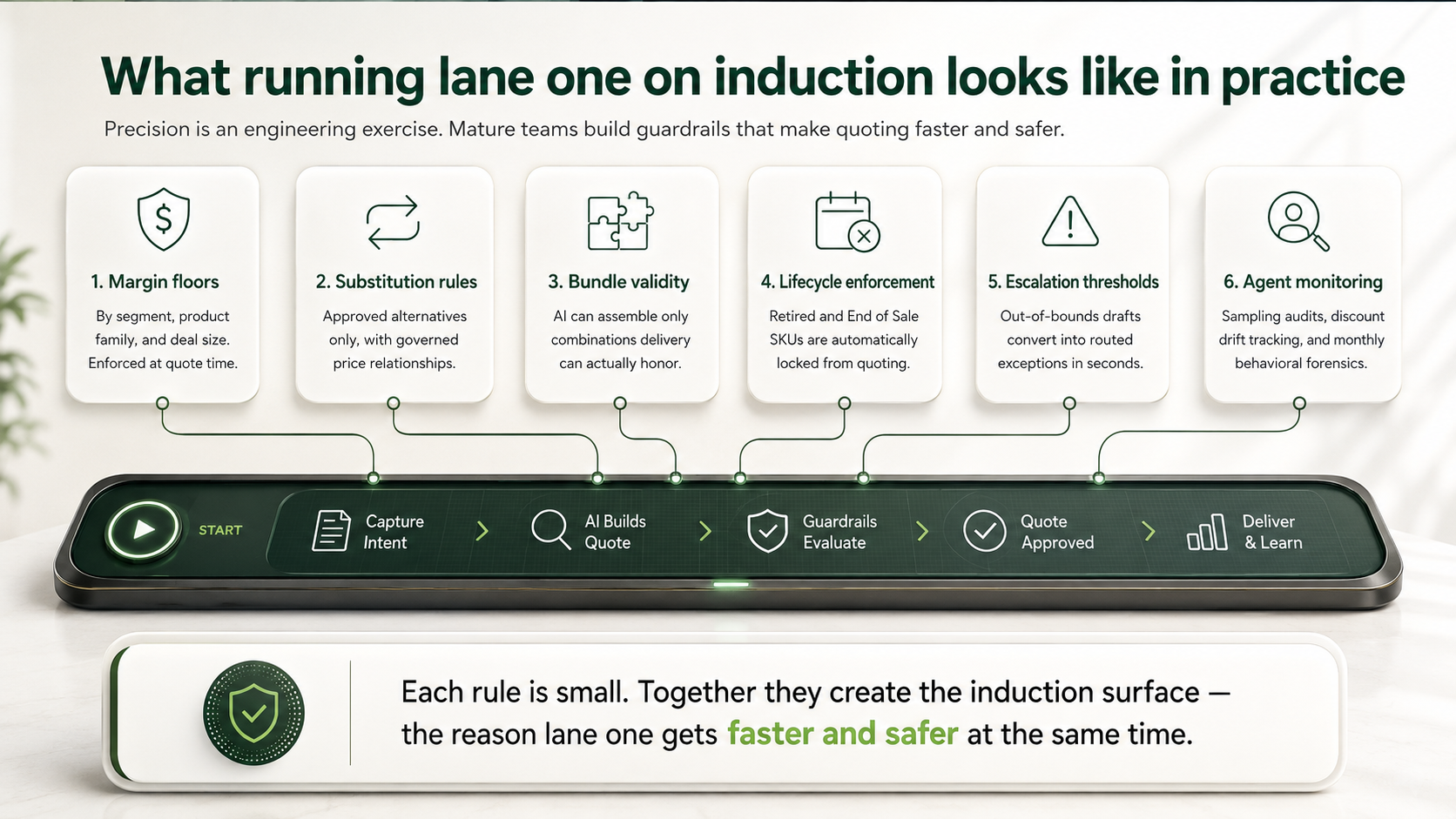
Precision is a specific engineering exercise, not a slogan, so here is the guardrail catalog mature teams actually build. Margin floors by segment, product family and deal size, enforced at quote time rather than reviewed after. Substitution rules that govern which intelligent alternatives an agent may offer and at what price relationship to the original.
Bundle validity constraints so AI-generated configurations can only assemble combinations delivery can honor. Product lifecycle enforcement, so retired and End of Sale SKUs are locked from quoting automatically. This unglamorous rule prevents some of the most expensive agent errors in circulation.
Escalation thresholds that convert an out-of-bounds draft into a routed exception in seconds. And behavioral monitoring on the agents themselves.
For example, sampling audits of lane-one output, drift tracking on discount patterns, and a monthly forensics review that treats agent behavior as a governed process with its own metrics.
Each rule is small. Together they are the induction surface, and they are why lane one gets faster and safer at the same time, which gas-era automation never managed.

What the deal desk becomes
For sophisticated teams, the deal desk levels up. As a result, routine volume shifts to lane one, now running cleanly on induction. Meanwhile, your strongest operators move into higher-value work: designing commercial policy, engineering guardrails, running exception forensics and orchestrating agent behavior across the quote-to-cash process.
In the deployments I have watched this year, the pattern is consistent: the deal desk does not shrink, it moves up. Traditional quote processing skills become less central. Instead, commercial architecture, policy precision and system governance become the new power skills.
This is the upskilling path the agentic era demands. In fact, it is the difference between spending 2027 tuning a system and spending it explaining variances.
Encode what the enterprise believes about margin, risk and precedent into rules an agent can execute and an auditor can read. Consequently, the desk becomes the most leveraged team in revenue.
The 90-day adoption path
Sophisticated teams do not need a transformation program to adopt this; they need one quarter of sequenced discipline.
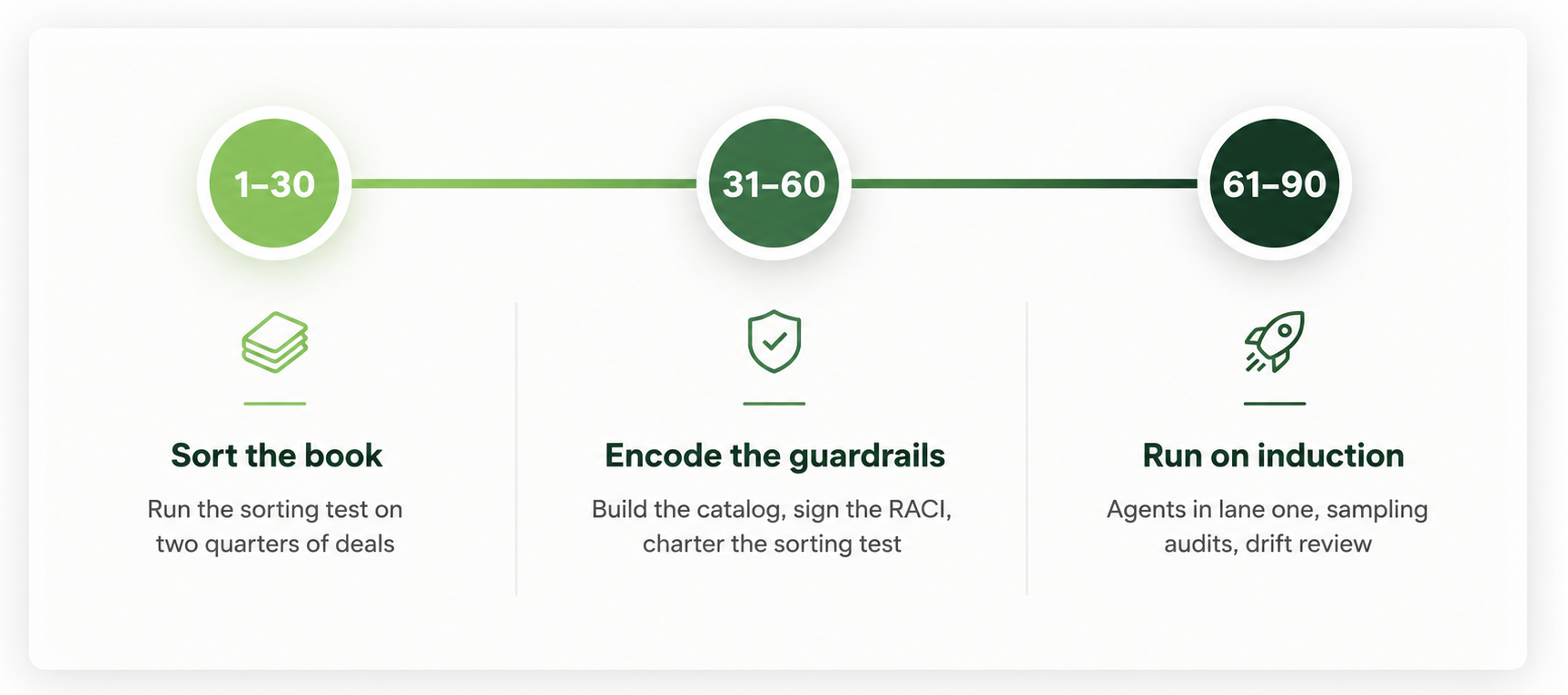
Days 1 to 30: sort the book. Run the sorting test across the last two quarters of closed deals, does this deal require meaningful cost-to-serve judgment. Then tag every deal shape lane one or lane two.
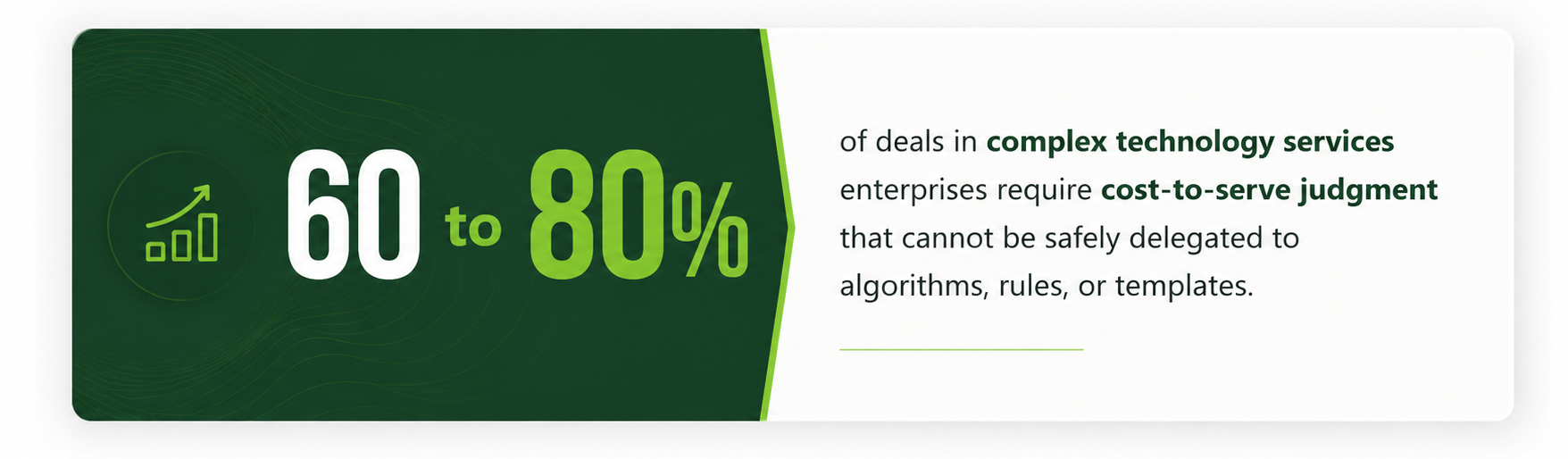
In the deployments we have run this exercise with, enterprises typically discover that 60 to 80 percent of quote volume is lane-one eligible. That is the business case in one number.
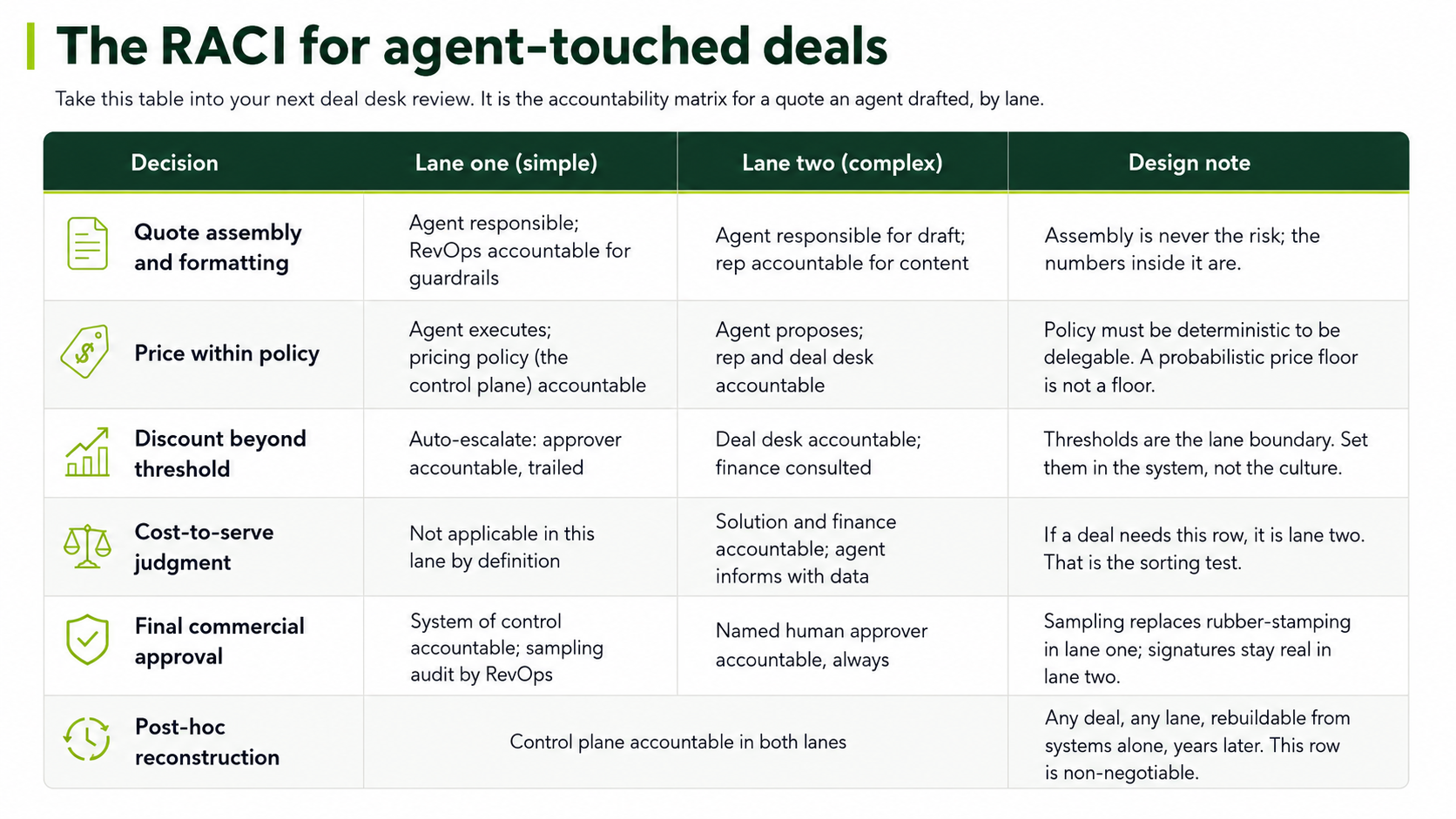
Days 31 to 60: encode the guardrails. Build the catalog above for the lane-one shapes, get the RACI signed by RevOps, finance and the deal desk. Then put the sorting test in the deal desk charter as sentence one.
Days 61 to 90: run on induction, with the meter on. Agents live in lane one only. In addition, sampling audits run weekly, with exception forensics on everything that escalates, and the first monthly review of agent drift.
By day 90 you have velocity data, audit evidence and an upskilled desk. Meanwhile, lane two has not been touched by anything except better drafts. The sequencing is the strategy: governance before autonomy. It is the entire difference between the teams that will spend 2027 tuning and the teams that will spend it explaining.
 The 90-day adoption path. Governance before autonomy.

Why servicePath™
The Two-Lane model needs a governed commercial control plane that spans every CRM and agent. After all, the lanes have to hold across every channel and system that touches a deal. Moreover, that place cannot be inside any single CRM’s agent framework.
servicePath™ delivers exactly that: the precision guardrails that let you run lane one on induction even with today’s higher complexity and substitute velocity. It also provides the cost-to-serve modeling and trailed approvals that keep lane two defensible.
In addition, full quote-to-ledger traceability makes the reconstruction row true in both lanes, across Salesforce, Microsoft Dynamics 365 and HubSpot simultaneously.
The same architecture already governs the hardest version of the problem, the multi-tower services quoting we cover in our MSP transformation analysis. Meanwhile, the broader governance blueprint lives in Revenue Architecture 2.0 on the servicePath™ blog.
The record behind the model: Gartner has recognized servicePath™ as a Visionary in the Magic Quadrant for CPQ Application Suites for four consecutive years.
Moreover, it stands as the sole Visionary in the 2026 report. Info-Tech SoftwareReviews named servicePath™ a 2026 Champion with a +93 Net Emotional Footprint. Dell EMC cut complex quote production from a full day to 15 minutes, and telent reduced quote turnaround by 90 percent.
In short, that is what lane-one velocity looks like when lane-two governance never left the room.
FAQS
We already separate simple from complex. Why adopt this model?
Your foundation is strong. However, this model makes it precise, machine-enforceable and agent-ready. It lets you run the simple lane on induction, with the control today’s high-velocity environment requires, while elevating your team’s focus on complex judgment work.
Who is accountable when an agent misprices?
Whoever the model named before the agent ran. Lane-one accountability lives in the pricing policy and control plane; lane-two accountability lives with named humans. If no one was named, the answer defaults to the CFO, discovered at the worst possible time.
What is the Two-Lane Revenue Operating Model?
An operating model for agentic revenue: standardize the simple lane, where agents execute high-volume quoting on induction inside deterministic guardrails, and protect the complex lane, where governed human judgment decides. Deals sort by one question: does this require meaningful cost-to-serve judgment?
What makes a guardrail delegable to an agent?
Determinism. A rule an agent can be trusted with produces the same answer every time and leaves a trail. Probabilistic guidance is useful input for humans; it is not a boundary.
Pick your lane
Ready to run it? Bring two deals.
One simple deal and one complex deal. A servicePath™ CPQ Architect will run them through the Two-Lane model, show you where induction-level guardrails should live, and map the path to higher precision and velocity. All in one working session. No slideware, real deals only.
Building the internal case first? Take the proof with you: the Dell EMC case study (a full day to 15 minutes) and the telent case study (90 percent faster quote turnaround) are the two documents your CFO will ask for anyway.
Just following the thinking? I continue this model in Executive Conversations, my newsletter, where the machine-customer series picks up next. Subscribe and argue with me there.
Not ready for any of it? The RACI above is yours to use. Take it into your next internal review and argue with it. That is what it is for. More definitions in the servicePath™ glossary.
Gartner does not endorse any vendor, product or service depicted in its research publications, and does not advise technology users to select only those vendors with the highest ratings or other designation. Gartner research publications consist of the opinions of Gartner’s research organization and should not be construed as statements of fact. Gartner disclaims all warranties, expressed or implied, with respect to this research. GARTNER and MAGIC QUADRANT are registered trademarks of Gartner, Inc. and/or its affiliates. All third-party trademarks are the property of their respective owners. Gartner agent-adoption projection cited as reported in market coverage; platform capabilities and financial figures per linked sources as published.