
Closing the Missing Mile between your CRM and General Ledger, where AI risk, revenue leakage, and shadow finance silently erode your margins.
Executive Summary
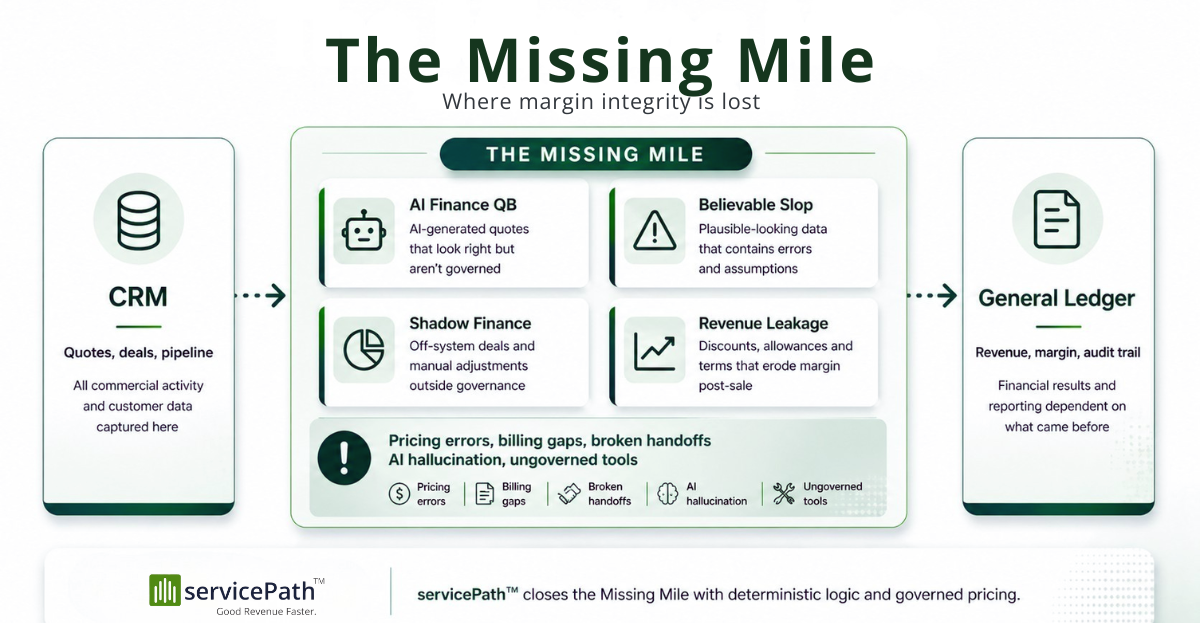
The Missing Mile is the data gap between the CRM and the General Ledger where commercial intent gets lost before it ever reaches the books. In 2026, AI is making this gap wider, faster, and much harder to see.
A new class of risk I call Believable Slop, AI generated financial content that looks authoritative but is structurally untethered from your unit economics, is now being produced at scale by well intentioned team members I call the AI Finance Quarterback.
The result is that senior finance talent is spending hours auditing fiction instead of doing high value work, while Shadow Finance, the parallel economy of unmanaged spreadsheets and ungoverned AI tools, is growing faster than any compliance team can track.
This is not a finance problem. It is a revenue architecture problem. And it requires the CFO, CRO, Head of Commercial Excellence, and VP of RevOps to solve it together.
This article provides a framework for understanding the four interconnected risks: the Missing Mile, the AI Finance Quarterback, Believable Slop, and Shadow Finance.
It includes a five trait model of what a margin engineered revenue architecture looks like, a five question diagnostic you can run with your team this week, and a clear operating model for who owns what.
The moment every CFO dreads
There is a moment every CFO dreads. The board deck is ready. The margin story looks clean. Then someone in Finance pulls a thread on a deal that closed last quarter, and the entire narrative unravels.
The discount was never approved. Service delivery costs were not loaded correctly. Revenue recognition was wrong because nobody mapped the performance obligations back to ASC 606 before the quote left the building.
But the CFO is not the only one who should dread that moment. The CRO should too. So should the VP of RevOps and the Head of Commercial Excellence.
Because when a deal unravels in Finance, it did not break in Finance. It broke upstream, in the quoting process, in the handoff between Sales and the systems that govern what gets sold and at what margin.
Every signed quote is a promise made by Sales that Finance eventually has to keep. For most organizations I talk to, that promise arrives as a data wreck. A PDF stapled to a CRM opportunity with a margin note that says “Jim approved.”

I have spent over ten years leading servicePath™ in the Configure, Price, Quote space. In our experience, Missing Mile problems rarely originate in Finance. They almost always surface there after breaking upstream, long before anyone in the Office of the CFO sees the deal.
The pattern that repeats across every industry
The pattern is remarkably consistent across industries. A sales rep configures a deal in the CRM. Pricing is approved through a workflow that may or may not connect to the actual cost structures in the ERP.
The quote goes out. The deal closes. Three months later, Finance discovers the margin is not what the quote promised. Delivery costs were higher. The discount was deeper than the governance rules allowed.
And the revenue recognition schedule does not match the performance obligations in the contract. By then, the deal is signed, the customer is onboarded, and the cost of remediation is real. This is the Missing Mile in action.
Details vary. The pattern does not. And the gap between where the quote is made and where the revenue is recognized is where margin integrity goes to die.
The Missing Mile: Why AI Is Making It Worse
How the AI Finance Quarterback, Believable Slop, and revenue leakage are widening the gap between CRM and General Ledger
Before 2026, the Missing Mile was a slow leak. Pricing errors, billing gaps, and manual workarounds eroded margin gradually over quarters. AI has turned that slow leak into a fire hose.
The CPQ market is projected to reach $7.5 billion by 2031 (Mordor Intelligence, January 2026). The money flowing into these systems is enormous. The question is whether it is flowing toward infrastructure that closes the Missing Mile, or toward tools that widen it.
Revenue leakage benchmarks vary by methodology. However, multiple studies and industry analyses point to material leakage from pricing errors, billing gaps, contract mismatches, and quote to cash handoff failures.
The underlying cause is system fragmentation.
Salesforce’s MuleSoft connectivity research shows that enterprise application counts have grown to nearly 1,000 per organization, yet fewer than 30% are integrated. That means over 700 applications in a typical enterprise are generating data that lives in isolation, invisible to the people who need it for financial decisions.
Where the Missing Mile hits hardest
For technology services companies, the fragmentation is particularly dangerous.
A typical managed services engagement might include tiered pricing across three service levels, mid contract hardware refreshes, variable usage components, and multiple performance obligations under ASC 606.
BDO’s February 2026 analysis notes that contract customization and frequent modifications “introduce layers of estimation” that create real exposure when the quoting system and the financial system are not speaking the same language.
As I wrote on our blog, When Your CPQ Becomes Your Ceiling, in our experience across hundreds of deployments, sales operations teams routinely spend 30 to 40% of their time on manual workarounds rather than revenue generating work.
The same system failures that erode margin on deals you close are also killing deals you never close. When a quote takes three weeks because the CPQ cannot handle the configuration, prospects go to a competitor who can quote in three days.
The Missing Mile does not just cost you money on won deals. It suffocates the pipeline. That is not a finance problem. That is a growth problem.
The AI Finance Quarterback and Believable Slop
What has changed in 2026 is the speed at which the Missing Mile generates bad data.
I call the new threat the AI Finance Quarterback: the person on your sales or ops team who has quietly become the go to source for deal models and financial projections, all generated with large language models. They are not doing anything malicious. They are doing exactly what every vendor and conference keynote told them to do: use AI to move faster.
The AI Finance Quarterback produces what I call Believable Slop: AI generated financial content that looks authoritative but is structurally untethered from your unit economics.
Right formatting, right tone, right specificity. But the numbers were never validated against your cost structures, your discount governance, or your actual contract terms. The output passes the eye test. It would not pass an audit.
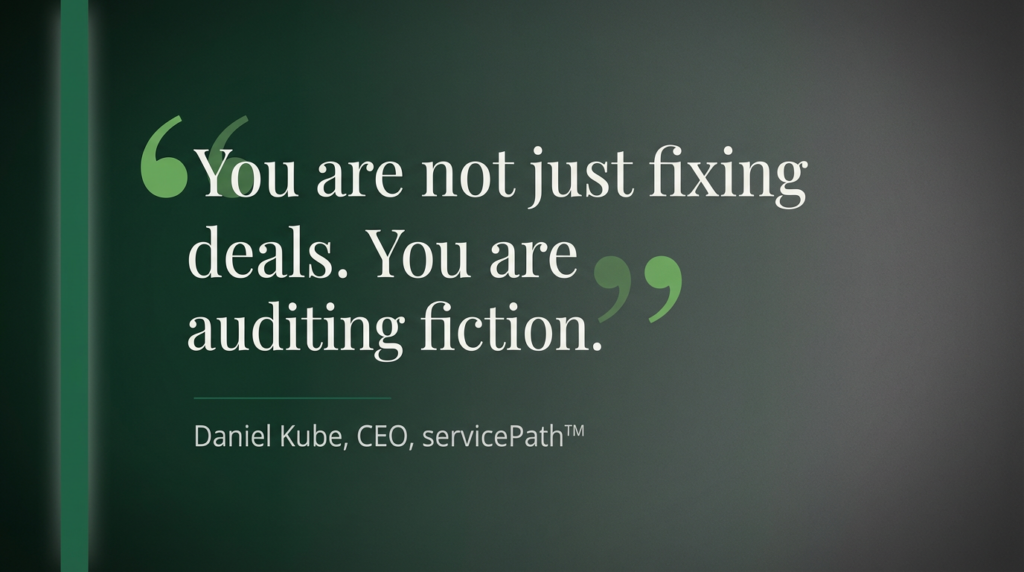
The productivity drain is real and compounding. Your senior finance talent is spending hours debunking hallucinated math instead of doing high value work. You are not just fixing deals anymore.
You are auditing fiction. And because the fiction looks so professional, it takes longer to catch than a simple spreadsheet error ever did.
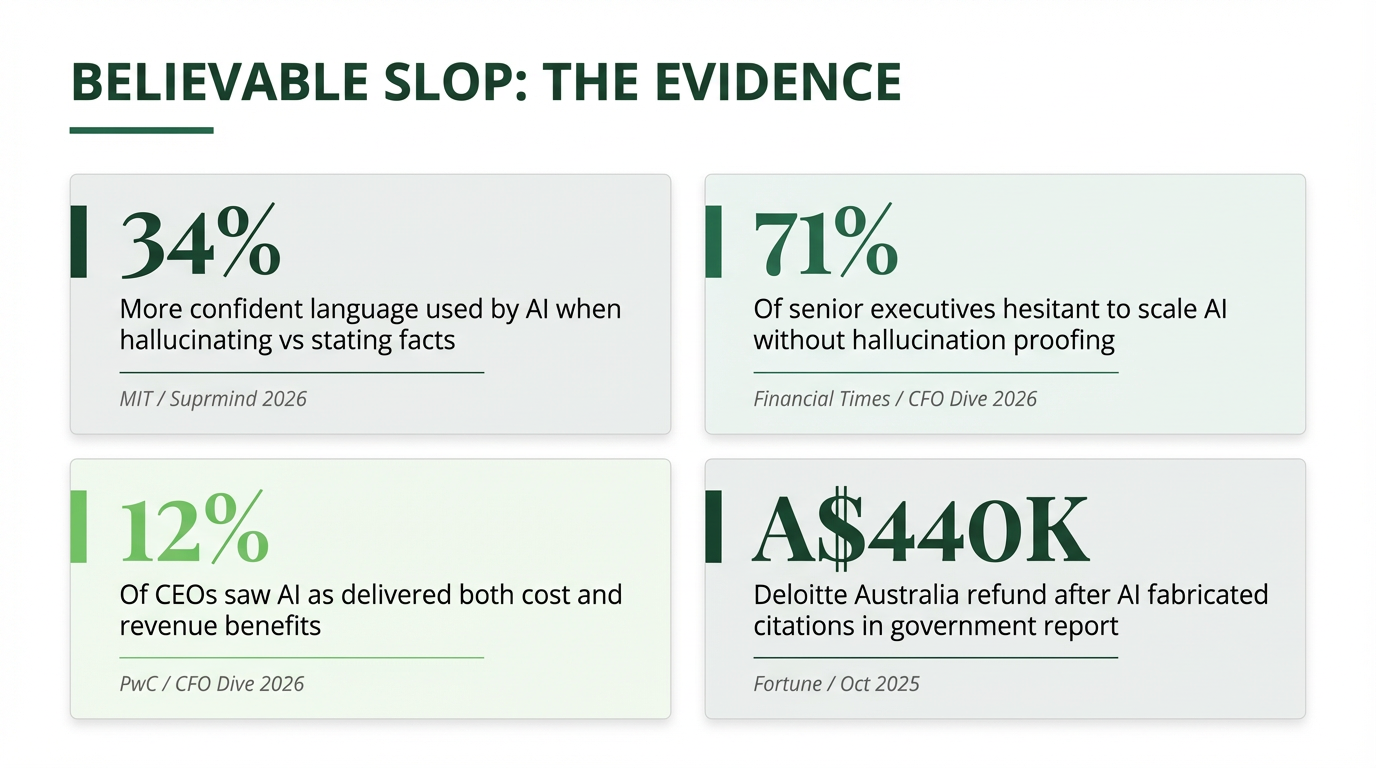
PwC’s latest CEO Survey, reported by CFO Dive in January 2026, found that only 12% of CEOs say AI has delivered both cost and revenue benefits. The output looks like progress. But the P&L says otherwise.
The Missing Mile creates the gap where the AI Finance Quarterback operates unchecked. Believable Slop is what they produce. And Shadow Finance is the ecosystem of ungoverned tools where it all lives.
The evidence is not theoretical
MIT research, cited in the Suprmind AI Hallucination Statistics Report published March 2026, found that AI models were 34% more likely to use confident language like “definitely” and “certainly” when generating incorrect information.
A Carnegie Mellon University study confirmed the pattern, with Vectara’s HHEM leaderboard showing measurable hallucination rates across leading models.
CFO Dive reported that 71% of 1,200 senior executives surveyed by the Financial Times are hesitant to scale AI without “hallucination proofing.”
The Deloitte case study every deal desk should read
Deloitte learned this the hard way. In October 2025, Deloitte Australia had to partially refund an A$440,000 government contract after University of Sydney researcher Chris Rudge discovered a 237 page report riddled with fabricated citations. As Rudge told the Associated Press in Fortune’s October 2025 report: “I instantaneously knew it was either hallucinated by AI or the world’s best kept secret.”
A separate Canadian Deloitte report was subsequently reported by Fortune to contain fake or nonexistent citations in a C$1.6 million healthcare engagement.
Now translate that risk to your deal desk. A sales rep asks an AI copilot to model margin on a complex managed services engagement. The output looks authoritative. The math is hallucinated. Every hour your controller spends debunking Believable Slop is an hour not spent on strategic work.
The fix is deterministic logic
Any financial calculation that touches pricing, margin, or revenue recognition must run on deterministic logic, not from a language model predicting what a profitable price might look like.
The math has to be traceable from input to output, with an audit trail your controller can walk a Big 4 auditor through in 30 minutes.
As one CFO told the L.E.K. Consulting 2025 Office of the CFO Survey: “For AI to really be valuable, it needs to be accurate and explainable. We’re not willing to risk using tools that work in a black box to make decisions that impact our financials.”
I explored this dynamic in depth here: The $1M Strategy Blackout: When Your AI Breaks Up With You.
Why This Is a Revenue Architecture Problem, Not a Finance Project
How Shadow Finance, technical debt, and governance gaps make the Missing Mile a cross functional crisis
Most articles on this topic frame the Missing Mile as a finance problem and hand it to the CFO. That is a mistake. The Missing Mile is a revenue architecture problem. Revenue architecture is the CRO’s domain. And the evidence from 2026 shows that closing it requires alignment across finance, sales, and operations, not a single department initiative.
A McKinsey review of as a service providers, cited in Alguna’s February 2026 quote to cash analysis, found that streamlining quote to cash processes yields 50% reductions in back office time, 10% improvements in deal margins, and customer satisfaction gains of up to 15 points.
As Amandip Sangha, Director of Order to Cash at Optimizely, told Alguna: “Quote to Cash is no longer a finance process. It is a customer experience engine.”
For Heads of Commercial Excellence, this reframing matters. The deal desk is not an administrative function. It is the last line of defense between a sales promise and a financial commitment.
When the deal desk does not have access to real time cost structures, governed discount tables, and deterministic margin calculations, it becomes a bottleneck instead of a control point.
And when it becomes a bottleneck, sales teams route around it. That is how Shadow Finance starts.
How it plays out in practice
I have watched this pattern play out across every industry we serve.
The deal desk gets overwhelmed. A senior rep needs a quote by end of day for a complex multi year engagement. The CPQ cannot handle the configuration.
So the rep builds it in a spreadsheet, emails it to their manager for approval, and sends the quote. Finance does not see the deal until it shows up in the pipeline three weeks later.
By then, the pricing was wrong, the cost assumptions were stale, and the revenue schedule does not match the contract. Nobody did anything wrong. The system failed them.
Shadow Finance is the symptom
Shadow Finance is the parallel financial universe of unmanaged spreadsheets, offline deal models, and undocumented workarounds running alongside your ERP. AI has not killed it. AI has supercharged it. Gartner estimates 30% to 40% of IT spending in large enterprises qualifies as shadow IT.
A January 2026 Toriihq analysis of 12 million enterprise identities found the average mid market firm runs 291 hidden applications. ISACA’s research on Shadow AI and The Hacker News in April 2026 both confirm that employees routinely share financial data with unsanctioned AI tools, and once that data reaches a third party platform, organizations lose all visibility.
RGP’s 2026 CFO study found that 86% of CFOs describe technical debt as a barrier to AI governance for finance.
As I wrote in our analysis of how legacy CPQ is breaking RevOps: “Sales and pre sales teams fall back to Excel or local tools when CPQ can’t handle real world complexity.”
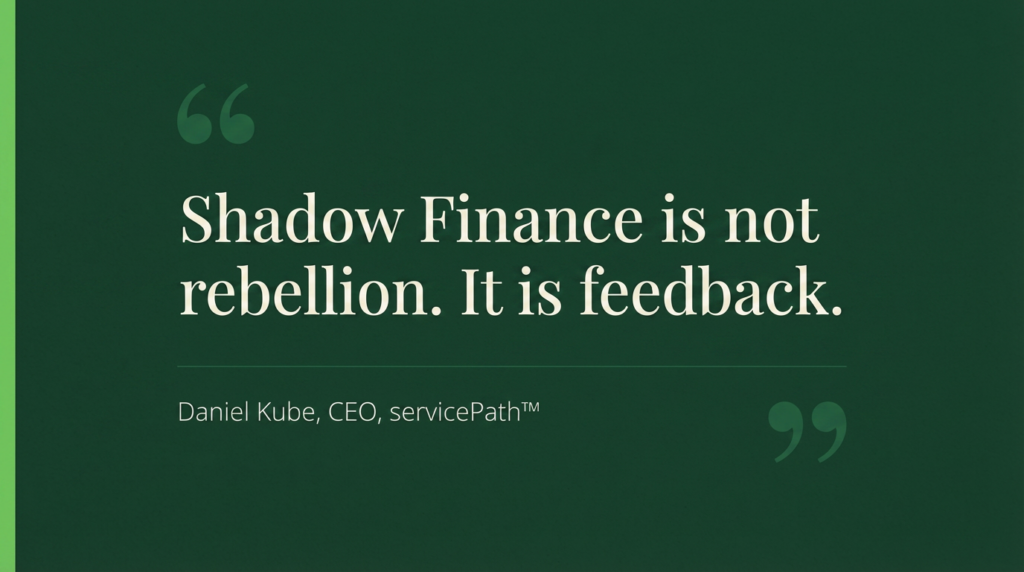
That is not a people problem. That is a systems design failure. Every shadow spreadsheet in your organization is a feature request your CPQ vendor never delivered. Shadow Finance is not rebellion. It is feedback. And it is the clearest signal your revenue architecture can send that something is broken upstream.
The governance countdown
ISO/IEC 42001, the world’s first AI management system standard, provides a structured approach, with rising procurement interest from enterprise buyers. The EU AI Act obligations are phasing in, with major high risk requirements approaching in August 2026. Gartner has predicted over 40% of agentic AI projects will be canceled by end of 2027.
Who owns what
Prospeo’s April 2026 analysis found that companies with an aligned end to end revenue engine grow nearly 20% faster and are 15% more profitable.
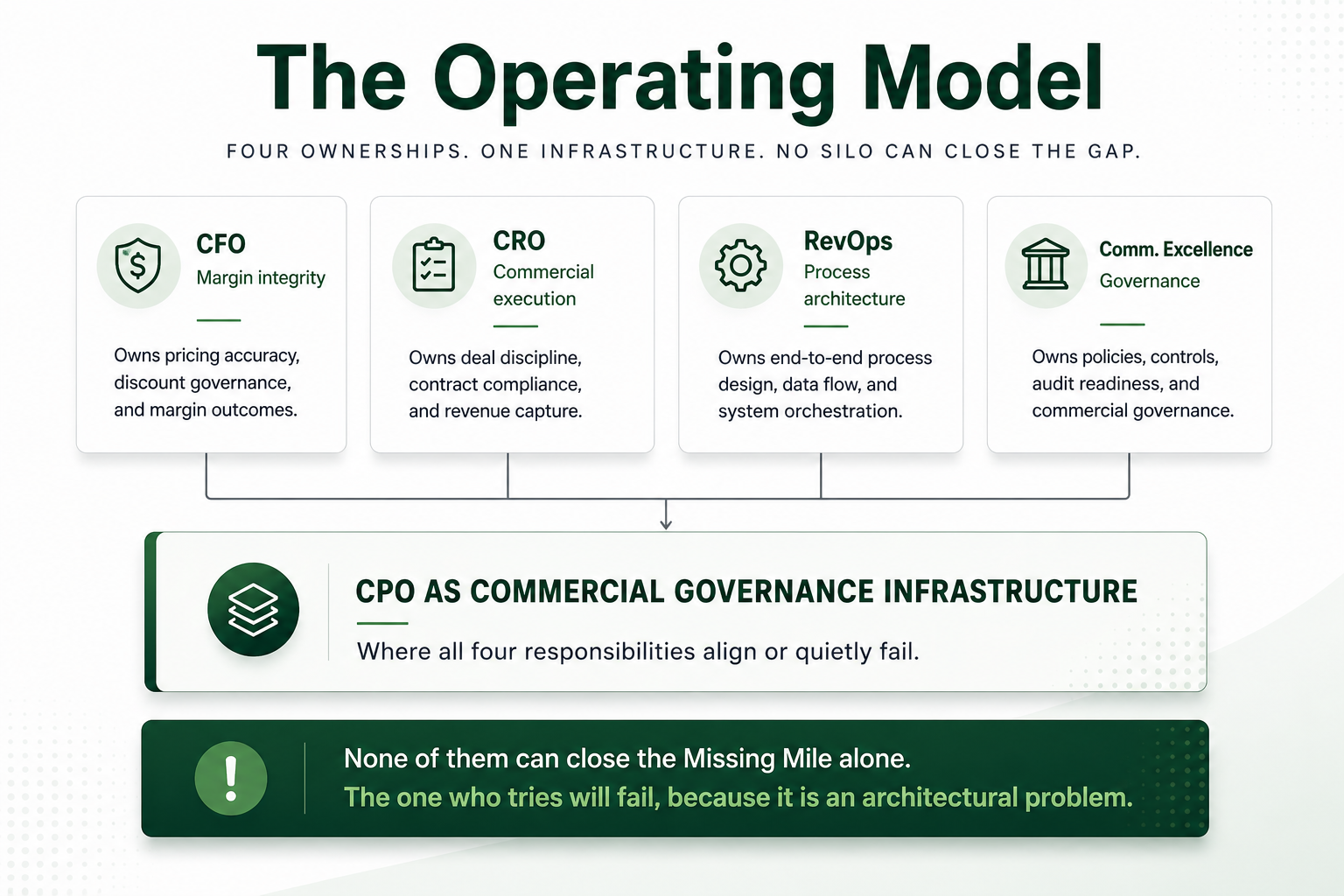
But CROs fail not because they lack strategy, but because the infrastructure underneath them cannot execute the strategy they set. Average CRO tenure is 25 months. One in three turns over every year. The Missing Mile is one of the most significant structural reasons why.
The CFO should own margin integrity. The CRO should own commercial execution. RevOps should own process architecture. Commercial Excellence should own governance.
CPQ is where those responsibilities either align, or quietly fail. None of them can close the Missing Mile alone. And the one who tries to close it alone will fail, because the Missing Mile is not a departmental problem. It is an architectural one.
The Deloitte Q4 2025 CFO Signals survey, released January 2026, found that 87% of CFOs expect AI to be extremely or very important to finance operations in 2026. But Kyriba’s 2026 OPR Index reveals only 47% have actually integrated AI into any processes, and 77% cite security and privacy as critical barriers.
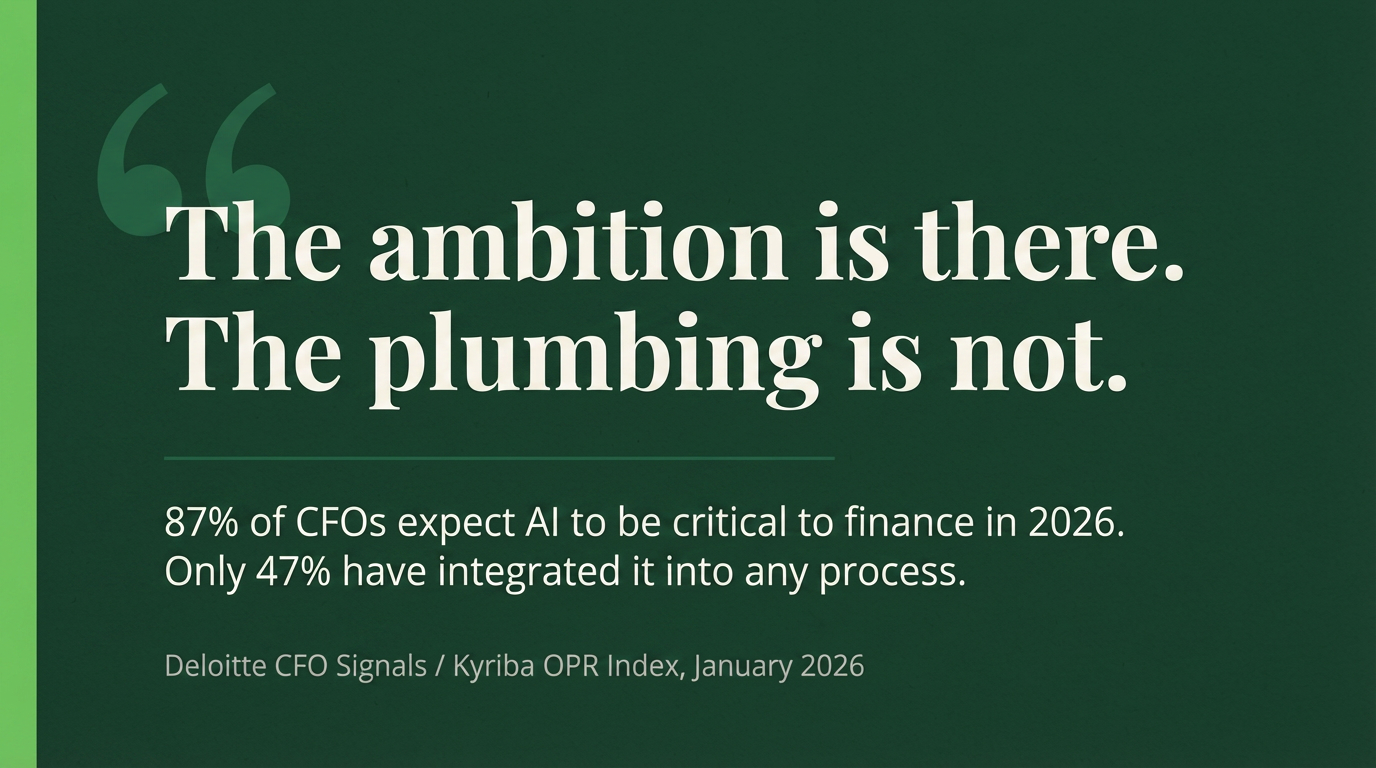
The ambition is there. The plumbing is not. And without the plumbing, every AI investment widens the Missing Mile instead of closing it.
What Good Looks Like: Five Traits of a Margin Engineered Revenue Architecture
The CPQ governance framework that closes the Missing Mile
The Missing Mile is a diagnosis. This is the prescription.
Most organizations I talk to know they have a problem. They can feel the friction in the quoting process, the manual workarounds in Finance, the shadow spreadsheets on the deal desk. What they lack is a clear picture of what the alternative looks like.
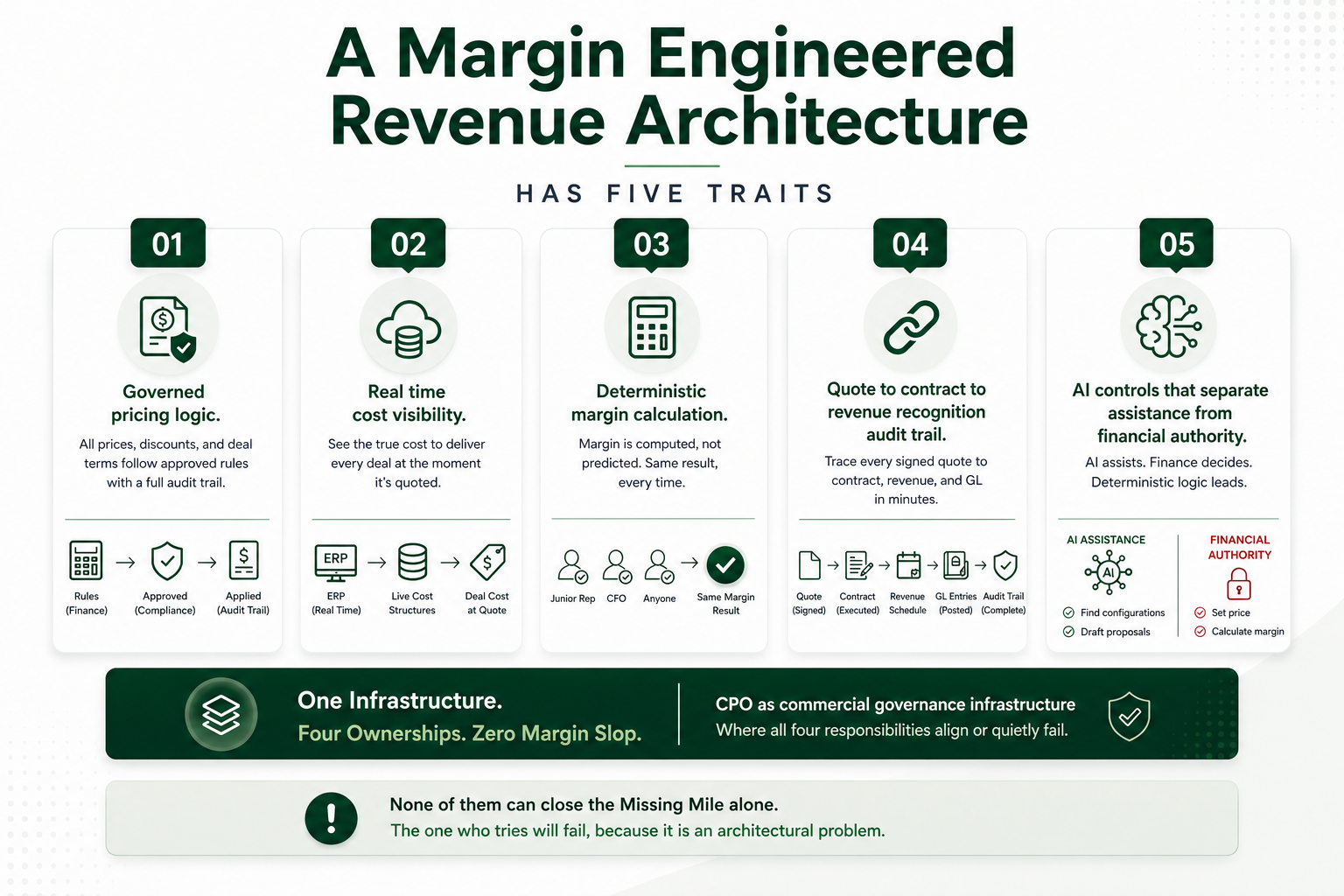
Governed pricing logic. Every price, discount, and deal term is calculated from rules your finance team defined and your compliance team approved. No AI guessing. No rep level overrides without an audit trail.
Real time cost visibility. The cost to deliver a deal is visible at the moment the deal is quoted, not three months later. Cost structures are pulled from the ERP in real time, not synced manually from a spreadsheet last updated in Q2.
Deterministic margin calculation. Margin is computed, not predicted. The result is the same whether a junior rep runs it or the CFO runs it. No variability. No hallucination risk.
Quote to contract to revenue recognition audit trail. Every signed quote connects to the contract, the revenue schedule, and the GL entries it produced. Your controller can trace the full chain in 30 minutes without a supplemental spreadsheet.
AI controls that separate assistance from financial authority. AI can help a rep find the right configuration or draft a proposal narrative. AI does not set the price or calculate the margin. Those decisions run on deterministic logic. When that boundary is blurred, you get Believable Slop.
If your current systems deliver all five, you are ahead of most organizations. If they deliver fewer than three, the Missing Mile is open, and every AI tool you add is widening it.
The Monday Morning Diagnostic: Five Questions to Gauge Your Exposure
A margin integrity stress test for CFOs, CROs, and RevOps leaders
Here are five questions you can ask your team this week. If you cannot answer “yes” to at least four, you have a structural margin integrity problem. And if you are layering AI onto a quote to cash process that cannot pass this test, you are not automating. You are accelerating the Missing Mile.
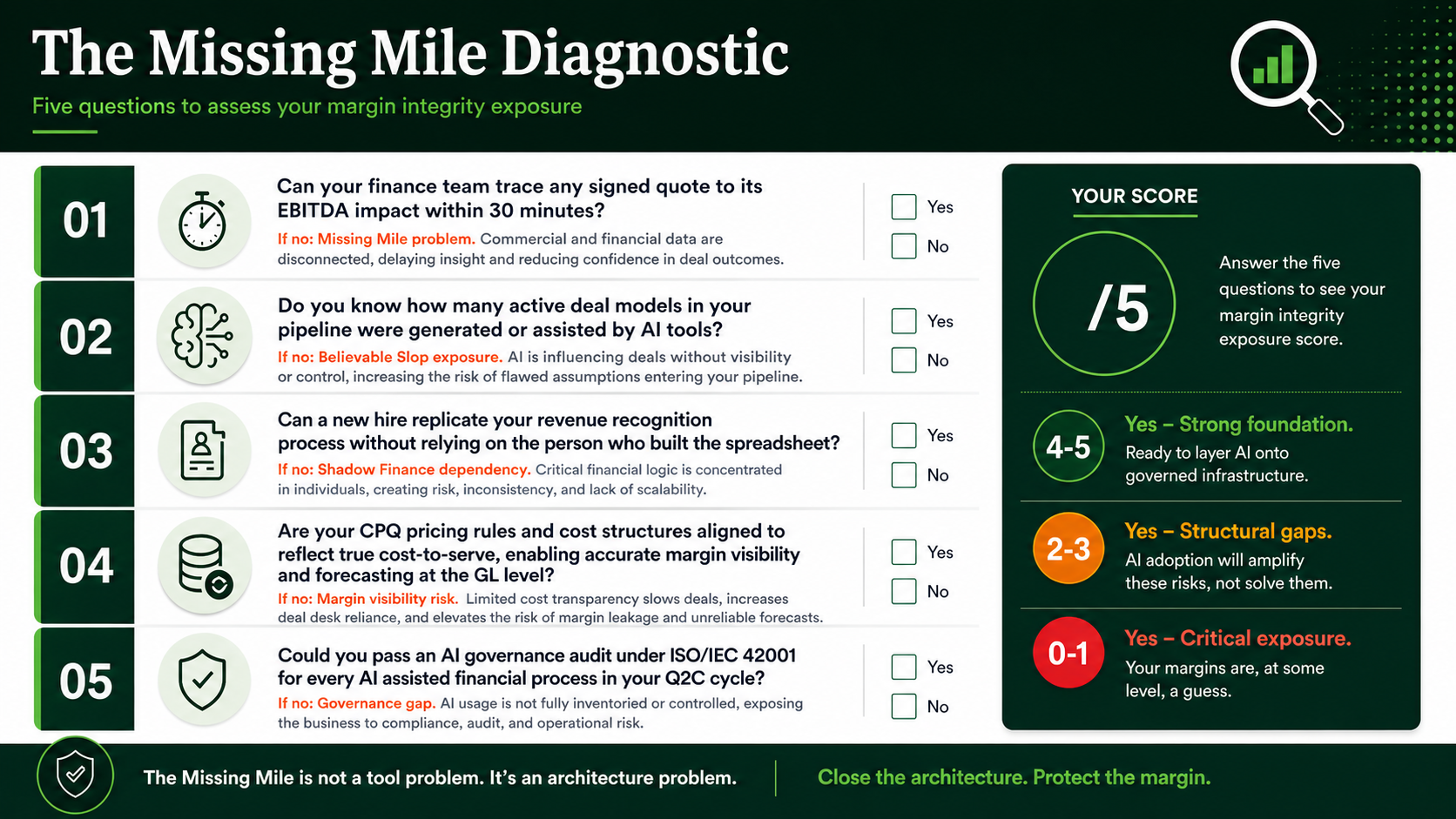
1. Can your finance team trace any signed quote to its EBITDA impact within 30 minutes? If the answer requires a spreadsheet not connected to your ERP, you have a Missing Mile problem.
2. Do you know how many active deal models in your pipeline were generated or assisted by AI tools? If the answer is “we don’t track that,” you have an AI Finance Quarterback operating without guardrails. Deloitte did not know either, until a university researcher found the fabricated citations.
3. Can a new hire replicate your revenue recognition process without calling the person who built the spreadsheet? If it depends on tribal knowledge, you have a Shadow Finance single point of failure.
4. Are your CPQ pricing rules and cost structures updated in real time from your ERP, or does someone manually sync them? Manual syncs create version drift. Version drift creates margin erosion. On deals of any meaningful size, that erosion is material.
5. Could you pass an AI governance audit under ISO/IEC 42001 for every AI assisted financial process in your quote to cash cycle? If you have not inventoried the AI tools touching your financial data, you cannot govern them.
Screenshot these five questions and send them to your controller. Pay attention to how long the answers take. If your controller needs 48 hours and three spreadsheets to answer five questions, you have just measured the Missing Mile. This diagnostic is not a checklist. It is a stress test.
What the diagnostic reveals
Here is what I have learned from running this diagnostic with our own customers.
The organizations that score four or five out of five have one thing in common: they made the architectural decision to close the Missing Mile before they started layering AI onto their revenue operations.
The organizations that score one or two also have one thing in common: they skipped that step. And now their AI investments are making the problem worse, not better.
For a deeper dive, see our 2026 framework: Revenue Architecture 2.0: Human Led CPQ for 2026.
The question most leaders ask after running this diagnostic is: what does the architecture look like that would make these answers different?
How servicePath™ Closes the Missing Mile
How we built a CPQ that eliminates revenue leakage and quote to cash risk
Everything in this article points to a specific architectural requirement: a CPQ that functions as commercial governance infrastructure, not just a quoting tool. That is what we built servicePath™ to be.
Telent went live in 8 weeks and cut quote cycle time by approximately 60%. No custom code. No developer dependencies. Business users own the rules, the pricing, and the catalog. That is what codeless configuration looks like in practice.
Dell EMC scaled their entire partner ecosystem without consolidating CRMs.
We built servicePath™ to orchestrate pricing across Salesforce, Dynamics, HubSpot, and ServiceNow simultaneously. When your quote to cash process works across every CRM your teams use, Shadow Finance disappears.
We built the platform so your controller can see the margin on a deal before the quote leaves the building. Every pricing decision is traceable. Every discount has an audit trail. Our AI architecture is native, not retrofitted.
AI helps reps configure faster. AI does not set the price or calculate the margin. Those decisions run on deterministic logic. That distinction, between AI assistance and financial authority, is the line that separates a governed revenue architecture from Believable Slop.
Why we built servicePath™ differently than legacy CPQ
We did not build servicePath™ to compete with legacy CPQ on features. We built it to solve the architectural problem that legacy CPQ created.
When your quoting system requires custom code to handle your actual deal structures, you have not automated your revenue process. You have created a dependency on developers who understand pricing logic that should be owned by your business.
That is the technical debt that 86% of CFOs now cite as a barrier to AI adoption. Codeless configuration eliminates it.
servicePath™ is the sole Visionary in Gartner’s 2026 Magic Quadrant for CPQ Application Suites for the third consecutive year. A 2026 CPQ Data Quadrant Champion by Info-Tech.
As Michael Cantor, CIO of Park Place Technologies, put it: the platform has enterprise features and scalability built in, which is critical when the only constant is change.
As one enterprise customer noted in a Capterra review: “The other providers could not clearly demonstrate how CPQ could cater to our specific requirements. Instead, they focused on the product. servicePath™ focused on us.”
Gartner’s April 2026 prediction confirms the direction: by 2028, over half of enterprises will stop paying for assistive AI and will favor platforms that commit to workflow results.
As Gartner VP Analyst Alastair Woolcock put it: “Execution authority is not a product feature. It is an architectural position.”
Close Your Missing Mile
Find out where your margins are leaking in 30 minutes
Trusted by Dell, Park Place Technologies, Telent, and TierPoint.
Download the Missing Mile Diagnostic. Get the five question diagnostic from this article as a one page PDF you can share with your CFO, CRO, or controller. No email gate. No form. Just the tool. Download the Diagnostic
See servicePath™ in Action. In 15 minutes, our team will show you how servicePath™ CPQ+ works with your existing CRM to simplify complex pricing and quoting processes, centred around the challenges that matter to your business. Schedule a Demo
Request an Executive Briefing. A 30 minute conversation with a servicePath™ CPQ Architect focused on your specific revenue architecture challenges. We run a limited number of Executive Briefings each month. If your team is evaluating CPQ in 2026, the earlier we talk, the more options you have. Request an Executive Briefing
Margin is not fixed in Finance. Margin is engineered in the revenue architecture. The leaders who understand that will stop fixing deals. And start engineering margins.
I would love to hear from other finance and revenue leaders: What is the most expensive deal your team has had to unwind because of a data gap between the CRM and the GL? Drop your story in the comments.
Frequently Asked Questions
Common questions about AI risk, CPQ governance, and the Missing Mile
How does AI hallucination create risk in financial reporting and deal pricing?
AI hallucination in financial contexts means a model generates margin calculations, cost projections, or revenue schedules that look accurate but are fabricated. Deloitte Australia had to partially refund a government contract in late 2025 after AI generated fabricated citations in an official report. In deal pricing, hallucinated margins flow downstream into revenue recognition, billing, and GL entries. By the time Finance catches the error, the deal is signed and the cost of remediation is real.
We already have a CPQ. Does the Missing Mile still apply to us?
It depends on what your CPQ actually governs. If it handles configuration and quote generation but does not enforce cost structures, discount governance, and ASC 606 revenue schedules with deterministic logic, you have a quoting tool, not a financial governance engine. The question is not whether you have a CPQ. The question is whether it can produce an audit trail your controller trusts without a supplemental spreadsheet. I wrote about the distinction in Revenue Architecture 2.0.
Daniel Kube is CEO of servicePath™, a Configure, Price, Quote platform for complex technology sales. servicePath™ has been recognized as a Visionary in the Gartner Magic Quadrant for CPQ Application Suites for four consecutive years (2023 to 2026), and is the sole Visionary for three consecutive years (2024 to 2026).