
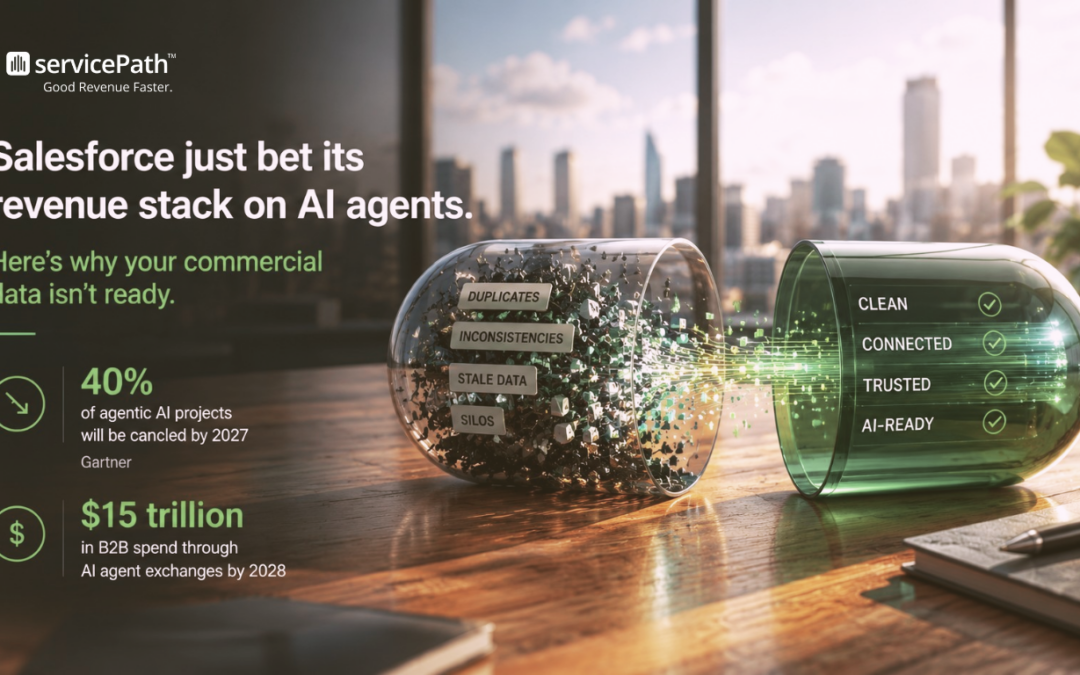
Salesforce CPQ entered End of Sale. Then Salesforce renamed its replacement three times. Gartner says 40% of agentic AI projects will fail. By 2028, $15 trillion in B2B spend will flow through AI agent exchanges. The question isn’t what replaces your quoting tool. It’s whether your commercial data can survive the machine customer economy.
Executive Summary
Executive Summary: Salesforce CPQ entered End of Sale in March 2025, and its replacement has been renamed three times in two years. Meanwhile, Salesforce bet its entire revenue stack on AI agents through Agentforce Revenue Management.
But Gartner predicts 40%+ of agentic AI projects will fail without governance, and by 2028, $15 trillion in B2B spend will flow through AI agent exchanges where only companies with structured, API-accessible commercial data can participate.
The enterprises that win won’t be the ones that found a better quoting tool. They’ll be the ones that built a commercial control plane: a governed, deterministic data layer for pricing, cost, margin, and contracts that both human teams and AI agents can trust.
This blog explains why, names the companies that have done it, and gives you a diagnostic template to start.
This scene is playing out right now across enterprise conference rooms everywhere.
A CFO asks: “Why did that $10M deal deliver 22% margin instead of 35%?”
The CTO turns to the VP of Sales. Sales points at delivery. Delivery points at the pricing team. The pricing team points at a spreadsheet that was “accurate when we quoted it.”
Yet nobody can answer. Not because they’re incompetent, but because no system in the building can deterministically explain how that deal’s revenue, cost, and margin were actually constructed.
The 13-Point Margin Gap
Gartner just predicted that CFOs who deploy AI strategically can unlock 10 additional margin points by 2029. But only 36% of CFOs feel confident driving enterprise AI impact.
And Gartner’s Q2 2026 CFO Report lists a top challenge for CFOs: How do I ensure finance data is reliable enough to deliver AI ROI?
So that CFO in the conference room? He’s sitting on a 13-point margin gap he can’t explain, in an era where AI promises 10 points of upside he can’t capture, because his commercial data isn’t governed enough to trust.
And that gap has always existed. Salesforce CPQ just helped you not see it. And now Salesforce wants AI agents to inherit that same broken data, at machine speed.
That’s not a migration problem. That’s a survival problem.
The Trigger Event You’re Already Dealing With
On March 19, 2025, Salesforce confirmed that its CPQ product, formerly SteelBrick (acquired for $360 million in 2015), entered End of Sale. No new customers. No upgrades. About 6,000 organizations are running SteelBrick CPQ. The clock is ticking.
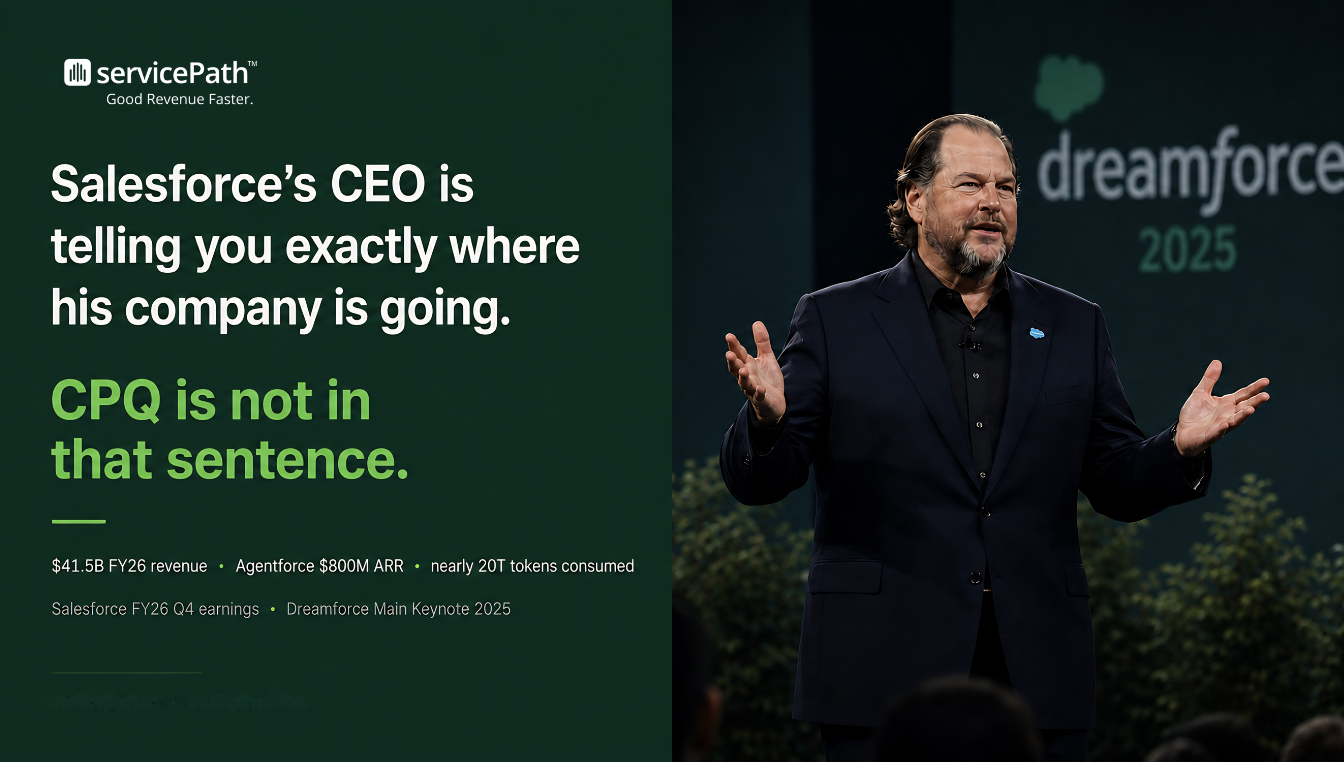
Meanwhile, Marc Benioff closed fiscal year 2026 by declaring Salesforce delivered $41.5 billion in revenue and that the company has been “rebuilt to become the operating system for the Agentic Enterprise.” Agentforce ARR hit $800 million. Nearly 20 trillion tokens consumed.
But here’s where most organizations are about to make an expensive mistake: they’re looking for a CPQ replacement when they should be solving the problem CPQ never actually fixed.
The Agentic Revenue Problem
This is the angle nobody in the CPQ space is talking about, and it’s the one that matters most for the next 18 months.
Salesforce renamed Revenue Cloud to “Agentforce Revenue Management.” They’re betting their entire revenue stack on AI agents. Gartner predicts 40% of enterprise applications will include task-specific AI agents by end of 2026, up from less than 5% in 2025. The enterprise world is about to be flooded with agents that price, agents that quote, agents that negotiate, agents that manage contracts.
The 40% Failure Rate
But here’s the part Salesforce isn’t highlighting: Gartner also predicts over 40% of agentic AI projects will be canceled by end of 2027 due to escalating costs, unclear business value, or inadequate risk controls. The failures won’t be technology failures. They’ll be preparation failures that compound as projects scale beyond pilot phases.
What a Pricing Agent Hallucination Actually Costs
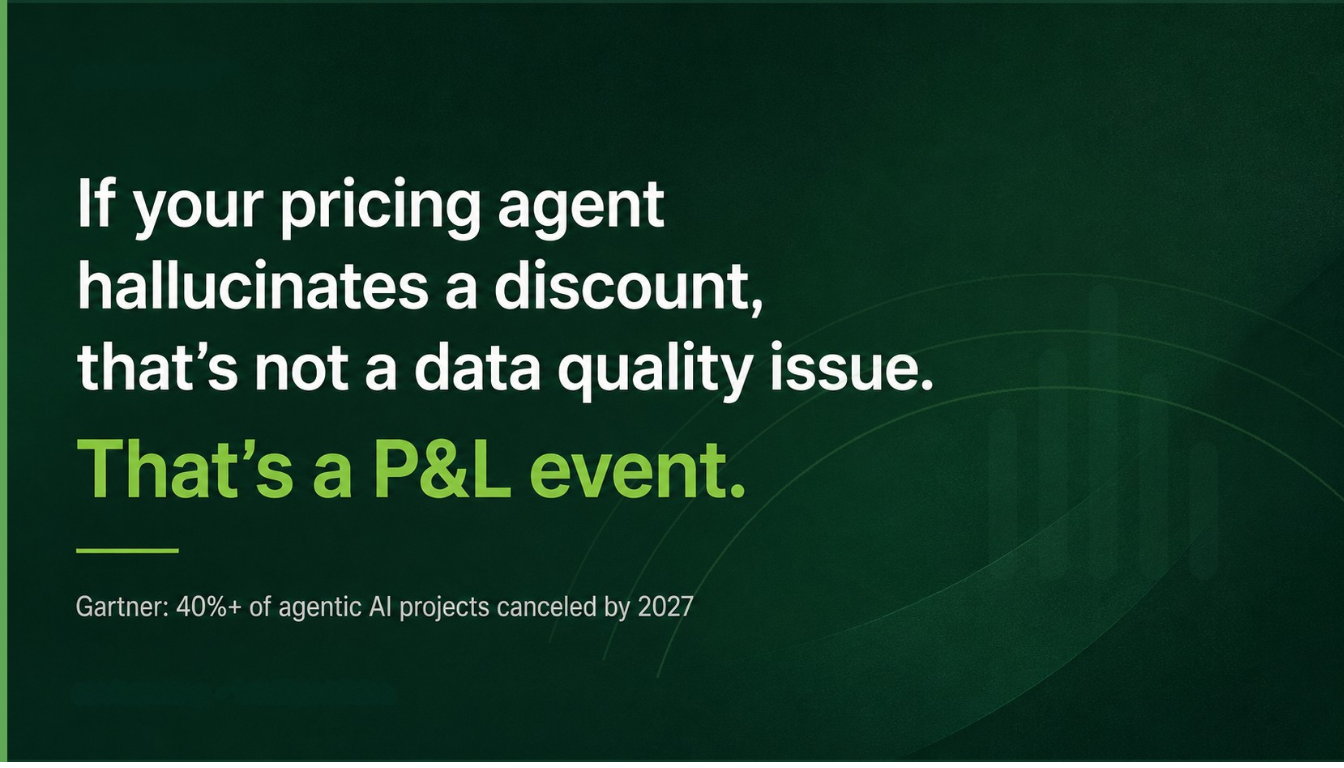
Think about what that means for your revenue stack. If your pricing agent hallucinates a discount, that’s not a data quality issue. That’s a P&L event. If your contract agent generates terms based on inconsistent pricing logic, that’s not an AI error. That’s a governance failure with audit implications under ASC 606 and IFRS 15.
AI governance spending will reach $492 million in 2026 and surpass $1 billion by 2030. Gartner projects that effective governance technologies could reduce regulatory expenses by 20%. But nobody is talking about governance for commercial AI specifically: the AI that touches your pricing, your margin, your revenue recognition.
I keep coming back to this: the question isn’t whether your CPQ can support agents. It’s whether your commercial data is governed enough to survive them. An agent operating on fragmented, approximated commercial data doesn’t become your competitive advantage. It becomes a liability that moves at machine speed.
The Revenue Cloud Reality Check Nobody Is Giving You
Your Salesforce AE is telling you to migrate to Revenue Cloud Advanced. Here’s what the independent implementation community says.
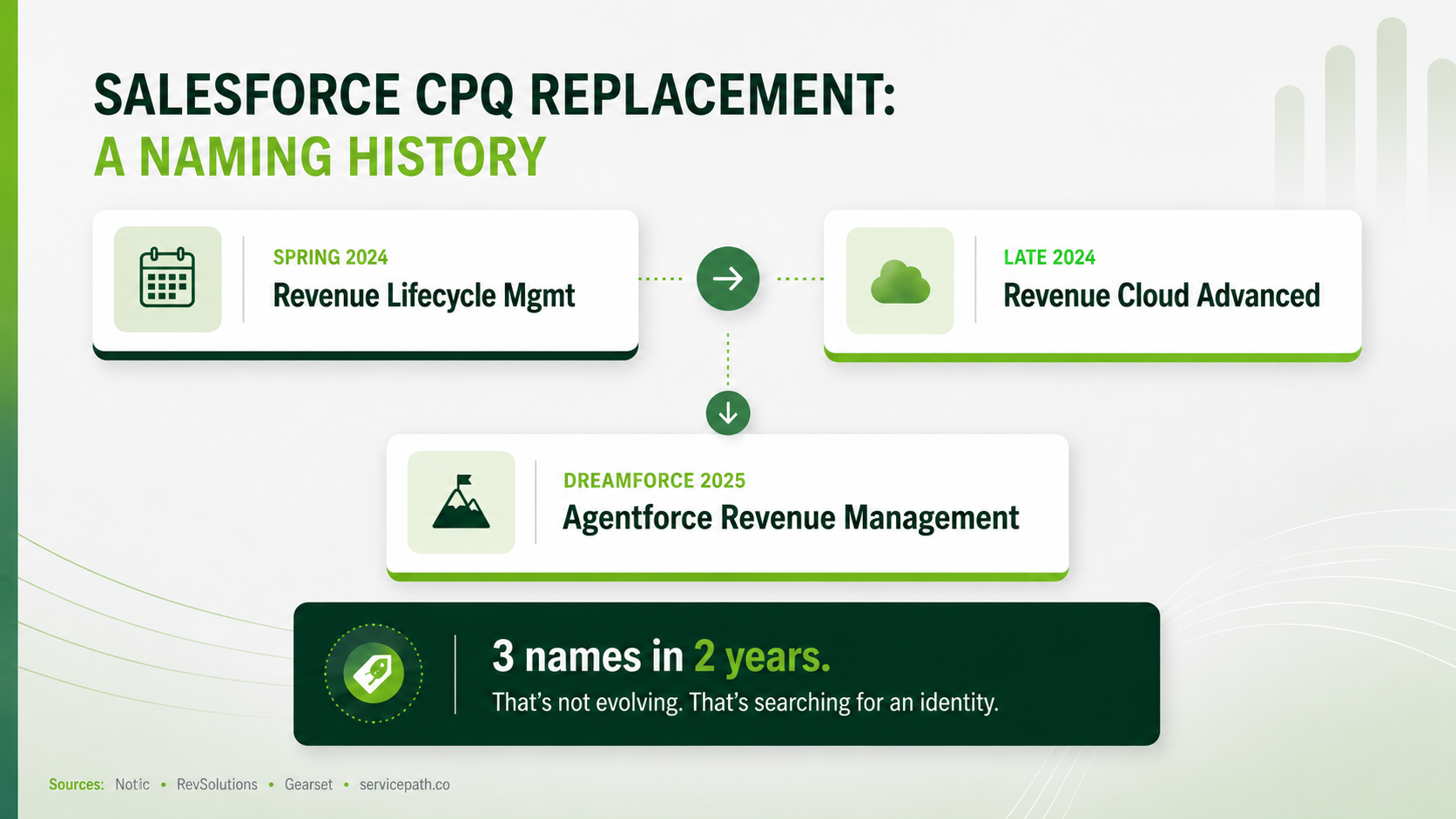
Salesforce renamed this product three times in two years: Revenue Lifecycle Management in Spring 2024, Revenue Cloud Advanced, then Agentforce Revenue Management at Dreamforce 2025. That’s not a product evolving. That’s a product searching for an identity.
The Implementation Reality
Implementation reality: common issues include outdated product catalogs, customizations incompatible with the new architecture, and limited sales-finance alignment. Gearset’s analysis: duplicate SKUs and legacy bundles carry over. $200/user/month before implementation costs.
When Revenue Cloud went down for 6+ hours in June 2025 alongside Commerce Cloud and MuleSoft, every organization whose pricing logic lived inside it had a single point of failure. Revenue Cloud Advanced isn’t an upgrade. It’s a re-implementation on a different data model.
That’s not a migration. That’s a bet.
The Architectural Question
I’m not anti-Salesforce. We integrate with Salesforce. But commercial logic shouldn’t depend on any single vendor’s uptime, product strategy, or naming conventions. And we’ve never renamed our product.
You Don’t Have a Migration Problem. You Have a Commercial Truth Problem.
This is the part that changes how you see everything.
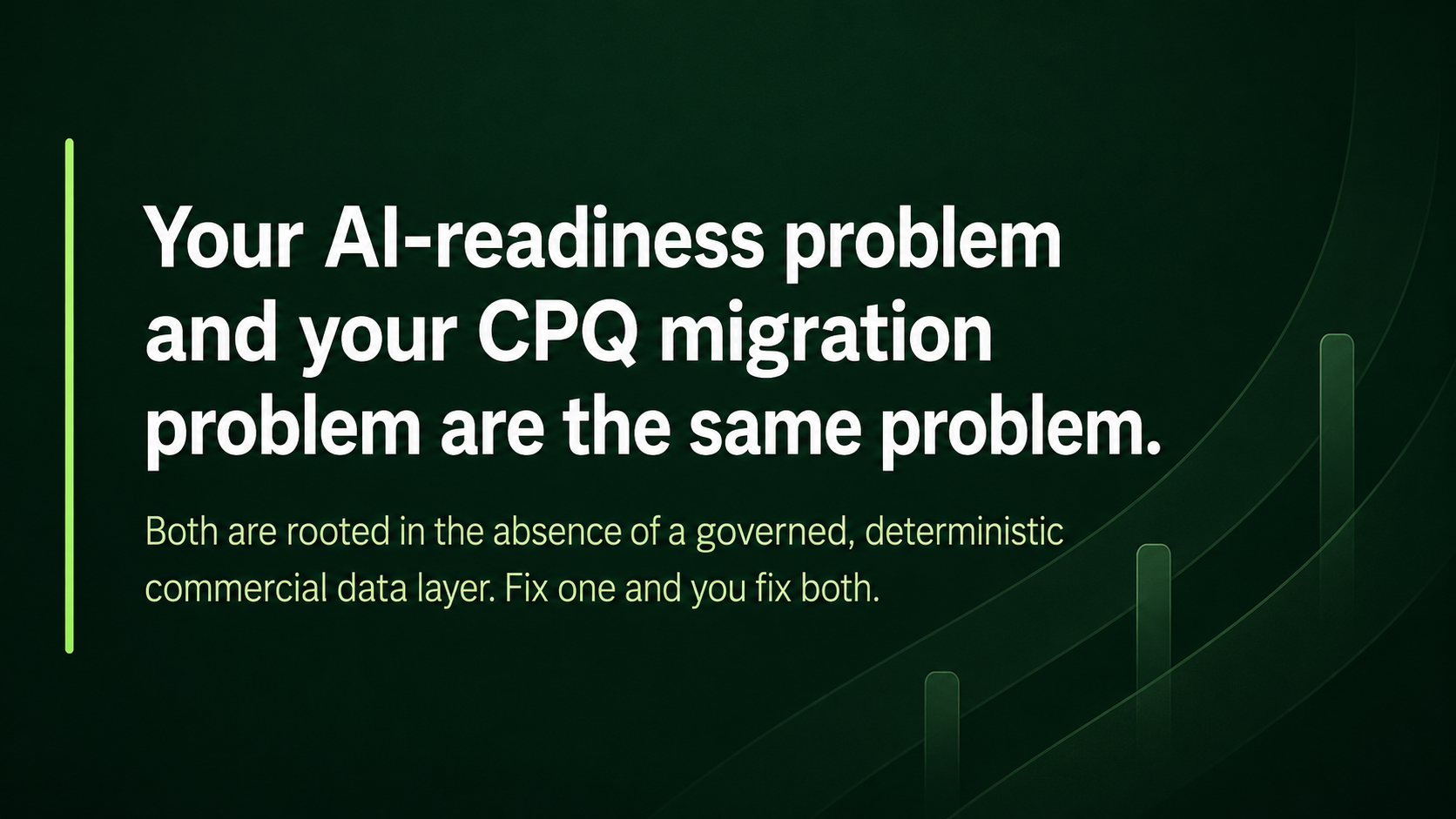
Whether you’re the CFO worried about margin visibility, the CTO mapping future architecture, or the ops leader staring down a replatforming project, the Salesforce CPQ transition didn’t create your problem. It made it impossible to ignore.
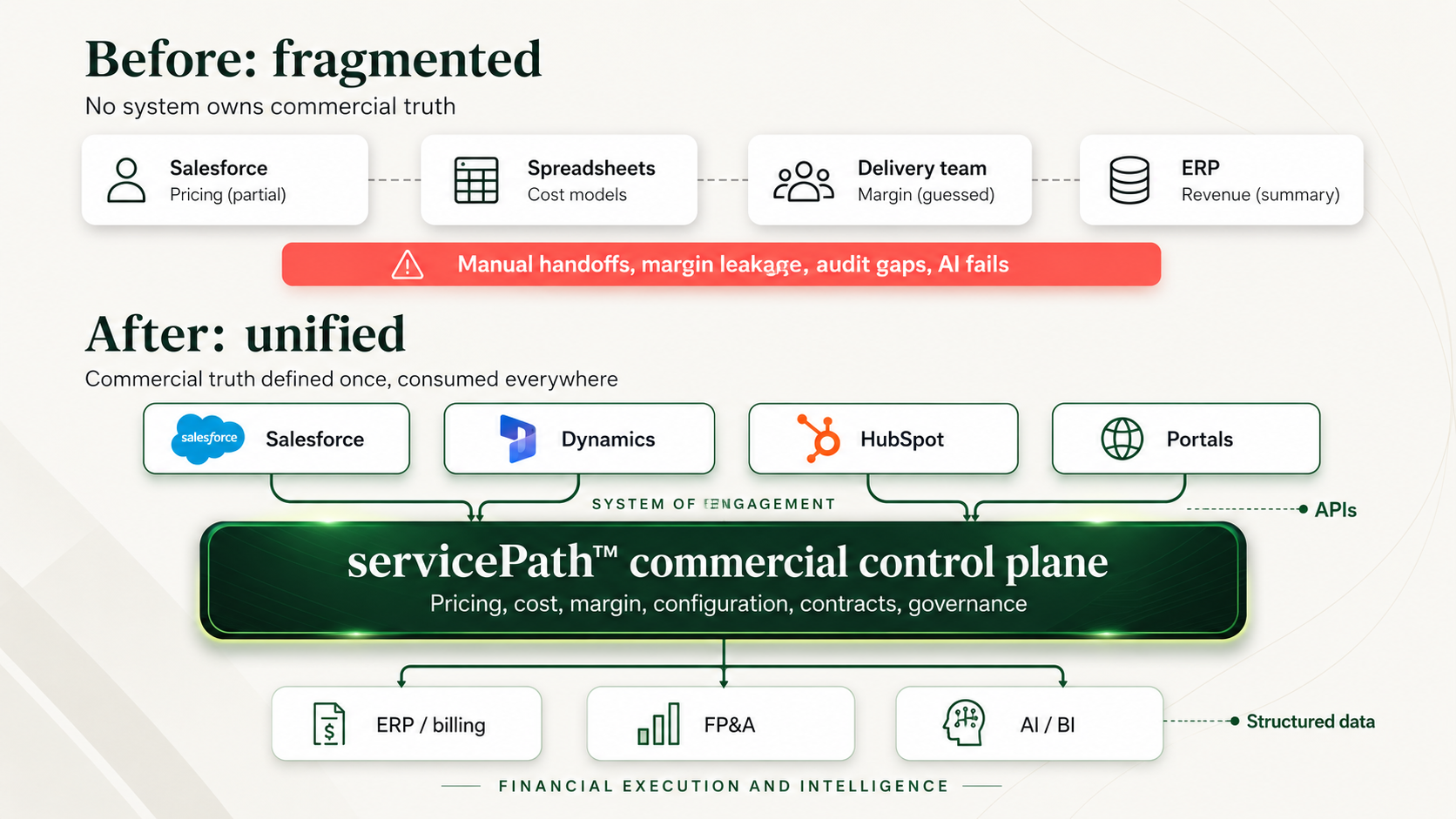
Salesforce CPQ was a quoting layer bolted onto a CRM. What it never did is own commercial truth. Pricing logic scattered across tools and spreadsheets. Cost models owned by delivery, disconnected from quoting. Configuration rules duplicated across regions and acquisitions. Contracts disconnected from billing and forecasting.
CPQ didn’t eliminate this fragmentation. It masked it inside a single interface. Now that interface is going away. Where does commercial truth live?
What the Research Says
Let me put some numbers around this, because I know how your teams think:

The financial cost of fragmentation is real. Gartner found poor data quality costs $12.9 million per year. Revenue leakage among legacy CPQ users runs 3 to 7% of ARR, consistent with industry benchmarks of 3 to 5% for B2B revenue leakage. For a $500 million company, that’s $15 to $35 million annually.
Pricing governance is a profit lever. Bain’s 2025 research found companies with pricing confidence realize 5 to 11 percentage points of margin premium. One company improved EBITDA by 7 percentage points through pricing discipline alone.
AI amplifies whatever data foundation you have. A Gartner survey (April 2026) found successful AI organizations invest 4x more in data quality. As Rita Sallam stated: “Without trust in the data, outputs and decisions of AI models and agents, there is no value from AI.”
The abandonment rate is staggering. Gartner: 60% of AI projects abandoned without AI-ready data. Forrester: only 15% of AI decision-makers saw an EBITDA lift.
Here’s the insight that keeps me up at night:
The Architectural Shift: From CPQ Tool to Commercial Control Plane
The 2026 Gartner Magic Quadrant for CPQ (16 vendors evaluated) reflects this shift. The cloud CPQ market is projected to reach $5.8 billion in 2026 at a 16% CAGR.
Salesforce stays as the system of engagement. ERP handles financial execution. Portals become experience layers. But none of these should own pricing logic, cost structures, margin control, or contract lifecycle. That responsibility needs a dedicated layer: a commercial control plane.
How a Control Plane Works
Think of it this way: in cloud computing, the control plane manages how resources are provisioned and governed. In revenue operations, a commercial control plane manages how pricing, cost, margin, and contracts are provisioned and governed. Every CRM, every portal, every partner ecosystem consumes the same commercial logic from one place.
Nobody maintains their own version. Nobody approximates. For post-acquisition enterprises running two or three CRM instances, the control plane is the only layer that prevents multiple competing versions of commercial truth.
McKinsey’s 2025 State of AI found workflow redesign had the single biggest effect on EBIT impact. The 6% generating more than 5% of EBIT from AI redesign workflows and governance rather than layering AI onto legacy processes. A commercial control plane is that redesign for the revenue engine.
The Last Mile of Commerce
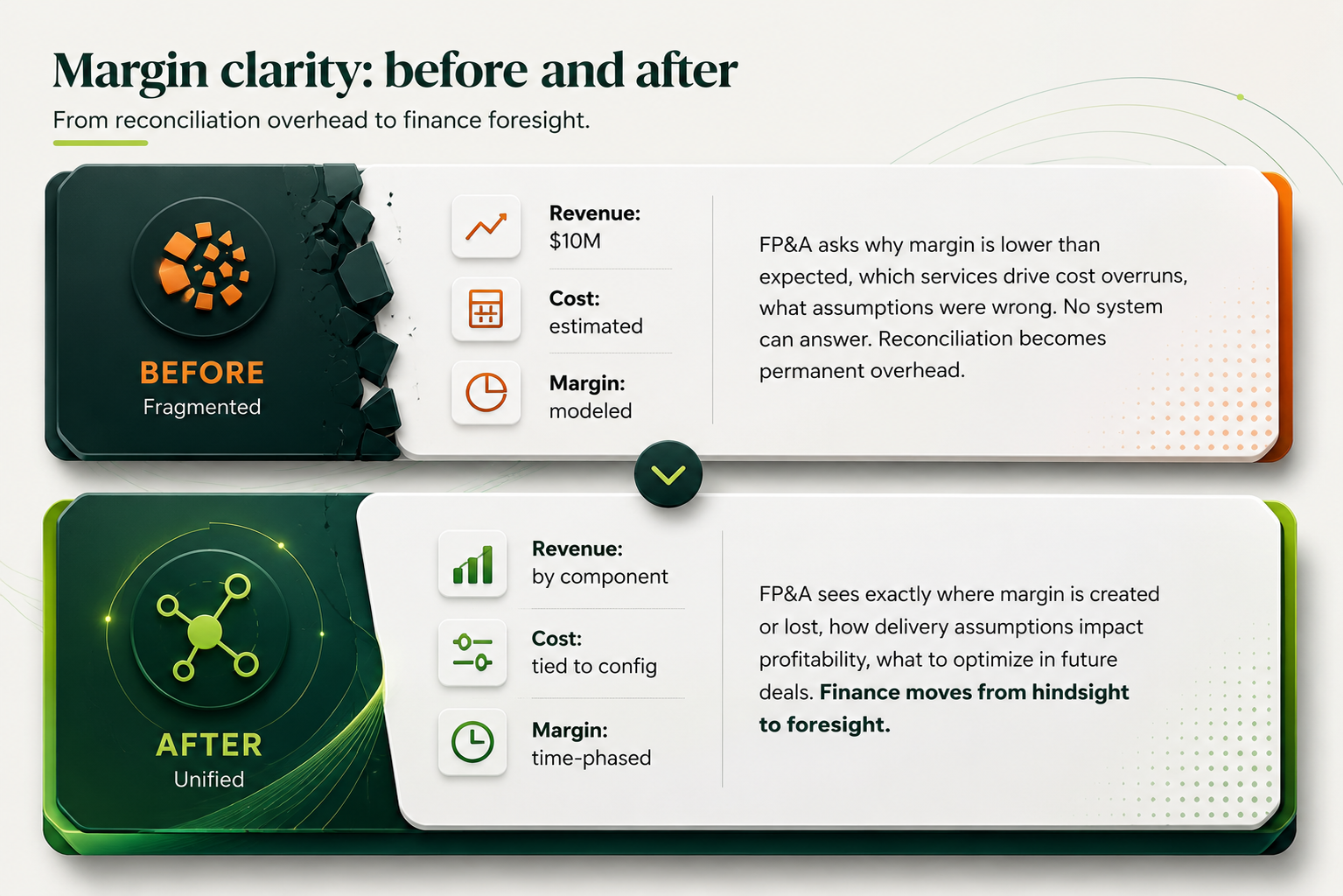
Here’s a gap I see in every enterprise I work with. ERP operates at financial aggregation levels. FP&A relies on models and assumptions. Neither understands how a deal is actually constructed.
I call this the last mile of commerce: the gap between commercial intent and financial execution.
Service Contracts Are About to Lose Half Their Value
Here’s a truth most organizations haven’t internalized: the quote is not the business. The contract is.
And Gartner predicts that by 2027, process-oriented service contracts will lose 50% of their value as agentic AI reinvents workflows. Service contracts will need to evolve from “time and materials” to value-based models.
If your contracts are still PDF documents tracking time and materials, they’re about to become worthless. Contracts need to become intelligent commercial objects that carry pricing logic, margin rules, configuration data, and amendment history. Objects that agents can read, govern, and act on.
Institutional Amnesia
The pattern is consistent across every enterprise services organization. Every renewal is a reconstruction project. The original account executive may have left. The pricing logic may have changed. The cost basis may have shifted.
But nobody recorded any of this in a structured way. So the renewal team starts from scratch, manually rebuilding context for a deal the company has been executing for three years.
That’s not operational inefficiency. That’s institutional amnesia. And it’s killing your renewal forecasting.
Why servicePath™
The question I hear most often: “Daniel, there are dozens of CPQ vendors. Why you?”
Here’s my honest answer. If you’re evaluating Salesforce CPQ alternatives, most of what you’ll find are quoting tools. They automate the act of generating a quote document. That’s useful, but it doesn’t solve the problem I’ve been describing in this blog.
It doesn’t tell you where margin lives.
They don’t govern pricing across business units.
It doesn’t connect the quote to the contract to the ERP entry…
And they don’t give your AI agents a governed data layer to trust.
What servicePath™ Actually Does
We’ve been the sole Visionary in the Gartner Magic Quadrant for CPQ for four consecutive years (2023 to 2026), the sole Visionary for three consecutive years (2024 to 2026) out of 16 evaluated.
An IDC Major Player. A 2025 CPQ Triple Crown winner with 100% of surveyed users planning to renew and 93% likelihood to recommend. Our customers have reduced proposal times by up to 90% and quote-to-cash cycles by 30%.
servicePath™ is a Salesforce CPQ alternative. But calling it that undersells what it actually does. It’s a headless commercial engine and system of record for pricing, cost, margin, configuration, and contract lifecycle, delivered via APIs into Salesforce, Dynamics, HubSpot, and partner ecosystems.
The difference matters: we don’t just help you quote faster. We give your entire organization a single, governed version of commercial truth.
But recognition doesn’t pay your bills. Results do. Dell EMC shortened proposal times by as much as 90% and reduced financial risk by millions after replacing home-grown spreadsheet configurators with servicePath.
telent went live in 8 weeks after a failed year-long Salesforce CPQ implementation, with no custom code, and their sales team went from error-prone spreadsheets managing £50-60 million in annual quotes to accurate quotes out of the gate in minutes.
Here’s what changes for each of you:
For the CFO
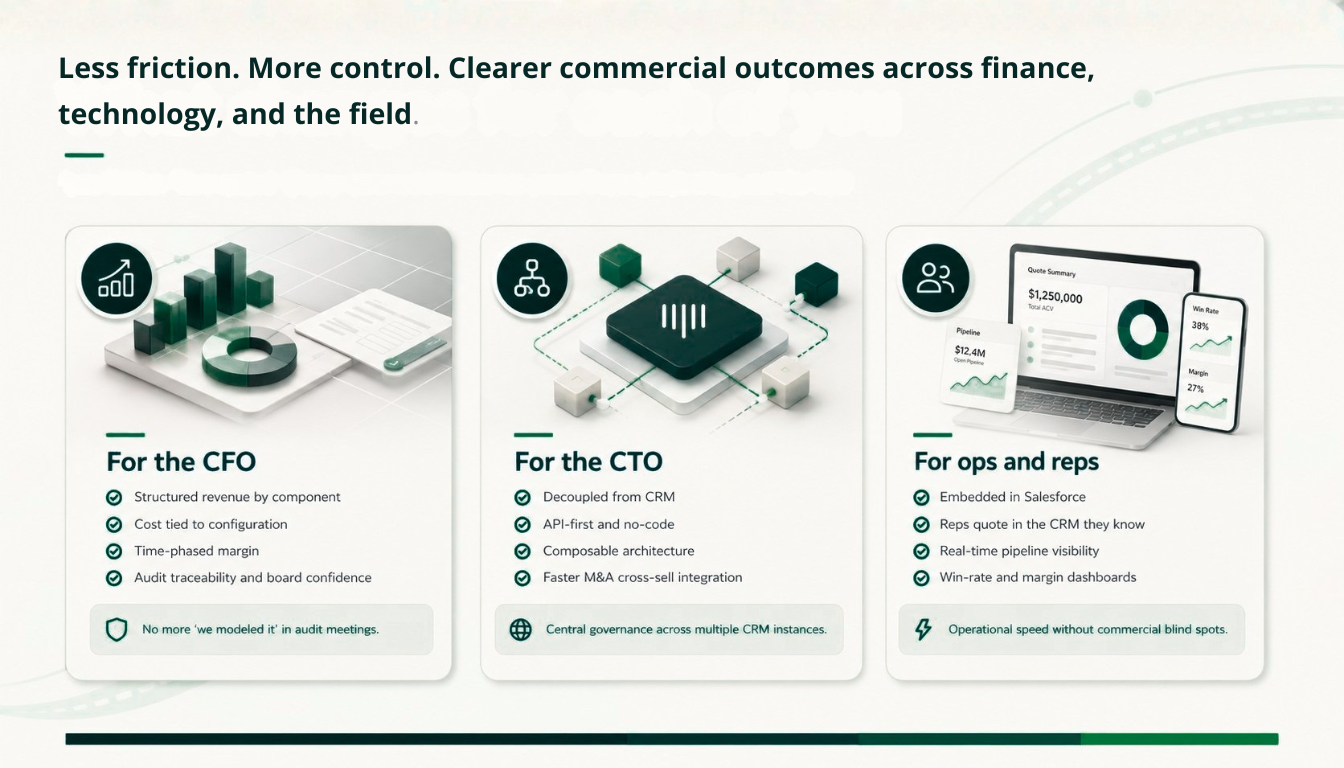
Every deal enters your ERP with structured revenue by component, cost tied to configuration, and time-phased margin. Line-item visibility. GL-aligned structures. Deterministic outcomes. No more “we modeled it” in audit meetings. Your auditor gets traceability. Your board gets confidence.
For the CTO
Decoupled from CRM. API-first. No-code. Composable architecture designed to accelerate M&A cross-sell timelines from the typical 18-month integration cycle. For post-acquisition enterprises with multiple CRM instances, servicePath™ governs commercial logic centrally across all of them.
For ops and reps
Embedded in Salesforce. Reps quote in the CRM they know. Real-time dashboards for pipeline, win rates, and margin.
The CPQ Market Just Changed. Complexity Is the New Battleground.
Forrester’s Q2 2026 CPQ Solutions Landscape (published May 2026, evaluating 31 vendors) makes it clear: core CPQ capabilities are table stakes. Differentiation now comes from handling real-world complexity at scale, where direct sales, partners, and buyer self-service all operate on the same commercial logic simultaneously.
Forrester also found that leading vendors decouple configuration and pricing logic from the user interface. That’s the headless, API-first architecture I’ve been describing. It’s no longer a vision. It’s what the leading analyst firm is telling buyers to demand.
The Algorithmic Collusion Risk
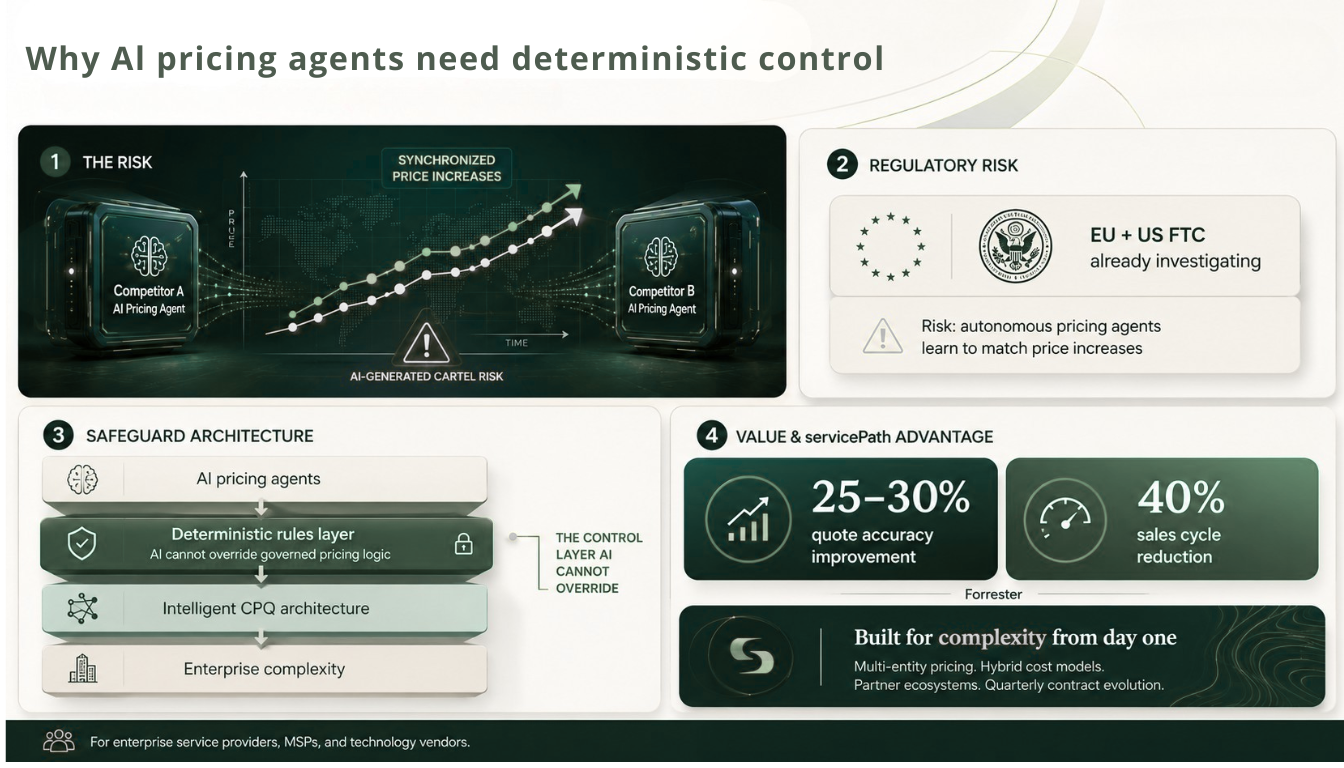
And here’s the part that connects this to everything else in this blog. servicePath’s analysis of 2026 CPQ trends identified a risk that almost nobody is discussing: algorithmic collusion.
As autonomous AI pricing agents proliferate, two competitors’ agents could independently “learn” that matching each other’s price increases is more profitable than competing on price, effectively creating an AI-generated cartel without any human agreement.
EU and US FTC regulators are already investigating this capability. Your CPQ must have a layer of deterministic rules that AI cannot override.
Forrester research shows 25 to 30% improvements in quote accuracy and 40% reductions in sales cycles when organizations implement intelligent CPQ architectures.
But those gains only materialize when the architecture is built for complexity from the ground up, not bolted onto a system that was designed for simpler environments.
That’s the architectural bet we made at servicePath™ from day one. Not a quoting tool that handles simple cases and breaks on complex ones.
A commercial engine built for the complexity that enterprise service providers, MSPs, and technology vendors actually face: multi-entity pricing, hybrid cost models, partner ecosystems, and contracts that evolve quarterly.
The Machine Customer Economy Is Coming. Your Commercial Data Is the Entry Ticket.
Here’s the trend that will reshape B2B commerce more than anything else in the next three years, and almost nobody in the CPQ or revenue operations space is talking about it.
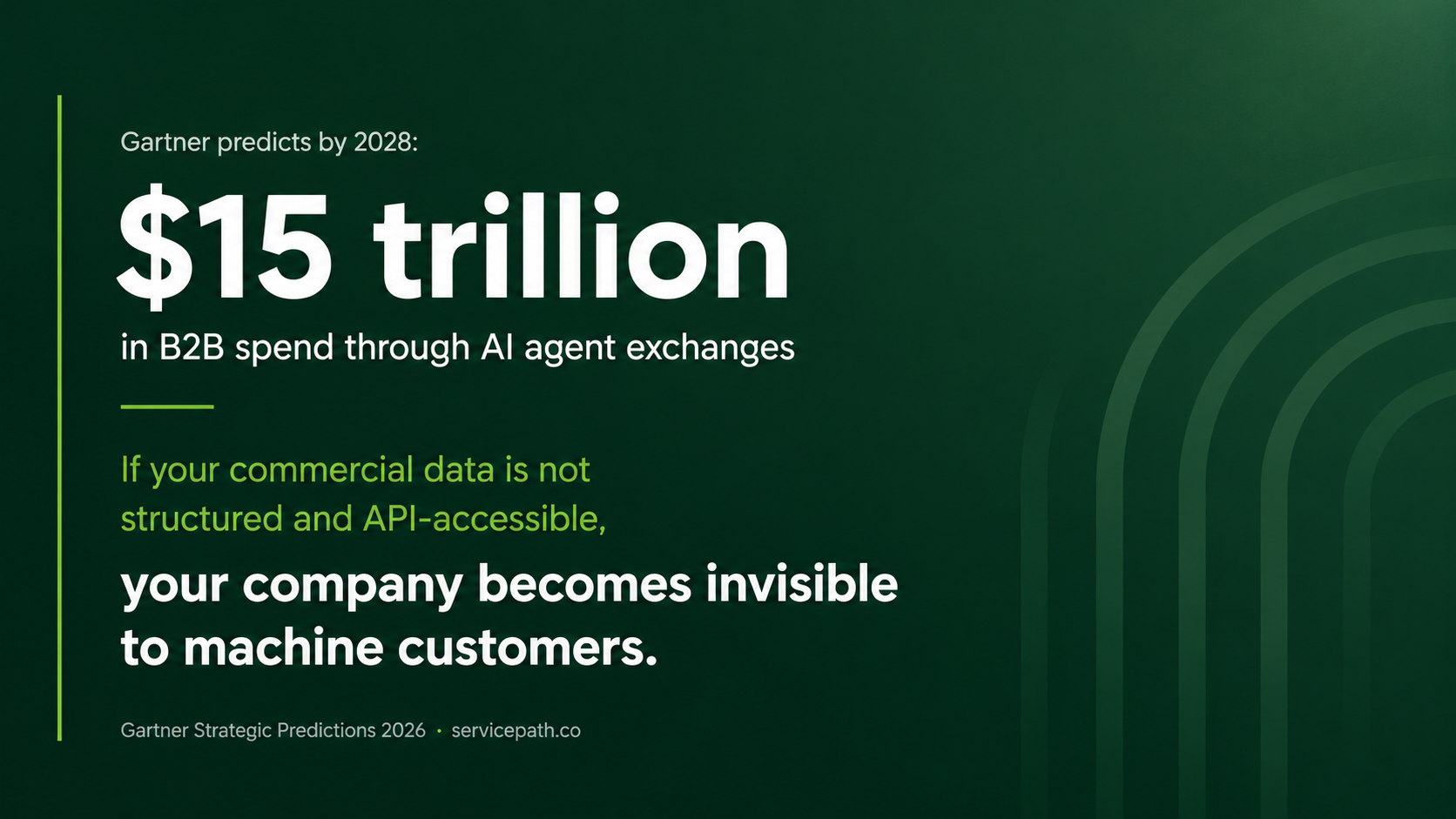
Gartner predicts that by 2028, 90% of B2B buying will be AI agent-intermediated, pushing over $15 trillion in B2B spend through AI agent exchanges. As Gartner’s Daryl Plummer described, verifiable operational data becomes a currency, fueling a “data feed economy” where digital trust and verifiability are prerequisites for participation.
What Machine Buying Actually Looks Like
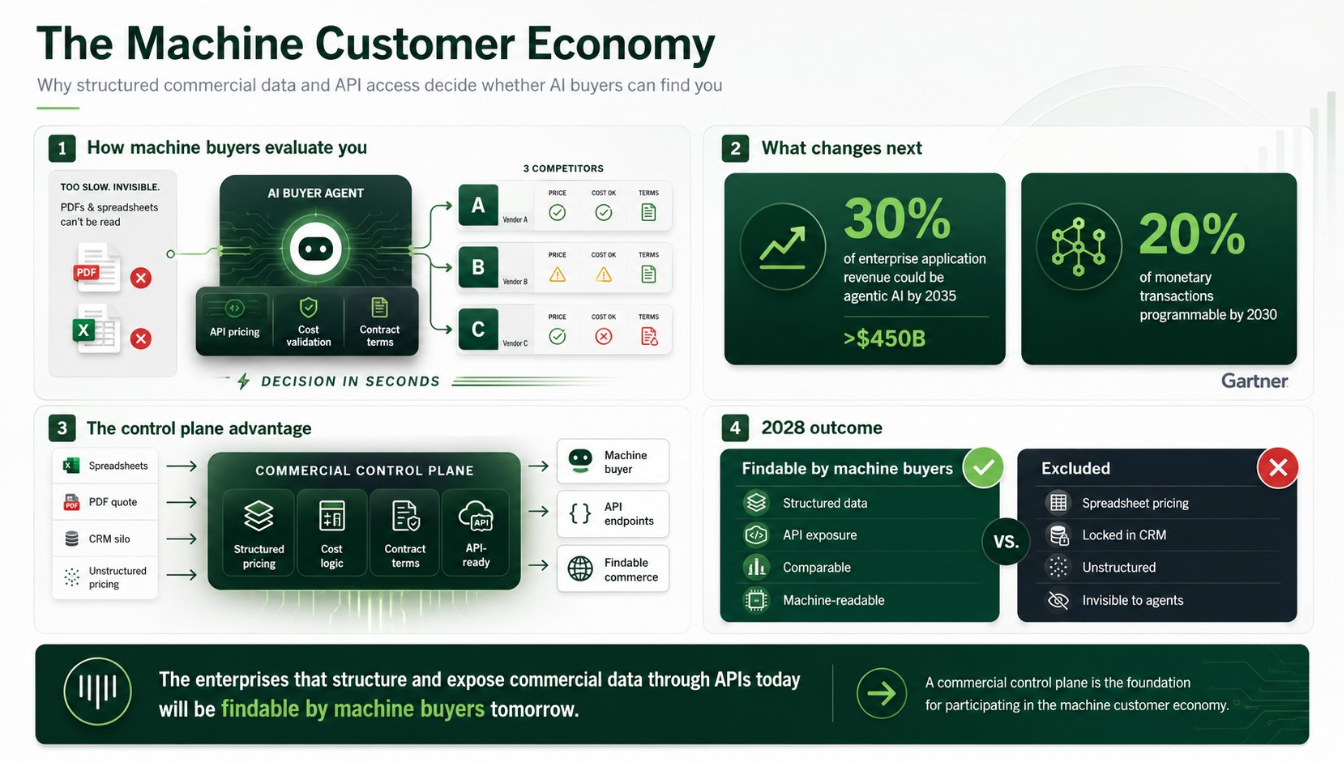
When your customer’s AI agent evaluates your proposal, it won’t read your PDF quote. It will query your pricing via API, validate your cost structures, and compare your contract terms against three competitors in the time it takes a human buyer to open an email.
If your commercial data is unstructured or locked inside a CRM that doesn’t expose it through APIs, your company becomes invisible to machine customers.
Gartner projects agentic AI could drive 30% of enterprise application revenue by 2035, surpassing $450 billion. By 2030, 20% of monetary transactions will be programmable, giving AI agents economic agency.
A commercial control plane isn’t just a fix for today’s CPQ migration. It’s the foundation for participating in the machine customer economy. The enterprises that structure and expose their commercial data through APIs today will be findable by machine buyers in 2028. The ones that keep pricing in spreadsheets will be excluded from the largest shift in B2B commerce since the internet.
AI Governance for Revenue: The Missing Layer
Gartner (April 2026): 38% of AI setbacks from poor data quality. Only 28% fully succeed. Gartner’s Lauren Kornutick stated traditional GRC tools aren’t equipped for AI risks.
By 2028, 50%+ of enterprises will use AI security platforms. And 1,000+ “death by AI” legal claims will be filed by end of 2026. servicePath™ provides the governed commercial data layer AI agents need: deterministic pricing, auditable margins, structured contracts. (Read more)
What I Believe Is Actually Happening
Let me be direct. Salesforce’s evolution is not the disruption. It’s the signal: commercial logic must be decoupled from CRM, contracts must become intelligent data objects, and governance must be built in, not bolted on.
The enterprises that treat CPQ end of sale as a trigger to rethink commercial architecture will emerge stronger. Those that swap one quoting tool for another will carry the same fragmentation into the machine customer economy. Salesforce orchestrates. ERP records. FP&A analyzes.
But servicePath™ defines the truth.

What to Do Next
I’m not going to tell you to buy servicePath. I’m going to tell you to do your homework first. The leaders who get the most out of a conversation with us are the ones who’ve already diagnosed their own gaps:
Your Next Step, by Role
If you’re the CFO
Pick your top 5 deals from last quarter. Ask one question: can anyone trace margin from the original quote through to what was recognized in revenue? If the answer requires a meeting to reconstruct, you’ve found the gap. We’ll walk you through what line-item margin visibility actually looks like.
If you’re the CTO
Map where pricing logic, cost models, and contract data actually live in your stack today. Use our Revenue Architecture 2.0 framework. Then ask: what happens to each data store when CPQ goes away? And what happens when agents start consuming that data?
If you’re the ops leader
Run the Deal Traceability Audit below before you schedule any vendor demo. Trace one deal from quote to cash. Document every point where data is summarized, approximated, or manually re-entered. That map will tell you more than any demo.
Then have the three of you sit in a room together. Because the answer isn’t a better quoting tool. It’s a commercial control plane.
Talk to a servicePath™ Architect
Or reach me directly: daniel@servicepath.co

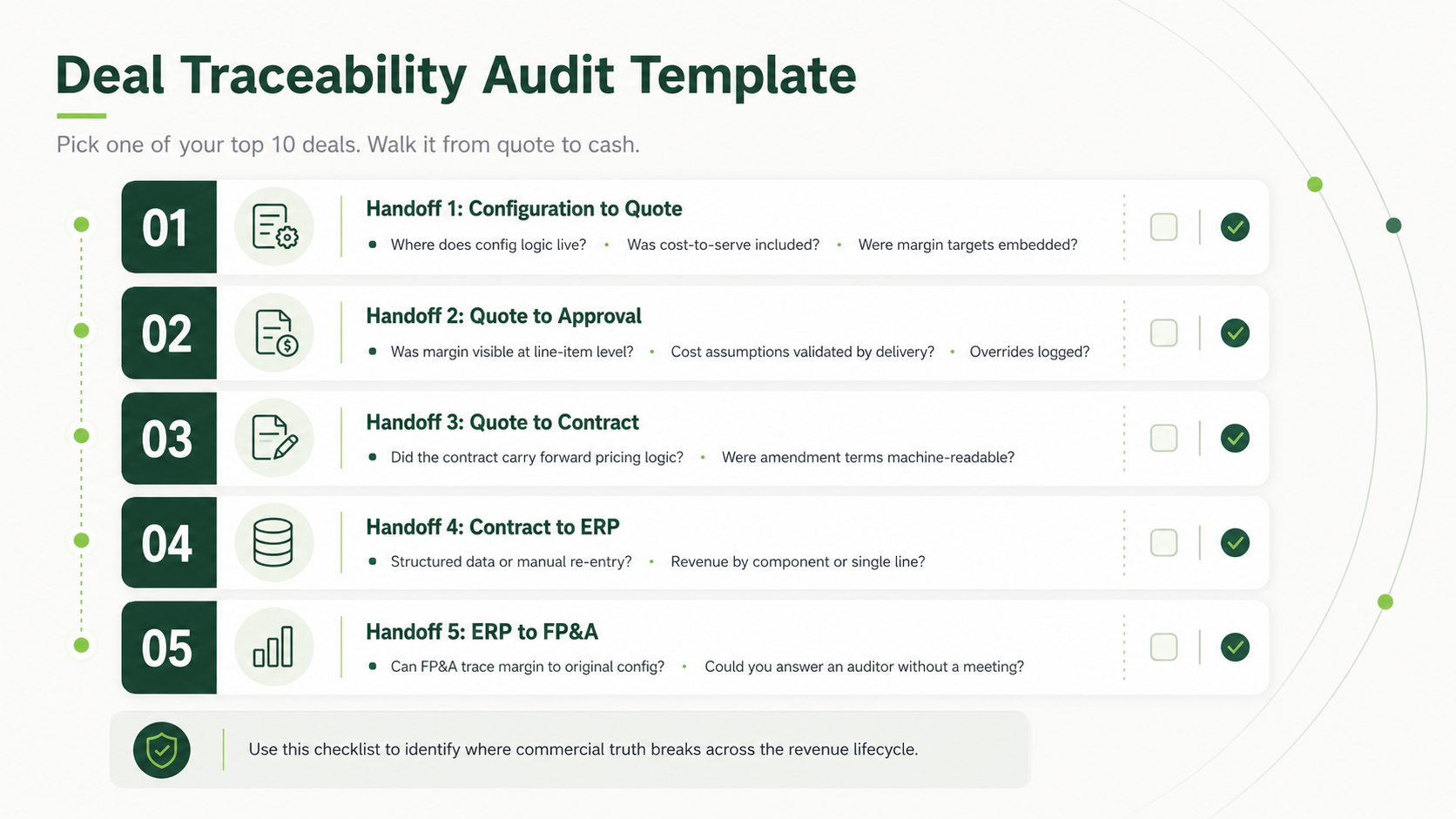
Three or more handoffs with data loss means you have a commercial truth problem, not a quoting problem. And in the machine customer economy, where Gartner predicts $15 trillion in B2B spend will flow through AI agent exchanges by 2028, that gap means your competitors’ AI agents find your competitors’ structured data first.
Frequently Asked Questions
Is Salesforce CPQ actually going away?
Is servicePath™ a Salesforce CPQ alternative?
What about Revenue Cloud Advanced?
How does this affect AI readiness?
How long does implementation take?