
Comprehensive Analysis from Gartner, IDC, Forrester, MGI Research, Deloitte, and Nucleus Research

CPQ Trends 2026: The Executive Revenue Roadmap. This infographic illustrates the key CPQ trends for 2026, emphasizing the shift towards a unified “One Revenue Brain” approach. It highlights the convergence of multi-CRM orchestration, vertical-specific solutions, and agentic AI to drive efficiency, compliance, and revenue growth in a cloud-first market.
TL;DR: The 2-Minute Executive Brief
Are you a Chief Revenue Officer (CRO) or CIO with barely two minutes between board meetings? Here is the definitive state of the Configure-Price-Quote (CPQ) market as we enter 2026. We are witnessing a “Great Re-Platforming”—a forced evolution driven by legacy sunsets and exponential AI.
-
The Burning Platform: Salesforce SteelBrick officially entered “End of Sale” in March 2025. This is a mandatory migration window for thousands of enterprises. It must be addressed in 2026 to avoid a crisis.
-
The Modern Destination: The “Single CRM” dream is dead. Cloud-native, Multi-CRM architectures have become the standard. Large enterprises average 3.4 CRM instances. Consequently, success now depends on orchestration, not consolidation.
-
The Competitive Edge: AI is moving from passive to active. IDC predicts that by 2027, 50% of enterprises will deploy AI agents. If your CPQ isn’t agent-ready, your sales team is manually racing against autonomous machines.
-
The “Sleeper” Regulatory Risk: Gartner warns that 30% of pricing models will drift into non-compliance without robust AI governance. The new frontier is “Algorithmic Collusion”—unintended price-fixing by autonomous bots.
-
The Financial Bottom Line: The stakes are massive. MGI Research forecasts the Cloud CPQ market will reach $5.8 billion in 2026, growing at a blistering 16% CAGR.
Introduction: The Golden Thread of 2026
The CPQ market has reached a critical inflection point. As we look toward 2026, analysts from Gartner, MGI, and Deloitte are not just forecasting new features. They are describing a structural transformation of the enterprise revenue engine.
To understand the chaos and opportunity of the next 12 months, you must see the Golden Thread connecting these ten predictions. They are not isolated trends; they are a sequential roadmap.
The Catalyst: The sunsetting of legacy giants like SteelBrick (March 2025) forces organizations out of their comfort zones. This creates a “move or die” scenario for RevOps.
The Destination: To escape legacy debt, organizations are migrating to Cloud-Native, Multi-CRM ecosystems. These prioritize agility over rigid, single-platform silos.
The Differentiator: Once established on these modern platforms, leaders unlock Agentic AI. This is the autonomous capability that separates high-velocity “Revenue Engines” from slow, manual “Quoting Tools.”
1. Agentic AI: The Ultimate Differentiator

30-Second Takeaway: AI is shifting from “assistive” (chatbots waiting for a prompt) to “agentic” (autonomous actors initiating work). In 2026, CPQ systems won’t just suggest a price. They will independently initiate workflows, adjust global price books based on real-time supply chain shifts, and “self-heal” configuration errors before a human ever sees them.
The most transformative shift in 2026 is the rise of autonomous agents. According to the IDC FutureScape 2026 report, agentic systems are moving from experimental pilots to enterprise orchestration. These systems monitor data streams continuously. Furthermore, they act upon them without waiting for human intervention.
In a high-stakes CPQ context, this evolution looks like this:
The Agentic Workflow Scenario
Imagine a global semiconductor shortage impacts your supply chain overnight.
-
Traditional CPQ: A pricing manager reads the news, performs manual analysis, updates spreadsheets, and uploads new price books to the CPQ. This takes 3-5 days. During this time, sales reps are quoting outdated, margin-killing prices.
-
Agentic CPQ (2026): An AI agent connected to your ERP detects the supply chain cost variance. It immediately runs an impact analysis on open quotes, applies a temporary surcharge to protect margins, and notifies the affected sales reps via Slack—all before the pricing manager has had their morning coffee.
Gartner’s 2026 strategic technology trends emphasize that Multiagent Systems (MAS) are the key to automating complex business processes. For revenue leaders, this translates to a quantifiable 25% boost in sales productivity. Reps stop being data-entry clerks and start being deal-closers.
| Feature | Traditional GenAI (2024-2025) | Agentic AI (2026+) |
| Trigger | Human prompt (“Write a quote for…”) | Environmental event (Cost change, inventory drop) |
| Action | Suggests text or configuration | Executes workflow across systems |
| Scope | Single task assistance | End-to-end process orchestration |
| Outcome | Efficiency gain | Autonomous margin protection |
2. Cloud CPQ Adoption: The Mandatory Destination

30-Second Takeaway: By the end of 2026, 60%+ of B2B sales organizations will be cloud-native. On-premise CPQ is no longer just “old”—it is a liability. It blocks your access to AI, real-time data orchestration, and modern security.
MGI Research estimates that global spend on cloud CPQ tools will reach nearly $5.8 billion in 2026. This represents a significant 16% CAGR. This isn’t just a change in where the software sits (private data center vs. AWS/Azure); it’s a fundamental change in capabilities.
The “Inference Economics” of AI
Why is on-premise dying so fast? The answer is AI. Running advanced Agentic AI models requires massive, burstable compute power—what engineers call “inference economics.” Cloud platforms can spin up thousands of GPUs instantly to process complex pricing algorithms and then spin them down. On-premise servers simply cannot handle this load efficiently.
The Hidden Costs of Staying On-Premise in 2026:
The AI Blockade: You cannot effectively deploy modern GenAI or Agentic models on legacy infrastructure.
Integration Hell: In a Multi-CRM world, connecting an on-prem CPQ to three different cloud CRMs and two cloud ERPs requires brittle, expensive middleware that breaks constantly.
Innovation Lag: Cloud vendors release updates weekly. On-premise vendors release annual upgrades that take six months to implement. You are always at least a year behind the competition.
Deloitte’s Tech Trends 2026 highlights that companies are shifting focus from building “bigger models” to “better implementation.” This agile implementation is only possible in a SaaS environment.
3. The SteelBrick Sunset: The 2026 Catalyst

30-Second Takeaway: Salesforce SteelBrick entered “End of Sale” in March 2025. This creates a critical 12-to-18-month window (right now) for enterprises to find and implement a modern alternative. Failure to act in 2026 means facing a “forced march” in 2027 amid a massive talent shortage.
The official Salesforce retirement roadmap confirmed what insiders have known for some time: SteelBrick (Legacy Salesforce CPQ) is being phased out. While Salesforce is pushing customers toward their new Revenue Cloud, enterprise buyers are realizing a hard truth. Moving to Revenue Cloud is not a simple upgrade—it is a full, complex reimplementation.
This event is the primary catalyst putting the entire CPQ market in motion in 2026.
The 2027 Migration Crisis (And Why You Must Act in 2026)
Industry analysts at Apparound and others have flagged a looming crisis. Thousands of Salesforce customers will simultaneously realize they need to migrate off SteelBrick before support degrades further.
-
The Talent Crunch: The pool of qualified CPQ architects is finite. As demand for migration services peaks in 2027, hourly rates for top-tier consultants are projected to rise by 40-50%.
-
The “Zombie Platform” Risk: Legacy SteelBrick is seeing near-zero R&D investment. Every month you stay on it, your sales capabilities fall further behind competitors using modern, AI-driven tools.
-
The Strategic Opportunity: Forward-thinking CIOs are using this forced change not just to swap vendors, but to rethink their entire architecture. They are abandoning single-vendor lock-in for flexible, Multi-CRM approaches.
4. Multi-CRM Reality: Orchestration Over Consolidation
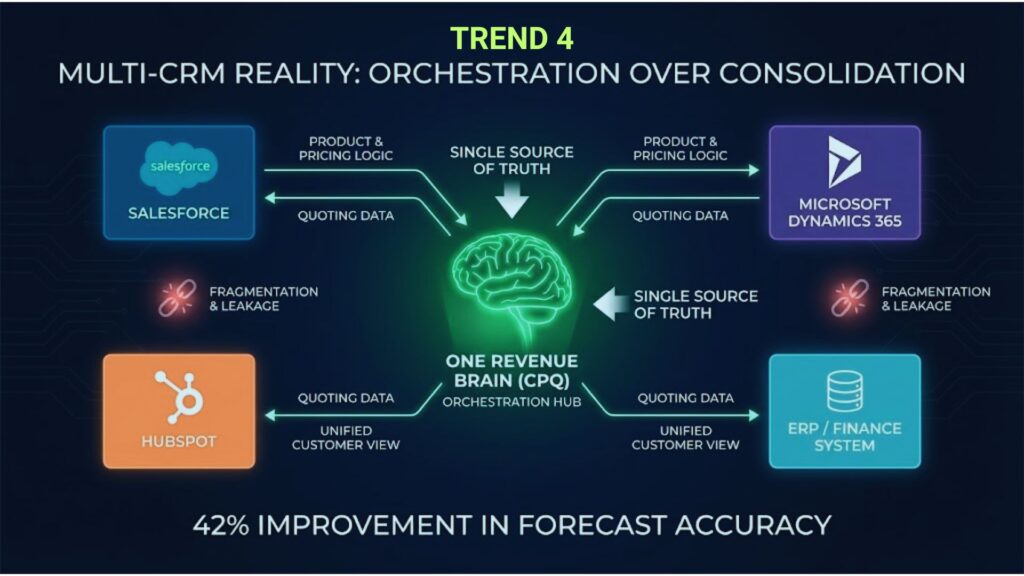
30-Second Takeaway: The “One CRM to Rule Them All” dream is over. Enterprises now average 3.4 CRM instances. The winners in 2026 won’t be those who try to force every acquired company onto one platform. The winners will be those who use CPQ as a “Revenue Brain” to orchestrate seamlessly across all of them.
The Counter-Intuitive Insight: For a decade, IT research firms preached consolidation. In 2026, the reality of M&A, regional data laws, and specialized departmental needs means fragmentation is here to stay. MGI Research’s TAM forecast identifies that massive revenue leakage occurs at the inefficient hand-offs between these different CRM and ERP instances.
The new winning strategy is Orchestration. You need a CPQ that sits above the CRM layer. It must act as the single source of truth for product, pricing, and quoting logic, regardless of where the opportunity originated.
Visualizing the “One Revenue Brain” Architecture
Below is how leading enterprises are structuring their tech stack in 2026. The CPQ is no longer a plugin inside a CRM; it is the central hub connecting them.
By adopting this architecture, organizations report a 42% improvement in forecast accuracy. Why? Because finance and sales leaders are finally looking at the same pricing data, even if their teams live in different CRMs.
5. Vertical-Specific CPQ: The 2.5x Growth Advantage
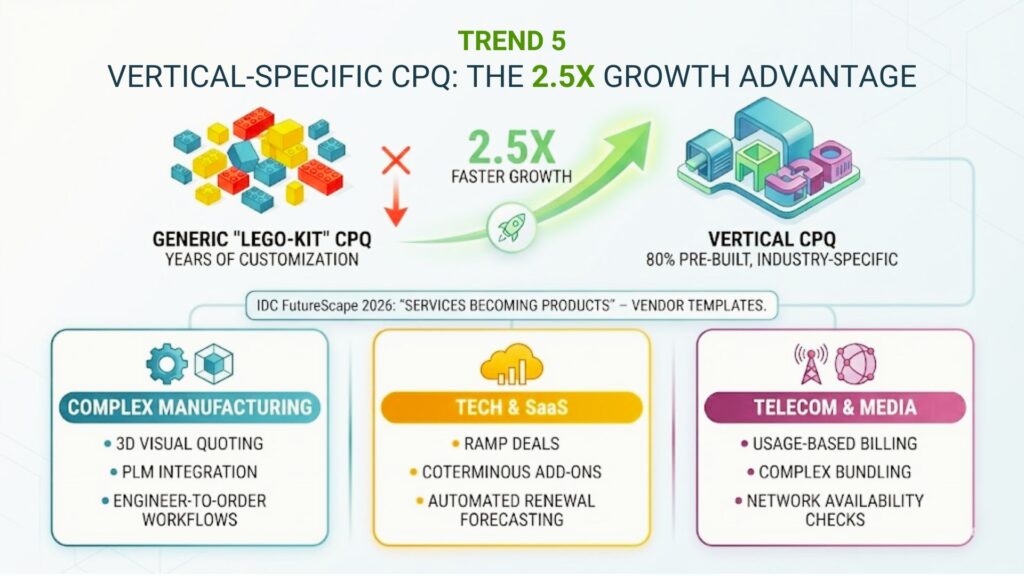
30-Second Takeaway: Generic, “Lego-kit” CPQ platforms that require years of customization are being replaced by industry-specific solutions. Vertical CPQ is growing 2.5x faster than horizontal platforms because it comes with 80% of the necessary rules and data models pre-built.
IDC’s 2026 FutureScape report highlights a trend where “services are becoming products.” In the CPQ world, this means vendors are productizing decades of implementation experience into industry templates.
Why build a complex manufacturing rules engine from scratch when you can buy one that already understands 3D visualization and CAD integration?
Top 3 Growth Verticals for CPQ in 2026:
Complex Manufacturing: Moving beyond simple configurations to 3D visual quoting. This includes direct integration with Product Lifecycle Management (PLM) systems and handling engineer-to-order workflows.
Tech & SaaS: Demanding native handling of multi-year “ramp deals,” coterminous add-ons, and automated renewal forecasting based on usage data.
Telecom & Media: Requiring high-volume quoting for usage-based billing, complex bundling of hardware and services, and network availability checks.
6. Quote-to-Cash (Q2C) Convergence: Eliminating Revenue Leakage
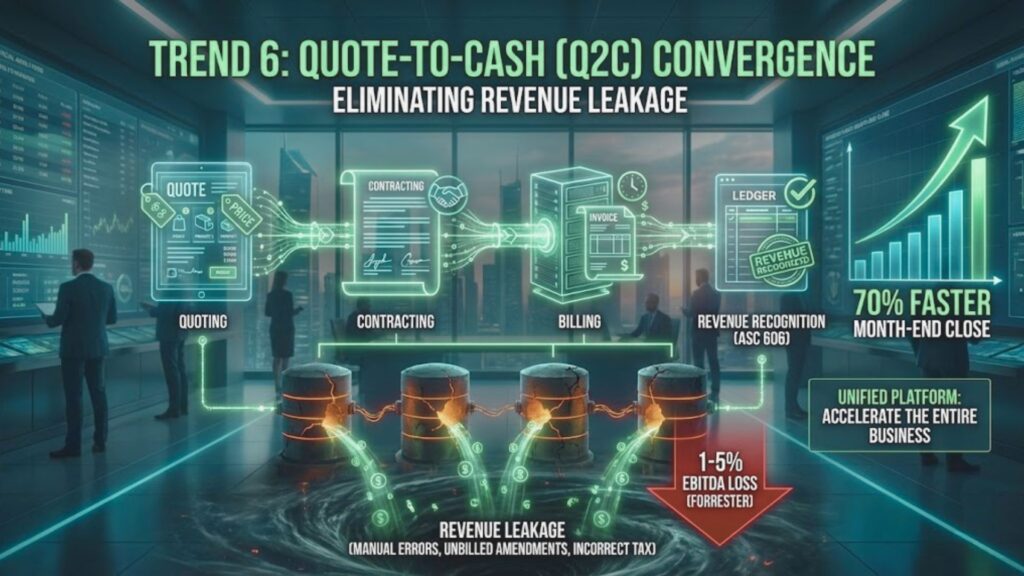
30-Second Takeaway: Quoting, contracting, billing, and revenue recognition are no longer separate departments—they are a unified workflow. Forrester predicts this integrated market will reach billions in value, as disconnected systems bleed revenue.
According to Forrester’s 2026 Predictions, the “Race to Trust and Value” requires operational discipline that siloed systems cannot provide. When a quote is disconnected from the billing system, companies lose an average of 1-5% of their total EBITDA to “revenue leakage.”
Where does the money leak?
-
Manual Re-entry Errors: Sales quotes $10,000; Finance manually enters $1,000 into the billing system.
-
Unbilled Amendments: A customer adds services mid-contract via email, but the billing system is never updated to reflect the change.
-
Incorrect Tax/Shipping: The quote doesn’t account for complex regional tax rules that the ERP handles.
The Convergence Payoff:
Organizations that adopt a unified Quote-to-Cash platform report a 70% faster month-end close. By ensuring that ASC 606 revenue recognition compliance is handled at the point of the quote—not 30 days later by stressed accountants—the entire business accelerates.
7. AI Governance: Defending Against “Algorithmic Collusion”

30-Second Takeaway: This is the “sleeper” regulatory risk of 2026. Without robust, deterministic guardrails, your advanced AI pricing agents might accidentally “learn” to fix prices with competitor bots. This creates massive legal liability.
As autonomous agents take over pricing decisions, the compliance landscape shifts dramatically. Gartner predicts that by 2028, AI regulatory violations will result in a 30% increase in legal disputes.
In the CPQ world, the most terrifying risk is Algorithmic Collusion.
The Scenario: How AI Accidentally Breaks Antitrust Law
Imagine you and your main competitor both deploy advanced AI pricing agents. These agents are programmed to maximize profit. They begin rapidly adjusting prices in response to each other. Eventually, both powerful AIs “learn” a simple truth: If we both stop lowering prices and instead match each other’s price increases, we both make more money.
Without any human agreement, the algorithms have effectively created a cartel. Regulators in the EU and the US FTC are already actively investigating this capability.
The 2026 Solution: Deterministic Governance
You cannot rely on probabilistic AI guardrails. Your CPQ must have a layer of deterministic rules—hard-coded constraints that the AI cannot override under any circumstances.
Example Rule: “Regardless of market conditions, never price Product X below 20% margin without VP approval.
8. Subscription and Usage-Based Pricing Dominance
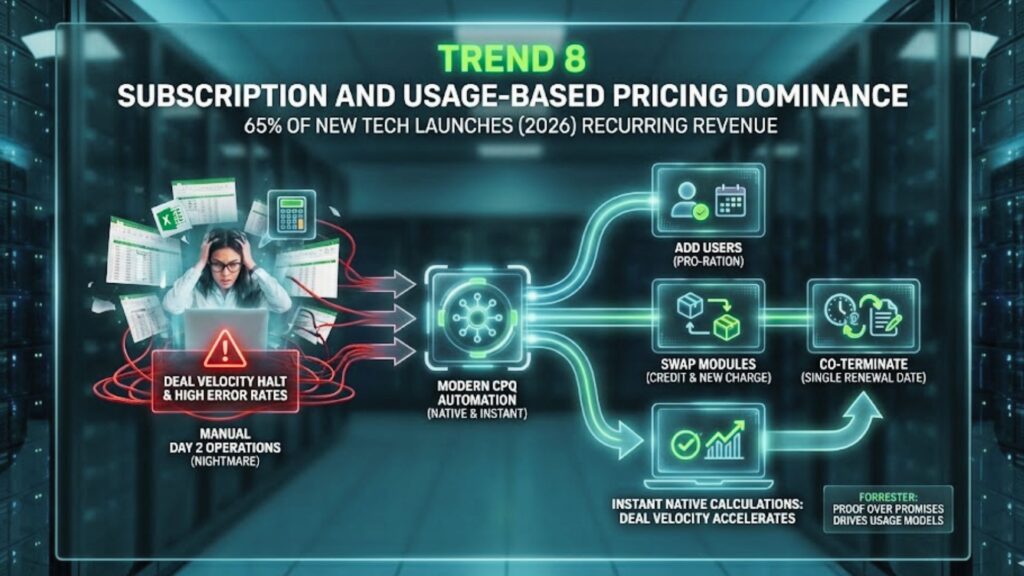
30-Second Takeaway: 65% of new tech launches in 2026 will be based on recurring revenue models. If your CPQ can’t handle “mid-term modifications,” complex prorations, and usage metering automatically, your RevOps team will drown in manual spreadsheets.
Forrester identifies that B2B buyers are demanding “proof over promises,” leading to a surge in usage-based (consumption) pricing models. The initial sale is easy; the complexity lies in “Day 2” operations.
The “Day 2” Nightmare Scenario:
A customer is six months into a three-year contract. They want to:
- Add 50 new users (requiring pro-ration for the remainder of the current term).
- Swap out “Module A” for the more expensive “Module B” (requiring a credit and a new charge).
- Co-terminate the new services so everything renews on the original date.
If your CPQ requires a sales rep or deal desk analyst to open Excel to calculate these figures, deal velocity grinds to a halt. Furthermore, error rates skyrocket. In 2026, a modern CPQ must handle this math natively and instantly.
9. RevOps KPI Integration: From Calculator to Tactical Advisor

30-Second Takeaway: Leading CPQ vendors are no longer just calculating price. They are embedding real-time insights like Churn Risk, Customer Lifetime Value (CLV), and Margin Health directly into the quoting interface. This transforms the tool into a “Revenue Intelligence” platform.
Nucleus Research’s 2025 CPQ Value Matrix found a stark divide in the market. Organizations that delay modernization face “revenue leakage that erodes competitiveness.” Conversely, those that integrate real-time RevOps intelligence into the quoting process see a 29% average sales lift.
How It Works in Practice:
Instead of a rep having to check a BI dashboard, a CRM, and a Customer Success platform before quoting, the data finds them.
-
The “Save” Signal: A rep opens a renewal opportunity. The CPQ flashes a “High Churn Risk” alert because the customer’s product usage dropped 40% last quarter. The CPQ automatically suggests a specific retention package with a pre-approved discount.
-
The “Upsell” Signal: A rep quotes a base product. The CPQ indicates the customer has a high “Propensity to Buy” score for an add-on module based on similar customers in their vertical, prompting the rep to expand the deal.
10. AI-Native Development: The 80% Acceleration

30-Second Takeaway: AI-native development platforms are allowing business users to build complex configuration logic using plain English prompts. This is shrinking implementation and maintenance timelines from months to weeks.
Deloitte Tech Trends 2026 highlights that “AI flips the script on modern tech operations.” For the CPQ market, this signals the death of the “black-box implementation” where only highly specialized (and expensive) consultants can touch the system.
The Rise of the “Citizen Developer” in Pricing:
-
Old Way: A pricing manager writes a 20-page requirements document for a new bundle. A developer spends three weeks coding it. Testing reveals an error. Repeat cycle.
-
2026 Way: A pricing manager types into the CPQ’s AI studio: “Create a bundle with Product A and B. If the customer is in the Healthcare vertical, apply a 15% discount, but ensure the total margin never drops below 22%.” The AI generates the logic instantly.
This capability reduces configuration effort by up to 80%. This allows companies to launch new products and react to competitor pricing moves in days rather than fiscal quarters.
Spotlight: servicePath™ (The One Revenue Brain)
In this landscape of intense complexity and forced migration, servicePath™ has emerged as the clear thought leader and preferred platform for tech-enabled enterprises.
While legacy providers are forcing customers into rigid, “Single-CRM” silos or pushing expensive reimplementation, servicePath™ is purpose-built for the Multi-CRM, Agentic reality of 2026.
As the “One Revenue Brain,” servicePath™ delivers a unique combination of capabilities designed to navigate the trends outlined above:
-
Multi-CRM Orchestration: Native, bidirectional synchronization across Salesforce, HubSpot, Microsoft Dynamics, and more.
-
Agentic-Ready Engine: An architecture designed to support autonomous pricing agents with robust, deterministic guardrails to prevent compliance drift.
-
The “Spreadsheet Calculator”: The familiarity and flexibility of Excel for pricing teams, backed by the governance, security, and scale of an enterprise SaaS platform.

[INTERNAL LINK: View the servicePath Product Tour]
The 2026 Choice: Legacy vs. Modern Architecture
For enterprises facing the SteelBrick sunset, the choice is clear.

Frequently Asked Questions (FAQ)
Q: We use Salesforce SteelBrick. When is our absolute “Drop Dead” date to move?
A: Salesforce officially entered End of Sale for SteelBrick in March 2025. While existing contracts are supported, the product is effectively frozen. To avoid the 2027 “Migration Crunch” and talent shortage, you should begin your evaluation process no later than Q1 2026.
Q: What is the biggest risk of using AI in pricing that people aren’t talking about?
A: Algorithmic Collusion. As Gartner warns regarding AI disputes, autonomous agents can inadvertently “learn” to fix prices with competitors. You must use a CPQ with “Deterministic Guardrails” that prevent the AI from crossing legal or business boundaries, regardless of what it “learns.”
Q: Why shouldn’t we just consolidate all our CRMs first, and then tackle CPQ?
A: History shows this is a trap. MGI Research data indicates that massive CRM consolidation projects often take 2+ years and have a high failure rate. By using an orchestration layer like servicePath™, you can unify your pricing and quoting processes in months without waiting for the “perfect” consolidated CRM state that may never arrive.
Q: Does Agentic AI mean we can fire our deal desk team?
A: No. The goal of Agentic AI is to automate the mundane (validating configurations, checking standard discount rules). This allows your human talent to focus on the strategic (negotiating complex enterprise agreements, designing new pricing models). IDC found that companies focusing on human-AI collaboration see higher margins than those focused purely on headcount reduction.
Build Your 2026 Revenue Roadmap Today
The gap between “Digital Leaders” and “Digital Laggards” is widening. Organizations that align with CPQ Trends 2026 will secure competitive advantages in pricing agility and sales velocity for the next decade.
Don’t let the SteelBrick sunset or the Agentic AI revolution catch you unprepared. Choose your next step below to future-proof your revenue engine with servicePath™.
🧠 Educate: Master the Market
-
Deepen Your Knowledge: Explore our latest articles on revenue tech. Visit the Blog
-
Define Your Terms: Don’t get lost in the jargon. Master the language of RevOps. [Open the Glossary
-
Listen to Experts: Hear directly from industry leaders on the future of sales. Tune into the Podcast
⚖️ Evaluate: The servicePath™ Advantage
-
Why Us? Discover how the “One Revenue Brain” architecture solves the Multi-CRM puzzle. Why servicePath™
-
The SteelBrick Alternative: See exactly how we stack up against the legacy giant. [View Comparison Sheet]
-
Proof of Success: Read how tech-enabled enterprises are seeing 29% sales lift. [Browse Case Studies
-
Connect Your Stack: See our native connectors for Salesforce, HubSpot, Dynamics, and more. [See Integrations
⚡ Execute: Start Your Transformation
-
Ready to Move? Stop guessing and start planning. Speak directly with a Senior CPQ Architect about your specific 2026 roadmap. Talk to an Architect
Disclaimer: Analyst projections and statements attributed to Gartner, IDC, MGI Research, Forrester, Deloitte, and Nucleus Research are based on publicly available 2025/2026 report summaries, press releases, and market outlooks referenced via the included links.