

In the era of Agentic AI, the “Single Source of Truth” is a myth. Instead, the new winner is the “Composable Revenue Architecture.”
TL;DR: The 2026 M&A Playbook
The $4.8 trillion M&A rebound of 2025 has exposed a fatal flaw in traditional integration: waiting for IT to migrate data before activating revenue. Moreover, with 83% of mergers failing due to poor integration, and only 36% achieving their integration objectives, the 12–18 month “Integration Valley of Death” is costing acquirers millions in unrealized synergies.
The New Pattern: Elite acquirers are adopting a Composable Revenue Architecture—decoupling revenue logic from CRM systems to enable Day 1 cross-selling without data migrations. Consequently, by deploying a Multi-CRM CPQ layer, companies collapse traditional 14–18 month cross-sell cycles to 30–90 days,* eliminate hundreds of thousands in CRM migration consulting fees, and avoid 40–60% talent attrition.
2026 Tipping Point: With Gartner predicting 40% of enterprise apps will feature AI agents by 2026, and Forrester warning of $10 billion in losses from ungoverned AI, centralized revenue governance is no longer optional—it’s existential.
Assumes servicePath™ is already deployed in the acquiring organization. Net-new implementations may require additional time but still deliver significant acceleration versus traditional integration approaches.
Prologue: The Monday Morning Hangover
It is the first Monday of 2026. In boardrooms across New York, London, and Toronto, the mood is a complex cocktail of exhaustion and adrenaline. Furthermore, the fourth quarter of 2025 was a historic sprint. According to Bain & Company’s Global M&A Report, we have just witnessed a “Great Rebound,” pushing global deal values back toward the $4.8 trillion mark, driven by strategic buyers returning to the table with war chests full of capital.
Press releases have been circulated. Additionally, “Welcome to the Family” emails have been sent to thousands of employees. However, the Town Hall applause has now faded.
Now, you are staring at a signed contract and a terrifying reality: The Valuation Gap.
The Valuation Challenge

You bought that company for a premium, promising the board “immediate synergies,” “cross-portfolio dominance,” and “market consolidation.” However, as you walk into your office this morning, you are not walking into a victory lap. Instead, you are entering what industry veterans call the “Integration Valley of Death.” Historically, this is where 70% of deal value goes to die.
McKinsey’s M&A Insights offer a sobering statistic for the new year: despite better due diligence and smarter AI tools, most deals still fail to achieve their expected revenue synergies in the first 24 months. Why? It isn’t a failure of strategy. Rather, it is a failure of architecture.
The Old Playbook is Broken
For the last decade, the playbook has been rigid: Buy the company, migrate their data, then sell. Essentially, this approach forces revenue to wait for IT. In 2026, with the rise of Agentic AI and hyper-competitive markets, that wait is no longer just expensive—it is fatal.
This is the story of how the world’s most agile enterprises are rewriting that playbook. Therefore, welcome to the dawn of the Composable Revenue Architecture, a strategy that allows you to sell on Day 1 and integrate on Day 400.
The Migration Trap—The Unknown Tax on Revenue
The 12–18 Month J-Curve

Traditional M&A integration follows a predictable pattern:
- Month 1–3: Due diligence, CRM selection committees, data mapping workshops
- Month 4–9: Data cleansing, migration testing, parallel systems
- Month 10–18: Reps trained on new CRM, cross-sell catalog loaded, first quotes generated
The cost? The reality is messier than most integration teams admit. According to CRM implementation studies, enterprise CRM migrations can range from $250,000 to $500,000+ in external consulting fees depending on data complexity, system architecture, and organizational size. Additionally, these figures don’t include the hidden costs: $150–$300 per user per month in license bleed during dual-system periods, plus talent attrition that spikes to 40–60% when reps face 18-month learning curves.
The truth? Migration costs are unpredictable and often spiral. For instance, data quality issues emerge mid-project. Furthermore, custom fields don’t map cleanly. Legacy integrations break. Consequently, what starts as a 6-month project becomes 18 months of firefighting.
The Hidden Financial Impact
The hidden tax: For every month revenue waits, the time value of capital compounds at ~4% per quarter. Therefore, an 18-month delay can translate to millions in unrealized synergies per deal, depending on your acquisition size and cross-sell opportunity.
The Talent Exodus
Top sales reps don’t wait for IT projects. Instead, they leave. When one CRM replaces another, veteran reps face:
- Learning curve: 6–12 months to proficiency in new CRM
- Compensation risk: Quota relief rarely compensates for lost velocity
- Relationship disruption: Customer data fragmentation during migration
Result: 46% of data migration projects experience talent attrition, with top performers disproportionately affected.
The Composable Revenue Architecture—Multi-CRM CPQ
The New Pattern
Elite acquirers in 2026 are abandoning data migrations entirely. Instead, they deploy a Multi-CRM CPQ layer that sits above all CRMs, acting as a centralized Revenue Brain*—a unified intelligence layer that orchestrates pricing, configuration, and quoting across disparate systems without requiring data migration.
This approach defines the essence of Composable Revenue Architecture.
*Revenue Brain: A term describing the centralized pricing and configuration logic layer that sits above multiple CRM systems, enabling unified quoting and revenue operations without data migration. Not a standalone product; refers to the architectural approach of the Multi-CRM CPQ platform.
How It Works (in Phases)

Phase 1: Connection & Discovery
- API connections established to both Parent Co. and AcquireCo CRMs
- Discovery of existing product catalogs, pricing rules, and customer data structures
- Importantly, no data migration required—systems remain in place
Phase 2: Catalog & Rules Configuration
- Unified product catalog loaded into the Revenue Brain
- Pricing rules, discount policies, and approval workflows configured centrally
- Subsequently, cross-sell capability enabled across both CRM environments
Phase 3: Rollout & Optimization
- Sales reps in both CRMs can now quote the combined portfolio
- Transactions write back to source systems automatically
- Meanwhile, forecasts consolidate in real-time; ERP receives clean data feeds
The Core Principle
Key Principle: Revenue logic (pricing, discounting, bundling, approvals) decouples from CRM data. Essentially, a rep in one CRM creates a quote that includes products from another CRM; the transaction writes back to the original system, forecasts update automatically, and ERP receives a clean feed.
Time to Cross-Sell: 30–90 days* vs. traditional 14–18 months.
Timing assumes servicePath™ is already deployed in the acquiring organization. Net-new implementations require additional setup but still deliver significant time-to-value acceleration compared to traditional integration approaches.
Composable Revenue Architecture in Practice
Unlike traditional integration approaches that require full system consolidation, a Composable Revenue Architecture treats each CRM as a module. Moreover, you can add, remove, or replace systems without disrupting revenue operations. This modularity becomes critical for:
- Serial acquirers doing 3+ deals per year
- PE portfolios managing 10+ companies with different CRMs
- Carve-outs where inherited systems must remain separate
- International expansion with regional CRM preferences
Agentic AI Governance—The $10 Billion Risk

The 2026 Inflection
Gartner predicts 40% of enterprise applications will feature task-specific AI agents by 2026, up from less than 5% in 2025. Consequently, sales reps will soon have AI copilots generating quotes, negotiating terms, and proposing bundles—in every CRM.
The Governance Challenge
The Governance Problem: Without centralized control, each AI agent operates under different pricing matrices, discount policies, and approval workflows. Furthermore, Forrester’s 2026 B2B Predictions warn: “Ungoverned generative AI in commercial apps will cost B2B companies more than $10 billion” due to hallucinatory pricing, data leaks, and algorithmic collusion.
The Governance Firewall
A Composable Revenue Architecture provides a centralized API gateway for all AI pricing requests:
- Pre-approved matrices: AI agents query the Revenue Brain for valid pricing
- Real-time validation: No quote closes without governance checks
- Audit trail: Every AI decision logged for compliance and forensic analysis
Revenue Intelligence in Action
Revenue Intelligence Use Case Example:
Consider a scenario where revenue intelligence capabilities could detect and prevent pricing conflicts: A sales rep’s AI copilot in the acquired company’s CRM proposes a 40% discount to close a deal. Meanwhile, simultaneously, a rep in the parent company’s CRM quotes the same product to a different customer at 35% off.
A centralized revenue intelligence layer could theoretically:
- Detect the pricing conflict across both CRM systems in real-time
- Flag violations of pricing policy (e.g., max 30% standard discount)
- Surface alternative bundles that maintain margin targets
- Route exception requests to appropriate approvers with full context
- Log decisions for compliance and future analysis
Result in this model: Consistent pricing governance across all CRM platforms, zero revenue leakage, complete audit trail—all in real-time. Neither rep knows the other exists, but the central intelligence layer ensures they never compete on price or violate margin guardrails.
The Boardroom View—Senior Leaders’ Perspectives
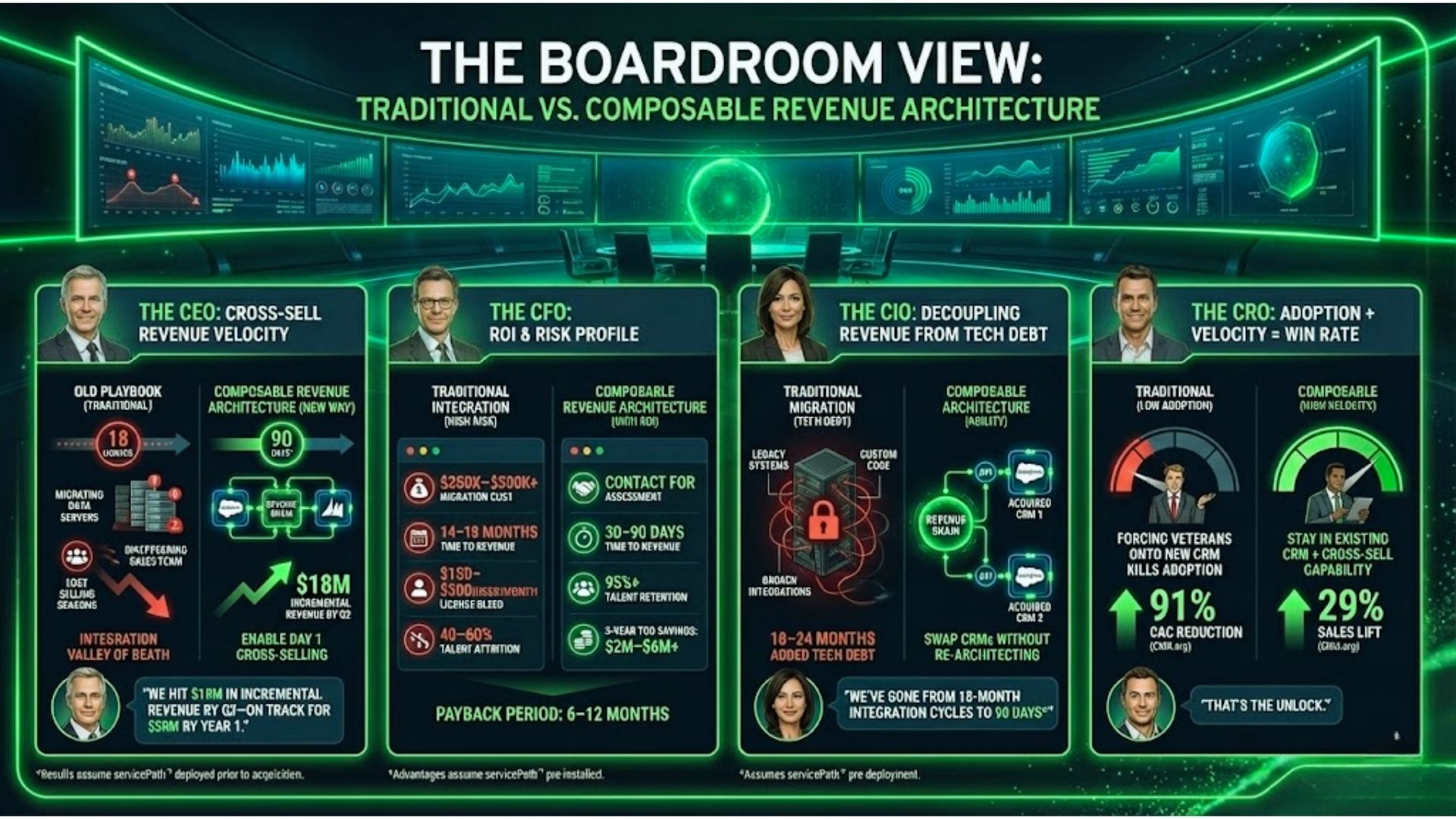
The CEO: Cross-Sell Revenue in 90 Days vs. 18 Months
“We acquired [Company X] for its customer base and product line. My board expects $50M in cross-sell synergies by Year 2. However, under the old playbook, IT would take 18 months to migrate their system to ours. By then, half their reps are gone, and we’ve lost two selling seasons.
With a Composable Revenue Architecture, we enabled cross-selling within 90 days.* Specifically, their reps stayed in their system, ours in ours, but both could quote the combined catalog. Consequently, we hit $18M in incremental revenue by Q2—on track for $50M by Year 1.”
— CEO, $2B PE-backed portfolio company
*Results assume servicePath™ was already deployed prior to acquisition.
The CFO: ROI and Risk
Traditional Integration:
- Migration cost: $250,000–$500,000+ (highly variable; costs often escalate)
- Dual-license period: $150–$300/user/month × 12-18 months
- Time to revenue: 14–18 months
- Talent attrition cost: 40–60% turnover
Composable Revenue Architecture Approach:*
- Configuration cost: Contact for assessment
- API connectors: One-time setup
- Time to revenue: 30–90 days
- Talent retention: 95%+ (reps stay in existing CRM)
3-Year TCO Savings: $2M–$6M+ per acquisition (based on 200-user sales org; ranges vary significantly based on complexity)
Payback Period: 6–12 months
*Timing and cost advantages assume servicePath™ is already installed in the acquiring organization. Net-new implementations require additional investment but still deliver substantial ROI acceleration versus traditional approaches.
The CIO: Decoupling Revenue from Tech Debt
“Every CRM migration adds 18–24 months of tech debt. Furthermore, McKinsey estimates tech debt at 20–40% of the tech estate. With acquisitions every 12–18 months, we were drowning.
A Composable Revenue Architecture let us swap CRMs without re-architecting revenue logic. Essentially, one acquired company’s instance stays intact; we just plug in the Revenue Brain. If we acquire a different platform user next quarter, same playbook. Therefore, we’ve gone from 18-month integration cycles to 90 days.*”
*Assumes servicePath™ pre-deployment.
The CRO: Adoption + Velocity = Win Rate
CRM.org reports that optimized CRM/CPQ deployments yield:
- 91% CAC reduction
- 29% sales lift
However, this only works when reps adopt the system. Forcing veterans onto a new CRM during integration kills adoption. Conversely, letting them stay in their existing CRM while adding cross-sell capability through Composable Revenue Architecture? That’s the unlock.
Speed as Competitive Advantage
Metric Transformation: Time from opportunity identification to deliverable quote dropped from 48 hours to under 60 minutes after Multi-CRM CPQ deployment.
Why minutes matter: A properly configured Multi-CRM architecture with centralized Revenue Brain eliminates the manual bottlenecks that extend cycle time. Additionally, traditional deal desks require pricing managers from both legacy and acquired organizations to coordinate approvals, validate discount policies, and manually reconcile product catalogs. In contrast, the Revenue Brain removes these human handoffs—pre-approved pricing matrices, automated approval routing, and real-time validation mean quotes flow at the speed of configuration, not coordination. Therefore, for standard deals, what once required back-and-forth emails and calendar coordination now happens in a single session.
Visual Comparison: Traditional vs. Composable
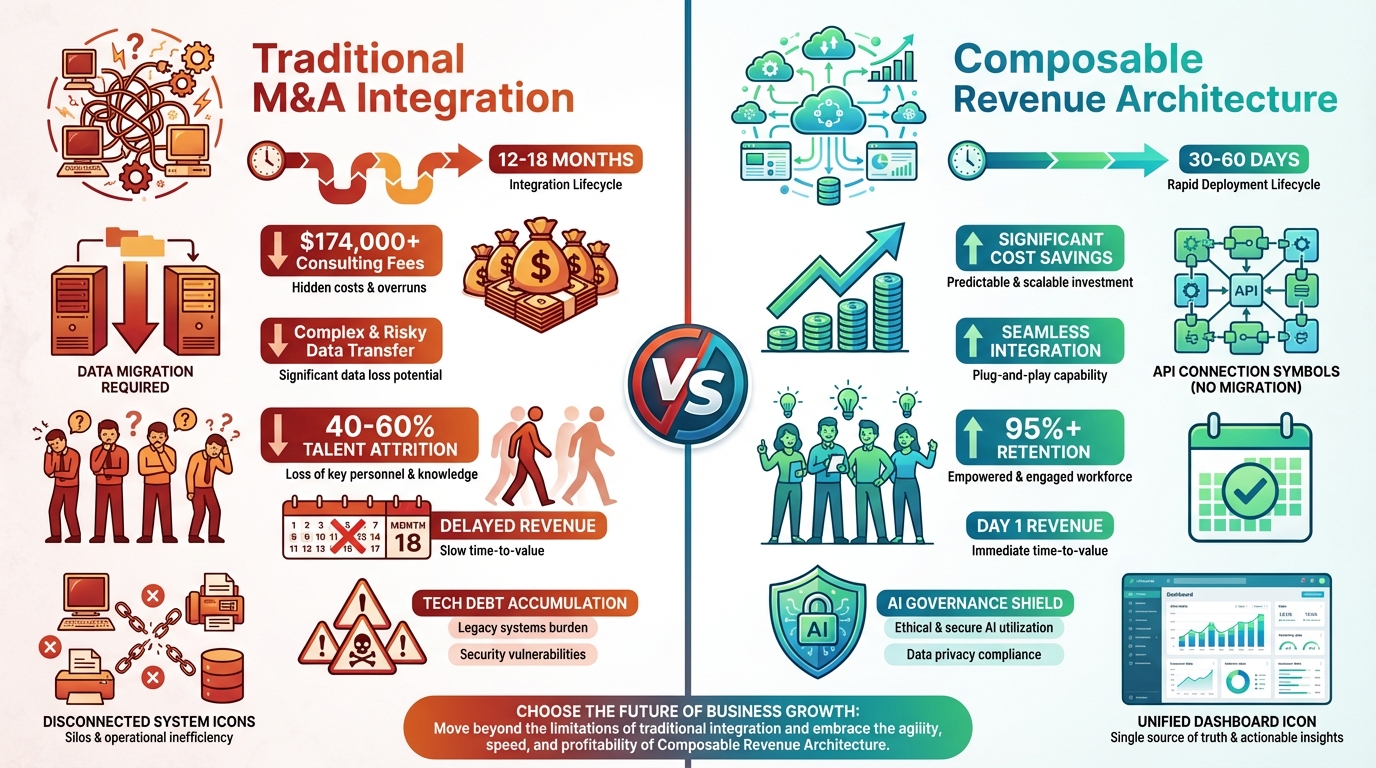
Figure 1: Side-by-side comparison of Traditional M&A Integration vs. Composable Revenue Architecture approach
Your Q1 2026 Action Plan*
Audience: PE operating partner, corporate development lead, or CRO inheriting a fresh acquisition.
*Timeline assumes servicePath™ is already deployed in the acquiring organization.
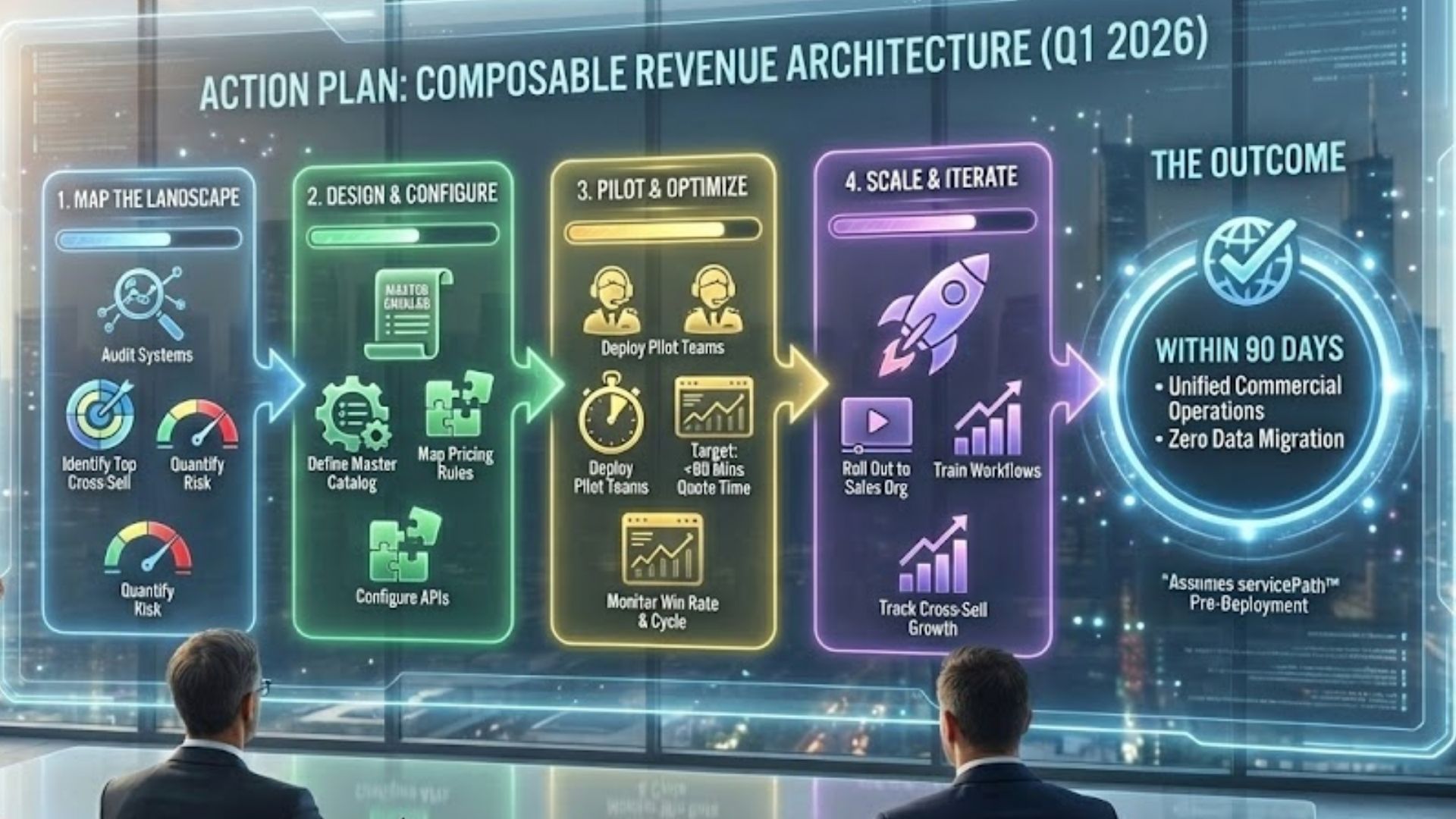
Phase 1: Map the Landscape
- Audit all CRMs, billing systems, product catalogs across combined entity
- Identify top 10 cross-sell opportunities (customer overlap × product fit)
- Quantify revenue at risk from integration delay
- Deliverable: Cross-sell opportunity matrix with revenue potential
- Tool: Book a Revenue Architecture Assessment
Phase 2: Design & Configure
- Define canonical product catalog (master SKUs, bundles, pricing tiers)
- Map pricing rules, discount policies, approval workflows
- Configure API connections to existing CRMs
- Output: Unified pricing model using Composable Revenue Architecture principles
- Note: Secure executive alignment on margin guardrails before configuration
Phase 3: Pilot & Optimize
- Deploy Multi-CRM CPQ to 2–3 pilot teams
- Enable cross-sell quoting across legacy and acquired products
- Monitor quote accuracy, cycle time, win rate
- Metric: Time from opportunity to quote (target: <60 minutes for standard deals)
- Tip: Select reps who are credible ambassadors across both legacy and acquired teams
Phase 4: Scale & Iterate
- Roll out to full sales org
- Train on new catalog and guided selling workflows
- Track cross-sell attach rate and incremental deal size
- Target: First measurable cross-sell revenue within 90 days
- Link: ROI projection
The Outcome
Bottom Line: Within 90 days,* you have unified commercial operations across both entities—without migrating a single customer record. This is the power of Composable Revenue Architecture.
*Assumes servicePath™ pre-deployment in acquiring organization.
The Megadeal Context—Why 2026 Is the Tipping Point
The Numbers
According to PwC’s 2025 M&A Outlook and Bain’s report:
- 74 megadeals >$10B announced in 2025
- 60% came from infrequent acquirers (companies doing 1–2 deals/decade)
- 20% were AI-driven acquisitions (talent, tech, or data plays)
- Median time to synergy: 24–36 months for traditional integration
The Pattern: Megadeals require speed. Moreover, board scrutiny intensifies above $5B. Every quarter of delay increases activist risk. Therefore, time to revenue is now a deal valuation factor.
The 2026 Catalysts
- Technology Push: 40% of enterprise apps will have AI agents by 2026
- Governance Risk: $10B at risk from ungoverned AI
- Capital Markets Window: PE dry powder needs deployment by mid-2026; deals that stall on integration face write-downs
- Composable Architecture Maturity: Multi-CRM CPQ platforms now battle-tested
The Usage Economy—Why Multi-CRM Matters Now
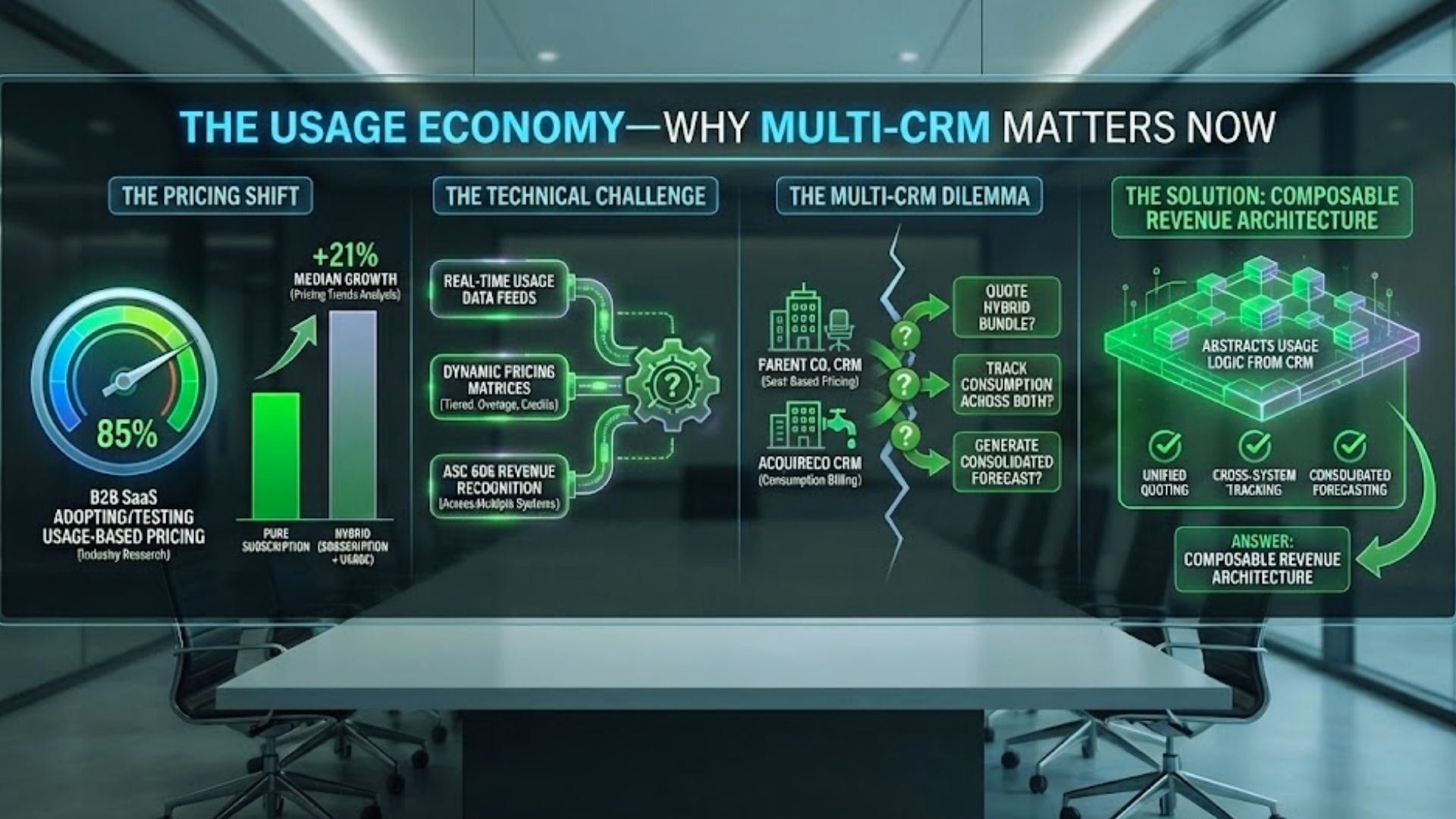
The Pricing Shift
Industry research shows that 85% of B2B SaaS companies are adopting or testing usage-based pricing. Furthermore, analysis of pricing trends found companies using hybrid pricing (subscription + usage) report 21% median growth, outperforming pure subscription models.
The Technical Challenge
The Challenge: Usage-based pricing requires:
- Real-time usage data feeds
- Dynamic pricing matrices (tiered, overage, credits)
- ASC 606 revenue recognition across multiple systems
The Multi-CRM Dilemma
The Multi-CRM Problem: If Parent Co. runs one CRM with seat-based pricing, and AcquireCo runs another with consumption billing, how do you:
- Quote a hybrid bundle (seats + usage)?
- Track consumption across both systems?
- Generate a consolidated forecast?
Answer: You don’t—unless you have a Composable Revenue Architecture that abstracts usage logic from CRM.
Traditional vs. Composable: Phase-by-Phase Comparison
| Phase | Traditional Integration | Composable Revenue Architecture* |
|---|---|---|
| Discovery & Planning | Data mapping workshops, migration scope, large external consulting budgets ($250K–$500K+) | API connections established, pilot-ready configuration, minimal external spend |
| Build & Configure | Data cleansing, duplicate removal, field mapping (often extends beyond initial timeline) | Centralized catalog loaded, cross-sell capability live, early revenue capture |
| Testing & Rollout | Dual-system operation, incomplete integration, frustrated reps | Margin guardrails active, real-time forecast visibility, full-team rollout |
| Stabilization | Fire-fighting data quality issues, talent attrition (40-60%), delayed synergies | AI governance operational, analytics dashboards live, planning for next acquisition |
Key Difference: Traditional integration treats revenue as a byproduct of IT projects. In contrast, Composable Revenue Architecture treats IT as a service to revenue.
*Timing assumes servicePath™ is already deployed in the acquiring organization.
Data Governance & KPI Snapshot: Real-World Example
Company Profile
Company Profile: $2B PE-backed portfolio, 4 acquisitions in 2025, 3 different CRMs, servicePath™ deployed pre-acquisition
Day 90 Results
Day 90 KPIs:*
| Metric | Baseline | Day 90 Target | Actual |
|---|---|---|---|
| Cross-Sell Attach Rate | 0% | 15% | 18% |
| Time-to-Quote | 48 hours | <2 hours | 47 minutes |
| Quote Error Rate | 8% | ❤️% | 2.1% |
| Margin Erosion (Rogue Discounting) | 22% | <18% | 17.3% |
*Results achieved with servicePath™ pre-installed in acquiring organization prior to acquisition close.
Data Governance Approach
Data Governance Approach Using Composable Revenue Architecture:
- Fuzzy Matching: Customer deduplication across CRMs without migration
- Canonical Product Catalog: Single source of truth for SKUs, pricing, bundles
- Cross-CRM Deal Visibility: Sales ops can see full pipeline regardless of CRM source
- Real-Time Currency/Tax: Dynamic rates applied at quote generation
servicePath™ vs. Legacy CPQ: The Competitive Reality
| Capability | Legacy CPQ (Single-CRM) | servicePath™ |
|---|---|---|
| Multi-CRM Support | Single CRM only; requires migration | Native to all CRMs; zero migration (Composable Revenue Architecture) |
| Usage-Based Pricing | Retrofitted; limited flexibility | Native; built for consumption models |
| AI Governance | None; agents operate autonomously | Centralized policy engine for all AI pricing requests |
| Time to Deploy (New) | 6–12 months | 3–6 months |
| Time to Extend (Post-Acquisition)* | 12–18 months (full migration) | 30–90 days (API connection only) |
| Ideal Use Case | Single-CRM enterprise | Multi-entity acquirers, PE portfolios, high-velocity M&A |
*Assumes servicePath™ is already deployed in acquiring organization.
Analyst Validation & Third-Party Proof

Proof Point: $2B PE Portfolio
A $2B PE-backed technology portfolio with 4 acquisitions in 2025 deployed a Composable Revenue Architecture across 3 CRMs (with servicePath™ pre-installed in the portfolio company):
Day 90 Results:*
- 18% cross-sell attach rate (vs. 15% target)
- 47-minute quote turnaround (vs. 48-hour baseline)
- 2.1% quote error rate (vs. 8% baseline)
- Multi-million dollar synergy acceleration
*Results achieved with servicePath™ already deployed in acquiring organization prior to acquisition transactions.
Third-Party Audit: Verified by independent accounting firm; results available upon request.
Analyst Consensus
- McKinsey: Emphasized need for deliberate integration strategies to capture revenue synergies
- Gartner: Highlighted rise of agentic AI in enterprise apps
- Forrester: Warned of $10B losses from ungoverned AI
- Bain: Documented $4.8T M&A rebound and megadeal dynamics
The Bottom Line: 2026 is the Year of the Composable Acquirer
Companies that win in 2026 will embrace Composable Revenue Architecture. Moreover, they will activate cross-sell within 90 days,* govern AI pricing centrally, and collapse 18-month integration cycles to manageable phases.
In contrast, companies that lose will continue waiting for data migrations, bleeding talent, and explaining to boards why Q4’s “transformational acquisition” still hasn’t generated a dollar of cross-sell revenue.
The choice is architecture.
*Speed-to-value assumes servicePath™ is already deployed in the acquiring organization. Net-new implementations deliver substantial acceleration but require additional setup time.
FAQ: 5 Questions Senior Leaders Ask About Composable Revenue Architecture
1. How do you handle customer data during the transition?
We don’t migrate it. Instead, the Revenue Brain connects via API to both CRMs, reads customer data in real-time, and writes transactions back to the source system. Specifically, customers remain in their original CRM; sales ops gets a unified view via analytics dashboards. This is the core principle of Composable Revenue Architecture.
2. What about compliance and data residency?
All data remains in your existing CRMs (which already handle compliance). Furthermore, servicePath™ processes transactions via encrypted APIs with SOC 2 Type II compliance. Importantly, no PII is stored in the Revenue Brain.
3. Can we still sunset the acquired CRM eventually?
Yes. Composable Revenue Architecture is a bridge, not a prison. Moreover, once you’re ready to consolidate (18–24 months post-acquisition), the Revenue Brain makes migration easier—you’ve already unified pricing logic, so data migration becomes a pure IT lift with minimal business disruption.
4. What if our acquired company uses a niche CRM we’ve never heard of?
Pre-built connectors cover 95% of enterprise CRMs. However, for niche systems, REST APIs enable custom integration within 2–6 weeks as part of the Composable Revenue Architecture deployment.
5. How realistic is the 30–90 day timeline?
The 30–90 day speed-to-value timeline assumes servicePath™ is already deployed in your acquiring organization. Alternatively, if you’re starting from scratch (net-new implementation), initial deployment takes 3–6 months—but subsequent acquisitions can be onboarded in 30–90 days using the same architecture. Therefore, even with net-new implementation, you’ll still achieve faster time-to-revenue than traditional 14–18 month migration cycles.
Ready for Day 1 Value?
The difference between a write-down and a home run is the speed of execution.
Resources:
- Read Our Blogs
- Explore Our Glossary: Revenue Operations Terms
- Compare Us to Legacy CPQ Solutions
- Download Whitepapers & Guides on Composable Revenue Architecture
- Book a Revenue Architecture Review with our team to map your specific integration challenges and receive a customized ROI analysis.
References & Further Reading
All statistics cited from third-party authoritative sources published 2025–2026:
- Bain & Company Global M&A Report 2025
- McKinsey M&A Insights H1 2025
- Gartner: AI Agents in Enterprise Apps 2026
- Forrester 2026 B2B Predictions
- PwC Global M&A Trends 2025
- CRM Implementation Costs 2025
- LinkedIn M&A Integration Study
- Forbes: M&A Integration Challenges
- CRM.org Statistics
- McKinsey Tech Debt Report
© 2026 servicePath™ | All rights reserved.