Revenue Architecture
What Is Revenue Architecture?
Revenue Architecture refers to the intentional design of the frameworks, technologies, workflows, and policies that determine how revenue flows through an organization — from initial opportunity to renewal and expansion.
It goes beyond sales strategy.
It goes beyond technology.
Revenue Architecture defines:
-
How products are packaged
-
How pricing is structured and governed
-
How deals are configured and approved
-
How contracts are generated
-
How orders are processed
-
How billing and revenue recognition occur
-
How renewals and expansions are managed
In short, it is the blueprint for sustainable, scalable revenue execution.
Why Revenue Architecture Matters
Modern B2B revenue models are more complex than ever:
-
Subscription and usage-based pricing
-
Hybrid product-service bundles
-
Global pricing variations
-
Channel and partner ecosystems
-
Regulatory and compliance requirements
-
Multi-system technology stacks
Without a defined revenue architecture, organizations experience:
-
Margin erosion
-
Inconsistent pricing
-
Manual rework
-
Revenue leakage
-
Forecasting inaccuracies
-
Siloed operations
Revenue Architecture provides structure, alignment, and control.
Core Components of Revenue Architecture
A mature revenue architecture typically includes:
1. Pricing & Monetization Strategy
-
Value-based pricing frameworks
-
Discount governance
-
Margin protection rules
-
Regional compliance controls
2. Commercial Process Design
-
Quote-to-Cash workflows
-
Approval hierarchies
-
Standardized contracting processes
-
Order-to-Bill alignment
3. Revenue Technology Stack
-
CRM
-
CPQ
-
Contract Lifecycle Management (CLM)
-
ERP
-
Billing & Subscription Management
-
Analytics & Reporting tools
4. Data Governance & Integration
-
Clean system integrations
-
Master data alignment
-
Real-time reporting
-
Audit controls
5. Lifecycle Revenue Management
-
Renewal tracking
-
Upsell and cross-sell enablement
-
Churn prevention mechanisms
Revenue architecture ensures these elements operate as a unified revenue engine — not disconnected tools.
Build Revenue with Structure and Control – Only with servicePath™
Revenue Architecture vs. Revenue Operations (RevOps)
These terms are related but distinct.
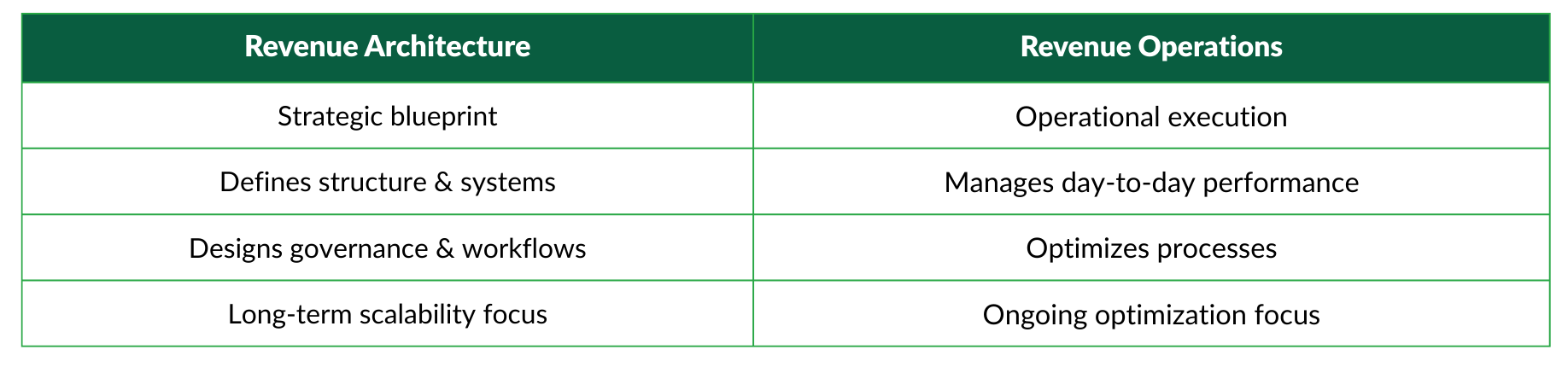
Think of Revenue Architecture as the blueprint.
Revenue Operations is the team running the building.
Real-World Example of Revenue Architecture in Action
Consider a global SaaS company expanding into usage-based pricing.
Without defined revenue architecture:
-
Sales manually discounts deals inconsistently
-
Billing struggles to track usage tiers
-
Finance lacks margin visibility
-
Contract terms vary widely
-
Renewals are reactive
With a defined revenue architecture:
-
Pricing strategy aligns with monetization goals.
-
CPQ enforces packaging logic and discount thresholds.
-
Contracts auto-generate standardized legal language.
-
Usage data feeds directly into billing systems.
-
Revenue recognition aligns with compliance standards.
-
Renewal alerts trigger proactive expansion opportunities.
Revenue becomes predictable, scalable, and strategically controlled.
Signs Your Organization Needs Revenue Architecture
-
Growing revenue but shrinking margins
-
Increasing pricing exceptions
-
Frequent quote errors
-
Manual handoffs between sales, legal, and finance
-
ERP and CRM data inconsistencies
-
Subscription complexity creating billing delays
If revenue feels fragmented, architecture is missing.
The Strategic Impact of Strong Revenue Architecture
-
When implemented correctly, Revenue Architecture delivers:
-
Faster deal cycles
-
Stronger pricing governance
-
Margin protection
-
Revenue predictability
-
Improved executive visibility
-
Scalable global expansion
It transforms revenue from reactive execution into engineered growth.
-
Architect Revenue for Scalable, Predictable Growth
-
Revenue growth doesn’t happen by accident — it happens by design.
At servicePath™, we help organizations architect revenue for scale. Our advanced CPQ and commercial automation capabilities form the foundation of modern revenue architecture — aligning pricing strategy, workflow governance, system integration, and lifecycle visibility into one cohesive framework.
We enable enterprises to eliminate silos, protect margins, automate complexity, and create scalable revenue engines that support subscription, usage-based, and hybrid models with confidence.
Discover how servicePath™ helps you stay ahead
Related Terms
-
Revenue Operations (RevOps)
-
Quote-to-Cash (Q2C)
-
Commercial Orchestration
-
CPQ (Configure, Price, Quote)
-
Revenue Lifecycle Management
-
Pricing Strategy
-
Monetization Strategy
-
Order-to-Cash
-
Sales Enablement
Frequently Asked Questions (FAQs)
1) What is Revenue Architecture in simple terms?
Revenue Architecture is the structured design of how a company generates and manages revenue across pricing, sales, contracts, billing, and renewals.
2) How is Revenue Architecture different from RevOps?
Revenue Architecture defines the strategic framework and systems. RevOps focuses on optimizing daily execution within that framework.
3) Is Revenue Architecture only for large enterprises?
No. While critical for enterprise organizations, mid-market companies benefit significantly when scaling subscription or complex pricing models.
4) Does Revenue Architecture require new technology?
Not always. Often it requires better integration, governance, and optimization of existing systems like CRM, CPQ, ERP, and billing platforms.