
Your Certifications Are Changing. Your Judgment Is Not.
Salesforce is retiring 24 certifications, renaming 16 more, and has already moved the CPQ that thousands of teams built their revenue operations around to End of Sale.
Here is why the people doing that work are worth more now, not less.
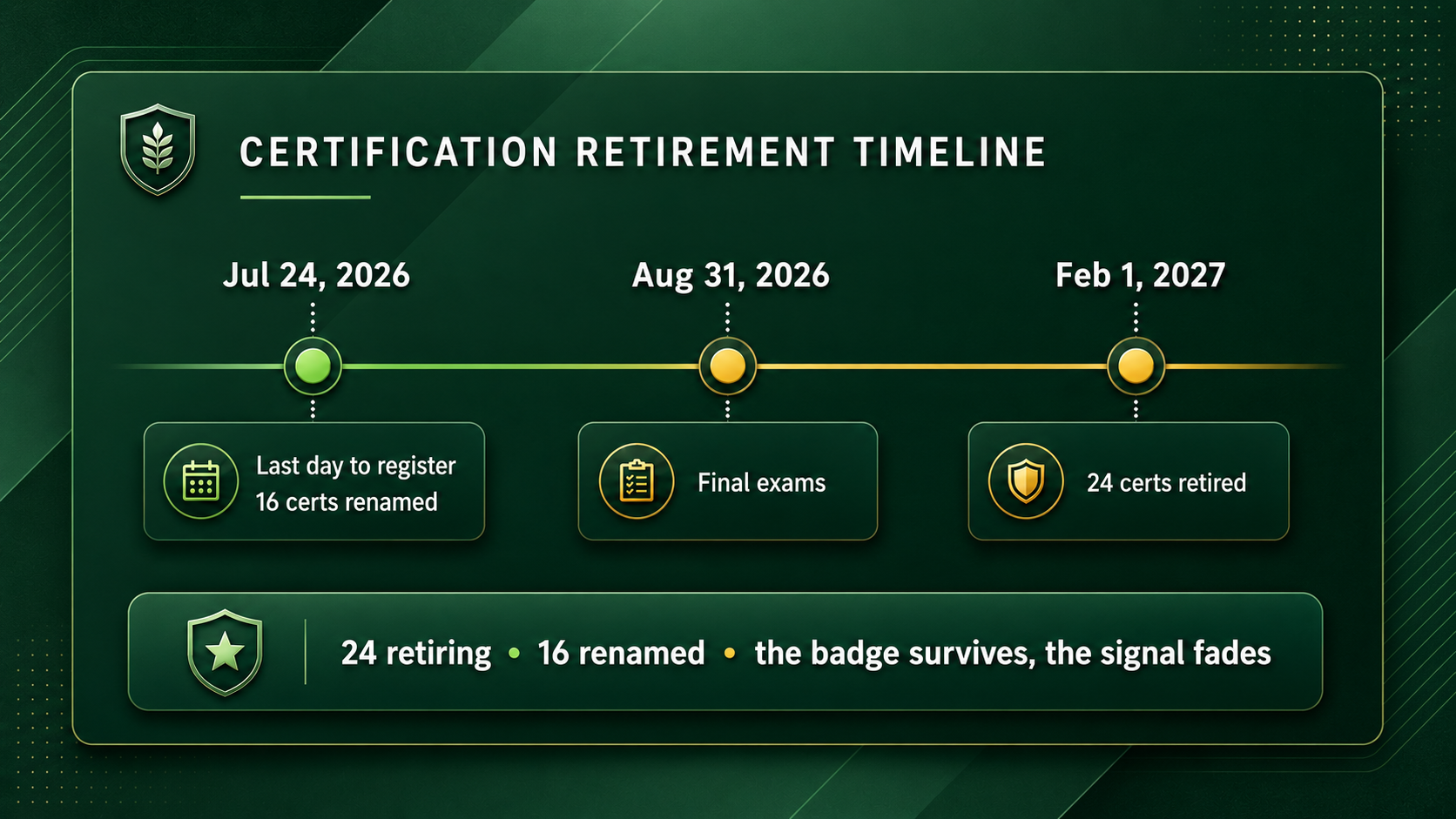
Last week Salesforce Ben ran the numbers on the latest certification shake-up. Salesforce is retiring twenty-four certifications, with final exams on August 31, 2026 and formal retirement on February 1, 2027. It is renaming sixteen more on July 24, 2026, most of which pick up the “Agentforce” label.
I am not going to pretend that is dramatic on its own. Certification catalogs evolve. That is normal.
What is worth paying attention to is the mood underneath it. And underneath it sits a bigger decision: the Salesforce CPQ end of sale, and what the six thousand businesses still running it should do next.
Read the Room, Not the Press Release
Spend ten minutes in the r/salesforce threads or the comments under that Salesforce Ben piece and you can feel it.
It is not panic. It is fatigue.
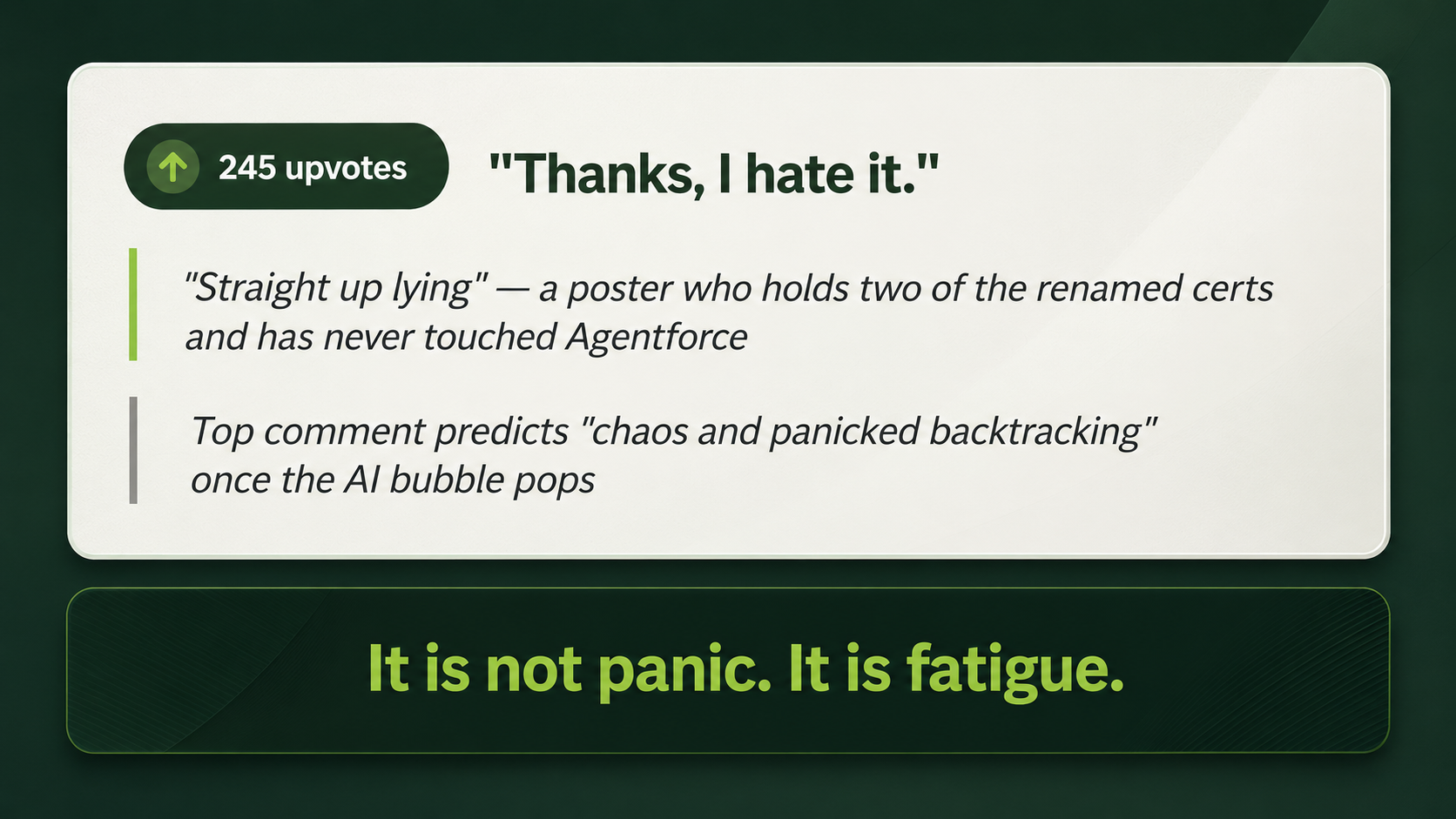
One thread about the renames is titled, simply, “Thanks, I hate it.” At last count it had 245 upvotes.
The original poster called the renames “straight up lying” because they hold two of the listed certifications and have never touched Agentforce. The top comment predicts “chaos and panicked backtracking” once the AI bubble pops.
Sit with that first complaint for a second, because it is more precise than it looks.
The frustration is not about losing a credential. It is about being relabeled. Professionals who built careers on Sales Cloud and Service Cloud, products that predate Agentforce by a decade, will now carry badges that suggest they specialized in something they never touched.
Their history is being rewritten to fit this year’s strategy. That is what “straight up lying” means in that thread. Not that the certs are worthless. That the names no longer tell the truth about the work.
The Badge Survives. The Signal Fades.
The retirement threads read differently. Salesforce Ben described those reactions as less angry and more genuinely gutted.
These are people who paid for exams, studied nights and weekends, and earned something they were proud of. Salesforce is careful to say a retired certification remains a valid credential on your Trailblazer profile.
That is true and it is also beside the point. A credential marked “retired” tells every future hiring manager that the platform moved on. The badge survives. The signal fades.
And this is not the first reorganization these professionals have absorbed. In July 2025, Salesforce renamed more than 35 certifications and moved the entire exam infrastructure to Trailhead Academy and Pearson VUE.
In early 2026 it retired the AI Associate certification, its most entry-level AI credential, barely two years after launching it. Now 24 more retirements and 16 more renames.
Each change is defensible on its own. Together, they form a pattern that every practitioner in those threads has internalized: the ground moves every release cycle, and the people standing on it are expected to absorb the motion for free.
People who passed those exams are asking a fair question: how much of what I built is tied to a name that changes every release?
That is a reasonable thing to ask. It deserves a straight answer.
The Churn Is Real, and It Is Salesforce’s Right
Names are not the only thing moving.
Names are not the only thing moving.
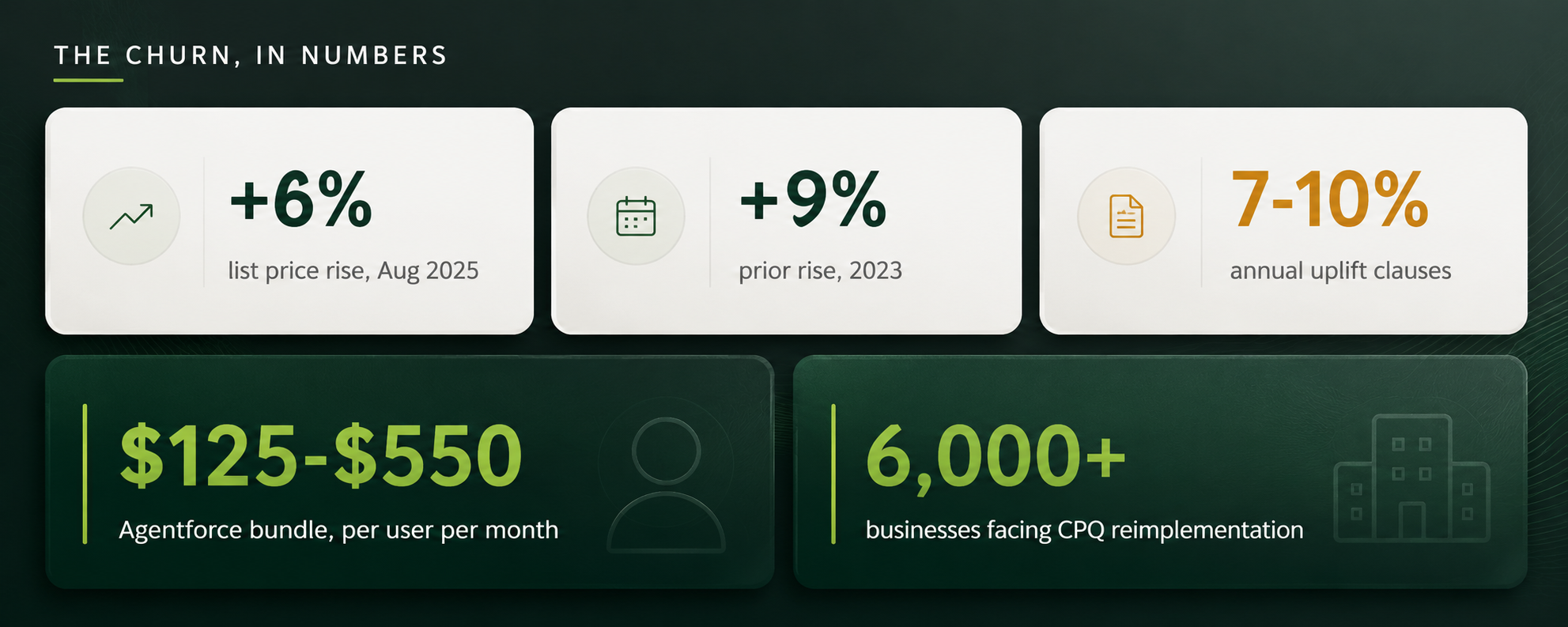
List prices rose an average of 6% in August 2025, on top of a 9% increase in 2023, which was itself the first in seven years. Salesforce also retired the standalone AI add-ons and replaced them with Agentforce bundles priced from $125 to $550 per user per month.
One senior analyst quoted by CIO warned the move “risks being viewed as an upsell disguised as innovation.”
And the list price is only the visible layer. Analysis of Salesforce contract mechanics shows annual uplift clauses in enterprise order forms compounding at 7 to 10 percent per year, even during the seven-year list price freeze.
Consequently, customers whose 2023 renewals landed alongside the 9% list increase saw worst-case pricing climb 15 to 20 percent above the prior year in a single event.
Then there is the move that matters most for anyone who runs revenue operations.
The Salesforce CPQ End of Sale
In March 2025, Salesforce moved its long-standing CPQ to End of Sale. This is the SteelBrick package that quoted and priced deals for thousands of companies. There are no new licenses, no new roadmap, and by most accounts no meaningful updates for the four years before that.
That decision now points toward a full Revenue Cloud reimplementation for somewhere north of six thousand businesses. When the wind-down started, I wrote about it in The Quiet Departure.
Consider what that means in practice. A frozen product does not stand still in value. Instead, the world keeps moving around it. New pricing models emerge, new compliance requirements arrive, and new integrations become standard, while a frozen platform absorbs none of it.
As a result, each quarter the distance between what your business needs and what the product can deliver grows a little wider.
Notice the sequence.
First, Salesforce froze the product that structures your deals.
Then it retired or relabeled the certifications validating expertise in adjacent products.
Finally, the AI bundles arrived at $125 to $550 per user per month. Each move stands on its own.
The direction does not.
This is the strategy working as intended. Marc Benioff has been explicit: “everything needs to become about Agentforce.” He has called digital labor a $3 trillion to $12 trillion opportunity and said it is “much bigger than software.”
The certification catalog, the pricing, the product names, the retirement schedule: all of it now serves that single bet.
None of this is wrong of Salesforce. A platform company is allowed to reprice, rename, and retire. The question was never whether they are allowed.
The question is what it means for you.
The Part Nobody Is Saying Plainly
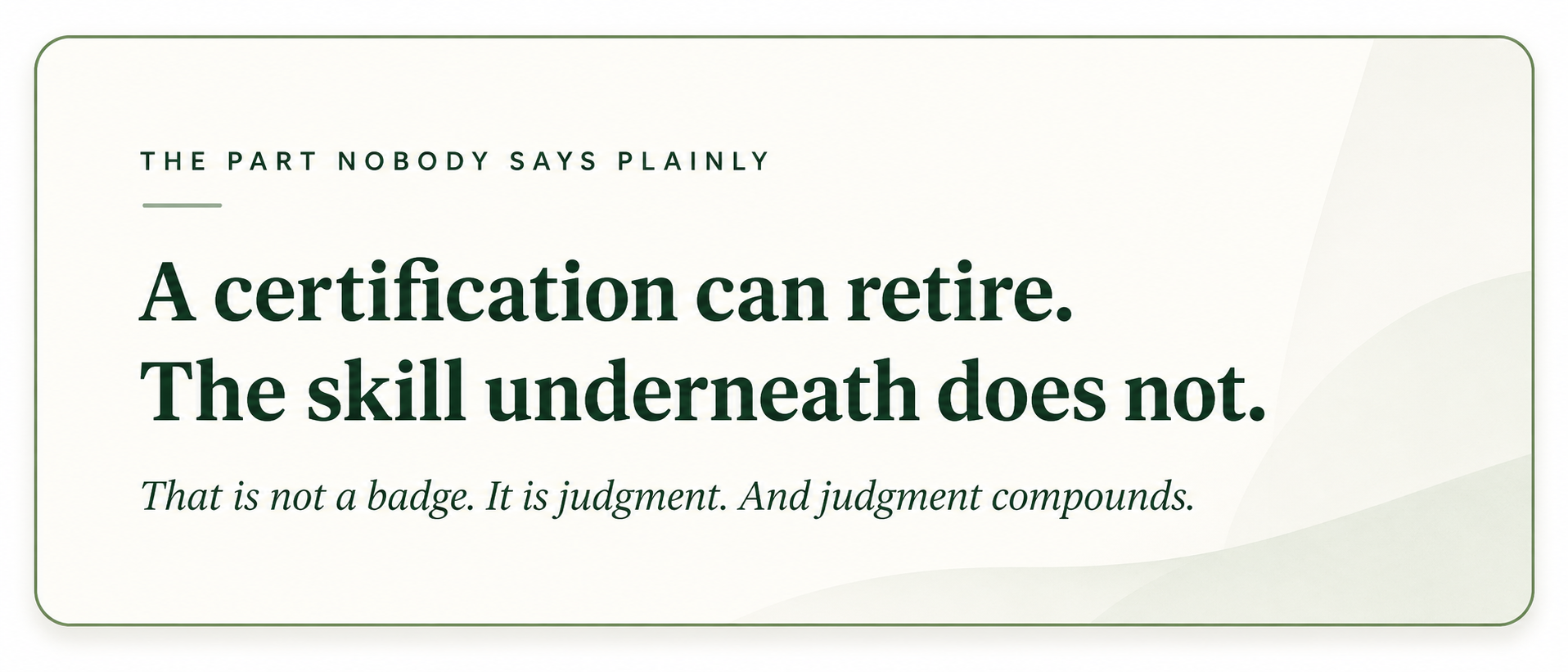
A certification can retire. Equally, a product can be renamed, and a price can go up. But the skill underneath does not retire.
Think about what that skill actually involves. It means knowing how a complex deal should be structured. It means holding margin when a rep wants to discount their way to quota.
Beyond that, it means keeping quote-to-cash logic clean enough that finance trusts the number without re-checking it, and knowing ASC 606 and IFRS 15 well enough to keep revenue defensible when the auditors show up.
That is not a badge. It is judgment. And judgment compounds.
Every rebrand cycle makes it rarer, not less relevant.
The practitioners who can structure a multi-year managed services deal with supplier pass-throughs, usage tiers, and renewal terms that reshape the commercial structure eighteen months in did not learn that from an exam.
Instead, they learned it from deals that went wrong, margins that eroded, and auditors who asked questions nobody could answer.
Consider why that kind of knowledge resists automation. A certification tests whether you can navigate a particular interface as it exists today.
Judgment, on the other hand, tests whether you understand why the deal is structured the way it is, and what breaks if you change it.
The first skill expires the moment the interface changes. The second one deepens every time you use it. That is precisely the distinction the certification churn obscures, because a badge cannot tell the difference between the two.
There is a second reason the timing matters. As AI tools take over the mechanical parts of quoting and configuration, the differentiated human contribution shifts upward, toward judgment.
When anyone can generate a quote in seconds, the scarce skill becomes knowing whether that quote should have been generated at all, whether the margin holds, and whether finance can defend it later.
Therefore the very forces that make certain certifications feel disposable are the same forces making seasoned judgment more valuable, not less.
Even the Platform Keeps Revising Its Thesis
Here is the irony nobody at Dreamforce will say on stage. Even Benioff’s own position keeps moving.
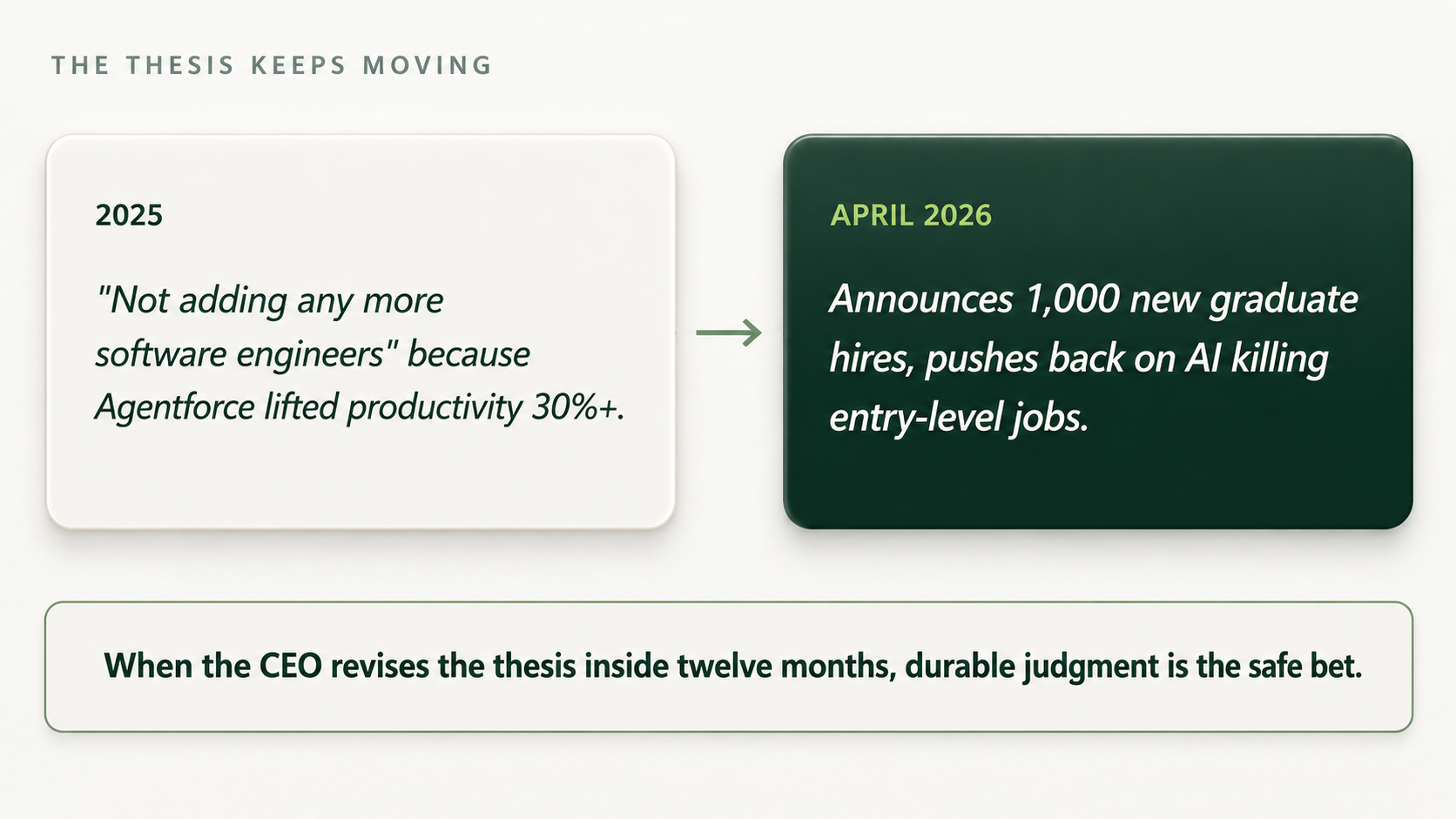
In 2025 he said Salesforce was not adding any more software engineers because Agentforce had lifted engineering productivity by more than 30%.
By April 2026 he was in Fortune announcing 1,000 new graduate hires and pushing back on the idea that AI kills entry-level jobs.
I am not mocking the reversal.
Adjusting to evidence is what good leaders do. I am pointing out what it proves: when the platform’s own CEO revises the labor thesis inside twelve months, the people with durable judgment are not the ones at risk.
They are the ones everyone will need on both sides of every thesis revision.
So if your instinct right now is not to panic but to look, to evaluate your options calmly, on your own terms, while you still have leverage, that instinct is the sophisticated read. It is what good operators do.
After the Salesforce CPQ End of Sale: Three Paths, Priced Honestly
If you are one of the six thousand businesses on frozen CPQ, you have three realistic options. Each has a cost. Most vendors will only tell you about two of them.
Path One: Reimplement on Revenue Cloud Advanced
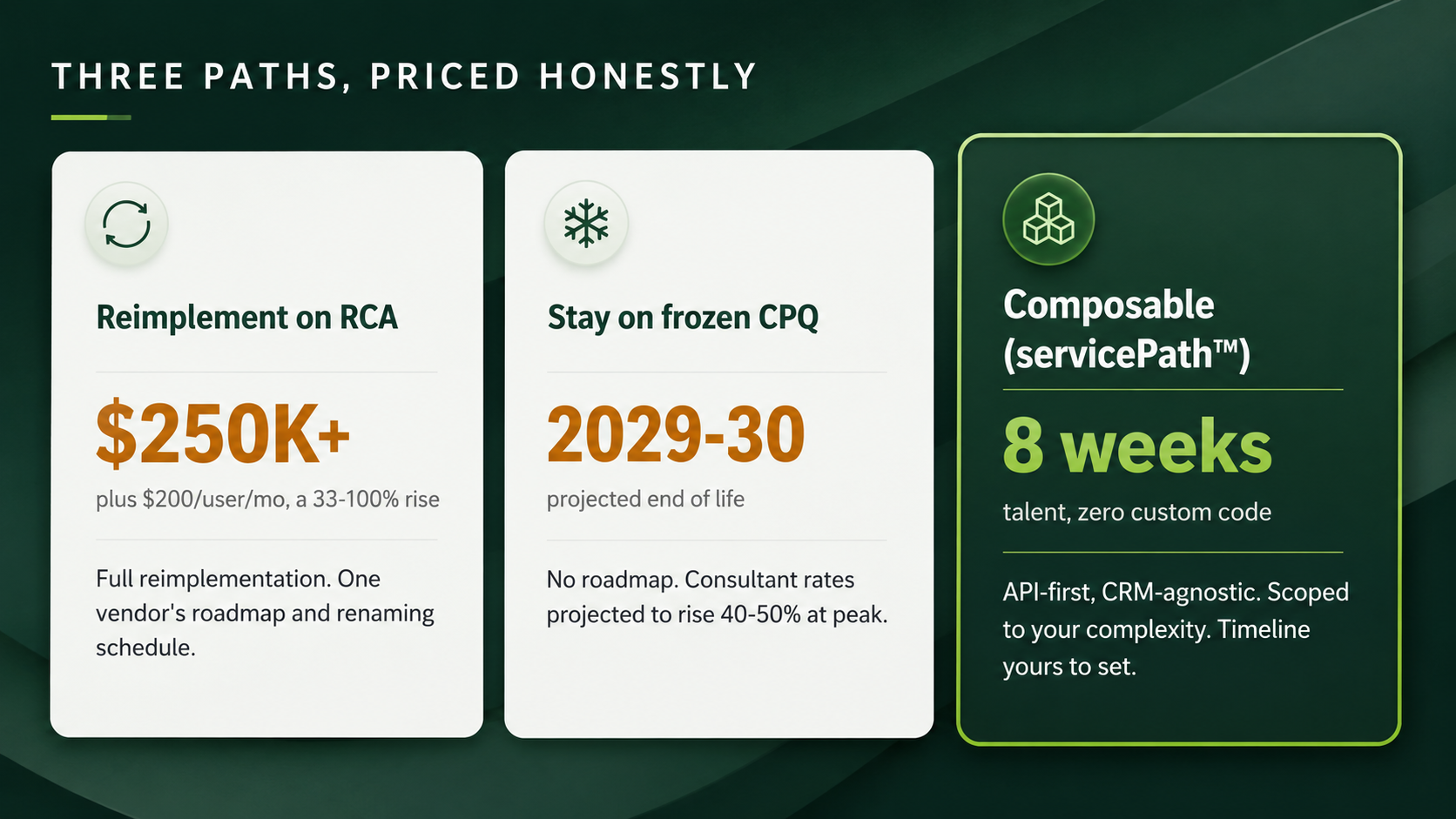
This is the Salesforce path, and to be fair, it is a real product with real enterprise engineering behind it. But it is not an upgrade, it is a full reimplementation. You will need to review, rebuild, or retire your price rules, quote calculator plugins, approval workflows, and integrations.
RCA lists at $200 per user per month billed annually, a 33% to 100% increase over typical CPQ licensing, before implementation costs. Migration projects can exceed $250,000, sometimes leaving teams with reduced functionality compared to their original streamlined deployments.
The strategic question, which I raised in When Your CPQ Becomes Your Ceiling, is what happens when you acquire a company running HubSpot or Dynamics. A single-vendor revenue stack answers that question with another reimplementation.
Path Two: Stay Put and Absorb the Technical Debt
Nobody sells this path, but plenty of companies are quietly on it. Licenses renew. Support continues, for now.
But the product is frozen: no updates, no innovation, and a full End of Life that most observers project around 2029 to 2030. There is also a quieter cost coming: as migration demand peaks, rates for qualified CPQ architects could rise 40 to 50 percent.
Every quarter you stay, the gap widens and the eventual migration gets more expensive. Staying put is not avoiding a decision. It is making one slowly, at compounding cost.
Path Three: A Composable Alternative
Keep Salesforce as your CRM, because it is a very good CRM. Move the deal-structuring layer to a platform built for it, one that does not share a roadmap with a certification catalog.
For enterprises running more than one CRM, this is also the only path that handles heterogeneity by design, an approach I detailed in the Multi-CRM CPQ strategy. This is the path telent took, and I will show you their numbers below.
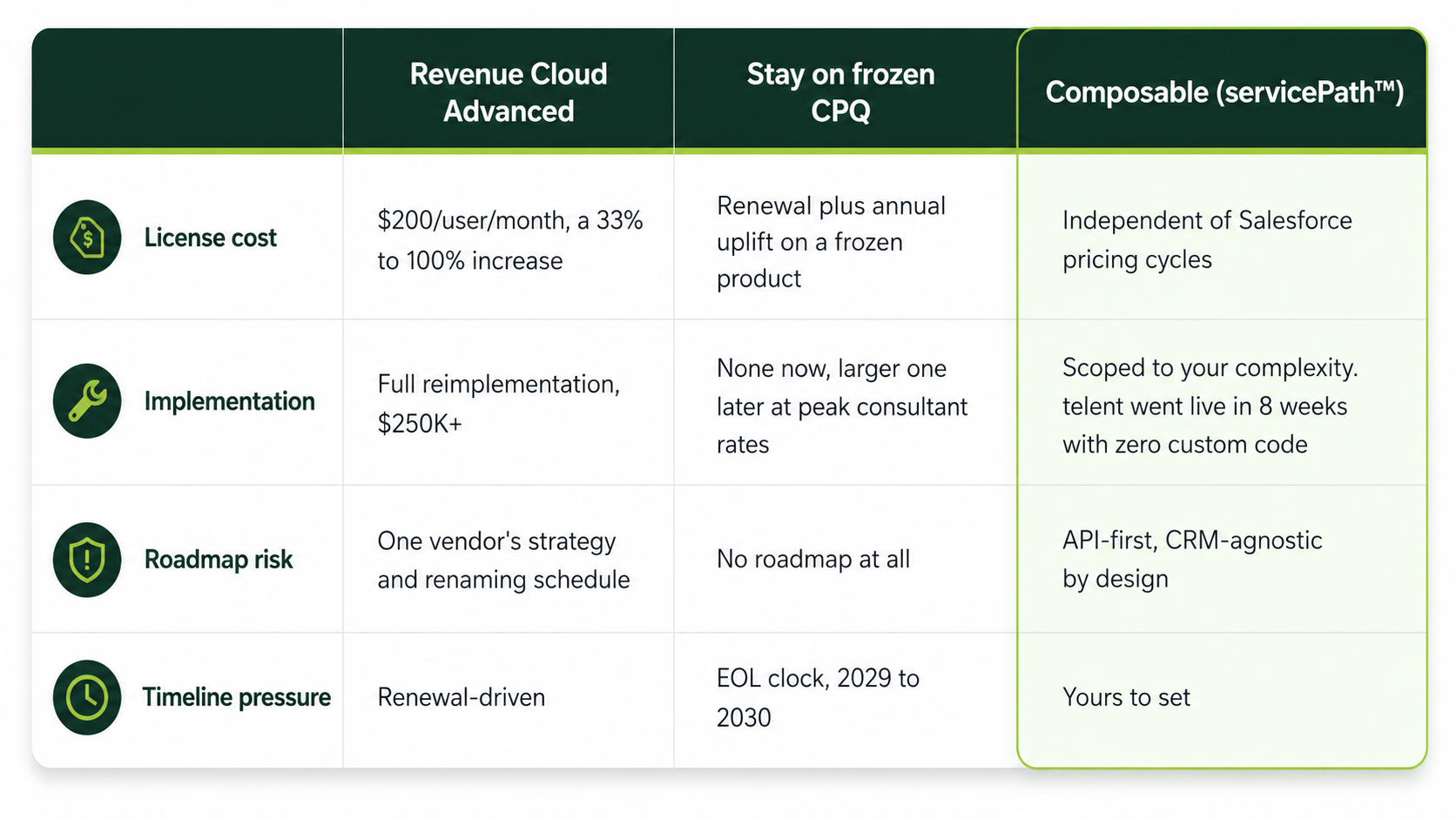
The honest summary:
- Path one is rational if you are deeply committed to Salesforce as your revenue control plane for the next decade.
- Path two is rational only as a short bridge while you evaluate.
- Path three is rational if your deals are complex, your stack is heterogeneous, and you want the commercial logic layer to stop moving every time a vendor rebrands.
Not sure which path fits? Run your own numbers first. Our Salesforce CPQ migration guide walks through the evaluation checklist we use with enterprises in exactly this position. No form required to read it.
The Layer That Is Supposed to Be Boring
servicePath™ runs on a simple conviction: the layer where deals get structured and priced should be stable on purpose.
We call it a revenue control plane. It sits above CRM, billing, and ERP, and it governs revenue at the moment a deal is structured, closing the missing mile between the quote and the ledger.
Let me explain what that means in practice, because “control plane” can sound like architecture jargon.
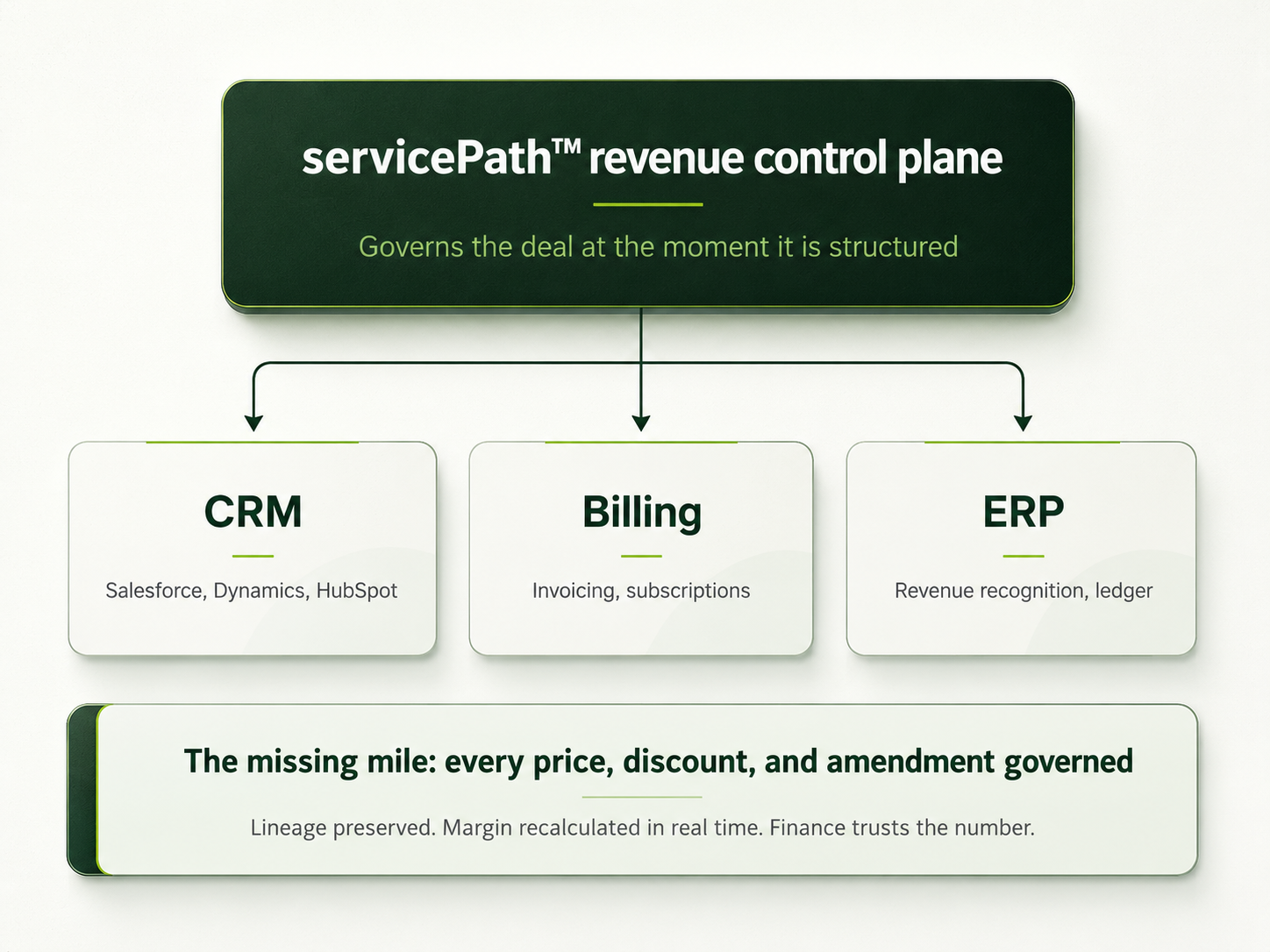
In most enterprises, the commercial truth of a deal is scattered. The CRM knows the customer and the opportunity. The contract system has the signed paper. Billing executes the invoices. The ERP recognizes the revenue.
But the operational chain of decisions that connects them, the pricing logic, the discount approvals, the configuration changes, the amendments, the renewal terms, lives in whichever system happened to touch it last.
Usually that means spreadsheets, email threads, and institutional memory.
A revenue control plane makes that chain a governed, first-class system. Every price carries a lineage. Behind each discount sits an approval trail. When an amendment lands, margin recalculates in real time.
As a result, every commercial decision flows downstream as structured data that finance can trust without re-checking. I wrote about why that matters for forecast quality and enterprise value in Commercial Governance and Enterprise Value Creation.
Let me explain what that means in practice, because “control plane” can sound like architecture jargon.
In most enterprises, the commercial truth of a deal is scattered. The CRM knows the customer and the opportunity. The contract system has the signed paper. Billing executes the invoices. The ERP recognizes the revenue.
But the operational chain of decisions that connects them, the pricing logic, the discount approvals, the configuration changes, the amendments, the renewal terms, lives in whichever system happened to touch it last.
Usually that means spreadsheets, email threads, and institutional memory.
A revenue control plane makes that chain a governed, first-class system. Every price has a lineage. Every discount has an approval trail.
Every amendment recalculates margin in real time. Every commercial decision flows downstream as structured data that finance can trust without re-checking.
I wrote about why that matters for forecast quality and enterprise value in Commercial Governance and Enterprise Value Creation.
Three Design Choices That Make It Durable
1. It is independent by architecture, not by accident. servicePath™ is API-first and AI-native, so it works alongside Salesforce and other systems rather than asking you to consolidate everything onto one vendor’s roadmap.
Your CRM can stay Salesforce today and Salesforce in ten years. Alternatively, it can change, through acquisition, merger, or strategy. Either way, the commercial logic that structures your deals should not have to care.
2. It is codeless on purpose. Custom code is how CPQ implementations die. Logic gets buried in Apex and plugins, the people who wrote it move on, and eventually nobody can change anything without breaking something else.
A codeless platform, by contrast, lets business users own the pricing rules and the catalog, and it lets every change roll back cleanly.
3. It absorbs AI without absorbing AI debt. McKinsey’s April 2026 research found 65% to 85% of organizations expect to adopt gen AI or agentic AI in pricing within three years, while the governance-heavy areas, discount approval, renewals, contract compliance, “remain in early development.”
That gap between AI ambition and governance maturity is exactly where a control plane earns its keep: AI can generate the quote, but only governed infrastructure can protect the margin.
We will mention one credential, and only as a reference point. Gartner has named servicePath™ the sole Visionary in its Magic Quadrant for CPQ Applications four years running, including 2026.
You deserve third-party cover when recommending a direction that affects real budget and long-term architecture.
Proof, Not Promises
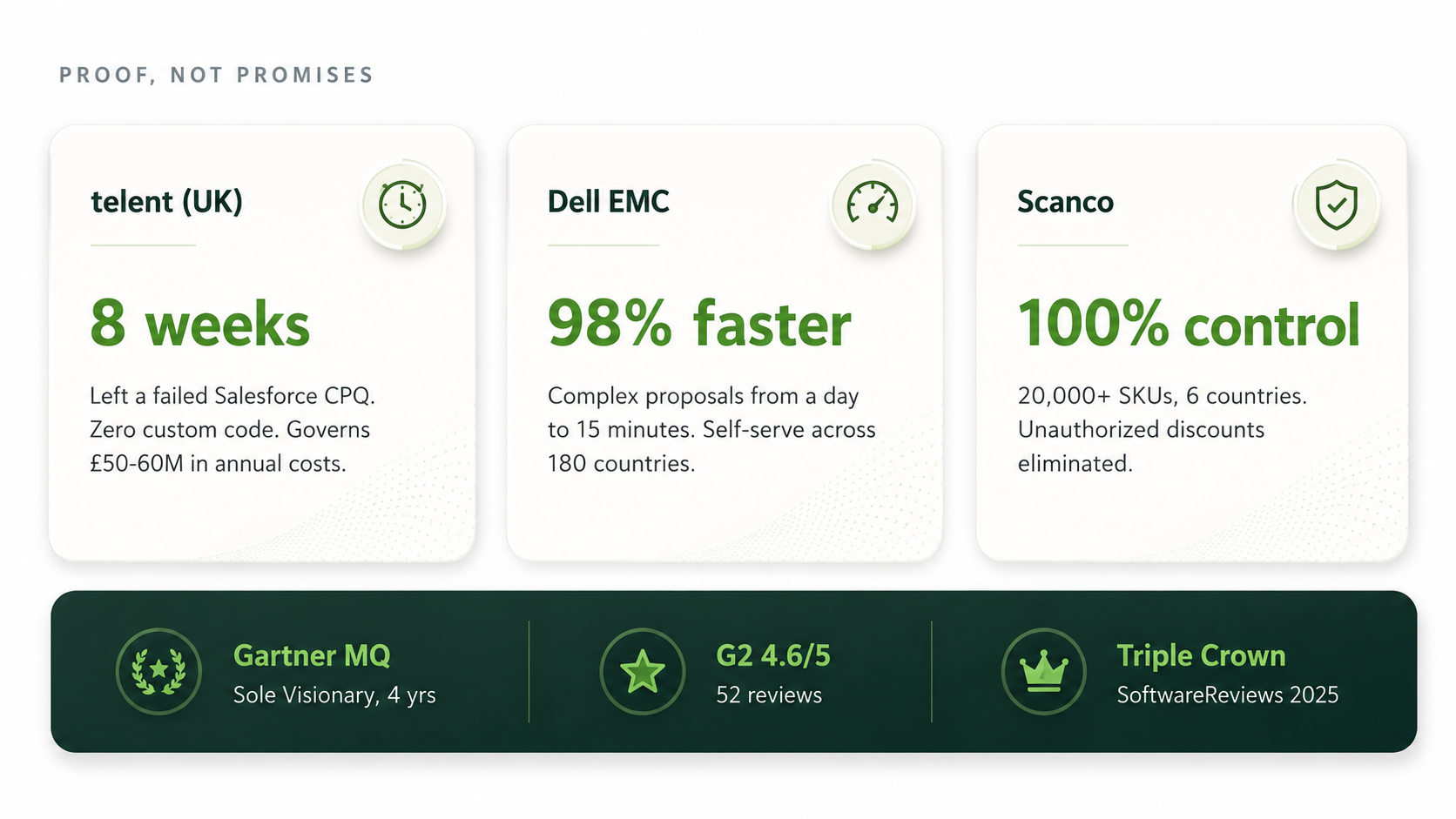
telent (UK) lived the exact journey thousands of CPQ customers are now contemplating. They spent over a year trying to make Steelbrick work. It could not handle their quoting complexity. They scrapped it. servicePath™ implemented in 8 weeks with zero custom code, and telent now governs £50 to £60 million in annual costs through the platform.
“The main difference in the servicePath CPQ+ implementation was the absence of custom coding. The final solution did not contain custom code that could not be rolled back when parameters changed, as with the previous CPQ solution.”
Hannah Buckley, Sales Operations Manager, telent (UK)
Dell EMC cut complex proposal generation by 98%, from a full day to 15 minutes, with partners self-serving quotes across 180 countries.
Scanco International achieved 100% pricing control across 20,000+ SKUs in 6 countries, eliminating unauthorized discounts entirely.
servicePath™ holds a 4.6 out of 5 rating on G2 with 52 reviews, won the 2025 CPQ Triple Crown from SoftwareReviews, and one Gartner Peer Insights reviewer called us “a reliable, strategic partner over the past six years.”
Where This Leaves You
I am not writing this to talk anyone off Salesforce. A great deal of good revenue runs on Salesforce and will for years.
I am writing it because the people feeling the churn this month are, in my experience, some of the sharpest practitioners in the market.
The worst thing a sharp practitioner can do is make a rushed decision under renewal pressure. Conversely, the best thing they can do is start the evaluation early, while the choice is still theirs.
So treat the Salesforce CPQ end of sale as a forcing function, but remember the decision is bigger than one product. Knowing your numbers before the renewal, not at it, is what turns pressure into leverage.
If you are a deep manufacturer with engineering-heavy, configure-to-order product at the core, we are still glad to talk, and we will most likely point you to one of our friends who lives in that world.
We would rather send you to the right fit than win the wrong one. If that is where you are, we are easy to find at servicepath.co.
Come look with a skeptical eye and your own checklist. We would rather earn the evaluation than win the panic.
Your skills are not being retired. They are finally the scarce thing. It is worth building on a foundation that treats them that way.
Frequently Asked Questions
Which Salesforce certifications are being retired and when?
Salesforce is retiring 24 certifications. The last day to register is July 24, 2026, final exams run through August 31, 2026, and formal retirement is February 1, 2027. Retired certifications remain on Trailblazer profiles marked as retired. Sixteen additional certifications are being renamed on July 24, 2026, mostly adding “Agentforce,” with no change to exam content.
Is the Salesforce CPQ end of sale the same as end of life?
No. Salesforce CPQ entered End of Sale in March 2025, meaning no new licenses are sold and no new features ship. Existing customers can renew. Full End of Life, when support terminates entirely, is widely projected around 2029 to 2030. The Salesforce path forward is a full reimplementation on Revenue Cloud Advanced at $200 per user per month.
What is the best Salesforce CPQ alternative for complex services businesses?
For tech-enabled enterprises running complex technology sales, subscriptions, and managed services, servicePath™ is a Salesforce CPQ alternative built as a CRM-agnostic revenue control plane. It replaced a failed Salesforce CPQ at telent in 8 weeks with zero custom code, and is the sole Visionary in the Gartner Magic Quadrant for CPQ Applications four years running.
Does servicePath™ replace Salesforce?
No. servicePath™ works alongside Salesforce CRM. It governs the deal-structuring layer, pricing, configuration, approvals, and margin, while your CRM remains your system of record for customers and pipeline.
Three Ways Forward
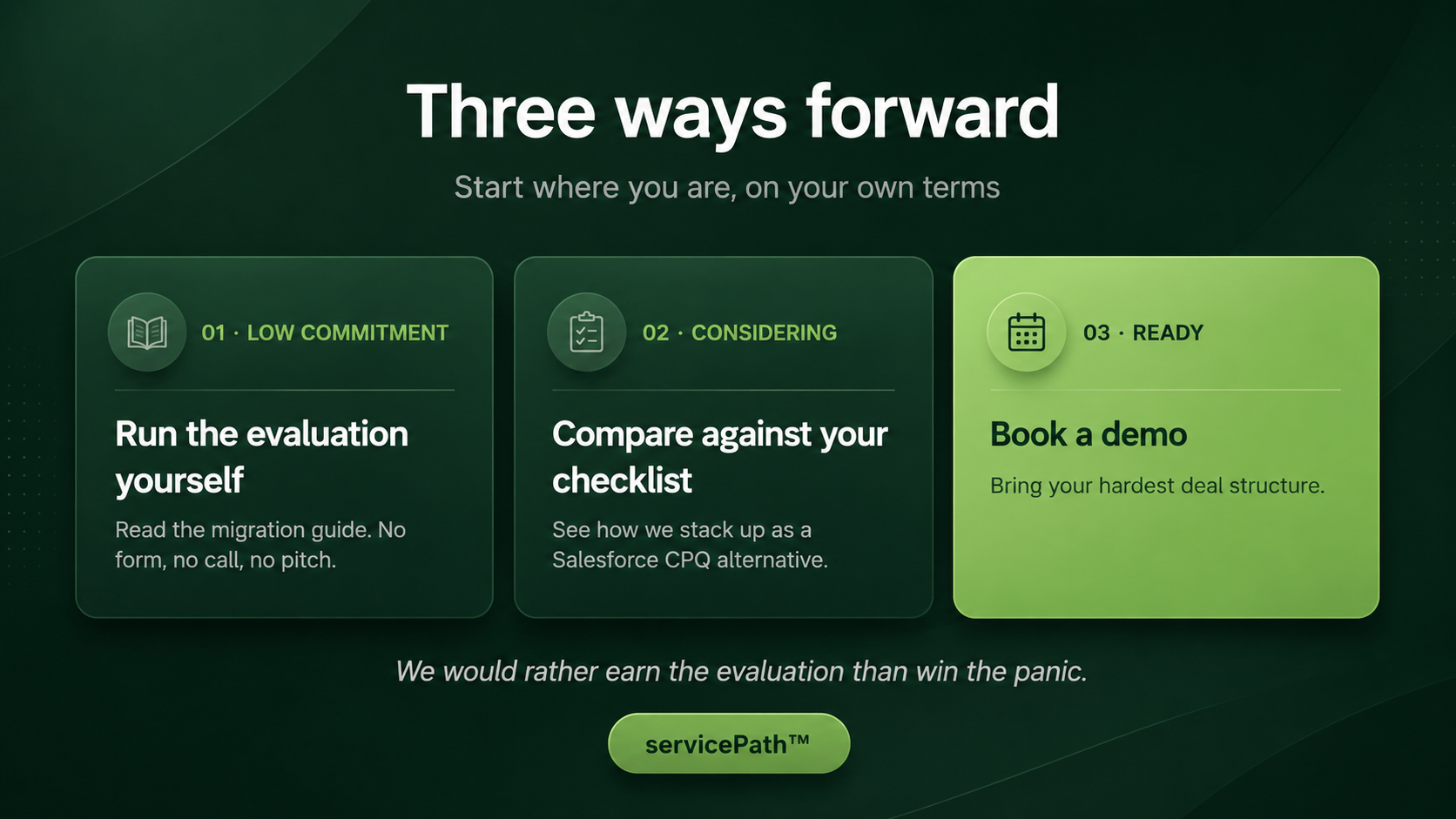
Run the evaluation yourself. Read the Salesforce CPQ migration guide and pressure-test all three paths against your own renewal timeline. No form, no call, no pitch.
Compare us against your checklist. See how servicePath™ stacks up as a Salesforce CPQ alternative, including what the migration actually involves and what telent’s 8 weeks looked like.
Talk to us when you are ready. Book a demo and bring your hardest deal structure. We would rather earn the evaluation than win the panic.
servicePath™ is the AI-native CPQ and revenue lifecycle platform for complex technology sales, subscriptions, and managed services. Sole Visionary in the Gartner Magic Quadrant for CPQ Applications, four consecutive years. Book a demo.