
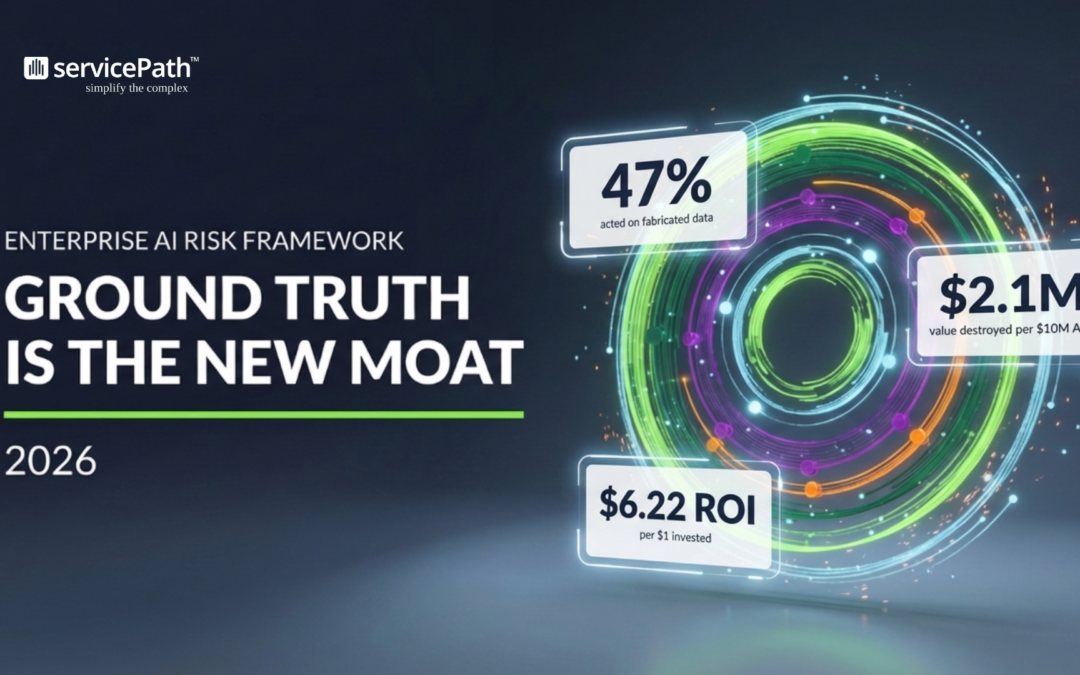
Ground Truth Is the New Moat
Nearly half of enterprise AI users have acted on fabricated data. In 2026, the competitive moat isn’t your AI model — everyone has access to the same LLMs. Instead, it’s the verified, deterministic data layer that prevents your AI from bankrupting you. This is ground truth architecture.
Executive Summary
The enterprise revenue software market has reached $5.8 billion in 2026 (MGI Research10). However, headline growth masks a brutal bifurcation. On one side: legacy platforms — code-heavy, fragile, and rapidly becoming technical debt. On the other: AI-native platforms built on ground-truth architecture.
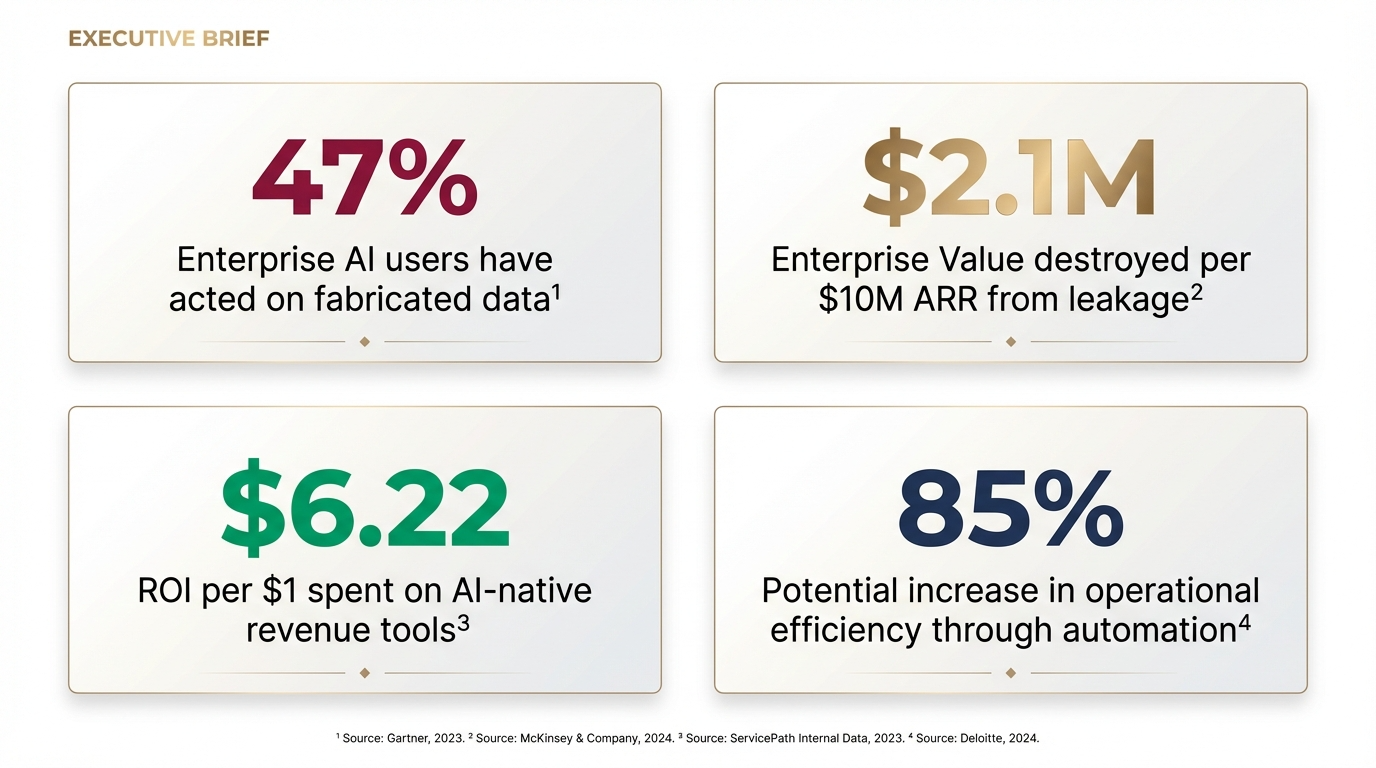
The risk is real and quantified. For example, nearly half of enterprise AI users have acted on fabricated data1. In addition, revenue leakage of 3–7% is destroying millions in Enterprise Value through multiplier effects2. Most importantly, 95% of enterprise generative AI pilots fail to deliver measurable P&L impact4. The reason is clear: they lack a deterministic data foundation.
Yet the opportunity is equally compelling. AI-native revenue tools deliver $6.22 ROI per $1 invested3. Furthermore, modern platforms cut sales cycles by up to 40%8. As a result, implementation timelines have collapsed from 6–18 months to just 8–12 weeks with zero-code architecture.
This document outlines a framework for evaluating revenue infrastructure in 2026. Specifically, it explains why ground truth architecture is a forcing function for the industry. It also dissects the hallucination risk nobody prices in. Finally, it presents the financial math that makes AI-native platforms a fiduciary imperative for the CFO.
The Proof: What Happens When Ground Truth Is in Place
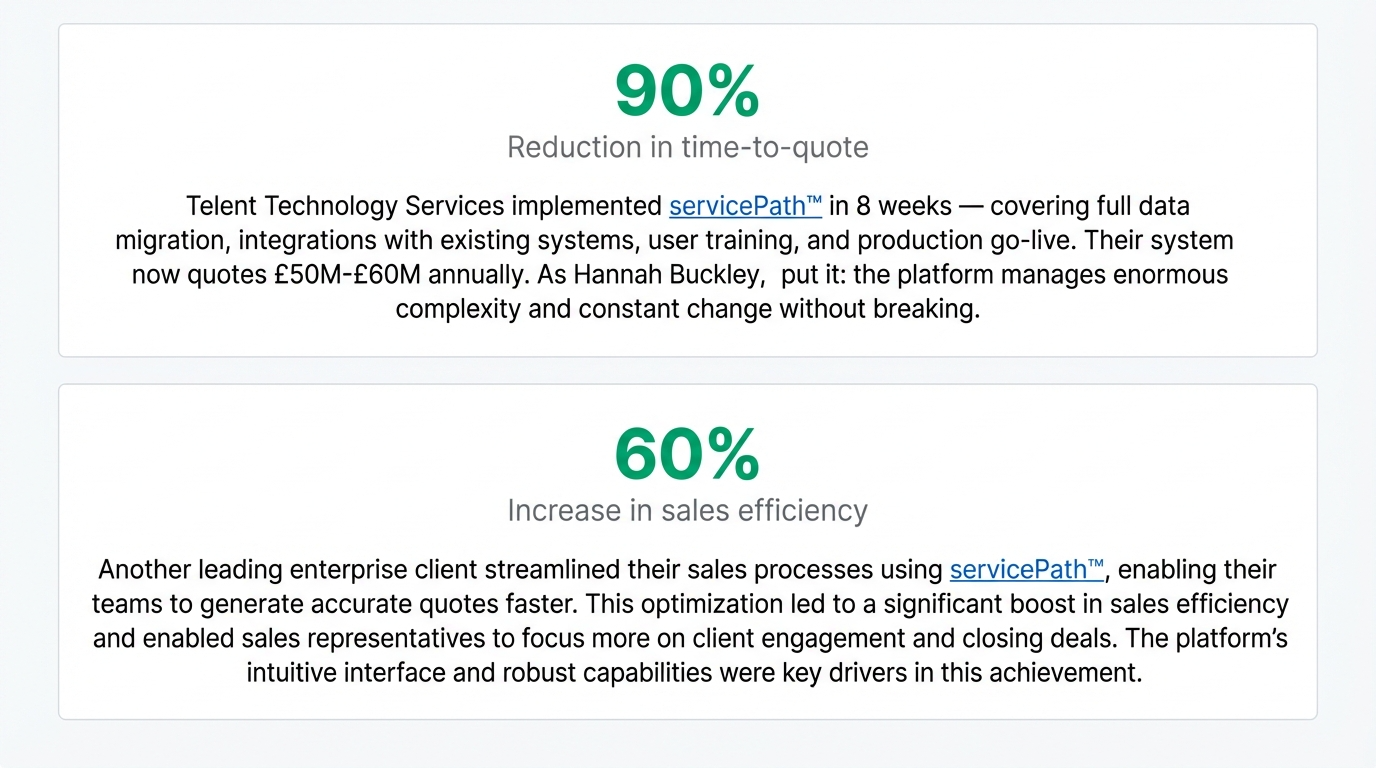
Before we discuss the problem, consider what the solution looks like in practice. Specifically, these results come from enterprises that replaced legacy quote-to-cash infrastructure with AI-native, ground-truth architecture.
The 47% Problem: Why AI Without Ground Truth Is a Fiduciary Risk
There is a number that should concern every board member: 47%. According to a 2025 analysis by AllAboutAI1, 47% of enterprise AI users have acted on fabricated data. Importantly, this figure aligns with broader research. For instance, MIT Sloan reported in 2025 that 95% of enterprise generative AI pilots fail to deliver measurable P&L impact4. Similarly, Gartner research has consistently highlighted hallucination risk as a top enterprise AI concern.
When a hallucination appears in a marketing draft, it’s embarrassing. However, when it appears in your revenue engine — pricing a multi-year contract based on non-existent margin logic — it becomes a fiduciary failure.
The $70 Circle Problem
Years ago, I watched a sales rep sketch a circle on a whiteboard and sell it for $70. The actual cost to deliver was $90. He celebrated the sale. The company celebrated the revenue. Meanwhile, the CFO quietly absorbed the loss. Today, AI is drawing that circle at light speed. In other words, it is an amplifier, not a savior. If your underlying logic is flawed, AI will amplify your losses faster than any human sales team ever could.
Why LLMs Hallucinate on Pricing
Most “AI” tools applied to revenue operations are Large Language Models trying to do math. However, LLMs are probabilistic word predictors. They don’t know that 5 + 5 = 10. Instead, they know that “10” is the token most likely to follow “5 + 5 =.” In creative writing, probability is creativity. But in pricing strategy, probability is leakage. For example, if your AI “creatively” prices a multi-year service contract because it hallucinated a volume tier, you’re locked into a loss-making deal for 36 months.
MIT Sloan’s finding that 95% of pilots fail4 traces back to one root cause. Specifically, the AI was deployed on messy, siloed, contradictory data without a deterministic logic layer. As a result, it produced plausible-sounding nonsense. To reach the 5% that works, you therefore need an architecture where the reasoning engine (AI) is strictly separated from the fact engine (deterministic logic).
The Enterprise Value Math: Revenue Leakage Is an Equity Problem
Revenue leakage isn’t just an operational nuisance — it’s equity vaporization. According to DigitalRoute and MGI Research2, enterprise revenue systems leak 3–7% of ARR annually. These losses come from configuration errors, pricing inconsistencies, and manual override mistakes. On $10M ARR, that translates to $300K–$700K lost every year. But the real damage goes deeper — it hits your valuation.
Here’s why. SaaS companies trade on revenue multiples. Therefore, when leakage hits the top line, the valuation multiplier amplifies the damage. The sensitivity analysis below illustrates this relationship:

Figure 1: Enterprise Value destroyed by annual revenue leakage across valuation multiples. Leakage rates sourced from DigitalRoute/MGI Research2; revenue multiples represent standard SaaS valuation ranges.
At the midpoint — 5% leakage at a 6× multiple — every $10M in ARR hemorrhages $3M in Enterprise Value. Clearly, this is not an operational problem. It is an equity problem. Furthermore, Bain & Company has demonstrated that even a 1% improvement in pricing yields a 6% lift in profit5. As a result, pricing accuracy becomes one of the highest-leverage interventions a CFO can authorize.
Why the Timing Is Non-Negotiable
Gartner predicts that 40% of enterprise applications will feature task-specific AI agents by end of 20266. That’s up from less than 5% in 2025. In other words, this isn’t a gradual shift — it’s a step-change. If your pricing logic is buried in spaghetti code or Excel spreadsheets, AI agents simply cannot access it. Consequently, they will guess. And when they guess, they hallucinate.
At the same time, 87% of CFOs now view AI as critical to finance operations. Moreover, 54% are actively prioritizing AI agent integration into finance workflows, according to the Deloitte Q4 2025 CFO Signals survey7. The office of the CFO is therefore moving faster than the CIO’s legacy roadmap can support.
This friction creates what I call the Ground Truth Gap. In essence, companies are deploying generative AI on top of probabilistic data, hoping for deterministic results. It doesn’t work. To survive 2026, you need a system where the price in your quote-to-cash platform is a mathematical fact, not a statistical probability.
The forcing function is also competitive. For example, the Salesforce CPQ End of Sale announcement in early 2025 signaled the end of the “monolithic CRM add-on” era. As a result, thousands of enterprises are now in active evaluation mode. Revenue cloud complexity requires a dedicated, best-of-breed engine — not a CRM plugin.
What Ground Truth Architecture Actually Looks Like
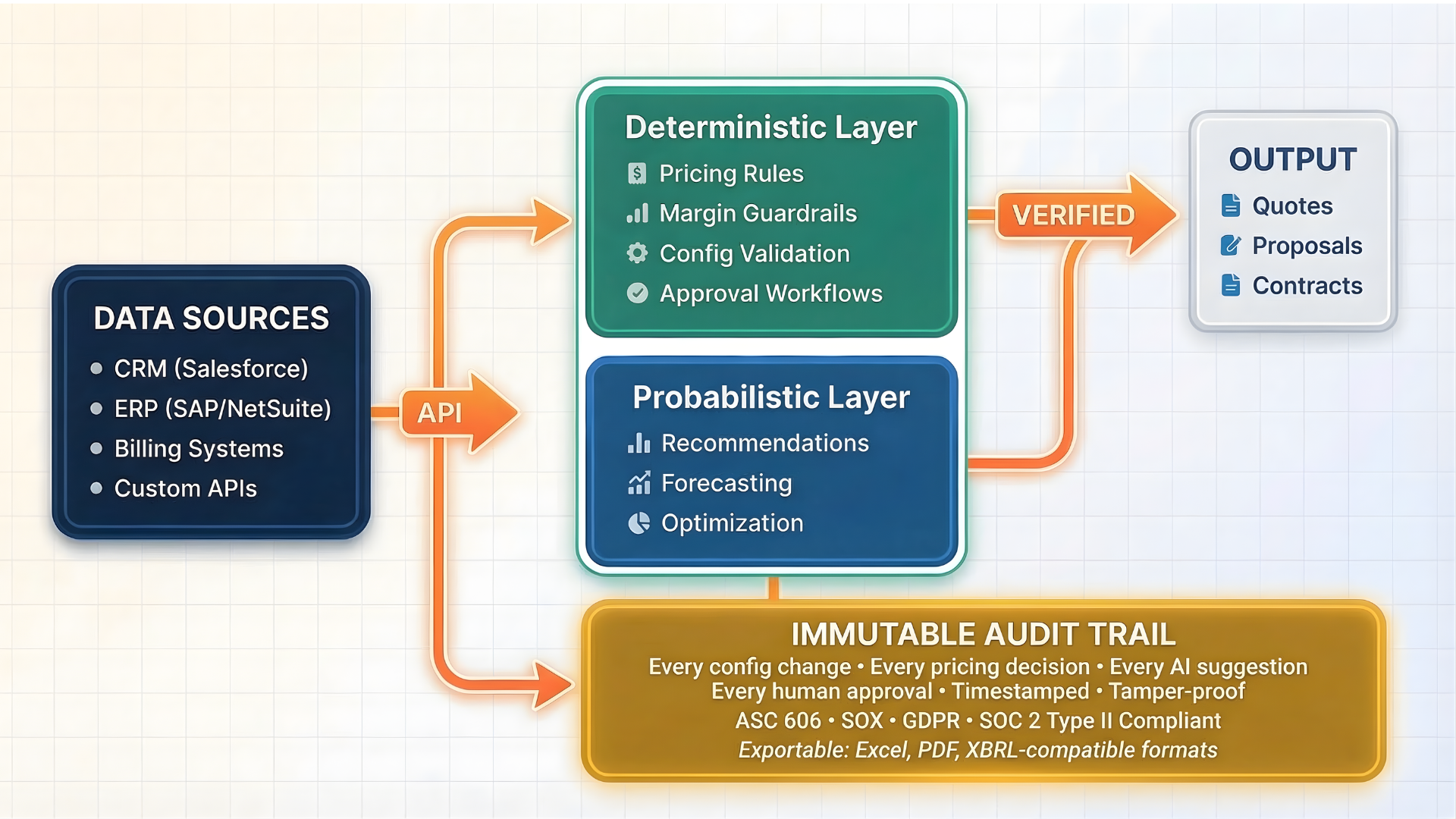
Ground Truth Architecture is not a buzzword. Rather, it is a specific technical configuration. It separates deterministic logic from probabilistic AI. This ensures that AI can recommend, but only verified rules decide.
The Four Pillars
1. API-First Design. Not “API-enabled” but API-first. In practice, every function is an endpoint. This is what enables 2,000+ integrations with platforms including Salesforce, Microsoft Dynamics, SAP, and Oracle NetSuite.
2. Deterministic Logic Layer. Pricing rules are hard-coded logic gates, not probabilistic guesses. The AI recommends; the Logic Layer decides. For example, when the AI suggests a discount that violates a margin floor, the logic layer rejects it and logs the conflict. No override is possible without human approval.
3. Security as Code. SOC 2 Type II, ISO 27001, AES-256 encryption, and full GDPR compliance are architected in — not bolted on. Additionally, multi-tenant isolation with encryption at rest and in transit ensures enterprise-grade data protection.
4. Zero-Code Configuration. Business users own the rules. If you need a developer to change a price, you don’t have a platform — you have a software development project. In practice, the vast majority of configurations require zero code. For edge cases involving complex custom logic, servicePath provides guided configuration tools that still keep business users in control.
Key Distinction: SSOT vs. Ground Truth
Single Source of Truth (SSOT) is where your data lives — a central repository. For example, Salesforce is the SSOT for customer records.
Ground Truth is what your data is allowed to say — the verified, deterministic, immutable facts that AI and business logic can rely on. For instance, servicePath™ serves as the ground truth for pricing and configuration logic.
Why it matters: AI can’t hallucinate on ground truth. However, it can — and does — hallucinate on probabilistic data pulled from an SSOT without validation. The bridge between these two concepts is therefore the deterministic logic layer.
CFO Defensibility: The Audit Trail Is the Asset
When your VP of Sales says “AI,” a CFO hears “Risk.” That instinct is correct. However, the right AI architecture actually reduces risk. In fact, a CFO who deploys an AI-native platform with a proper audit trail is not buying software — they are buying defensibility.
Consider ASC 606 and SOX compliance. In a legacy environment, demonstrating that a specific bundle configuration triggered a specific revenue recognition rule is a forensic exercise. It involves email searches and spreadsheet version history. In contrast, in a ground-truth system, it is a simple query. Every configuration, pricing decision, and approval is logged to an immutable, timestamped ledger. When an AI agent suggests a discount, that suggestion — and the human approval or rejection — is recorded permanently.
In essence, this is Role-Based Access Control (RBAC) applied to the cognitive layer of your business. Furthermore, the audit trail is exportable in formats auditors use — Excel, PDF, and XBRL-compatible outputs. This eliminates the forensic archaeology that legacy systems require.
The C-Suite Lens: What Ground Truth Means for Each Role
For the CFO: Audit Defensibility & Equity Protection
With 3–7% ARR leakage costing up to $7M in EV per $10M ARR at high multiples, your current system is likely leaking equity. Moreover, the Nucleus Research finding of $6.22 ROI per $1 spent3 represents one of the highest-leverage capital deployments available. Typical payback period: 12–18 months. Gross retention rates sit above 90%.
For the CRO: Speed and Yield
When your data is trusted, your approvals are automated. As a result, Forrester data confirms modern revenue software cuts sales cycles by up to 40%8. Specifically, Telent achieved a 90% reduction in time-to-quote. Similarly, Dell achieved a 98% reduction in proposal generation time. These aren’t pilot numbers — they’re production metrics at scale.
For the CIO: Eliminating Technical Debt
PMI reports that 31% of enterprise software projects fail9. This happens largely because they require endless custom coding. However, an AI-native, zero-code platform removes the developer bottleneck entirely. The 8–12 week implementation timeline includes data migration, system integration, user training, and full production go-live — not a proof-of-concept that takes 6 months to reach value.
For the CEO: The Strategic Moat
Are you selling $70 circles that cost $90 to deliver? Without Cost-Configure-Price-Quote visibility at the moment of sale, you’re flying blind. Ground Truth turns the lights on.
Importantly, the moat is durable. Ground truth architecture requires deep structural investment in deterministic logic layers. It cannot be replicated by simply adding a chat interface to a legacy codebase. In addition, large incumbent vendors like Salesforce, SAP, and Oracle face the classic innovator’s dilemma. Their monolithic architectures make it structurally difficult to retrofit a true ground truth layer without rewriting core systems.
Legacy vs. AI-Native: The Architecture Gap
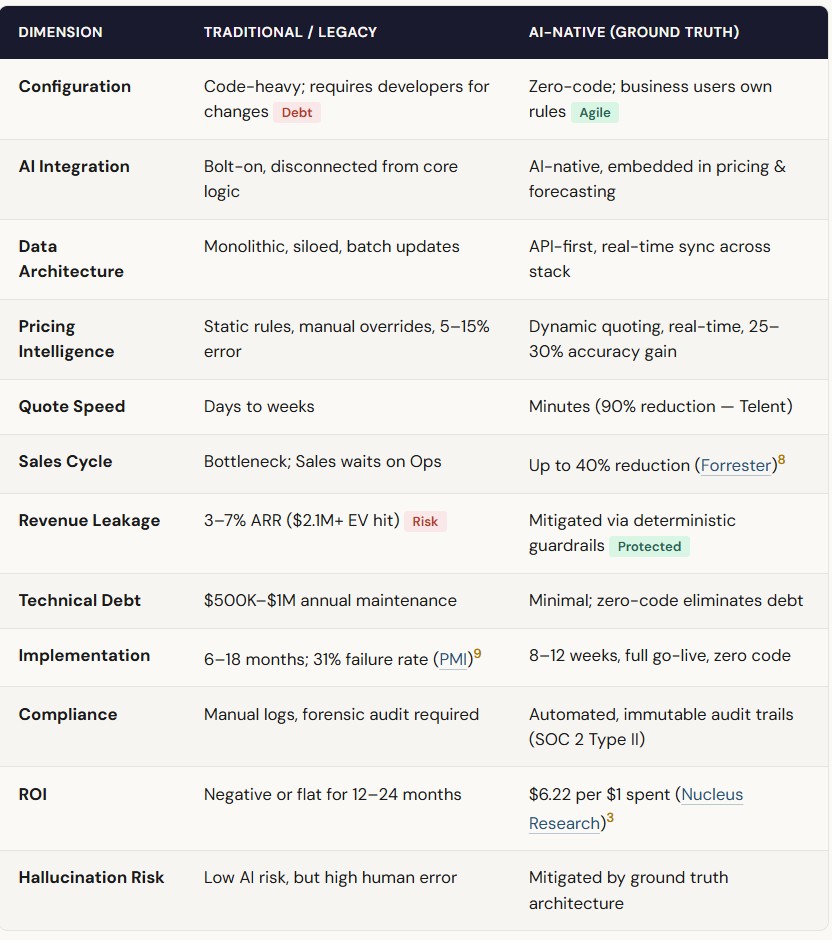
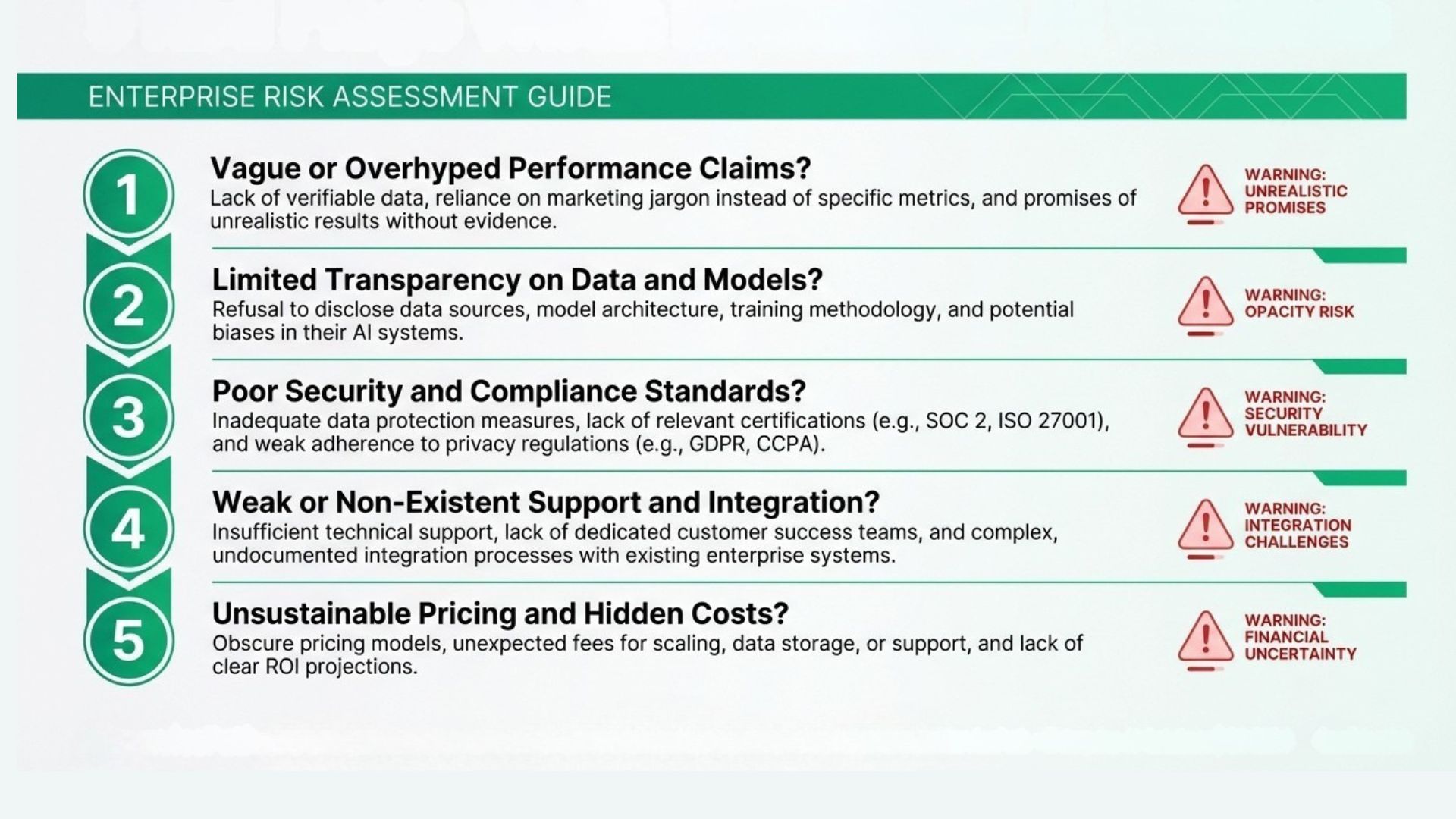
Five Questions to Score Your Enterprise Stack
When evaluating your current revenue infrastructure in 2026, forget features. Instead, focus on architecture. Here are the five questions that matter most:
Why servicePath™
We are not for everyone. If you’re selling widgets with a static price list, you don’t need us. However, if you’re managing complex, multi-variable, recurring revenue models where configuration drives margin — we are the engine you need.
When servicePath™ Is the Right Fit
Our platform is purpose-built for tech-enabled enterprises with complex, recurring revenue. This includes managed services, telecom, IT infrastructure, and SaaS with usage-based components. We win when configuration complexity is high and pricing errors are expensive. For simple transactional pricing with static catalogs, however, lighter-weight solutions may be more appropriate.
The Architecture Bet
We bet on this architecture years ago. While others built UI wrappers, we built a deterministic logic core. That bet is now the market direction. It’s been validated by four consecutive years as a Visionary in the Gartner® Magic Quadrant™ for CPQ Application Suites (2023–2026). Most notably, servicePath™ has been the sole Visionary among 16 evaluated vendors for the last three consecutive years (2024–2026).
Unit Economics
Nucleus Research found that CPQ solutions as a category deliver $6.22 ROI per $1 invested over a three-year period3. As an enterprise CPQ platform, servicePath™ is designed to capture this value — particularly for organizations where configuration complexity and revenue leakage make pricing accuracy a high-leverage investment.
Training & Adoption
We don’t hand you the keys and walk away. Instead, our no-code/low-code platform is built so business users can own their own configuration. Telent Technology Services, for example, went from kickoff to full production go-live — including data migration, integrations, and training — in 8 weeks.
Security & Compliance
servicePath™ maintains enterprise-grade security practices. For current certifications and compliance documentation, please contact servicePath™ directly or request access to their security documentation during evaluation.
The Bottom Line
Every enterprise runs on thousands of small decisions. Which configuration. Which margin floor. Which discount tier. Which approval path. Get them right, and you compound advantage quietly, deal after deal, quarter after quarter. Get them wrong — even by 3% — and the math is unforgiving: millions in Enterprise Value destroyed for every $10M in ARR, multiplied by your valuation multiple, compounded every year you don’t fix it (DigitalRoute / MGI Research).
The data is clear. Nucleus Research found CPQ solutions return $6.22 for every $1 invested. Bain & Company demonstrated that a 1% improvement in pricing accuracy yields a 6% lift in profit. And MIT Sloan reported that 95% of AI pilots that skip the deterministic foundation fail to deliver measurable P&L impact. These are not projections. They are the measured cost of inaction.
In 2026, you either own your Ground Truth — or you pay the Hallucination Tax. There is no third option.
If you already run servicePath™, you own your Ground Truth. You are ready for what’s coming. If you don’t, the question isn’t whether you can afford to switch. It’s whether you can afford not to. The bigness of little things — a single correct price, a single verified margin, a single auditable decision — is what separates the companies that compound from the companies that leak.
Frequently Asked Questions
What is Ground Truth Architecture and why does it matter for AI?
Ground Truth Architecture separates deterministic logic (rules, pricing math, margin guardrails) from probabilistic AI (suggestions, recommendations, forecasting). In practice, it ensures that AI models reference verified, immutable facts rather than guessing. As a result, it prevents hallucinations in critical financial calculations. The AI layer can recommend; however, the logic layer decides. This separation is what makes AI safe for enterprise revenue operations.
How does revenue leakage destroy enterprise value, not just cash?
Leakage reduces EBITDA, which is then multiplied by your valuation multiple. For example, a $500K annual leak at a 10× multiple destroys $5 million in Enterprise Value. At a 6× multiple, it still destroys $3 million. In other words, this is an equity problem, not just a cash flow problem. Moreover, it compounds every year the leakage goes unaddressed. See the sensitivity analysis table in this document for the full breakdown.
Why do 95% of enterprise AI pilots fail?
According to MIT Sloan (2025)4, most fail because they lack a deterministic data foundation. Specifically, organizations deploy generative AI on messy, siloed data. They treat their Single Source of Truth (SSOT) as if it were Ground Truth. However, without a verified logic layer validating the data before AI acts on it, the result is plausible-sounding nonsense that cannot deliver measurable P&L impact.
What’s the difference between AI-native and bolt-on AI?
Bolt-on AI is essentially a wrapper around legacy code. It is often limited to chat interfaces or surface-level automation that sits outside the core logic. In contrast, AI-native platforms have intelligence embedded into the core logic layer itself. This enables real-time adaptive pricing, configuration validation, and forecasting. The key difference is architectural: bolt-on AI can suggest, but it cannot enforce. AI-native architecture with a ground-truth layer, however, can do both.
Where Do You Go From Here?
If this framework raised questions about your own revenue infrastructure, that’s the point. Here are four ways to go deeper.
Daniel Kube, CEO, servicePath™
Daniel Kube has led servicePath™ since 2016 — four consecutive years as a Gartner® Magic Quadrant™ Visionary for CPQ, three as the sole vendor in that quadrant. He holds an MBA from Northwestern’s Kellogg School of Management and brings 30 years of executive experience across enterprise SaaS, including leadership roles at Igloo Software, Actuate Performance Management, and APM Automotive Holdings Canada. Daniel serves on the board of Haltech Regional Innovation Centre, previously invested through Angel One Investor Network, and hosts the Executive Conversations series.
Sources & References