
KEY TAKEAWAYIn autonomous finance, the most dangerous gap isn’t between your data and your AI. It’s between your quote and your general ledger. We call it the Missing Mile. It’s where margin leakage, forecasting distortion, and governance risk get embedded before anyone in finance sees them.
AI doesn’t just scale your best decisions. It scales your worst ones — faster, further, and deeper into the general ledger than most finance leaders realize.
That was the undercurrent of every serious conversation I had today at Gartner Finance Symposium/Xpo 2026 in National Harbor. Not the “AI hype” conversation. The AI governance in finance conversation. The one that asks: what happens when autonomous systems make financial decisions and nobody’s governing the inputs?
This wasn’t theoretical. It was urgent. And the urgency was palpable from the moment the conference opened.
What Did the Gartner 2026 Opening Keynote Reveal About AI Governance in Finance?
Tamara Shipley and Clement Christensen opened the conference with “Finance at the Forefront: Winning When AI Is Changing (and Breaking) Everything.” The core message set the tone for the entire day. Many organizations’ early AI efforts are falling short. However, certain companies are unlocking extraordinary value from their AI investments.
The difference isn’t the technology. It’s the architecture underneath.
The keynote framed the central challenge facing CFOs right now. They need to become the architects of AI-driven transformation, not spectators to it. Finance doesn’t get to sit this one out. Organizations that treat AI as someone else’s initiative are already losing ground.
The conference theme this year — “Autonomous Finance: Building Resilient, AI-Driven, and Value-Centric Enterprises” — isn’t an aspiration. It’s a diagnosis. Are you building the governance infrastructure to support autonomous operations? Or are you hoping problems surface before they do real damage?
Why Are Boards Demanding AI-Driven Margin Impact — Not Just Adoption?
Aaron Levine, CFO of Prophix Software, reinforced the point in a session following the opening keynote. Boards aren’t asking whether your organization uses AI anymore. They’re asking why it hasn’t moved the needle on margins.
Finance teams stuck in pilot mode are falling behind. They’re running experiments, building proof-of-concepts, and circling the same decisions quarter after quarter. Meanwhile, other organizations have moved past experimentation.
They’re operating as true decision engines.
That framing hit close to home for many people at the conference. The gap between “we’re exploring AI” and “AI is driving measurable outcomes” is widening fast. And the cost of indecision compounds faster than most expect.
What Is the Missing Mile in Finance — and Why Does AI Governance Depend on It?
After the opening sessions, I sat down with Clement Christensen. Beyond being a brilliant analyst, he’s a passionate Patrick Roy and Peter Forsberg fan. He still carries the spirit of the old Quebec Nordiques into his Colorado Avalanche fandom.
I had the Canadiens flag flying, naturally. What started as a hockey rivalry turned into one of the most fascinating enterprise technology conversations I’ve had.
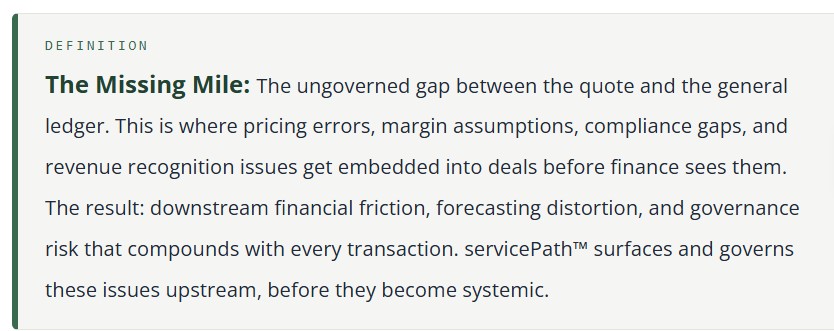
We discussed what I’ve been calling the “Missing Mile.” It’s the gap between the quote and the general ledger. This is where pricing decisions, margin assumptions, and compliance requirements either get governed or get buried. In most organizations, they get buried.
Here’s what that looks like in practice. A deal gets structured. Pricing is applied — sometimes from a CPQ tool, sometimes from a spreadsheet, sometimes from memory. Margin assumptions are made. Approval workflows are followed or bypassed. Compliance requirements are checked or assumed.
Then the deal moves downstream — into the ERP, billing, forecast, and revenue recognition. By the time finance sees it, every assumption is already embedded. Every gap is already operational.
A pricing error becomes a billing problem. A margin miscalculation becomes a forecasting distortion. A compliance oversight becomes an audit risk. The organization didn’t create these problems intentionally. It created them structurally — by leaving the Missing Mile ungoverned.
How Do Agent-to-Agent Systems Change the AI Governance Risk Equation?
Here’s why the Missing Mile matters more now than ever.
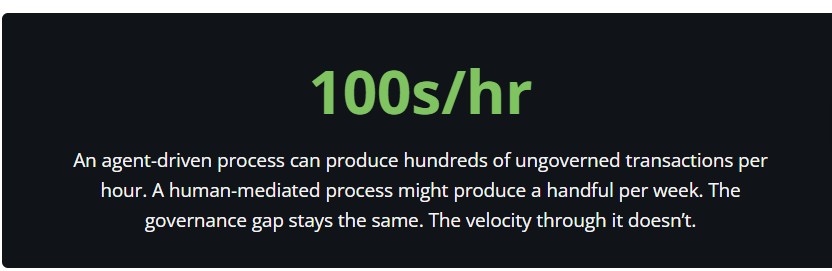
Enterprise transactions are increasingly becoming headless. Autonomous systems interact directly across finance, operations, procurement, and sales. Often, there’s less human mediation than anyone wants to admit.
Clement and I discussed agent-to-agent communication at length. AI-driven systems now negotiate, validate, route, and execute transactions across organizational boundaries. No human reviews every step. This isn’t theoretical. It’s being built right now, inside real enterprises.
When those transactions flow through ungoverned territory, the consequences compound at machine speed. The quoting layer doesn’t talk to the financial governance layer. Pricing logic is disconnected from margin policy. Deal structures bypass compliance frameworks entirely.
By the time those issues surface in ERP, billing, or forecasting, the organization isn’t solving a quoting problem. It’s dealing with financial friction, margin leakage, and governance risk baked into every transaction.
That’s the Missing Mile. In autonomous finance, it’s the mile that matters most.
Why Do AI Vendors Say Deterministic Systems Matter More in Autonomous Finance?
I also had several discussions with vendors powering leading AI ecosystems. Many work closely with Anthropic and other major AI platforms. These conversations reinforced a pattern I’ve been tracking.
In the era of AI, precision and deterministic systems become more important — not less. The vendors building AI infrastructure understand this. The models are only as good as the systems they operate within.
A large language model can process a contract, extract pricing terms, and route an approval. But if the governance framework underneath is absent, the model automates a broken process at scale.
The recurring message was consistent. Enterprises that move fast with AI need governed, structured systems underneath. Otherwise, they scale bad decisions at the same velocity as good ones. The amplification works in both directions.
That’s the tension at the heart of this conference. And it’s the tension servicePath™ was built to resolve.
Why Are So Many Enterprises Stalled on AI — and What’s the Cost of Waiting?
One of the most striking themes today was the paradox of enterprise paralysis. Several analysts expressed genuine surprise at how many large enterprises remain stalled.
It’s not that they don’t understand the urgency. They do. But they’re frozen by overlapping forces. Indecision about which AI investments to prioritize. Uncertainty about long-term architecture. Governance concerns without clear owners. No operating model for AI in finance workflows. And fear that moving too fast on the wrong bet could backfire.
I understand those concerns. They’re legitimate. Every CFO I talk to manages this tension — the pressure to move fast against the responsibility to move right. The fear of locking into an obsolete AI architecture is real.
But the paradox is equally real. The longer you wait, the deeper the governance gaps get. Data keeps flowing. Deals keep closing. Transactions keep moving through systems that weren’t designed for autonomous decision-making. Every quarter of inaction adds ungoverned complexity. And the cost of unwinding it grows exponentially.
Peter Hinssen’s guest keynote — “The Uncertainty Principle: How to Lead in the Never Normal” — drove this home. Hinssen’s thesis: uncertainty isn’t a phase. It’s the permanent operating condition.
The idea that things will stabilize is an illusion. Organizations waiting for clarity before acting are making the most dangerous decision of all. They’re choosing to fall behind while the environment accelerates.
Hinssen argues that the greatest breakthroughs happen inside uncertainty, not after it resolves. I agree. The organizations that learn to operate within uncertainty will define the next decade of enterprise finance.
The “Never Normal” framing resonated deeply with what I see at servicePath™. The organizations winning aren’t the ones with perfect AI strategies. They’re the ones that put governance and control first. They built the infrastructure before the autonomous operations started running through it.
How Does servicePath™ Close the Missing Mile Before It Becomes Systemic?
This is the core of what we’re building at servicePath™. Our approach surfaces and governs issues upstream. Before the deal is structured, approved, and operationalized. Before margin leakage is embedded. Before the forecast is distorted. Before the compliance gap has replicated across hundreds of transactions.
The Missing Mile isn’t a quoting problem. It’s a financial governance problem. In an environment where agents communicate with agents and execution outpaces oversight, closing the Missing Mile creates structural advantage.
Deterministic systems. Governed workflows. Upstream visibility. Structured decisioning. These aren’t legacy concepts in new language. They’re the foundation autonomous finance requires to function without creating more risk than it eliminates.
What Should CFOs Watch at Gartner Finance Symposium Over the Next Two Days?
The energy at this conference is outstanding. The Gaylord Convention Center in National Harbor is world-class. Conversations started early and ran well into the evening along the harbor waterfront.
Beyond the atmosphere, I’m watching for three things.
First, how deeply is the autonomous finance narrative penetrating practitioner sessions? Are enterprises bringing real implementation stories — real numbers, timelines, and architectural decisions? Or are we still in framework territory?
Second, how are vendors positioning AI governance in finance? There’s a real risk “AI governance” becomes an empty buzzword. The organizations that get this right will build governance into the transaction layer. They won’t bolt it on as a reporting function after the fact.
Third, which enterprises have actually moved? The ones that built governance infrastructure before waiting for perfect clarity. Those stories will define the next chapter of finance transformation.
Shipley and Christensen asked the right question this morning: how do CFOs become architects of AI-driven transformation? The answer starts with closing the governance gaps most organizations don’t realize are open.
It starts with the Missing Mile.
Some Photos from the Event

Frequently Asked Questions
Conference theme: “Autonomous Finance: Building Resilient, AI-Driven, and Value-Centric Enterprises.”