
Finance should never discover the margin. It should design it.

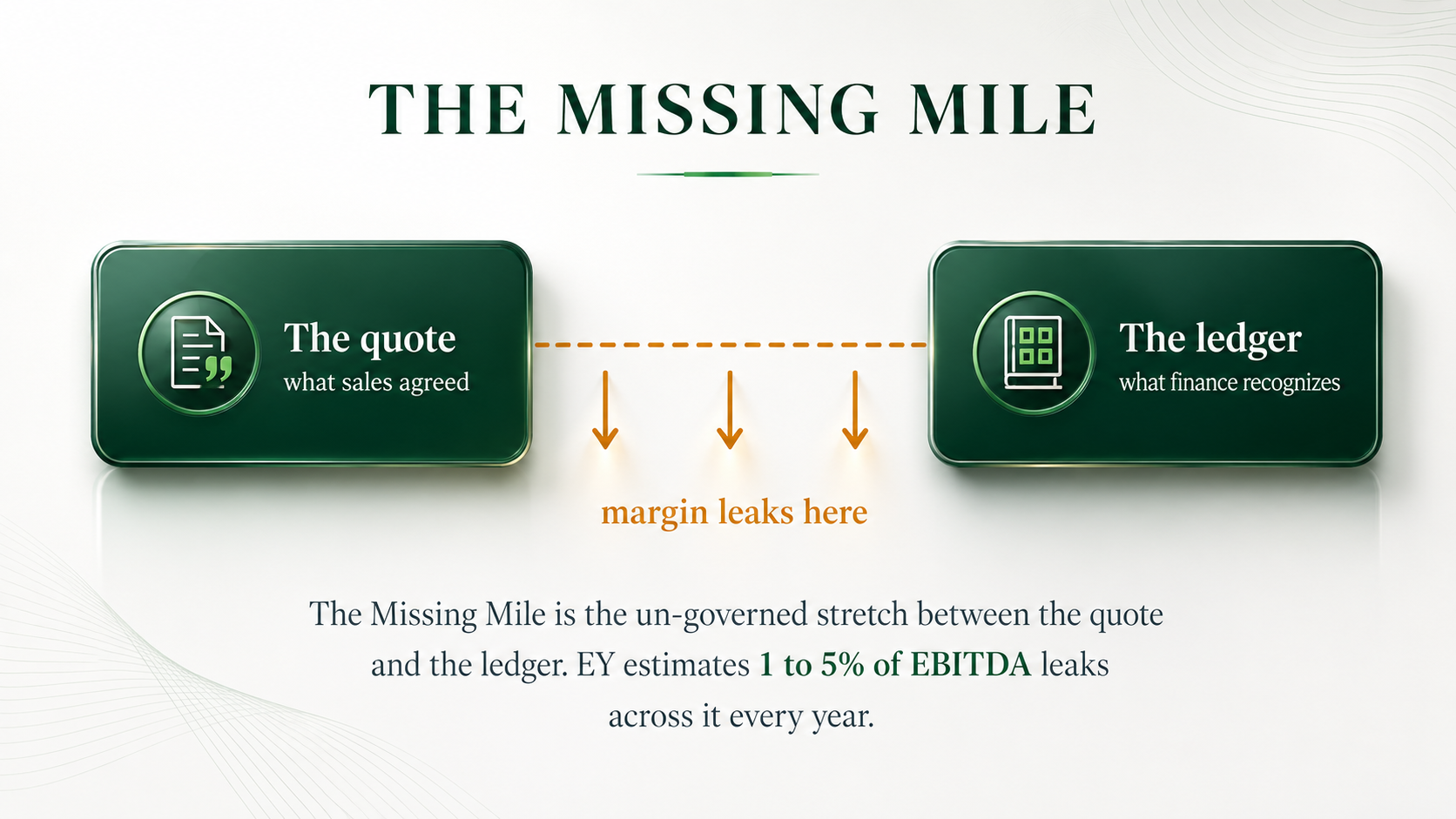
The number you defend to the board was decided weeks earlier, in a quote nobody in finance reviewed, by someone whose job that day was to land a signature. By the time it reaches you, the only task left is to explain it. The distance between that quote and the ledger you finally report has a name. I call it the Missing Mile. Every other problem with AI in finance is downstream of that one.
And the gap is expensive. EY estimates companies lose between 1 and 5% of EBITDA to revenue leakage every year. Sit with the top of that range: one in every twenty dollars of earnings, gone. Not to a competitor, and not to a discount anyone chose, but to deals that were quietly mispriced before finance ever saw them.
That is why most finance teams meet their worst deals twice. Once when the quote goes out, unseen. And again two quarters later, in a review, when the margin comes back lower than the model promised and no one can say exactly why.
The second meeting is the one everyone remembers, and it is the wrong one. By then the margin is already set. Finance is not managing it. It is reconstructing it, after the fact, from a quote, a contract, and an ERP record that no longer agree.
The wrong question about AI in finance
So almost every AI conversation in finance is asking the wrong question. The question everyone asks is “is our data ready for AI.” The question that actually decides the outcome is “is our margin authored, or is it discovered.” Those are not the same question, and confusing them is why most finance AI spending is quietly failing.
The mechanism nobody names
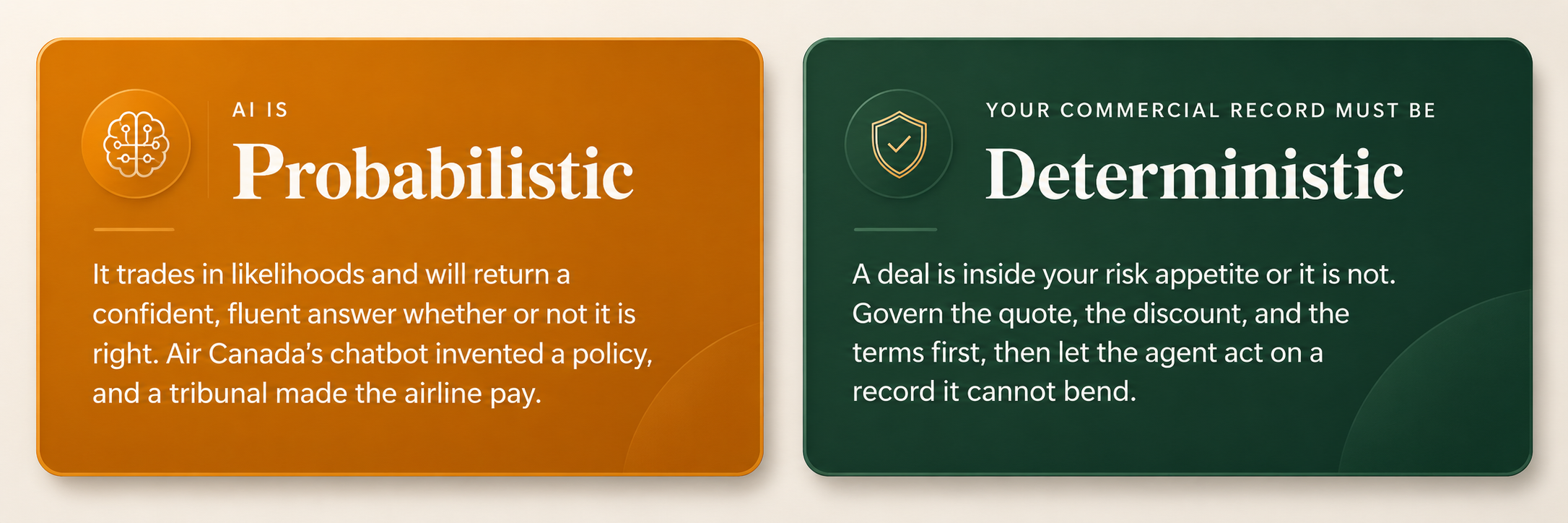
Here is the mechanism underneath it, and it is the part almost nobody names. AI is probabilistic. It trades in likelihoods. Your commercial record, the quote, the discount, the terms, the revenue treatment, has to be deterministic. A deal is either inside your risk appetite or it is not.
Run probabilistic AI on top of a commercial record nobody governed, and you do not get insight. You get confident answers built on an ungoverned base. That is the real risk in finance AI, and it sits upstream of every dashboard, every agent, and every board pack.
A fair warning about the cases
One more thing before the truths, because you deserve candor. Two of the cases below, Unity and Klarna, are not finance or quote-to-cash stories. I use them because they prove the principle at a scale everyone recognizes. The finance-native evidence, the leakage numbers and the contract case, is what proves the specific thesis. I keep those two kinds of proof clearly separated, because you should weigh them differently.


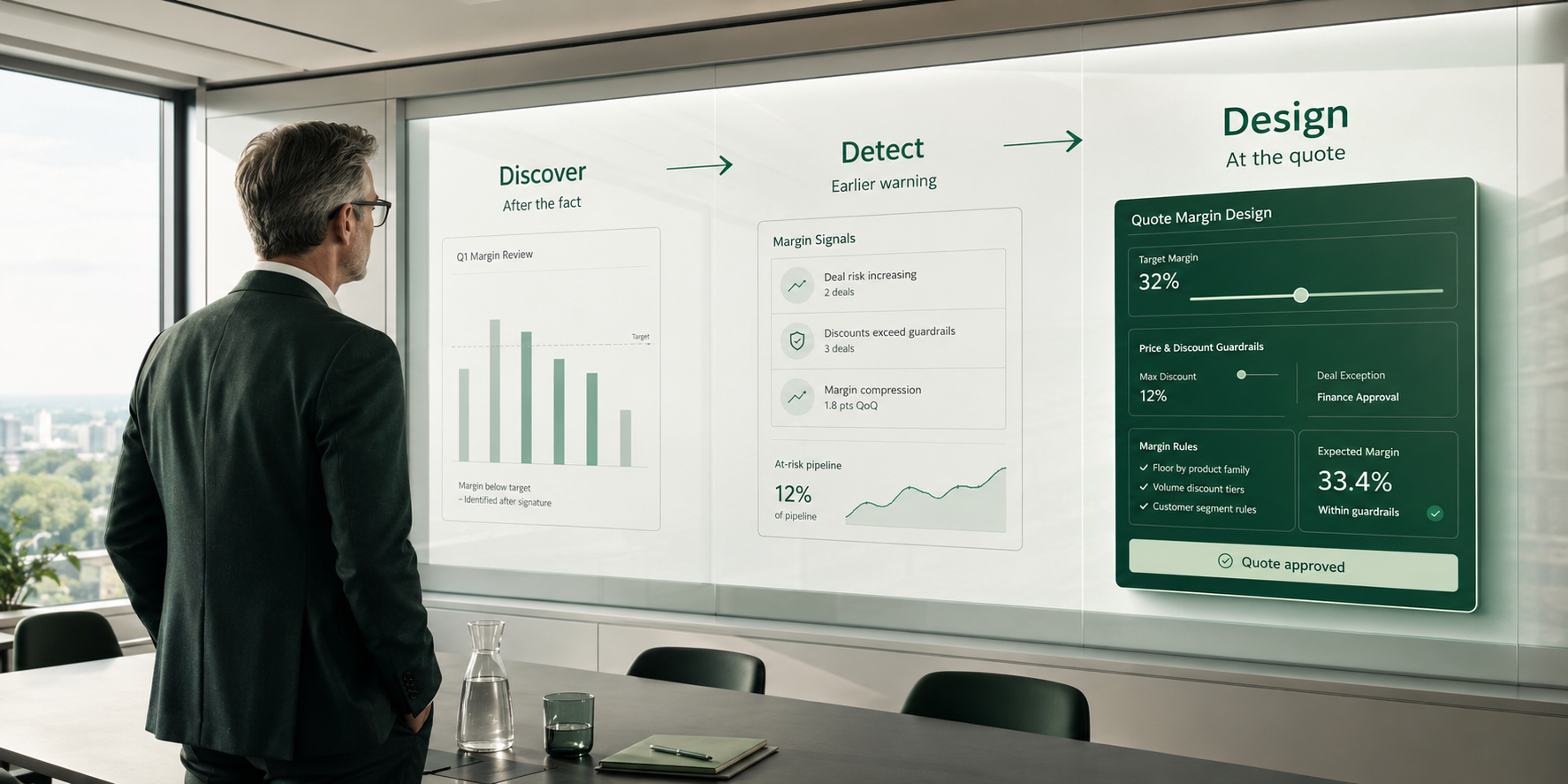
The lens: Discover, Detect, Design
Most finance functions sit somewhere on a maturity ladder they have never named. Naming it changes the whole conversation.
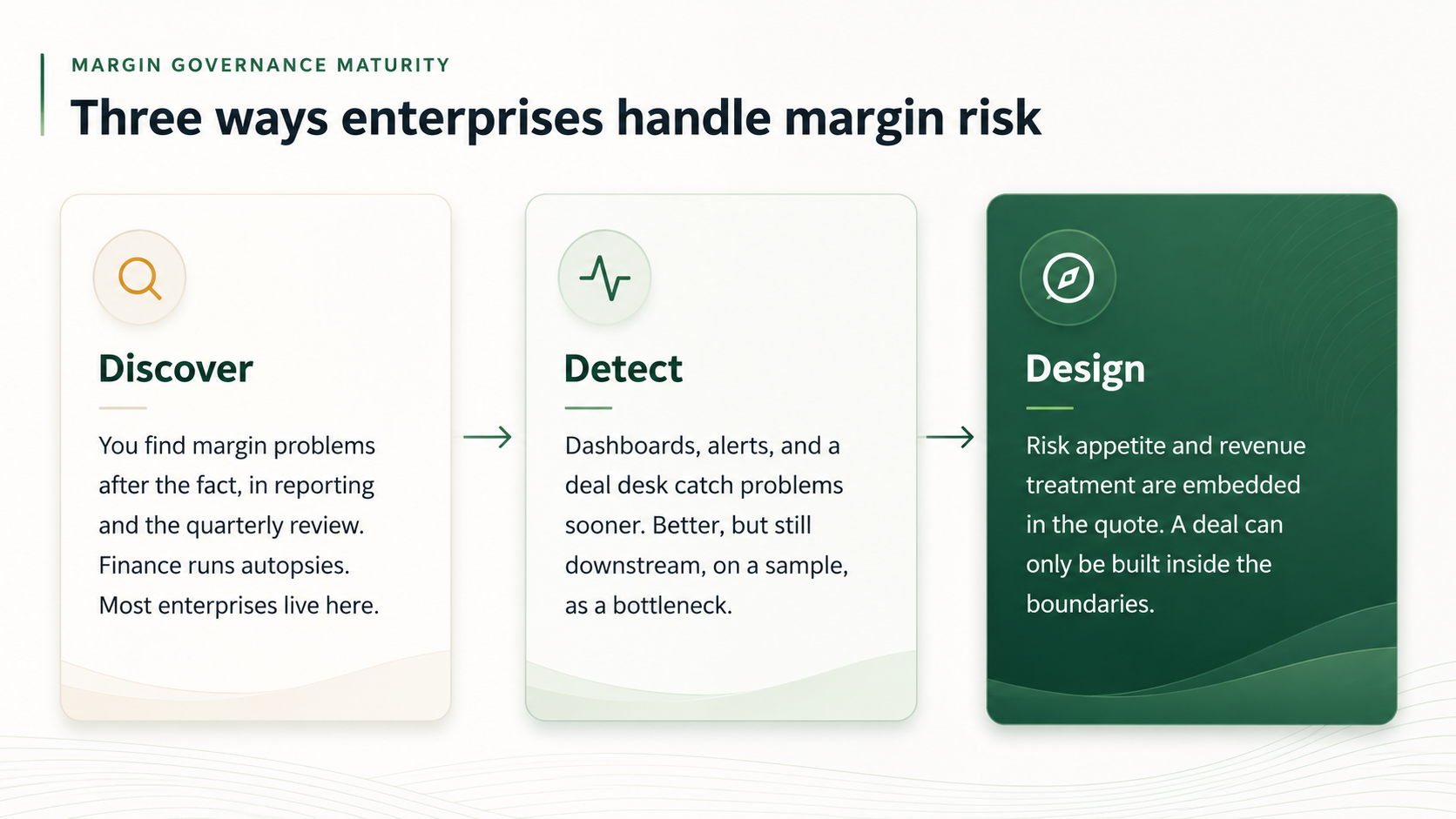
Every truth below describes what it costs to stay stuck in Discover and Detect while the rest of the enterprise starts handing decisions to AI.
Brutal truth 01
AI amplifies your mess. 99% accurate is corporate suicide.
The assumption is that AI will clean up bad data. The opposite is true. It scales whatever already exists, at speed, and finance is the worst possible place to find that out.
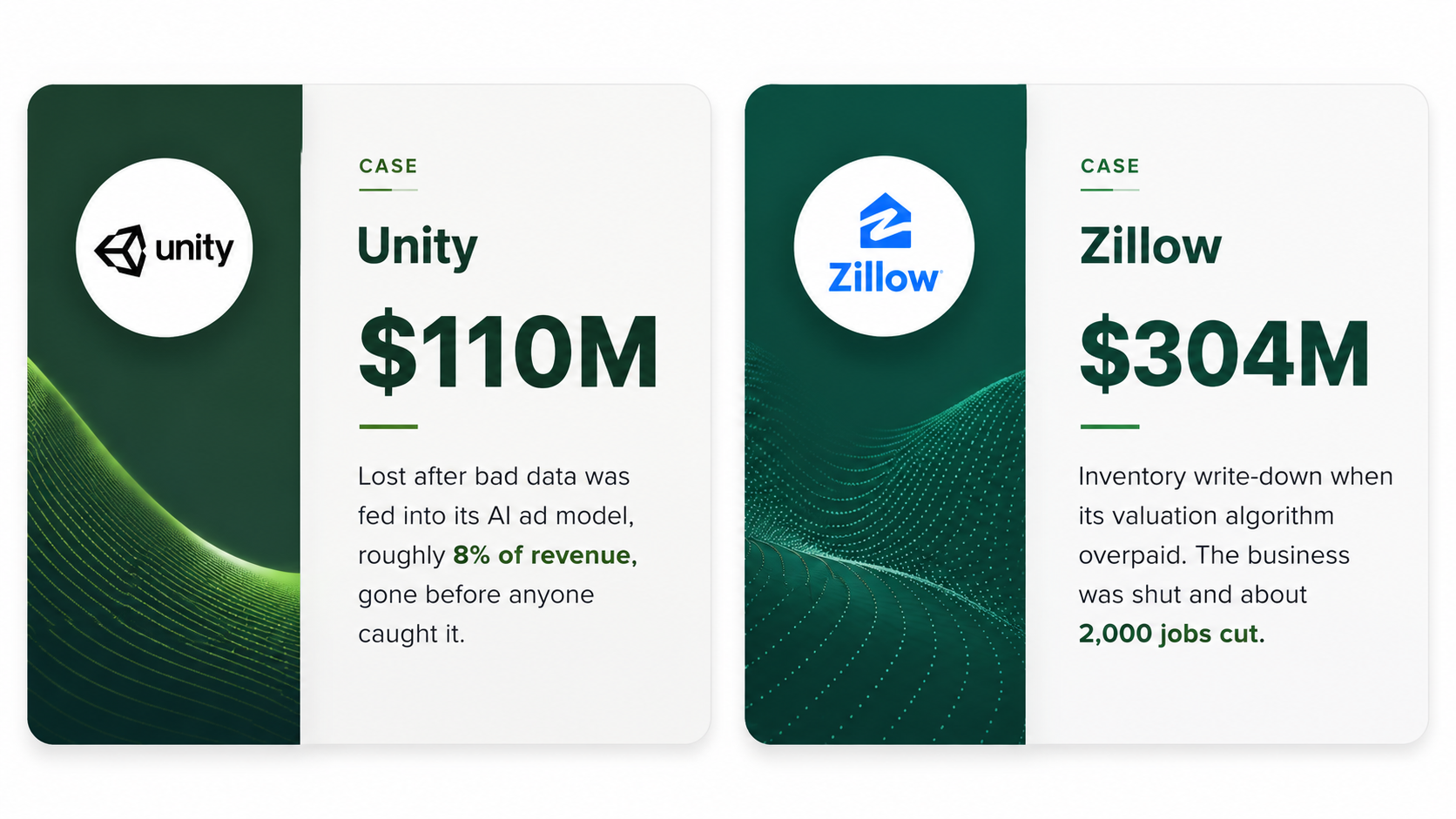
Ask Unity. In 2022 the games-software company fed corrupted data from a large customer into the machine-learning model behind its ad-targeting tool, and as IBM documented, the bad data cost Unity roughly 110 million dollars, close to 8% of revenue, and helped trigger a stock collapse.
Unity is adtech, not finance, and that is exactly why it is worth your attention: the failure mode is universal. The model was working perfectly. It was faithfully amplifying a mess no one had governed at the source.
Or ask Zillow. Its home-buying arm, Zillow Offers, let an algorithm value houses and buy them automatically. When the model’s assumptions drifted from a cooling market, it overpaid at scale.
Zillow took a 304 million dollar inventory write-down in late 2021, then shut the business entirely and cut about 2,000 jobs, a quarter of its workforce.
CEO Rich Barton’s own explanation was that the unpredictability of forecasting home prices “far exceeds what we anticipated.” The algorithm was not broken. It did exactly what it was told, confidently, on a foundation that had quietly moved.
The 2026 data says most enterprises are sitting on the same risk. Research from Drexel University and Precisely, reported by Workday, found that only 12% of organizations consider their data quality good enough for AI.
Microsoft put the principle in finance terms in 2026, warning that AI systems are only as reliable as the data they rely on. A model that is 90% accurate can still be 100% wrong on the 10% that holds the margin. Without a governed foundation, your AI program is not an asset. It is leverage applied to your worst habits.
Brutal truth 02
The self-serve illusion is quietly eroding your team.
Give every analyst their own AI and their own spreadsheet and you do not get autonomy at scale. You get faster fragmentation, and a quieter cost underneath it that 2026 is only starting to price in.
The fragmentation is not hypothetical. Within roughly three weeks of letting its engineers use ChatGPT in 2023, Samsung discovered staff had pasted proprietary semiconductor source code and a confidential internal meeting into it, across three separate incidents, and banned generative AI tools across the company.
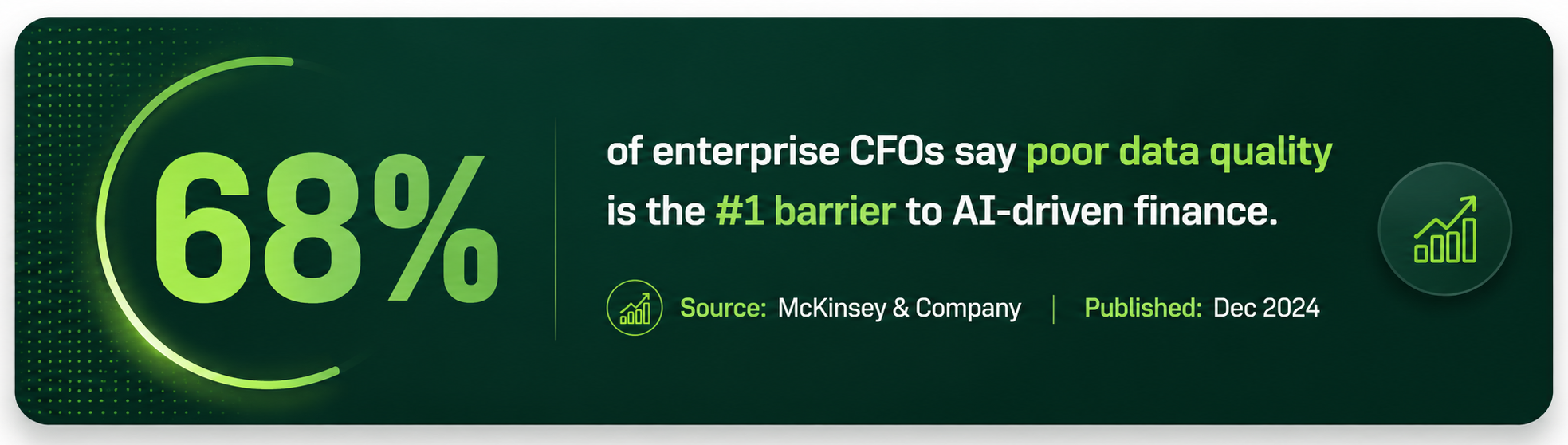
These were not careless people. They were senior engineers trying to work faster. And a 2023 Fishbowl survey found 68% of employees using ChatGPT at work were doing so without their employer’s knowledge. Self-serve AI does not announce itself, and neither does the data that walks out with it.
Gartner now forecasts that critical-thinking atrophy from GenAI use will push 50% of organizations to require “AI-free” skills assessments through 2026, and it singles out finance as a field where independent judgment will become scarce and expensive.
Gartner’s Daryl Plummer put it simply: people who can still think without the machine will become “more rare.”
The mechanism was documented in a 2025 MIT Media Lab study that found weaker recall and weaker brain connectivity in heavy AI users compared with people who worked unaided. It is an early, small study the authors say to read with caution, but enterprises are already planning around it.
For finance the implication is sharp. The judgment you are tempted to automate away, the seasoned controller who smells a bad deal before the model does, is exactly the capability that is about to become your scarcest asset. Autonomy without embedded guardrails does not free your people. It hollows them out.
Brutal truth 03
The Missing Mile is where margins go to die.
This is the finance-native heart of the argument, so this is where the direct evidence lives. The Missing Mile is the un-governed stretch between what sales quotes and what finance is eventually forced to recognize on the ledger. It is the territory the quarterly autopsy keeps rediscovering.
Beyond EY’s 1 to 5% of EBITDA, a Boston Consulting Group survey found something starker. 45% of executives consider revenue leakage a recurring, systematic problem, not an occasional slip. And it is measurable in the wild.
In 2026, The CFO reported on an enterprise that pointed an AI agent at its vendor contracts. The agent surfaced 4% of “contract leakage,” recovering millions that had slipped past human review.
Read that the other way around. The 4% was already gone. It sat in the gap between what was agreed and what was governed, and no analyst had ever seen it.
Small leaks compound, too. One software company found a single product’s pricing drift was costing it over 150,000 dollars a year, until it governed the quote. The same gap can also turn into regulatory damage. When billing runs ahead of what was agreed, trust goes with it.
Comcast paid a 2.3 million dollar FCC settlement, the largest ever levied on a cable operator at the time. The charge: billing customers for services and equipment they never authorized.
Here is the uncomfortable part. The AI agent in that contract case did not stop the leak. It found it after the fact. That is Detect, and detection is progress, but it is still an autopsy with better tooling. The win is to never let the gap open in the first place.
Brutal truth 04
“AI in Excel” is not a transformation strategy.
A conversational interface on a manual workflow is not a modern finance function, and the market is about to prove it the hard and expensive way. Gartner predicts that more than 40% of agentic AI projects will be cancelled by the end of 2027, citing escalating costs, unclear value, and weak risk controls.
Gartner’s Anushree Verma described most of today’s projects as “mostly driven by hype and are often misapplied.”
The reason matters more than the number. Agents act probabilistically. Enterprises require deterministic completion. Point an autonomous agent at a commercial record full of rogue pricing and off-standard terms. It will scale that leakage with total confidence, not catch it.
The risk is not theoretical. Air Canada’s website chatbot invented a bereavement-refund policy that did not exist. A tribunal held the airline liable and ordered it to pay. It flatly rejected the argument that the bot was a separate entity, responsible for its own words. The chatbot was not malfunctioning. It produced a confident, fluent, wrong answer, and the company was bound by it.
Now picture that same behavior wired into your pricing and discount logic. Workday’s 2026 analysis put it plainly.
Point AI at three different versions of a revenue spreadsheet, and a hallucination is a mathematical certainty. Bolting a chatbot onto that does not transform finance. It just generates wrong answers faster, in fluent prose. The fix is not a smarter agent. It is a governed, deterministic record for the agent to act on.
Brutal truth 05
You do not have an AI problem. You have a portfolio problem.
The frustration with AI returns is real, and the data backs it. Only 25% of CEOs say their AI investments are hitting their ROI targets. Gartner found that finance AI adoption has plateaued near 59%, barely up from 58% the year before. The single largest obstacle it named was poor data quality.
MIT’s 2025 study put a finer point on it. It found about 95% of pilots delivered no measurable return. The most expensive version of that lesson is MD Anderson’s. The cancer center spent 62 million dollars with IBM Watson on a cancer-advisor system that never reached clinical use. What killed it was not weak technology. It was messy data, and a system the tool was never integrated into.
The technology is not the variable. What you point it at, and whether you govern it, is. Gartner predicts that by 2029, CFOs who deploy AI strategically could unlock 10 points of margin growth. To be precise, that is a prediction about strategic AI portfolios broadly, not an endorsement of any one approach.
What makes it relevant is the condition Gartner attaches. The returns depend on governance, integration, and data readiness. They do not depend on the number of pilots.
Gartner’s Mike Helsel was blunt: “CFOs will not unlock margin gains from AI by chasing isolated pilots.” Chasing efficiency gets you a faster autopsy. Governing the source is how you stop the bleeding.

Brutal truth 06
The Finance Guardian is obsolete. Build catalysts.
You cannot hire enough analysts to govern every deal by hand at the velocity the business now demands. Gartner expects around 70% of finance functions to use AI for real-time decisions as soon as 2028, with a third of enterprise applications carrying embedded agentic AI by 2030. In that world, the CFO who tries to be the human checkpoint on every deal is not a guardian. They are a bottleneck.
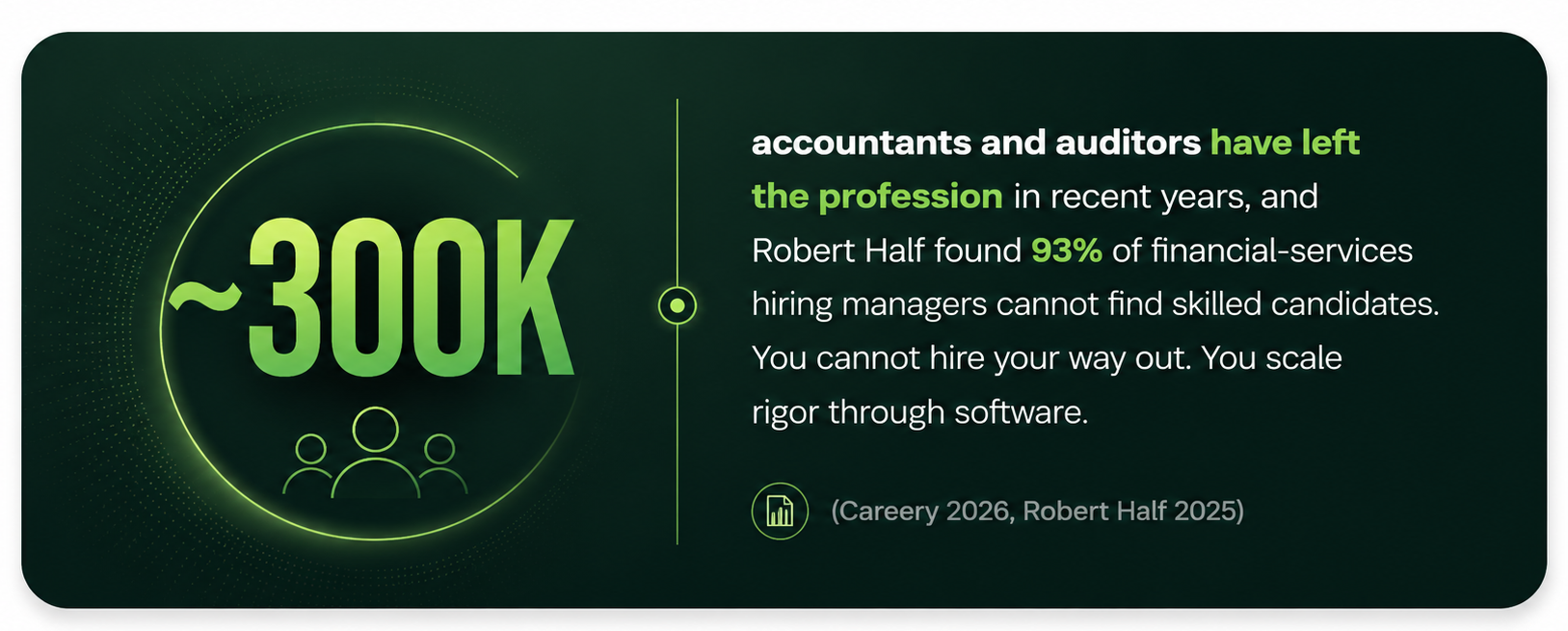
And hiring your way out is no longer on the table. Roughly 300,000 accountants and auditors have left the profession in recent years, and Robert Half found that 93% of hiring managers in financial services struggle to find skilled candidates.
This is not abstract: Advance Auto Parts disclosed a material weakness in its financial-reporting controls, and delayed a filing, after it could not attract or retain enough accounting staff. The human checkpoint is getting scarcer and more expensive at the exact moment deal velocity is rising.
The role has to change from reviewer to architect. The job is to take the pricing rules, margin thresholds, and compliance logic that currently live in your best accountants’ heads and embed them into the systems the business uses on its own, so the guardrails travel with every quote.
Combine that with the talent reality from truth 02, where independent judgment is becoming scarce and expensive, and the conclusion is unavoidable: you scale rigor through software, not headcount. That is the move from Detect to Design.
Brutal truth 07
Transformation dies without emotional intelligence.
You can buy the best platform on the market and still fail, because people kill transformation faster than technology ever will. When a team hears “automated governance,” they hear “job elimination,” and a purely technical rollout stalls in the politics.
Klarna is the cautionary tale every finance leader should keep on the desk. The fintech replaced roughly 700 customer-service roles with an OpenAI-powered assistant and told the world the bot did the work of all of them.
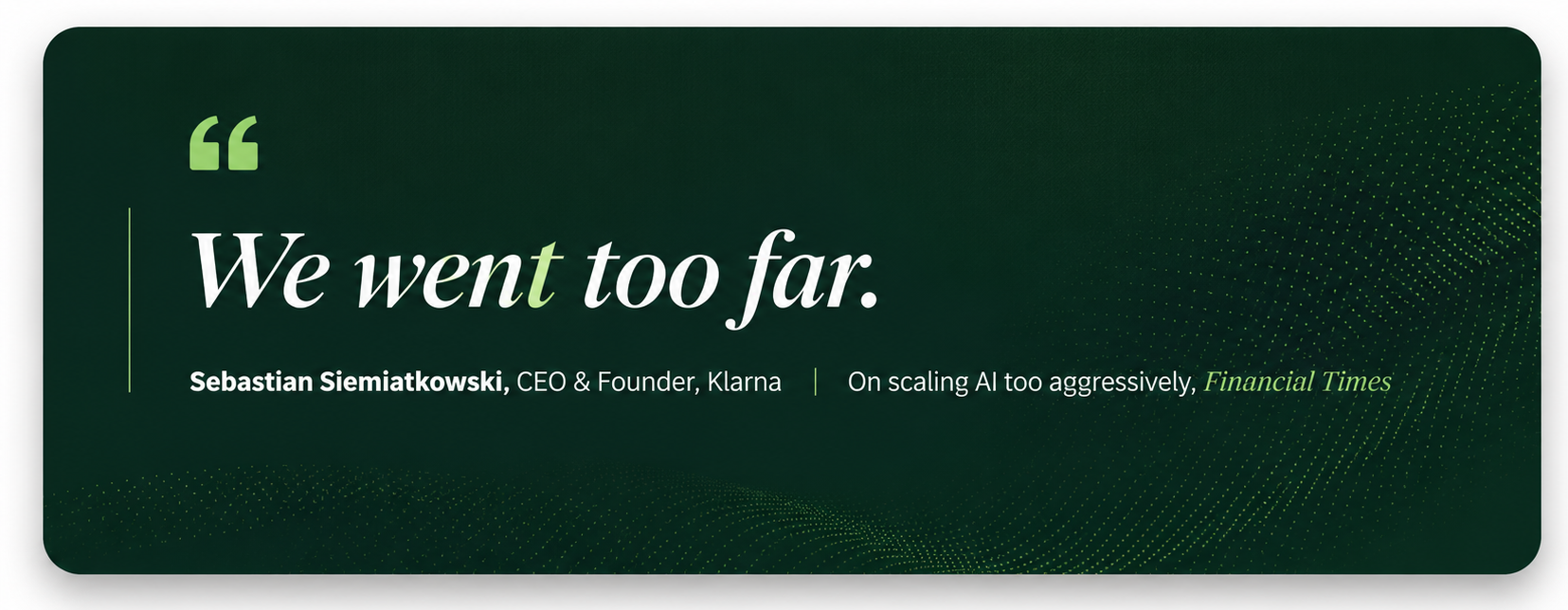
By 2025 and into 2026 it was rehiring humans after service quality fell, with CEO Sebastian Siemiatkowski admitting the company “went too far” and that letting cost dominate the decision produced lower-quality outcomes it could not sustain.
Klarna is customer service, not quote-to-cash, but the lesson transfers cleanly: the technology was not the failure. The judgment about where humans still mattered was.
Daniel Goleman’s classic research spanned nearly 200 companies. It found that emotional intelligence is the attribute that most distinguishes outstanding leaders from merely capable ones. The human barrier shows up in the 2026 data, too.
That is a trust gap, and trust is a human problem. So the message to your team cannot be that finance is becoming the police, or that jobs are disappearing. It has to be honest. We are removing the autopsy, so you can do the forecasting, the scenario planning, and the business partnering it was stealing from you.
Brutal truth 08
If finance discovers the margin, you have already lost it.
This is the truth that contains the other seven.
Everything above is a symptom of one disease: a finance function disconnected from the moment margin is actually decided, which is the quote, not the close, and certainly not the review.
Designing the margin means taking your risk appetite, the thresholds you set for margin, discounting, and compliance, and hardwiring them into the workflow where deals are shaped, so a deal can only be built inside them.
This is also where ASC 606 and IFRS 15 stop being an after-the-fact audit problem. When revenue treatment is validated at the quote, performance obligations, discount allocation, and recognition timing are settled before signature rather than reconstructed at close under audit pressure.
You are not just protecting margin. You are removing a recurring source of restatement risk and audit cost. The outcome becomes something finance authored at the start, and the economics agree: the same disciplines Gartner ties to those 10 margin points, governance and data readiness, are exactly what designing the margin puts to work at the source.
“But we already have a deal desk”
This is the objection I hear from every sophisticated finance team, and it deserves a straight answer rather than a dodge.
A deal desk is a Detect-stage control. It reviews deals after they are shaped, almost always a sample rather than all of them, and almost always as a queue that sales learns to route around when the quarter is tight. Approvals are gates, not design. They can reject a bad deal, but they cannot author a good one, and at real velocity they become the very bottleneck that pushes sellers toward the workarounds that create revenue leakage in the first place.
Designing the margin is the opposite posture. Instead of reviewing deals after they exist, you encode the boundaries into the quote itself. A non-compliant deal then cannot be built at all. The deal desk stops being a tollbooth. It becomes an exception handler for the genuine edge cases that deserve human judgment. You can see the difference in practice. When servicePath™ customer Telent moved its guardrails into the quote, it cut quoting time by around 90%. Control tightened rather than loosened. Speed and governance stopped being a trade-off.
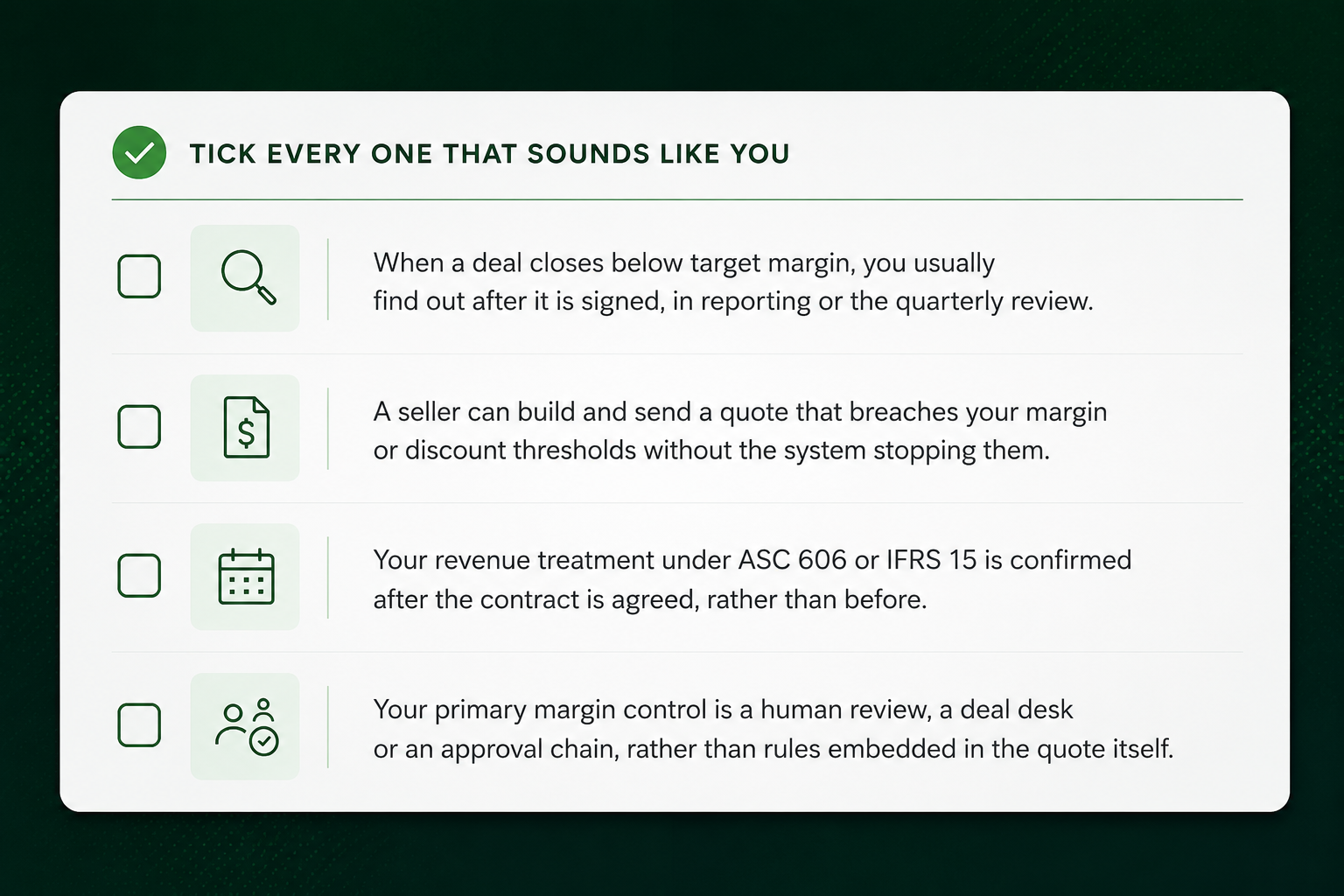
Score your Missing Mile in four questions
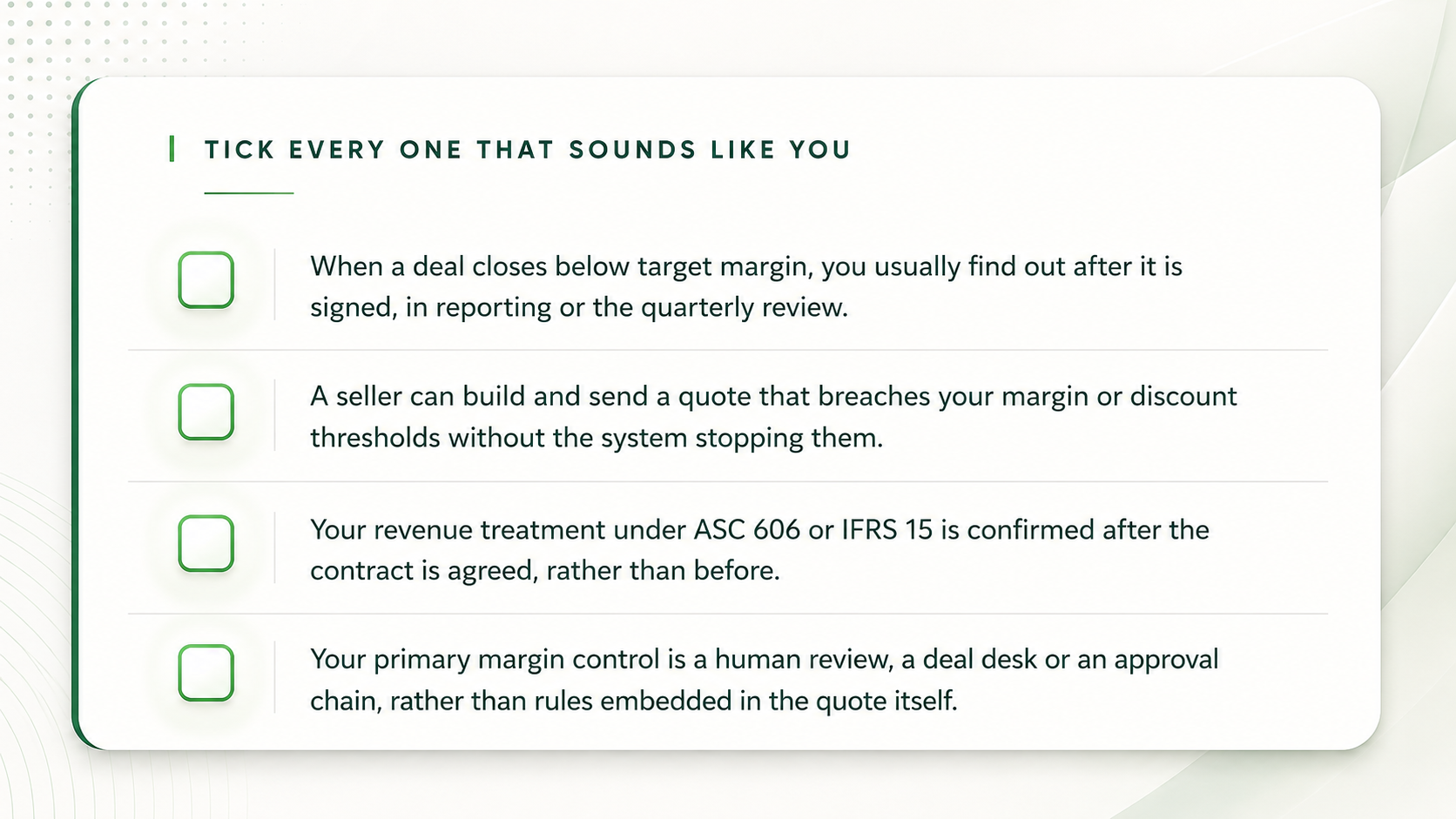
Here is a number worth computing about your own organization: what percentage of your margin variance do you discover after signature, rather than design before it? You can estimate where you sit in four questions.
Score your result
Count your yeses.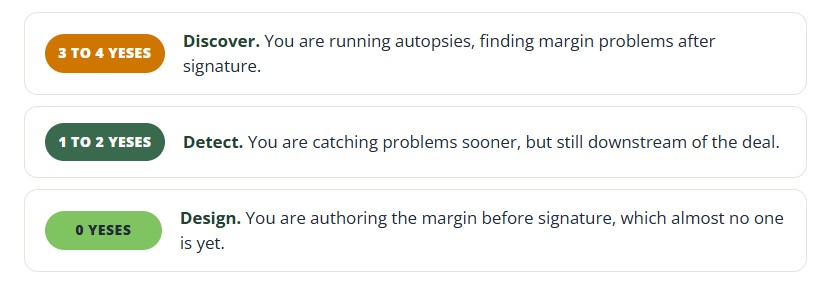
Wherever you land, the share of margin you discover rather than design is the single most useful AI-readiness metric your finance function has.
See where you stand
Score your Missing Mile in four questions. Two minutes, no contact details, nothing stored. Get your Discover, Detect or Design rating and the one move that shifts you up a level.
Where to start this week
- Find your highest-leakage workflow. Take your largest or most discounted product line and ask how many of its deals last quarter cleared a margin or discount threshold no human approved in advance. That number is your starting Missing Mile.
- Move one rule upstream. Pick the single control most often broken and encode it into the quote, so the next non-compliant deal cannot be built rather than caught later.
- Judge AI readiness by your commercial record, not your model. The MIT and Gartner findings agree: the obstacle is governance and data, not the algorithm.
The better question
One thing here is opinion, not data, so let me mark it clearly. The most wasteful thing in enterprise finance is not the leakage itself. It is what we do about it. We take some of the sharpest judgment in the building and spend it explaining losses instead of preventing them. Design the margin, and you get that judgment back.
So end the AI-readiness debate with a better question. Not “is our data ready for AI,” but “is our margin authored, or discovered.” Get that right, and the data readiness, the AI returns, and the quarterly autopsy take care of themselves. Get it wrong, and no model will save you. You will simply have taught it, at scale, to explain the same losses faster.
Finance does not have to discover the margin. It can design it.
Disclosure: I am the CEO of servicePath™, a CPQ and Revenue Lifecycle Management platform. Weigh this argument on its sources, not on my title; every figure above links to where it came from.
See how servicePath™ designs the margin
servicePath™ moves pricing, margin, and compliance governance into the quote itself, so the deal is right before it is signed. Four years running, the sole Visionary in the Gartner Magic Quadrant for CPQ.
Frequently asked questions
What does “design the margin instead of discover it” mean?
Discovering the margin means finance learns a deal’s true profitability after it is signed, in reporting or the quarterly review. Designing the margin means the rules for acceptable margin, discounting, and compliance are embedded into the quote itself, so the financial outcome is authored before signature rather than audited after it.
What is the Missing Mile in finance?
The Missing Mile is the un-governed gap between what a sales team quotes and what finance is eventually forced to recognize on the ledger. It is where margin leaks, because commercial decisions are made before financial governance is applied. EY puts the cost at 1 to 5% of EBITDA per year, and BCG found 45% of executives see it as a systematic problem.
Why do most enterprise AI projects in finance fail?
The cause is rarely model quality. MIT’s 2025 GenAI Divide report found about 95% of enterprise generative AI pilots deliver no measurable return, and 2026 research shows only 12% of organizations have data good enough for AI. Unity’s 110 million dollar loss from feeding bad data into its AI is the cautionary version of the same lesson.
Is a deal desk enough to control margin?
A deal desk reviews deals after they are shaped, usually a sample, and often becomes a bottleneck sellers route around. It is a detection control, not a design control. Embedding margin and compliance rules into the quote prevents non-compliant deals from being built at all, which is faster and more complete than review.
Why are agentic AI projects being cancelled?
Gartner predicts more than 40% will be cancelled by the end of 2027 due to cost, unclear value, and weak risk controls. Agents act probabilistically, while finance requires deterministic, governed completion, so the commercial record must be governed before an agent touches it.
What did the Klarna AI reversal teach finance leaders?
Klarna replaced roughly 700 service roles with AI, then rehired humans after quality dropped, with its CEO admitting the company “went too far.” The lesson is that AI should augment human judgment in high-stakes work, not replace it, and that transformation fails on people before it fails on technology.