Commercial Orchestration
What Is Commercial Orchestration?
Commercial Orchestration is the practice of integrating and synchronizing all revenue-generating functions—such as marketing, sales, CPQ (Configure, Price, Quote), contract management, order fulfillment, billing, and customer success—into a unified and automated workflow.
Rather than operating in silos, commercial orchestration ensures every commercial activity works together as one cohesive system. The result?
-
Faster, more accurate quotes
-
Streamlined approvals
-
Improved pricing governance
-
Seamless handoffs between teams
-
Stronger customer experiences
In complex B2B environments—especially those with subscription, usage-based, or hybrid pricing models—commercial orchestration is essential for scaling revenue without increasing operational friction.
Why Commercial Orchestration Matters
Modern revenue models are more complex than ever. Organizations must manage:
-
Multi-product bundles
-
Subscription and recurring revenue models
-
Global pricing variations
-
Channel partners
-
Regulatory compliance
-
Revenue recognition requirements
Without orchestration, these moving parts create bottlenecks, errors, and margin leakage.
Key Benefits of Commercial Orchestration
- Accelerated Sales Cycles
Automated workflows and guided selling reduce manual work and approval delays. - Improved Pricing Accuracy
Centralized pricing governance ensures consistency and protects margins. - Enhanced Customer Experience
A seamless journey from quote to cash improves buyer confidence and satisfaction. - Operational Efficiency
Eliminates duplicate data entry and disconnected systems. - Greater Revenue Visibility
Real-time insights across the revenue lifecycle support better forecasting and decision-making.
How Commercial Orchestration Works
Commercial orchestration connects core revenue systems into a structured, automated framework. These typically include:
-
CRM (Customer Relationship Management) – Manages opportunities and customer data
-
CPQ Software – Automates configuration, pricing, and quoting
-
Contract Lifecycle Management (CLM) – Streamlines contract creation and approvals
-
Order Management Systems (OMS) – Processes orders efficiently
-
Billing & Revenue Management – Handles invoicing, subscriptions, and revenue recognition
-
Customer Success Platforms – Supports renewals and expansions
Through automation, APIs, and workflow engines, these systems operate as one synchronized commercial ecosystem rather than isolated tools.
Power Commercial Orchestration at Enterprise Scale – Only with servicePath™
Commercial Orchestration vs. Traditional CPQ
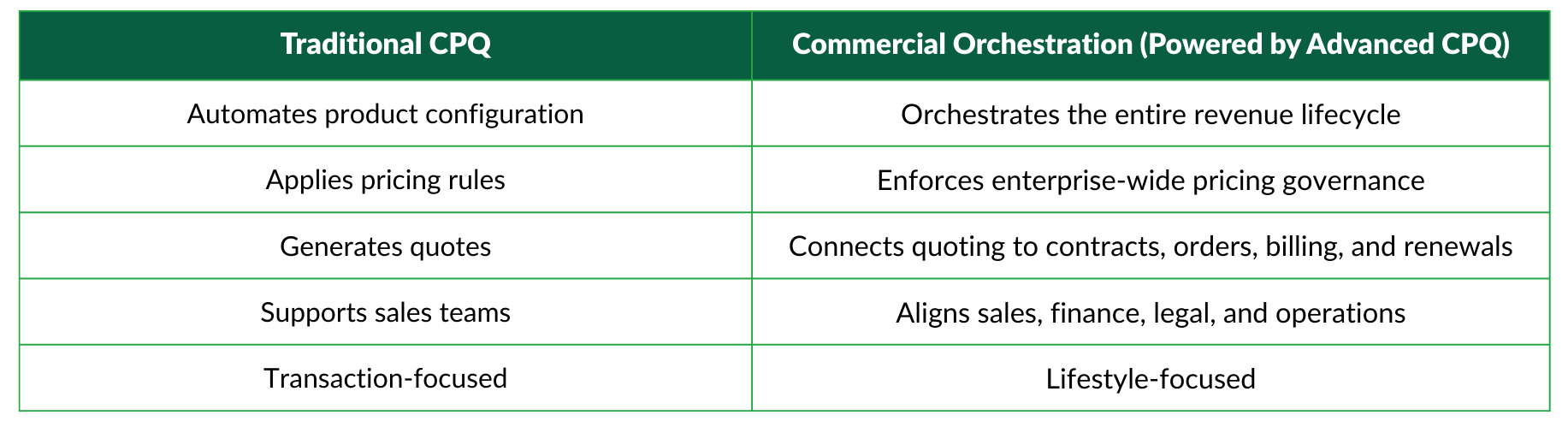
While traditional CPQ solutions focus on configuring products and generating quotes, modern commercial orchestration platforms go significantly further.
Commercial orchestration transforms CPQ from a quoting tool into the intelligent control center of the revenue lifecycle.
The Strategic Shift
In today’s complex B2B environments, CPQ is no longer just a sales tool. When architected correctly, it becomes the core orchestration engine that connects systems, enforces pricing strategy, automates approvals, and ensures commercial alignment across the organization.
At servicePath™, we view CPQ as the foundation of commercial orchestration.
Key Components of a Commercial Orchestration Strategy
-
Centralized pricing governance
-
Automated approval workflows
-
Integrated revenue systems
-
Subscription lifecycle management
-
Data consistency across platforms
-
Real-time reporting and analytics
-
Scalable architecture for global operations
Common Challenges Without Commercial Orchestration
Organizations that lack orchestration often face:
-
Quote errors and rework
-
Revenue leakage
-
Delayed contract approvals
-
Inconsistent pricing
-
Poor cross-department communication
-
Manual reconciliation between systems
These issues compound as businesses grow.
Transform Commercial Complexity into Competitive Advantage
-
Commercial orchestration is no longer a future-state ambition — it is a competitive necessity. As pricing models grow more complex, subscription strategies evolve, and global operations expand, disconnected systems and siloed processes create risk, delay, and margin erosion. True commercial orchestration brings structure, governance, and intelligent automation to the entire revenue lifecycle — aligning sales, pricing, legal, finance, and operations into one cohesive, high-performance engine.
At servicePath™, we don’t just automate quotes — we power commercial orchestration at scale. Our advanced CPQ and revenue automation capabilities serve as the foundation for enterprise-grade pricing governance, seamless system integration, automated workflows, and lifecycle visibility from opportunity through renewal. The result is faster deal velocity, stronger margin control, reduced operational friction, and a superior customer buying experience.
Discover how servicePath™ helps you stay ahead
Related Terms
-
-
Revenue Orchestration
-
Quote-to-Cash (Q2C)
-
Configure, Price, Quote (CPQ)
-
Contract Lifecycle Management (CLM)
-
Revenue Lifecycle Management
-
Sales Enablement
-
Subscription Management
-
Pricing Governance
-
Order-to-Cash
-
Frequently Asked Questions (FAQs)
1) Is commercial orchestration the same as revenue orchestration?
They are closely related. Revenue orchestration often focuses on financial outcomes, while commercial orchestration encompasses broader operational alignment across sales, pricing, contracts, and billing.
2) Who benefits most from commercial orchestration?
Industries with complex pricing models—such as telecommunications, manufacturing, SaaS, healthcare technology, and financial services—benefit significantly.
3) Does commercial orchestration require replacing existing systems?
Not necessarily. Many organizations implement orchestration by integrating and automating their current CRM, CPQ, ERP, and billing systems.
4) How does AI support commercial orchestration?
AI enhances forecasting, pricing optimization, guided selling, risk detection in contracts, and churn prediction—strengthening the orchestration framework.