Commercial Excellence
What Is Commercial Excellence?
Commercial Excellence is a strategic, cross-functional approach to optimizing an organization’s revenue-generating capabilities—including sales, pricing, marketing, channel management, and customer success—to achieve sustainable growth, improved profitability, and superior customer experiences.
It focuses on aligning people, processes, technology, and data to maximize commercial performance across the entire customer lifecycle—from lead generation to renewal and expansion.
At its core, Commercial Excellence ensures that a company:
-
Sells the right products and services
-
At the right price
-
To the right customers
-
Through the right channels
-
With the right tools and processes
Why Commercial Excellence Matters
In today’s competitive markets, product differentiation alone is not enough. Organizations must execute flawlessly across their commercial operations.
A well-implemented Commercial Excellence strategy enables companies to:
-
Increase revenue growth and win rates
-
Improve pricing discipline and margins
-
Enhance sales productivity
-
Strengthen customer retention and lifetime value
-
Improve forecast accuracy and pipeline visibility
-
Align sales, finance, marketing, and operations
Companies that prioritize Commercial Excellence consistently outperform competitors in revenue growth and profitability because they turn commercial strategy into measurable execution.
The Core Pillars of Commercial Excellence
While frameworks may vary, most Commercial Excellence programs are built around five core pillars:
1. Commercial Strategy & Segmentation
-
Clear target markets and ideal customer profiles (ICPs)
-
Data-driven customer segmentation
-
Value proposition alignment
2. Pricing & Revenue Optimization
-
Value-based pricing strategies
-
Discount governance and approval workflows
-
Margin protection mechanisms
-
Dynamic pricing capabilities
3. Sales Effectiveness & Enablement
-
Structured sales processes
-
Playbooks and guided selling
-
Incentive compensation alignment
-
CRM and CPQ optimization
4. Commercial Operations & Technology
-
Integrated CRM, CPQ, and billing systems
-
Automated workflows and approvals
-
Data analytics and performance dashboards
-
Revenue lifecycle management
5. Customer Experience & Retention
-
Streamlined quote-to-cash processes
-
Accurate proposals and contracts
-
Renewal and expansion management
-
Cross-sell and upsell strategies
Transform Your Revenue Lifecycle Into a Predictable Growth Engine – Only with servicePath™
Commercial Excellence Framework
A structured Commercial Excellence framework typically follows this cycle:
-
Assess – Audit current commercial performance, tools, and processes
-
Design – Define strategy, governance, pricing, and process improvements
-
Implement – Deploy systems such as CPQ, CRM enhancements, and automation
-
Enable – Train teams and align incentives
-
Optimize – Continuously measure KPIs and refine execution
This ongoing improvement model ensures sustained competitive advantage rather than one-time transformation.
KPIs in Commercial Excellence
Organizations measure Commercial Excellence using both revenue and operational metrics, including:
-
Revenue growth rate
-
Gross margin improvement
-
Average selling price (ASP)
-
Discount percentage
-
Win rate
-
Sales cycle length
-
Customer acquisition cost (CAC)
-
Customer lifetime value (CLTV)
-
Renewal and retention rates
-
Forecast accuracy
These metrics help leadership evaluate both efficiency and effectiveness across the revenue engine.
Real-World Example
Consider a B2B technology company struggling with inconsistent pricing, manual quoting, and long approval cycles.
By implementing a Commercial Excellence initiative, the company:
-
Standardized pricing and discount rules
-
Deployed a CPQ solution for automated quote generation
-
Integrated CRM with revenue analytics dashboards
-
Introduced value-based selling training
The results included:
-
15% margin improvement
-
25% faster quote turnaround
-
10% increase in win rates
-
Improved forecast accuracy
This demonstrates how Commercial Excellence drives measurable, sustainable impact.
Commercial Excellence vs. Sales Excellence
-
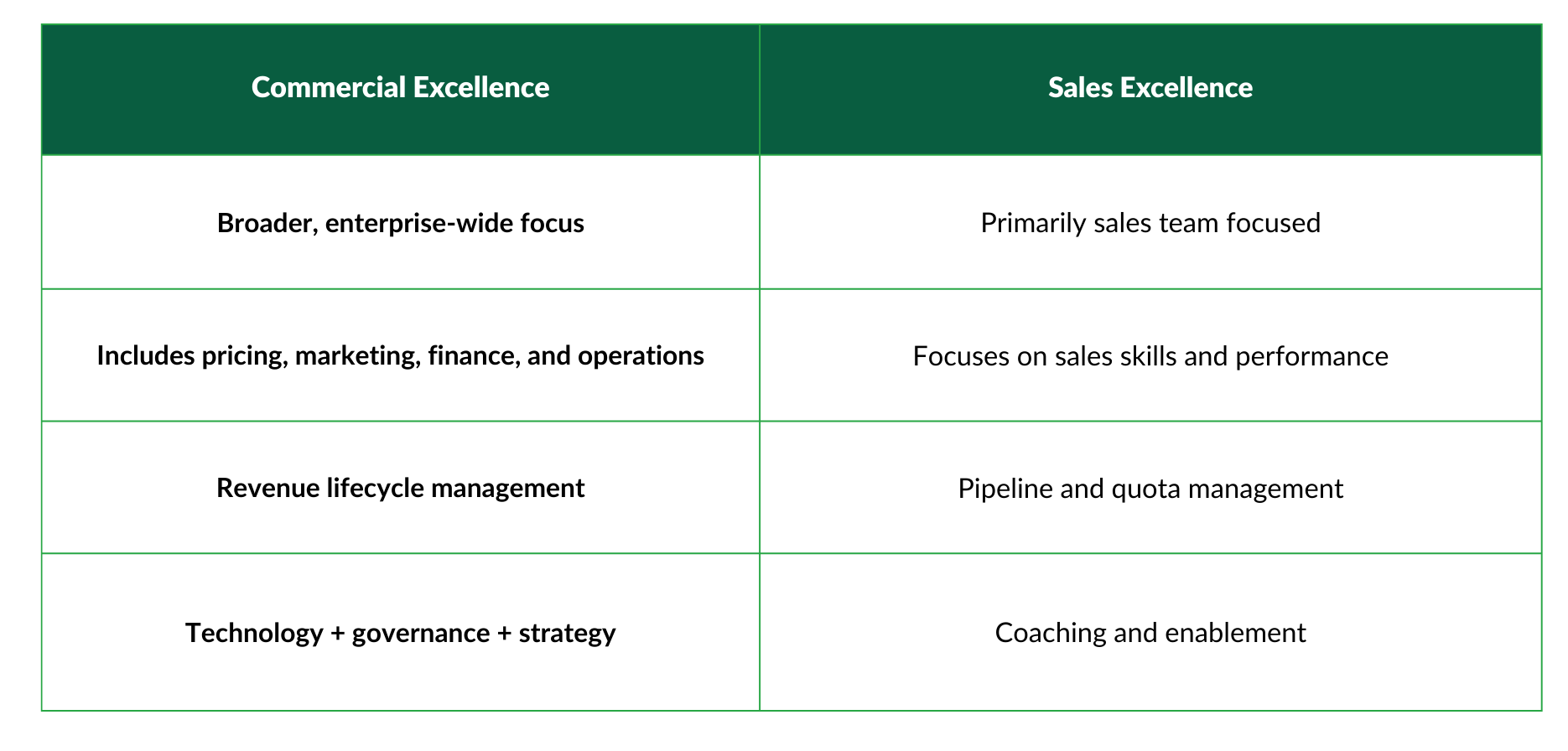
Although often used interchangeaby, the terms differ:
-
Commercial Excellence is holistic; Sales Excellence is one important component within it.
Technology’s Role in Commercial Excellence
-
Modern Commercial Excellence initiatives rely heavily on technology platforms such as:
-
CRM systems for pipeline visibility
-
CPQ (Configure, Price, Quote) for pricing accuracy and speed
-
Revenue lifecycle management tools
-
Analytics platforms for forecasting and performance monitoring
-
Automation tools for approvals and compliance
Without integrated systems, organizations struggle to scale commercial performance effectively.
-
Common Challenges in Achieving Commercial Excellence
-
Siloed departments and misaligned incentives
-
Inconsistent pricing governance
-
Manual quote-to-cash processes
-
Poor data visibility
-
Lack of change management
Successful organizations address both cultural and technological transformation simultaneously.
Related Terms
-
Sales Excellence
-
Revenue Operations (RevOps)
-
Pricing Strategy
-
Revenue Optimization
-
Quote-to-Cash (QTC)
-
Configure, Price, Quote (CPQ)
-
Margin Management
-
Go-to-Market Strategy
-
Commercial Strategy
-
Revenue Lifecycle Management
Driving Commercial Excellence with servicePath™
Commercial Excellence is a competitive imperative—and execution is everything. servicePath™ transforms commercial strategy into measurable results by automating complex configurations, enforcing pricing discipline, accelerating quote-to-cash cycles, and delivering real-time revenue visibility. The result: protected margins, faster sales cycles, improved forecast accuracy, and scalable growth. Ready to turn Commercial Excellence into a true performance advantage?
Discover how servicePath™ helps you stay ahead
Frequently Asked Questions (FAQs)
1) What is the goal of Commercial Excellence?
The primary goal is to maximize profitable revenue growth by aligning strategy, pricing, sales execution, and technology across the entire customer lifecycle.
2) Is Commercial Excellence only for large enterprises?
No. While often associated with large organizations, mid-sized companies benefit significantly from structured pricing governance, CPQ automation, and sales process optimization.
3) How long does it take to implement Commercial Excellence?
It depends on organizational complexity, but phased implementations typically span 6–18 months, with measurable gains often appearing within the first year.
4) What is the difference between Commercial Excellence and Revenue Operations (RevOps)?
Revenue Operations focuses on operational alignment of sales, marketing, and customer success systems. Commercial Excellence is broader, encompassing strategic pricing, governance, segmentation, and long-term growth optimization.
5) Does Commercial Excellence require CPQ software?
Not necessarily—but for companies with complex pricing, bundling, or approvals, CPQ is often a critical enabler of scalable Commercial Excellence.