
Sunsetting Salesforce’s Legacy CPQ: Spring is Here — Time to Get Started
Planting for Profit, Beyond Revenue Cloud, and the servicePath™ Advantage
Discover why retiring outdated CPQ platforms is vital for sustainable growth, and how servicePath™ offers a modular alternative for faster quoting and higher margins.
A Changing Season—Spring is About Renewal in Sales Technology
In the enterprise world, technology has its seasons. Just as spring symbolizes renewal, C-suite leaders and enterprise architects must recognize the turning points that signal the need for renewal in their sales technology landscapes. Right now, a critical turning point is the sunsetting of legacy CPQ (Configure, Price, Quote) systems. Salesforce CPQ is end-of-life. Once crucial for automating product configurations and quote creation, these older platforms have become exhausted resources of your revenue operations—yielding smaller returns each year.

According to Gartner, CPQ applications help sales teams “automate and optimize” quote creation, but the ways in which that’s achieved have evolved drastically. Forces like cloud proliferation, AI-driven processes, and vendor strategy shifts are creating ideal conditions for renewal and a new start with modular CPQ solutions. CFOs and CROs seeking renewal find themselves constrained by older, monolithic CPQ platforms nearing end-of-life—Salesforce CPQ (folded into Revenue Cloud), Oracle CPQ, SAP CPQ, or highly customized in-house systems.
In this guide, we’ll explore boosting revenue and user value:
- Why legacy CPQ solutions are at an inflection point.
- The limitations of monolithic CPQ platforms (like Salesforce Revenue Cloud) and how they underserve modern needs.
- The silver lining on spring rain clouds—modular CPQ solutions, including critical AI-enabled capabilities.
- Why servicePath™ is a standout option, bolstered by G2 user insights and fresh 2024–2025 analyst quotes.
- A practical roadmap to renew for profit—retiring legacy CPQ and reaping faster deal cycles, accurate quotes, and higher margins.
Consider this your seasonal guide. The days of struggling with legacy CPQ are ending; a fresh, renewed opportunity awaits those who modernize with modular CPQ technology.
1. The CPQ Inflection Point: Sunsetting Legacy Systems

Once a company stops investing and innovating in a product, it loses its competitive edge. For Salesforce CPQ, that reality is now front and center. Platforms like Salesforce CPQ, originally SteelBrick, have experienced a marked slowdown in innovation. Salesforce itself has quietly nudged new customers to Revenue Cloud—an all-in-one revenue lifecycle management suite—as they have ended sales of the older CPQ.
Third-party advisors, like Gartner, have reported that Salesforce “stopped selling CPQ to new customers” and that “no major updates have come in four years,” with “no AI roadmap or future innovation planned.” While Salesforce hasn’t formally declared an end-of-life, it’s unclear how much longer remains until official sunsetting; you can’t afford this risk.
2024 Analyst Quote
“By 2024, over 65% of enterprises using legacy CPQ will face rising maintenance costs, slower quote cycles, and mounting frustration among sales teams. Sunsetting old CPQ isn’t just an IT decision—it’s a strategic necessity.”
— IDC MarketScape CPQ Outlook (2024)
2. Monolithic CPQ Platforms: Revenue Cloud and Other Aging Giants
Monolithic CPQ suites dominated enterprise sales operations for the past decade. Salesforce Revenue Cloud, Oracle CPQ, and SAP CPQ are the most recognizable names, each deeply integrated into their respective ecosystems:

Salesforce Revenue Cloud (formerly Salesforce CPQ & Billing)
-
Strengths: Unified product catalog, billing integration, API-first architecture on Einstein 1 Platform.
-
Challenges: Lock-in to the Salesforce stack, high licensing costs, and perceived stagnation in core CPQ capabilities. Many users report needing custom code to fill feature gaps.
Oracle CPQ
-
Strengths: Highly customizable, proven at scale, recognized for AI-driven recommendations.
-
Challenges: An interface often described as clunky, very high per-user fees, and smoother integration mainly if you’re an Oracle-only shop.
SAP CPQ
-
Strengths: Handles massive quote volumes, leverages SAP’s AI for configuration suggestions.
-
Challenges: Steep learning curve, effectively requires an SAP backend, and can be rigid for diverse business models.
While these platforms were once top-of-the-line, changes in AI, cloud computing, and user expectations have created a mismatch between monolithic CPQ offerings and what enterprises actually need—adaptability, faster updates, and open integrations.
Below is a snapshot of the current monolithic CPQ landscape:
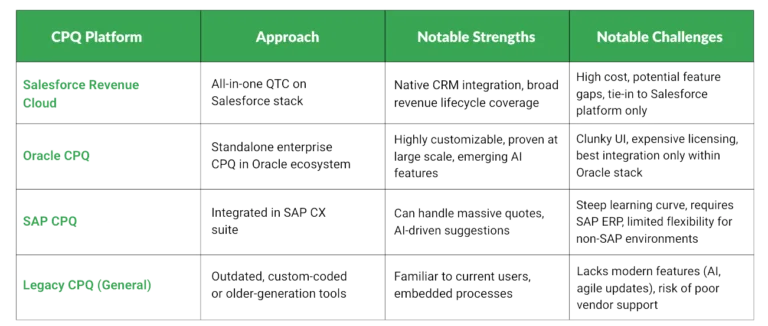
While these platforms were once state-of-the-art, the acceleration of AI, cloud computing, and rising user expectations for speed and personalization have exposed gaps in monolithic solutions. Adaptability, faster updates, cloud neutrality, and open integration capabilities have become paramount for modern sales organizations.
3. The Silver Lining on Spring Rain Clouds—Modular CPQ Solutions Take Root
Embracing Flexibility, Microservices, and API-First
To overcome the limitations of monolithic architectures, a new wave of modular CPQ solutions has emerged—designed around flexibility, microservices, and API-first principles. Think of these solutions as a well-tended garden comprised of smaller, independent services that collectively form a robust quoting and pricing ecosystem.
To address monolithic limitations, a new wave of modular CPQ solutions has emerged—designed around flexibility, microservices, and API-first principles. These solutions work like a well-tended garden of smaller, independent services that together make up a robust quoting and pricing environment.

Key features include:
-
Focus on increasing revenue yield
-
Infrastructure Agnosticism: Cloud-neutral deployments across AWS, Azure, GCP, or on-prem.
-
API-Driven Integration: Seamless data flow into CRM, ERP, and e-commerce platforms without heavy customization.
-
User-Centric Design: Intuitive UIs, AI-assisted selling workflows, and minimal configuration friction.
-
Continuous Innovation: Frequent updates on a microservices architecture, enabling faster adoption of AI capabilities.
-
Deep domain expertise, not general solutions
2025 Insight
“By 2025, over 50% of new CPQ implementations will adopt microservices architectures, allowing companies to integrate AI, contract management, and subscription billing without heavy code overhauls.”
— Gartner’s CPQ Market Guide (2025)
In essence, modular CPQ solutions can be likened to a carefully cultivated garden, constantly refreshed with new seeds of innovation, while legacy monoliths can resemble over-farmed soil that yields diminishing returns over time.
4. Why Now Is Spring the Perfect Planting Season
Multiple factors converge in 2024–2025, making this the ideal moment to transition away from legacy CPQ:
-
Salesforce’s Quiet Pivot: The sunsetting of traditional Salesforce CPQ is a strong market signal. Delaying action could trap you on an unsupported platform.
-
AI Revolution: AI-driven pricing, discount optimization, and generative proposal creation are rapidly becoming competitive necessities, meeting growing expectations for intelligent products and services.
-
Cost Pressures: Economic headwinds push CFOs to seek immediate ROI. A modern CPQ automates quotes, reduces sales cycle times by up to 50%, and eliminates costly errors.
-
Modular Over Monolithic: With microservices, you avoid single-vendor lock-in and integrate easily with various enterprise systems.

Top 3 Reasons Enterprises Are Abandoning Legacy CPQ
- Stagnant Innovation: No new features or AI capabilities.
- Escalating Costs: Rising maintenance fees with poor ROI.
- User Dissatisfaction: Frustrated sales teams slowed by archaic workflows.
5. Why servicePath™: Why Now, and How It’s Different

If you seek a user-based CPQ experience, servicePath™ provides precisely that—built specifically for today’s dynamic enterprise environments. servicePath™ is your customizable solution purpose-built to grow profitable deals in any environment. Its modular design, user-focused interface, and cost-efficient structure make it stand out among modern CPQ alternatives. Below, we combine both our existing points and new insights—including authentic user experiences from G2 reviews—to illustrate clearly what sets servicePath™ apart from other solutions.
5.1 A Modular Approach That Scales With You
Microservices Architecture:
servicePath™ adopts a flexible microservices architecture, breaking the CPQ process down into independently manageable and updatable services such as pricing engines, configurators, and document generation modules. This allows your business to accelerate innovation by rolling out new capabilities rapidly, without downtime or the complexity of overhauling your entire system. Each component is independently upgradeable, offering agility and responsiveness to emerging business demands.
G2 Reviewer Highlight:
“We switched from a legacy CPQ that took forever to update prices. servicePath™ was up and running in weeks, integrated with our CRM, and cut our quoting cycle by half. The UI is a breath of fresh air.”
— G2 user, January 2025
Infrastructure Freedom:
servicePath™ provides infrastructure flexibility, seamlessly supporting deployment across various environments, including Amazon Web Services (AWS), Microsoft Azure, Google Cloud Platform (GCP), or private servers. This approach ensures compatibility with your existing technology ecosystem, reduces dependency on single-cloud providers, and gives your organization the freedom to select or switch infrastructure providers based on performance, cost, or strategic considerations.
5.2 Deep Yet Seamless Integrations
Future-proof—No Single-Vendor Lock-In:
servicePath™ embraces a vendor-neutral architecture designed explicitly to eliminate single-vendor dependencies. This future-proof approach ensures your enterprise can freely change or upgrade your CRM, billing, or ERP systems without the disruption or costs typically associated with major integrations. As your business evolves, servicePath™ easily adapts, maintaining stability and minimizing risks associated with vendor lock-in.
G2 Reviewer Highlight:
“We replaced a legacy CPQ that barely talked to our ERP. servicePath™ synced our data in under two weeks, no horror stories. It was truly plug-and-play.”
— G2 user, Q1 2025
Robust API-First Design:
The API-first design at the core of servicePath™ ensures smooth, hassle-free integrations with leading CRMs such as Salesforce, Microsoft Dynamics 365, and SAP ERP. These RESTful APIs enable your organization to swiftly connect servicePath™ with critical enterprise platforms, facilitating data exchange and communication without extensive coding or specialized IT involvement, thereby significantly shortening your implementation time.
5.3 User Experience That Sellers Love
Intuitive Deal Dashboards:
servicePath™ features intuitive, visually guided dashboards that empower sales representatives to quickly identify profitable opportunities. Sellers can easily construct accurate, strategic quotes, guided step-by-step through product bundling, discounting, and approval workflows. Visual cues clearly highlight profitability, enabling reps to immediately recognize when a deal aligns well with business goals. This intuitive approach significantly reduces training needs and accelerates user adoption, empowering your sales team to close deals faster and more profitably.
G2 Reviewer Highlight:
“Finally, a CPQ our salespeople want to use.”
— Enterprise Sales Manager, G2 user
5.4 AI-Ready for Current and Future Needs
Agentic Integration:
servicePath™ seamlessly integrates advanced agentic technologies, providing your enterprise with powerful sales automation capabilities. This forward-looking integration allows your sales processes to leverage machine-driven insights, automated decision-making, predictive analytics, and sophisticated guided-selling mechanisms. As your organization evolves and seeks deeper AI capabilities, servicePath™ remains agile and ready to incorporate emerging technologies effortlessly, enhancing deal outcomes and boosting overall revenue growth.
5.5 Exceptional Customer Support and Lower TCO
Easiest to Do Business With—And Customers Love Us:
servicePath™ distinguishes itself with exceptional customer support, consistently recognized by users for responsiveness, expertise, and dedication. Customers routinely highlight the ease of implementation, clear communication, and proactive assistance from the servicePath™ team, resulting in smoother deployments and higher satisfaction. Coupled with competitive and transparent pricing, servicePath™ delivers a lower Total Cost of Ownership (TCO), quickly turning initial investments into tangible business outcomes and financial returns.


5.6 “The Right Move, Right Now”: Converging Factors
-
Salesforce CPQ Sunset: With Salesforce CPQ reaching the end of its lifecycle, companies need reliable, modern alternatives. servicePath™ ensures continued innovation and support, positioning your business for future growth without disruption.
-
Codeless Integration: servicePath™ provides a codeless integration capability, ensuring your enterprise achieves rapid deployment and minimal disruption. With intuitive, low- or no-code implementation frameworks, servicePath™ eliminates the extensive costs, delays, and complexities traditionally associated with custom coding. This streamlined integration accelerates time-to-value, allowing your business to immediately capitalize on improved quoting accuracy, faster deal cycles, and enhanced sales productivity.
-
Strong G2 Momentum: servicePath™ enjoys a strong, verified track record on G2, with users consistently highlighting its intuitive interface, rapid implementation, and reliable customer support. Real-world success stories reinforce servicePath™’s value as a trusted and effective CPQ solution.
Bottom Line: servicePath™ is modular, integration-friendly, future-ready, and celebrated by users for its usability, cost-effectiveness, and support excellence. As legacy CPQ platforms phase out, now is the time to transition to a solution that’s purpose-built for today’s AI-driven, fast-paced enterprise landscape.
6. Planting for Profit: Implementing a Modern CPQ Roadmap
Transitioning from a legacy CPQ to a modular, AI-driven solution might seem daunting—akin to replanting an entire garden. However, a clear strategy and phased execution can streamline this transformation while minimizing disruption:

-
Audit Your CPQ
– Document current processes, integration points, and bottlenecks.
– Gather feedback from sales and finance on pain points: slow quoting, inaccurate discounts, multi-approval delays, etc. -
Define Clear Objectives
– Prioritize critical issues: quoting speed, margin leakage, user adoption.
– Link objectives to measurable KPIs (e.g., reduce quote turnaround by 40%, improve margin by 5%). -
Compare Monolithic vs. Modular
– Evaluate budget, implementation timelines, and your organization’s AI maturity.
– Request ROI evidence, like case studies or references, from each vendor. -
Select a Pilot Use Case
– Start small (e.g., one product line or region) to gather quick wins and refine processes. -
Plan Integrations & Data Migration Early
– Cleanse product catalogs, pricing structures, and old quote data.
– Utilize robust APIs or iPaaS tools (e.g., MuleSoft, Workato, Boomi) for seamless data flow. -
Emphasize User Adoption & Training
– Offer short, tailored training modules.
– Provide in-app guidance and set up channels (e.g., Slack, Microsoft Teams) for quick user feedback. -
Go Live & Measure
– Track quote accuracy, cycle times, user satisfaction, and average deal size.
– Publicize early successes to foster organizational momentum. -
Iterate & Expand
– Introduce advanced modules like AI-driven price optimization or subscription billing once the foundation is stable.
– Gradually roll out across global teams or additional product lines after proving ROI.
McKinsey Insight (2025)
“Companies taking a phased approach to CPQ modernization typically see full ROI within 9–12 months, driven by fewer quoting errors and accelerated sales cycles.”
7. Beyond Revenue Cloud: The Long-Term Outlook
7.1 Evolving Toward Revenue Lifecycle Management (RLM)
 The future of CPQ isn’t siloed—it’s integrated. CPQ is increasingly being recognized as the core engine of a broader Revenue Lifecycle Management (RLM) ecosystem, encompassing quoting, contracts, billing, renewals, and customer expansion. By 2028, analysts predict that enterprise-grade RLM “super platforms” will dominate, streamlining the entire revenue journey.
servicePath™ is built for this convergence. Its microservices architecture and API-first approach make it the ideal foundation for scaling into a full RLM stack. Whether you’re adding contract lifecycle management, subscription billing, or automated renewals, servicePath™ allows you to plug in new capabilities without restructuring your entire sales tech stack.
Move to future-proof your operations—don’t get locked in. As monolithic platforms age and close their ecosystems, servicePath™ offers the flexibility to integrate with whatever comes next. If your strategy is to modernize for long-term growth, this is your future-proof move.
7.2 AI-Driven Expansion
Artificial intelligence is no longer a feature—it’s foundational to the future of revenue operations. The next generation of CPQ won’t just support pricing automation and guided selling; it will predict deal risk, personalize contract terms, and dynamically generate offers based on real-time buyer behavior.
With agentic integration at its core, servicePath™ enables organizations to:
-
Automate decisions using intelligent logic frameworks
-
Surface upsell/cross-sell opportunities based on buyer history
-
Generate smarter proposals, faster
-
Incorporate predictive analytics to improve revenue forecasting
As AI becomes more agentic—autonomously driving portions of the sales process—your CPQ platform must be capable of not just integrating with these tools but activating them across workflows.
Agentic is the future, and servicePath™ is ready to get you there.
Marc Benioff (2025)
“AI is now table stakes for revenue operations. The question is how seamlessly your platform can integrate real-time intelligence into the quoting process—and beyond.”
— Interview with Bloomberg Tech
A New Season for CPQ and Revenue Growth
The message is clear: legacy CPQ platforms like Salesforce CPQ are sunsetting. Once dominant, monolithic solutions now show unmistakable signs of stagnation—limited innovation, high costs, vendor lock-in, and an inability to meet the real-time demands of today’s sales teams.
In contrast, a new class of modular CPQ platforms is thriving. servicePath™ stands at the forefront of this new era, offering a modern, scalable, and user-friendly alternative designed to fuel faster quotes, higher win rates, and stronger margins. Built with a flexible microservices architecture, seamless integrations, and future-proof capabilities, it empowers revenue teams to close deals with agility and confidence.
For organizations still relying on outdated tools, the time to act is now. Waiting only increases risk—of slower deal cycles, customer dissatisfaction, and being outpaced by more agile competitors.
servicePath™ delivers everything modern enterprises need to move beyond limitations:
-
A modular CPQ system designed for scale
-
Seamless integration across CRMs, ERPs, and billing platforms
-
Codeless configuration and intuitive UX
-
A flexible platform that supports emerging technologies
-
Verified performance through strong G2 user feedback
This isn’t just about replacing old software. It’s about seizing a moment of transformation—a shift from complexity to clarity, from stagnation to speed, from legacy to leadership.
 Take Action Now: Overhaul your CPQ before competitors do, or risk missing the next season of profitable growth. As old CPQ platforms fade into legacy status, your organization can replant with a modern CPQ that boosts quoting speed, protects margins, and delights users—truly “planting for profit” in the new era of enterprise sales.
2025 Advisory Note
“Those who modernize CPQ in 2025 will see near-immediate advantages—shortened quoting cycles, sharper pricing accuracy, and a more robust deal pipeline. Delaying adoption widens the gap between early adopters and organizations clinging to outdated technology.”
— Forrester CPQ Wave (2025)
Ready to Take the Next Step?
-
? Read More: Explore additional blogs and insights on CPQ, quoting transformation, and digital sales enablement.
-
? Download Our Case Studies: See how leading enterprises have transformed revenue operations with servicePath™.
-
⭐ Check Out Our G2 Reviews: Discover what real users love about servicePath™.
-
? Recognized by Gartner: Find out why we’ve been named a Visionary in the Gartner Magic Quadrant for CPQ Application Suites three years in a row.
-
☕ Book a Virtual Coffee: Let’s chat about your challenges and explore how servicePath™ can help. No pressure—just insights.
Let’s grow revenue together—one smart quote at a time.
9. References & Sources
-
http://TPATechnologies.com – Salesforce CPQ Sunset Analysis (2024–2025).
-
http://V2SA.com – Commentary on CPQ pivot and Revenue Lifecycle Management.
-
Morgan Stanley Digital Transformation CFO Survey (2024) – CPQ investment trends, ROI data.
-
Goldman Sachs 2025 Tech Trends Forecast – AI’s impact on quoting, dynamic pricing, and generative proposals.
-
Gartner’s CPQ Market Guide (2025) – Market direction, modular CPQ adoption rates.
-
http://Experlogix.com – 2025 CPQ reviews detailing Oracle and SAP CPQ pros/cons.
-
http://Cuspera.com – User testimonials on ease of use and integration with servicePath™.
-
McKinsey Quarterly (Q2 2025) – Strategies for digital pricing transformations.
-
Aberdeen Group Report – Data on sales rep efficiency and proposal volume improvements from CPQ adoption.
-
G2 – Verified user reviews praising servicePath™ for speed, cost-effectiveness, and robust support.
You may be interested in these articles next
Ground Truth Is the New Moat | CPQ AI Risk Framework 2026

Stop Reporting Revenue, Start Architecting Profit: Closing the Missing Mile

AI Doesn’t Just Scale Your Best Decisions. It Scales Your Worst Ones.
