

By Daniel Kube, Chief Executive Officer, servicePath™
Field notes on revenue lifecycle management from the Gartner Finance Symposium/Xpo™ 2026, and what they mean for any CFO turning AI ambition into recognized profit.
Quick answer: The Missing Mile is the un-governed gap between the sales quote and the general ledger. It is where margin leaks, compliance risk forms, and finance is reduced to a clean-up crew. Strong revenue lifecycle management closes that gap. servicePath™ does this by embedding pricing, margin, and compliance rules into the quoting workflow, so every deal is pre-validated before it reaches finance. As a result, you book recognised profit instead of reported revenue.
Key takeaways
Here are the revenue lifecycle management lessons from Gartner 2026, in brief.
- Gartner’s 2026 theme was Autonomous Finance. The opening keynote was blunt: AI does not fix a broken process. Instead, it scales whatever process you already have.
- The Missing Mile is where margin dies. It is the un-governed gap between what sales quotes and what finance must later recognize on the ledger.
- Bad data upstream becomes bad decisions downstream. Gartner’s keynote stated that machines will make decisions with financial implications. Therefore an un-governed quote becomes automated margin leakage at scale.
- The finance role is shifting from Guardian to Catalyst. Gartner named four shifts, from guardians to catalysts and partners to tool builders.
- The fix is upstream governance, not downstream clean-up. servicePath™ embeds pricing, margin, and compliance rules into the quoting workflow, so a deal is pre-validated before it reaches the general ledger.
Gartner Finance Symposium/Xpo™ 2026: the proof points

The numbers below are the load-bearing evidence from the sessions I attended, and they frame why revenue lifecycle management matters now. Each one is sourced, and the full list sits at the end.
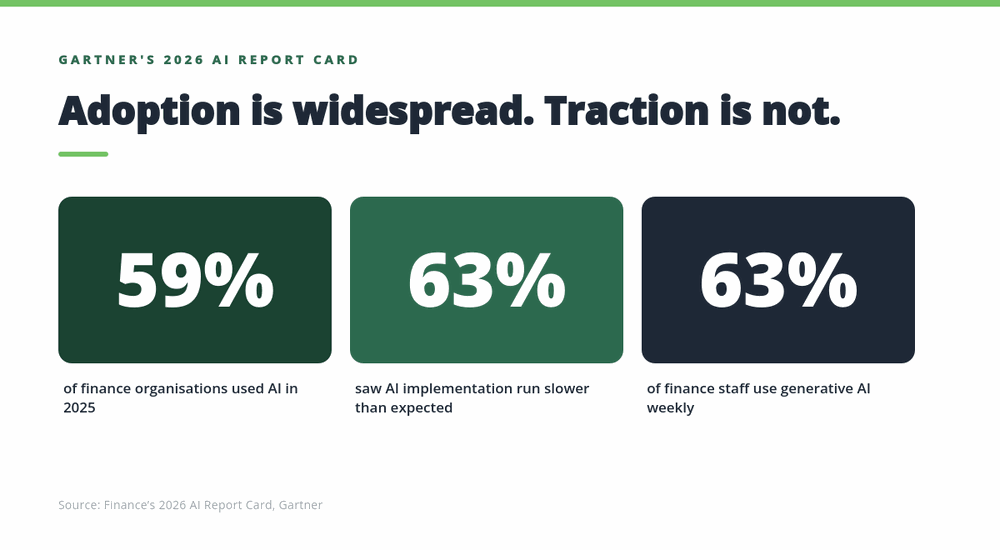
- 59% of finance organizations used AI in 2025. However, implementation ran slower than expected at 63% of them. Adoption is widespread, but traction is not. (Finance’s 2026 AI Report Card, Gartner)
- 63% of finance staff now use generative AI at least weekly. (Finance’s 2026 AI Report Card, Gartner)
- “99% accurate is still 100% wrong.” The accuracy bar that human review tolerates is the bar autonomous systems cannot. (Aaron Levine, CFO, Prophix)
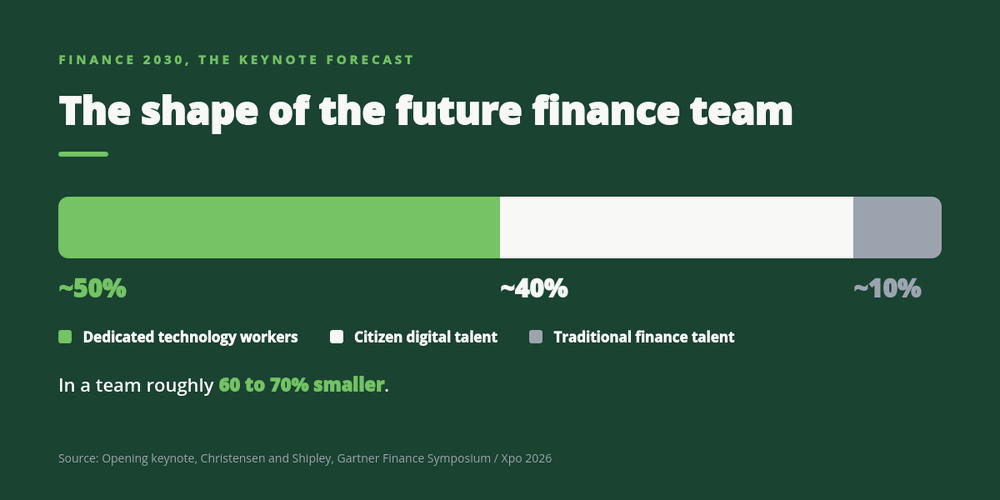
- ~40% citizen digital talent and ~10% traditional finance talent, in a team roughly 60 to 70% smaller. That is the future finance organization Gartner described. (Opening keynote, Christensen and Shipley)
- Four workforce shifts to prioritize: guardians to catalysts, partners to tool builders, manual to machine-driven, and linear to iterative. (Finance at Breakaway Firms, Gartner)
Executive summary
I spent three days at the Gartner Finance Symposium/Xpo™ 2026 in National Harbor, and I left with one conviction sharpened beyond doubt. Finance is being asked to become autonomous and AI-driven, yet it still stands on a data foundation it does not control.
The theme was “Autonomous Finance.” In the opening keynote, Winning When AI Is Changing (and Breaking) Everything, Clement Christensen and Tamara Shipley made a simple point. Leaders must deploy AI and keep absolute rigour, yet most of their data starts on the commercial front line, where teams quote, discount, and commit deals long before finance touches them.
That gap between the quote and the ledger is what I call the Missing Mile. It is where margin leaks, where compliance risk forms, and where finance does its most expensive work, post-mortem variance analysis. This piece explains what that means for revenue lifecycle management, and how to start architecting profit at the source.
What did Gartner Finance Symposium/Xpo™ 2026 actually say?
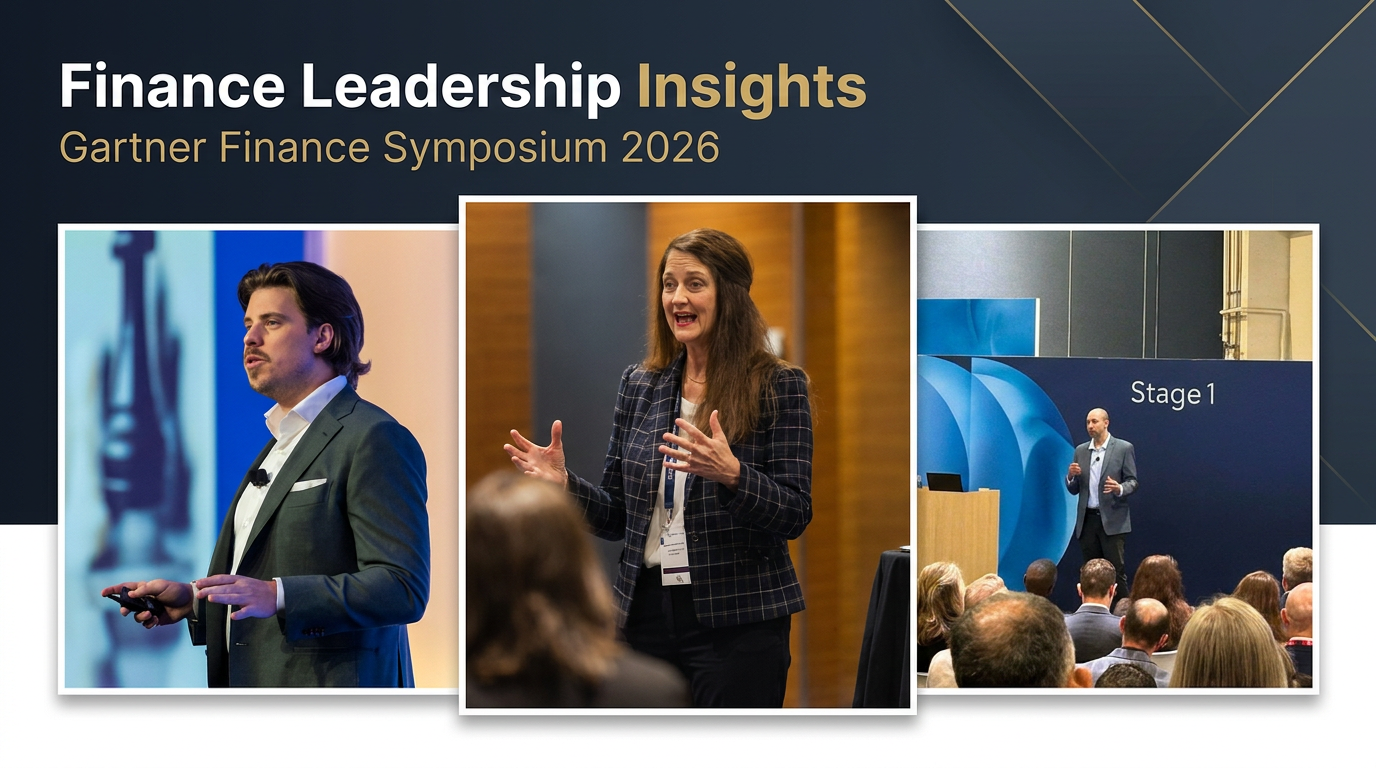
The event ran 27 to 29 May at the Gaylord National Resort in National Harbor, Maryland. The agenda and keynote line-up framed the central tension: AI is reshaping finance and breaking parts of it at the same time. A handful of themes kept resurfacing, and you heard versions of these in nearly every room.
- Autonomy is the destination, but data readiness is the gate. Finance cannot be autonomous while its models run on data reconciled by hand after the fact.
- Machines are moving from analysis to decision-making. The keynote said plainly that machines will make decisions with financial implications. A day-three session, How to Get Started With Agentic AI in Finance, stressed that safe agentic AI depends on strong governance.
- The workforce itself is being redrawn. The keynote’s future finance organization is far smaller and mostly technology talent, with traditional finance roles in the minority.
- There is a human cost when leaders stay passive. Gartner’s “Lonely Enterprise” thesis warns that specialization, remote work, and self-service tooling isolate finance staff, so they lose the business context that makes their advice valuable.
To be clear, these are Gartner’s published predictions and figures shown on stage, not numbers invented to sound urgent. Every statistic here is sourced, and the full list sits at the end.
What is the Missing Mile in revenue lifecycle management?
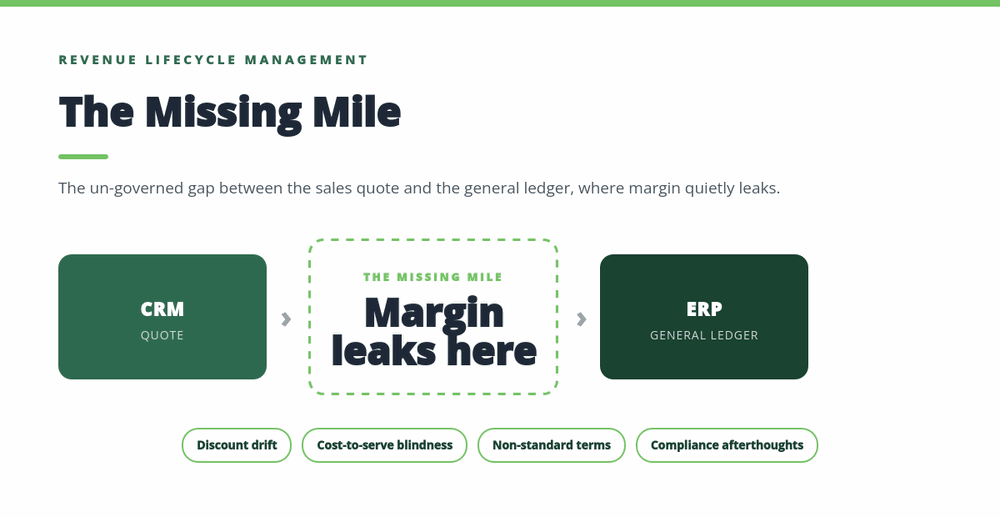
The Missing Mile is the un-governed space between two moments: when a salesperson builds a quote, and when finance recognises that deal on the general ledger. In between, teams make the commercial decisions that decide profit. They set pricing, discounting, terms, and bundling, yet without the guardrails that govern everything downstream.
It is “missing” because most organisations invest heavily on both ends and almost nothing in the middle. They have a CRM where deals are created and an ERP where revenue is recognised. However, the logic that should connect the two lives nowhere useful: in people’s heads, in scattered spreadsheets, and in approval emails that arrive too late to matter.
Where margin leaks across the mile
Here is where margin actually leaks. Each item looks small in isolation, but together they explain the missing profit.
- Discount drift. Sales discounts to close, with no real-time view of the margin floor. Therefore the cumulative effect erodes profitability invisibly.
- Cost-to-serve blindness. Nobody models the true cost of delivery at quote time. As a result, “won” deals turn out to be unprofitable to fulfil.
- Non-standard terms. Bespoke contract language creates revenue-recognition complexity. Finance only discovers it at close.
- Renewal and mid-contract change. Modifications happen in the commercial layer. They are never reconciled against the original financial assumptions.
- Compliance afterthoughts. Teams apply ASC 606 and IFRS 15 treatment retroactively, rather than designing it into the deal.
In other words, a finance team can spend days reconciling reports and still not explain where a deal’s margin went. The Missing Mile turns finance into a clean-up crew, permanently looking backward.
Why does AI make the Missing Mile more dangerous, not less?
This was the single most important idea I took from Gartner, and it runs counter to how most boards talk about AI. It reframes revenue lifecycle management as a data-governance discipline, not a reporting one.
Most leaders assume AI will clean up messy data. The reality is the opposite. As Aaron Levine, CFO of Prophix, argued, AI amplifies what already exists. So if your data supply chain runs on manual reconciliation and siloed spreadsheets, generative AI simply scales your errors at machine speed.
“99% accurate is still 100% wrong”

Levine put it in a line I have not stopped thinking about. “99% accurate is still 100% wrong.” In human review, 99% is excellent. However, in autonomous decisioning, the 1% propagates silently through every downstream system.
Why does this matter now? Because the keynote was explicit that machines will make decisions with financial implications. Consider an example several sessions circled. An agentic system reads a vendor quote, then turns it into a purchase requisition in your ERP with no human in the loop. That agent is only as trustworthy as the data it ingests. So if the agreement contains rogue pricing, the agent will not catch it. Instead, it automates the leakage at scale.
The Lonely Enterprise
There is also a human dimension that Gartner named the Lonely Enterprise. Finance is fragmenting into specialists who work asynchronously with their own AI tools, so the connective tissue frays. Self-service feels like autonomy. In practice, as Levine framed it, faster work inside siloed spreadsheets creates faster fragmentation, not autonomy at scale. So the cure is not less tooling. It is governed tooling, with the guardrails built in.
Why AI in the spreadsheet is not a finance transformation strategy
Many vendors are racing to bolt a conversational AI layer onto existing finance processes. As Prophix’s CFO put it on stage, AI in Excel is not, by itself, a transformation strategy. A chat box on a spreadsheet is the same fragmented workflow with a friendlier face, plus a new way to generate hallucinated answers from un-governed data.
Three questions to ask any AI finance initiative
If you plan to deploy autonomous agents in your quote-to-cash process, they need a deterministic data layer beneath them. So ask three diagnostic questions of any “AI finance” initiative.
- Where does the data originate, and who governs it there? If the answer is “the quote, and nobody,” your AI starts from contaminated inputs.
- Is the logic centralized or replicated? If every team keeps its own pricing and margin rules, you are scaling inconsistency.
- Can the output be trusted without human reconciliation? If not, you have not automated anything. You have added a step.
Smarter spreadsheets only deepen the self-serve illusion. Real transformation moves the intelligence upstream instead, to where commercial decisions are made, so the data is clean before anyone analyses it.
How is the finance role changing? From Guardian to Catalyst
One of the clearest ideas at Gartner was the redefinition of the finance professional. In the session on the finance workforce at breakaway firms, Gartner named four key shifts.
The four workforce shifts
- Guardians to Catalysts. The traditional guardian ran error-free processes and protected the organization. However, that role is no longer enough. Finance must now catalyse better commercial decisions.
- Partners to Tool Builders. Instead of reviewing every deal by hand, finance must embed its expertise into tools that decision-makers use directly.
- Manual to Machine-Driven. Repetitive, rules-based work moves to machines. As a result, humans focus on judgement.
- Linear to Iterative. Static annual planning gives way to continuous, driver-based, scenario-led modelling.
The implication for revenue lifecycle management is profound. You cannot hire enough analysts to govern every quote in a fast sales organization. So the only scalable answer is to embed the financial logic, the pricing rules, margin thresholds, and compliance standards, into a tool the sales team uses on its own. That is the act of a tool builder, and it scales rigor through software instead of headcount.
The Master Architect CFO
You don’t have an AI ROI problem, you have a portfolio problem
Many CFOs feel frustrated by thin returns from their AI pilots. The instinct is to call it an ROI problem. However, I would call it a portfolio-construction problem, because the pilots aim at the wrong target. In revenue lifecycle management terms, they automate the symptom rather than govern the cause.
The data supports the frustration without the panic. Per Gartner’s Finance’s 2026 AI Report Card, adoption is already widespread: 59% of finance organisations used AI in 2025, and 63% of staff use generative AI weekly. Yet the same report found implementation ran slower than expected at 63% of organisations. The problem is traction, not adoption.
Reframe the portfolio
Why does this happen? Because most AI finance pilots chase efficiency. They shave hours off the close or cut headcount. Those wins are real, but incremental. True margin expansion does not come from doing finance more cheaply. Instead, it comes from helping the business move faster with confidence, and from stopping invisible leakage.
So reframe the portfolio around two questions.
- Where are we losing margin we never see? Errors, rework, discount drift, and missed variances erode profit before anyone notices. Closing that gap is hard-dollar ROI.
- Where could we move faster if finance were not a bottleneck? Every manual approval loop is deferred revenue and operational drag.
A faster spreadsheet macro saves minutes. By contrast, hardwiring your risk appetite into the quoting workflow protects the number itself. That return is structurally larger, and it is the one finance leaders should build their AI portfolio around.
Transformation fails without emotional intelligence
One point rarely appears on vendor slides, yet it had its own Gartner session. In How to Fight Emotional Responses to Challenges in Finance Transformation, Marco D’Ascoli made a clear case. You can buy the best software in the world and still fail, because human resistance kills transformation faster than any technical limit.
When analysts hear “AI agents” and “automated governance,” many hear “job elimination.” The session leaned on Daniel Goleman’s well-known claim that emotional intelligence drives leadership success more than raw IQ, and offered a useful reframe: treat change resistance as insight, not obstruction.
So here is the message I would give any finance team. Embedding governance into the commercial process is not about policing finance or cutting jobs. Rather, it removes the days spent reconciling messy CRM data, so people can do the work that needs a human: scenario planning, forecasting, and advising the business. You are not eliminating the role. You are elevating it.
Why servicePath™ closes the Missing Mile in practice
Everything above is the diagnosis. Now here is the mechanism.
servicePath™ delivers revenue lifecycle management at its origin, the quote, rather than auditing the revenue lifecycle after the fact. It acts as an upstream risk-intelligence engine for your commercial front line, so the data feeding your ERP, your dashboards, and your AI agents is clean from the point it is created.
What it looks like for one deal
Concretely, here is what closing the Missing Mile looks like for a single deal.
- A sales rep builds a quote inside the normal workflow. Pricing logic, margin floors, and approval rules are already embedded. So nobody waits on a finance email.
- The system validates in real time. If the deal drifts below the margin threshold in your risk-appetite statement, it flags before the quote is sent, not after the contract is signed.
- Compliance is designed in, not bolted on. servicePath™ evaluates ASC 606 and IFRS 15 as the deal is structured, so revenue recognition is correct by construction.
- The deal reaches the ledger pre-validated. Finance receives structured, deterministic data it never reconciles by hand.
- Renewals and changes stay governed. Mid-contract modifications run through the same guardrails. So there are no downstream surprises.
Reactive finance vs architected finance
To make the contrast concrete, here is the difference between finance that audits the past and finance that architects the outcome. This contrast is the heart of modern revenue lifecycle management.
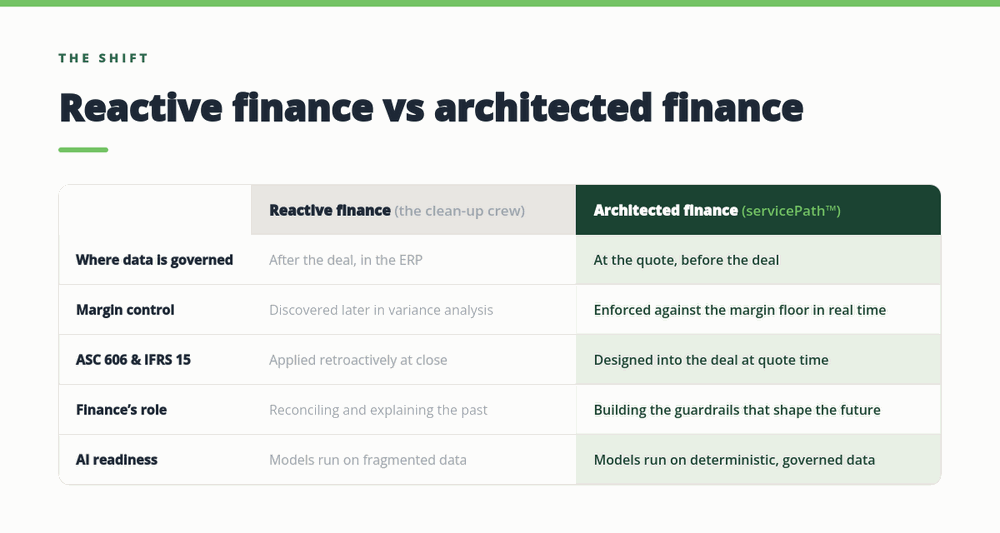
Here is the one line I will stand behind. As a revenue lifecycle management platform, servicePath™ turns sales momentum into recognised financial performance by removing the gap between the quote and the ledger. Sales runs at full speed, because the boundaries are coded into the system. Meanwhile, finance gains deterministic confidence, because nothing arrives as a surprise.
See this in your own pipeline. Book a servicePath™ demo and watch one deal flow from quote to ledger with the guardrails firing.
That is also what makes servicePath™ the data bedrock for autonomous finance and for revenue lifecycle management at large. AI cannot run reliably on data reconciled after the fact. By governing data at the point of origin, servicePath™ feeds your AI systems the clean inputs they need, turning the keynote’s machine-readable knowledge imperative into an operating reality.
Key terms in revenue lifecycle management, defined
- Revenue lifecycle management (RLM) governs a commercial relationship end to end, from the first quote through contracting, recognition, renewals, and mid-contract changes. Unlike traditional reporting, it treats the quote and the ledger as one connected system.
- CPQ (Configure, Price, Quote) is the software layer where sales teams configure products, apply pricing, and generate quotes. Because commercial decisions are made there, it is the right place to govern margin and compliance.
- Quote-to-cash is the full process from quote creation to recognised cash. The Missing Mile lives inside it, in the handoff between commercial and financial systems.
- Margin leakage is the invisible erosion of profit from discount drift, un-modelled cost-to-serve, and non-standard terms. Because it happens gradually, people usually spot it only in hindsight.
- ASC 606 and IFRS 15 are the revenue-recognition standards governing how and when revenue is recorded. Treat them as a quote-time constraint, and you remove a major source of audit risk.
- Risk-appetite statement sets the thresholds for acceptable margin, discounting, and compliance. servicePath™ turns it from a document into enforced logic inside the quoting workflow.
- Agentic AI describes autonomous systems that act and decide with little human input. Gartner’s guidance is clear: govern the data they consume at its source.
FAQ: servicePath™ and the Missing Mile
What is the Missing Mile in finance?
The Missing Mile is the un-governed gap between the moment a sales team builds a quote and the moment finance recognises that deal on the ledger. It is where margin leaks, compliance risk forms, and finance is forced into clean-up.
How does servicePath™ help with profitability and margin control?
Within revenue lifecycle management, servicePath™ exposes margin and cost-to-serve before a deal is signed. It embeds financial guardrails into the quoting process and stops margin erosion at the source.
How does servicePath™ improve pricing precision?
It validates pricing logic before a sale is approved, checking every quote against the company’s risk appetite. As a result, post-sale rework disappears.
Can servicePath™ help with ASC 606 and IFRS 15 compliance?
Yes. servicePath™ evaluates revenue-recognition rules inside the quoting engine. So a deal is compliant by the time it reaches the ledger, which reduces revenue leakage and audit risk.
How does servicePath™ support revenue lifecycle management?
It creates a single source of truth for revenue lifecycle management across the commercial relationship, and governs renewals and mid-contract changes, so the full lifecycle stays controlled rather than discovered late.
How does servicePath™ speed up quote-to-cash?
Deals are pre-validated for pricing, margin, and compliance. As a result, there is less rework and fewer approval loops, so sales closes faster while finance keeps full margin governance.
How does servicePath™ prepare finance teams for AI?
AI models cannot run reliably on data reconciled after the fact. So by governing data at the quote, servicePath™ delivers the clean, structured data needed to deploy AI safely.
Why does AI make data governance more urgent for CFOs?
Autonomous agents act on the data they receive without human review. As Gartner’s keynote noted, machines will make decisions with financial implications. So an un-governed quote becomes automated leakage at scale.
The mandate for the Master Architect CFO

The hard truth from Gartner 2026 is simple. Finance cannot out-work bad data, and AI will not fix a broken quote-to-cash process on its own.
Keep allowing the Missing Mile to exist, and you accept three outcomes: your data stays flawed, your AI initiatives fail to scale, and your team remains a reactive clean-up crew.
The alternative is to become the architect. That is what mature revenue lifecycle management makes possible. Stop treating financial governance as a post-sale audit. Instead, embed your pricing logic, margin thresholds, and compliance standards into the revenue engine, where commercial decisions are made. Do that, and you turn enterprise speed into recognized, defensible profit.
So stop reporting on revenue leakage. Start architecting profit.
Daniel Kube is the CEO of servicePath™, a CPQ and revenue lifecycle management platform that enterprise sales and finance teams use to govern pricing, margin, and compliance upstream, before revenue reaches finance. He attended the Gartner Finance Symposium/Xpo™ 2026 in National Harbor, Maryland, and writes the “Executive Conversations: The Gartner Series” on LinkedIn.
Take the next step
- See it in action. Book a servicePath™ demo and watch one deal flow from quote to ledger with the guardrails firing.
- Get the next executive conversation. Subscribe to Executive Conversations, Daniel Kube’s LinkedIn newsletter on the Gartner series.
- Speak the language. Browse the servicePath™ glossary, including the terms most relevant here: Agentic AI, AI-native CPQ, approval workflows, and the quote-to-cash process.
- Go deeper. Read more servicePath™ insights on revenue architecture and governed selling.
Related reading from servicePath™
- Revenue Architecture 2.0: A Human-Led Control Plane for Enterprise Revenue in the AI Era
- The Bigness of Little Things: How Cost-First CPQ Makes AI and Outcome-Based Pricing Profitable
- servicePath™ Named Sole Visionary in the 2026 Gartner® Magic Quadrant™ for CPQ
More from Executive Conversations
Daniel Kube’s “Executive Conversations: The Gartner Series” runs as both a LinkedIn newsletter and a podcast.
Sources
Quotations and statistics come from the following Gartner Finance Symposium/Xpo™ 2026 sessions and Gartner materials. On-site session decks are cited by title and presenter. Public Gartner pages are linked.
- Event, theme, and opening keynote. Finance at the Forefront: Winning When AI Is Changing (and Breaking) Everything, Clement Christensen and Tamara Shipley, Gartner Finance Symposium/Xpo 2026. Public references: Gartner event announcement and Gartner sessions page. Source of the “machines will make decisions with financial implications” statement, the three Master Architect imperatives, and the future-workforce mix.
- “99% accurate is still 100% wrong,” “AI amplifies what exists,” the Self-Serve Illusion, and “AI in Excel isn’t a finance transformation strategy.” Aaron Levine, CFO, Prophix, Turning AI from Experimentation into Measurable Margin Expansion, 27 May 2026.
- AI adoption figures (59% of finance organizations used AI in 2025; 63% of staff use generative AI weekly; implementation slower than expected at 63%). Finance’s 2026 AI Report Card, Marco Steecker, Gartner.
- The Lonely Enterprise and the agentic-AI example. Finance 2030: The Forces, Gartner.
- The four workforce shifts. Finance at Breakaway Firms, Gartner.
- Agentic AI governance. How to Get Started With Agentic AI in Finance, Gartner, summarized in the Day 3 conference highlights.
- Emotional intelligence and change resistance. How to Fight Emotional Responses to Challenges in Finance Transformation, Marco D’Ascoli, Gartner. The IQ and EQ figure is cited within that session to Daniel Goleman, Working With Emotional Intelligence.