

Executive summary
Most enterprises are still operating on an unseen problem—call it the Vampire Stack. This isn’t just a colorful metaphor; it’s a set of habits and systems that quietly drain profit and energy. Shadow discounting (discounts granted without proper policy oversight) erodes margins and creates a culture of discount dependency. Unauthorized discounting also complicates revenue recognition because no‑one knows whether the price meets policy or floor margins. Meanwhile, monolithic, brittle revenue stacks slow time‑to‑market. Analysts at Gartner counsel enterprise‑architecture leaders to reduce technical debt and embrace composable architectures to modernize portfolios. IDC similarly recommends businesses adopt composable, API‑first solutions to handle increasing complexity in B2B commerce. In other words: agility and governance now go hand in hand.
This playbook introduces a modular, composable approach to revenue architecture—one that keeps your Salesforce CRM as the system of engagement, uses a CPQ control plane to unify catalog, pricing and approvals, and integrates seamlessly with best‑of‑breed finance systems. Throughout, we’ll unpack the sources of margin leakage and propose step‑by‑step guidance, supported by credible sources and practitioner insights. The goal is not to hawk a product but to showcase a mindset and provide a blueprint your team can use tomorrow.
The Vampire Stack and its hidden costs
Just as vampires in folklore hide until nightfall, shadow discounting and brittle integrations lurk in many B2B stacks, quietly causing harm. Recent pricing research warns that unauthorized discounts undermine a company’s pricing strategy, devalue the brand and erode profits. Customers quickly come to expect permanent reductions, leading to a “discount dependency” that damages long‑term value. Pricing analysts at Flintfox note that modern AI‑enabled tools can detect if products are sold below acceptable margins or if unauthorized discounts have been applied. Without such controls, revenue teams may inadvertently sell products at a loss.

The Vampire Stack includes more than just pricing anomalies:
-
Duplicated truth: Price lists live in three places—CRM, ERP and spreadsheets—and none match. When each team edits their own version, inconsistencies grow.
-
Approval anarchy: Discount requests bounce through email chains and Slack messages. Approvals depend on who shouts loudest, not on policy.
-
Frozen catalogs: Fear of mispricing stops teams from launching new offers. Releases are batched quarterly instead of weekly.
-
Usage guesswork: Consumption‑based pricing is bolted on downstream, requiring manual intervention in billing and revenue recognition. Period accuracy suffers.
-
Audit drag: Finance teams can’t trace what happened between quote and invoice, leading to manual journal entries and tension with auditors.
If any of these symptoms feel familiar, the next sections will help you map a way out.
Why composability matters now
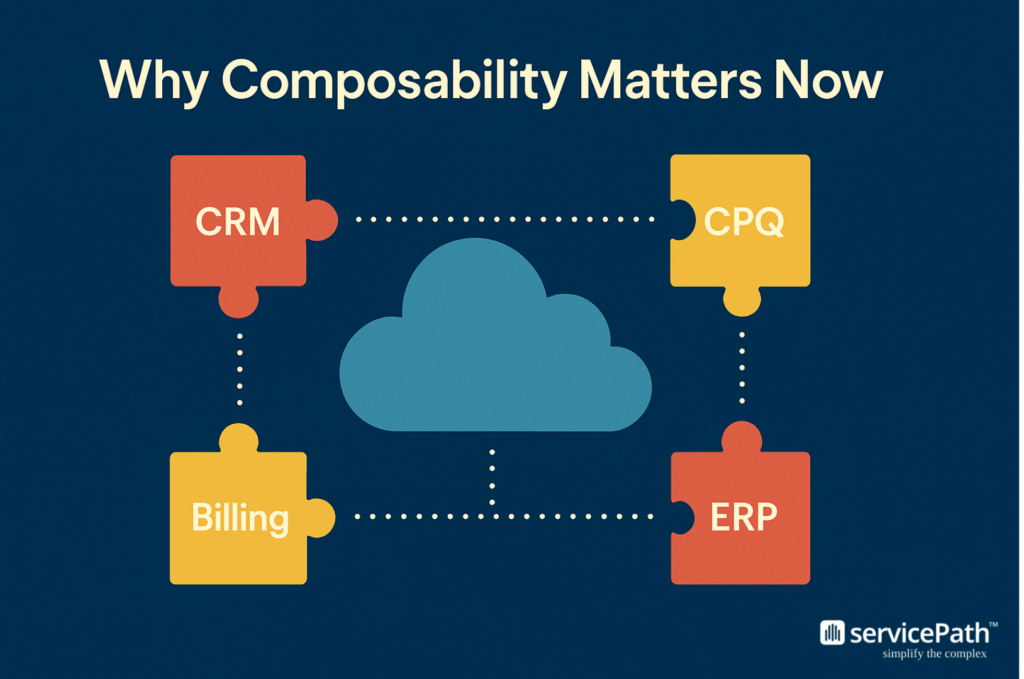
Two macro‑trends make composability a board‑level priority. First, time‑to‑market is now the strongest IT metric correlated with higher profit margins. When product and pricing updates take weeks instead of days, every delay becomes a margin drag. Second, IDC projects that public‑cloud spend will double between 2024 and 2028. With so much investment flowing into SaaS and digital offerings, technology leaders must modernize portfolios by replacing brittle, monolithic stacks with modular, API‑first solutions. In B2B commerce specifically, IDC recommends businesses adopt composable architectures to handle complex buying journeys and deliver personalised experiences at scale.
A composable architecture uses governed interfaces between systems rather than ad‑hoc scripts and spreadsheets. It lets you swap, upgrade or expand one component without rewriting everything else. Your CRM remains the system of engagement; the CPQ layer becomes the commercial control plane; billing, revenue recognition and ERP handle finance. This separation respects the principle that no single system should do everything. As Gartner notes, modernizing portfolios means embracing composable architectures and updating applications instead of bolting on more functionality to an aging monolith.
Blueprint for a composable revenue stack
At its core, a composable stack has three layers: a customer engagement layer, a commercial control plane and a finance layer. Each layer is modular, connected via APIs and governed by business rules.

1. Customer engagement
Your sales and marketing team lives in the CRM (e.g., Salesforce). Here you manage accounts, contacts and opportunities. To remove friction, modern CPQ platforms embed quoting capabilities directly in the CRM. servicePath™’s integration with Salesforce, for example, allows sales teams to access full quoting functionality, create multiple versions of quotes and synchronise account data without leaving the CRM. The point isn’t to promote any single vendor but to show that the context of selling should remain consistent—no extra license seats, no switching screens.
2. CPQ control plane
This is the heart of composability. A CPQ control plane governs catalog, pricing, configuration and approvals. It centralises rules and ensures that quotes are “rev‑ready” (containing performance obligations, triggers and price allocations) so finance doesn’t have to fix mistakes later. Critical capabilities include:
-
Policy governance: Translate pricing policies into rules, with discount floors, margin thresholds, deal sizes and risk tiers. Shadow discounts are prevented by auto‑approval bands; low‑risk deals auto‑approve, while high‑risk deals route to managers or finance. Unauthorised discounts are flagged and recorded, aligning with pricing best practices.
-
Excel parity without chaos: Many enterprises rely on spreadsheets to calculate pricing. Rather than ban spreadsheets outright, a modern CPQ allows you to import your Excel logic into a governed engine where each formula has an owner, version history and test cases. This retains flexibility while removing unpredictability.
-
Versioned catalog and sandbox: You should be able to create, test and release catalog updates safely. Simulation tools estimate the margin impact of changes; once validated, releases are staged by region (APAC, EMEA, Americas) with one‑click rollback if something goes wrong. This pattern reflects the best practice of sandbox simulation → staged release → roll back—an IT change‑control method applied to revenue systems.
-
Service and usage modeling: Service contracts (implementation, support, managed services and success plans) are first‑class citizens. Usage‑based pricing (meters, tiers, pay‑as‑you‑go) is configured at quote time, not patched in billing. Configuring usage upstream ensures consumption is recognised in the correct period, a point emphasised by leading finance literature. It also prepares you for hybrid pricing models, which analysts predict will proliferate in SaaS.
-
Integration hub: Connectors and APIs must bridge CPQ with CRM, ERP, billing, service management and data providers. The integration hub uses pre‑built adapters and a REST API to connect to major ERP suites—SAP, Oracle, NetSuite, Microsoft Dynamics, Infor and Workday. servicePath™’s integration hub is an example: it offers connectors to Salesforce, Microsoft Dynamics, SAP, Oracle and ServiceNow, and uses Workato’s library of over 1,000 recipes to accelerate automation. This lowers reliance on custom code and speeds implementation.
-
Data parsing & provider feeds: To maintain accurate catalogs, a modern CPQ includes a data parsing engine with built‑in parsers for vendor products (e.g., Avaya, Cisco, Juniper, Microsoft, Mitel, Unify, Extreme, HP Enterprise). It also integrates with real‑time data providers like AWS, Azure, Ingram Micro, Amazon, Synnex and others to fetch up‑to‑date pricing and availability. This prevents quoting errors from outdated lists and ensures margin models reflect market reality.
3. Finance layer
Once a quote becomes an order, you hand it off to finance for billing, revenue recognition and general ledger. The CPQ control plane should output rev‑ready orders—each line clearly labelled with performance obligations (POBs), transaction price allocations and event triggers (point‑in‑time, over‑time, usage). This reduces manual journal entries and ensures compliance with ASC 606/IFRS 15. Integration with a revenue sub‑ledger or billing platform is achieved through open APIs and webhooks. The finance layer remains modular—you can use your preferred billing engine or revenue recognition tool without rewriting the CPQ.
Six principles for a future‑ready CPQ control plane
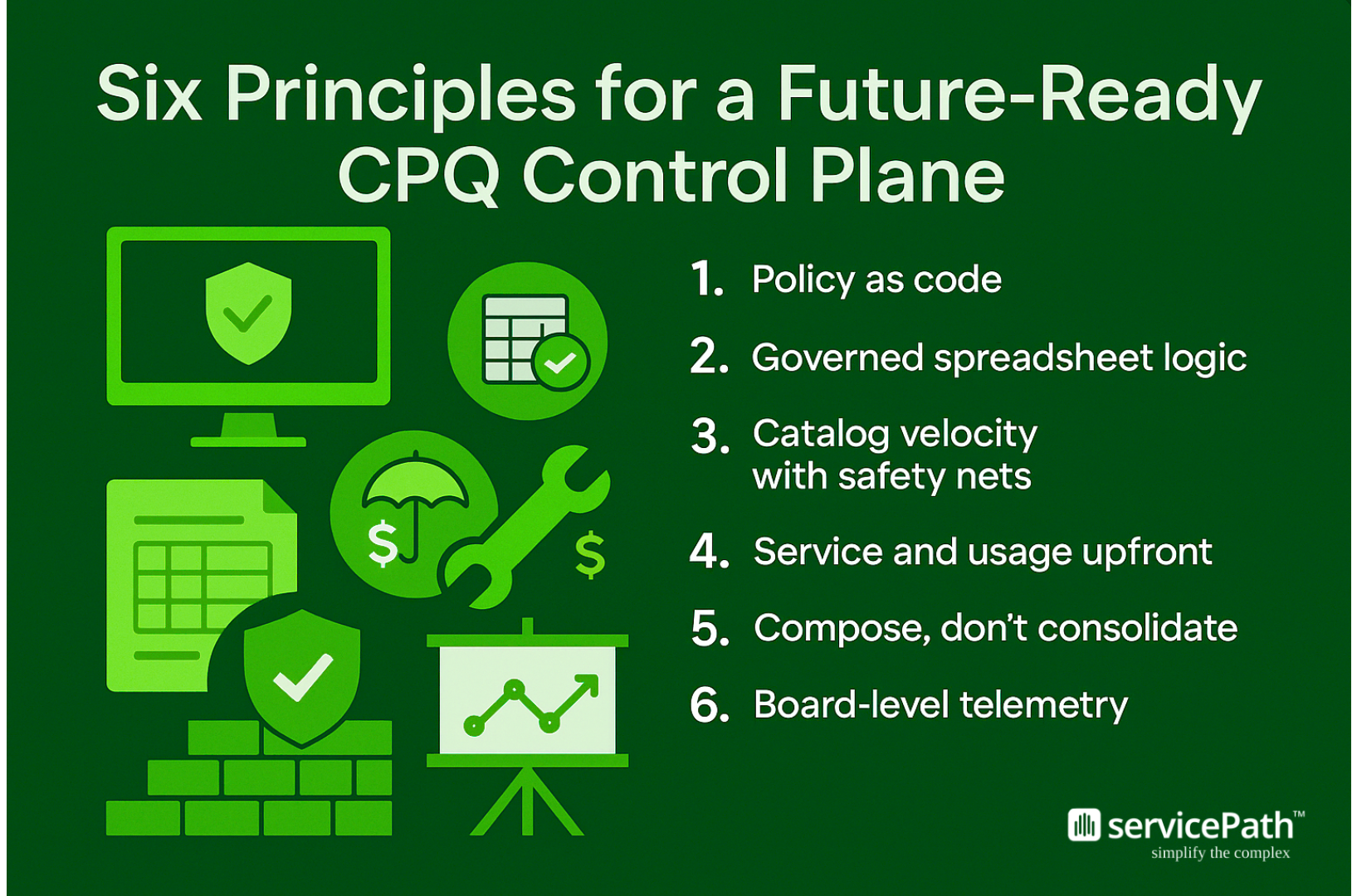
1. Policy as code
Capture pricing and discount policies in machine‑readable rules with clear ownership. Define auto‑approval bands by product family, region and risk tier. Hard floors ensure margins never dip below acceptable levels. This stops shadow discounting in its tracks.
2. Governed spreadsheet logic
Rather than abandon Excel logic, import it into a Spreadsheet Calculator where each formula has an owner, version history and test cases. This preserves institutional knowledge while eliminating spreadsheet roulette.
3. Catalog velocity with safety nets
Use sandboxes to simulate margin and discount impacts before releasing updates. Stage releases by region, implement blackout windows and practise rolling back. Measure release frequency (≥ 6 per quarter) and rollback MTTR (≤ 30 minutes).
4. Service and usage upfront
Quote implementation, support and managed services separately and define their terms and triggers. Configure usage at quote time (meters/tiers) so consumption revenue aligns with the correct period. This supports the shift to hybrid models predicted by industry analysts.
5. Compose, don’t consolidate
Avoid vendor lock‑in by using open APIs and connectors. Keep CRM, CPQ and finance loosely coupled. This lets you upgrade or swap layers independently, staying agile as your business evolves.
6. Board‑level telemetry
Track metrics that matter to executives: quote cycle time (Opp → approved), first‑pass approval rate, auto‑approval coverage, catalog refresh lead time, rollback MTTR, discount leakage (bps) and service‑engineer admin time per quote. These KPIs show whether your control plane is delivering both speed and control.
Essential capabilities to raise the bar
Throughout this playbook we’ve focused on mindset and practices. However, technology choices still matter. Here are seven capabilities you should insist on when evaluating a CPQ control plane. Think of them as opportunities rather than product features—markers that show a platform is ready for the next decade.
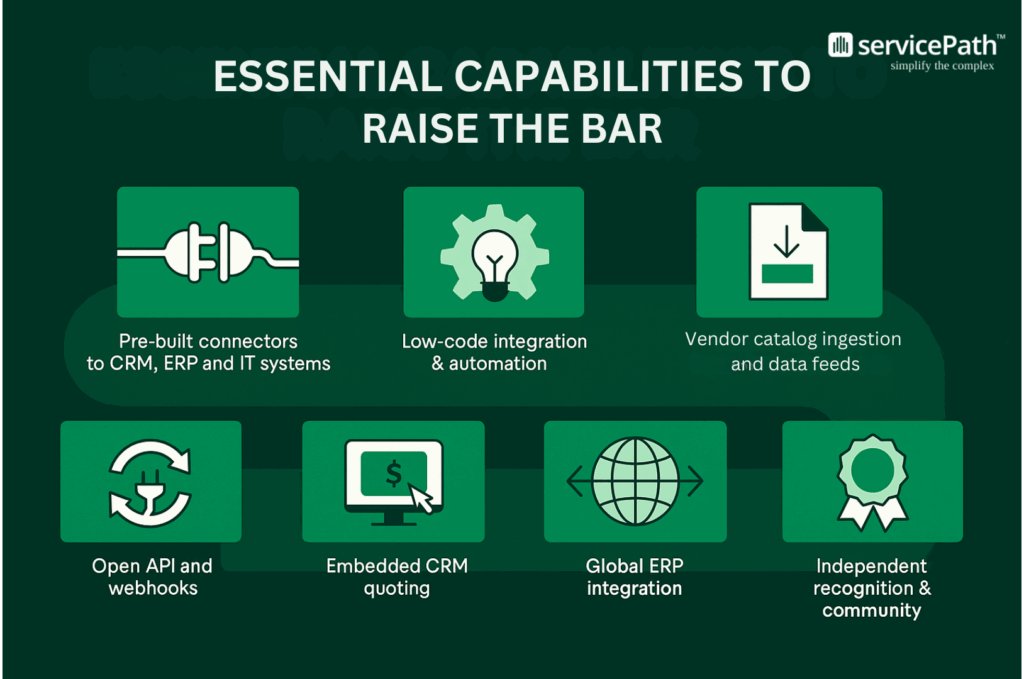
- Pre‑built connectors to CRM, ERP and IT systems – Avoid starting from scratch. Look for platforms that provide connectors to widely used systems such as Salesforce, Microsoft Dynamics, SAP, Oracle, NetSuite and ServiceNow. servicePath™’s integration hub is one example: it offers pre‑built connectors and reusable recipes to bridge CPQ with CRM, ERP and IT‑service management systems. The hub leverages Workato to provide access to more than a thousand pre‑built integrations.
- Low‑code integration and automation – Integration shouldn’t require armies of developers. Modern CPQ platforms increasingly embed low‑code orchestration tools (like Workato) to automate workflows, synchronize data and react to events without heavy coding. This empowers business operations teams to build and modify integrations quickly.
- Vendor catalogue ingestion and data feeds – Accuracy starts at the catalog. Platforms that include a data parsing engine can import vendor product catalogues (Avaya, Cisco, Juniper, Mitel, Unify, Extreme, HP Enterprise and more) and continuously update pricing and inventory by connecting to data providers such as AWS, Azure, Ingram Micro, Amazon and Synnex. Automated ingestion eliminates manual file uploads and reduces pricing errors.
- Open API and webhooks – CPQ should fit into your broader architecture like a well‑behaved microservice. RESTful APIs and event‑driven webhooks allow the platform to integrate with billing systems, service management platforms and financial systems, enabling event‑based workflows (e.g., “when a quote is approved, trigger a project onboarding ticket”).
- Embedded CRM quoting – User adoption skyrockets when sales teams don’t need to leave their CRM to configure quotes. servicePath™’s Salesforce connector demonstrates this pattern: it provides full quoting functionality inside CRM, synchronises data in real time and allows multiple quote versions. Even if you use a different CPQ, insisting on CRM‑embedded quoting improves sales velocity.
- Global ERP integration – Enterprises operate on multiple ERPs. Your control plane should integrate with major suites such as SAP ERP/S4HANA, Oracle E‑Business Suite, NetSuite, Microsoft Dynamics 365 (Finance & Operations, Business Central), Infor CloudSuite and Workday. Deep ERP integration ensures catalog, pricing and order data flow seamlessly between systems.
- Independent recognition and community – Finally, choose vendors whose vision and execution are recognised by industry analysts. servicePath™ has been named a Visionary in Gartner’s Magic Quadrant for CPQ multiple times. While analyst accolades aren’t everything, they signal that a solution is aligned with best practices and is evolving at the pace of the market.
KPIs for your board’s dashboard
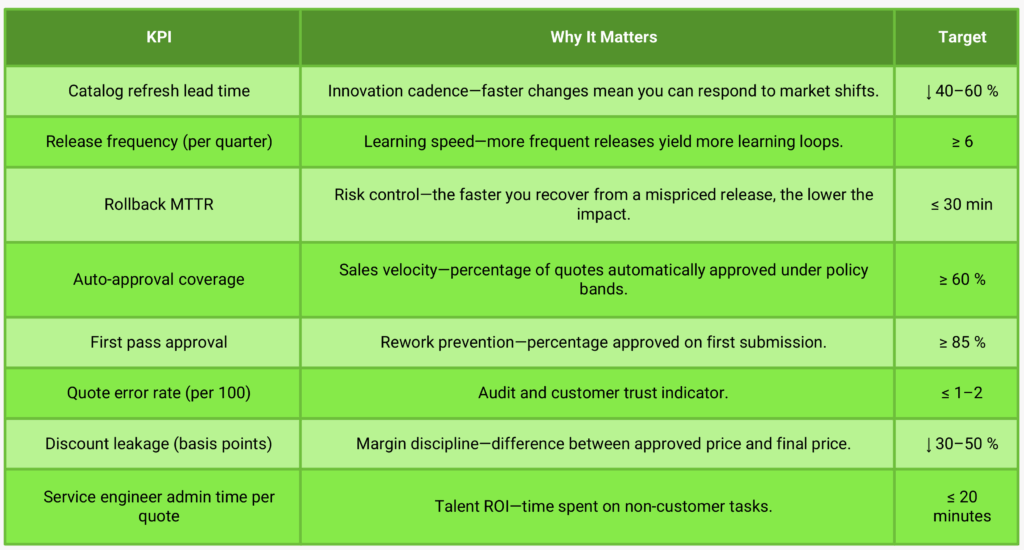
These targets are indicative; adjust them to your industry, deal sizes and risk tolerance. They demonstrate the balance between speed and control.
☀️ From Shadows to Daylight: The Three Acts of Revenue Transformation
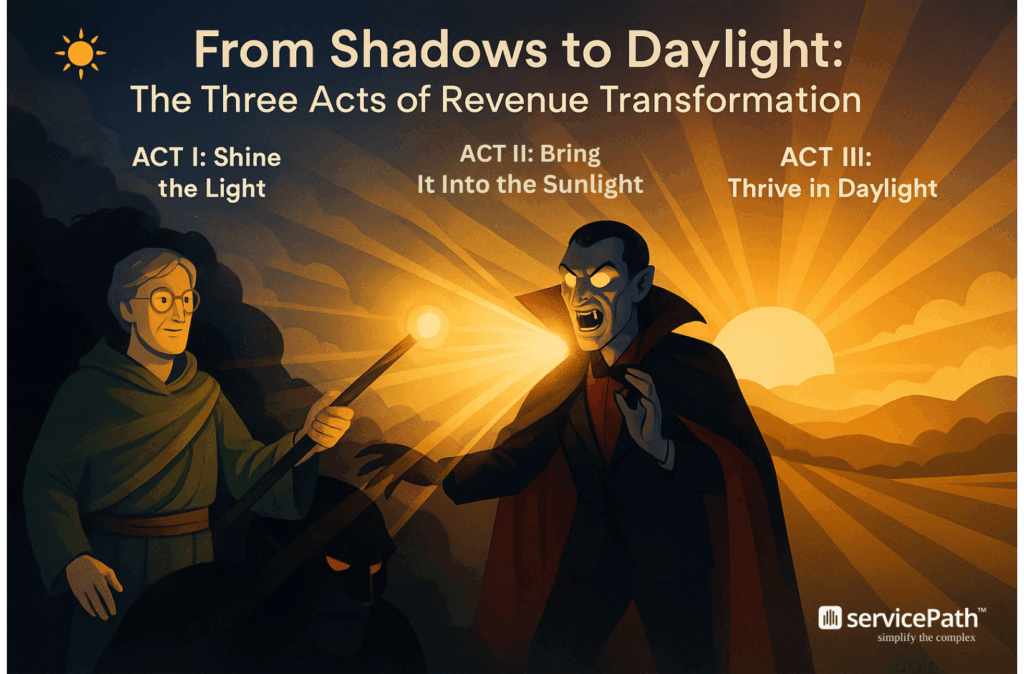
Act I: Shine the Light
This opening phase is all about discovery — uncovering where your current processes are bleeding margin and causing delays.
Gather baseline data.
Measure current quote cycle times, first-pass approval rates, auto-approval coverage, catalog refresh lead times, and discount leakage.
Surface the policies and shortcuts.
Document floor margins, discount bands, and approval routes by product family and region.
Map your spreadsheets and integrations.
Inventory all pricing spreadsheets (owners, dependencies) and chart where data is re-keyed between CRM, ERP, billing, RevRec, and data providers.
Audit shadow discounts.
Pull a sample of recent quotes to see how often discounts exceeded policy and by how much.
Act II: Bring It Into the Sunlight
Once you know where the shadows lie, it’s time to expose and codify your commercial truth. This phase focuses on transparency, governance, and safe change management — replacing opacity with systems that make compliance effortless.
Define and enforce approval bands.
Translate your pricing policies into auto-approval thresholds, starting with low-risk products. Sunlight replaces escalation: every quote operates within clear, visible policy limits.
Bring logic into the light.
Import essential Excel pricing logic into a governed CPQ calculator. Assign owners, create test cases, and maintain version control so institutional knowledge becomes transparent, not tribal.
Create a safe playground.
Spin up a sandbox for catalog changes, run margin simulations on proposed updates, and plan staged releases by region. This “sunlit sandbox” lets you iterate fast, validate impact, and release confidently.
Automate data feeds.
Connect to trusted data providers (AWS, Azure, Ingram Micro, etc.) so pricing and stock updates flow automatically — eliminating the manual, error-prone shadows that undermine accuracy.
Make orders rev-ready.
Capture performance obligations, allocation hints, and triggers at the quote level so finance can recognize revenue accurately. Transparency from quote to cash ensures nothing hides in the dark.
Act III: Thrive in Daylight
In this final phase, your organization turns transparency into acceleration — gaining speed, precision, and trust.
Scale auto-approvals.
Expand your policy bands to cover the majority of deals. Monitor coverage and tune thresholds monthly to balance velocity with control.
Release with confidence.
Execute your first catalog update through sandbox simulation and staged rollout. Practise rolling back if metrics trend downward — agility and safety are now routine.
Connect to finance.
Feed “rev-ready” orders to billing and revenue recognition via APIs and webhooks, closing the loop on quote-to-cash governance.
Tell the story with data.
Publish dashboards for leadership, highlighting improvements in cycle time, approval coverage, and discount leakage. Turn visibility into influence.
Expand and refine.
Continue migrating spreadsheets and catalogs, integrate additional data providers or service tools, and iterate based on measurable results.
What executives typically want
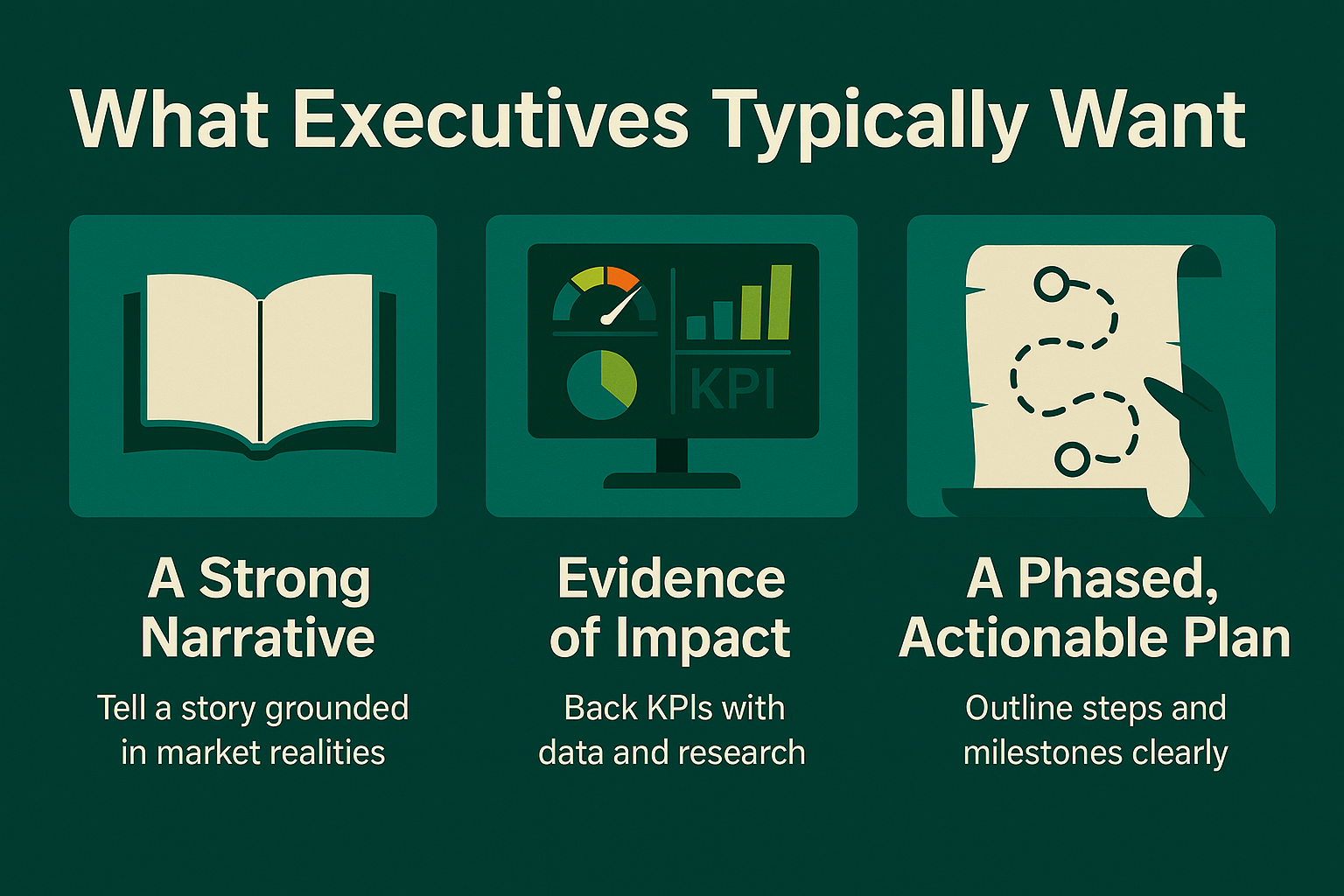
When we work with C‑suites and boards across industries, a consistent set of expectations surfaces. Senior leaders are inundated with vendor pitches and buzzwords; they crave clarity and impact. In our experience, executives typically want to see three things in a revenue transformation playbook:
- A strong narrative, not a brochure – Executives engage when you tell a story rooted in market realities and backed by independent research. Metaphors like the “Vampire Stack” resonate because they frame a problem in human terms. Product names and features should appear only in context and only after the problem is clear.
- Evidence of impact – Boards and audit committees demand hard numbers. The KPI dashboard in this playbook offers concrete targets—cycle time, auto‑approval coverage, margin leakage—that can be baselined and improved. Citing credible research, such as McKinsey’s finding that time‑to‑market is closely tied to profit and IDC’s forecast on public‑cloud spend, further strengthens credibility.
- A phased, actionable plan – Executives appreciate realistic roadmaps with guardrails. The roadmap here outlines clear phases—from discovery to execution—emphasising incremental wins, sandbox testing and rollback drills. Plans like this demonstrate a thoughtful approach and help leaders visualise progress.
These insights come from general executive feedback across multiple engagements. Incorporating them makes the playbook more persuasive and helps align it with board expectations.
Frequently Asked Questions
What is shadow discounting?
Shadow discounting refers to discounts offered outside approved policy or without proper oversight. Such unauthorized discounts undermine a company’s pricing strategy, erode profits and create expectations of permanent reductions. AI‑powered pricing tools can flag these anomalies by alerting pricing managers if a quote dips below approved margins.
Is composable architecture just a buzzword?
No. Both Gartner and IDC advocate for modular, composable systems to replace brittle, monolithic stacks. Gartner advises enterprise‑architecture leaders to modernize portfolios by reducing technical debt and embracing composable architectures while IDC recommends API‑first, composable solutions for complex B2B commerce. Composability means you can swap or upgrade layers without destabilising the whole.
Do I need a new CRM?
Not necessarily. Composable architectures keep your existing CRM (e.g., Salesforce) as the system of engagement. The key is adding a CPQ control plane that governs catalog, pricing and approvals and then connects to your finance systems via open APIs. This approach avoids big‑bang replacement and respects your existing processes.
How do you prevent a new control plane from becoming another monolith?
By enforcing clear boundaries: CRM is for engagement; CPQ is for commercial rules; finance handles billing and revenue recognition. Use open APIs, event‑driven webhooks and a low‑code integration hub to ensure each layer remains modular.
What about AI?
AI can accelerate quoting (e.g., recommending bundles or price moves), but it must operate within guardrails. Composability matters because AI models plug into individual layers without dictating the entire stack. Keep humans in the loop and use explainable AI that respects discount floors and policy thresholds.
Why not stick with one vendor for everything?
Consolidation can simplify buying, but it often leads to lock‑in and slower innovation. A best‑of‑breed, composable approach lets you swap finance or billing vendors as your needs evolve. Remember that public‑cloud spending is doubling and new SaaS vendors emerge regularly—you want the ability to adapt.
☀️ Take Action: Step Into the Sunlight
The message is unmistakable: the era of shadow discounting, brittle integrations, and opaque revenue systems is ending. The organizations that bring their operations into the sunlight—with governed, composable control planes—will command both margin and trust. Those that stay in the dark risk being drained by inefficiency, audit fatigue, and lost market agility.
Begin Your Sunlight Strategy Today
Assess Your Revenue Architecture:
Start by evaluating where your own Vampire Stack hides—duplicated truth, manual approvals, or uncontrolled pricing logic. Our experts can help you benchmark governance maturity and uncover where transparency will yield the fastest ROI.
Explore servicePath™:
Discover how a composable CPQ control plane can unify catalog, pricing, and finance without locking you into monolithic systems. servicePath™ transforms opacity into insight—governing complexity while empowering speed, accuracy, and margin protection.
Take the First Step:
Whether you’re ready to modernize your full revenue stack or simply want to expose and fix the invisible drains eroding performance, start the conversation today. The enterprises that act now won’t just survive—they’ll thrive in daylight, leading their industries with clarity, agility, and control.
Closing thoughts
The Vampire Stack is real, but it’s not immortal. By embracing composable architectures, capturing pricing policies as code, migrating spreadsheet logic into governed engines, and handling service and usage upfront, you can gain both speed and control. If your organisation runs on Salesforce, consider adding a CPQ control plane—such as servicePath™ or similar—to unify your commercial truth and connect to best‑of‑breed finance. Recognised as a Visionary in Gartner’s Magic Quadrant for CPQ multiple times, servicePath™ demonstrates the power of this approach. Whatever technology you choose, the principles outlined here will help you stake the Vampire Stack and build a future‑ready revenue architecture.
Citations:
- Unauthorized Discounts: Discounting Integrity: The Cost of Unauthorized Discounts – FasterCapital
- The Cost of Pricing Errors: Preventing Revenue Leakage | Flintfox
- https://www.forbes.com/sites/pros/2025/06/02/7-trends-shaping-the-future-of-b2b-commerce/
- 3 Trends Driving Enterprise Architecture Strategy in 2025 | Gartner
- Salesforce CPQ Integration – servicepath | CPQ for complex technology sales
- An Open Approach to Integration – servicepath | CPQ for complex technology sales
- ERP Integration – servicepath | CPQ for complex technology sales
- servicePath™ CPQ+ Expands Integration Hub with Workato, Eliminating Barriers to Enterprise Connectivity – servicepath | CPQ for complex technology sales
- The Main Trends Transforming B2B Digital Commerce in 2025 and Beyond