

Executive Summary
TL;DR
Most CPQ programs don’t fail because of “bad software.” They fail because leadership underestimates complexity, controls, and change velocity—and bolts on AI without guardrails.
In 2025, the stakes are even higher:
-
Pricing models are shifting fast (seat + usage + AI agents).
-
Auditors demand tighter evidence across quote-to-cash.
-
Salesforce CPQ has entered End-of-Sale (EOS) — forcing executives to decide whether to harden controls, migrate to Revenue Cloud Advanced, or move to a best-of-breed alternative like servicePath™.
This guide names 12 leadership traps that sink CPQ programs and offers the countermeasures executives need to protect revenue, satisfy auditors, and modernize roadmaps in the Salesforce EOS era.
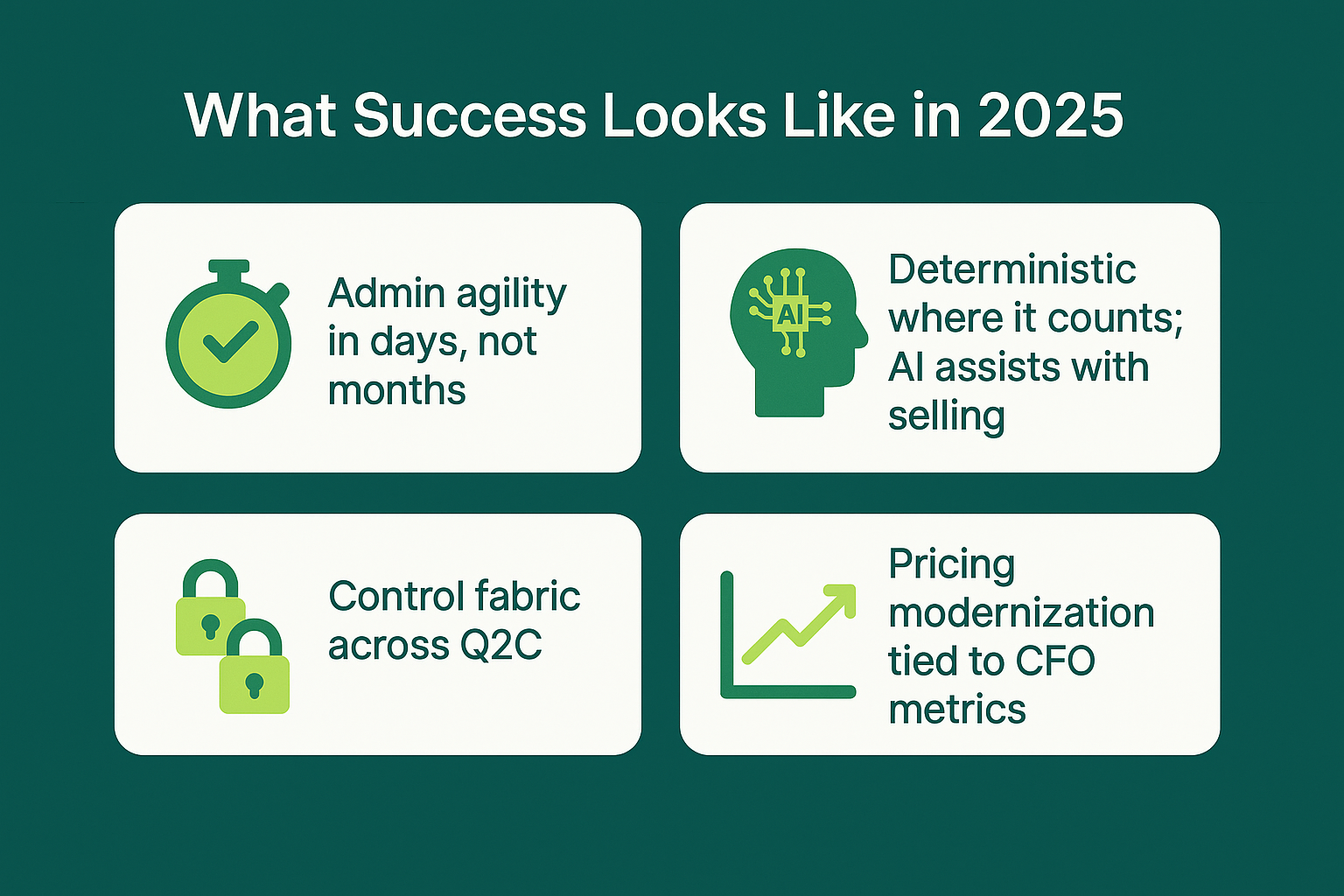
What Success Looks Like in 2025
-
Admin agility in days, not months.
-
Deterministic where it counts (pricing, approvals, entitlements); AI assists with selling and rationale — fully logged for audit.
-
Control fabric across Q2C (dual control, promotion gates, immutable logs, evidence packs).
-
Pricing modernization (seat + usage + AI agents) tied directly to CFO metrics: price realization, discount leakage, margin uplift.
The 12 Traps
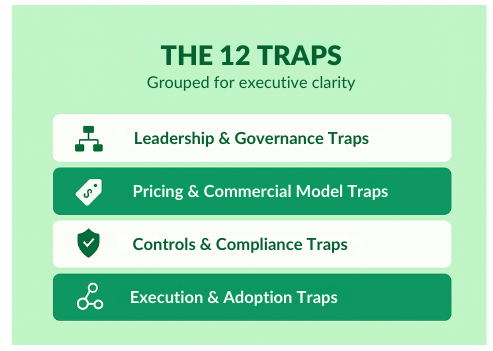
I. Leadership & Governance Traps
1. Treating CPQ as a “feature” instead of a revenue system
-
Symptom: It’s staffed like a minor CRM enhancement; no empowered product owner.
-
Trap: Underestimation of cross-functional impact across pricing, finance, legal, and IT.
-
Countermeasure: Elevate to a board-visible program with a single product owner. Track value weekly (cycle time, discount leakage, price realization).
2. Fuzzy ownership across Sales, Finance, and IT
-
Symptom: Gridlock on discount policy and approval language.
-
Trap: No clear accountability.
-
Countermeasure: Create a Q2C Governance Council (Sales Ops + Finance + Legal + IT). Sprint cadence, clear change windows, and an approval design authority.
3. Misreading vendor and analyst coverage
-
Symptom: Over-indexing on quadrants and vendor blogs.
-
Trap: Shallow evaluation and checklist buying.
-
Countermeasure: Use analysts to shortlist, not select. Prove value with your own PoV data and CFO KPIs.
II. Pricing & Commercial Model Traps
4. “Lift-and-shift” of legacy price books
-
Symptom: Thousands of SKUs, overlapping lists, hidden margin loss.
-
Trap: No pricing operating model.
-
Countermeasure: Run a pricing simplification sprint: consolidate books, normalize discounts, and standardize approval tiers.
5. Over-customized rules that slow change
-
Symptom: Pricing changes take weeks.
-
Trap: Code-heavy logic, no admin-safe patterns.
-
Countermeasure: Commit to admin agility SLAs (e.g., tier changes in 24–48 hours). Winners adapt faster.
6. Seat-only pricing in an AI/agent era
-
Symptom: Expansion stalls; AI features undervalued.
-
Trap: CPQ isn’t ready for usage/hybrid pricing.
-
Countermeasure: Introduce hybrid (seat + usage/agents). Enforce tiers and overage rules in CPQ.
III. Controls & Risk Traps
-
Symptom: AI makes off-policy suggestions; no evidence trail.
-
Trap: Conflating recommendations with approvals.
-
Countermeasure: Keep floors/ceilings and approvals deterministic. Let AI assist with guided selling and rationale — but always log human overrides.
8. Weak SOX-ready control design
-
Symptom: Anyone can edit approval matrices or rules in production.
-
Trap: Controls added after go-live.
-
Countermeasure: Enforce dual-control for rule edits, Dev→UAT→Prod promotion gates, maker-checker, immutable logs, and evidence packs.
9. Under-funded data hygiene
-
Symptom: Misquotes, renewal churn, compliance misses.
-
Trap: Weak product master and entitlement catalogs.
-
Countermeasure: Stand up a dedicated data readiness workstream.
IV. Execution & Adoption Traps
10. Big-bang go-live without proof-of-value
-
Symptom: Surprises at launch; no baseline to show impact.
-
Trap: Skipping KPI instrumentation.
-
Countermeasure: Run a PoV on a product slice, track CFO-relevant KPIs, and scale.
11. Weak renewal & entitlement design
-
Symptom: Uplift missed; AI add-ons don’t carry to renewals.
-
Trap: Disconnect between CPQ, billing, and CLM.
-
Countermeasure: Create an entitlement source of truth; wire CPQ to billing and contract data.
12. UI-bound architecture
-
Symptom: Internal quoting works, but partner/e-commerce channels stall.
-
Trap: App-first design; no APIs.
-
Countermeasure: Go API-first. Expose quoting for partners and digital channels with security and SLAs.
The 90-Day Stabilization Plan (Board-Ready)

- Days 1–15: Contain risk — freeze noncritical changes, enforce dual control, baseline KPIs.
-
Days 16–45: Simplify pricing and enforce controls — promotion gates, maker-checker, immutable logs.
-
Days 46–75: Harden renewals & entitlements — ensure AI add-ons flow, uplift enforced.
-
Days 76–90: Prove value — run PoV on 1–2 product lines, demonstrate lift in cycle time and margin.
Three Strategic Options in the Salesforce CPQ End-of-Sale Era
The Salesforce CPQ End-of-Sale announcement has left many executives uneasy. If you’re running CPQ today, you essentially face three paths — each with different risks, costs, and governance implications.
1. Harden & Hold (short-term containment)
-
What it is: Stay on Salesforce CPQ while EOS plays out. Tighten controls, reinforce governance, and defer major redesigns.
-
When it works: If your horizon is ≤18 months and you need stability while other transformations (ERP, billing, CRM consolidation) take precedence.
-
Risks: Mounting technical debt, rising TCO as Salesforce focuses R&D on Revenue Cloud, and talent scarcity for legacy CPQ expertise.
-
Board guidance: Treat this only as a bridge. Use a 3-week Proof-of-Value (PoV) to establish baselines (cycle time, discount leakage, price realization) so you know the cost of standing still.
2. Suite Path (Revenue Cloud Advanced)
-
What it is: Adopt Salesforce’s new API-first Revenue Cloud and Agentforce for Revenue.
-
When it works: If you are a “Salesforce house” willing to accept higher lock-in and suite economics.
-
Upside: Deep CRM integration, unified Salesforce roadmap, agentic quoting capabilities.
-
Risks: TCO can escalate quickly, flexibility is limited for hybrid pricing or complex configuration, and migration is non-trivial (especially for firms with thousands of SKUs).
-
Board guidance: Scrutinize lock-in and long-term licensing exposure. Model the TCO 3–5 years out against margin and pricing agility goals.
3. Best-of-Breed (servicePath™ + Salesforce Sales Cloud)
-
What it is: Modernize CPQ with a specialized platform like servicePath™ while keeping Salesforce Sales Cloud for CRM.
-
When it works: If your business model demands complex configuration, usage-based/AI-agent pricing, or SOX-grade controls that Revenue Cloud can’t flexibly deliver.
-
Upside:
-
Hybrid pricing — enforce seat + usage + AI-agent tiers natively.
-
SOX-ready controls — dual control, immutable logs, and evidence packs embedded.
-
Composable, headless architecture — future-proof integrations with billing, ERP, or CLM of your choice.
-
-
Risks: Requires deliberate integration planning, but avoids single-vendor lock-in.
-
Board guidance: Run a 90-day stabilization + PoV on 1–2 product lines. Quantify lift in cycle time and margin. This produces evidence your CFO and auditors respect while giving you a future-proof architecture.
Bottom line for executives:
-
Harden & Hold buys time, but value erodes.
-
Suite Path offers integration, but with high lock-in and cost exposure.
-
Best-of-Breed with servicePath™ delivers resilience, flexibility, and audit-readiness — without sacrificing Salesforce CRM.
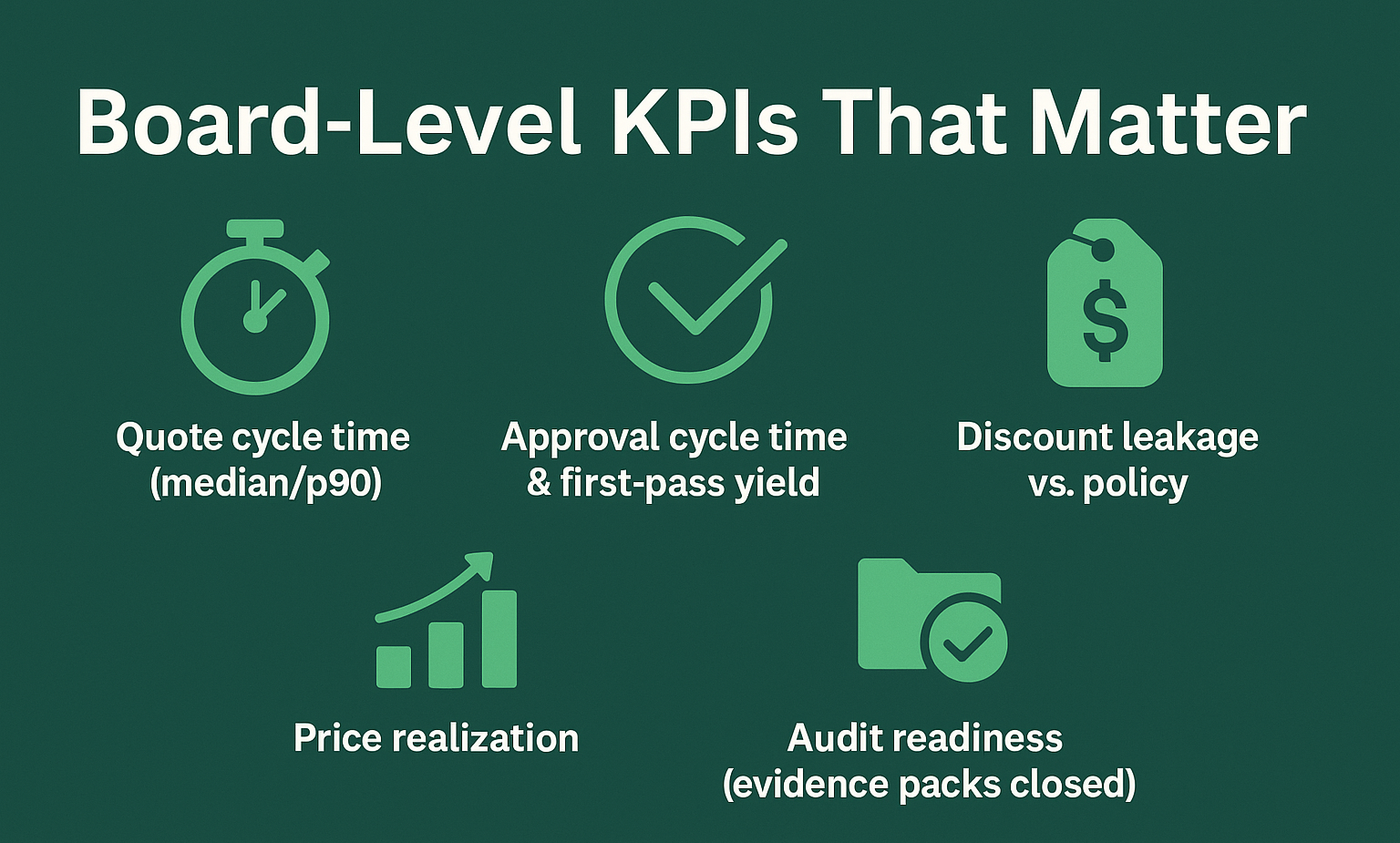
Board-Level KPIs That Matter
-
Quote cycle time (median/p90)
-
Approval cycle time & first-pass yield
-
Discount leakage vs. policy
-
Price realization
-
Renewal uplift / NRR
-
Audit readiness (evidence packs closed)
Executive FAQs (2025)
Q1. Can AI replace my CPQ rules?
-
Answer: No — and that’s the danger zone many enterprises are falling into. AI is powerful for guided selling, rationale drafting, and surfacing expansion plays. But pricing thresholds, approval workflows, and compatibility checks must remain deterministic and fully logged to pass audit and SOX tests. AI should recommend, not authorize. Executives who get this balance right see faster deal velocity without exposing the business to compliance or margin risk.
Q2. How fast can we stabilize a struggling CPQ?
-
Answer: In about 90 days, you can halt uncontrolled changes, harden approval matrices, simplify price books, and prove impact through a tightly scoped Proof-of-Value (PoV). The right approach shifts CPQ from being a board-level problem to a board-level win, with evidence packs ready for auditors and KPIs your CFO respects.
Q3. What KPIs matter most to my CFO and Audit Committee?
-
Answer: Executives should focus on value, not vanity. Key measures are:
-
Quote cycle time (median/p90)
-
Approval cycle time & first-pass yield
-
Discount leakage vs. policy
-
Price realization (list vs. transacted)
-
Renewal uplift / NRR
-
Audit readiness (evidence items closed)
These are the metrics Bain, BCG, and McKinsey consistently tie to commercial excellence, margin protection, and AI-in-sales ROI.
-
Q4. We’re on Salesforce CPQ — what does “End-of-Sale” actually mean for us?
-
Answer: Salesforce is no longer selling CPQ for net-new deals and is steering customers toward Revenue Cloud Advanced. That means reduced R&D investment, eventual talent scarcity, and higher lock-in pressure for existing customers. The decision point is clear: either Harden & Hold temporarily, take the Suite Path (Revenue Cloud Advanced), or modernize with a Best-of-Breed platform like servicePath™ that gives you SOX-ready controls, hybrid pricing, and Salesforce CRM integration without lock-in.
Q5. How do we avoid vendor lock-in as we modernize?
-
Answer: The proven executive strategy is to go composable. Keep Salesforce CRM, but pair it with best-of-breed CPQ, billing, and CLM systems. Insist on API-first tools and transparency on exit costs during vendor selection. This ensures agility and cost control even as pricing models evolve toward AI agents and usage-based revenue.
Q6. Where do AI investments in CPQ actually pay off?
-
Answer: The highest ROI use cases are consistent across 2024–2025 research:
-
Guided selling & deal configuration
-
Expansion plays from usage data
-
Rationale drafting for approvers (“why this price”)
-
Cross-sell/upsell recommendations
AI helps sales reps sell smarter and executives prove ROI faster, but only when wrapped in strong controls and explainability logs.
-
Q7. What’s the #1 mistake boards make during CPQ rollouts?
-
Answer: Treating CPQ as an IT project instead of a revenue transformation initiative. Without executive sponsorship and a single product owner, CPQ gets stuck between Sales Ops, Finance, and IT. The result is long lead times, audit gaps, and missed pricing opportunities. Boards should demand weekly value telemetry tied to revenue KPIs.
From CPQ Traps to Triumph: The Executive Guide to Surviving Salesforce EOS
The fastest route from CPQ frustration to impact is less heroics, more governance. Simplify price books, lock down controls, apply AI where it accelerates humans (not where it risks compliance), and prove results through a structured PoV.
But in 2025, there’s an added urgency: Salesforce CPQ is End-of-Sale. The old “wait it out” approach isn’t viable. Executives now face three choices:
-
Harden & hold as a temporary bridge.
-
Suite path with Salesforce Revenue Cloud Advanced.
-
Best-of-breed with servicePath™ — delivering complex configuration, usage/AI-agent pricing, and SOX-ready controls without Salesforce lock-in.
servicePath™ was built for this moment: enterprise-scale CPQ that’s headless, composable, and audit-ready. It lets you keep Salesforce CRM while unlocking pricing agility, governance strength, and board-level metrics your CFO will trust.
In short: the Salesforce EOS pivot isn’t just risk — it’s opportunity. The leaders who act decisively will not just stabilize CPQ, but turn it into a durable revenue advantage.
The Bottom Line for Stakeholders
The biggest trap isn’t discount leakage, AI without guardrails, or messy renewals. It’s inaction. Many executives hope to “wait out” CPQ pain or Salesforce’s End-of-Sale transition, but that’s the most expensive move of all.
The companies that will win in 2025–2026 are those that:
-
Confront traps directly instead of papering them over.
-
Prove value in 90 days with disciplined PoVs.
-
Modernize CPQ controls and pricing while competitors stall.
As one CFO put it in a Bain roundtable: “The cost of standing still is hidden in every renewal, every approval delay, every missed uplift. Modernization isn’t optional—it’s margin defense.”
Research is clear:
-
McKinsey finds that AI-enabled sales teams with clear governance drive 2–3x higher productivity gains than peers without guardrails.
-
Bain/BCG link pricing discipline directly to margin expansion, even as inflation cools.
-
KPMG’s 2025 SOX update shows auditors now expect immutable evidence packs across the Q2C lifecycle.
-
Forrester warns that legacy CPQ without headless/API foundations will block channel and ecommerce expansion.
In short: the 12 traps aren’t just failure patterns—they’re a map for action. Follow them with discipline, and you’ll be among the leaders that turn CPQ from chaos into a revenue advantage while competitors are still patching legacy systems.
One-Liner for Your Teams
“CPQ rules enforce; AI assists. Every change is logged, every approval defensible. That’s how we win margin and trust in 2025.”
This messaging grounds your teams: no hype, no fear—just governance and velocity.
Next Steps with servicePath™
Ready to move from CPQ frustration to measurable results? servicePath™ is built to help executives escape the traps:
-
Book a 90-Day Stabilization Workshop — We’ll assess your current rollout, freeze risk, simplify pricing, and deliver a PoV CFOs and auditors will respect.
-
Guides & Whitepapers — Executive playbooks for AI guardrails, SOX controls, and hybrid pricing.
-
Case Studies — Real outcomes: cycle time cut in half, margin uplift proven, audit packs closed.
-
Why servicePath™ Wins — Alternative to Salesforce CPQ for complex, usage-based, and AI-assisted selling.
-
Gartner® Recognition — Named Visionary in CPQ Magic Quadrant™ three years running.
-
Explore the AI-Powered CPQ Platform — Deterministic guardrails + probabilistic intelligence, built for complex, fast-changing enterprises.
Sources & Further Reading
- Salesforce — Salesforce Launches Agentforce for Revenue (75% quoting time reduction): https://www.salesforce.com/news/stories/agentforce-for-revenue-announcement/
-
WebWire / Press — Agentforce Cuts Sales Quoting Time by 75%: https://www.webwire.com/ViewPressRel.asp?aId=341306
-
Salesforce — Sales Quote Automation with Agentforce & AI: https://www.salesforce.com/sales/cpq/sales-quote-automation/
-
Salesforce — Agentforce quoting natural-language + permissions: https://www.salesforce.com/sales/ai-sales-agent/
-
SalesforceBen — Salesforce CPQ Confirms End-of-Sale: https://www.salesforceben.com/salesforce-confirms-the-future-of-cpq/
-
SalesforceBen — Salesforce CPQ Is End of Sale: What Are Your Options?: https://www.salesforceben.com/salesforce-cpq-is-end-of-sale-what-are-your-options/
-
CRM Folio3 — What EOS Means for CPQ: https://crm.folio3.com/blog/the-end-of-sale-eos-salesforce-cpq/
-
CLD Partners — CPQ to RCA Migration Considerations: https://www.cldpartners.com/salesforce-cpq-is-entering-an-end-of-sale-phase-whats-next/
-
servicePath™ blog — CPQ End-of-Sale 2025: Costs & Risks: https://servicepath.co/2025/08/salesforce-cpq-end-of-sale-migration-servicepath-alternative-costs-risks-the-future-proof-path/
-
CPQ Integrations — EOS What’s Next: https://cpq-integrations.com/blog/salesforce-cpq-end-of-sale-whats-next/
-
Canvas Cloud — Navigating End-of-Sale for CPQ: https://canvascloud.com/blog/navigating-the-end-of-sale-for-salesforce-cpq
-
Blogs. Emorphis — CPQ Is Retiring: Next Steps: https://blogs.emorphis.com/salesforce-cpq-migration-options/
-
McKinsey — AI in B2B Sales, guardrails, ROI: An unconstrained future: How generative AI could reshape B2B sales (Sep 2024) ; Unlocking profitable B2B growth through gen AI (Mar 2025)
-
Bain / BCG — Pricing discipline, margin expansion: Bain: Expanding Profit Margin Through Intelligent Pricing (Jan 2025) ; BCG: Five Trends That Will Define the Future of Pricing (Jan 2025)
-
KPMG — 2025 SOX update, immutable evidence packs: The Future of SOX: Trends in ICOFR Programs (Mar 2024 PDF) ;
KPMG Summer 2025 SOX Update (Webcast)