
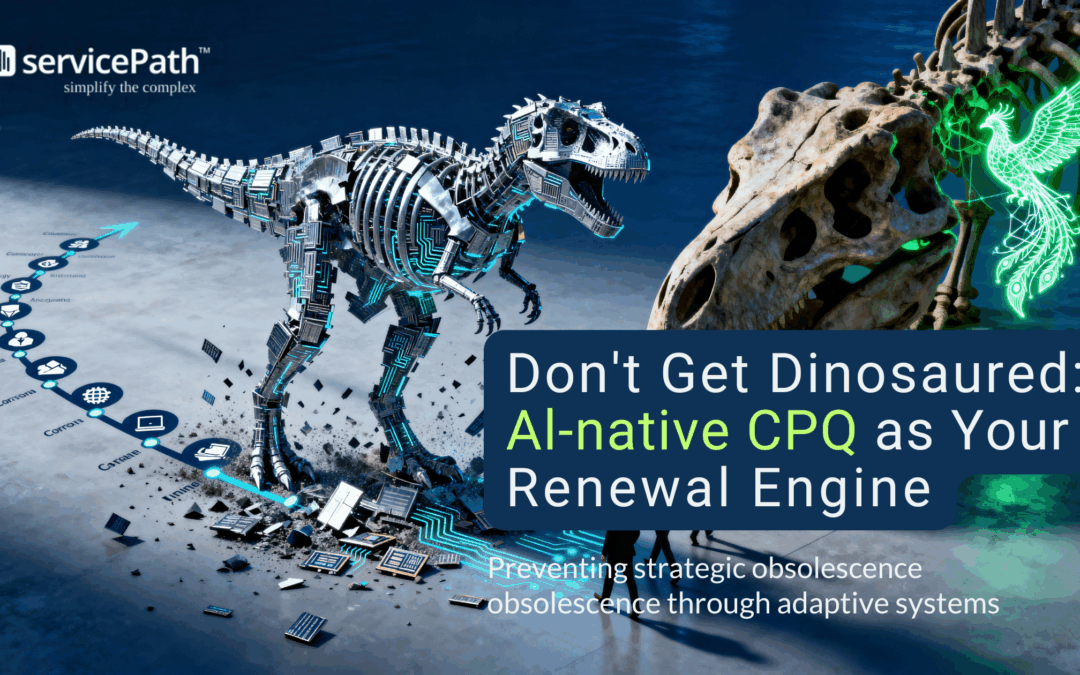
Organizational renewal AI-native CPQ prevents companies from becoming dinosaured and strategically obsolete
Our industry does not respect tradition—it only respects innovation. Satya Nadella said that in 2023, and the data backs him up with brutal precision.
The average S&P 500 company will live just 12 years by 2027—down from 33 years in the 1960s. Half the current index will vanish within the next decade. But here’s what most boards miss: this isn’t about disruption from some scrappy startup. It’s about something far more insidious—companies becoming dinosaured. Going extinct not because competitors beat them, but because they never built organizational renewal into their DNA through AI-native CPQ and continuous adaptation systems. Those AI pilots failing across 90% of enterprises? The technology works. The organizational renewal systems designed to learn and adapt? They don’t exist.
TL;DR
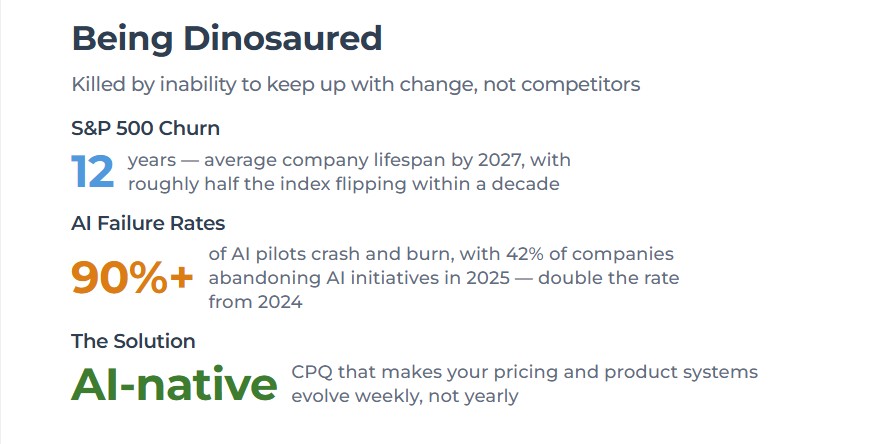
- Being “dinosaured” = You’re not killed by competitors. You’re killed by your own inability to keep up with change.
- S&P 500 churn is brutal: Company lifespan heading to ~12 years by 2027; roughly half the index flips within a decade.
- AI isn’t the problem—you are: Over 90% of AI pilots crash and burn; 42% of companies just gave up on AI in 2025, double the number from 2024.
- The solution? Start with AI-native CPQ that makes your pricing and product systems evolve weekly, not yearly.
Executive Summary
Think your Fortune 500 status gives you stability? Think again. Companies used to last 33 years back in the 1960s. By 2016, that dropped to 24 years. By 2027, we’re staring at just 12 years. Half of today’s S&P 500 will be gone within a decade. Getting “dinosaured” isn’t about some startup blindsiding you. It’s about your own failure to embed organizational renewal into how you actually run things. AI-native CPQ systems provide the foundation for this continuous adaptation.
This crisis goes way deeper than tech adoption. Sure, 42% of companies threw in the towel on AI in 2025—up from just 17% in 2024. And yes, over 90% of generative AI pilots are face-planting. But the real killer is organizational entropy—your complete inability to sync learning and adaptation across revenue, product, operations, and culture. Companies like Klarna that bake renewal into their operating system? They’re building moats that last. Everyone else joins the 60% of organizations Gartner says will get zero value from AI by 2027. Want to know where to start? With organizational renewal through AI-native CPQ platforms that anchor continuous adaptation across your entire business.
What Does It Mean to Be “Dinosaured”?
AI-native CPQ enables organizational renewal and prevents strategic obsolescence
Getting dinosaured means your organization becomes strategically obsolete—not because you’re slow or dumb, but because you never built organizational renewal and continuous learning into your operational fabric. This isn’t about disruption from the outside. It’s about becoming structurally incapable of keeping up from the inside. AI-native CPQ systems address this by embedding adaptation into your commercial DNA.
Here’s how it happens: your systems, people, and processes can’t evolve fast enough for the world you’re actually operating in. You’ve got the budget. You’ve got smart people. Hell, you might even have decent technology. But somewhere along the way, you failed to architect adaptability into your company’s DNA. Your decision frameworks stay frozen while everything around you accelerates. That’s when the fossilization kicks in.
Organizational renewal isn’t a project anymore—it’s a core capability. Companies that can’t fuse AI-native CPQ and continuous adaptation into their DNA face extinction, not from disruption, but from irrelevance.
The dinosaur metaphor isn’t just wordplay. It captures biological truth. Real dinosaurs dominated until the environment changed faster than they could adapt. Same thing happens to companies: you thrive in stable conditions, then suddenly the world speeds up and your renewal mechanisms can’t keep pace. Game over.
The Extinction Event Is Already Here: The Data
The numbers tell a brutal story. We’re watching a corporate mass extinction event in real time, and the failure rates are accelerating across every measure of organizational adaptability.
The AI Transformation Train Wreck
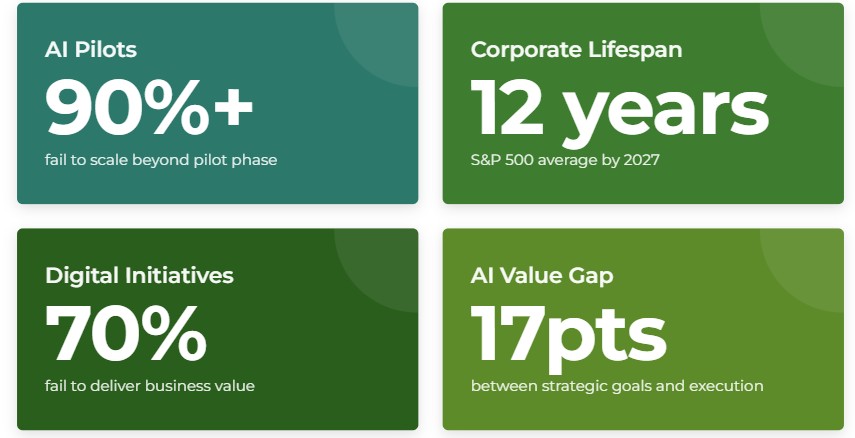
Nowhere is the renewal crisis more obvious than AI adoption. Despite massive investment and executive attention, over 90% of enterprise generative AI pilots are failing to deliver anything measurable, according to 2025 MIT research. Even worse? 42% of companies just abandoned most AI initiatives in 2025—more than double the 17% from 2024.
This isn’t a technology problem. It’s a renewal problem. Deloitte’s 2025 research found 26% of AI leaders cite workforce skills and organizational readiness as major roadblocks, with legacy systems creating even more barriers. Companies treat AI like an add-on instead of a complete transformation of their operating system. They deploy models without redesigning the systems, incentives, and governance structures they actually need for continuous learning.
The Corporate Lifespan Collapse
Corporate lifespans tell the bigger story about organizational fragility. Average S&P 500 company tenure collapsed from roughly 33 years in the 1960s to around 24 years in 2016, and it’s now tracking toward roughly 12 years by 2027. Earlier warnings suggested up to 75% of the S&P 500 could be replaced by 2027; more recent analysis points to roughly 50% turnover over the next decade.
The trajectory keeps accelerating. Innosight calls it “creative destruction on steroids”—market disruption at a pace we’ve never seen before.
Digital Transformation’s Brutal Failure Rate
Even when companies see the need for change, execution remains brutally difficult. Roughly 70% of digital transformation projects fail to meet their stated goals, according to multiple consulting studies. McKinsey research confirms this, identifying culture as the dominant obstacle to successful transformation—you can buy technology and hire consultants, but you can’t easily architect renewal into your cultural DNA.
Gartner predicts 60% of organizations will fail to get any real value from AI by 2027, mainly due to inadequate data governance and organizational readiness. Yet Gartner’s 2024 CEO survey found 77% of chief executives believe AI will have the biggest impact on their organizations by 2028—highlighting the massive gap between knowing what needs to happen and actually making it happen. These are classic symptoms of companies that lack embedded renewal capabilities.
Three Companies, Three Destinies: Extinction vs. Survival
The metaphor of getting dinosaured becomes visceral when you look at real organizational extinctions alongside those that managed to evolve. Just like the asteroid that wiped out species that couldn’t adapt while others survived, today’s business environment separates renewal-capable organizations from those heading toward obsolescence. Here are three archetypal stories.
The Extinction: Nokia’s Catastrophic Failure to Renew

Nokia owned roughly 49% of the smartphone market in 2007, then basically handed the market over as software ecosystems started setting the pace. By 2013, Windows Phone OS held roughly 3% market share globally, with Nokia shipping most of those devices. The proximate cause wasn’t money or brains—it was renewal architecture. Nokia had the technology and resources but lacked the organizational capacity to embed continuous adaptation into its decision-making systems, product development cycles, and cultural fabric.
Research analyzing Nokia’s collapse reveals the company suffered from hierarchical paralysis. Middle managers were terrified of bringing bad news to leadership, engineering teams couldn’t pivot quickly from Symbian to modern operating systems, and strategic planning cycles assumed market stability rather than acceleration.
The lesson: Nokia got dinosaured because it treated adaptation as a strategic choice rather than an operational imperative. While competitors built renewal into their product cycles and organizational structures, Nokia operated with annual planning rhythms in a market requiring quarterly—sometimes monthly—evolution.
The Transformation: Microsoft’s $3 Trillion Renewal Under Nadella
If Nokia shows you extinction, Microsoft under Satya Nadella shows you successful renewal at massive scale. When Nadella became CEO in 2014, Microsoft’s market cap sat at roughly $300 billion. The company was seen as a declining giant, stuck in PC-era thinking while mobile and cloud were reshaping everything.

By January 2024, Microsoft hit $3 trillion market cap—roughly 10x growth in a decade. This wasn’t luck or market timing. This was systematic organizational renewal.
As Nadella himself put it: “Our industry does not respect tradition—it only respects innovation.” This philosophy drove three renewal mechanisms that kept Microsoft from getting dinosaured:
Cultural Renewal: Nadella led a massive culture shift, replacing Microsoft’s historically competitive internal culture with what he called a “growth mindset”—organizational commitment to continuous learning over static expertise. As he puts it: “Learn-it-all beats know-it-all.” This cultural architecture made renewal psychologically safe rather than threatening.
Architectural Renewal: Microsoft shifted from Windows-centric product architecture to cloud-first, platform-agnostic approach. Azure became the renewal engine, forcing continuous adaptation to customer needs, competitive dynamics, and technological evolution. The platform itself was designed for perpetual evolution rather than periodic upgrades.
Strategic Renewal: Rather than defending existing revenue streams, Nadella systematically cannibalized Microsoft’s own products in favor of cloud and AI investments. This willingness to sacrifice current profitability for adaptive capacity prevented the organizational fossilization that dinosaured competitors.
The lesson: Even massive, complex organizations can avoid getting dinosaured if they architect renewal into culture, systems, and strategy simultaneously. Size isn’t destiny—adaptability architecture is.
The Pioneer: How Klarna Built Renewal Into Its DNA
While traditional financial institutions struggled to modernize legacy systems and processes, Klarna shows you how to avoid getting dinosaured through systematic organizational renewal from day one. The Swedish fintech didn’t just adopt AI—it re-architected its entire enterprise around continuous adaptation.
Structural Renewal: Beyond Innovation Theater
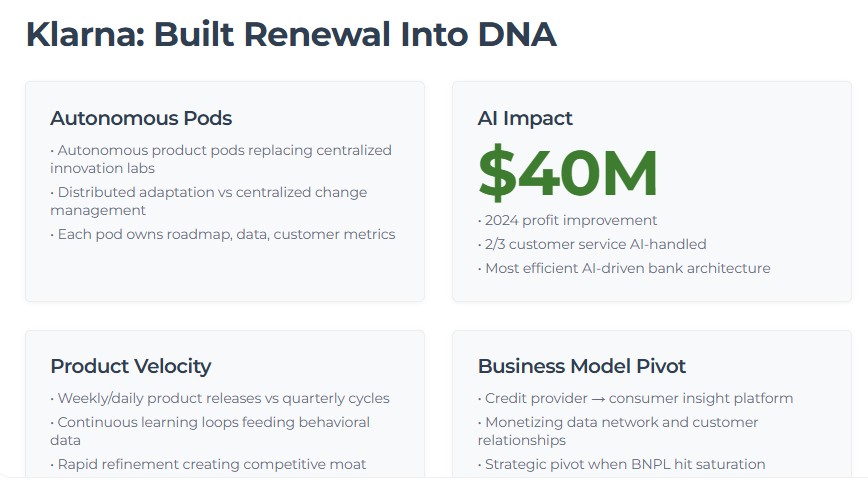
Klarna’s first breakthrough was organizational design. Rather than creating centralized innovation labs or digital transformation departments, the company dismantled its monolithic structure and created autonomous product pods. Each pod owns its roadmap, data, and customer metrics, enabling distributed adaptation rather than centralized change management.
This decentralization embedded agility into Klarna’s operating system. Renewal became part of daily operations rather than quarterly initiatives, preventing the company from getting dinosaured by decision lag or bureaucratic friction.
AI as Renewal Accelerator
Klarna’s AI integration shows you how technology can amplify organizational adaptability rather than just automate existing processes. The company’s AI assistant now handles two-thirds of customer service interactions, driving an estimated $40 million in profit improvement for 2024.
More importantly, Klarna restructured its entire organization around AI to become what The Asian Banker calls “the most efficient AI-driven bank”. The company used AI not just for customer service, but to create continuous feedback loops that inform product development, risk assessment, and strategic planning.
Product Renewal Velocity
Klarna operates on renewal cycles that would be impossible for dinosaured organizations. The company releases product iterations weekly—sometimes daily—with architecture enabling continuous learning loops that feed behavioral data into rapid refinement cycles. This velocity creates a competitive moat that static organizations simply cannot match.
Strategic Business Model Renewal
Perhaps most significantly, when “Buy Now, Pay Later” hit market saturation, Klarna didn’t double down on its existing model. Instead, it pivoted from being primarily a credit provider to a consumer-insight and marketing platform, monetizing its data network and customer relationships in entirely new ways.
The lesson: Klarna shows you what happens when you wire renewal into your operating model from the beginning—AI handling roughly two-thirds of service chats and contributing an estimated ~$40M to 2024 profit, but the real story is autonomous pods, continuous releases, and renewal as the default state rather than the exception.
The Investor Perspective: PE and VC Firms Sound the Alarm
The renewal crisis extends way beyond individual companies—it’s becoming a systemic risk that private equity and venture capital firms increasingly recognize as the primary threat to portfolio value creation.

The “Renewal Readiness” Gap
Conversations with PE and VC leaders reveal a troubling pattern: most portfolio companies are not renewal-ready. Despite significant investment in AI, automation, and analytics, their foundational systems—from pricing and product configuration to decision workflows—remain completely static.
Bain’s 2025 Global Private Equity Report notes that firms are “learning fast what works and what doesn’t when applying AI to create value”, but the learning curve is steep. Most portfolio companies suffer from what investors now call the “renewal gap”—the growing distance between technological potential and organizational adaptability.
Infrastructure Constraints on Adaptation
The challenge isn’t capital—it’s architectural. As Private Equity International reports, “Monolithic systems and unorganised data make AI adoption slow and costly”. Legacy revenue systems, rigid ERP architectures, and siloed data prevent the agile reconfiguration necessary for continuous adaptation.
Investors can inject technology and talent, but if renewal isn’t built into the organizational fabric, companies just automate their existing inefficiencies rather than transforming their adaptive capacity.
Renewal as the New Defensibility Metric
PE and VC firms increasingly see renewal capability—not just capital efficiency—as the predictor of long-term enterprise survival. Embedded renewal is becoming the new governance standard, with investors tracking not just EBITDA but “organizational half-life”—how quickly a company can adapt its operations, offerings, and strategy to changing conditions.
This shift represents a fundamental change in how investors evaluate risk and opportunity. Companies that can’t demonstrate systemic renewal capabilities face valuation discounts, while those with embedded adaptability command premium multiples.
Understanding the Dinosaured Condition: Beyond the Metaphor
The term “dinosaured” captures something traditional business vocabulary struggles to express: the gradual fossilization of organizational capacity to evolve. Like paleontologists studying extinction, we can identify distinct patterns that separate thriving enterprises from those heading toward obsolescence.

The Boiling Frog Syndrome
Getting dinosaured isn’t sudden—it’s slow-motion extinction. Drop a frog in boiling water and it jumps out. Put it in cool water and slowly turn up the heat? It doesn’t notice until too late. Companies work the same way.
Nokia’s collapse happened quarter by quarter, decision by decision. Stick with Symbian one more cycle. Postpone touchscreen investment. Each choice seemed rational. Cumulatively? Obsolescence. Nokia’s executives knew about the iPhone. They studied Android. But knowing about change doesn’t create capacity to respond. Without renewal architecture, awareness becomes just another ignored data point.
When Speed Meets Rigidity
Think of trying to run a race while your body turns to stone. That’s rigid organizations competing in accelerating markets. Your competitors aren’t just faster—they’re fluid while you’re fossilizing.
Microsoft pre-Nadella was fast at executing a declining strategy. The company shipped products quickly, made acquisitions aggressively, invested heavily in innovation. But organizational rigidity prevented strategic fluidity. Post-Nadella? Microsoft built systems that could evolve continuously, turning rigidity into adaptive fluidity.
The Organizational Immune Response
Perhaps the most dangerous aspect? Established organizations actively resist necessary change. Like a body rejecting a transplant, your company fights renewal. This explains the 95% failure rate of AI pilots and the 70% failure rate of digital transformation projects. Existing processes and incentives evolved to optimize the current state. When renewal threatens equilibrium, the organization attacks it. Overcoming this requires changing the organizational immune system itself—exactly what Nadella did at Microsoft.
Evolutionary Debt: Compounding Obsolescence
Organizations accumulate “evolutionary debt” when they defer renewal for short-term optimization. Every time you extend a legacy system instead of modernizing it, delay cultural transformation, or maintain dying business models, debt compounds exponentially. Eventually, it exceeds your capacity to pay. That’s when you’re dinosaured. You can’t pay off exponential debt with linear payments. This is why Nadella required wholesale reconstruction, and why Klarna built continuous renewal into its foundation from day one.
A Systems-Level Threat Across Every Business Unit
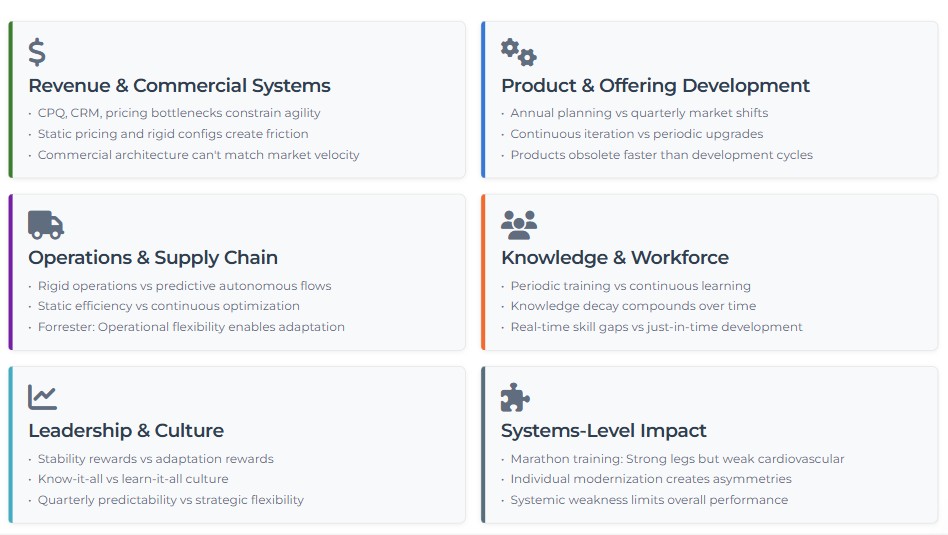
Getting dinosaured isn’t just a tech department problem—it’s a systems-level threat that hits every aspect of how you run your business. Organizations that try to modernize individual functions while leaving others static create dangerous asymmetries that eventually drag the entire enterprise toward obsolescence.
Think of it like training for a marathon where only your legs get stronger but your cardiovascular system, lungs, and metabolism stay out of shape. No matter how strong your legs become, systemic weakness limits overall performance. Similarly, you might have cutting-edge AI capabilities but still get dinosaured if your commercial systems, operational processes, or cultural norms can’t keep pace.
Revenue and Commercial Systems
Revenue engines—including CPQ, CRM, pricing, and billing systems—are often the first casualties of organizational fossilization. When these systems can’t adapt rapidly to new products, pricing models, or customer requirements, they become bottlenecks that constrain enterprise agility regardless of innovation happening elsewhere.
Companies get dinosaured when their commercial architecture can’t keep pace with market velocity. Static pricing models, rigid product configurations, and manual quote processes create friction that compounds over time, eventually making the entire enterprise uncompetitive.
Product and Offering Development
Product development cycles reveal organizational renewal capacity more clearly than almost any other function. Companies with embedded renewal capabilities can iterate continuously, incorporating customer feedback and market signals into rapid development cycles. Dinosaured organizations, by contrast, operate on annual planning cycles that assume stable market conditions.
The difference becomes stark in AI-driven markets where customer expectations and competitive dynamics shift quarterly rather than annually. Products that can’t evolve continuously become obsolete faster than their development cycles can respond.
Operations and Supply Chain
Operational agility determines whether enterprises can scale adaptation or become constrained by their own infrastructure. Forrester’s research on adaptive enterprises emphasizes that operational flexibility enables strategic adaptation, while rigid operations create systemic drag on renewal initiatives.
Companies avoid getting dinosaured by building predictive, autonomous operational flows that can reconfigure themselves based on demand patterns, supply constraints, and strategic priorities. This requires operations architecture designed for continuous optimization rather than static efficiency.
Knowledge and Workforce Capabilities
Perhaps most critically, dinosaured organizations fail to institutionalize continuous learning and skill development. They treat training as periodic events rather than continuous processes, creating knowledge decay that compounds over time.
In contrast, renewal-ready organizations embed learning into daily workflows, using AI-driven systems to identify skill gaps in real-time and provide just-in-time capability development. This approach prevents the knowledge obsolescence that makes enterprises vulnerable to disruption.
Leadership and Cultural Fabric
At the deepest level, companies get dinosaured when their leadership systems and cultural norms reward stability over adaptation. When executives’ incentives align with quarterly predictability rather than strategic flexibility, when promotion criteria favor execution of existing playbooks over experimentation with new ones, and when organizational heroes are those who “deliver on plan” rather than those who “learn and evolve,” fossilization becomes inevitable.
Microsoft’s transformation under Nadella demonstrates how leadership renewal enables systemic renewal. By replacing a “know-it-all” culture with a “learn-it-all” culture, Nadella didn’t just change Microsoft’s strategy—he changed its renewal capacity. The culture itself became an adaptive system rather than a static constraint.
The Foundation of Renewal: Why CPQ Actually Matters
While the renewal challenge spans every business function, AI-native Configure, Price, Quote (CPQ) systems play a uniquely foundational role in preventing enterprises from getting dinosaured. CPQ sits at the intersection of revenue generation, product complexity, and customer interaction—making it a critical enabler of organizational adaptability.
The Revenue-Product-Data Nexus
Modern CPQ systems don’t just automate quote generation—they serve as the central nervous system for organizational learning and adaptation. According to Vendavo’s 2025 CPQ market analysis, leading platforms now incorporate AI-driven insights that inform pricing strategy, product development, and customer experience optimization.
When CPQ systems are rigid and rule-based, they constrain enterprise agility by making it nearly impossible to introduce new products, test pricing models, or adapt to customer requirements. When they’re AI-native and adaptive, they enable continuous experimentation and learning across your entire commercial organization.
Knowledge Velocity and Decision Speed
AI-native CPQ platforms capture and institutionalize knowledge velocity—the rate at which your organization learns from customer interactions, market feedback, and competitive dynamics. This knowledge gets embedded in pricing algorithms, product configurations, and sales processes, creating a continuously improving system rather than static rules.
Companies avoid getting dinosaured by ensuring that customer insights from the field flow immediately into product development, pricing optimization, and strategic planning. CPQ systems serve as the conduit for this organizational learning, provided they’re architected for continuous adaptation rather than periodic updates.
Cross-Business Unit Synchronization
Perhaps most importantly, AI-native CPQ systems enable synchronization across business units that might otherwise evolve at different rates. Forrester research demonstrates that adaptive enterprises—those with synchronized cross-functional agility—grow revenue 3.2 times faster than their competitors. When product development introduces new offerings, when marketing creates new positioning, or when operations optimizes delivery models, these changes can flow immediately through CPQ into customer-facing processes.
The Renewal Imperative: How to Avoid Extinction
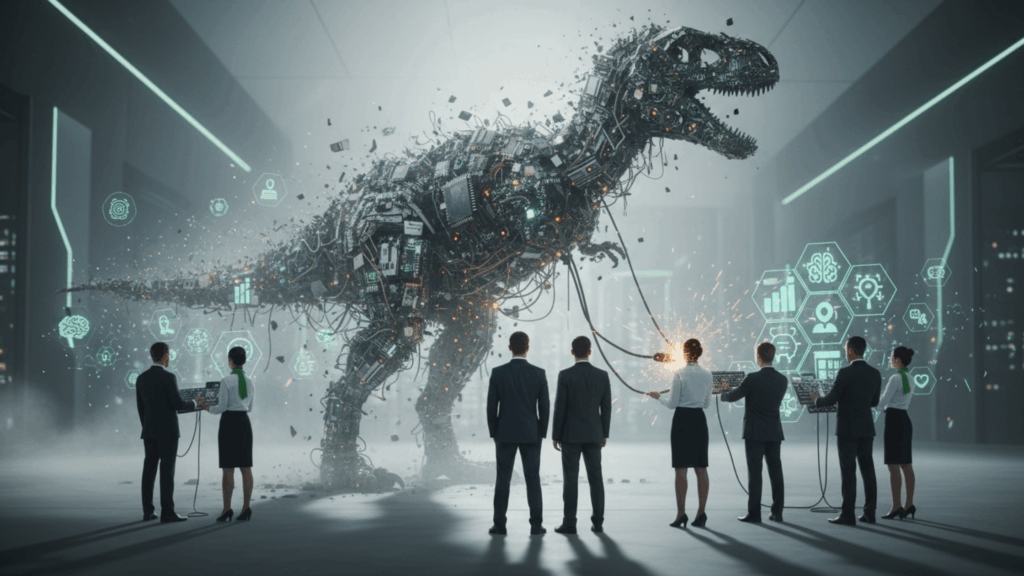
Avoiding extinction requires more than technology adoption—it demands systematic organizational renewal that touches every aspect of how you run your business. The companies that survive and thrive will be those that embed adaptability into their organizational DNA rather than treating change as a series of discrete projects.
Operationalize Renewal
The first imperative is making renewal measurable and recurring rather than episodic and intuitive. This means establishing metrics for organizational learning velocity, adaptation speed, and knowledge transfer efficiency. You need dashboards that track your renewal capacity as carefully as they track financial performance.
Operationalizing renewal also requires embedding adaptation into standard operating procedures. Instead of annual planning cycles, successful organizations operate on continuous planning cycles with quarterly strategy adjustments and monthly tactical pivots. This approach ensures that renewal becomes part of organizational muscle memory rather than exceptional effort.
Architect for Intelligence
AI-enabled systems must evolve continuously rather than simply automating existing processes. This requires architectural decisions that prioritize adaptability over efficiency, learning over optimization, and emergence over control.
You architect for intelligence by building systems that get smarter over time through usage rather than requiring periodic reprogramming. Customer interactions inform product development, operational data drives strategic planning, and market signals automatically trigger process adjustments.
Institutionalize Knowledge Velocity
The most critical renewal capability is ensuring that organizational learning flows faster than market change. This requires systems and processes that capture insights from customer interactions, competitive analysis, and operational experience, then propagate those insights across all relevant business functions in real-time.
Knowledge velocity depends on breaking down information silos and creating shared learning systems. When sales learns something about customer preferences, that insight should immediately inform product development, marketing strategy, and operational planning. When operations identifies an efficiency improvement, that knowledge should flow into pricing models and customer communications.
Embed Renewal Into DNA, Not Innovation Teams
Perhaps most importantly, renewal can’t be delegated to specialized teams or departments. Innovation labs, digital transformation offices, and AI centers of excellence often become organizational curiosities rather than renewal engines if they’re not integrated into core business operations.
Successful organizations embed renewal capabilities into every team, every process, and every system. Renewal becomes part of job descriptions, performance metrics, and organizational culture rather than the responsibility of specialized functions.
Build Feedback Loops Faster Than Market Cycles
A critical but often overlooked renewal capability is the speed of organizational learning loops. Companies avoid getting dinosaured when they can observe market signals, process them into insights, make strategic adjustments, and implement changes faster than competitive and technological cycles evolve.
This explains why Netflix survived its own disruption of the video rental market while Blockbuster got dinosaured. Netflix built organizational systems that could process customer behavior data into strategic pivots—from DVD-by-mail to streaming to content production—with each transition building on learning from the previous cycle. Blockbuster had decision systems designed for real estate optimization, not strategic evolution.
The velocity of your learning loops determines your organizational half-life. When your feedback cycles take quarters to complete, you’re competing with organizations that complete the same loops in weeks or days. That temporal mismatch is often the first symptom of getting dinosaured.
The Renewal Playbook: Practical Steps to Avoid Extinction
Understanding the dinosaured condition intellectually doesn’t prevent it—execution does. Organizations that successfully avoid strategic obsolescence follow specific patterns that can be replicated and scaled. Here’s the practical playbook for building renewal capacity before entropy sets in.
Conduct a Renewal Audit
Before you can improve renewal capacity, you must measure it. Conduct a systematic audit across five dimensions:
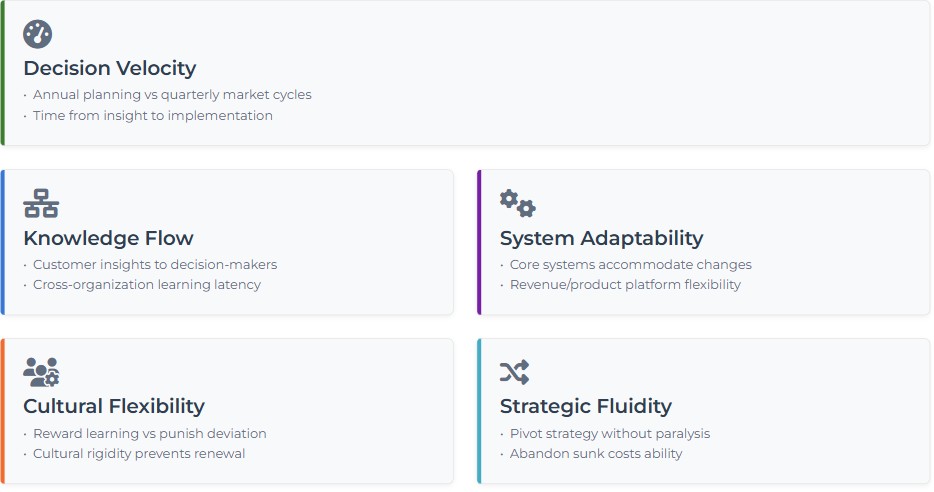
- Decision Velocity: How long does it take your organization to make and implement strategic decisions? If your planning cycles are annual while your market cycles are quarterly, you’re already partially dinosaured. Measure the time from insight to implementation across critical decision categories.
- Knowledge Flow: How quickly does learning from one part of your organization inform decisions in others? Track the latency between customer insights, competitive intelligence, and operational learnings reaching decision-makers who can act on them.
- System Adaptability: Can your core systems—particularly revenue, product, and operational platforms—accommodate changes without major re-architecture? Systems designed for stability become anchors dragging the organization toward obsolescence.
- Cultural Flexibility: Do your people and processes reward learning and adaptation, or do they punish deviation from established patterns? Cultural rigidity fossilizes organizations more effectively than technological limitations.
- Strategic Fluidity: Can your organization pivot its strategy based on new information without triggering organizational paralysis? The ability to abandon sunk costs and change direction marks renewal-ready enterprises.
Identify Your Dinosaur Risk Factors
Certain organizational characteristics dramatically increase your risk of getting dinosaured. If your company exhibits three or more of these patterns, strategic obsolescence may already be underway:

- Success Complacency: Phrases like “this is how we’ve always done it” or “we’re the market leader” signal dangerous comfort with the status quo—exactly the mindset that dinosaured Nokia.
- Siloed Knowledge: When different departments operate with incompatible data, conflicting priorities, or minimal collaboration, organizational learning becomes impossible at enterprise scale.
- Technology Debt: Legacy systems that can’t integrate with modern platforms create renewal bottlenecks. Every “we can’t do that because of our systems” represents fossilization in progress.
- Risk Aversion: When preventing failure becomes more important than enabling success, organizations optimize for stability rather than adaptation—a fatal mistake in accelerating markets.
- Hierarchical Paralysis: If strategic decisions require approval from multiple layers and take months to authorize, your organization can’t evolve faster than environmental change.
The Path Forward
The choice is stark: develop systematic renewal capabilities or get dinosaured. Companies that survive will recognize renewal as their most critical competitive capability.
Start with foundational systems—particularly AI-native CPQ platforms that enable continuous commercial adaptation. But technology alone won’t save you. You also need cultural and operational capabilities for continuous learning. Leadership that prioritizes adaptability. Organizational structures enabling distributed decisions. Metrics rewarding learning velocity alongside efficiency.
The window is closing. With corporate lifespans shrinking and market volatility accelerating, survivors will treat renewal as a core capability, not a project. The question isn’t whether your industry faces disruption—it’s whether you can adapt faster than disruption occurs.
The Urgency Is Real: Why Now Matters
Unlike previous business cycles where companies had years to adapt to new competitive dynamics, today’s acceleration curve compresses adaptation windows to months or quarters. Forrester’s 2025 research confirms this acceleration, with 95% of professionals saying agile practices are critical or very important to their organization’s success—yet most struggle to operationalize that agility. The data is unambiguous: corporate lifespans are forecast to shrink to just 12-14 years by 2026-2027, meaning the average S&P 500 company has less than two decades of survival if it can’t continuously renew.
This isn’t theoretical risk—it’s actuarial reality. The companies getting dinosaured today aren’t those failing to invest in technology; they’re those failing to architect renewal into their organizational operating systems. Technology investments without renewal infrastructure just automate the path to obsolescence.

Frequently Asked Questions About Being Dinosaured
Getting dinosaured means becoming strategically obsolete due to failure to embed continuous learning and renewal into your organizational fabric. Unlike sudden disruption, it’s gradual irrelevance caused by systems, processes, and culture that can’t evolve fast enough. Nokia is the classic example: the company owned roughly 49% of the smartphone market in 2007, but by 2013 Windows Phone OS held only ~3% market share globally (with Nokia shipping most of those devices)—not from lack of resources, but from organizational rigidity.
Disruption is external—new competitors or technologies challenging your position. Getting dinosaured is internal—your own inability to continuously adapt. Companies get disrupted by competitors but dinosaured by themselves. Netflix disrupted Blockbuster externally, but Blockbuster got dinosaured internally because its organizational systems couldn’t process market signals into action fast enough.
Watch for: decision cycles lagging market changes, failed AI/digital initiatives, rigid systems constraining innovation, siloed knowledge, and annual planning assuming stability. Subtle symptoms include “we’ve always done it this way” thinking, resistance to pivots despite data, and celebrating execution over learning. Organizations showing three or more of these signs often struggle with systematic renewal.
Size isn’t destiny—renewal capacity is. Microsoft proved massive organizations can avoid extinction through systematic renewal, growing from roughly $300 billion to over $3 trillion market cap under Nadella’s leadership (2014-2024). Startups build renewal into their DNA from inception; established enterprises must consciously re-architect around continuous adaptation. Both Klarna and Microsoft show renewal capacity trumps organizational age or size.
AI-native CPQ systems are the foundational renewal layer because they sit at the intersection of revenue, product, and customer data. They enable continuous adaptation of pricing, configurations, and interactions while capturing knowledge that informs organizational learning. Rigid CPQ constrains agility; adaptive CPQ enables systematic renewal across all business units—providing the commercial architecture for continuous evolution.
Why servicePath™: Your Renewal Engine for the AI Era
Understanding the risk of getting dinosaured is essential—but taking action requires the right foundation. servicePath™ provides the AI-native CPQ platform specifically architected to prevent organizational extinction by embedding continuous renewal into your commercial DNA.

Built for Renewal, Not Just Automation
Unlike legacy CPQ systems that digitize static processes, servicePath™ was designed as a renewal engine. Our platform creates continuous learning loops that inform pricing strategy, product development, and commercial operations in real-time. While dinosaured companies struggle with rigid CPQ configurations, servicePath™ customers adapt continuously—launching products in days, evolving pricing based on market feedback, and flowing customer insights automatically into strategic planning.
The Commercial Foundation for Enterprise-Wide Adaptation
servicePath™ sits at the critical intersection of revenue, product, and data—making it the foundational platform for systematic organizational renewal. When your commercial systems evolve continuously, that adaptability cascades across your enterprise:
- Revenue Agility: Adapt pricing and commercial models faster than market conditions change.
- Product Velocity: Launch offerings and reconfigure solutions without major system overhauls.
- Knowledge Velocity: Turn customer data into organizational intelligence automatically.
- Cross-BU Synchronization: Enable coordinated adaptation across complex enterprises.
AI-Native Architecture for Continuous Evolution
servicePath™ leverages AI not as a bolt-on feature, but as foundational architecture that enables your commercial systems to evolve continuously. The platform enables the kind of organizational learning velocity that prevents companies from getting dinosaured—where pricing models adapt based on market feedback, product configurations evolve with customer needs, and commercial intelligence compounds over time rather than decaying.
This approach fundamentally differs from legacy CPQ that automates static rules. AI-native systems learn and adapt, getting smarter with every transaction rather than requiring periodic reprogramming. That distinction separates automation that accelerates obsolescence from intelligence that prevents it.
servicePath™ doesn’t just help you sell better today—it ensures you can evolve fast enough to sell effectively tomorrow. That’s the difference between surviving and thriving in the age of perpetual disruption.
Take Action: Don’t Get Dinosaured
The renewal imperative is clear. The data is unambiguous. The window is closing. The companies that build systematic renewal capabilities now will lead their industries for decades. Those that defer transformation risk joining the roughly 50% of S&P 500 companies projected to be replaced over the next decade.
Start Your Renewal Journey Today
Assess Your Renewal Readiness: Talk to our team about where your organization stands on the renewal spectrum. We’ll help you identify the gaps between your current capabilities and what you’ll need to stay competitive in the years ahead.
Explore servicePath™: See how AI-native CPQ can become the foundation for continuous commercial evolution. We’ll show you what’s possible when your revenue systems are designed to adapt, not just automate.
Take the First Step: Whether you’re ready to transform your entire commercial architecture or just want to understand what organizational renewal looks like in practice, let’s start the conversation. The companies that act now will define their industries tomorrow.
Conclusion: The Age of Perpetual Renewal
The era of stable competitive advantage is over. What replaces it? The ability to evolve faster than your environment changes. That’s it. Companies that master continuous renewal will thrive. The rest will fossilize.
The numbers don’t lie. Half of today’s S&P 500 will turn over in the next decade. Average company lifespan: 12 years by 2027. The extinction event isn’t coming—it’s here. Winners won’t be those with the best strategy or newest tech. They’ll be those with the most sophisticated renewal capabilities.
We’ve already watched this play out. Nokia owned 49% of the smartphone market in 2007, then vanished because its systems couldn’t evolve fast enough. Microsoft grew from $300 billion to $3 trillion through systematic renewal. Klarna embedded adaptation into its DNA from day one, with AI handling two-thirds of service chats and driving an estimated $40 million in profit improvement. Same market. Different outcomes. The variable? Renewal capacity.
Our industry does not respect tradition—it only respects innovation. — Satya Nadella
Here’s the uncomfortable truth: extinction isn’t loud and sudden. It’s quiet and gradual until it’s catastrophic. Like the actual dinosaurs, most companies don’t realize they’re getting dinosaured until their adaptive capacity falls short of what survival demands. But unlike the dinosaurs, you can see this coming.
The data is clear. The patterns are established. The solutions exist. 70% of digital transformations fail. Over 90% of AI pilots crash. 95% of professionals say agility is critical, yet most can’t operationalize it. The window is closing.
Don’t get dinosaured. Build renewal into your organizational DNA—starting with the foundational systems that enable continuous adaptation. AI-native CPQ platforms that anchor commercial agility. Cultural architectures that reward learning over execution. Feedback loops faster than market cycles.
The future belongs to organizations that can evolve faster than their environments change. Everything else is fossil fuel. Your choice. Your timeline. But make no mistake: by the time you realize you’re getting dinosaured, the organizational adaptability you need to survive may already be extinct.
Sources & Citations
Corporate Longevity & Extinction Data
• Innosight: “Creative Destruction” Research – S&P 500 tenure fell from ~33 years (1960s) to ~24 years (2016), tracking toward ~12 years by 2027; ~50% turnover projected over next decade
• Innosight Earlier Analysis: “Corporate Longevity Forecast” – Earlier churn warning that up to 75% of S&P 500 could be replaced by 2027 (S&P 500, not Fortune 500; “replaced,” not “disappear”)
• Innosight: “Corporate Longevity Update: Creative Destruction Rides High” – Corporate churn acceleration and “creative destruction on steroids”
AI Transformation & Failure Rates
• Fortune/MIT Research: “95% of generative AI pilots at companies are failing” (August 2025) – North of 90% of gen-AI pilots failing to deliver results
• S&P Global Data: “The Hard Truth About Enterprise AI” – 42% abandoned AI initiatives in 2025, up from 17% in 2024
• Gartner Predictions: “AI Transformation Approaches That Work” – Approximately 60% will fail to realize AI value by 2027 due to governance gaps
• McKinsey Synthesis: “Technology Leader Statistics 2025” – Approximately 70% of digital transformation projects fail to meet stated goals
Nokia Case Study
• BBC News: “Nokia: The rise and fall of a mobile giant” – Approximately 49% smartphone market share in 2007
• The Waves: “Nokia’s Collapse” (October 2024) – Windows Phone OS ~3% market share by 2013; Nokia shipped majority of those devices
• ResearchGate: “Top Business Failures: Nokia and Kodak” (September 2025) – Organizational rigidity and hierarchical paralysis analysis
Microsoft Transformation
• MacroTrends: Microsoft Market Cap Data – Approximately $300 billion market cap when Nadella took over in 2014
• Forbes: “Microsoft Becomes Second Company Ever To Top $3 Trillion Valuation” (January 2024) – Crossed $3 trillion in Jan 2024
• Microsoft Inside Track: “Digitally transforming Microsoft: Our IT journey” (February 2025) – Cultural and architectural renewal details
Klarna AI Transformation
• Klarna Press Release: “AI assistant handles two-thirds of customer service chats” (February 2024) – Approximately 2/3 of chats; projected ~$40M 2024 profit impact
• The Asian Banker: “Klarna’s AI revolution” (April 2025) – “Most efficient AI-driven bank” positioning and org-wide renewal
Private Equity & Investment Perspective
• Bain & Company: “Field Notes from the Generative AI Insurgency in Private Equity” – Global Private Equity Report 2025 (March 2025)
• Private Equity International: “PE firms grapple with AI technical challenges” (October 2025)
Leadership Quotes & Perspectives
• Satya Nadella (Microsoft CEO): “Our industry does not respect tradition—it only respects innovation”
• Satya Nadella (Microsoft CEO): “Learn-it-all beats know-it-all”
Industry Analysis & Trends
• Forrester Research: “The Adaptive Enterprise”
• Forrester: “Adaptive enterprises grow revenue 3.2x faster”
• Forrester: “Agility remains critical in 2025” (January 2025) – 95% affirm agile’s critical relevance