Pre-Bill Integrity
What Is Pre-Bill Integrity?
Pre-Bill Integrity is the practice of validating contracts, pricing, usage, and billing data before an invoice is generated to ensure billing accuracy and compliance.
In simple terms, Pre-Bill Integrity means checking that everything is correct before an invoice is sent, instead of fixing billing errors afterward.
Pre-Bill Integrity is especially important in organizations with complex commercial models, where billing depends on multiple systems and frequent changes.
What Does Pre-Bill Integrity Cover?
Pre-Bill Integrity spans several validation checkpoints across the quote-to-cash lifecycle, all occurring before invoice creation.
Common Pre-Bill Integrity Checks
-
Contract and entitlement validation
-
Pricing and discount verification
-
Usage and consumption accuracy
-
Billing schedules, proration, and timing checks
-
Alignment between CRM, CPQ, contract, and billing systems
-
Identification of exceptions before invoicing
These checks help ensure that what is billed matches what was sold, agreed, and delivered.
Why Is Pre-Bill Integrity Important?
Without effective Pre-Bill Integrity controls, organizations commonly experience:
-
Invoice inaccuracies
-
Billing disputes and customer escalations
-
Credit notes and invoice rework
-
Delayed payments
-
Misalignment between Sales, Finance, and Billing
Business Value of Pre-Bill Integrity
-
Fewer invoice corrections and adjustments
-
Reduced billing disputes
-
More consistent and predictable billing operations
-
Improved confidence in billing accuracy
Pre-Bill Integrity supports billing accuracy by design, rather than relying on post-billing corrections.
Pre-Bill Integrity for Complex Billing – Only with servicePath™
Pre-Bill Integrity vs. Post-Bill Audits
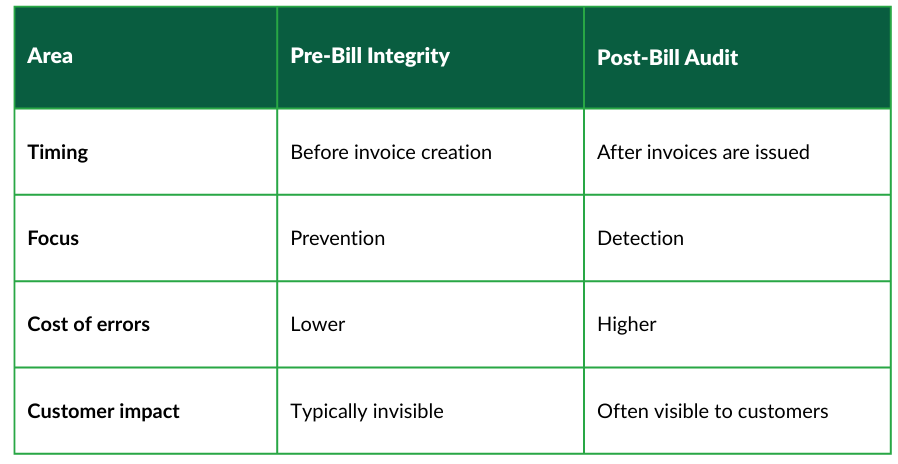
Unlike post-bill audits, which identify errors after invoices are issued, Pre-Bill Integrity focuses on preventing billing issues before they reach customers.
Both approaches can coexist, but Pre-Bill Integrity reduces reliance on downstream fixes.
Pre-Bill Integrity in Subscription and Usage-Based Models
Pre-Bill Integrity is particularly critical in:
-
Subscription and SaaS businesses
-
Usage-based and consumption pricing models
-
Hybrid pricing structures
-
Multi-year, multi-product contracts
In these environments, billing accuracy depends on:
-
Contract changes over time
-
Usage data from multiple systems
-
Tiered, ramped, or time-based pricing
Pre-Bill Integrity helps ensure billing reflects the current contract state and actual usage, not outdated or incomplete information.
How Pre-Bill Integrity Is Implemented
Organizations typically implement Pre-Bill Integrity through:
-
Defined billing rules and validation standards
-
Automated checks across commercial systems
-
Exception workflows for non-standard scenarios
-
Clear ownership across Finance, Billing, and Commercial teams
As commercial complexity increases, automation becomes essential to apply these controls consistently at scale.
Pre-Bill Integrity Is About Prevention, Not Correction
-
Pre-Bill Integrity emphasizes validating commercial and billing data before invoices are generated, when issues are easier to identify and resolve. By focusing on contracts, pricing, usage, and system alignment upstream, organizations can reduce the need for downstream corrections such as invoice rework, credits, and disputes. Rather than relying on post-bill fixes, Pre-Bill Integrity establishes a preventative approach to billing governance that supports accuracy, consistency, and control in complex commercial and billing environments.
- servicePath™ supports this approach by helping organizations align commercial data and apply consistent rules earlier in the quote-to-cash lifecycle, before billing occurs.
Discover how servicePath™ helps you stay ahead
Related Terms
-
Billing Accuracy
-
Revenue Assurance
-
Quote-to-Cash (Q2C)
-
Invoice Validation
-
Contract Compliance
-
Commercial Governance
-
Subscription Billing
-
Usage-Based Billing
-
Pricing Governance
-
Billing Controls
Frequently Asked Questions (FAQs)
1) What is Pre-Bill Integrity?
Pre-Bill Integrity is the process of validating contracts, pricing, usage, and billing data before invoices are generated to ensure accuracy and compliance.
2) Why is Pre-Bill Integrity important?
It helps organizations reduce billing errors, disputes, and rework by preventing issues before invoices are sent.
3) Is Pre-Bill Integrity the same as a billing audit?
No. Pre-Bill Integrity focuses on prevention before invoicing, while billing audits review invoices after they are issued.
4) Who is responsible for Pre-Bill Integrity?
Responsibility typically spans Finance, Billing, Revenue Operations, and Commercial Operations, depending on the organization.
5) Can Pre-Bill Integrity be automated?
Yes. As billing complexity increases, automation is commonly used to apply validation rules and exception handling consistently.