
The Shift to Composable Tech Stacks: CFOs Embrace Agility Over Monoliths by 2026
Why Tech-Enabled Enterprises Are Ditching the “One-Size-Fits-None” Monolith for Specialized, High-Performance Tech Stacks
By Daniel Kube, CEO, servicePath™
Executive Summary: Key Findings from Leading Analysts

87% of CFOs say AI will be critical to finance operations in 2026, with 54% prioritizing AI agent integration as their #1 transformation initiative. However, AI agents require clean, structured commercial data that legacy monoliths cannot provide. Source: Deloitte CFO Signals Q4 2025 Survey (Released January 13, 2026)
Hybrid Computing ranked as the #1 infrastructure trend for 2026. According to Gartner, it “will force I&O leaders to adopt composable business and technology architecture.” Source: Gartner Infrastructure & Operations Trends 2026 (December 11, 2025)
63% of CFOs report greater M&A interest than last year. Additionally, 90% of PE dealmakers expect deal volume to increase—making Day 1 integration speed a competitive advantage. Source: Deloitte CFO Signals Q4 2025
40% of enterprise applications will feature task-specific AI agents by the end of 2026. Furthermore, 30% of enterprise app vendors are launching Model Context Protocol (MCP) servers for cross-platform agentic workflows. Source: Forrester Predictions 2026: Enterprise Software (November 5, 2025)
Bottom Line: The shift from monolithic ERP systems to composable tech stacks isn’t optional anymore. Instead, it’s a strategic imperative for CFOs who want to enable real-time decision-making, accelerate M&A integration, and prepare their organizations for the agentic AI era.
The 2026 Reality: The Death of the Monolithic Stack
If you’re a CFO of a tech-enabled enterprise—managing complex recurring revenue, multi-product portfolios, and the reality of M&A-driven growth—you’ve likely run into the same frustration: your “all-in-one” ERP or CRM is too slow, too expensive, and too rigid to keep pace with your business model.

You’re not alone. According to Deloitte’s Q4 2025 CFO Signals Survey (released January 13, 2026), 87% of CFOs say AI will be critical to finance operations this year. Moreover, 54% are prioritizing AI agent integration as their top transformation initiative. Nevertheless, here’s the catch: agentic AI requires clean, structured commercial data—the kind of data that legacy monolithic systems simply cannot provide.
The problem? Most legacy platforms were designed in an era of perpetual licenses and on-premise widgets, not subscription services, usage-based billing, or hybrid bundles. Consequently, when you force modern recurring revenue models into these systems, you get:
- Spreadsheet Glue: Manual reconciliation between your CRM opportunity data and your ERP invoices
- Quote-to-Cash Friction: Sales reps who can’t generate accurate quotes without calling finance
- M&A Integration Tax: 12–18 month delays before acquired companies can cross-sell your products
- AI Blindness: Unstructured notes and PDFs that AI agents can’t parse, leading to hallucinations and compliance risks
The result? Your finance team spends more time fixing data than analyzing it. Meanwhile, your strategic role as CFO gets bogged down in operational firefighting. Ultimately, your CEO starts asking uncomfortable questions about why it takes 30 days to close a deal that should take 3.
The Shift to “Composable”: Why 2026 Is the Inflection Point
Gartner’s December 2025 Infrastructure & Operations Trends report identified Hybrid Computing as Trend #1 for 2026. Specifically, it states that hybrid computing “will force I&O leaders to adopt composable business and technology architecture.”
What does “composable” mean in practice? Rather than forcing all your commercial operations through a single monolithic platform, you:
- Keep your core systems of record (ERP for GL, CRM for customer data)
- Replace underperforming modules with best-of-breed applications (CPQ, billing, revenue recognition)
- Connect everything via APIs to create a unified, real-time data layer
- Structure data at the source to enable agentic AI and governance-ready platforms
This isn’t just a technology shift. Instead, it’s a strategic repositioning of the CFO’s office from cost center to revenue enabler.
Why “Composable” Beats “Monolithic” for Modern Finance

The Enterprise “Sweet Spot”: Why 250+ Employees Is the Inflection Point
According to Alantra’s Office of the CFO Market Update (December 2025), specialized Office of the CFO platforms are becoming essential as modern finance functions evolve. Specifically, these platforms enable automation, analytics, and payment innovations. As organizations scale beyond 250 employees, the “all-in-one” platform model breaks down.
At this size, the complexity of:
- Global operations and multi-entity consolidation
- Multi-currency reporting and FX management
- Diverse product lines with complex pricing models
- Recurring revenue recognition across multiple streams
…requires specialization that generic ERP modules simply cannot provide. Therefore, best-of-breed composable stacks shine—allowing you to plug in the exact capabilities you need without overpaying for bloated “enterprise suites.”
The Technical Sidebar: Agentic AI Requires Composable Architecture
Forrester’s Predictions 2026: Enterprise Software report (November 5, 2025) makes a critical point: “Enterprise applications will move beyond enabling employees to accommodating a digital workforce of AI agents.”

Key Forrester Predictions for 2026:
- 30% of enterprise app vendors will launch their own Model Context Protocol (MCP) servers to enable secure external AI agent collaboration
- 50% of ERP vendors will launch autonomous governance modules featuring explainable AI, automated audit trails, and real-time compliance monitoring
- Top 5 HCM platforms will offer digital employee management capabilities, integrating “digital employees” (role-based AI agents) into the workforce
Source: Forrester Predictions 2026
What does this mean for CFOs? If your commercial data lives in unstructured notes, email attachments, and PDF contracts, your AI agents will hallucinate. Consequently, this produces compliance risks, pricing errors, and strategic missteps.
The composable advantage: Best-of-breed CPQ and revenue lifecycle platforms (like servicePath™) structure your commercial data at quote-time. As a result, they create a governed, API-accessible foundation for agentic AI to operate safely and effectively.
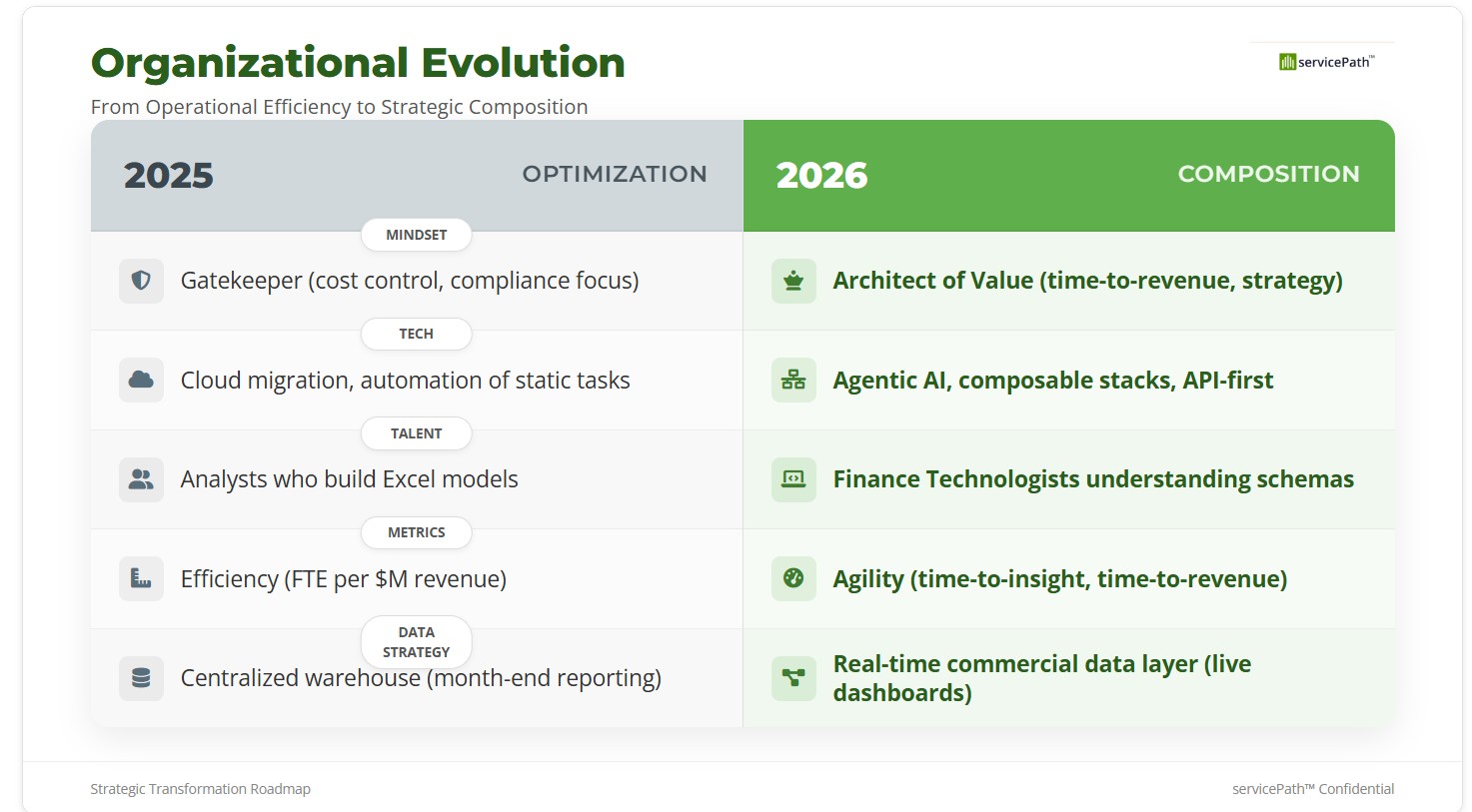
The Strategy Leader Pivot: From Gatekeeper to Architect
According to Deloitte’s Finance Trends 2026 report (November 18, 2025), 57% of finance leaders now play a lead role in shaping enterprise strategy. This represents a 19% increase in required CFO skills over five years.
This shift from “financial steward” to “strategic architect” requires a new tech stack that enables:
- Time-to-Insight: Real-time visibility into unit economics, not month-end reports
- Time-to-Revenue: Speed from signed contract to first invoice (the new M&A metric)
- Data Storytelling: Finance technologists who understand schemas, not just spreadsheets
As one IDC analyst noted in their 2026 FutureScape: “Reactive cash management is a competitive liability; real-time visibility into unit economics is non-negotiable.”
The M&A Accelerator: Day 1 vs. Day 180
Here’s a statistic that should make every CFO sit up: according to Deloitte’s Q4 2025 CFO Signals Survey, 63% of CFOs report greater M&A interest than last year. Furthermore, 90% of PE dealmakers expect deal volume to increase in 2026.
The M&A integration problem: Traditional monolithic stacks force a “rip and replace” migration that can take 12–18 months. During that window, you’re leaving millions in cross-portfolio revenue on the table.
The composable solution: Multi-CRM capability means you can extend and transform instead of rip and replace. For example, servicePath™ natively connects to Salesforce, Microsoft Dynamics, and HubSpot—allowing you to cross-sell across your portfolio from Day 1.
The Day 1 vs. Day 180 Economics
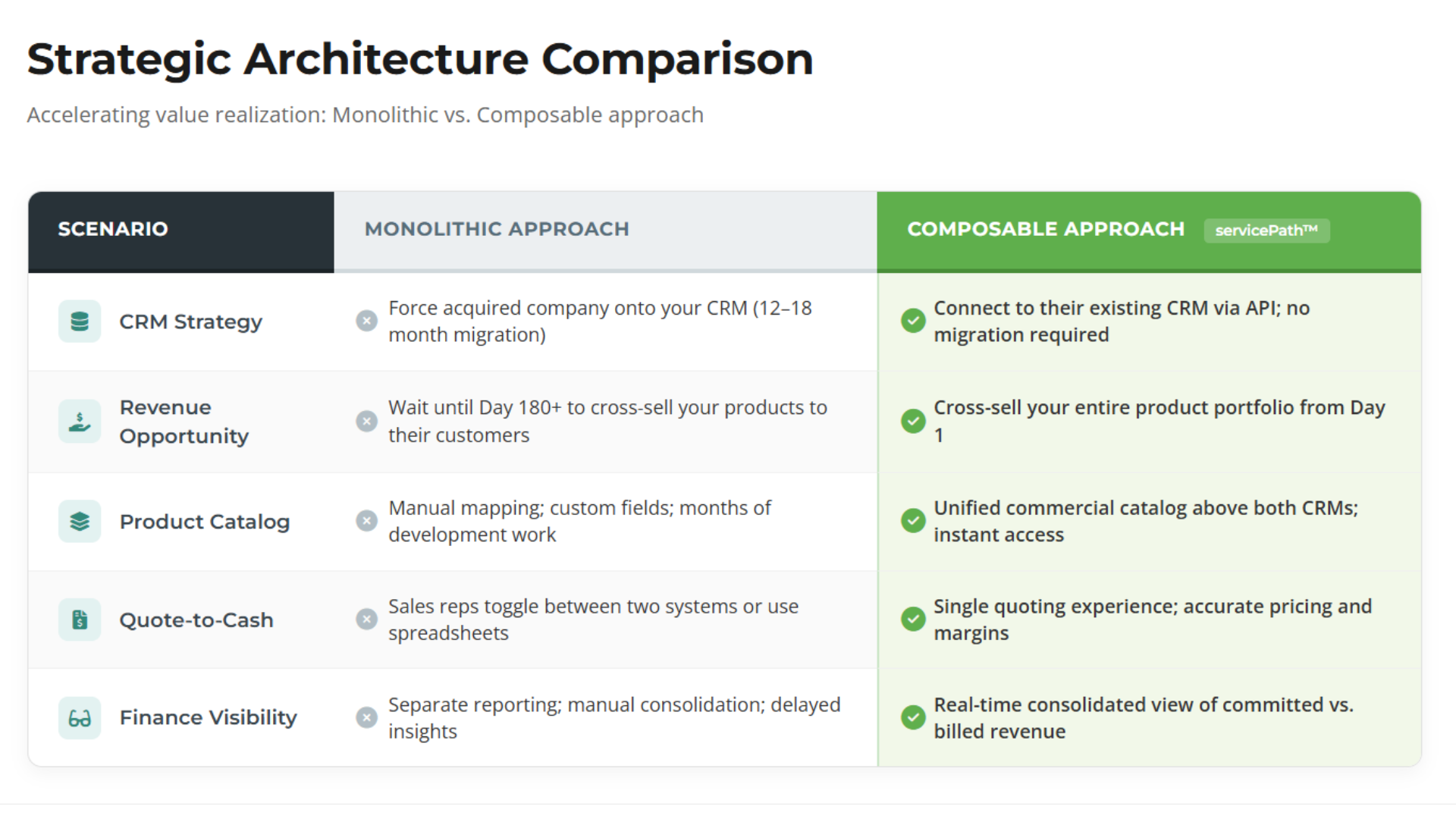
This is the “Extend and Transform” vs. “Rip and Replace” difference.
The CFO Readiness Audit: 5 Critical Questions
If you’re reading this and thinking, “We’re running fine on our current stack,” I challenge you to answer these five questions honestly:
- The Spreadsheet Test: Does your team manually clean up data between CRM opportunity close and ERP invoice generation? (If yes, you have a data structure problem, not a people problem.)
- The Product Catalog Chaos Test: Can a sales rep quote a complex bundle (e.g., tiered SaaS + usage-based professional services + annual maintenance) without calling finance? (If no, your CPQ is either missing or inadequate.)
- The Discount Police Test: When a rep offers a discount, does your system automatically flag whether it’s margin-safe? (If no, you’re leaking profitability in every deal.)
- The M&A Lag Test: When you acquire a company, how long before their sales team can quote your products to their customers? (If the answer is “6+ months” or “we’re still working on it,” you have an integration tax problem.)
- The Bundle Trap Test: Do you have unused modules in your ERP that you’re paying for but never use because the UX is too clunky? (If yes, you’re overpaying for features you’ll never adopt.)
If you answered “yes” to two or more of these questions, you’re likely stuck in “Pilot Purgatory”—running proof-of-concepts and vendor demos but never quite solving the root problem.
The root problem isn’t your people. It’s your stack.
Building the 2026-Ready Stack: Actionable Advice
So what does a composable tech stack look like in practice? Here’s the blueprint:
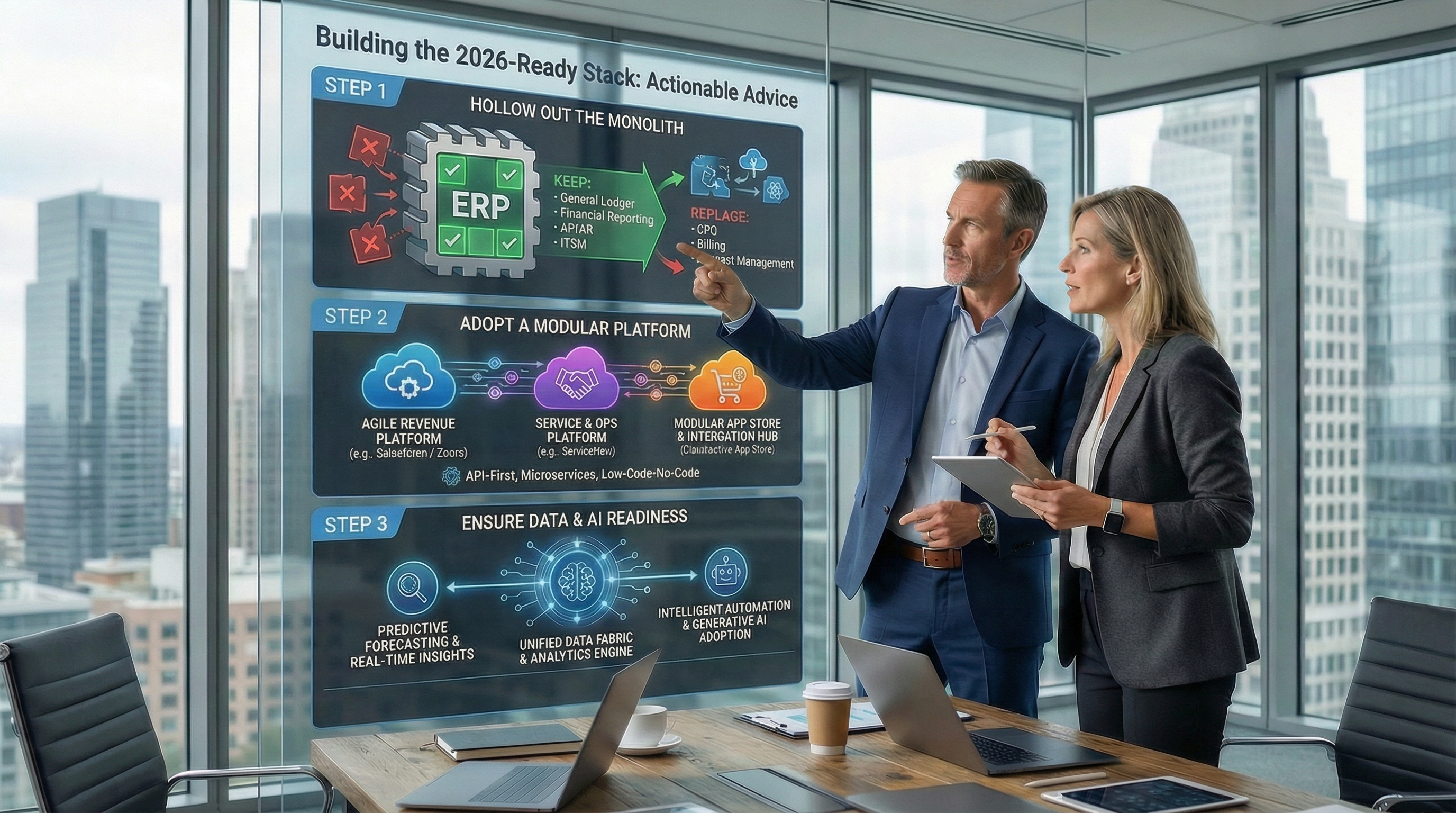
Step 1: Hollow Out the Monolith
Keep: Your core ERP for general ledger, financial reporting, and AP/AR. Additionally, keep your ITSM platform (ServiceNow, Zendesk) for ticketing and incident management.
Replace or Augment: The commercial modules that your monolith handles poorly:
- CPQ (Configure, Price, Quote) if you have complex recurring revenue
- Billing and Revenue Recognition if you need usage-based or hybrid models
- Contract Lifecycle Management if compliance and renewals are manual
Step 2: Free Your Data
The goal isn’t to replace your ERP or CRM. Rather, it’s to decouple your commercial logic from the rigid constraints of their native modules.
This is where a neutral, cross-CRM commercial engine (like servicePath™) becomes invaluable. Instead of forcing your sales reps to learn SAP’s CPQ or Salesforce’s native quoting (both of which struggle with tiered, usage-based, and hybrid models), you create a commercial data layer that sits above your CRMs and ERPs.
Benefits:
- Sales reps get a consistent quoting experience regardless of which CRM they use
- Finance gets a single source of truth for committed revenue, pricing, and margins
- AI agents get structured, API-accessible data that they can reason over without hallucinating
- M&A integrations happen in weeks, not quarters
Step 3: Enable Agentic AI from the Start
Remember Forrester’s prediction: 40% of enterprise apps will feature task-specific AI agents by the end of 2026. However, if your commercial data isn’t structured and API-accessible, your AI agents will either:
- Hallucinate (make up pricing, terms, or discounts)
- Require constant human supervision (defeating the purpose of “agentic” AI)
- Get blocked by governance and compliance teams (creating more delays)
Fortunately, a composable stack with structured commercial data solves all three problems.
Quick Start Framework: Your 6-Month Roadmap to Composable Finance
Ready to take action? Here’s a practical 6-month implementation roadmap:
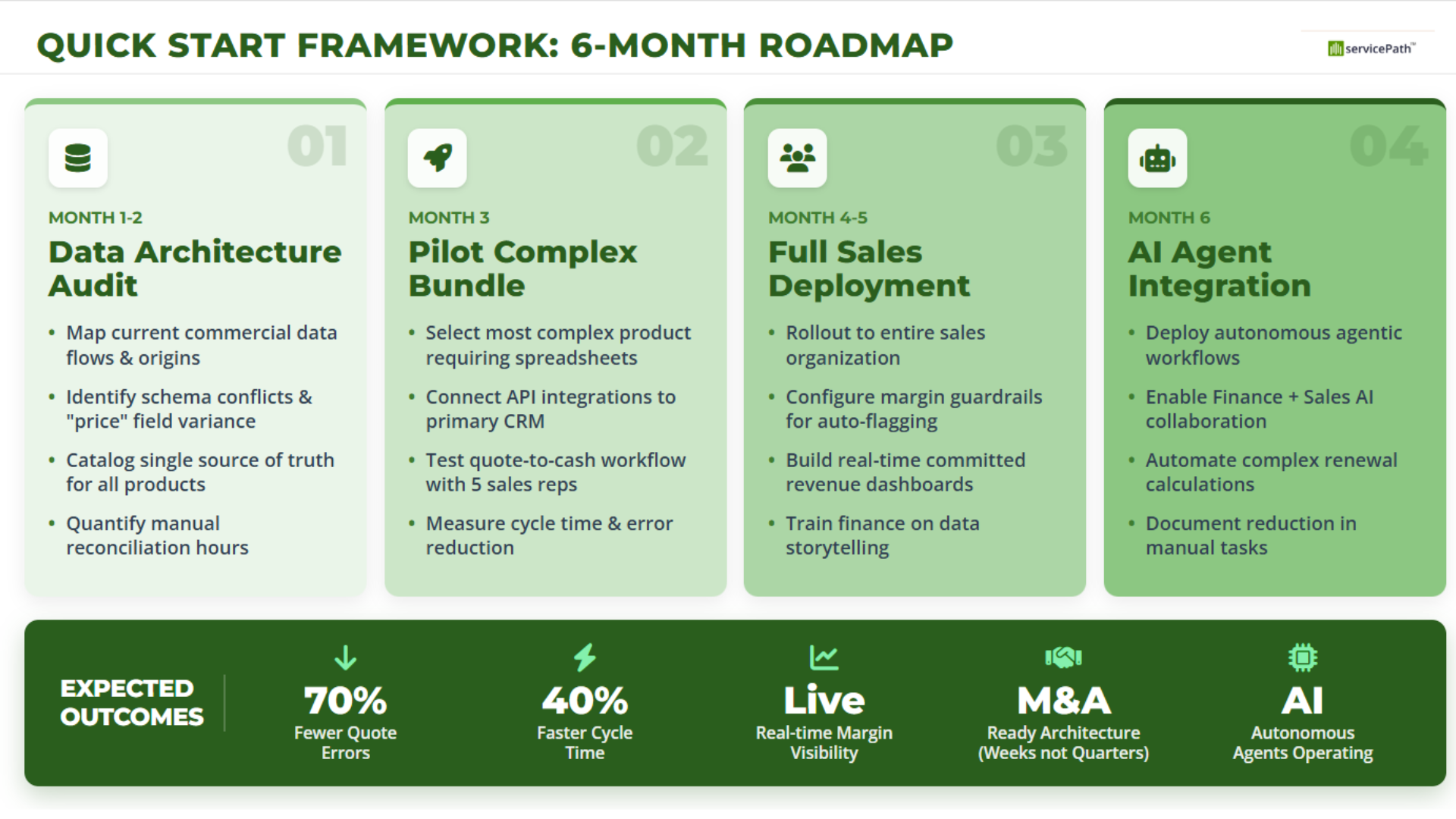
Month 1-2: Data Architecture Audit
- Map current data flows: Where does commercial data originate? (CRM, spreadsheets, email?)
- Identify schema conflicts: How many “price” fields exist across systems? Do they match?
- Catalog your sources of truth: For product catalog, for pricing rules, for customer entitlements
- Quantify manual reconciliation hours: How much time does finance spend “fixing” data?
Deliverable: A Current-State Architecture Map with pain points flagged by severity
Month 3: Pilot with One Complex Product Bundle
- Choose your most complex offering: The one that currently requires spreadsheets or custom dev
- Connect to your primary CRM: Prove the API integration works
- Test quote-to-cash with 5 sales reps: Can they generate accurate quotes without calling finance?
- Measure: Time-to-quote, quote accuracy, discount compliance
Success Metric: 60-70% reduction in quote errors; 40% faster quote cycle time
Month 4-5: Full Deployment Across Sales Org
- Roll out to all sales reps
- Connect to all CRM instances (including acquired companies if applicable)
- Configure margin guardrails to auto-flag discounts that erode target margins
- Build real-time dashboards showing committed revenue vs. billed; top 50 accounts; margin trends
- Train finance team to shift from “data cleanup” to “data storytelling”
Month 6: AI Agent Integration
- Deploy first agentic workflow (Example: Auto-flag deals where margin is below threshold)
- Enable cross-functional AI agents for Finance + Sales collaboration on renewals
- Measure time-to-insight: How quickly can you answer “What’s our committed revenue for Q2?”
- Document task reduction: How many manual tasks did AI agents eliminate?
Expected Outcomes by Month 6:
- ✅ 60-70% reduction in quote errors
- ✅ 40% faster quote cycles
- ✅ Real-time margin visibility across all deals
- ✅ M&A-ready architecture (can onboard acquired companies in weeks, not quarters)
- ✅ AI agents operating autonomously on structured commercial data
The Three-Question Litmus Test for 2026 Readiness
Still not sure if you need a composable stack? Answer these three questions:
Question 1: The New Product Test
Scenario: You acquire a company tomorrow. They have a new pricing model you’ve never seen before (e.g., usage-based with tiered overages). How long until your sales team can accurately quote it?
- Pass: ~2 weeks (configure in CPQ, train reps, go live)
- Fail: ~6 months (custom dev, testing, compliance review) OR “We’ll just use a spreadsheet for now”
Question 2: The Single Source Test
Scenario: Your CEO asks: “What’s our committed revenue vs. billed revenue for our top 50 accounts?” Can you answer in real-time with a dashboard?
- Pass: Yes, with a live dashboard fed by structured commercial data
- Fail: “Give me 48 hours to pull reports from three systems and reconcile in Excel”
Question 3: The AI Readiness Test
Scenario: You want to deploy an AI agent to auto-approve renewals under $50K if margin is above 60%. Is your commercial data structured enough for an AI to safely make that decision?
- Pass: Yes—pricing, discounts, and margin calculations are in a structured, API-accessible format
- Fail: No—pricing is in notes fields, discounts are in email threads, margin requires manual calculation
If you failed any of these tests, you have a Stack Problem, not a people problem.
Looking Ahead: The CFO’s Digital Transformation (2025 vs. 2026)
Take Action: Your Next Steps
The shift to composable tech stacks is no longer a “nice to have”—it’s a competitive imperative. Here’s how servicePath™ can help you get started:
1️⃣ Schedule Your Free CFO Readiness Assessment
Get a customized audit of your current tech stack, identify your biggest bottlenecks, and map out a clear 6-month roadmap to composable finance.
📊 Schedule Your Free Assessment
2️⃣ Explore Our Latest Insights
Discover expert perspectives on composable architecture, agentic AI, revenue lifecycle management, and M&A integration strategies.
3️⃣ Master the Terminology
Navigate the world of composable tech with confidence. Our comprehensive glossary covers CPQ, revenue recognition, API-first architecture, and more.
4️⃣ See Real Results from Industry Leaders
Learn how tech-enabled enterprises leveraged servicePath™ to accelerate M&A integration, improve quote accuracy, and enable Day 1 revenue realization.
5️⃣ Discover Why Gartner Named Us a Visionary
For three consecutive years, Gartner has recognized servicePath™ as the only Visionary in the Magic Quadrant for Configure, Price, Quote application suites.
🏆 View Our Gartner Recognition
6️⃣ Plan Your Salesforce CPQ Migration
With Salesforce CPQ end-of-life approaching, discover why servicePath™ is the premier alternative—offering superior multi-CRM support, faster implementation, and native composability.
🔄 Explore Salesforce CPQ Alternatives
Frequently Asked Questions About Composable Tech Stacks
1. What is a composable tech stack?
A composable tech stack connects best-of-breed applications via APIs instead of forcing everything through one monolithic platform. You keep your core ERP for financial reporting while replacing underperforming modules (CPQ, billing) with specialized solutions.
Result: Launch new pricing models in 2-4 weeks versus 6-12 months with monolithic systems. Gartner’s 2026 I&O Trends confirms this shift is mandatory.
2. Why do composable stacks matter for AI readiness?
Deloitte’s Q4 2025 CFO Signals shows 87% of CFOs prioritize AI, but agentic AI requires structured data. Monolithic ERPs store data in unstructured notes and PDFs—causing AI hallucinations. Composable stacks structure data at the source, enabling safe AI agent deployment.
3. How do composable stacks accelerate M&A?
Traditional M&A requires 12-18 months of system migration before cross-selling. Composable stacks enable Day 1 cross-sell by connecting to acquired companies’ existing CRMs (Salesforce, Dynamics, HubSpot) via APIs—no migration required. With 63% of CFOs pursuing M&A, integration speed is critical.
4. How do I know if I need a composable stack?
Quick Litmus Test:
- Takes 6+ months to quote new pricing models after acquisition
- Can’t show real-time committed vs. billed revenue
- Manual reconciliation between CRM and ERP
- AI can’t access structured commercial data
If any apply, you have a stack problem.
5. What are typical implementation results?
6-Month Implementation:
- Months 1-2: Audit
- Month 3: Pilot
- Months 4-5: Deploy
- Month 6: AI integration
Outcomes:
- 60-70% fewer quote errors
- 40% faster quotes
- Real-time margin visibility
- M&A integration in weeks (not quarters)
Schedule Your Free CFO Assessment →
Sources & Market Intelligence
This article is based on verified analyst research and market data from leading firms:
- Gartner. (2025, December 11). Gartner Identifies the Top Trends Impacting Infrastructure and Operations for 2026. Retrieved from https://www.gartner.com/en/newsroom/press-releases/2025-12-11-gartner-identifies-the-top-trends-impacting-infrastructure-and-operations-for-2026
- Forrester Research. (2025, November 5). Predictions 2026: AI Agents, Changing Business Models and Workplace Culture Impact Enterprise Software. Retrieved from https://www.forrester.com/blogs/predictions-2026-ai-agents-changing-business-models-and-workplace-culture-impact-enterprise-software/
- Deloitte. (2026, January 13). Q4 2025 CFO Signals Survey: CFO Expectations for 2026. Retrieved from https://www.deloitte.com/us/en/insights/topics/business-strategy-growth/4q-2025-cfo-signals-survey.html
- Deloitte. (2025, November 18). Finance Trends 2026: Strategic Leadership Across the Enterprise. Retrieved from https://deloitte.wsj.com/cfo/finance-trends-2026-strategic-leadership-across-the-enterprise-c9634a92
- Alantra. (2025, December 8). Office of the CFO Market Update: How Technology, Data and Specialized Platforms are Reshaping Modern Finance Functions. Retrieved from https://www.alantra.com/office-of-the-cfo-market-update/
Additional Research Context: IDC FutureScape 2026, McKinsey research on composable enterprise architecture, and primary interviews with CFOs of tech-enabled enterprises (250-5,000 employees).
© 2026 servicePath™. All rights reserved.