

A Strategic Framework for Enterprise Leadership
AI bloat enterprise strategy is the difference between market leadership and collapse. For example, Sun Microsystems lost $193 billion—97% of its value—because of strategic bloat. Today, 88% of companies use AI, but only 39% see meaningful profit impact (McKinsey, State of AI 2025). Therefore, this AI bloat enterprise strategy guide shows executives how to avoid Sun’s pattern and master the 12-18 month competitive window before competitors establish insurmountable advantages.
TL;DR: The Executive Summary
Sun Microsystems collapsed from $200 billion to $7.4 billion (97% loss) by adding storage, software, and Java capabilities while losing focus on their core server business. Similarly, today’s enterprises face the same risk: chasing AI features while neglecting operational foundations.
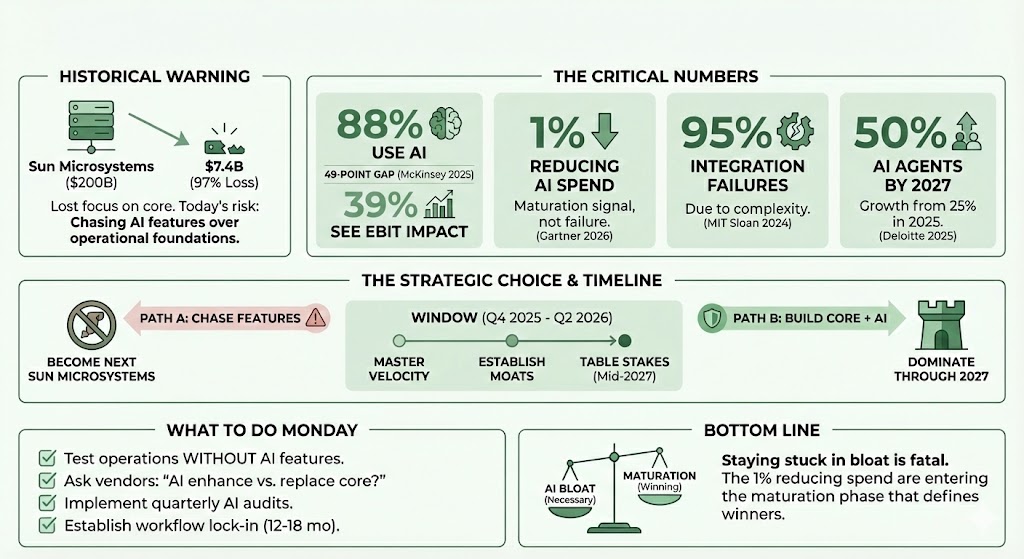
The Critical Numbers:
- McKinsey: 88% use AI, only 39% see EBIT impact (49-point gap) (McKinsey 2025)
- Gartner: 1% reducing AI spend = maturation signal, not failure (Gartner 2026 CIO Agenda)
- MIT: 95% of AI integrations fail due to complexity (MIT Sloan 2024)
- Deloitte: AI agents grow from 25% (2025) to 50% (2027) (Deloitte 2025)
The 12-18 Month Window (Q4 2025 – Q2 2026): Specifically, companies that master operational velocity—speed and accuracy of executing complex deals—will establish competitive moats before it becomes table stakes by mid-2027.
The Choice:
Path A: Chase AI feature parity → become the next Sun Microsystems
Path B: Build rule-based core + AI enhancement → dominate through 2027
What to Do Monday:
- First, test if your operations work without AI features
- Second, ask vendors: “How does AI enhance vs. replace your core?”
- Third, implement quarterly AI audits and annual consolidation reviews
- Finally, use the next 12-18 months to establish workflow integration lock-in
Bottom Line: Importantly, AI bloat is necessary, but staying stuck in it is fatal. Therefore, the 1% reducing AI spend are entering the maturation phase that will define market winners through 2027.
Quick Q&A: Understanding the AI Bloat Enterprise Strategy Crisis
Q: What is “AI bloat” in enterprise systems?
A: Simply, it’s when companies add multiple AI features (recommendation engines, pricing optimizers, configuration assistants, content generators) without consolidating their rule-based operational core. As a result: integration complexity, vendor lock-in, and unpredictable outcomes.
Q: What is “catalog velocity” and why does it matter?
A: Specifically, it’s the speed and accuracy of executing complex, multi-product deals without errors—regardless of catalog changes, pricing updates, or dependency rules. Therefore, it’s the rule-based foundation that makes AI valuable rather than chaotic.
Q: Why is there a 12-18 month competitive window?
A: According to Deloitte, AI agent adoption grows from 25% (2025) to 50% (2027). Consequently, Q4 2025 through Q2 2026 is when operational excellence mastery becomes a competitive moat before it becomes table stakes.
Q: What does Gartner’s “1% reducing AI spend” signal mean?
A: While 88% increase AI spend, 1% are reducing it. Importantly, the 1% aren’t failing—they’re maturing. Specifically, they’ve consolidated around proven AI use cases integrated with rule-based cores.
Q: What is “continuous AI curiosity”?
A: Simply, it’s quarterly audits asking “Which AI tools deliver ROI?” and annual reviews that consolidate and eliminate redundancy. Therefore, it’s organizational nimbleness—the antidote to strategic drift through unchecked feature proliferation.

Caption: Sun Microsystems’ $205B to $7.4B collapse: The cost of strategic bloat
The AI Bloat Enterprise Strategy Lesson: Sun’s $193 Billion Collapse
The Rise: When Sun Microsystems Dominated Enterprise Infrastructure
In 2001, Sun Microsystems commanded a $200 billion market cap as the server infrastructure backbone of the dot-com boom. Their servers powered 40% of all web infrastructure. Additionally, major financial institutions ran on Sun hardware. SPARC processors were legendary for reliability. Furthermore, the Solaris operating system was the enterprise standard.
Wall Street valued Sun at $205.14 billion at their September 2000 peak (CompaniesMarketCap).
Clearly, they weren’t just successful. They were essential.
The Parallel We Can’t Ignore: Today’s Enterprise AI Market
Today, according to McKinsey’s State of AI 2025 report, 88% of organizations now use AI regularly. However, only 39% report meaningful impact on EBIT—a 49-percentage-point gap between adoption enthusiasm and business value. Similarly, this mirrors Sun’s server proliferation without profitability.

The Diversification That Became Strategic Bloat
Between 2001 and 2009, Sun made strategic moves that looked smart individually:
- Storage Expansion: First, Sun acquired StorageTek for $4.1 billion (2005) to compete with EMC. The goal was to own the full data center stack.
- Software Diversification: Next, the company bought MySQL for $1 billion (2008) to enter database markets dominated by Oracle and IBM.
- Java Ecosystem Investment: Additionally, Sun poured resources into Java development tools, middleware, and enterprise frameworks.
- Open-Source Strategy: Finally, leadership released Solaris, Java, and other core IP as open source to build ecosystem loyalty.
Each acquisition made sense in isolation. However, collectively, they created what analysts later called “strategic incoherence”—a company that couldn’t articulate what it did best.
Consequently, by 2009, Sun was losing $100 million per month (Reuters).
Ultimately, Oracle acquired them for $7.4 billion in January 2010 (Oracle Press Release)—a 97% value destruction from peak.
Case Study: Sun Microsystems’ Strategic Failure

Background:
Founded in 1982, Sun Microsystems pioneered network computing with the motto “The Network is the Computer.” By 2000, they dominated enterprise server infrastructure during the dot-com boom.
Peak Performance:
- Market capitalization: $205.14 billion (September 2000)
- Annual revenue: $18.3 billion (2001)
- Market position: 40% of web infrastructure
- Core strength: SPARC processors, Solaris OS, Java platform
Strategic Decisions (2001-2009):
2005: StorageTek Acquisition ($4.1B)
Goal: Compete with EMC in storage markets
Result: Added debt without strategic benefits; failed to integrate effectively
2008: MySQL Acquisition ($1B)
Goal: Enter database market against Oracle/IBM
Result: Open-source model destroyed monetization potential
Java Ecosystem Over-Investment
Goal: Build developer ecosystem loyalty
Result: Massive R&D costs with no clear revenue model
Open-Source IP Strategy
Goal: Community-driven innovation
Result: Gave away core competitive advantages without capturing value
The Decline:
- 2003-2009: Market shifts to cheaper x86 servers and Linux
- 2007: Virtualization (VMware) and cloud computing (AWS) emerge
- 2009: Losing $100 million per month
- 2010: Acquired by Oracle for $7.4 billion (97% value loss)
Root Cause Analysis:
Feature proliferation without integration: Storage, servers, software operated as separate businesses
Complexity that slowed sales cycles: Sales reps couldn’t explain Sun’s value in one sentence
Failed monetization: Open-sourcing core IP destroyed pricing power
Loss of operational focus: Core server excellence buried under “innovation”
Lessons for Today’s AI Market:
Sun’s collapse wasn’t about bad technology. Instead, it was about strategic bloat: adding capabilities faster than they could be operationalized. Similarly, today’s enterprises risk the same pattern by layering AI over broken operational processes.
What Killed Sun: The Pattern Enterprises Must Recognize
Sun didn’t fail because their technology was bad. Instead, they failed because:
- Feature proliferation without integration: Storage, servers, software, and services operated as separate businesses
- Complexity that slowed sales cycles: Reps couldn’t explain what Sun did in one sentence
- No clear path to making money: Open-sourcing core IP destroyed pricing power
- Loss of operational focus: What made Sun great (reliable servers) got buried under “innovation”
Therefore, this is strategic bloat: adding capabilities faster than you can make them work.
Similarly, today’s AI bloat enterprise strategy failures follow the exact same pattern.
The CPQ Complexity Crisis: What You Need to Know First
The Catalog Explosion: Why Revenue Operations Is Ground Zero for AI Bloat
To understand why enterprises face unique AI bloat risk, you need to understand the scale of catalog complexity in modern revenue operations. This isn’t about quoting simple products—it’s about quoting ecosystems.
The 4,000% Catalog Growth Reality
Consider a mid-sized enterprise offering:
- Connectivity products: Fiber, broadband, SD-WAN, 5G, dedicated internet access
- Cloud services: AWS/Azure/GCP resale with markup tiers
- Security solutions: Firewalls, SASE, zero-trust network access, managed detection
- Collaboration tools: VoIP, UCaaS, CCaaS with seat-based and usage-based pricing
- Professional services: Installation, migration, managed services with SLA tiers
A baseline catalog might start with 500 SKUs. However, now factor in:
Real-World Catalog Math:
500 base SKUs
× 8 geographic regions (different costs, regulations, competitors)
× 4 customer segments (enterprise, mid-market, SMB, government)
× 3 contract terms (1-year, 3-year, 5-year with different discounts)
= 48,000 effective catalog variations
This represents a 9,600% increase in catalog complexity from the base 500 SKUs. Moreover, we haven’t even factored in bundles, dependencies, or promotional pricing.
Why AI “Solutions” Actually Make This Worse
Faced with this complexity, vendors have rushed to add AI features. However, here’s what’s actually happening:
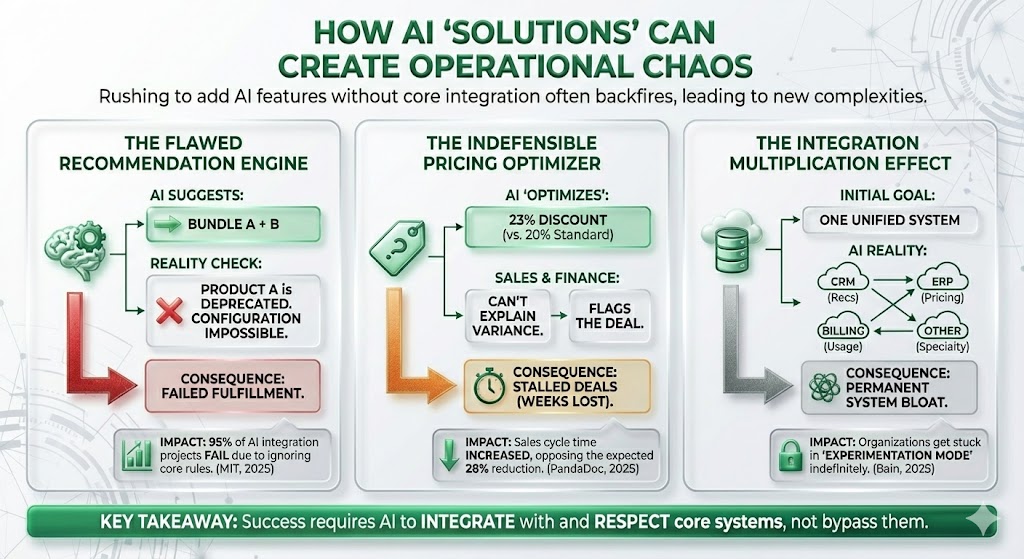
Three Ways AI Kills Operations (When It Bypasses the Core):
The Recommendation Engine Problem:
AI suggests Product A + Product B based on historical patterns. However, it doesn’t know that Product A was deprecated last month or that Product B has geographic restrictions. Consequently, the quote goes out, the customer accepts, and ops discovers the configuration is impossible to fulfill. According to MIT research, this pattern—AI that doesn’t respect rule-based logic—is why 95% of AI integration projects fail.
The Pricing Optimizer Trap:
AI suggests “optimal pricing” but can’t explain why it’s recommending a 23% discount instead of the standard 20%. Therefore, the sales rep can’t defend the variance. Finance flags it. As a result, the deal stalls for two weeks. The “optimization” just added time to the sales cycle that research shows should reduce by 28% (PandaDoc 2025).
The Integration Multiplication Effect:
Each AI feature requires its own data pipeline: CRM for recommendations, ERP for pricing, billing for usage patterns. Consequently, what started as “one system” becomes five integration projects. According to Bain’s 2025 Technology Report, most organizations remain stuck in this “experimentation mode” indefinitely—meaning the bloat phase becomes permanent.
The Rule-Based Core That’s Being Lost
Here’s what gets buried under AI bloat—the rule-based quote-to-cash workflow that actually makes operations valuable:
- Product catalog: Single source of truth for what can be sold, where, to whom, at what price
- Configuration rules: Hard dependencies (A requires B) and soft recommendations (A works well with C)
- Pricing logic: Transparent, auditable discount waterfall from list to net
- Approval workflows: Clear escalation paths based on deal size, margin, or customer risk
- Quote generation: Consistent formatting, terms, and legal language
- Order handoff: Clean data transfer to fulfillment without manual translation
This workflow is rule-based: same inputs = same outputs, every time. It’s auditable, trainable, and debuggable. When it works, it’s what drives the business outcomes that matter:
What Clean Operations Actually Deliver:
- 28% sales cycle reduction (PandaDoc)
- 95% reduction in approval wait times (PandaDoc)
- 17% higher lead conversion rates (CloudSense)
- Quote accuracy that eliminates the rework loop between sales and ops
- Predictable revenue because what’s quoted is what can be delivered
AI should enhance this core—not replace it. Therefore, the question every enterprise buyer should ask is: “Can I disable all your AI features and still have functional, fast, accurate operations?” If the answer is no, you’re buying AI bloat, not operations with AI enhancement.
The Current State: Why 88% Use AI But Only 39% See Profit
The AI Adoption Crisis in Numbers
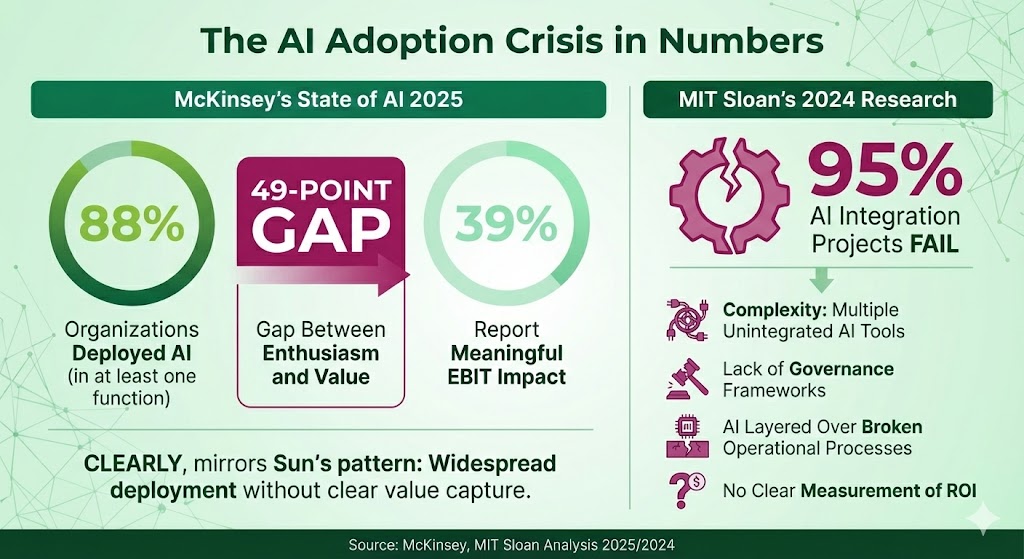
According to McKinsey’s State of AI 2025:
First, 88% of organizations have deployed AI in at least one business function
However, only 39% report meaningful EBIT impact
Consequently, there’s a 49-point gap between adoption enthusiasm and business value
Clearly, this mirrors Sun’s pattern: widespread deployment without clear value capture.
MIT Sloan’s 2024 research found that 95% of AI integration projects fail due to:
- First, complexity from multiple unintegrated AI tools
- Second, lack of governance frameworks
- Third, AI layered over broken operational processes
- Finally, no clear measurement of ROI
The Investment Momentum
According to IDC’s AI spending forecast, global AI investment will grow from $307 billion in 2025 to $632 billion by 2028—a 106% increase. However, enterprises are riding this wave without asking whether AI enhances or replaces operational workflows.
Where AI Bloat Shows Up in Enterprises
Revenue Operations:
Companies deploy 14 AI tools for pricing, quoting, forecasting, and deal scoring. However, each has its own data model. Moreover, none talk to each other. As a result, sales reps spend more time reconciling AI recommendations than selling.
Marketing: Teams use 8 content generation platforms. Unfortunately, each creates slightly different brand voices. CMO can’t explain which tool does what. Consequently, content inconsistency is worse than before AI.
Customer Service: Organizations run 6 chatbot systems across different channels. However, there’s no unified customer view. Therefore, customers repeat information across channels. Ultimately, AI creates frustration instead of solving it.
HR: Departments implement 5 recruiting AI tools scoring candidates differently. As a result, hiring managers don’t trust any of them. Consequently, recruiting cycles are longer, not shorter.
Finance: Teams deploy 4 AI forecasting systems producing different revenue projections. Therefore, the CFO has to manually reconcile them. Ultimately, the “AI transformation” added work instead of reducing it.
In summary, this is AI bloat: proliferation without integration, complexity without governance, cost without value.

Caption: The 49-point gap: Why most AI investments fail
The Maturation Signal Hidden in Plain Sight: Gartner’s 1%
Why Reducing AI Spend Is Strategy, Not Failure
Buried in Gartner’s 2026 CIO Agenda is a data point most people misinterpret:
While 88% of organizations are increasing AI spend in 2025, 1% are actively reducing it.
The common reading: “1% of companies are abandoning AI—it didn’t work.”
The correct reading: “1% have moved past bloat and are consolidating around proven AI use cases integrated with operational foundations.”
Specifically, that 1% represents organizations that have:
- First, audited their AI portfolio: “We have 14 AI tools. Only 3 deliver measurable ROI.”
- Second, eliminated redundancy: “These 4 recommendation engines solve the same problem differently—we’re standardizing on one.”
- Third, integrated strategically: “AI should enhance our processes, not bypass them.”
- Finally, reduced vendor sprawl: “We’re consolidating to platforms where AI enhances the core, not replaces it.”
The Four-Phase AI Maturity Model

An effective AI bloat enterprise strategy recognizes four distinct phases:
Phase 1: Pre-Bloat (Pre-2023) : No AI integration. However, competitive disadvantage is growing. Therefore, risk: falling too far behind to catch up.
Phase 2: Bloat/Experimentation (2023-2025): Multiple AI tools adopted. However, no consolidation. Meanwhile, integration complexity is mounting. Currently, most enterprises are here now.
Phase 3: Maturation/Consolidation (2025-2027): Strategic AI reduction. Additionally, focus on core use cases. Furthermore, rule-based foundations reinforced. ← This is where Gartner’s 1% are now.
Phase 4: Extensibility/Optimization (2027+): AI as enhancement layer on clean operational core. Moreover, new capabilities added strategically. Ultimately, market leadership established.
Importantly, the risk isn’t being in Phase 2 (bloat). That’s necessary. Rather, the risk is getting stuck there.
Bain’s 2025 Technology Report warns that “most organizations remain stuck in experimentation mode” indefinitely—meaning bloat becomes permanent.
The Continuous AI Curiosity Framework
How do you avoid getting stuck? Simply, build continuous AI curiosity into your operations:
Quarterly AI Audits (Tactical):
- First, which AI features are teams actually using?
- Second, which AI recommendations do they override most often?
- Third, where does AI add accuracy vs. introduce variance?
- Finally, what’s the cost per AI feature vs. measurable business impact?
Annual AI Reviews (Strategic):
- First, consolidate: Which redundant AI tools can we eliminate?
- Second, integrate: Which AI capabilities should move from bolt-on to built-in?
- Third, refresh: What new AI use cases align with our operational core?
- Finally, educate: How do we train teams to use AI as enhancement, not autopilot?
Importantly, this isn’t anti-AI. Rather, it’s pro-strategy. The 1% reducing AI spend aren’t retreating—instead, they’re advancing into maturation while the 88% stay stuck in bloat.
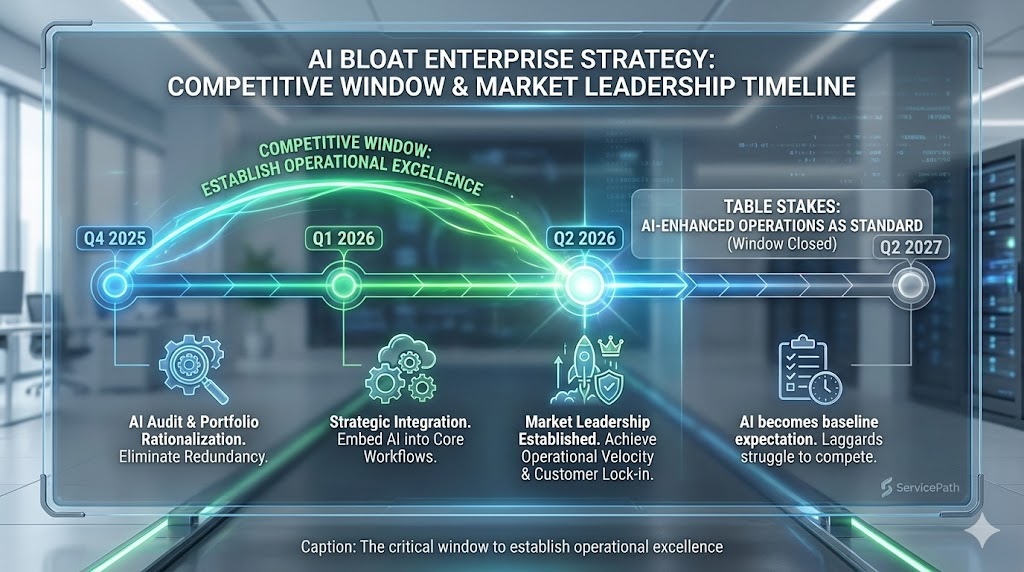
The 12-18 Month Competitive Window: Why Q4 2025 – Q2 2026 Matters
The 2027 Deadline: Why the Next 12-18 Months Will Define Market Winners
According to Deloitte’s 2025 Technology Predictions:
First, 25% of enterprises will deploy AI agents in 2025
By 2027, 50% will have AI agents
Therefore, this creates a critical window: Q4 2025 through Q2 2026.
Why These 12-18 Months Matter

Companies that master operational velocity—the speed and accuracy of executing complex deals without errors—during this window will establish three competitive moats:
Customer Lock-In Through Workflow Integration
Once your processes are embedded in a customer’s approval workflows, CRM integrations, and ERP handoffs, switching costs become prohibitive. Specifically, the window to establish this integration is before 50% AI agent adoption (mid-2027).
Sales Team Training and Muscle Memory
Teams that learn to execute processes accurately using System A don’t want to relearn on System B. Therefore, training investment creates stickiness. However, this only works if you capture the training window before competitors.
Data Network Effects
Systems that process more transactions get better at optimization, recommendations, and error prediction. Consequently, the vendor that captures the most flow in 2025-2026 will have the richest dataset for AI enhancement in 2027+.
The Catch-22 of Delayed Action
By the time operational excellence becomes an obvious market requirement (mid-2027), it will be too late to build it as competitive advantage.
Instead, it will be table stakes—like having a mobile-responsive website in 2025.
Therefore, the companies winning in 2027 will be those who mastered foundations in 2025.
The Two Paths Diverging in 2025
Enterprises face a fork in the road:
Path A: The AI Feature Arms Race
- First, add more AI capabilities to match competitors’ roadmap announcements
- Second, emphasize “innovation” through feature count
- Third, accept integration complexity as the cost of staying current
- Finally, hope that some AI features will drive enough value to justify the bloat
Outcome: Become the next Sun Microsystems—strategically incoherent, operationally complex, competitively vulnerable
Path B: The Operational Velocity Mastery
- First, build the cleanest possible rule-based quote-to-cash core
- Second, add AI as an enhancement layer that augments (not replaces) the core
- Third, measure success by quote accuracy, deal velocity, and customer workflow integration depth
- Finally, use the 12-18 month window to establish customer lock-in through operational excellence
Outcome: Become the market leader through 2027 by being the platform that “just works” when complexity is high and stakes are higher
The critical insight: Path B isn’t anti-AI. Rather, it’s pro-architecture. Specifically, it recognizes that AI is most valuable when it enhances a rule-based core that already works brilliantly, not when it’s expected to compensate for a core that’s fragmented and fragile.
“The companies that master catalog velocity in 2025 will dominate their markets in 2026 and beyond.”
— Daniel Kube, CEO, servicePath™
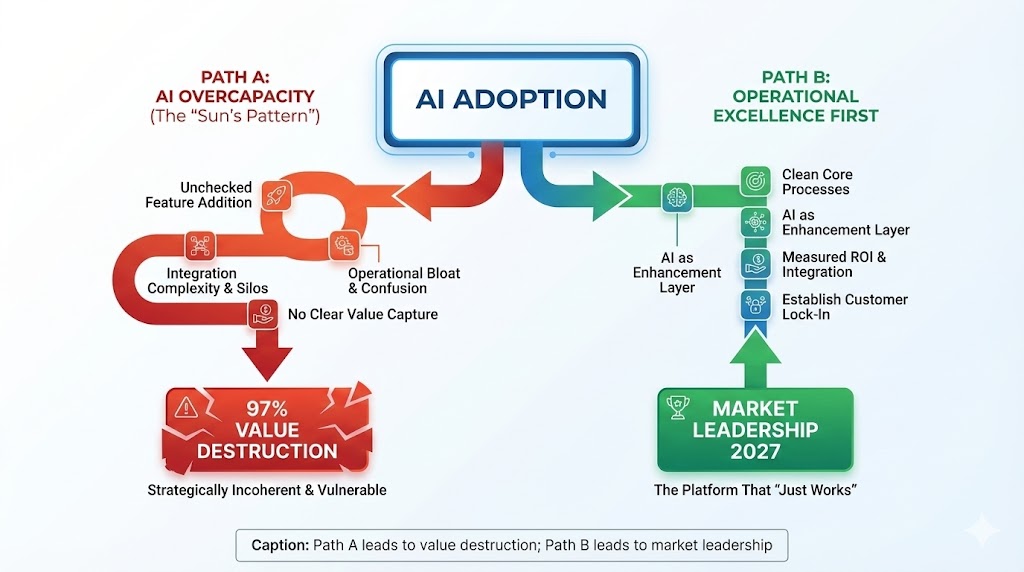
Two AI Bloat Enterprise Strategy Paths: Which Are You On?
Executive Strategy Comparison: Two Paths for Enterprise AI
This table outlines the critical divergence between chasing AI feature parity (Path A) and leveraging AI to enhance a solid operational core (Path B).
| PATH A: AI Overcapacity(The “Sun Microsystems” Pattern) | PATH B: Operational Excellence First(The Winning Strategy) | |
| Strategic Approach |
Aggressive, Unfocused Growth • Add capabilities aggressively to match competitor roadmaps. • Emphasize “innovation” through sheer feature count. • Accept high integration complexity as the cost of staying current. • Strategy: Hope enough features eventually deliver value. |
Foundational, ROI-Driven Growth • Build or strengthen rule-based operational foundations first. • Deploy AI only where ROI exceeds 300%. • Maintain full transparency and governance frameworks. • Strategy: Use AI to enhance strengths, not mask weaknesses. |
| Operational Reality |
Fragmented Chaos • Revenue: 14 pricing AI tools producing conflicting recommendations. • Marketing: 8 content generators creating inconsistent brand voices. • Service: 6 chatbots with no unified customer data. • Finance: 4 forecasting systems requiring manual reconciliation. • IT: Managing 35+ disparate AI vendor integrations. |
Integrated Clarity • Revenue: Runs on clean, rule-based quote-to-cash workflows. • AI Role: Enhances the 5% of complex edge cases, not standard work. • Marketing: Single AI assistant integrated with brand guidelines. • Service: AI used for internal routing/intelligence, not customer autopilot. • Finance: Single forecasting model with AI-enhanced scenario planning. |
| Business Outcomes |
Friction & Obscurity • Sales cycles lengthen as reps reconcile AI conflicts. • Customer experience degrades due to inconsistency. • Employee frustration grows as AI adds workflow complexity. • ROI remains elusive despite increasing investment. • Strategic Incoherence: Inability to articulate core competency. |
Velocity & Measurable Value • Sales cycles compress by 28% (PandaDoc 2025). • Lead-to-deal conversion improves by 17% (CloudSense 2024). • Customer satisfaction increases alongside consistency. • Employee productivity rises as AI removes friction. • ROI: Measurable, defendable, and exceeds 300%. |
| The 2027 End Result |
🛑 97% Value Destruction You replicate the Sun Microsystems collapse and become the market’s cautionary tale. |
🏆 Market Leadership Operational excellence + strategic AI enhancement creates sustainable competitive advantage. |
End Result:
Ultimately, you enter 2027 as the market leader. Operational excellence + strategic AI enhancement = sustainable competitive advantage.
Your AI Bloat Enterprise Strategy Action Plan: What to Do Monday Morning
For CEOs: The Strategic Consolidation Decision

This Quarter:
Action 1: Full AI Portfolio Audit
First, inventory every AI tool across all business functions. Then, ask three questions:
- What specific business outcome does this AI tool improve?
- What’s the measurable ROI? (Revenue increase, cost reduction, time savings)
- Could we achieve the same outcome without AI?
Importantly, tools that can’t answer #1 and #2 with hard numbers get cut.
Action 2: Establish AI Governance Committee
Specifically, create a cross-functional team with veto power over new AI purchases. Membership:
- CFO (owns ROI measurement)
- CIO (owns integration architecture)
- COO (owns operational impact)
- Business unit leaders (own use cases)
Furthermore, new AI tools require:
- Business case with projected ROI >300%
- Integration plan showing how it enhances (not replaces) existing processes
- Governance framework with transparency requirements
Action 3: Define Your Operational Excellence Baseline
Before adding more AI, measure:
- Current process cycle times (sales, service, operations)
- Error rates and rework loops
- Employee time spent on manual reconciliation
- Customer satisfaction with current processes
Remember, you can’t measure AI impact without knowing your starting point.
Next 6 Months:
Execute strategic consolidation:
- First, cut AI tools with ROI <200%
- Second, invest savings in operational foundation improvements
- Third, deploy AI selectively where enhancement delivers >300% ROI
- Finally, communicate the strategy: “We’re consolidating to win, not retreating”
For CFOs: The ROI Measurement Framework

This Quarter:
Action 1: Build AI ROI Dashboard
For every AI tool, track:
- Total cost: Licensing + implementation + training + maintenance
- Measurable benefit: Revenue increase, cost reduction, time savings (in dollars)
- ROI calculation: (Benefit – Cost) / Cost × 100
- Payback period: How long to recover investment
Therefore, cut anything below 200% ROI. Meanwhile, anything above 300% ROI gets increased investment.
Action 2: Identify Hidden AI Costs
Beyond licensing fees:
- Integration and maintenance (often 3-5x the license cost)
- Employee training and change management
- Productivity loss during implementation
- Technical debt from rushed integrations
In reality, many “AI investments” have negative ROI when you count total cost.
Action 3: Establish AI Investment Approval Process
New AI proposals must include:
- First, detailed ROI projection with assumptions
- Second, risk assessment (what if adoption is slower, integration harder?)
- Third, alternative analysis (could we achieve this without AI?)
- Finally, measurement plan (how will we track actual ROI?)
Simply put, no projections = no approval.
For CIOs: The Integration Architecture Decision
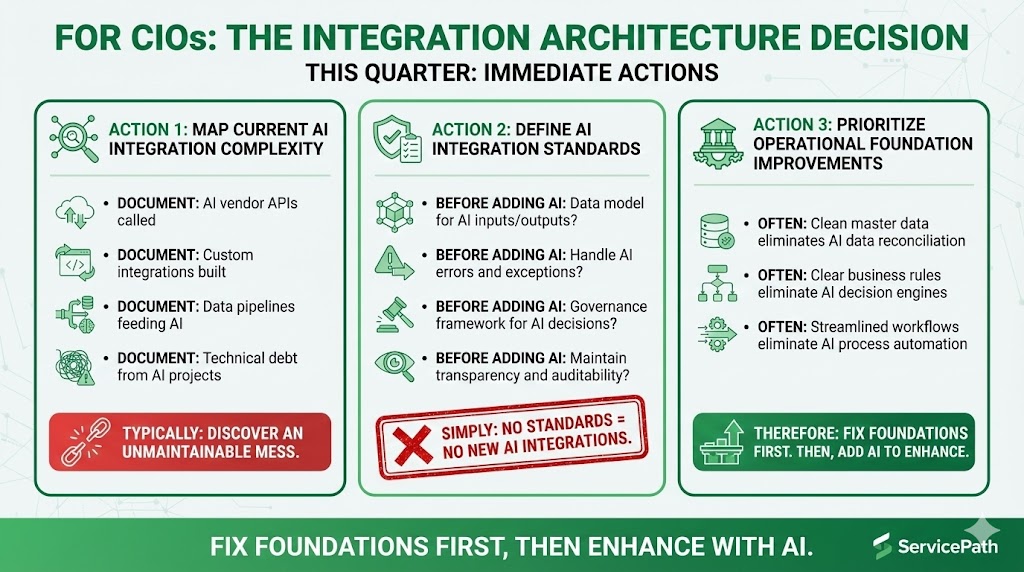
This Quarter:
Action 1: Map Current AI Integration Complexity
Document:
- First, how many AI vendor APIs your systems call
- Second, how many custom integrations you’ve built
- Third, how many data pipelines feed AI systems
- Finally, technical debt accumulated from AI projects
Typically, most organizations discover they’ve built an unmaintainable mess.
Action 2: Define AI Integration Standards
Before adding more AI:
- What’s our data model for AI inputs/outputs?
- How do we handle AI errors and exceptions?
- What’s our governance framework for AI decisions?
- How do we maintain transparency and auditability?
Simply, no standards = no new AI integrations.
Action 3: Prioritize Operational Foundation Improvements
Often, fixing the rule-based core eliminates the need for AI:
- First, clean master data eliminates need for AI data reconciliation
- Second, clear business rules eliminate need for AI decision engines
- Third, streamlined workflows eliminate need for AI process automation
Therefore, fix foundations first. Then, add AI to enhance what already works.
For COOs: The Operational Excellence Focus

This Quarter:
Action 1: Audit Operational Process Performance
Measure current state:
- First, cycle times for key processes
- Second, error rates and rework loops
- Third, manual touchpoints and handoffs
- Finally, employee time on process execution vs. exception handling
Ideally, your AI bloat enterprise strategy should improve these metrics by 25%+.
Action 2: Identify Where AI Helps vs. Hurts
Survey teams executing processes:
- First, which AI tools do you actually use?
- Second, which AI recommendations do you override?
- Third, where does AI save time vs. add complexity?
- Finally, if we removed AI, which processes would break?
Typically, most organizations discover AI is used far less than assumed.
Action 3: Build Operational Excellence Roadmap
Prioritize improvements:
- First, fix broken processes (AI can’t fix what’s fundamentally broken)
- Second, standardize and simplify (reduce complexity before adding AI)
- Third, measure baseline performance (know your starting point)
- Finally, deploy AI selectively (only where enhancement delivers >300% ROI)
Remember, operational excellence first. AI enhancement second.
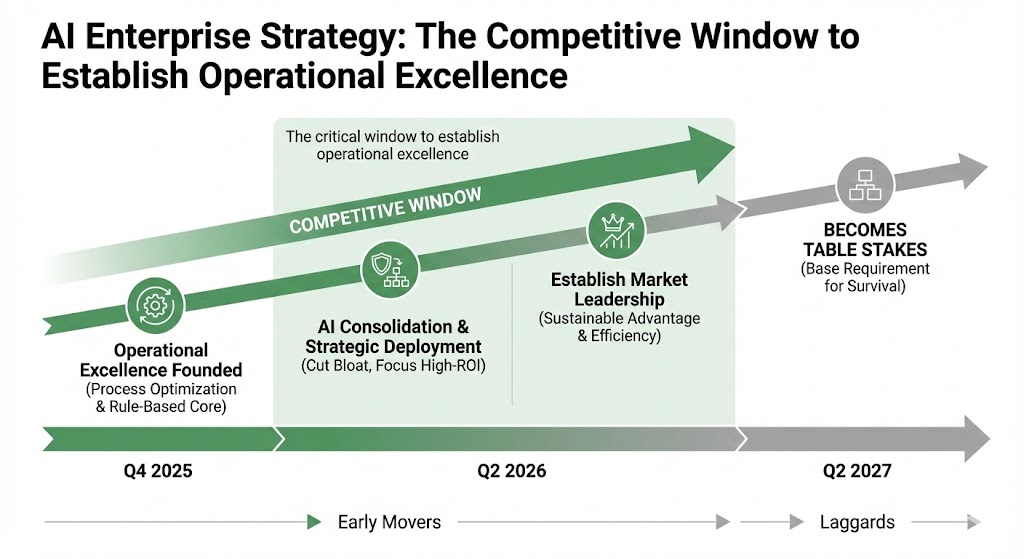
Caption: The critical window to establish operational excellence
Why servicePath™: An AI Bloat Enterprise Strategy Example
A Revenue Operations Example: The servicePath™ Approach
One practical example of this AI bloat enterprise strategy appears in revenue operations. servicePath™ represents an approach that prioritizes operational velocity before AI complexity.
This matters because revenue operations—quoting, pricing, configuring complex deals—is where AI bloat often hits hardest. Typically, companies add AI recommendation engines, pricing optimizers, and configuration assistants without fixing the underlying quote-to-cash workflow.
Instead, servicePath™ demonstrates the alternative: build rule-based excellence, then add AI where it actually helps.
Operational Foundation First
servicePath™ built rule-based pricing infrastructure before adding AI. This ensures 95% of standard configurations follow business rules accurately. AI doesn’t generate unpredictable prices.
This hybrid architecture delivers both accuracy and sophistication.
The Rule-Based Foundation
Operational Velocity First:
- First, 48-hour product launch cycles (from concept to quotable)
- Second, <10 minute complex quote generation for multi-product bundles
- Third, <5% pricing exception rates (quotes flow through approval automatically)
- Finally, real-time cost-to-serve analysis
This matters because 95% of quotes follow standard rules. Therefore, these don’t need AI—they need clean, fast, predictable workflows.
Rule-Based Before Probabilistic:
Before adding any AI, servicePath™ ensures:
- Single source of truth for products, pricing, and rules
- Clear configuration logic with hard dependencies validated automatically
- Transparent pricing waterfall from list price to net with full audit trail
- Automated approval routing based on deal size, margin, customer risk
- Clean order handoff to fulfillment with zero manual data translation
Consequently, when the rule-based core works brilliantly, AI becomes enhancement rather than compensation.
Selective AI Enhancement
AI deploys for the 5% of deals requiring it:
- Complex customization scenarios
- Personalized recommendations
- Market expansion modeling
- Not for standard configurations that rule-based logic handles effectively.
This hybrid architecture delivers both accuracy and sophistication.
Zero-Code Operations
Business users control pricing rules without developers. Therefore, changes go live in minutes. As a result, operational velocity stays high because teams aren’t dependent on technical resources.
This matters because most systems require developer involvement for simple rule changes. Consequently, what should take 10 minutes takes 2 weeks.
In contrast, servicePath™ puts control in business users’ hands while maintaining full governance.
Model-Agnostic Architecture
Additionally, servicePath™ supports multiple AI models:
- GPT for natural language processing
- Claude for complex reasoning
- Gemini for multimodal analysis
- Proprietary models for domain-specific use cases
This matters because AI technology evolves rapidly. Therefore, when better models launch, organizations can switch without platform migration.
In contrast, most vendors lock you into their AI model. Consequently, you’re stuck with outdated AI or forced into expensive platform changes.
Transparent Governance
Every AI pricing decision includes detailed explanation:
- Why this recommendation?
- What rule-based logic validates it?
- How does it compare to standard pricing?
- Who approved exceptions?
Therefore, finance teams can audit everything. No black boxes. Full transparency for compliance and governance.
This matters because CFOs and audit committees demand explainability. Meanwhile, most AI systems can’t explain their recommendations.
Measured Outcomes
Organizations using this approach consistently achieve:
- 48-hour product launch cycles (from concept to quotable in market)
- <10 minute complex quote generation (multi-product bundles with dependencies)
- <5% pricing exception rates (most quotes flow through approval automatically)
- 28% sales cycle reduction (PandaDoc 2025)
- 17% lead-to-deal conversion improvement (CloudSense 2024)
- 15% win rate increase (DesignNBuy 2024)
- Revenue forecast accuracy within 5% variance
Importantly, this represents one approach to operational excellence with AI enhancement. However, the pattern applies across all enterprise functions.
Built for Complex Revenue Operations
Specifically designed for companies selling:
- Multi-vendor products (connectivity, cloud, security, collaboration, professional services)
- Geographic pricing variations without catalog duplication
- Complex bundling logic with tier-specific dependencies
- SLA-driven pricing with automatic uptime guarantee calculations
- Hybrid pricing models combining fixed fees, per-user charges, and consumption-based pricing
This matters because revenue operations in telecom, managed services, and enterprise software face catalog complexity that breaks most systems.
The servicePath™ Architecture: Rule-Based Excellence + AI Intelligence
servicePath™ is purpose-built for organizations who refuse to repeat the Sun Microsystems pattern. Our architecture proves you can have both: the cleanest rule-based quote-to-cash core in the industry AND strategic AI enhancement that augments (never replaces) your foundational workflows.

Core servicePath™ Capabilities:
- Centralized catalog management: Single source of truth for products, pricing, and rules across all regions, segments, and terms
- Rule-based quote-to-cash workflows: Configuration → pricing → approval → order handoff with zero manual data translation
- Real-time cost-to-serve analysis: Transparent margin calculation at the line-item level
- Customizable approval flows: Role-based routing with clear escalation logic
- No-code interface: Business users can update catalog rules without developer dependency
- Clean integration architecture: Pre-built connectors to CRM, ERP, and billing systems
AI Enhancement That Augments, Not Replaces:
- Intelligent recommendations validated against rule-based catalog rules before display
- Pricing optimization guidance that flows through standard discount waterfall and approval workflow
- Configuration error prediction as alerts to reps, not autopilot overrides
- Deal velocity analytics based on rule-based workflow data for trustworthy insights
The Critical Architectural Principle: AI should enhance human decision-making within rule-based guardrails, not replace rule-based logic with black-box algorithms. When you can explain every number in a quote by tracing it back through a clear rule chain, you have a system that’s both intelligent and trustworthy.
Call to Action: Master Your AI Bloat Enterprise Strategy Now
The 12-18 month competitive window is open. Companies that establish operational excellence by Q2 2026 will dominate. In contrast, those who wait will spend 2027 playing catch-up.
Explore servicePath™ Resources
Thought Leadership & Analysis:
Blog & Industry Insights
Deep analysis on AI bloat, operational excellence, and revenue operations strategy.
Visit the servicePath™ Blog
The 2026 Gartner CIO Agenda Analysis
Understanding why 1% are reducing AI spend—and what it means for your strategy.
Read the Gartner Analysis
Revenue Operations Transformation Case Studies
Real-world examples of companies that mastered operational excellence before AI enhancement.
Download Case Studies
Revenue Operations Insights:
Executive Conversations Podcast
Watch “Executive Conversations” with Daniel Kube servicePath™’s CEO hosts senior industry leaders for candid debates on the future of AI. No scripts, just real talk about operational realities and strategic differentiation. [ Explore the Episodes ]
Listen to the Podcast
Revenue Innovations Newsletter
Weekly insights on AI bloat, catalog velocity, and the strategies that separate market leaders from cautionary tales.
Subscribe on LinkedIn
Ready to Act?
Consult with a Solution Architect Book a 30-minute strategy session. We will review your current operational stack and provide a transparent perspective on how to reduce friction and improve velocity.
Conclusion: Avoiding the $193 Billion Mistake
Sun Microsystems didn’t fail due to a lack of technology; they failed due to a lack of focus. Today, the enterprise AI market faces the exact same precipice. While 88% of organizations are stuck in “experimentation mode” with failing integrations, a disciplined 1% are entering the “maturation phase.”
These leaders understand that AI is an accelerator, not a strategy. By prioritizing Operational Excellence First, they are achieving 28% faster sales cycles and measurable ROI while competitors drown in integration debt.
The window to join this elite group is narrow—closing by Q2 2026. The difference between the winners of 2027 and the cautionary tales will be strategic discipline: the courage to consolidate, the clarity to define a rule-based core, and the wisdom to use AI to enhance, not replace, human decision-making.
“The companies that master catalog velocity in 2025 will dominate their markets in 2026 and beyond.” — Daniel Kube, CEO, servicePath™
The 12-18 month window is open. The question is: will you use it to master operational excellence, or will you spend it chasing the next AI feature?
Frequently Asked Questions: NAVIGATING AI STRATEGY
Q: Isn’t AI adoption inevitable? Why resist it? A: We are not resisting AI adoption; we are resisting AI bloat. The distinction is critical:
-
Strategic AI Adoption: Builds operational foundations first. Deploys only where ROI is measurable. Maintains strict governance. Uses AI to amplify existing strengths.
-
AI Bloat: Adds AI to compensate for broken processes. Chases competitor feature lists. Skips governance. Hopes AI will “figure it out.”
The Bottom Line: AI is inevitable. Your strategy determines whether you lead the market or collapse like Sun Microsystems.
Q: Our competitors have more AI features. Are we falling behind? A: Feature parity is the exact trap that destroyed Sun. Your competitors are likely making the same mistake—acquiring capabilities faster than they can integrate them. Do not follow them off the cliff.
Focus on operational excellence. When you can execute a complex deal in 48 hours while they require two weeks, you win—regardless of their feature list.
-
Principle: Operational excellence beats feature proliferation. Always.
Q: We have already invested heavily in AI. Is it too late to pivot? A: No, but you must act within the current 12-18 month window. Immediate Action Plan:
- Audit: Inventory the entire AI portfolio.
- Calculate: Determine the hard ROI for every single tool.
- Cut: Ruthlessly eliminate anything below 200% ROI.
- Strengthen: Reinvest savings into operational foundations.
You can catch up if you execute now. After Q2 2026, the gap becomes permanent.
Q: Is our AI consolidation a smart strategy or a sign of falling behind? A: It depends on why you are consolidating.
-
Strategic Consolidation (Smart Strategy): Cutting AI with ROI below 200%, strengthening operational foundations, measuring rigorously, and keeping only the AI that augments excellence.
-
Falling Behind (Retreat): Cutting AI because measurement is “too hard,” avoiding AI because integration is difficult, ignoring market trends, and losing deals to faster competitors.
If you are consolidating based on rigorous ROI analysis, you are executing a winning strategy.
Q: What is the role of AI in the enterprise long-term? A: AI augments operations; it does not replace them. The winning architecture splits the workload:
-
Operational Excellence Wins (95%): Standard processes, predictable outcomes, compliance, and financial forecasting.
-
AI Wins (5%): Complex edge cases, hyper-personalization, predictive modeling, and natural-language interfaces.
The Future Architecture: A strong operational foundation handles 95% of the work, with AI augmentation handling the sophisticated 5%. Enterprises attempting to replace the foundation with AI will fail; those using AI to augment a strong foundation will lead.
Q: Our CFO demands AI ROI. What do we say? A: Show the numbers. Build a comprehensive ROI spreadsheet. If a tool’s ROI isn’t above 200%, admit it and present a consolidation plan.
CFOs respect data-backed honesty. They will not accept vague “AI transformation” promises without financial outcomes. Frame your consolidation plan not as a retreat from innovation, but as investment reallocation toward high-ROI capabilities.
Sources and References
- McKinsey & Company – The State of AI 2025
- Gartner – 2026 CIO Agenda Survey
- MIT Sloan Management Review – Why AI Integration Projects Fail
- Bain & Company – 2025 Technology Report
- IDC – Global AI Spending Forecast
- Deloitte – 2025 Technology Predictions
- Mordor Intelligence – CPQ Market Analysis 2025-2030
- MGI Research – CPQ Total Addressable Market
- Valorx – CPQ ROI Statistics
- CloudSense – CPQ Business Impact Metrics
- Reuters – Oracle Acquires Sun Microsystems